AFFORDABLE CARE ACT
MARKETPLACE
ENROLLMENT: MITIGATING
THE BARRIERS THAT
ASSISTERS FACE IN
ENROLLING IMMIGRANT
POPULATIONS IN NORTH
CAROLINA
Alexa Zoellner
1
INTRODUCTION
Immigrant Health in North Carolina
In the last 20 years, the number of foreign-born residents in the United States has doubled from 20 million in 1990 to 40 million in 2010. Approximately 710,000 immigrants reside in North Carolina and 33% of these immigrants are naturalized citizens (have lawful citizen status). Most of foreign-born North Carolinians are from Latin America (~421,000) and Asia (~179,000) (Johnson Jr & Appold, 2014). In general, immigrants have better health than the average American when they first enter the country. However, it is common for an immigrant’s health status to decline in relation to length of time in the U.S. (Derose, Escarce, & Lurie, 2007). Foreign-born residents are less likely to have a regular source of care and tend to use emergency rooms more frequently as a source of care than their native-born counterparts (Derose, Bahney, Lurie, & Escarce, 2009).
Foreign-born residents have a lower mean earnings and are more likely to live in poverty than native-born residents. However, they are less likely than the native-born to rely on public sources for health insurance coverage and significantly less likely to be covered by health insurance than the general population (48.4% compared to 81.6%) (Johnson Jr & Appold, 2014). This is due, in part, to Medicaid eligibility restrictions for immigrants and foreign-born populations. The barriers that foreign-born populations face when seeking care and health insurance coverage greatly depend on their legal status and circumstances. Lack of health insurance coverage contributes to diminished health, quality of care, and access to care (Derose et al., 2009) (The Kaiser Family Foundation, 2001). However, the Patient Protection and Affordability Act, also known as The Affordable Care Act (ACA) and “Obamacare,” attempts to mitigate this disparity for many immigrants and foreign-born populations who reside in the U.S. legally.
Affordable Care Act
The ACA was signed into U.S. law by President Barak Obama on March 23, 2010 and has significant implications for providers, payers, and consumers. It amends many facets of the health system and seeks to improve quality and performance. Overall, the law broadly focuses on controlling healthcare costs, improving quality of care, advancing population health, and expanding health insurance coverage and access to services.
2
thirty-five other states, decided to use the federally facilitated marketplace (The Kaiser Family Foundation, 2014). From October 1, 2013- April 19, 2014, 357,584 North Carolinians enrolled in health plans through the marketplace.
Upon implementation of the ACA, North Carolina became a “non-embracing state” by demonstrating political resistance and little effort by the state government to raise awareness, educate the broad public, reach special populations, and facilitate the enrollment process. Even still, North Carolina achieved the ninth highest rate of enrollment nationwide after Open Enrollment 1. Compared to other non-embracing states, North Carolina achieved the third highest rate of enrollment (Silberman, 2014). Much of the success can be attributed to the work of community-based organizations and a network known as the NC Get Covered Coalition, formerly known as “The Big Tent”, which is made of different stakeholders working on outreach, education, and enrollment. Members included representatives of navigator organizations, Federally Qualified Health Centers (FQHCs), Certified Application Counselor organizations (CACs), insurance agents and brokers, representatives of insurance carriers participating in the Marketplace, and other interested organizations and individuals. Together they shared information, identified workarounds to common problems, and promoted ACA enrollment. In addition, the national non-profit Enroll America contributed to statewide education and enrollment in North Carolina and in other states that use the federally facilitated marketplace and have large populations of uninsured people. The combined effort of North Carolina’s community organizations has been championed across the country given the success of the last enrollment (Warren, 2014).
Enrollment
Enroll America found that during the first open enrollment period (October 1, 2013- March 31, 2014) consumers were twice as likely to enroll if they received in-person assistance. Only about 16% of people were able to enroll successfully without assistance (Enroll America, 2014). As indicated by Enroll America’s findings, assisters play a vital role in the success of North Carolina’s enrollment statistics. Assisters varied on their level of training, their status, and the type of organization and circumstances under which they aided enrollment.
As assisters guided consumers through the marketplace, they were faced with many challenges (Volk, Corlette, Ahn, & Brooks, 2014). Furthermore, while some barriers to enrolling the consumer were somewhat common across most appointments (i.e. technical problems), other issues were as unique as the consumer. In particular, immigrants presented assisters with a myriad of challenges due to a variety of access and eligibility issues. Many of these problems have not been resolved; successfully enrolling immigrants is an on-going challenge (Pollitz & Tolbert, 2014). It is important to determine what issues assisters are confronting in trying to enroll these populations and what is known about how to best mitigate these barriers.
Research Questions
1. What do assisters perceive to be the barriers to enrolling Latino immigrants, temporary migrant workers, and non-immigrant refugees in the ACA?
3
LITERATURE REVIEW
Immigrant Health in North Carolina
Immigrants face unique challenges in obtaining the insurance coverage needed to help pay for necessary healthcare services. In order to address these challenges, it is important to understand who immigrants are, the factors that impact their ability to access health services in the U.S., and why it is important to obtain health insurance.
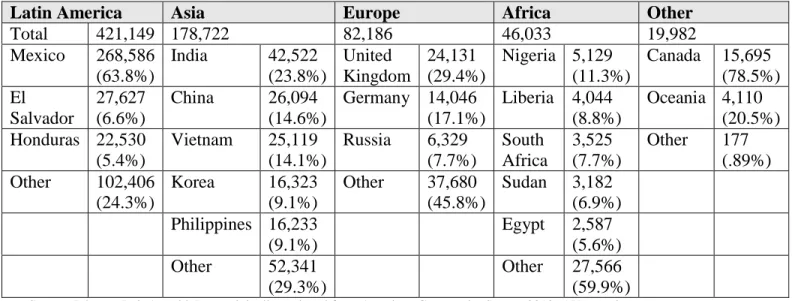
The Immigration and Migration Act of 1965 ended discrimination in granting citizen status based on country of origin. Prior to 1965, the United States gave preference to immigrants coming from certain regions, such as northern and western Europe. This act had long term implications for immigration demographics. Origin demographics have changed drastically between 1990 and 2012. Beginning in the 1990s, employers in North Carolina began to seek inexpensive labor by recruiting international workers, primarily from Mexico and Central America. As of 2010, due to heightened security measures along the U.S. – Mexico borders, the rate of immigration from Latin America dropped and the rate from Asia has increased. Table 1 shows the specific countries of origin for North Carolina’s foreign-born population (Johnson Jr. & Appold, 2014).
Table 1. Countries of Origin of Foreign-born North Carolina Population
Latin America Asia Europe Africa Other
Total 421,149 178,722 82,186 46,033 19,982
Mexico 268,586 (63.8%)
India 42,522
(23.8%)
United Kingdom
24,131 (29.4%)
Nigeria 5,129 (11.3%)
Canada 15,695 (78.5%) El
Salvador
27,627 (6.6%)
China 26,094
(14.6%)
Germany 14,046 (17.1%)
Liberia 4,044 (8.8%)
Oceania 4,110 (20.5%) Honduras 22,530
(5.4%)
Vietnam 25,119 (14.1%)
Russia 6,329 (7.7%)
South Africa
3,525 (7.7%)
Other 177 (.89%) Other 102,406
(24.3%)
Korea 16,323
(9.1%)
Other 37,680 (45.8%)
Sudan 3,182 (6.9%) Philippines 16,233
(9.1%)
Egypt 2,587 (5.6%)
Other 52,341
(29.3%)
Other 27,566 (59.9%) Source: Johnson Jr & Appold, Data originally retrieved from American Community Survey 2012, 5 Year estimates
4
provides a list of categories of immigrants who are eligible to purchase insurance in the ACA Marketplace.
Fifty percent of North Carolina’s foreign-born population fall between the ages of 25-44 (prime working years), compared to 25% of the native-born population. In 2010, 42.5% of immigrants had a high school degree or less (Johnson Jr & Appold, 2014). Immigrants participate in the civilian labor force at a higher rate than native-born residents (71% vs. 61%), yet their occupations tend to be significantly more risky (Orrenius & Zavodny, 2009). These jobs often pay less on average than the jobs that their native-born counterparts hold. Foreign-born families are twice as likely to live in poverty as native-born families (Johnson Jr & Appold, 2014) . Low income jobs and blue collar jobs are much less likely to offer health insurance to their employees, which is how most Americans access health insurance (The Kaiser Family Foundation, 2013).
Despite a higher rate of poverty among this population, immigrants are less likely to use public programs such as Medicaid and the Children’s Health Insurance Program (CHIP), the Supplemental Nutrition Assistance Program (SNAP), and Temporary Assistance to Needy Families (TANF), which provide health, nutrition and economic support to low-income families (Perreira et al., 2012). It has been shown that these programs improve health and nutrition and contribute to stability in a household (Mills et. al., 2011). Eligibility regulations limit many legally residing immigrants from participating.
Prior to the enactment of the Personal Responsibility and Work Opportunity Reconciliation Act (PRWORA) on August 28, 1996, legal immigrants were broadly considered eligible for public benefits. However, PRWORA restricted access to Medicaid and the Child Health Insurance Program (CHIP) in a variety of ways. Under this law, legal immigrants were classified into two groups: qualified and unqualified. Qualified legal immigrants were deemed eligible on the basis of their time of arrival in U.S. (before enactment of PRWORA or after) and the length of residency in the U.S. (less than or greater than 5 years). Legal permanent residents (LPRs) who arrived prior to August 28, 1996 or who had arrived after and resided within the U.S. for more than 5 years are
generally eligible. Most LPRs who have been in the United States for less than five years are ineligible for Medicaid and CHIP (although states can choose to cover LPR children and pregnant women who have resided in the US for less than five years). Certain refugees and asylees receive 8 months of Medicaid coverage upon their arrival in the U.S. They are not subject to the 5 year requirement if they meet the income and family eligibility requirements. Within this group, low-income single adults without children lose eligibility after 8 months because they do not meet the regular Medicaid eligibility rules (this group is comprised largely of single, childless men). For all immigrants, eligibility is determined on an individual basis rather than a family basis, so some members of a family could be considered eligible given the correct combination of immigration status, time of arrival, and length of residence while their family members remain ineligible (Perreira et al., 2012).
5
from another. In addition, undocumented immigrants in “mixed-status” families (e.g, a family with both qualified immigrants and undocumented immigrants) may have a fear that a member would be reported to the U.S. Immigration and Customs Enforcement (ICE) during a Medicaid or NC Health Choice (North Carolina’s Child Health Insurance Program) application. They may also worry that applying for these programs may adversely affect their ability to gain legal status (Woomer-Deters, 2014). Nationwide, 36% of all children who are eligible for Medicaid, but not enrolled in the program, live in immigrant families (Woomer-Deters, 2014).
Because of the difficulties qualifying for publicly-subsidized health insurance coverage and reduced access to employer-sponsored insurance, only approximately half of immigrants had insurance in 2012 (Johnson Jr & Appold, 2014). A lack of health insurance can have major health implications. It can impact when and where a person receives necessary medical care and their health status. The uninsured often forgo or postpone receiving healthcare services, and as a result, preventable conditions go undetected and untreated. They often face issues when trying to access care; over half of the uninsured have no regular source of care (The Kaiser Family Foundation, 2014). High healthcare costs reduce the feasibility of receiving care for anything that is not an absolute priority or an emergency. This leads to an increased likelihood of hospitalization for avoidable health problems and decreased overall health. Gaining coverage can lead to a revitalized health status (The Kaiser Family Foundation, 2014).
While immigrants generally have better health status than the average American citizen when they first arrive, their health tends to deteriorate with increased acculturation. This deterioration is due to a myriad of factors, such as lifestyle changes, living in unhealthy environments, and poor access to personal and public health services (Derose et al., 2009). Perreira et al. conducted a series of focus groups that targeted immigrants and refugees around North Carolina and found that although many participants experienced confusion around the topic of insurance and eligibility, 81% of the participants believed that healthcare insurance was an absolute necessity. Many reported difficulties in obtaining “critical medical care” or paying medical debts. Without insurance, many felt that they had no “peace of mind” (2014). The Affordable Care Act makes most legally residing immigrants eligible for health insurance in North Carolina (Healthcare.gov, 2014).
Special Considerations: Health Access for Migrant Workers and Refugees Migrant Workers
Migrant workers are workers that travel away from their homes for extended periods of time to work, often in agriculture. Overall, migrant workers have a variety of legal statuses. Some may be citizens, others are immigrants that have documents which permit them to live and work in the United States, and still others are undocumented. A large portion work through the H2 Temporary Guest Worker Program, which provides foreigners with work visas to work in agriculture (H2-A visas) and other, non-agricultural (H2-B) industries. This study will refer to participants in the H2 Temporary Guest Worker Program as “temporary migrant workers” or simply as “migrant farmworkers.” Each year North Carolina employs thousands of H2-A workers in agriculture and H2-B workers in forestry.
6
for Farmworker Health, Inc., 2012). For instance, farmworkers in North Carolina work long hours and are at a high risk for heat stress and pesticide poisoning. Furthermore, their living conditions present public health issues due to lack of clean water, crowded spaces, and unsanitary conditions (Farmworker Ministry Committee, 2012). A study in 2008 found that 89% of migrant labor camps in North Carolina violated at least one provision from the Migrant Housing Act of North Carolina, which sets the minimum standards of living for labor camps. Seventy eight percent of the workers surveyed in the study reported having a crowded living space (Vallejos et. al., 2012).
Although workers endure injuries and disease because of the poor conditions of their habitation and work, they often have limited access to healthcare services. A variety of factors prevent workers from receiving the care they need, including a lack of insurance coverage, transportation, limited hours of clinic operations, limited interpreter services in nearby facilities, and frequent relocation due to the search for work or change of season (Farmworker Ministry Committee, 2012). Temporary migrant workers are ineligible for Medicaid and public benefits (Guild, no date). Migrant farmworkers with H2-A visas receive workers’ compensation if injured on the job, but are not typically provided with employer sponsored health insurance plans. Growers are not required to provide workers compensation to workers that do not have H2-A visas unless they employ 10 full time, year-long workers, so others go without workers compensation and employer based health insurance. The Affordable Care Act requires most people, including legally residing migrants (those who are citizens or H2 Temporary Guest Workers) to have health insurance coverage or pay a penalty (unless they otherwise meet an exemption) (Guild, no date). These individuals can purchase health insurance coverage through the marketplace and are offered subsides below 100% of the Federal Poverty Line. However, due to the population-specific living and working conditions, barriers to enrolling this population in the ACA may be different than barriers to enrolling the North Carolina immigrant population at large.
Refugees
The Office of Refugee Resettlement (ORR) settles several thousand refugees and asylees in North Carolina each year. In recent years, the majority came from Bhutan, Burma, and Iraq (Martin & Yankay, 2012). According to U.S. immigration law, refugee status can be granted to people who are outside their country of origin and have been persecuted or fear they will be persecuted because of their race, religion, nationality, and/or membership in a specific social group or identify with a particular political ideology. Asylum status is granted to those who meet the U.S. government definition of refugee, are already in the U.S., and are seeking admission at an entry point. This study will refer to people who have either refugee status, asylum status, or are asylum seeking, as refugees, as there is little practical difference between the statuses once they are obtained.
7
Refugees are less likely to utilize healthcare and social services than other immigrant groups. This is due to internal barriers, such as mental illness, mistrust, and perceived discrimination; structural barriers, including affordability, limited services, poor cultural competency among accessible services; and resettlement challenges like shelter, food, and employment security. Barriers in navigating a complex health system and inadequate community support can also inhibit refugees from seeking the care that they need (Asgary & Segar, 2011).
Upon arrival, refugees can receive healthcare coverage through Refugee Medical Assistance, which provides 8 months of coverage under the federal Immigration and Naturalization Act through Medicaid. After 8 months have passed, many refugees lose healthcare coverage because they may not work for employers that offer affordable insurance and do not meet the requirements needed to maintain their Medicaid eligibility (U.S. Department of Health and Human Services, 2013). The Affordable Care Act extends the same opportunities for obtaining healthcare coverage to refugees as it does to citizens (Refugee Health Technical Assistance Center, 2012).
The Affordable Care Act and the Expansion of Coverage
The Affordable Care Act (ACA) is one of the most significant overhauls of the U.S. healthcare system since the passage of Medicare and Medicaid in 1965. The ACA generally focuses on expanding access to healthcare services through broadening health insurance coverage, increasing safety net capacity, and placing more focus on the health professional workforce; Furthermore, it seeks to improve population health through increased investments in public health and prevention; enhance the quality of care by defining, measuring, and reporting, and paying for quality; and reduce the rate of increase in healthcare costs (Silberman, 2014).
The Expansion of Coverage: Who
The ACA expands the population that can access health insurance and the manner that they obtain it. Prior to the first open enrollment period (October 1, 2013 – March 31, 2014) there were approximately 47 million nonelderly, uninsured Americans (18% of the nonelderly population).a At full implementation of the ACA, had all states chosen to expand Medicaid, it was predicted that the uninsured rate would fall by almost 50%, reducing the number of uninsured by over 23 million (Kenney et. al., 2013). In 2013, 48% of the U.S. population had employer sponsored insurance, about 18% had public insurance, and only about 6% had private, non-group insurance (The Kaiser Family Foundation, 2013,2).
One way in which the ACA will change how Americans access their healthcare insurance is by requiring businesses to offer insurance to their employees. The number of uninsured is closely linked to the unemployment rate in the U.S. Further, most uninsured workers are employees of a company that does not offer health insurance, are ineligible for their employer’s insurance, or cannot afford their employer’s insurance premiums. Firms with a high percentage of low-wage workers are less likely to offer coverage than firms with fewer low-wage workers, and a consistent disparity exists across industry groups between white and blue collar job access to health insurance (The Kaiser Family Foundation, 2013). By 2016, the ACA will require that businesses with 50 or more full-time equivalent (FTE) employees offer insurance to their workers. Failure to comply with this regulation will result in an Employer Shared Responsibility Payment in their federal tax
8
return. Very small businesses with 25 or fewer employees and average annual wages of $50,000 or less are offered a tax credit to assist the business in providing coverage. By 2016, all employers with less than 100 FTEs will be able to shop for insurance for their employees in the Small Business Health Options Program (SHOP) Marketplace.
Many uninsured individuals will still be unable to access group insurance through their employer if they work for a small business that is not subject to the requirement (as many of the uninsured do) or if the premiums of the insurance that their employer offers is considered unaffordable (more than 9.5% of their income). The ACA also sought to extend public insurance as well as make individual, private insurance much more affordable. Upon the creation of the ACA, it was envisioned that all states would expand Medicaid coverage to individuals who have an income below 138% of the federal poverty line (for continental U.S. 138% FPL=$15,856 for an individual, $32,499 in four person household in 2014). Individuals that have an income between 100%-400% of the FPL are able to shop for insurance in the individual marketplace and will be eligible for premium tax credits, which are offered on a sliding scale basis to limit the cost of a premium if they are not eligible for publicly-subsidized health insurance (Medicaid, CHIP, Medicare) and they are not eligible for affordable employer sponsored insurance. In addition, individuals with an income between 100%-250% of the FPL will be offered cost-sharing subsidies to limit out-of-pocket expenses.
In discordance with the original vision of the ACA, on June 28, 2012, the Supreme Court ruled in the case National Federation of Independent Business v. Sebelius, 567 US ___ (2012), 132 S.Ct 2566 that states cannot be required to expand Medicaid or be threatened by the loss of Medicaid funding due to its decision. By March of 2014, 19 states had decided not to expand and five were in open debate (Garfield et. al., 2014). Individuals that reside in those states who are not eligible for Medicaid and are below 100% of the FPL fall into an insurance gap. They are not eligible for subsidies and, therefore, likely cannot afford to purchase private insurance at full price. In many of these states, Medicaid eligibility has stringent qualification rules and does not cover all adults with incomes up to 100% of the FPL. For instance, in North Carolina, individual adults without children are only eligible if their incomes are below 45% of the FPL (Garfield et. al., 2014). Due to North Carolina’s decision to forgo expansion, approximately 318,710 individuals will fall into the coverage gap (Garfield et. al., 2014).
The Implications of the Expansion of Coverage: Health Services
9 Remaining Uninsured
Lack of sufficient healthcare insurance coverage is not only a threat to personal health and risks the health of the public; it also creates significant personal financial vulnerability and a financial burden for the public. When an uninsured consumer seeks health services, they are frequently charged a much higher rate than the rate for a third party payer (Anderson, 2007). If the procedure is not an emergency, the uninsured can be turned away or asked to pay immediately for their service, participate in the provider’s payment plan, or pay with credit cards. In general, the uninsured pay a much higher proportion of their care out-of-pocket than a person with an insurance plan (The Kaiser Family Foundation, 2013). Almost one-quarter of uninsured, nonelderly individuals have medical bills that they are unable to pay at all (Cohen, 2012). Unpaid bills go on to affect other aspects of a person’s life, such as their ability to get credit. Furthermore, an uninsured consumer is at a higher risk of falling into medical bankruptcy than someone with health insurance. About half of all bankruptcies in the United States can be attributed, at least in part, to medical debts (Himmelstein, et. al., 2009). The uninsured are more likely to be “very worried about not being able to afford healthcare services” and more likely to put-off or postpone needed healthcare, therefore risking the state of their overall health (The Kaiser Family Foundation, 2013,3). The burden to pay for the uncompensated costs of the uninsured falls on the provider, federal, state, and local funds, and the public at large through cost shifting (The Kaiser Family Foundation, 2013).
Even though the ACA seeks to vastly expand coverage, a large number of people are likely to remain uninsured. For example, undocumented immigrants are ineligible to purchase coverage with subsidies or tax credits in the Marketplace, and as noted earlier, are not eligible for Medicaid or CHIP. Others may find that health insurance coverage is still unaffordable, such as adults with incomes below 100% FPL who live in states that did not expand Medicaid (excluding immigrant groups that are offered subsidies below 100% FPL). Some people are exempt from the insurance mandate (e.g. not subject to the tax penalties), including those for whom the lowest cost plan exceeds 8% of their income; people who would have been eligible for Medicaid if their state expanded coverage, but who live in a state that chose not to expand Medicaid; people who participate in a healthcare sharing ministry; and those who are currently incarcerated. People who do not qualify for an exemption and who chose not to get covered will be required to pay a tax penalty that increases each year. In 2014, the penalty equaled $95 dollars per adult and $47.50 per child or 1% of their taxable income (whichever is greater) and will increase each year until 2016, at which time it will be $695 per adult, $347 per child, or 2.5% of yearly household income (whichever is greater) (Patient Protection and Affordable Care Act, 2010). Although everyone will continue to be able to access emergency services under provisions in the 1986 Emergency Medical Treatment and Active Labor Act, the health risks and the financial burden associated with remaining uninsured are likely to persist. Due to the increasing tax penalty and the associated risks of remaining uninsured, it is important for individuals to take advantage of the ACA’s expansion of insurance coverage and for society to value and prioritize the enrollment of all uninsured individuals.
Enrollment in ACA Marketplace Insurance
10
insurance options and enroll into coverage (Patient Protection and Affordable Care Act, 2010). In addition, other types of organizations or individuals can help people with the enrollment process. There are four primary types of Assister Programs which operate in North Carolina and are described briefly below (Pollitz & Tolbert, 2014).
Navigator Assister Programs have contracts with the U.S. Centers for Medicare and Medicaid Services (CMS) and provide free outreach and enrollment assistance services. In addition, they are required to educate the public and complete outreach efforts, help consumers apply for subsidies, facilitate enrollment in qualified health plans, and provide fair and impartial information about the insurance plans. Navigators complete a federal training program, which takes 20-30 hours online.
Certified Application Counselor (CAC) organizations do not receive direct funding from the Marketplace, but also provide assistance to consumers for free. CACs are not required to engage in outreach, although many do, and primarily focus on direct enrollment assistance. CAC organizations are registered with the Marketplace and their assisters go through a 5-10 hour online federal training.
Federally Qualified Health Centers (FQHC) are Assister programs that are operated by health centers. They receive federal funding to provide primary care services and generally have a mission to treat anyone, regardless of their ability to pay. Because they serve primarily low income and uninsured patients, they are funded by the Health Resources and Services Administration to provide enrollment and education services. FQHCs are required to complete the 5-10 hour online training for Certified Application Counselors.
Agents and Brokers are paid by insurance companies to provide professional assistance in educating consumers about Marketplaces and insurance affordability programs. Further, they provide in-person assistance during the marketplace application process. They played an important role in assistance with helping consumers enroll in the Marketplace.
The U.S. Department of Health and Human Services has awarded organizations in North Carolina over $3,000,000 in 2013 and $2,800,000 dollars in 2014 for providing navigator services, including outreach and education efforts (Navigator Curriculum, 2014). In addition, during the fiscal 2013 year, the Health Resources and Services Administration awarded over $4,000,000 to FQHC’s in North Carolina (HRSA, 2013). Nationwide, most assister organizations were funded by private sources or by federal safety net clinic programs (Pollitz & Tolbert, 2014). These organizations have trained volunteers and employees to assist consumers in any way possible, promote enrollment, and educate the public.
Consumer Assistance Programs (CAPs) also assist by answering questions about eligibility and enrollment and resolving complaints. Navigators and other Marketplace assisters are required to refer consumers to CAPs for post-enrollment assistance. North Carolina’s CAP is run by the Health Insurance Smart NC, a program within the NC Department of Insurance.
11
out-of-pocket costs but the highest premiums, and are designed to cover 90% of average healthcare costs (Addendum, 2014). During the first open enrollment period, most North Carolinians chose silver plans, which offer cost sharing reductions based on income eligibility.
Consumers can apply or change health insurance plans during open enrollment periods. Open Enrollment Period 1 ran from October 15, 2013 through April 19, 2014. Open Enrollment Period 2 ran from November 15, 2014 through February 15, 2015. Consumers that are part of a federally recognized tribe or an Alaska Native Shareholder can enroll at any point during the year. Any other consumer can apply during the Special Enrollment Period (SEP), which covers the rest of the year, if they have undergone a “qualifying life event” and apply within 60 days of the event during the year. Qualifying life events include a change of residence, gaining citizenship, release from incarceration, marriage or divorce, involuntary loss of health coverage, or birth or adoption of a child. Over 11 million Americans were enrolled in a health plan through a marketplace by the end of Open Enrollment Period 2 (February 15, 2015). More than a half a million North Carolinians (559,473) selected a plan during this time period (U.S. Department of Health and Human Services, 2015).
The Kaiser Family Foundation produced a report after surveying health insurance marketplace assister programs after Open Enrollment 1 that discussed pertinent findings that aid in understanding ACA enrollment (Pollitz & Tolbert, 2014). Most assister programs served specific geographic areas or targeted population groups and rely on a small staff (71% have 5 FTEs or fewer). CAC Programs are more likely to rely on volunteers. Enrollment assistance is time-intensive; more than 60% of programs reported that helping a consumer required, on average, 1-2 hours per person and 23% reported an average time that exceeded 2 hours. The primary reasons that consumers sought help from assisters was due to a limited understanding of the ACA, help understanding plan choices, a lack of confidence to apply alone, and technical difficulties in applying by themselves. Assister programs reported after Open Enrollment 1 that consumers had difficulties with website outages, subsidy eligibility rules based on tax code rules, and communication issues between the Marketplace and Medicaid agencies. Most of the consumers that received assistance were uninsured and had limited health insurance literacy. Eighty-nine percent of Assister Programs reported that consumers had questions that weren’t easily answered (Pollitz & Tolbert, 2014).
While Assister Programs reported numerous challenges that affected the general population, such as website problems, income verification, and difficulty understanding plan choices, there were specific problems unique to immigrant populations. For example, Assister Programs reported that language needs could not always be met, problems verifying immigration status, and issues with identity verification. Immigration issues often presented particular difficulties, such as data matching problems that prevented the government from identifying the information of naturalized citizens, leading to cases where immigrants had to sign up during the SEP.
12
13
METHODOLOGY
Research Design
The researcher conducted a multiple case study to gain a better understanding of the factors that prevent and facilitate assisters in enrolling the Latino immigrant population, temporary migrant workers with H2-A or H2-B visas, and refugees in a qualified health plan through the marketplace in North Carolina. As defined by Yin, case studies allow for an investigation of “a contemporary phenomenon within its real-life context” (1994. p. 13). Each case study was “bounded” by the three populations mentioned above. (Merriam, 2009). Following Yin’s framework (1994), this study used a holistic qualitative design to examine the nature of the barriers that assisters experience in enrolling the specific population that they work with, and how the assisters attempt to overcome challenges that they experience. Then, the researcher used themes from the within-case analyses to compare and contrast themes that were specific and generalizable between each population.
Research methods and data sources
To gather the data for each case study, the researcher conducted telephone interviews using a semi-structured interview guide that asked about the challenges that they experienced in enrolling a specific population and the strategies that they used to overcome the barriers. According to Merriam, qualitative research is derived from the philosophy of phenomenology which focuses on the experience itself and how experiencing something is transformed into consciousness. In other words, phenomenology is “a study of people’s conscious experience of their life-world” (2009, p. 25).
Assisters who work directly with these populations in helping to facilitate enrollment are the most familiar with issues that foreign-born populations confront during their Marketplace application, and how best to address them. The assister perspective is an excellent resource for other assisters conducting enrollment appointments and for policy makers who should understand how the ACA and the Marketplace directly impact these populations. A total of 8 interviews were conducted with assisters from 7 different organizations. Information about the migrant farmworker population was supplemented by a webinar created by North Carolina Community Health Center Association called “Helping H-2A Farmworkers Enroll: Practical Tips for Connecting with Workers and Helping them Enroll” which was released on Thursday March 26, 2015.
Participants and Sampling Methods
14 Table 2. High Case Population Type per County
Counties with highest proportion
of noncitizen immigrants
Counties with highest proportion of migrant workers
Counties with highest proportion of refugees/asyllees
Mecklenburg Nash Guilford
Wake Harnett Mecklenburg
Guilford Sampson Wake
Cumberland Duplin Durham
Union Wilson Craven
Orange Wayne New Hanover
Johnston Johnston Orange
Data Retrieved from ACS-5 Year Estimates, Employment Security Commission, and NC Division of Social Services
Participants came from a variety of organizational types and positions. All contacts were made by email and phone to set up the interview. Everyone who replied with interest was interviewed as long as they personally provided direct enrollment assistance to the target population.
Instrument: Interview Guide
Interviews were utilized to “obtain a special kind of information,” (Merriam, 2009, p. 88). Identifying the barriers and facilitators to enrolling foreign-born populations in the Affordable Care Act would not be possible through observation. The interview guide prompted assisters to provide the researcher with data about their perceptions of the facilitators and barriers that they encounter when helping a consumer of a certain population and how they attempt to mitigate the challenges that they face.
The semi-structured interview guide asked study participants about their experiences with outreach/education (where the assister reaches out to the population to spread general information about insurance and the advantages of being covered), marketing for their assistance services, direct consumer assistance to help people apply for and select a plan in the marketplace, and follow-up efforts. Respondents were asked both about barriers and facilitators they encountered working with Latino (referring to Latino immigrants), migrant farmworkers (specifically H-2A visa holders), or refugee populations. The guide is provided in Appendix B, and explained in more detail in the findings section of this study.
Data Analysis Methods
Data from the interviews were coded to analyze themes within each population case study in order to understand the assisters’ perceptions of the barriers and facilitators that their target population faces in enrollment (Merriam, 2009). The researcher used a matrix to conduct an across-case analysis (Miles and Huberman, 1994) to determine how barriers and strategies may overlap or differ between population cases. This was useful to identify strategies that have only been implemented to assist one specific population, but may also be advantageous for assisters helping other populations.
15
Data collected by interviews is data provided directly by people and can therefore impact the participant in sometimes negative ways. Maintaining confidentiality was an extremely important prerogative during the data collection and analysis process. All data was kept in password protected files and not released or viewed beyond the researcher herself. Ethical considerations are particularly important for this study because interview participants spoke about their job and challenges they face while doing their work. During data collection and analysis, personally identifiable information was contained to one file and their interview information was coded on any other file used. Furthermore, any contact made (by email or phone) was later deleted from the phone/email account. To minimize the risk of experiencing a loss of professional standing or reputation, any data that could potentially hinder the participant was left out of the analysis.
16
FINDINGS
Qualitative Analysis
Qualitative data were compared within each case study population (Latino population, migrant farmworker population, and refugee population) and then across groups to understand the barriers to enrolling consumers and how assisters may mitigate these barriers to ensure successful enrollment. By comparing the responses provided by the key informants in each case, we can gain a better understanding of whether certain strategies are more effective in handling situations that occur in one target population but not others.
Interviews were divided into 6 sections. First, respondents were asked to describe their organization and target population. Then assisters were asked about the following four areas to uncover barriers and facilitators to enrollment: Marketing, Outreach, and Education; The Enrollment Process; After the Appointment/ Follow-up and Education; and Keys to Success/Recommendations). Within each of these areas, key informants emphasized varying topics depending on their target population. Overall, Marketing and Outreach varied the most significantly between the three targeted populations. Respondents incorporated education into various steps of the enrollment process. Below are the different themes that emerged from the interviews.
Assisting the Latino Population
In-person assisters interviewed were very experienced in serving Latino populations. The respondents worked within businesses that already serve Latino clients in other services (legal and clinical). Both of the key informants worked in organizations that were provided funding for their ACA efforts. Further, because their organizations had been involved since Open Enrollment 1, they were heavily involved in both local and statewide coalitions of organizations that do ACA work.
17
community through word-of-mouth and because they may become eligible if they become legal permanent residents.
Marketing and Outreach
Unlike respondents who worked for refugee and migrant farmworker populations, respondents that targeted the Latino population noted that connecting with radio stations was one of the most effective manners to reach consumers. Respondents established relationships with local Latino radio stations that enabled them to provide informative commercials and regular question/answer segments in which listeners could call in to ask the assister their questions. Both assisters mentioned that these radio segments were a primary reason that many of their clients sought out enrollment assistance services. In relation to the radio, one interviewer mentioned the importance of timing heavy advertising to important deadlines and highlighting the potential tax penalty for failure to enroll as two successful tactics to reach the Latino population:
I often find that it has to do with timing because when it’s the beginning of open enrollment or near the end, regardless [of immigration status] people have their ears tuned to this…It could be in part because the general media covers it more and there is a bigger push, not just from our agencies but maybe health insurance companies, so it is just out there more… We found that we got flow in general appointments and attendance to our outreach events kind of in the middle, like right after that first deadline passed. We found [that] …. a lot of Latinos thought that the deadline was December 15, because a lot of messaging was ‘sign up by December 15 so that you have your coverage by January 1’ so a lot of people thought that was the deadline.
Another practice that was highlighted by one respondent was being creative to target a ‘lively community’ and population. Specifically, his organization used ice cream trucks to capture the attention of the Latino community during the off season of enrollment. The ACA educators created a fun ACA educational event by having consumers spin a wheel that included ACA and Marketplace related themes. The consumers had to spin the wheel and learn about the ACA before he or she was able to purchase ice cream. This respondent later stressed this message when he emphasized being creative, having fun, and being yourself as lessons he learned about successful marketing and outreach efforts.
Lastly, one respondent mentioned that word-of-mouth in the Latino population is the most valued manner of spreading pertinent information about the ACA and gaining new clients to assist:
I find that half of my clients are related to each other or know each other. It could be a week’s worth of my clients are the friends or relatives of one initial person that I helped, and his coworkers… In that sense, it is good to build that trust and that rapport with Latino clients because they really do spread the message. And I think that could be applied to really all immigrant populations.
Helping People Enroll
18
via signs, arrows, and within clinic advertising (in Spanish and English). The other traveled to a variety of community organizations to hold appointments, attempting to eliminate or lessen barriers that often led to cancelations such as conflicting work schedules, lack of transportation, and family situations/childcare.
Both respondents said that the minimum time they spent with consumers was two appointments. The appointments could last 1-2 hours, depending on the needs of the specific consumer, how prepared they were for the appointment (e.g. whether they had all necessary documents, knew the information needed to complete the application, allotted appropriate amount of time for appointment), the size of their family, and any complications of the specific case. One assister used the first appointment to work towards completing the application and used the second appointment to tie up loose ends in the application, choose a plan and educate about next steps and specific insurance plan that the consumer chose. The other assister used the first appointment specifically for education and determining potential eligibility, but waited for the second appointment to fill out the application and sign up for the plan with the consumer:
Believe it or not, it is more convenient [to use two, separate appointments]. It is a lot [of information] to give [in one appointment]. It is too much, especially when health insurance is brand new. They are asking all of these questions and for recommendations. And you are also dealing with other issues. And when they come back they ask for you and for your people to address them by name, and how they are doing. We have circumstances where they come 4-5 times, because of their cases and we still treat them with the same quality of care. If we know we don’t have an appointment following, we will go longer than one hour, but we try to stick to one hour.
This statement demonstrates that not only do multiple appointments allow consumers to digest complicated and abundant information and the time to make the right decision, but they also aid in the establishment of a trusting relationship between the consumer and the assister. In addition, scheduling multiple appointments may create more efficiency by enabling the assister to maintain time blocks and not go over time with one appointment if both parties know a follow-up appointment will occur soon.
Both respondents spoke Spanish fluently and provided all documents in Spanish. In addition, it was mentioned that it is valuable to use other community organizations to better understand the Latino population that the organization serves and to share appropriate language materials and tools for ACA enrollment. Specifically, simple and highly visual tools that do not go higher than 5th grade reading levels should be utilized when possible to simplify the complicated process.
19
The Hispanic community loves to have that one-on-one interaction with someone and have that sensation, that trustworthy sensation, that someone is helping them out. That never will be satisfied by computer or even by phone. They will always be looking for that interaction one-on-one.
Building this trust goes beyond the appointments and face-to-face interaction; it later becomes essential during follow up. It was important to both respondents that the consumers felt comfortable enough to call back with any question that they had about their insurance plan. Furthermore, both respondents had practices of calling all consumers after they had chosen a plan in order to reach out to answer questions.
It is worth noting that assisters who targeted the Latino community had the best idea of their population’s satisfaction level of the insurance they chose. Respondents got the overall impression that consumers who did not need medical services in the past year either felt neutral towards the plan that they chose or dissatisfied in general for having to pay for insurance. Consumers who did utilize medical insurance and purchased a bronze plan were typically the most dissatisfied, because they felt that their insurance did not adequately cover their medical costs. Conversely, many that chose a silver plan during OE2 and utilized medical services expressed that it worked in saving them money.
Key Points
At the end of each interview, respondents had the opportunity to voice what they considered to be the keys to success in working with their target population. The first respondent emphasized partnering with organizations in the community that already serve the local Latino populations and meeting community members in places that they already go to, facilitating the interaction for consumers. Furthermore, according to this respondent, it is important to collaborate with others so as to not “reinvent the wheel”. In contrast, the second respondent emphasized self-awareness. The assister should feel capable in delivering the message, even if they are not 100% bilingual. This feeling of confidence will make consumers feel more comfortable, which makes them more likely to approach the assister for help.
Assisting the Migrant Farmworker Population:
Key informant responders who assisted the migrant farmworker population worked in FQHCs that provided outreach and clinical services to this population. All three began providing ACA focused services during the first Open Enrollment period.
Because the respondents were all from health service delivery organizations, they were very familiar with the way that farmworkers typically access medical services. Farmworkers have variable availability of transportation, time off, and existing networks of care in their communities. In addition, the growers who hire the farmworkers have inconsistent expectations and resources. Some communities’ healthcare organizations provide transportation and/or bring physicians to the farms so that farmworkers can receive the care they need, while farmworkers in other places are unable to access the medical care they need because of lack of transportation or lack of existing infrastructure to serve their needs.
20
experience helped teach them about the high costs within the U.S. medical system and the risks of going without insurance. Otherwise, farmworkers typically tried to hold off on receiving medical services until they return to their home country. Farmworkers often have mixed reactions about signing up, once the ACA has been fully explained to them. Two of three respondents noted how informal leaders sway the opinion and impact the emotion of all the workers in each farm camp. They explained that interpersonal relationships among farmworkers can therefore affect the assisters’ ability to engage entire camps in ACA enrollment.
So usually, if we have one person in one camp or two people that are very interested maybe they can get the rest interested but when one has a negative feeling about it and just doesn’t want to do it and is a leader, the rest of the group will follow it, and that’s very, very common.
Like the general Latino population, farmworkers frequently asked assisters “What if I choose not to enroll in the Affordable Care Act?” They wanted to understand how the law would negatively impact them and their ability to obtain their visas when they return in upcoming years. Assisters noted that one advantage of working with this population is that they are eager to comply with the law because they are worried about their ability to continue working in the U.S. if they do not comply.
Marketing and Outreach
The vast majority of marketing, outreach, education, and enrollment occurred at the farmworker camps and not by appointment in an office or clinic. This means that assisters went directly to where the farmworkers reside to build relationships, educate farmworkers about the ACA, and hold enrollment events. They also worked with partner organizations that had previously built and established relationships with the farmworker populations for help with outreach. One respondent mentioned that working with the grower (the boss of the farmworker) was also an important way to reach this population, but can be very variable in terms of reciprocated support.
All of the respondents noted that the best way to reach this population was going to the farms where the farmworkers reside. Building trust was also heavily emphasized by all assisters. This was supported by the recommendation that assisters understand the culture and lives of the farmworker populations. One respondent briefly mentioned that advertising in community businesses where farmworkers frequent is another way to spread information (such as contact information of the assister organizations).
One important way in which this population differed from the other two populations was that they lacked community support and networks that other populations have and use to share information. Farmworkers are typically very secluded and have limited ability to share knowledge and information. This made going to the farms even more important because there are very few resources other than the assister that farmworkers can use to learn about the Affordable Care Act.
Helping Consumers Enroll
21
ineffective in spreading this information at the camp. Assisters that were interviewed go to the camps with examples and visual explanations to facilitate their explanation about how obtaining insurance may be helpful to consumers in this population. This often took multiple visits to the camp prior to beginning the application. When the application is completed, it was usually during the special enrollment period, by phone, and on the weekend when the workers have days off.
In addition to the regular challenges of finding times when it is convenient to work with the consumers, assisters who work with migrant farmworker communities had to do all the education and enrollment activities within the 60 days of when they first arrive in the state (their special enrollment period). Most workers arrive to North Carolina around April/ June and leave in the fall. When they file their taxes, they must show that they were enrolled in insurance coverage except during periods of transition, which exempts them from the penalty for a period of 60 days. However, assisters emphasized that it can be difficult to enroll farmworkers during that special enrollment period because they may not have received income documentation or their social security card (although they can still apply as long as they have their number by the time they file their taxes). (Webinar, NCCHCA 2015).
Some aspects of the application that may seem simple when working with other populations can be complicated for the farmworker population. Sometimes they do not have their own mailing address to list on their application to receive notifications from the marketplace or they may use the address of the grower that they work for. According to assisters, during the pre-enrollment visits they asked farmworkers to consider what they would use as their mailing address.
Applications in this population were completed over the phone for a number of reasons. Most of these consumers did not have access to computer technology that enabled them to fill out or check their application online. While most do not have computers, many do have phones (often paid per minute). Assisters typically completed the application using their own phones rather than the farmworkers’, as an effort to save the farmworkers money. Two assisters mentioned that before the application is completed, consumers were educated and familiar enough with insurance and their options to have a very good idea what insurance they would choose so they do not make a quick decision over the phone. Applying over the phone allows consumers to bypass the barrier that literacy may have created in the online or written application. Conversely, it was mentioned by two respondents that shyness sometimes prevented consumers from being eager to call the marketplace to complete their application and have their questions answered. If the assister used a computer to complete the application, it was mentioned by assisters in one organization that it is best to stop at the identity verification portion and complete that section over the telephone because the verification can be done more simply using a marketplace assistant than online (webinar NCCHCA, 2015).
22
provided an envelope with the address already written, and even a ride to send in the payments. Assisters were the primary source of information for the farmworkers so they were very proactive in helping meet the needs of the hundreds of consumers that they served. Not only did they provide very detailed instructions on how to start their plan and how to use it, they also provided directions on how to cancel their plan and reminders to cancel their plan when they returned to their home country.
Key Points
One assister involved the growers to help reach the migrant farmworker population, but the other two respondents leveraged community organizations’ relationships with returning farmworkers to reach the population. All respondents emphasized that going to where people congregate was an important way to spread news and quick information. As was mentioned in the Latino population case study, speaking Spanish and understanding the culture and immigration status (and how it applies to eligibility and qualification for subsidies within this population) of the client was critical to facilitate the enrollment process.
Assisting the Refugee Population
Each of the three respondents worked in non-profit organizations that served refugees in different ways. One respondent worked in an organization that directly advocated for this population and provided general refugee and immigrant assistance, another worked within a legal agency that provides free legal services to refugees (among other populations), and the third worked within an organization that coordinates care and promotes collaboration to improve health services delivery to the uninsured within their county. Two of the respondents were navigators, while the third was a certified application counselor. Respondents served fewer refugees than did the assisters who served Latinos or migrant farmworkers (the highest number of refugees served by one assister was approximately 50). Respondents reported that they reached this population by partnering with organizations that served refugees in their transition and adjustment to living in the U.S. or with organizations that refugees frequently used (i.e. churches).
Even though many refugees receive eight months of Medicaid upon arrival, many other factors create barriers in seeking proper medical care. All three respondents emphasized language as a primary barrier to refugees receiving the care that they need, despite the use of language lines. Respondents also listed transportation as a huge barrier to accessing medical services. Further, despite having eight months with Medicaid, respondents mentioned that consumers in the refugee population still have little understanding of how health insurance works. They have a difficult adjustment once their Medicaid ends and they are required to pay for health services. Assisters reported difficulty explaining the ACA because of the language barrier and concern that their explanation is not being fully understood. Similar to the general Latino immigrant population, refugees were also concerned about breaking the law and worry about how not obtaining health insurance may impact their ability to become citizens.
Marketing, Outreach, and Education
23
there was not a more efficient way to spread information to many refugees at once; word of mouth takes lots of time and lots of educational and outreach efforts to other organizations in the community. Language remained a huge barrier to effective communication. Because of language barriers and the number of languages that refugees speak, it was more difficult to do mass presentations with this community than with the other targeted populations.
It’s been really difficult to impart the importance of signing up for the Affordable Care Act… that there was a deadline that they had to sign up but and if they didn’t sign up by the deadline there is possibility of being fined. At some of the places that we were doing outreach, there were still a lot of people that could have benefitted that we didn’t get to, even though we went every week to some of those places. It’s hard to do a general presentation, or general announcement, because not everyone understands when you do it in English and meeting with people on an individual basis takes a long time. Even to explain the Affordable Care Act and how it affects that one individual may take an hour and a half or two, it might take up the whole appointment slot….. but that’s when the understanding goes up a lot, when they are able to ask questions and air their doubts and get the information that they are unsure about. But it takes a lot of resources for there to be enough assisters to sit down and do that.
Assisters found that language barriers also made explaining the advantages of the ACA to the refugee population much more difficult. Furthermore, all respondents emphasized that explaining the ACA was complicated by refugees’ previous experiences with free health coverage through Medicaid; it was difficult to explain why they now must pay for the coverage in premiums each month when they previously received insurance for free, especially when many have had no experience with health coverage, either in the US or in their home country. One assister suggested that the best way to conduct outreach and education may be through setting up informational tables rather than through general presentations. This way, initial education may be conducted through a less formal setting than an appointment, but still allow the opportunity for consumers to come by and quickly ask questions. From there, consumers could set up individual appointments to learn more and to enroll. Alternatively, it was suggested by a few assisters that education needs to be divided by language groups. Then, it becomes far less complicated to share basic information when the assister and the group of consumers are working only between two languages, rather than 5.
24 Helping Consumers Enroll
Transportation and language barriers remained major issues throughout every step of the enrollment process with consumers in refugee communities. All assisters suggested meeting consumers for enrollment appointments where they already go. Respondents also noted that having an interpreter present for the appointment was more valuable than the language line, although the line was the most used language resource. Two respondents ran into situations where the language line did not offer the necessary dialect. Respondents felt that communicating was easier if an interpreter was available to meet with both the consumer and the assister.
Assisters also mentioned a variety of external barriers that impact refugees’ ability to obtain insurance. One of these, related to language, is that the insurance companies themselves did not offer their services or materials in the languages needed by all the refugee populations. Thus, it was more difficult for consumers in refugee communities to understand their insurance coverage or to work with the insurers when they had questions. Furthermore, many refugees lacked telephones or used phones with a limited number of minutes; it became costly to make the necessary calls and wait for the appropriate language adjustments. Moreover, many refugees had low levels of literacy, and needed assistance to navigate the health insurance enrollment process.
On the other hand, two respondents mentioned that serving the refugee population may be easier than serving consumers in other communities because they are one of the most patient of the different populations, perhaps because they are accustomed to long processes and exorbitant amounts of paperwork. Furthermore, in comparison to other immigrant groups, refugees often had the necessary paperwork and documentation, facilitating the enrollment process. Because of this, respondents who targeted the refugee population had mixed responses about how long their normal appointment was. One assister noted that it typically took a single two hour appointment with consumers to enroll them. However, two of the respondents mentioned that it takes at least 2 appointments (each ~1.5 hours), but a third or fourth appointment was common because of the language barriers and the time it took to educate about health insurance and the ACA.
Beyond the aforementioned barriers, affordability remained a factor that prevented enrollment for many refugees. Unlike other immigrants who are lawful permanent residents or hold another status that is subject to the 5 year ban in Medicaid, refugees are not eligible for the special rules for Marketplace coverage that would enable them to qualify for subsidies even if their incomes were below 100% FPL. As a result, refugees sometimes fall into the Medicaid coverage gap like other North Carolinians if they don’t qualify for Medicaid but have incomes below 100% FPL.
Key Points
All three respondents suggested that assisters who reach out to the refugee population remember patience and positivity, even though it may take longer to enroll a consumer of this population. One respondent emphasized keeping a positive attitude within an arduous process.
25
whatever, just keep positive and just being prepared that it can take a while, that it is going to take a while.
Overall, assisters seemed to feel like there was much more that could be done within refugee communities to educate and enroll consumers. Two assisters briefly mentioned that there were fewer community partners focusing on ACA enrollment in the refugee community compared to the Latino population or the farmworker population. It was also mentioned that refugee assistance organizations tended to focus on helping refugees secure employment rather than on addressing their health needs. Sometimes there was no one within these organizations supporting the health needs of refugees by coordinating their care and educating them about the U.S. health system. In addition, the organizations themselves were unfamiliar with the ACA and how it may apply to the refugee populations that they serve.
Shared Themes among the Three Populations
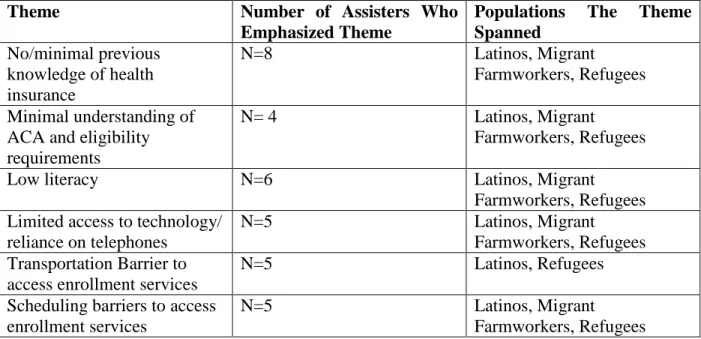
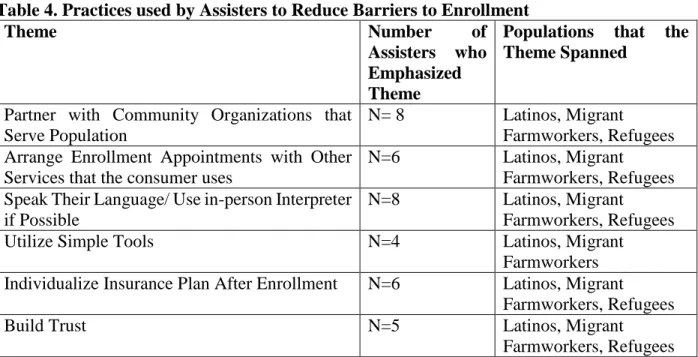
Several themes emerged during the interviews across the three case populations. Assisters mentioned numerous barriers that they faced when serving these different populations and shared strategies to mitigate the challenges they faced. In table 3, themes in the barriers mentioned are displayed along with the frequency of assisters who mentioned the theme. The third column shows the number of populations that the theme spanned. Table 4 mirrors the structure of table 3 but demonstrates the themes in practices utilized to mitigate common barriers among the three populations. Below each table, the themes are discussed briefly.
Table 3. Barriers faced in enrolling the Three Case Populations
Theme Number of Assisters Who
Emphasized Theme
Populations The Theme Spanned
No/minimal previous knowledge of health insurance
N=8 Latinos, Migrant
Farmworkers, Refugees
Minimal understanding of ACA and eligibility requirements
N= 4 Latinos, Migrant
Farmworkers, Refugees
Low literacy N=6 Latinos, Migrant
Farmworkers, Refugees Limited access to technology/
reliance on telephones
N=5 Latinos, Migrant
Farmworkers, Refugees Transportation Barrier to
access enrollment services
N=5 Latinos, Refugees
Scheduling barriers to access enrollment services
N=5 Latinos, Migrant
Farmworkers, Refugees