Development
on
the
Urban
Fringe:
Recent
Chinese
Experience
Simon
G.
Powell
The
challengeof developingon
theurban
fringe takeson
new
dimensionsin the changingeconomic
climateof China.This article explores the difficulties planners face in trying to balance China's desire for increased industrial
growth
on the fringe with the politicalgoal of Chinese cities to maintain a self-sufficient agricultural base.
Introduction
In recent years, Western
media
reportshaveemphasizedthedramatic reforms
which
havebeen sweeping contem-porary China, transforminga rigid, bureaucraticsocialistsystemintoaburgeoningmarket
economy
True,important advanceshave beenmade
inChina
since1978when Deng
Xiaopingconsolidatedhispower-base. Butas
many
foreignfirms, luredto
China by
theprospect ofone
billion con-sumers have discoveredto their cost,China
is farfrom
being a
market
economy.
The
realityofeconomic
reform inChina
is a picture ofuneven and
patchydevelopment.The
officialplanning system—
despitesome
relaxations—
stillcontrols thepro-duction
and
supplyof themost
importantgoodsand
com-modities,
and
inmany
ways
remains asunwieldy
now
asit
was
undertheMaoists. Itisin thiscontext—asysteminastateofupheaval
—
thatcurrentdevelopments
on
theurban
fringemust
be placed.Nanjing: the setting
One common
location ofrelativeprosperityinthecur-rent phaseof
development
ison
theurban
fringe.The
extent
and
depth ofdevelopment
will varyfrom
city tocity, butbeltsof significant ruralwealth aretobe
found
on
the outskirts ofmost
Chinese cities.Throughout
historyNanjing hasbeen
one
ofChina'smost
important cities. First settled in 472 B.C., Nanjinghasatvarious times
been
China'scapital. Situatedon
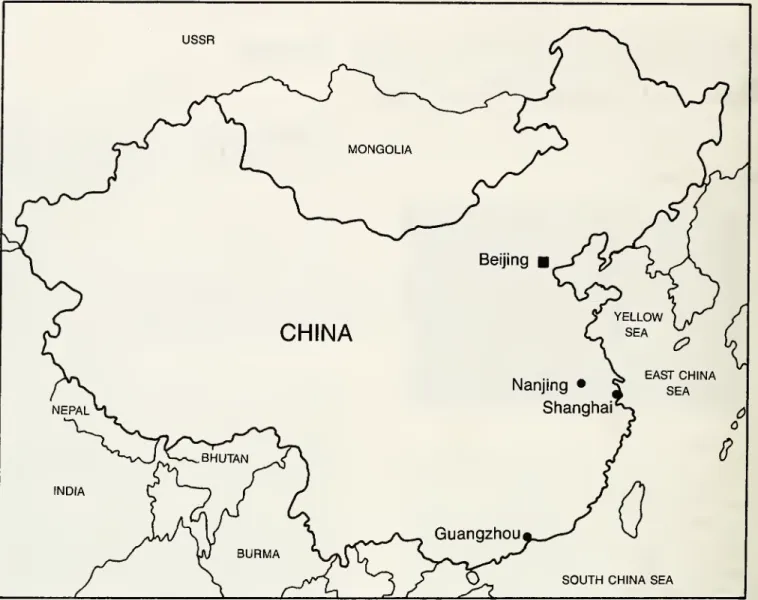
aplain in southwestern Jiangsu province, eastern China,
Nanjingissurrounded
by
aterrainoflow
hillsand
rivers,most
notably the Yangzi.The
urbancoreissurroundedby
suburbancitydistrictsof
mixed
landuse—
Dachang, Qixia,Yuhuataiand
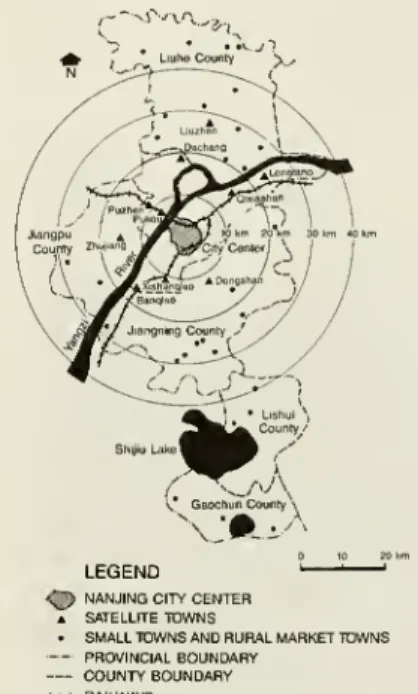
Pukou.Beyond
thesuburbandistrictsarethefivedty-administeredrural counties
—
Jiangpu, Jiangning, Liuhe, Lishuiand
Gaochun
—
with 198,000hectares(ha) of cultivableland(seeFigure1).
The
peripheryalso contains a diversity ofmineralwealthincluding deposits ofiron,
gypsum,
lead,zinc
and
manganese
aswell aslimestoneand
sandstone.Agriculture
and
ruralindustry arebothwelldeveloped.Figure
1.Nanjing
MunicipalityLEGEND
INANJINGCITYCENTER
SATELLITETOWNS
SMALLTOWNS ANDRURALMARKETTOWNS PROVINCIALBOUNDARY
COUNTY BOUNDARY RAILWAYS
MONGOLIA
Beijing
CHINA
YELLOW
SEA
<?
NEPAL
INDIA
Nanjing
•
Shanghai'
EAST
CHINA
SEA
.BHUTAN
8
BURMA
Guangzhou*
^L
SOUTH
CHINA
SEA
Table1 illustratesthe
growth
ofNanjing in thiscentury:Table 1. Nanjing*. Population. Spatial
Growth.
Various Years.
Population
Population Area Densities
(millions) (km2) (persons/km2)** City Municipality City Municipality City
1922 0.3 n/a n/a n/a n/a
1931 0.63 n/a n/a n/a n/a
1937 1.01 n/a 840 n/a 1202
1949 1.14 n/a 840 n/a 1357
1960 1.65 n/a 840 n/a 1964
1970 1.58 n/a 840 n/a 1880
1973 1.3 2.4 840 3190 1547
1977 1.7 3.2 840 4500 2023
1979 1.95 n/a 840 n/a n/a
1981 2.08 3.65 867 4718 2399
1982 2.13 3.74 867 4718 2456
1983 2.17 4.56 867 6516 2502
1984 2.2 4.6 867 6516 2537
*Nanjingisthemunicipality consisting of theurbancoreandthesuburban
districts (city)andthe5 city-administered counties. **A11 figures deduced.
Compiled frommaterialsinnote1.
The
rapid increaseinpopulationinthe1920swas
aresultofNanjing
becoming
China'scapitalonceagain.Nanjingsufferedbadly duringtheJapanese occupation but
grew
significantly inthe 1950s, aperiodofrural-urban
migra-tion.Population
growth
was
stalledinthelate1960sand
early 1970s(theperiodof theCultural Revolution)
by
apolicy of rustification, in
which
significantnumbers
ofcity dwellers
were
forciblymoved
to the countryside.However,
by
theend
of the 1970s,withthereturn ofthose sentdown
to the countryside during the rustificationmovement,
thecitypopulation continuedtogrow.Popu-lation densities within the city also
grew
steadily.This
growing
pressureupon
availablespaceand
infra-structure is
one
of the keyproblems
currently facingNanjingplanners.
There
isaclearneedto deflectfurthergrowth from an
alreadyover-crowdedurban
coreand
inparticularto
manage
futureindustrialgrowth. Thisisan
urban
planningproblem
true for cities throughout theworld.
Another
key concernishow
tofeed theexpandingcity. Thisisaruralplanningproblem,uniquetotheThird
World
and
toChina
inparticular, withitsgoal ofurban
self-sufficiency in foodstuffs. This articleexaminestwo
Industrial
Growth
and
SatelliteTowns
The
expansion of industrial activity within the citycenterhas longbeena
problem
forNanjing
planners. Inthe 1930sNanjing
had
little intheway
ofan
industrialbase, itssize
and
staturereflecting itsroleascapital citywithallthe administrative
and
bureaucraticorganswhich
accompany
such a position.2However,
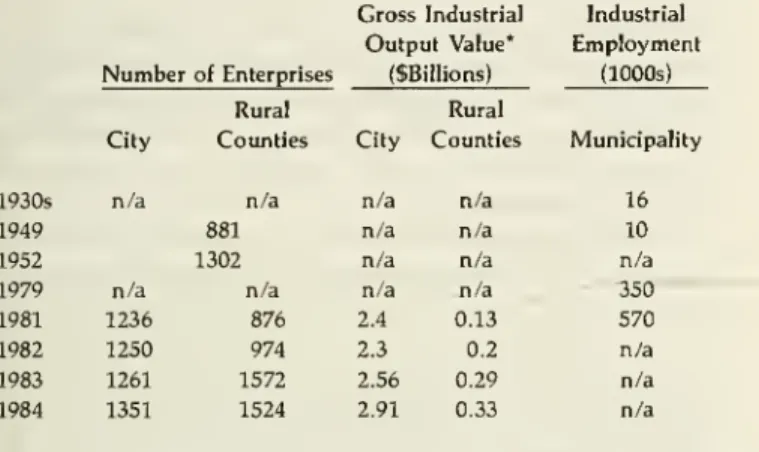
after Liberationin 1949, industrial
growth
in Nanjingwas
rapid:Table 2 Nanjing. Industrieil
Grow
th. Various Years.GrossIndustrial Industrial
OutputValue* Employment
Numberof Enterprises Rural
(SBillions) (1000s) Rural
City Counties City Counties Municipality
1930s n/a n/a n/a n/a 16
1949 881 n/a n/a 10
1952 1302 n/a n/a n/a
1979 n/a n/a n/a n/a 350
1981 1236 876 2.4 0.13 570
1982 1250 974 2.3 0.2 n/a
1983 1261 1572 2.56 0.29 n/a
1984 1351 1524 2.91 0.33 n/a
*1981 GrossIndustrialOutput Valueat1970constantprices; 1982ff. valuesat1980constantprices.
Compiledfrom materials innote3.
The
firstexpansionof industrywas
predominantly withinthe
urban
core.By
thelate1950s, expansionof industrialactivity
was
so extensivethatshortages of housing, publicutilities
and
othersupport serviceswerebecoming
increas-ingly evident. In the 1960s, enterprises
began
tolocateinthe
suburban
districts toaccomodate
further industrialgrowth. Small townships suchas
Dachang,
Longtan,Ban-qiao
and
Xishanqiao developedinto significant industrialzones.
However, development
was
somewhat
misman-aged,withindustrial
development
oftenconductedattheexpenseof the
most
productivefarmland—
surroundingthe
urban
core—
amajor
sourceof vegetables forurban
consumption.
By
the 1970s, industrial space in theurban
corewas
all but saturated. Further growth, even if physically
possible,
would
onlyexacerbateurban overcrowding,pol-lution
and
wastedisposalproblems.Thus, Nanjingplan-ners continued the established trend of developing the
industrialzoneinthe suburbs.
By
thistime, the diversity ofindustrialconcernsinthecitycenterand
suburbswas
considerable.Activitiesincluded mining,metallurgy,
tel-ecommunications, machine-building, petrochemicals,
trucks,
and
chemical fibres.Currently, thesuburbs themselvesare
becoming
over-crowded. Industrial
growth
is expanding through thesuburbsinto the city-administered rural counties. In
an
effort toeffectivelycontrolthisexpansion, planners have
tried to channel
growth
into designated satellite towns,such as the rural townships of Liuzhen, Zhujiang
and
Dongshan.
The
suburban townshipsofDachang, Longtan,Banqiao
and
Xishanqiao, de facto satellitetowns
for anumber
of years,were
included in this group.The
conceptofsatellitetowns
was
firstput forwardby
Chinese plannersin theearly 1950s. Ideally, such
towns
would
rangein sizefrom
50,000to200,000people.While
accesstothenearbycity
was
considered important,itwas
perceivedthatsatellite
towns
would
be independent urbanentities
and
the location of asignificantnumber
of urban-basedemployment
opportunities,and
adequateurban
facilities.
Satellite
towns
were
intended to relieve the pressureson
China'sovercrowded
cities. Industrialenterprisesreal-ized thatexpansion
was
limitedby
severalfactors: a lackofspace; increasingtrafficcongestion; housingshortages,
a situation
made
worse
by
thesignificantin-migrationtoChinese cities in the 1950s;
and
increasing levels ofpollution
—
industrialand
domestic—
exacerbatedby
growing
overcrowding.However,
theexperience ofsatellitetowns
inNanjingrevealsa sharpdivergence
between
planning theoryand
practical achievement. First, satellite
town development
hasfailed to
match
industrialgrowth
with the construc-tionofadequateurban
infrastructure. Livingconditionsarepoor, whilelivingcostsare high. Transportation
and
communications
links, even tothecity center, areweak.
Education
and
sanitary standards are low.Furthermore,
much-needed
capitalinvestmentfundsarelargelyunavailable.
While
Kirkbyreports thatsince1982some
improvements
in this situation are beingmade
inthe
suburban
satellite towns, the situation in the rural Farmingforurban consumption.satellites remains bleak.4
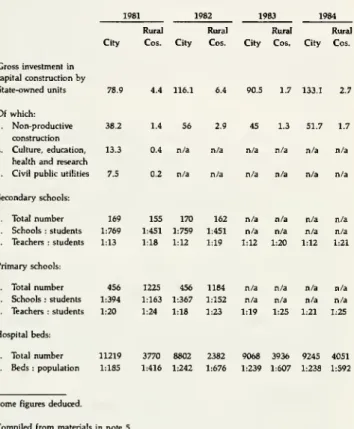
Compare,
for example, the figures inTable3.Although
notdirectlycorrelatedtoser-vice provision in satellite towns, Table 3 gives a clear
indication of the discrepancyin capital availability
and
service provision
between
theurban
and suburban
dis-tricts (City),
and
the remainder of the municipality Table 3. Nanjing. Investment. Service Provision.Various indicators. 1981-1984. ($ percapita)
Rural Rural Rural Rural City Cos. City Cos. City Cos. City Cos.
Grossinvestmentin capita]constructionby
State-ownedunits 78.9 4.4 116.1 6.4 90.5 1.7 133.1 2.7
Ofwhich:
1. Non-productive 38.2 1.4 56 2.9 45 1.3 51.7 1.7 construction
2. Culture, education. 13.3 0.4 n/a n/a n/a n/a n/a n/a healthandresearch
3. Civil publicutilities 7.5 0.2 n/a n/a n/a n/a n/a n/a
Secondaryschools:
1. Totalnumber 169 155 170 162 n/a n/a n/a n/a
2. Schools:students 1:769 1:451 1:759 1:451 n/a n/a n/a n/a
3. Teachers:students 1:13 1:18 1:12 1:19 1:12 1:20 1:12 1:21
Primaryschools:
1. Totalnumber 456 1225 456 1184 n/a n/a n/a n/a
2. Schools:students 1:394 1:163 1:367 1:152 n/a n/a n/a n/a
3. Teachers:students 1:20 1:24 1:18 1:23 1:19 1:25 1:21 1:25 Hospital beds:
1. Totalnumber 11219 3770 8802 2382 9068 3936 9245 4051
2. Beds:population 1:185 1:416 1:242 1:676 1:239 1:607 1:238 1:592
Somefiguresdeduced.
Compiled frommaterialsinnote5.
Satellite
towns
also sufferfrom poor
management.
Alltoo oftenland useplanningisweak,resulting inthesiting
of incompatible uses (e.g., chemical plants located next
to hospitals
and
schools).The
weakness
of planningmeasuresisalso wellillustrated
by
reportsbothofmisuseand
waste of valuable cultivable landaround
satellitetowns.6
Currently theillegaluse oflandforhousingconstuction
around
theruralsatellitesisof particularconcern. In 1984allbut3.4percent ofresidentialbuildingspaceunder
con-struction
by
stateand
collective unitswas
locatedinthecity center
and
suburbs.7 Forthe
most
part, individualsintheruralsatellitesareresponsible forhousing
construc-tion.In
many
cases thishasresulted inhousing beingbuilton
land designated for other purposes. LiuZhongchun
reportsthatbetween 1976
and
1981, 1,000ha
ofcultivableland
were
lost inthe municipality tohousingconstruc-tionaswell asbrickworks,factories
and
commercialen-terprises.8
However,
theofficialfiguresforcultivableland
availability inTable4
do
notreflectthis—
an
indication thattheofficial statisticsmust
betreatedwithcare.(More
accurateinformationisunavailable,
and most
likelydoesnot exist.)
Inthe
suburban
satellites, theissuenow
isnotsomuch
illegaluseof land,but
an
absolute lack of land.The
rateof construction is increasing, with ten-story residential
buildings
becoming
more
common.
Populationdensitiesare rising, putting a severe strain
on
the alreadyover-burdened
infrastructure.Clearly, in
both
thesuburban
and
ruralsatellitetowns,much
capitalinvestmentininfrastructureisneeded.Too
much
ofwhat
little capital investment does take placeservesonly tocreatefurtherpressure
on
thealreadyweak
existing infrastructure. This is a difficult situation with
no
easy solutions.Another
concernisthat the industrialbasewhich
has been developedinthesatellitetowns, ostensiblyprovidingthe foundation for
autonomous
urban
development, isweak.
A
distinctionmust
bedrawn
herebetween thein-dustry ofsuburbansatellites,
and
that ofthemore
recently-established rural satellites.
The
industrial base of thesuburbs appearstobesolid.
As
Table2indicates,virtuallyall of Nanjing's gross industrial output value is derived
from
theurban
coreand
suburbs.While
numericallytheruralindustrialbaseislarge, itactually consists of
small-scaleundertakingsusing obsolete
equipment
withinferiortechnical levels.
Lack
of capital is a distinguishing factor here.Poor
planningisanother.
Supply
of certainkeyraw
materialsislimited,
and
theplanning system remains unabletomeetthe increasing
demands
forthese materialsfrom
thewide
range ofenterprises
which
requirethem, leadingtofrustra-tion
and economic
hardship.9Zhang
Fubao
notes that theindustrialbase ofZhujiangforexample, faces
competi-tion
from
more
efficient, well-established factories forboth markets
and raw
materials.Inthe currenteconomic
climate, in
which
industrialwage
levelsare linkedtopro-ductivity
and performance
in the marketplace, there islittle
room
forsentimentamong
competing
factories. Inthis environment, fledgling industrialenterprises inthe
rural satellites will continue to find competition intense
and growth
difficult.In Nanjing, theburdenofdeflectingfuture
growth
away
from
theurbancoreliesprincipallywiththeruralsatellitetowns.
The
suburban
satellitetowns
have, inmany
respects,done
asmuch
as possibleto reducepressureon
theurbancenter.Theirfuturerole in thisregardislimited.
Given
thisfact, therelativelyseveredifficultiescurrentlyexperienced
by
rural satellitetowns
must
be of criticalAt
thistime, theruralsatellitetowns
have onlyaweak
industrial base
from which
to develop awide
range ofurban-based
employment.
Theirurban
infrastructure isevenlessdeveloped. Currently theirpopulation
growth
owes
more
to peasantsmoving
infrom
thecountryside than anymovement
outfrom
thecity center. Furthermore,unlesslivingconditions
improve
markedly, itisunlikelythat
any
suchmovement
from
thecitycenterwould
occur without a great deal of pressurefrom
the authorities.Whilethesetowns
may
be promotingsome
localizedwealthin the countryside
around
them, these benefitsdo
littleto ease the
burden
of overcrowding in theurban
core.For the
moment, improvements
remainunlikely.Invest-ment
capitalislimited,and
much
ofwhat
isavailablecon-tinues to be used to shore
up
longstandingproblems
withinthe
urban
and suburban
districts.It isdifficult toseea
way
out ofthissituation. Significantinputsof capitaland
strictcontrolsovercurrentgrowth
inthecity center,suburbs,
and
ruralcounties areneeded. Neitherseems
tobe forthcoming.
Feeding the City
It has long been a planning goal that Chinese cities
should,as
much
aspossible,beself-sufficientinprovidingfoodstuffs.
To
attain this goal, citieshaveincludedneigh-boringruralcountieswithin theirmunicipal boundaries.
Self-sufficiencyasaplanninggoalispoliticallyimportant
inthatitgivesacityasignificantelementofindependence
from
thestate planningsystem. Itis also a reflection ofeconomic
realitybecauseitisimportantthatcitiesavoidlongdistance interprovincialtrade
and
transfersoffood-stuffs.
Such
movements
inevitably involvehightranspor-tationcosts,excessive
amounts
ofspoilageand
waste,and
placea
heavy burden
upon
an
alreadyfragiletransporta-tion
and commercial
system.In pursuit of self-sufficiency,
Nanjing
planners haveestablished
two
distinct production zones within themunicipality.
The
first, cultivable land in thesuburban
districts, isazoneofpredominantlyvegetableproduction;
the second, the rural counties, is a zone
where
grain isthe
major
crop.The
establishment of aperiurbanvegetableproductionzone has
numerous
advantages.Vegetableproducershaveeasy access to
urban
markets for sales toconsumers, aswell as to vegetable processing plants. This proximity
minimizes spoilage
and
wastage losses incurred duringshipment, as well as transportcosts.Thereisalsoa
plenti-fulwater supply
and
theavailabilityof nightsoilcollecteddaily
from
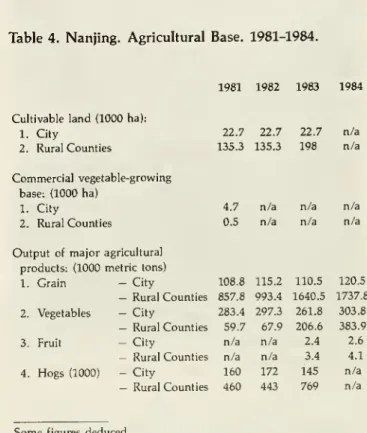
theurbancore.Pigbreedingisstronglyassoci-atedwithvegetableproduction,
and
inNanjing,periurbanpigproductionisan importantpart of thecity's
meat
sup-ply (see Table 4).
Table 4. Nanjing. Agricultural Base. 1981-1984.
1981 1982 1983 1984
Cultivableland (1000ha):
1. City 22.7 22.7 22.7 n/a
2. RuralCounties 135.3 135.3 198 n/a
Commercial vegetablegrowing
base: (1000ha)
1. City 4.7 n/a n/a n/a
2. RuralCounties 0.5 n/a n/a n/a
Outputofmajoragricultural
products: (1000 metrictons)
1. Grain
—
City 108.8 115.2 110.5 120.5—
RuralCounties 857.8 993.4 1640.5 1737.82. Vegetables City 283.4 297.3 261.8 303.8
—
RuralCounties 59.7 67.9 206.6 383.93. Fruit City n/a n/a 2.4 2.6
- RuralCounties n/a n/a 3.4 4.1
4. Hogs (1000) City 160 172 145 n/a RuralCounties 460 443 769 n/a
Somefigures deduced
Compiledfrommaterialsinnote 10.
InNanjing, thiszoneof vegetableproduction
was
for-mallyestablishedin1959. Productionishighlyspecialized
and
intensive, withheavy
inputs ofboth laborand
ferti-lizer. Production is alsomechanized
to a significantdegree.Thiszone has
produced and
continuestoproducesubstantial quantities of vegetables for thecity (seeTable
4).
The
exception to thisoccurred during the early1970swhen,
likemuch
ofChina, Nanjing's vegetablebasewas
cut to allow increased grain production.
Beyond
thiszone, significantamounts
ofvegetables areproduced
in the ruralcounties, as Table 4 illustrates. Inthe rural counties, however, grain is still the
dominant
crop,withvegetableproductionplaying a subsidiaryrole.
Even
for a city the size of Nanjing, with its fertileagricultural resource base, achieving a goal of
self-sufficiencyisnoteasy.
As
notedabove
forinstance, thereis stillcontinuing pressure
on
periurban cultivable landfor use in building projects.
Of
greater significance aredifficultiesingrainproduc-tion.
Throughout
history, producing sufficient grain tofeed a
huge
population has been a yardstickby which
regimesin
China
have beenjudged.Thisproblem
isDespite thereemergence offreemarkets, foodstuffsinurbanareas are inshort supply.
Since the1978agriculturalreforms, stateplannershave
attemptedtogivepeasantsthe incentiveto
improve
agri-culturaloutputs, particularly that ofgrain,by
allowingthem
tosellprivatelyortothestate,any
producebeyond
allottedproduction quotas. Peasantshavebeen encouraged
to diversify crop production (againafter thefulfillment
of allotted quotas) as well as to develop non-agrarian undertakingssuchas local industry, serviceoccupations
and
animal husbandry.These
policieshaveundoubtedly
stimulated grainpro-duction within the municipality.
However,
pressurere-mainstoincreasegrainoutputfurther.
A
keyvariablehereis the official price of grain. Production quotas require the supply of a stated
amount
of grain atan
officialmarket
price. Thisprice, despiterecentincreases, islow
relative toother crops,and
also tothe use-value ofgrain.Grain production is thus
unpopular
with the peasants,and
productionbeyond
personal needand
the allottedgrain quota is discouraged.
However,
the bare fulfillment of production quotasalonedoesnotsatisfyurbangraindemands. Thus, Nanjing
plannersarefaced with the
problem
ofhow
to increasegrain output even further. Raising grain output quotas
is not something that
would
be readily tolerated in therural counties. In essence, the extent to
which
peasants can prosper is determinedby
their ability to generatewealth, throughagrarianor other occupations,once
allot-ted grainquotashave beenmet.
Given
thatcurrentquotalevels represent significant inputs of land, labor
and
capital,raisinggrainquotas
would
havean
immediateim-pact
on
peasantincome
levels,making
itmore
difficultto engage in anything but grain farming,
and
severelylimiting theirenthusiasmforagriculturalproduction.
(An
emphasis
upon
grainproductionintheCulturalRevolu-tion, forinstance,
was
a key explanation forpoor
agri-cultural performance during that period.)The
alternatives tohighergrainquotasare limited. Inrecent years, Nanjing has attempted to bolster its grain
production
by
incorporating additional rural countieswithinthe municipality. In1974 Liuhecounty
was
incor-porated, followedin1983,
by
Lishuiand
Gaochun
coun-ties.
The
effectoftheselatteradditionsupon
agriculturaloutput
was marked
(see Table4); however, this impactwas
aone-timeadditiontoproductionand
isnotinitselfan
answer
to Nanjing's future increasingdemands
foragricultural produce.
Future sources of extra grain will be sought
from
in-creasesintheper-unityieldsofexistinggrainfields.There
are
two
elementstothisincrease.The
firstelementistheimprovement
of yields offarmerswho
producethebareminimum
ofgrain allowedby
theirquotas. Thiswould
facilitate increases in the quota without necessarily
in-creasinginputs ofland,althoughthiswill
mean
increasesinlabor
and
capitalinputs. Second, the yields offarmerswho
specialize almost exclusively in grain productionmust
be increased.To implement thefirstelement,agriculturalproduction withintheNanjing countrysideisdemonstratinga
grow-ingsophistication.Liu
Daochun
etal.reportthatagrow-ing
number
ofpeasanthouseholdsaremoving
away
from
agriculturalproductionitselftoprovidea variety ofskilled agriculturalproductionservicestoother peasants.11
Inthis
way, skills in such diverseareas as seedling cultivation, seed-straindevelopment, disease
and
pestcontroland
fer-tilizerapplication arebecoming
availabletoawider rangeofpeasants
and
it ishoped
that per-unit yieldswill riseaccordingly.
However,
forthis tooccur,plannersneedtoensure thatsupplies ofchemicalfertilizer, pesticides
and
otherkey farming inputs are available so that peasants
can take advantage of the skills being offered to them. There have beenreports that these supplies areboth in-sufficient
and
irregular.12Given
what
hasbeen said about thepoor
returns forgrain production, it
may
be surprising to discover thatany
producersarewilling to specialize ingrainproduction.Farmersare requiredtodevotesignificantlyhigher inputs of land, labor
and
capital tograin productionand
subse-quently they supply higherrates of
commodity
graintothestate than
most
producers.The
keyto thisdevelop-ment
is theamount
of subsidy offered to these grainspecialists.Thesesubsidies
may
involvecheapand
incomesubsidies,matchingtheincomesof grainspecialists
tothoseearned
by
peasantswho
diversifybeyond
grain.Such
subsidiesareexpensivetothelocalauthoritieswithinthe municipalities
who
administerthem, butarejustifiedby
reports ofboth highper-unit yieldsand
total outputby
the grain specialists.13 It is unclear, however, if thisinitialsuccesscanbe maintained
and
developedtosatisfy all of the city's graindemands.
Failure to increase grain output will certainly leave
plannerswithhardchoicesaboutfuturedevelopmentsin
Nanjing. Increasesinthenon-productive population
with-outconcomitantincreases ingrainproductionwillbe diffi-cult to accept. Furthermore, it is already clear that sig-nificanttensionsexistwithintheruralcounties as aresult
of thecurrent direction of rural
development
withinthemunicipality.
Therearetensions, for instance,caused
by
therelativeconcentration of vegetable production, a sourceofhigh
producer incomes, inthe
suburban
districts. Table4 indi-catesthat sincetheaddition of Lishuiand
Gaochun
coun-tiesin 1983, theruralcountieshave a
much
bigger shareofthevegetablemarket, butitisunlikelythatthisincrease
has
done
more
than temporarily ease the tension. Similarly, tensions arefound
within theruralcounties assome
producers prospermore
thanothers.The
furthergeographically
removed
peasants arefrom
urbanmarkets,the
more
difficultitbecomes
totakeadvantageof thecur-rentfreedoms withintheruralproductionsystem.
Com-mercial
and
transport links to the city centerfrom
theperiphery, onlya distance of perhaps 50 to 60
km,
areextremely
weak.
This isespeciallytrue to thenorthand
west of the city
beyond
the Yangzi,and
in the extremesouthofthe
new
city-administered counties of Lishuiand
Gaochun.
Thus,on
the periphery,income and
employ-ment
opportunities are increasingly limitedtothearable.Commodity
productionislikewise limited,which
restrictsthe potential of the peripheral authorities to subsidize
grainspecialists, limiting the extentto
which
otherpeas-ants are abletodiversify
beyond
grainand
localdevelop-ment
in general.Thissituation contrastssharplywiththeprosperity exhibitedbytheruralcommunities
more
proxi-mate
to the cityand
suburbs.Finally,asnoted above, recent
growth
inruralsatellitesowes
more
toaninfluxofpeasantsfrom
thecountrysidethan tomigration of
urban
dwellersfrom
thecitycenterand
suburbs.While
livingconditionsintheruralsatellitesmay
not appealtoexisting citydwellers, theyare attrac-tive to peasantsin thesurroundingcountryside, seekingmore
urban-basedemployment.
Becausethework
has tra-ditionallybeenseen aslessrewarding,and
certainlymuch
harder than urban-based
employment,
it is difficult tomaintainpeasantenthusiasmforagriculturalproduction.
Though
plannersare eagerto develop ruralsatellites to relievepressureon
thecitycenterand
suburbs, thesame
developmentcreatesfurtherdifficultiesforthoseplanners
seekingtoencourageagricultural productioninorderto
attain self-sufficiency.
Conclusion
Theoretical prescriptions for thedevelopmentof the
ur-ban
fringe ofNanjing
havebeen
quite readilymade,
butthe realityof the
economic environment
inwhich
theseprescriptionshave
been
implemented
hasproduced
onlypartial success. In Nanjing, the
suburban
satellitetowns
did
much
to relieveearlypressureon
thecity center, buttheytendedtobe developed withoutthenecessary
invest-ment
inurban
infrastructure, a deficiencywhich
isonlynow
being rectified.Given
the limited capital available,plannerswillfindit difficultto effectively developrural satellitetowns
and
preventthem from
fallingintothesame
trap.
Furthermore, whilethecurrent
economic
environmentin
China
has certainly proved successful in generatinggrowth
(albeitperhaps onlyintheshortrun), policiesofincreasing competitiveness pose
problems
for plannersand
theirdevelopment
goals. Industrialgrowth
in theruralsatellites issubject tofierce competition, hindering planning objectives for the strength of their industrial base.
The
openingup
ofurban marketstoruralproducers,combined
withthelow
priceofgrain,hasresulted ingrainacreagebeingreducedinfavor of
more
remunerativecashcrops,
making
self-sufficiencymore
difficult to achieve.This
changed
economic environment
hascreatednew
problems
and
opportunities for planners,and
hasaccen-tuatedlong-standingdifficulties.
The
way
inwhich
plan-nersreact to this changing
environment
will largely be determinedby
themeasure
offlexibility theyare giventosolve
problems
and
the resources that aremade
avail-able to them. It will also
depend
on
how
much
they themselves can adapttoplanninginasystemwhich
ifnot governedby
the market, certainly needs to respond tomarketforces.Thisrepresents arealchallengeafter
plan-ning in a rigid, socialist system. It is unclear
from
thematerial presented forNanjingiftheywillhavesufficient
resolve or resources.
SimonPowell receivedhisdoctorateinChineseGeographyfromthe
Landshortageon theurbanfringeencourages peasants touse allavailableland.
NOTES
1. G.B. Cressey, China's Geographic Foundations
(McGraw-Hill, 1934); C.W. Pannell "Recent growth and change in China'surbansystems",in UrbanDevelopmentin
Modern
China eds. L.C.J.
Ma
and E.W. Hanten (Boulder,CO
Westview, 1981); Shen Daoqi and Yao Shimou"Nanjing
EvolutionandDevelopment,"in ed.V.E SitChineseCities
theGrowthof theMetropolissince1949(HongKong:
OUP
1985); China Reconstructs, Vol.22(3)21-26,44; L.C.J.
Ma
"Urbanhousing supplyinthe People'sRepublicofChina", in
Ma
and Hanten op.cit.; Statistical Yearbookof China(SYC), 1981(Beijing)1981;
SYC
1982;SYC
1983;5YC
1984.2. G.B. Cressey op.cit.
3. ChinaReconstructsop.cit.;
SYC
1981;SYC
1982;SYC
1983;SYC
1984.4. R.J.R. Kirkby, Urbanization inChina:
Town
and CountryinaDeveloping Economy, 1949-2000a.d. (Columbia,1985).
5.
SYC
1981;SYC
1982;SYC
1983;SYC
1984.6.
Zhang
Fubao"Preliminaryresearch of thedevelopmentof small towns in Jiangpu county," Jingji Dili (EconomicGeography (2)139-146, (1982). 7.
SYC
1984.8. LiuZhongchun"Put a stoptotheevilpractice of irregular
occupation of vegetable land," Renmin Ribao (People's
Daily), 6
March
1982. 9.Zhang
Fubaoop.cit.10.
SYC
1981;SYC
1982;SYC
1983;SYC
1984.11. Liu
Daochun
etal."Dongshancountryside's agricultureser-vicecompany'sseven points for households,"XinhuaRibao
(New
ChinaDaily), 21May
1983.12. Liu
Daochun
et al. "Enthusiasticallysupportthe peasantswho
are enteringinto circulation,"XinhuaRibao(NewChinaDaily), 10 February1983.
13. LiuJiaren,"10,000 characterhouseholds appearinNanjing's
suburban counties," Xinhua Ribao