ABSTRACT
The use oftobacco has been an important public health concern within the past several decades and is still expected to be problematic well into the future. Recently, cigarette smoke has been associated with a decreased immune response to the influenza vaccine; however, there is limited data regarding previous smokers and how the immune system functions following the cessation of smoking. The focus of this study was to determine how the antibody response to the H1N1pdm09-like strain within the influenza vaccine varied among current smokers. previous smokers, and nonsmokers as well as between lean and obese individuals within each group. Pre-and post-vaccination serum samples from 60 study subjects from the 2016-2017 influenza season were analyzed via hemagglutination inhibition assays (HAl) to determine the antibody titers in response to the H 1 N 1 pdm09-like strain in the influenza vaccine. There was a general trend for the lean subjects to have higher HAl titers than the obese subjects; however, this trend was insignificant. Additionally, it was found that the HAl titer differences between current smokers, previous smokers, and nonsmokers were insignificant. The percent sero-protected (the
percentage of individuals with an HAl titer of 40 or greater) and the titer fold change (a measure ofthe antibody level change between pre-vaccination and post-vaccination) were both found to be insignificant between all six groups. Several limitations ofthis study such as a small sample size may have led to insignificant results; however, although this study did not produce
INTRODUCTION
Background/History
Tobacco has played a significant role in human life for thousands of years. Beginning roughly 2000 years ago, tobacco was first utilized for ceremonial purposes; however, it was not until the 1700s that smoking became more common due to the growth of the tobacco industry. 1 Slightly over 200 years had passed before the first links of smoking and lung cancer were observed in the 1920s.1 Several decades later, published medical reports certified that tobacco use could directly cause a number of serious illnesses and worsen others. Currently, patterns predict that 5 million tobacco related deaths will result each year worldwide and is expected to rise to 10 million tobacco related deaths by 2030.1 As seen in these statistics, tobacco has devastating effects on human health; therefore, many government and nonprofit programs have focused on preventing cigarette smoking. With this approach, however, one large group is left out: previous smokers. Only recently, research is beginning to focus on previous smokers. Is it possible for previous smokers' health to improve to that of a nonsmoker? If so, how long until health returns? In this study, the focus is on the immune system: if and when it recovers from smoking. Knowing this information is critical to improving the overall health of previous smokers.
cells to produce and secrete antibodies, a lower number of helper T cells can potentially lead to a decreased antibody production from B cells.3
Study Aims
The goal of this study is to determine how antibody levels for both lean and obese individuals in response to the H1Nlpdm09like virus in the influenza vaccine vary among three groups: current smokers, previous smokers, and nonsmokers. My hypothesis is that current smokers will have the lowest antibody levels, followed by previous smokers, and then by nonsmokers with the highest antibody levels, and that the obese individuals within these three groups will have lower antibody levels than the lean individuals.
METHODS Study Population
The Beck Lab, a clinical biochemistry research lab, at UNC Gillings School of Global Public Health leads an prospective clinical study investigating how obesity affects the immune response to the influenza vaccine. Participants are recruited from the UNC Family Medicine Center in Chapel Hill, NC and must be at least 18 years old without a history of
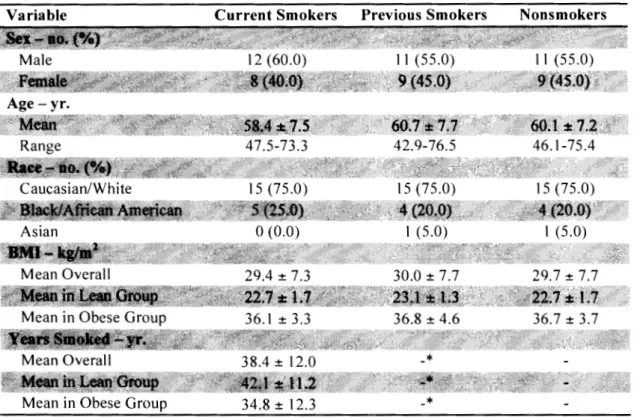
immunosuppressive diseases or a history of taking immunosuppressive medicines in order to participate.4 The sample population for this study was selected from those who were enrolled in the study during the 2016-2017 influenza season. Subjects in the sample population were categorized into one of three groups: current smoker, previous smoker, or nonsmoker (Table 1). A current smoker is defined in this study according to the CDC definition of a current smoker -''an adult who has smoked I 00 cigarettes in his or her lifetime and who currently ~mokes
smoking for at least 10 years. After 10 years post-smoking, the risk of developing lung cancer is 30% to 50% of that of a continuous smoker, and the risk of developing diabetes is that of a nonsmoker.6 Due to a limited sample from which to choose study participants, however, 5 of the 20 study participants selected for the category of previous smokers did not report the year in which they had quit smoking. For the remaining 15 study participants, 14 of the 15 had quit smoking at least 10 years ago, and one had quit 6 years ago. A nonsmoker is defined in this study according to the CDC definition of a nonsmoker- "an adult who has never smoked, or who has smoked less than 100 cigarettes in his or her lifetime.''5 Both current smoker and nonsmoker designations were defined on the survey distributed to the participants at the time of enrollment. Study subjects were further categorized by weight status into lean or obese smokers, previous smokers, and nonsmokers. Subjects were placed into the lean group of smokers,
Table I. Demographic Characteristics of Study Sample
Variable Current Smokers Previous Smokers
Male 12 (60.0) II (55.0)
Age -yr.
/.¥¥":'7¥~%::~::/J" ';?;'i':i~~--·~:r.s.·
..
Range 47.5-73.3
~._,~!i;F,;~~~r·~,~
· · ..
Caucasian/White 15 (75.0)
Asian 0 (0.0)
f~.~;lll~i;i''';~,:r;,\;'s:·. Mean Overall
Mean in Obese Group 36.1 ± 3.3
Mean Overall 38.4 ± 12.0
•tt!l!!!i!ltll!~.::.:·· .·.:;k":~~FFttli'~'-il~1l~J·.· Mean in Obese Group 34.8 ± 12.3
*Years smoked for previous smokers arc unknown
Preparation
'(4s:o).
· M.1:rt'1,
1; ·.
42.9-76.515 (75.0)
I (5.0)
36.8 ± 4.6
*
*
Nonsmokers
< .J*1~;.yT
46.1-75.4
15 (75.0) ;::~~i#~.-.1}~'"'.
I (5.0)
36.7 ± 3.7
At the time of subject enrollment, a pre-vaccination blood sample was drawn from each subject followed by administration ofthe 2016-2017 seasonal trivalent int1uenza vaccine, which included the A/California/7/2009 (H1N1)pdm09-like virus, the A/Hong Kong/4801/2014 (H3N2)-like virus, and the B/Brisbane/60/2008-like virus.7 Participants returned within 28-32 days after administration of the influenza vaccine for drawing of a post-vaccination blood sample.4 Whole blood is collected in heparinzed tubes and left undisturbed at room temperature for
i
5-30 minutes to allow for clotting. The supernatant is known as serum, which ismL sterile eppendorftubes. Following the serum addition, RDE (90 ~-tL) was added to the eppendorf tubes. The tubes were then incubated at 3 7°C for 18 to 20 hours followed by heat
activation in a water bath at 56°C for 1 hour. After the samples cooled to room temperature, physiological saline (180 ~-tL) was added to each eppendorf tube resulting in a final serum dilution of 1:10. All samples must then be frozen for at least 4 hours before use.
A 0.5% red blood cell (RBC) suspension, necessary for both hemagglutination assays and hemagglutination inhibition assays, was prepared using Turkey red blood cells (RBC) and the proportionate amount of sterile phosphate buffered saline. The Turkey RBCs were centrifuged three times at 270 g and 4
oc
for 10 minutes per cycle. Following the first and secondcentrifugations, the supernatant was discarded and sterile phosphate buffered saline ( 10 mL) was added. After the final centrifugation, the size of the RBC pellet was estimated to determine the volume of sterile phosphate buffered saline to add to create a 0.5% packed RBC suspension. Hemagglutination Assay (HAU)
Hemagglutination Inhibition Assay (HAl)
On a 96-well V -bottom plate, serum samples were added in duplicate to the first eight wells of the first row. The last four wells of the first row included a positive control, a negative control, a back titration, and turkey RBCs only, respectively. Serial dilutions of serum samples and controls were performed down the 96-well V -bottom plate followed by the addition of a standard amount ofHINl virus (25 r-tL) to all serum containing wells and to the positive and negative control wells. The plate was incubated for 15 minutes to allow for the antibodies to bind the virus. After incubation, the 0.5% RBC suspension was added to all wells to provide a measure of agglutination. For high serum antibody concentrations, the virus will sufficiently be bound by the antibodies, preventing it from causing agglutination of the red blood cells. A pellet will result in these wells. For low serum antibody concentrations, not enough antibodies are present to bind the virus; therefore, the virus is able to bind the red blood cells causing agglutination. The highest dilution of serum containing antibodies resulting in inhibition of agglutination and formation of a red blood cell pellet is the endpoint of the hemagglutination inhibition assay. The reciprocal of the endpoint dilution is the HAl titer.
Analysis
the statistical significance across each 'smoker' category for the percent sera-protected. A one-way ANOV A was used to analyze the statistical significance for titer fold change among all six groups: lean current smokers, obese current smokers, lean previous smokers, obese previous smokers, lean non-smokers, and obese non-smokers. For all statistical tests, a p-value of <0.05 was deemed significant.
RESULTS
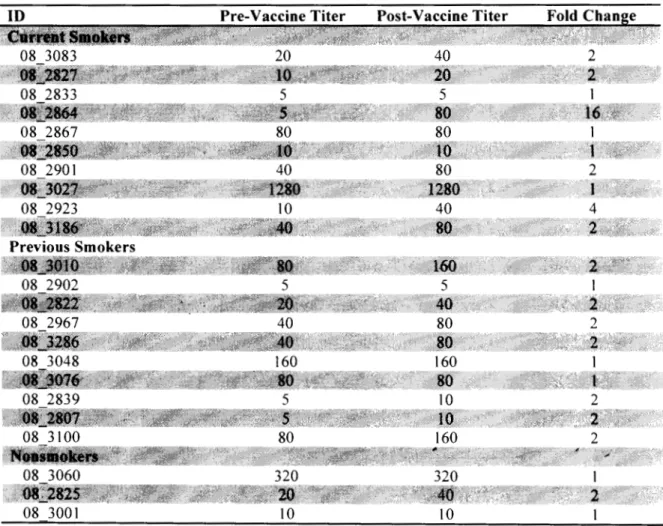
Hemagglutination inhibition assays (HAls) were run on pre- and post-vaccination serum samples for all 60 subjects in the study. The HAl pre- and post-vaccination titer values were determined (Table 2 and 3).
Table 2. HAl Titer Data for Lean Individuals in Sample Study Population
08 2833 5
08 2867 80
08 2901 40
m''
,:-•t . .
~~~~~qjf,¥:~:::7{~;~~~~\~ti~>ic(;:'c(f,::'08 2923 10
'c -~:fiit~~ftr£~j<::if;~*~'i!::~}~i?f1 c:: ',,•·Vmvm.h"' .L.&&iitilln'
Previous Smokers
08 3100
ci-~~--~i'fY;?~~'~':
08 3060
,
:;~~~~~JP5'fJJ'lf§i'~· 08 300180 320 10 5 Iff 80 . ·:le 80 '1280 40
81 .. :,
,160 ' ) "
5 ·40· 80 ~0 160
80
10· to
160 320 10
I
···
l';z;r;~~;'
08 3056 20
: ';,,c{~•i•a-~;~::::~,~}~-~UA,}i~~i,Z13':;$~ft",',~~ttfft~;·!.~1JYjJO;·,·:,;:
132 10
08 3245 5
80
,,;;;,;".,'
20
,}; 4tt::,
5
Table 3. HAl Titer Data for Obese Individuals in Sample Study Population
08 3150 08 3272
:~.¥,Qa:*t.r.J;Jr
Previous Smokers
;1!-~~!:·~~
80
08 2903 80
;r9IDIIJ~;'01Jf>s,', ;:::l;,,·;~!~"£':tf~i~4>::¥?rit~;¥:;,*~;;;;;,.;(.»' ''L'•'''>Jr::,:"•··
08 2821 20
·~C:~~:;~;r~~:flP;!;J:t~¥~~
.. ;.·: ·-
::')'fj~<~~ii'~":i'':c•;!•';(;,:jL 08 3171i11!J~cf(;1 .. ,,, 08 2912
Jf?';Qf!:,.,r':r
;'>,08 2968 ,~:t:~..,l§r£0'
08 2965
~str(lttf,-ft~~~~&;i:Y ~;::~~~-~fi< 20 160 5 5 20 ·:~~:;:r•f 160
5
80'··· 40
40 10
s
80 40 160'40''
40 5 4 2 4 I: !
I 1 2l
I 2 I 1 2 l 2 I'l
nonsmokers; however, the trend is insignificant (Figure 1 ). Within the obese subjects, the previous smokers have the highest average HAl titers of the three "smoker'' groups with current smokers and nonsmokers having similar average titer values. The differences between the "smoker" groups for the obese subjects are insignificant (Figure 1 ). Next, HAl titers were compared within each "smoker" category between lean and obese subjects. Lean current smokers, lean previous smokers, and lean nonsmokers all had a greater change in titer values from pre- to post-vaccination than their respective obese subjects, but these changes are
insignificant (Figure 2). The lean nonsmokers also had higher titer values for both pre- and post-vaccination than the obese nonsmokers, but the difference was not significant (Figure 2). The titer fold change is a measure of how much the titer has changed from pre-vaccination to post-vaccination and can be used to determine if a subject seroconverted to the vaccine. There was a general trend for the lean current smokers, previous smokers, and nonsmokers to have higher titer fold changes than their respective obese counterparts; however. there were no significant differences in the titer fold changes among any of the six groups (Figure 3). Lastly, in order to be considered protected from the H 1 N 1 influenza virus, an antibody titer of 40 or higher is needed. There are a higher percentage of lean current smokers, previous smokers, and
a)
b) 40
30
...
~1- 20
~
40
30
...
~
1- 20
C(
:I:
HAl H1N1 Antibody Titer Lean
• Pre-Vaccination
• Post-Vaccination
• •
HAl H1 N1 Antibody Titer Obese
• Pre-Vaccination
•
•
• Post-Vaccination•
•
•
Figure 1. HAl titers for current smokers, previous smokers, and nonsmokers for the lean (a) and obese (b) groups. No significant difference in HAl titer levels between current smokers,
a) HAl H1 N1 Antibody Titer Current Smokers
• Pre-Vaccination
•
• Post-Vaccination..
==
1- 10
C(
J:
b) HAl H1 N1 Antibody Titer Previous Smokers
40
•
•
..
~1- 20
~
c) HAl H1 N1 Antibody Titer Non-Smokers
..
~1- 20
C(
J:
•
•
• Pre-Vaccination
• Post-Vaccination
• Pre-Vaccination
• Post-Vaccination
Ill
C)
2
; 1
.s::.
0
"C
0
u.
HAl H1 N1 Titer Fold Change
•
I .
. ..
···I····~
.... : ....
~
....
!T! ....
+····
Figure 3. Titer fold change for both lean and obese current smokers, previous smokers, and nonsmokers. No significant difference in titer fold change between any of the six groups (P-value = 0.5078).
HAl H1 N1 Percent Protected from H1 N1
- 40 Cut-Off
80 Cut-Off
- 160 Cut-Off
DISCUSSION Findings
The influenza virus is one of the most serious viruses of public health concern due to the ease oftransmission through inhalation of viral particles and direct contact with infected persons. The most recent worldwide pandemic of influenza occurred in 2009 by the H 1 N 1 strain of the virus leading to a total death toll between 151,700 and 575,400 people worldwide.8 According to the CDC, the pandemic H1N1 vaccine, which was distributed as early as November of2009, prevented an average of 1 million influenza illnesses and saved on average 300 lives in the United States; however, had the vaccine been available and distributed two weeks earlier, nearly 60% more influenza illnesses could have been avoided. 8 Even more recently during the 2014-2015 influenza season, the H 1 N 1 pdm09 strain of the influenza virus became pandemic in India. During this season a total of 33,761 influenza illnesses were reported with a death toll of 2,035 through March 30, 2015.9 Vaccination plays a major role in slowing pandemic or epidemic outbreaks of influenza by preventing acquisition of the virus. In the current influenza season from 2016 to 2017, a total of 36,649 specimens positive for influenza have been recorded to date in the United States and territories.10 Also in the United States and territories during the 2016-2017 season, 72 influenza-related pediatric deaths have been recorded to date.10
made in recent years to quit smoking. The CDC sponsored a campaign titled Tips From Former Smokers to aid those wanting to quit to take the right steps to quitting. From 2012 to 2015, this campaign has helped more than 500,000 people in the United States quit smoking indetinitely.13 Because of campaigns such as this one among many others, the number of previous smokers has been increasing over time; therefore, it is necessary to conduct studies such as this one to
discover how their bodies respond post-smoking.
In previous studies it has been observed that smoking has a negative effect on the antibody response to the influenza vaccine. A review by Sopori found that smoking can reduce human serum immunoglobulin levels.2 Studies in animals have also found that the antibody response was significantly decreased in response to specific antigens for those exposed to cigarette smoke.2 As seen in Figure 1, the trend within the lean group of individuals was for the antibody response to increase from current smokers to previous smokers to nonsmokers.
Although this trend was insignificant, it does support the data discovered by others for nonsmokers to have higher antibody levels than current smokers. Within the lean group, previous smokers fall between current smokers and nonsmokers as expected. It was also hypothesized for previous smokers to have titers more similar to that of nonsmokers than to current smokers; however, because of the small sample size, it is difficult to distinguish
an outlier in the previous smoker group. Increasing numbers of subjects will aid in determining statistical relevance.
Obesity also has a negative effect on the antibody response to the influenza vaccine. In a study by Sheridan et al., BMI was negatively associated with antibody levels in response to the influenza vaccine around 12 months post vaccination.4 As seen in Figure 2, within current smokers, within previous smokers, and within nonsmokers, there is an insignificant trend for the lean subjects to have larger titer increases from pre- to post-vaccination as compared to the obese subjects. Although the trend is not significant, it does produce results that correspond with those found by Sheridan et al.. Figure 3 shows a similar, albeit insignificant, trend. Lean individuals in all cigarette consumption categories have higher titer fold changes than obese individuals in the respective cigarette consumption categories, again supporting the findings by Sheridan et al.. Figure 4 also shows evidence of a negative relationship between obesity and antibody response to the influenza vaccine. In order to be considered protected from the HIN1 virus, a titer of 40 or higher is needed. There is an insignificant trend within current smokers, within previous smokers, and within nonsmokers for the lean subjects to have a higher percent protected from the HlNl virus than the obese subjects. Although the data support findings by Sheridan et al., it is insignificant; therefore, more studies should be done to increase the strength of the findings. Study Limitations and Future Studies
Several limitations are evident within this study. Although 60 subjects were used in this study, the sample size was still small, as each of the six categories only contained a total of 10
subjects. A small sample size can provide difficulties in finding statistically significant
smokers on when each quit smoking. Originally, previous smokers in this study were to have quit smoking for at least 10 years, as at that point the body has been shown to exhibit signs of recovery and repair of damage. Lacking this information potentially means that some of the subjects in this study may have quit smoking more recently, which may bias the results if their antibody levels were different.
Another important limitation of this study involves the methods of data collection. In this study, the subjects were recruited on a volunteer basis. These subjects were already going to the UNC Family Medicine center to receive an influenza vaccine when asked if they would be willing to enter the study. A statistically significant difference may be evident between the people who willingly receive a flu shot versus those who do not. Also, smoking in this study was self-reported, bringing about the potential for inaccurate reporting or recall bias. This type of bias may have impacted the classification of individuals into one of the six groups, which in tum could bias the results.
Hemagglutination inhibition assays (HAis) were only performed using the H 1 N 1 pdm09-like virus. During the 2016-2017 influenza season, the H3N2 strain was the most common circulating strain, which was unknown at the start of this study.7 Subjects can respond differently to different virus strains; therefore, in future studies more strains should be tested. The average titer fold change for each of the six groups was below 4, which is the change needed to show a seroconversion to the vaccine. In each of the six groups, however, at least 50% of the
individuals were sero-protected, suggesting that these individuals may have had high titers pre-vaccination and were already sero-protected before administration of the vaccine. The
previous vaccinations.14 If this study population is not representative of the general population for example because these individuals receive the influenza vaccination yearly, this could cause a bias in the results.
Apart from the small sample size, the other limiting factor that contributes heavily to this study is due to age. In a study by Lambert et al., it was discovered that adults over the age of 65 have decreased antibody responses to the influenza vaccine than younger adults.15 Diminished antibody response to the vaccine as a result of aging, due to the degradation of both the adaptive and innate divisions of the immune system, is known as immunosenescence.15 In this study, thirteen subjects were over the age of 65, causing age to be a potential confounder.
Future studies of smoking status on the response to the influenza vaccine are necessary to discover new trends and confirm existing trends. The most important characteristic of future studies for this topic focuses on appropriate sample size and selection. As evident in the results of this study, a small sample size proved difficult to obtain any significant relationships as outliers easily skewed the data. Having a larger sample size can prevent such skews from
outliers and provide a more accurate relationship between the two variables - smoking status and antibody levels. The methods in how individuals are chosen for this study should also be
Future studies should also test for other viral strains of influenza. As mentioned above, the A/Califomia/7 /2009 (HI N I )pdm09-like virus has been present in influenza vaccines since 2012, possibly leading to higher starting antibody levels and lower titer fold changes found in this study. 14 Other strains of the virus should also be tested such as the A/Hong Kong/ 4801120 14 (H3N2)-like virus. It is the first year that this strain has been used in an influenza vaccine; therefore, individuals should not have antibody responses to this strain until after vaccination.16
References
1. "A Brief History of Smoking- Cancer Council NSW." Cancer Council NSW. N.p., 20 Dec. 2011. Web. 12 Oct. 2015.
2. Sopori, Mohan. "Science and Society: Effects of Cigarette Smoke on the Immune System." Nature Reviews Immunology 2.5 (2002): 372-77. Web.
3. Ferson, M., Anne Edwards, Anne Lind, G.W. Milton, and P. Hersey. "Low Natural Killer-Cell Activity and Immunoglobulin Levels Associated with Smoking in Human Subjects." International Journal of Cancer 23.5 (1979): 603-09. Web.
4. Sheridan, P. A., H. A. Paich, J. Handy, E. A. Karlsson, M.G. Hudgens, A. B. Sammon, L.A. Holland, S. Weir, T. L. Noah, and M.A. Beck. "Obesity is Associated with
Impaired Immune Response to Influenza Vaccination in Humans.'' International Journal
ofObesity 36.8 (2011): 1072-077. Web.
5. Centers for Disease Control and Prevention (CDC). "Tobacco Glossary.'' National Center
for Health Statistics. CDC, 17 June 2009. Web. 22 Apr. 2017.
6. Office of the Surgeon General, and Office on Smoking and Health. The Health
Consequences of Smoking: A Report ofthe Surgeon General. Rockville, MD: U.S. Dept.
of Health and Human Services, Public Health Service, Office of the Surgeon General, 2004.
7. Centers for Disease Control and Prevention (CDC). "Frequently Asked Flu Questions 2016-2017 Influenza Season." Influenza (Flu). CDC, 23 Mar. 2017. Web. 22 Apr. 2017. 8. Centers for Disease Control and Prevention (CDC). ·'First Global Estimates of 2009
H1N1 Pandemic Mortality Released by CDC-Led Collaboration." CDC, 25 June 2012. 22 Apr. 2016.
9. Tharakaraman, Kannan, and Ram Sasisekharan. "Influenza Surveillance: 2014-2015 H1Nl "Swine"-Derived Influenza Viruses from India." Cell Host & Microbe 17.3
(2015): 279-82. Web.
10. Centers for Disease Control and Prevention (CDC). "Weekly U.S. Influenza Surveillance Report.'' Influenza (Flu). CDC, 21 Apr. 2017. Web. 22 Apr. 2017.
11. Centers for Disease Control and Prevention (CDC). "Fast Facts.'' Smoking and Tobacco
U'ie. CDC, 29 Mar. 2017. Web. 22 Apr. 2017.
12. Centers for Disease Control and Prevention (CDC). "Chapter 3 Chemistry and
Toxicology of Cigarette Smoke and Biomarkers of Exposure and Harm>' Hi.Jw Tobacco
MD: U.S. Dept. of Health and Human Services, Public Health Service, Office of the Surgeon General, 2010. N. pag.
13. Centers for Disease Control and Prevention (CDC). "About the Campaign.'' Tips From
Former Smokers. CDC, 17 Jan. 2017. Web. 22 Apr. 2017
14. World Health Organization. "Recommended Composition of Influenza Virus Vaccines for Use in the 2012-2013 Northern Hemisphere Influenza Season." Influenza. World Health Organization, 23 Feb. 2012. Web. 22 Apr. 2017.
15. Lambert, Nathaniel D., Inna G. Ovsyannikova, V. Shane Pankratz, Robert M. Jacobson, and Gregory A. Poland. "Understanding the Immune Response to Seasonal Influenza Vaccination in Older Adults: A Systems Biology Approach.'" Expert Review o.f Vaccines
11.8 (2012): 985-94. Web.