Intrauterine Devices in Adolescents: A Systematic Review
By: Jeremy Belch
A Master’s Paper submitted to the faculty of the University of North Carolina at Chapel Hill in
partial fulfillment of the requirements for the degree of Master of Public Health in the Public
Health Leadership Program.
Chapel Hill
2011
______________________________________
Advisor:
______________________________________
Date
______________________________________
Second Reader:
______________________________________
1
ABSTRACT
Background: Adolescent pregnancy is a major public health problem in the United States
associated with negative sequelae for women, families, and children. Most of the recent
decline in adolescent pregnancy in the United States is due to contraception; however the rate
of adolescent pregnancy in the United States is still higher than in other developed nations.
Long-acting reversible contraception is underutilized in this respect.
Purpose: To review the literature on the outcomes of pregnancy rate, expulsion rate, and
continuation rate in adolescent women using an IUD for contraception
Data sources: MEDLINE, ISI Web of Science, and POPLINE searches; relevant reference lists
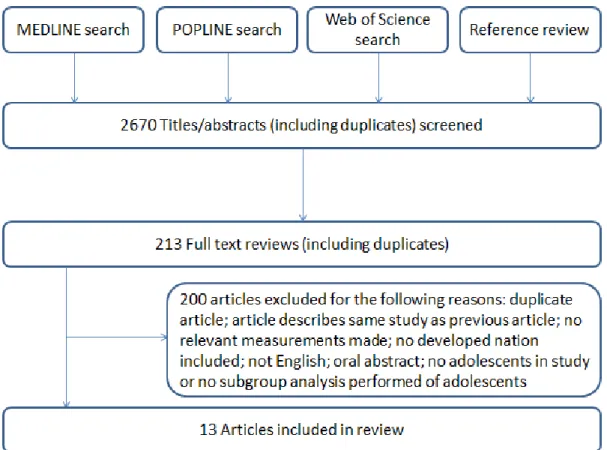
Data extraction: 2670 titles and abstracts were reviewed, of which 213 were given full text
reviews. 13 studies were included in the final review.
Study selection: Studies were given relative weight based on the type of study and their
strength of internal and external validity
Data synthesis: The data are mixed for all three primary outcomes of the review with a large
amount of heterogeneity in types of devices used. More and higher quality studies are needed
to determine the effective rates as compared to other contraceptive interventions.
2
Teenage pregnancy has many negative consequences to health and society in the
United States. Recent declines in teenage pregnancy and birth have most likely been due to an
increase in the use of contraception by teenagers. Long-acting reversible contraception, such
as that provided by the copper and progesterone-secreting intrauterine devices (IUDs), is likely
the most effective solution for contraception, but these methods have not been adequately
studied in the teenage population.
INTRODUCTION
1.
Teenage Pregnancy in the United States
Teenage pregnancy has serious personal and societal consequences. With more than
half of teenagers in the United States who become pregnant giving birth, this represents a
substantial number of births: 435,436 in 2006.
1A population-based cohort study found that
teenage mothers compared to those who become mothers later in life have an increased risk of
premature death in later life independent of socio-economic status (rate ratio 1.6), meaning
that reduction of teenage pregnancy and thus birthrate could have a significant positive
influence on women’s health well beyond the teenage years.
2The children of teenage mothers are also at risk of negative health outcomes compared
to children born to older mothers. Teenage pregnancy is independently associated with worse
fetal outcomes, including preterm delivery, low birth weight, and neonatal mortality.
3Teenage
mothers are more likely to have a diet deficient in micronutrients (such as iron), which may
explain the increased incidence of small for gestational age infants in children born to teenage
mothers.
43
born as result of a teenage pregnancy leads to worse outcomes in adults in various facets of
health, education, inactivity, and earnings.
5Despite recent decreases, teenage pregnancy and birth remains a serious problem in
the United States. The teenage pregnancy rate (women ages 15-19) reached a peak of 116.9
per 1,000 women in 1990 and steadily declined through 2005 to 69.5 per 1,000, which
represents the lowest rate in over 30 years. However, in 2006 (the last year for which finalized
data are available), this increased to 71.5 per 1,000.
1Preliminary data for the rate of birth to
teenage mothers are available through the year 2009, and they show a similar trend to
pregnancy, with a peak of 61.8 births per 1,000 in 1991 and a decrease through 2005. There
was a slight increase through 2006-2007, but this was reversed in 2008 and 2009, with 2009
having a rate of 39.1 per 1,000 women.
6These encouraging trends belie the fact that the
United States still has a higher pregnancy and birth rate than those of all European nations,
including former Soviet bloc nations.
7The National Survey of Family Growth (administered by the National Center for Health
Statistics) periodically conducts a nationally representative survey of women ages 15-44. As
part of this survey, respondents are asked questions to determine whether each of their
pregnancies had been intended or unintended. Pregnancies are classified as unintended if they
are either mistimed (the woman would have liked to become pregnant in the future, but did
not desire pregnancy at that point) or unwanted (the woman did not desire pregnancy at that
time or in the future). Pregnancies about which women were indifferent are classified as
4
and Henshaw estimated that one fifth of all unintended pregnancies in the United States are to
teenagers, and 82% of all teenage pregnancies are unintended.
8It must be noted that relative statistics such as the proportion of pregnancies which are
unintended can be misleading. For example if the intended pregnancy rate suddenly rose
without a change in the unintended pregnancy rate, the proportion of unintended pregnancies
would suddenly drop, without a change in the absolute number. The data used by Finer and
Henshaw shows that the 82% statistic may belie the fact that teenage pregnancy rates are
decreasing for both unintended (from 82 per 1000 to 67 per 1000 from 1994 to 2001) and
intended pregnancies (from 25 per 1000 to 15 per 1000 during the same time period).
8The
data also comes from a retrospective survey, which means that recall bias is likely to affect the
results, and in this case it may underestimate the intendedness of the pregnancy at the time of
the conception. An analysis of the 2002 National Survey for Family Growth shows that
dichotomous classification of pregnancy intendedness is not sufficient to predict pregnancy
outcomes, and a multidimensional model incorporating aspects such as timing and desire is a
much stronger predictor.
9Wantedness rather than intendedness may better correlate with
outcomes; however, dichotomous intendedness outcomes continue to be the main reported
statistic in this area of consideration.
10,11Although it is unclear how large this majority is, and unclear further how important of a
measure intendedness actually is, the fact that the majority of adolescent pregnancies are
unintended leads to the conclusion that proximal factors such as adolescent sexual behavior
5
intervention that has been popular in recent years is abstinence-only or abstinence-based sex
education in schools; however, this has proven marginally effective at best, with most studies
showing no effectiveness in decreasing adolescent pregnancy, while comprehensive sex
education has been more effective.
12This has been corroborated by an analysis of data from
the 2002 National Survey of Family Growth, which found that those reporting receiving
comprehensive sex education had a statistically significantly decreased risk of reporting
adolescent pregnancy compared to those who reported receiving abstinence-only or no sex
education, between which there was no significant difference. This was despite no significant
difference in reported vaginal intercourse.
13It must be taken into consideration that these data
are from a retrospective study and thus recall bias for all of these statistics is an important
possibility. If the association is true, however, the proximal factor likely to have had the largest
effect on decreasing pregnancy rates is contraception, as reporting of vaginal intercourse was
not significantly affected by a report of either intervention.
2.
Contraceptives
According to analyses of data from the 1995 and 2002 National Survey of Family Growth
by Santelli, et al., the recent decline in teenage pregnancy and births is 86% attributable to
increased use of contraceptive use, with the rest of the decline attributable to a decrease in
sexual activity, mostly among women ages 15-17.
14,15The slight increase in teen pregnancy and
birth rates in 2006 and 2007 was accompanied by a slight decrease in use of contraception as
measured by the Youth Risk Behavior Survey in those years, with no significant change in sexual
6
teen pregnancy and birth rates.
15The disparity between teenage pregnancy rates in the United
States and Europe is also explained by a difference in the rate of contraceptive use.
15Like the
decreases in teen pregnancy and birth rate in the United States, the decreases in Europe cannot
be explained by a decrease in sexual activity; in fact, the age at sexual initiation has decreased
in both the United States and Europe during the same time period.
16Thus, contraception is
likely the best choice for a proximal intervention to prevent teenage pregnancy and birth, given
its crucial role in recent decreases in the teen pregnancy and birth rate.
The 1960s saw the development of two radical and effective methods of birth control.
In 1960, the FDA allowed the makers of Enovid (an oral combination of an estrogen and a
progesterone) to market on its contraceptive claims after three years of indication only for
gynecological disorders.
17In the early 1960s, Gynekoil was introduced as the first
mass-produced intrauterine device (IUD) in the United States, and since that time 8 other IUDs have
entered the market.
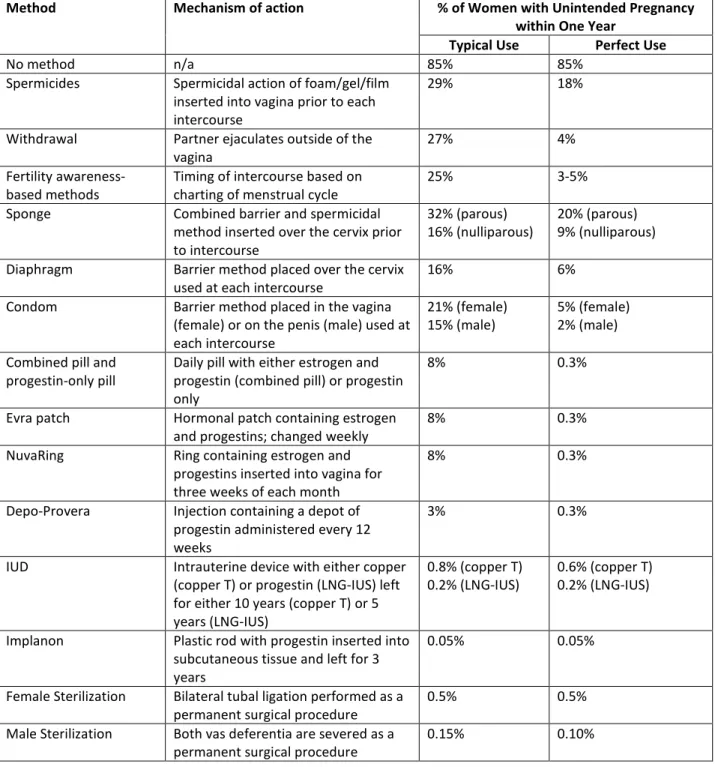
18Since the 1960s, many hormonal and non-hormonal birth control
methods have been added to the market; a summary of these methods as well as their typical
7
Table 1. Methods of contraception currently available in the United States.
19Method Mechanism of action % of Women with Unintended Pregnancy
within One Year
Typical Use Perfect Use
No method n/a 85% 85%
Spermicides Spermicidal action of foam/gel/film inserted into vagina prior to each intercourse
29% 18%
Withdrawal Partner ejaculates outside of the vagina
27% 4%
Fertility awareness-based methods
Timing of intercourse based on charting of menstrual cycle
25% 3-5%
Sponge Combined barrier and spermicidal method inserted over the cervix prior to intercourse
32% (parous) 16% (nulliparous)
20% (parous) 9% (nulliparous) Diaphragm Barrier method placed over the cervix
used at each intercourse
16% 6%
Condom Barrier method placed in the vagina (female) or on the penis (male) used at each intercourse
21% (female) 15% (male)
5% (female) 2% (male) Combined pill and
progestin-only pill
Daily pill with either estrogen and progestin (combined pill) or progestin only
8% 0.3%
Evra patch Hormonal patch containing estrogen and progestins; changed weekly
8% 0.3%
NuvaRing Ring containing estrogen and progestins inserted into vagina for three weeks of each month
8% 0.3%
Depo-Provera Injection containing a depot of progestin administered every 12 weeks
3% 0.3%
IUD Intrauterine device with either copper (copper T) or progestin (LNG-IUS) left for either 10 years (copper T) or 5 years (LNG-IUS)
0.8% (copper T) 0.2% (LNG-IUS)
0.6% (copper T) 0.2% (LNG-IUS)
Implanon Plastic rod with progestin inserted into subcutaneous tissue and left for 3 years
0.05% 0.05%
Female Sterilization Bilateral tubal ligation performed as a permanent surgical procedure
0.5% 0.5%
Male Sterilization Both vas deferentia are severed as a permanent surgical procedure
8
Of the many methods of contraception available, there are currently only two IUDs on the
market in the United States: a copper-containing IUD, or copper T380A and a
progesterone-secreting IUD, or LNG-IUS.
3.
IUDs Currently on the Market in the United States
Based on a systematic review of the literature on contraceptive failure, these methods
are highly effective, with a failure rate of 0.8% for the copper T and 0.2% for LNG-IUS in the first
year under typical use; with perfect use, the failure rate for the copper T is 0.6%.
20The fact that
there is little difference in failure rates between perfect and typical use underlines the fact that
IUDs have the advantage of not requiring patient action each day, and not surprisingly, thus
prove more effective than typical use of combined oral contraceptive pills (OCPs), which have a
failure rate of 8% with typical use, and 0.3% with perfect use.
20,21As well as the advantage of
being “forgettable” (i.e. requiring no patient action in normal use) LNG-IUS may also hold an
advantage over OCPs in terms of continuation. A trial that randomized nulliparous women ages
18-25 to either OCPs or LNG-IUS found that the continuation rate at one year was higher for
LNG-IUS than OCPs, with 20% of women discontinuing that IUD and 27% of women
discontinuing the OCPs.
22A larger prospective cohort study (Contraceptive CHOICE) has found
that among women given a choice of free contraceptive methods, those who chose the IUDs
had the highest continuation rates (88% for LNG-IUS, 84% for copper T), as well as higher
satisfaction compared to OCPs (54% of OCP users were satisfied).
23Although it is beyond the immediate scope of this review, IUDs also confer
9
pain, and heavy menstrual bleeding, and it has been shown to decrease the risk of endometrial
cancer.
24The copper-T shows promise as an emergency contraception technique that uniquely
continues to provide contraceptive benefit, with a failure rate of 0.09% found by a systematic
review of non-randomized studies.
25In Europe as in the United States, the dominant method of long-acting reversible
contraception is the IUD. All Western European nations, however, have much higher overall
rates of use, with a full 27% of women using contraception in Norway utilizing an IUD, the
highest proportion of any nation.
26This difference in IUD use between the United States and
Western Europe may be partly because provider and public attitudes in the United States
towards the IUD as birth control were negatively affected by the Dalkon Shield, an aberrant
device in the 1970s that caused septic miscarriages and was subsequently removed from the
market.
26After the Dalkon Shield entered and quickly exited the market, the rate of IUD use
among women in the United States dropped precipitously from a high of nearly 10% of all
contraceptive users in the early 1970s to a low of 1% of all contraceptive users in 1995, which
represented the lowest rate of use in any developed nation at that time.
27,28Since that time,
there has been an increase in long-acting reversible contraception (LARC) to 5.5% of all
contraceptive users in 2006-2008, most of which is due to increased use of IUDs, and
particularly LNG-IUS.
27This increase was most pronounced in women younger than 24 and
older than 35. Additionally, those who had first intercourse at age 17 or younger experienced
10
4.
Summary
In the Contraceptive CHOICE trial, more than 60% of adolescents (69% of participants
14-17 and 61% of participants 18-20) chose long acting reversible contraception (including both
IUDs and implantable hormonal birth control) when given a full range of contraceptive
options.
29A study that compared patient satisfaction with IUDs to patient satisfaction with
implantable hormonal birth control found that at six months, more women were satisfied with
the IUD than with the implantable hormonal birth control.
30Despite the popularity of the IUD
when presented as an option, a survey of adolescents and young women found that only 45.4%
had heard of the IUD, and a survey of primary care obstetrician-gynecologists found that only
18% “always” presented the IUD when discussing options for contraception.
31,32While the
American Congress of Obstetricians and Gynecologists has issued a Committee Opinion that
agrees with the World Health Organization’s assessment that IUDs are an appropriate choice of
contraceptive for adolescents, the most recent systematic review of available data (including
studies through 2008) shows that the existing literature was promising but insufficient to
confirm this stance.
33,34Thus, we need a current systematic review of the important clinical
question: are IUDs an appropriate option for first-line contraception for adolescents in the
11
METHODS
1.
Clinical Question
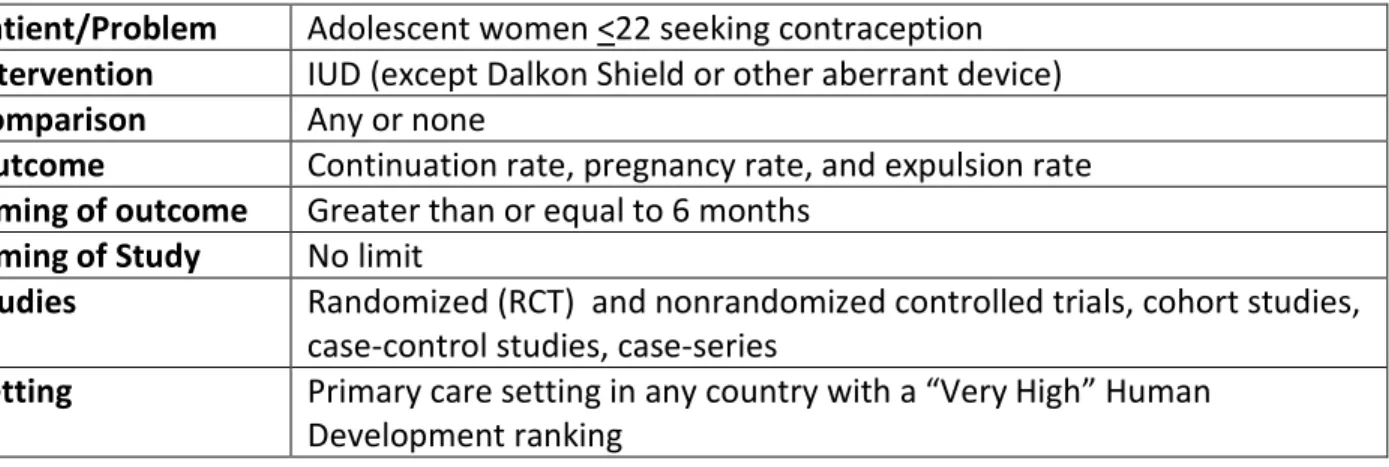
The focused clinical question that this paper will address is: “Are IUDs an appropriate
option for first-line contraception for adolescents in the United States?” For the purposes of
this systematic review, IUDs will exclude the Dalkon shield as an aberrant device. The
comparison was initially to be made to condoms and OCPs, as these are, respectively, the most
used and second most used contraceptives by adolescents in the United States.
35However, this
stipulation was abandoned based on the initial lack of appropriate studies in the literature
search. Appropriateness will be based on continuation rate, pregnancy rate, and expulsion
rate. Adolescents will be defined as females who are 18 years of age or younger.
Table 2. PICOTS Table of the Clinical Question for this Systematic Review.
Patient/Problem
Adolescent women <22 seeking contraception
Intervention
IUD (except Dalkon Shield or other aberrant device)
Comparison
Any or none
Outcome
Continuation rate, pregnancy rate, and expulsion rate
Timing of outcome
Greater than or equal to 6 months
Timing of Study
No limit
Studies
Randomized (RCT) and nonrandomized controlled trials, cohort studies,
case-control studies, case-series
Setting
Primary care setting in any country with a “Very High” Human
Development ranking
This review originally considered adolescence to be between the ages of 10-21, which is
the definition typically accepted in pediatrics.
36However, one study found during the literature
review would have been acceptable other than the inclusion of women up to age 22, and the
12
with the method of contraception, as satisfaction mirrors continuation rate, and continuation
rate is a more objective measure and thus more likely to be reported and quantified.
37This
review will not consider the outcome of pelvic inflammatory disease (PID) since PID is rare in
the United States even in high risk populations receiving IUDs as found by a meta-analysis that
examined the use of antibiotics in preventing PID as well as an earlier systematic review
exploring the association between IUD insertion and PID.
38,39Additionally, a previous
systematic review has shown that while women with a sexually transmitted infection (STI) at
the time of IUD insertion have an increased risk of PID in comparison to women without a STI at
the time of IUD insertion, it is unclear whether this represents a risk in IUD insertion itself or an
increased background risk for women with STIs.
39,40This review will not consider the effect of
parity on IUDs in adolescents, instead focusing on the problem of IUDs in adolescents
in toto
.
2.
Eligibility Criteria
This review included English language studies with the goal of examining pregnancy rate
and/or birth control continuation rate and/or IUD expulsion rate in women 21 or younger as
compared to OCPs or condoms (for pregnancy rate and continuation rate). Also included were
studies with a subgroup analysis of a subgroup that is within the definition of an adolescent as
being from ages 10-22. The followup period needed to be at least 6 months. Studies
conducted at any time were included. To maximize the number of results, no stipulation was
made concerning the type of IUD, save that it was not the Dalkon Shield or other aberrant
device, as a previous review found no studies of the devices currently in use in the United
States.
3413
States, at least one of the study settings must be a similarly developed nation. Developed
nations for this review will be defined as those on the list of the United Nations’ list of countries
with a “Very High” rating of Human Development as of 2010, based on the Human
Development Index which takes into account health, education, and living standards.
41Box 1
outlines the 43 nations that are included in this definition.
Box 1. Nations with a Very High Human Development Rating.
41•
Norway
•
Australia
•
New Zealand
•
United States
•
Ireland
Liechtenstein
•
Netherlands
•
Canada
•
Sweden
•
Germany
•
Japan
•
Korea,
Republic of
•
Switzerland
•
France
•
Israel
•
Finland
•
Iceland
•
Belgium
•
Denmark
•
Spain
•
Hong Kong,
China
(SAR)
•
Greece
•
Italy
•
Luxembourg
•
Austria
•
United
Kingdom
•
Singapore
•
Czech Republic
•
Slovenia
•
Andorra
•
Slovakia
•
United Arab
Emirates
•
Malta
•
Estonia
•
Cyprus
•
Hungary
•
Brunei
Darussalam
•
Qatar
•
Bahrain
•
Portugal
•
Poland
•
Barbados
3.
Search Strategy
The author searched PubMed, ISI Web of Science, and Popline to find relevant studies. All
searches were designed to broadly capture any article with relevance to IUDs and adolescents.
The PubMed search involved the use of Medical Subject Heading (MeSH) terms to include any
documents that had been indexed under “Intrauterine Devices,” which includes both
medicated and copper devices, as well as “Adolescent” or “Young Adult”, which includes the
14
terms which could be construed as fitting either IUD or adolescent in order to include articles
that had not been indexed to the appropriate MeSH term. The ISI Web of Science and Popline
searches both used a similar spectrum of terms. The PubMed, ISI Web of Science, and Popline
searches yielded 1852, 278, and 497 records, respectively. In addition to this search strategy,
the bibliography of the only previous systematic review of this topic in the literature was
examined. This article included 43 citations. The actual strategies and results are shown in
table 3.
Table 3. Search Strategies and Results.
Source Search Strategy Records* Full Text
Reviewed*
Met Criteria*
PubMed MEDLINE (Limits activated: English)
("Intrauterine Devices"[Mesh] OR IUD OR IUCD OR IUS OR intrauterine contracepti* OR intrauterine system* OR intrauterine device*) AND
("Adolescent"[Mesh] OR "Students"[Mesh] OR "Young Adult"[Mesh] OR adolescen* OR student* OR teen* OR youth)
1852 162 14
ISI Web of Science
(IUD* OR IUS OR IUCD* OR
intrauterine device* OR intrauterine system* OR intrauterine contracepti*) AND (adolescen* OR youth OR
student* OR teen*)
278 24 8
Popline (IUD*/IUS/IUCD*/intrauterine device*/intrauterine
contracepti*/intrauterine system*) & (adolescen*/teen*/youth/student*)
497 14 4
Deans and Grimes. “Intrauterine devices for adolescents: a systematic review”
Bibliography review 43 13 7
15
4.
Quality Criteria
The original intent of the review was to exclude case studies, case series, and, case-control
studies in favor of controlled trials and cohort studies, since cohort studies provide a greater
level of evidence (Level 3; Level 2 if the study is well-conducted and demonstrates a dramatic
effect) than do case-control studies (Level 4) according to Oxford’s Centre for Evidence Based
Medicine (OCEBM).
42The levels of evidence for treatment benefits and harms according to
OCEBM are illustrated in table 3. However, due to the relative dearth of the literature on this
subject, descriptive studies were included in the review.
Table 3: Levels of Evidence for Treatment Benefits and Treatment Harms.
42Treatment Benefits Treatment Harms
Common Rare
Level 1 Systematic review of randomized trials or n-of-1 trials
Systematic review of randomized trials,
systematic review of nested case-control studies, n-of-1 trial with the patient you are raising the question about, or observational study with dramatic effect
Systematic review of randomized trials or n-of-1 trial
Level 2 Randomized trial or observational study with dramatic effect
Individual randomized trial or (exceptionally)
observational study with dramatic effect
Randomized trial or
(exceptionally observational study with dramatic effect
Level 3 Non-randomized controlled cohort/follow-up study
Non-randomized controlled cohort/follow-up study (post-marketing) surveillance) provided there are sufficient numbers to rule out a common harm (for long-term harms the duration of follow-up must be sufficient)
Level 4 Case-series, case-control studies, or historically controlled studies
Case-series, case-control, or historically controlled studies
16
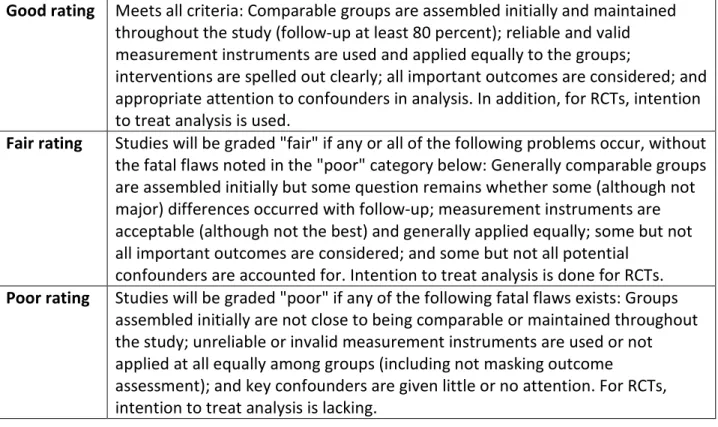
This review used the United States Preventive Services Task Force’s (USPSTF) guidelines for
assessing the internal validity of all comparative studies. The criteria used for the guidelines are
specific to each study type, with randomized controlled trials and cohort studies having nearly
identical criteria except for those which account for their mechanistic differences. A study
received a rating of “good” if it met all criteria and maintained appropriate follow-up, “fair” if it
had any of the problems listed in Table 4 but no flaw fatal enough to invalidate the results, or
“poor” if there were flaws in the study that were fatal enough to invalidate the results.
43The
criteria and the rating system are outlined in box 2 and table 5. The internal validity of the
case-series was also assessed along a good/fair/poor gradient based on author’s judgment, as
there are no specific USPSTF criteria for case-series since no comparison is being made.
Box 2: USPSTF Minimal Criteria for Randomized Controlled Trials and Cohort Studies.
43•
Initial assembly of comparable groups:
o
For RCTs: adequate randomization, including first concealment and whether
potential confounders were distributed equally among groups.
o
For cohort studies: consideration of potential confounders with either restriction
or measurement for adjustment in the analysis; consideration of inception
cohorts
•
Maintenance of comparable groups (includes attrition, cross-overs, adherence,
contamination).
•
Important differential loss to follow-up or overall high loss to follow-up
•
Measurements: equal, reliable, and valid (includes masking of outcome assessment).
•
Clear definition of interventions.
•
All important outcomes considered.
•
Analysis: adjustment for potential confounders for cohort studies, or intention to treat
17
Table 5: USPSTF Internal Validity Ratings for RCTs and Cohort Studies.
43Good rating
Meets all criteria: Comparable groups are assembled initially and maintained
throughout the study (follow-up at least 80 percent); reliable and valid
measurement instruments are used and applied equally to the groups;
interventions are spelled out clearly; all important outcomes are considered; and
appropriate attention to confounders in analysis. In addition, for RCTs, intention
to treat analysis is used.
Fair rating
Studies will be graded "fair" if any or all of the following problems occur, without
the fatal flaws noted in the "poor" category below: Generally comparable groups
are assembled initially but some question remains whether some (although not
major) differences occurred with follow-up; measurement instruments are
acceptable (although not the best) and generally applied equally; some but not
all important outcomes are considered; and some but not all potential
confounders are accounted for. Intention to treat analysis is done for RCTs.
Poor rating
Studies will be graded "poor" if any of the following fatal flaws exists: Groups
assembled initially are not close to being comparable or maintained throughout
the study; unreliable or invalid measurement instruments are used or not
applied at all equally among groups (including not masking outcome
assessment); and key confounders are given little or no attention. For RCTs,
intention to treat analysis is lacking.
In addition to considering internal validity, the review also assessed the external validity
of the studies using the USPSTF’s criteria for generalizability and criteria for assessing external
validity.
44The external validity of all included studies was assessed as compared to the source
population in the United States. A study received a rating of “good” if it minimally differed
from the generalizability requirements with regards to the study’s population, situation, and
providers. A study received a rating of “fair” if it moderately differed from the generalizability
requirements with regards to the study’s population, situation, and providers. A study received
a rating of “poor” if it majorly differed from the generalizability requirements with regards to
the study’s population, situation, and providers. Table 6 illustrates the USPSTF ratings system
18
Table 6: USPSTF External Validity Ratings.
44Good
The study differs minimally from the US primary care population/situation/providers
and only in ways that are unlikely to affect the outcome; it is highly probable (>90%)
that the clinical experience with the intervention observed in the study will be attained
in the US primary care setting.
Fair
The study differs from the US primary care population/situation/providers in a few ways
that have the potential to affect the outcome in a clinically important way; it is only
moderately probable (50-89%) that the clinical experience with the intervention in the
study will be attained in the US primary care setting
Poor
The study differs from the US primary care population/situation/providers in many
ways that have a high likelihood of affecting the clinical outcomes; the probability is low
(<50%) that the clinical experience with the intervention observed in the study will be
attained in the US primary care setting.
5.
Study Selection
The titles and abstracts of the articles identified through the search strategy were reviewed
by the author. If it was absolutely clear from the title and/or abstract that the given article met
exclusion criteria, the article was discarded; every effort was made for a sensitive rather than a
specific approach to abstract and title review. The articles that remained after this exclusion
process were given a full text review. Articles in which full text review did not reveal any
exclusion criteria were included in the abstraction process for systematic review.
6.
Abstraction Process
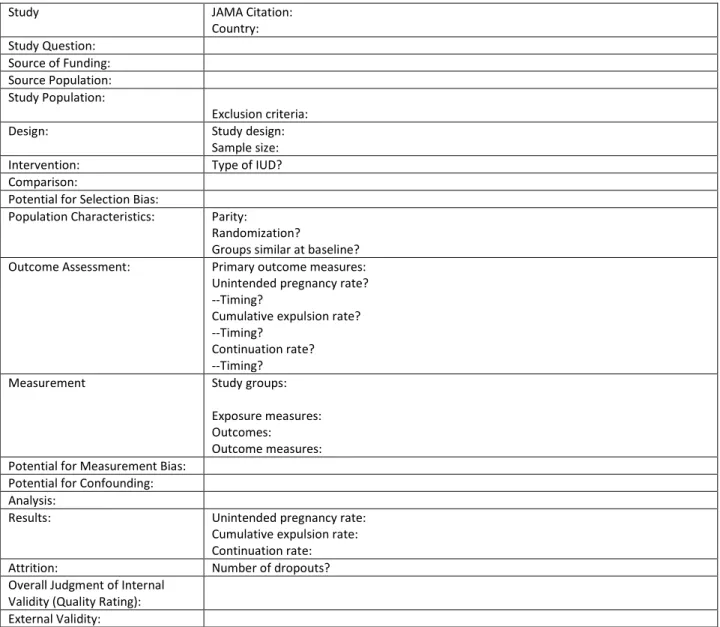
The author performed the data abstraction solely for the articles that were selected for the
systematic review after full text review using a standard form for each study. The following
information was extracted for each study: general information (including citation and country
19
intervention, comparison, potential for selection bias, population characteristics (including
randomization and group similarity), outcome assessment, measurement, potential for
measurement bias, potential for confounding, type of analysis, results, attrition (number of
dropouts), overall judgment of internal validity, and external validity. Table 7 illustrates the
standard data extraction form used.
Table 7. Example Data Extraction Form.
Study JAMA Citation:
Country: Study Question:
Source of Funding: Source Population: Study Population:
Exclusion criteria: Design: Study design:
Sample size: Intervention: Type of IUD? Comparison:
Potential for Selection Bias:
Population Characteristics: Parity:
Randomization?
Groups similar at baseline? Outcome Assessment: Primary outcome measures:
Unintended pregnancy rate? --Timing?
Cumulative expulsion rate? --Timing?
Continuation rate? --Timing?
Measurement Study groups:
Exposure measures: Outcomes:
Outcome measures: Potential for Measurement Bias:
Potential for Confounding: Analysis:
Results: Unintended pregnancy rate: Cumulative expulsion rate: Continuation rate: Attrition: Number of dropouts? Overall Judgment of Internal
20
7.
Synthesis of Evidence
As this review assesses a topic on which the vast majority of the literature is
non-randomized and focused on a very heterogeneous group of devices which are not currently in
use in the United States, a meta-analysis based on pooled data is not appropriate at this time.
The evidence extracted from each study will be entered into template with a narrative
interpretation of the results for each study. An example of the template is shown in table 8.
The templates will then be combined into a single table, and the overall evidence profile of all
studies will be performed for each of the primary outcomes for this review: pregnancy rate,
expulsion rate, and continuation rate. In synthesizing the final results for the review, attention
will be paid to the results of the studies, as well as their respective size, type, and quality.
Table 8. Template for Synthesis of Studies.
Citation
Number of
participants
Ages
Parity Internal
Validity
External
Validity
IUDs
used
21
RESULTS
1.
Study Selection
A total of 2670 title/abstract combinations were reviewed based on the results of the
literature search. Of these 2670 articles, 213 underwent full text review. Of the 213 which
underwent full text review, 13 met the final inclusion criteria for the systematic review. Of
these 13, there were 5 cohort studies, 6 case-series, 1 randomized controlled trial, and 1
synthesis of pooled data from multiple trials, Figure 1 illustrates the flow of information
through the phases of the review, and summarizes the reasons for exclusion based on full text
review.
22
Studies were reviewed in alphabetical order by first author last name. Full data
extraction tables are included in Appendix A.
Study 1
Citation
Behringer T, Reeves MF, Rossiter B, Chen BA, Schwarz EB. Duration of
use of a levonorgestrel IUS amongst nulliparous and adolescent
women.
Contraception
. 2011;84(5):e5-e10.
Study Design
Retrospective cohort
Study population
(number, ages,
parity)
131 adolescents, ages 14-20, 18.3% nulliparous
697 adult women ages 21-50, 11.5% nulliparous
Length of follow-up
36 months
IUDs used
LNG-IUS
Internal validity
Fair
External validity
Fair
Results:
Pregnancy rate:
Expulsion rate:
Continuation rate
Not measured
9.9% at 36 months
80.9% at 36 months
The Behringer et al. study, “Duration of use of a levonorgestrel IUS amongst nulliparous
and adolescent women” is a retrospective cohort published in
Contraception
in 2011.
Participants were selected by retrospective chart review of women aged 14-50 years old seen in
an academic clinic in Pittsburgh, PA and receiving an LNG-IUS for contraception, dysmenorrhea,
or menorrhagia between June 2005 and April 2008. In this study, women from 14-20 were
considered to be adolescents. There were 131 adolescents, of which 18.3% were nulliparous.
The clinical outcomes of adolescents and adults were compared, as were the clinical outcomes
23
The internal validity of the study was deemed to be “fair” based on the moderate
potential for selection bias and confounding, and low to moderate potential for measurement
bias. The external validity of the study was deemed to be “fair” as it was not clear that the
source population is highly comparable to the primary care population of the United States.
Although adolescents had a non-statistically significant higher expulsion rate (9.9% vs. 5.4%),
the adolescent group was found to have no statistically significant difference in expulsion rate
or continuation rate at 36 months as compared to adult women (aged 21-50) based on hazard
ratios which controlled for confounders.
Study 2
Citation
Godfrey EM, Memmel LM, Neustadt A, et al. Intrauterine contraception
for adolescents aged 14-18 years: A multicenter randomized pilot study
of levonorgestrel-releasing intrauterine system compared to the
copper T 380A.
Contraception
. 2010;81(2):123-127.
Study Design
Randomized controlled trial
Study population
(number, ages,
parity)
23 women, ages 14-18, 12 nulliparous
Length of follow-up
6 months
IUDs used
Copper-T380A (11 participants), LNG-IUS (12 participants)
Internal validity
Fair
External validity
Fair
Results:
Pregnancy rate:
Expulsion rate:
Continuation rate
N = 0 in LNG-IUS, N = 1 in copper-T380A at 6 months
N = 0 in LNG-IUS, N = 2 in copper-T380A at 6 months
75% (N = 9 of 12) in LNG-IUS, 45% (N = 5 of 11) in copper-T380A
The Godfrey et al. study “Intrauterine contraception for adolescents aged 14-18 years: A
multicenter randomized pilot study of levonorgestrel-releasing intrauterine system compared
24
2010. Participants were selected from patients seen in an academic family planning and family
medicine clinic in Chicago. Of the 37 approached, 23 were eligible and randomized to either
LNG-IUS (12 patients) or copper-T 380A (11 patients). The patients were blinded to the
intervention, but the investigators and study coordinators were not. The clinical outcomes of
the two groups were compared.
46The internal validity of this study was deemed to be “fair” based on the moderate to low
potential for selection bias, measurement bias, and confounding. The external validity of this
study was deemed to be “fair” based on the fact that although the study population likely was
characteristic of the United States primary care population, the study size was too small to be
able to draw definitive conclusions. The study found no statistically significant difference in
pregnancy rate, cumulative expulsion rate, or continuation rate at 6 months between users of
the LNG-IUS and users of the copper T 380A.
Study 3
Citation
Goldman JA, Dekel A, Reichman J. Immediate postabortion intrauterine
contraception in nulliparous adolescents.
Isr J Med Sci
. 1979;15(6):522.
Study Design
Prospective cohort
Study population
(number, ages,
parity)
162 women, ages 13-18, all nulliparous (126 primigravid, 36
multigravid)
Length of follow-up
12 months
IUDs used
Lippes loop A, copper-7, copper-T
Internal validity
Poor
External validity
Poor
Results:
Pregnancy rate:
Expulsion rate:
Continuation rate
25
The Goldman et al. study “Immediate postabortion intrauterine contraception in
nulliparous adolescents” was published in the
Israeli Journal of Medical Science
in 1979. In this
prospective cohort study, 300 pregnant teenagers (ages 13-18) referred for abortion were
offered immediate postabortion intrauterine contraception. 162 adolescents consented to the
study. 56 were allocated to the Lippes loop A, 45 to the copper-7, and 61 to the copper-T.
Clinical outcomes of pregnancy rate, expulsion rate, and continuation rate were obtained for
both the individual devices and the overall study population.
47The internal validity of this study was deemed to be “poor” due to the high potentials
for selection bias, measurement bias, and confounding. The external validity of this study was
deemed to be “poor” due to the lack of information regarding characteristics of those who did
and did not participate in the study. The study found an unintended pregnancy rate of 3.7% at
12 months for all methods, a cumulative expulsion rate of 11.1% at 12 months for all methods,
26
Study 4
Citation
Goldman JA, Reichman J. Contraception in the teenager. A comparison of four methods of contraception in adolescent girls. Isr J Med Sci. 1980;16(7):510.Study Design
Prospective cohort
Study population
(number, ages,
parity)
160 women, ages 14-18, all nulliparous
N = 72 receiving OCPs
N = 30 receiving IUD
N = 38 advised to use condoms N = 20 receiving contraceptive foam
Length of follow-up
24 months
IUDs used
Copper-7, copper-T
Internal validity
Poor
External validity
Poor
Results:
Pregnancy rate:
Expulsion rate:
Continuation rate
N = 1 of 30 at 24 months
N = 2 of 30 at 24 months
73.3% at 24 months
The Goldman and Reichman study “Contraception in the teenager. A comparison of four
methods of contraception in adolescent girls” is a prospective cohort study published in the
Israeli Journal of Medical Science
in 1980. Participants were selected from women aged 14-18
“of high socioeconomic standing” who were referred to a clinic or private practitioner by their
parents or school nurse following request for contraception. 160 adolescents were enrolled,
and given access to and counseling on four contraceptive methods: OCPs., IUD, condoms, and
contraceptive foam. 72 chose OCPs, 30 chose IUDs, 38 chose condoms, and 20 chose
contraceptive foam. Clinical outcomes at 24 months were then compared amongst the
groups.
48The internal validity of this study was deemed “poor” due to high potential for selection
27
unclear exactly what characteristics were of the source population, and how participants were
selected from the source population. The study found 1 unintended pregnancy (of 30
participants receiving IUD) at 24 months, compared to 0 (of 72) for OCPs, 2 (of 38) for condoms,
and 1 (of 20) for foam. There were 2 expulsions (of 30 receiving the IUD) of the IUD at 24
months. There was a continuation rate of 73.3% at 24 months for IUDs, compared to 72% for
OCPs, 78.9% for condoms, and 15.8% for contraceptive foam.
Study 5
Citation
Hirvonen E, Kaivola S. A new copper IUD (Fincoid) in adolescent and young nulliparous women. Contracept Deliv Syst. 1983;4:149.Study Design
Case-series
Study population
(number, ages,
parity)
241 women, ages 15-21, all nulliparous
Length of follow-up
12 months
IUDs used
Fincoid
Internal validity
Poor
External validity
Poor
Results:
Pregnancy rate:
Expulsion rate:
Continuation rate
4.2 per 100 women at 12 months
1.9 per 100 women at 12 months
73.1% at 12 months
.The Hirvonen and Kaivola study “A new copper IUD (Fincoid) in adolescent and young
nulliparous women” is a case-series published in
Contraceptive Delivery Systems
in 1983. 241
adolescents aged 15-21 were recruited from adolescents seeking contraception at an
outpatient clinic in Helsinki in whom OCPs had caused side-effects or were contraindicated.
The study participants received the Fincoid IUD, and clinical outcomes were assessed after 12
28
The internal validity of this study was deemed “poor” due to the high potential for
selection bias, and measurement bias. The external validity of this study was deemed “poor”
due to the lack of information about the source population. The unintended pregnancy rate
was 4.2 per 100 women at 12 months, the cumulative expulsion rate was 1.9 per 100 women at
12 months, and the continuation rate was 73.1% at 12 months.
Study 6
Citation
Jorgensen V. One-year contraceptive follow-up of adolescent patients. Am J Obstet Gynecol. 1973;115(4):484.Study Design
Prospective cohort
Study population
(number, ages,
parity)
184 women, ages 11-17, all parous
N = 90 selecting OCPsN = 82 selecting IUD N = 2 selecting diaphragm
Length of follow-up
12 months
IUDs used
Lippes loop, copper-T
Internal validity
Poor
External validity
Poor
Results:
Pregnancy rate:
Expulsion rate:
Continuation rate
5 of 184 at 12 months (all methods)
5 of 82 IUDs at 12 months
88% for IUD
The Jorgensen study “One-year contraceptive follow-up of adolescent patients” is a
prospective cohort study published in the
American Journal of Obstetrics and Gynecology
in
1973. 221 “high risk” postpartum women seen in an adolescent obstetrics and gynecology
clinic were assessed for eligibility, and 213 were given 5 weeks of OCPs for the interim between
discharge and 5 week follow-up. At the 5 week follow-up, 184 returned to clinic and selected
29
The internal validity of this study was deemed “poor” due to moderate to high potential
for selection bias and measurement bias and high potential for confounding. The external
validity of this study was deemed “poor” due to the lack of information concerning the source
population. There were 5 overall pregnancies in the study group at 12 months (of 184
participants using all methods). The cumulative expulsion was 5 (of 82 IUD users) at 12 months,
and the continuation rate was 88% for IUDs vs. 70% for OCPs at 12 months.
Study 7
Citation
Kulig JW, Rauh JL, Burket RL, Cabot HM, Brookman RR. Experience with the copper 7 intrauterine device in an adolescent population. J Pediatr.1980;96(4):746.
Study Design
Case-series
Study population
(number, ages,
parity)
120 participants, ages 13-22, 81% nulliparous
Length of follow-up
36 months
IUDs used
Copper-7
Internal validity
Poor
External validity
Fair
Results:
Pregnancy rate:
Expulsion rate:
Continuation rate
3 of 120 at 36 months (2.0 per 100 woman-years of IUD insertion)
18% expulsion rate at 36 months
39% continuation rate at 36 months
The Kulig et al. study “Experience with the copper 7 intrauterine device in an adolescent
population” is a case-series published in the
Journal of Pediatrics
in 1980. Participants were
selected from adolescent patients seen in the Cincinnati Adolescent Clinic choosing an IUD for
contraception from 7/1974 to 6/1978. There were 120 participants, all of whom received the
30
The internal validity of this study was deemed “poor” due to moderate to high potential
for selection bias and measurement bias. The external validity of this study was deemed “fair”
since the sample was likely broadly representative of the U.S. primary care population. The
study found that n = 3 of 120 had an unintended pregnancy at 36 months, that the cumulative
expulsion rate was 18% at 36 months, and that the continuation rate was 39% at 36 months.
Study 8
Citation
Lane ME, Sobrero AJ. Experience with intrauterine contraception by adolescent women. Mt Sinai J Med. 1975;42(4):337.Study Design
Case-series
Study population
(number, ages,
parity)
101 patients, ages 13-19, 96% nullilparous
Length of follow-up
9 months
IUDs used
Loop C, Loop D, LEM, W
Internal validity
Fair
External validity
Poor
Results:
Pregnancy rate:
Expulsion rate:
Continuation rate
N = 4 at 9 months
N = 21 at 9 months
73.2% at 9 months
The Lane and Sobrero study “Experience with intrauterine contraception by adolescent
women” is a case-series published in the
Mount Sinai Journal of Medicine
in 1975. Of 399
adolescent patients aged 13-19 seen at the Margaret Sanger Teen Center from
3/1971-12/1972, 101 selected the IUD as their contraceptive method. The patients were fitted with
one of four devices: either Loop C (N = 44), Loop D (N = 1), LEM (N = 54), or W (N = 2). The
31
The internal validity of the study was deemed “fair” due to a low number of dropouts,
as well as a moderate potential for measurement bias and moderate potential for selection
bias. The external validity of the study was deemed “poor” because of a lack of information
about the source population and how it relates to the U.S. primary care population. The study
found N = 4 (of 101) unintended pregnancies at 9 months, an N = 21 (of 101) expulsions at 9
months, and a continuation rate of 73.2% at 9 months.
Study 9
Citation
Larsson B, Hagström B, Viberg L, Hamberger L. Long-term clinical experience with the Cu-7-IUD. Evaluation of a prospective study. Contraception.1981;23(4).
Study Design
Prospective cohort
Study population
(number, ages,
parity)
179 women, ages 15-19
1267 women, ages 20-49
Overall parity: 59 nulliparous (unclear how this was stratified by age)
Length of follow-up
24 months
IUDs used
Copper-7
Internal validity
Poor
External validity
Poor
Results:
Pregnancy rate:
Expulsion rate:
Continuation rate
6.1% at 24 months for 15-19
12.9% at 24 months for 15-19
77.2% at 24 months for 15-19
The Larsson et al. study “Long-term clinical experience with the Cu-7-IUD. Evaluation of
a prospective study” is a prospective cohort published in
Contraception
in 1981. 1446 women
aged 15-49 receiving contraception at a private clinic in Stockholm or one of two family
planning centers in Huddinge from 1971-1979 were selected for the study, of which 179 were
adolescents aged 14-19. The participants who elected for IUDs received the copper-7 IUDs, and
32
The internal validity of the study was deemed “poor” based on the high potential for
selection bias, measurement bias, and confounding. The external validity of the study was
deemed “poor” based on the lack of information on the characteristics of the source
population. The study found a pregnancy rate of 6.1% at 24 months in those ages 15-19; this
was higher, but not statistically significantly higher than that found in those ages 20-49
(1.4-5.4%). There was a cumulative expulsion rate of 12.9% at 24 months in those ages 15-19, which
was statistically significantly higher than the expulsion rate of those ages 49 (p < 0.05 vs.
20-24 and p < 0.01 vs. 25-49). The continuation rate for those aged 15-19 was 77.2% at 20-24 months,
but was not analyzed with respect to significant differences with the other age groups.
Study 10
Citation
Patchen L, Berggren EK. Use of the copper T380A intrauterine device by adolescent mothers: Continuation and method failure J Pediatr Adolesc Gynecol. 2011;24(2):71-73.Study Design
Retrospective case-series
Study population
(number, ages,
parity)
39 women, ages 15-21, all parous
Length of follow-up
24 months
IUDs used
Copper-T 380A
Internal validity
Fair
External validity
Poor
Results:
Pregnancy rate:
Expulsion rate:
Continuation rate
10% at 24 months
15% at 24 months
39% at 24 months
The Patchen and Berggren study “Use of the copper T380A intrauterine device by
adolescent mothers: Continuation and method failure” is a retrospective case-series published
33
mothers aged 15-21 participating in a teen secondary pregnancy prevention program who had
delivered prior to age 18 were reviewed. Of these 318, 39 had a copper-T 380A IUD inserted as
a contraceptive and were included in the study; 93% were Hispanic. Outcomes at 24 months
post-insertion were determined by chart review.
54The overall judgment of internal validity was deemed “fair” because of a moderate
potential for measurement bias and a moderate potential for selection bias. The overall
judgment of external validity was deemed “poor” as the study population was small and likely
not representative of the U.S. primary care population. The study found an unintended
pregnancy rate of 10% at 24 months, a cumulative expulsion rate of 15% at 24 months, and a
continuation rate of 39% at 24 months.
Study 11
Citation
Paterson H, Ashton J, Harrison-Woolrych M. A nationwide cohort study of the use of the levonorgestrel intrauterine device in New Zealand adolescents Contraception. 2009;79(6):433-438Study Design
Retrospective case-series
Study population
(number, ages,
parity)
133 responders to questionnaire, ages 10-19, n = 114 nulligravid
Length of follow-up
12 months
IUDs used
LNG-IUS
Internal validity
Fair
External validity
Fair
Results:
Pregnancy rate:
Expulsion rate:
Continuation rate
34
The Paterson et al. study “A nationwide cohort study of the use of the levonorgestrel
intrauterine device in New Zealand adolescents” is a retrospective case-series published in
Contraception
in 2009. Despite being named a cohort study, the design was that of a
case-series as there was no comparison group. 177 adolescents 10-19 were identified as having
received the LNG-IUS through New Zealand’s Intensive Medicine Monitoring Program, and of
those, 133 were included in the study based on response to a questionnaire sent to their
provider.
55The internal validity was deemed “fair” due to a moderate potential for selection bias
and a moderate potential for measurement bias. The external validity was deemed “good” as
this study represented a broad sample of adolescents throughout a developed nation. The
study found no pregnancies in the study population, although time period for this was not
specified, and the study was not powered to assess pregnancy rate. The study found a
“cumulative incidence” of 11 expulsions in the 133 patients; however, this was not given a time
period and thus is not a true measure of incidence. The study found a continuation rate of 85%
35
Study 12
Citation
Sivin I, Stern J. Long-acting, more effective copper T IUDs: A summary of U.S. experience, 1970-75. Stud Fam Plann. 1979;10(10).Study Design
Pooled data from random assignment and cohort studies
Study population
(number, ages,
parity)
N = 706 women <20 receiving TCu 380A N = 2830 women >20 receiving TCu 380A N = 465 women <20 receiving TCu 220C N = 1385 women >20 receiving TCu 220C N = 2280 women <20 receiving TCu 200 N = 7558 women >20 receiving TCu 200
Parity for TCu 200 acceptors was 42.8%, parity for TCu 380A acceptors was 63.7%, and parity for TCu 220C acceptors was 70.3%; no information regarding parity by age group
Length of follow-up
24 months
IUDs used
Copper-T 200, copper-T 380A, copper-T 220C
Internal validity
Poor
External validity
Fair
Results:
Pregnancy rate:
Expulsion rate:
Continuation rate
For women <20:
1.0 per 100 acceptors for TCu 380A at 24 months
2.2 per 100 acceptors for TCu 220C at 24 months
6.6 per 100 acceptors for TCu 200 at 24 months
14.6 per 100 acceptors for TCu 380A at 24 months
12.6 per 100 acceptors for TCu 220C at 24 months
17.5 per 100 acceptors for TCu 200 at 24 months
Not stratified by age
The Sivin and Stern study, “Long-acting, more effective copper T IUDs: A summary of
U.S. experience, 1970-75” is an analysis of pooled data from 42 random assignment and cohort
studies that was published in
Studies in Family Planning
in 1979. This study selected studies
carried out in the U.S. (with one in Canada) on three models of copper IUDs, with the exclusion
criteria that none of the included studies have a dropout rate over 30%. These data were
stratified by multiple characteristics, including age (with a stratum of <20), and the results were
36
The internal validity of the study was deemed “poor” due to high potential for selection
bias, moderate to high potential for measurement bias, and high potential for confounding.
The external validity of the study was deemed “fair” due to the large amount of aggregate data
on thousands of women, which in sum are more likely to represent the U.S. population than
any individual study. For women <20, the 24 month rate of unintended pregnancy was 1.0 per
100 acceptors for TCu 380A, 2.2 per 100 acceptors for TCu 220C, and 6.6 per 100 acceptors for
TCu 200. Also for women <20, the 24 month rate of expulsion was 14.6 per 100 acceptors for
TCu 380A, 12.6 per 100 acceptors for TCu 220C, and 17.5 per 100 acceptors for TCu 200.
Study 13
Citation
Weiner E, Berg AA, Johansson I. Copper intrauterine contraceptive devices in adolescent nulliparae. Br J Obstet Gynaecol. 1978;85(3):204.Study Design
Prospective case-series
Study population
(number, ages,
parity)
243 women, ages 13-20, all nulligravidae
Length of follow-up
6 months
IUDs used
Copper-T 200 and copper-7
Internal validity
Poor
External validity
Poor
Results:
Pregnancy rate:
Expulsion rate:
Continuation rate
2% at 6 months
11.5% at 6 months
78.8% at 6 months
The Weiner et al. study “Copper intrauterine devices in adolescent nulliparae” is a
prospective case-series published in the
British Journal of Obstetrics and Gynaecology
in 1978.
The patients were drawn from a group of 772 women in Sweden aged 13-20 seeking
37
The study population was the 243 patients from that group that elected to receive an IUD.
Clinical outcomes were then assessed at 6 months.
57The internal validity of this study was deemed to be “poor” due to high potential for
selection bias and moderate to high potential for measurement bias. The external validity of
this study was deemed to be “poor” due to lack of characteristic information about the source
population. At 6 months, the unintended pregnancy rate was 2%, the cumulative expulsion
rate was 11.5%, and the continuation rate was 78.8%.
Synthesis of the Evidence
Of the 13 studies, none had “good” internal or external validity. Three studies had “fair”
internal and external validity. Two studies had “poor” internal validity and “fair” external
validity. Two studies had “fair” internal validity and “poor” external validity. Two studies had
“poor” internal validity and “fair” external validity. Six studies had “poor” internal and external
validity.
The IUDs used in the studies included the LNG-IUS, copper-T 380A, Lippes loop A,
copper 7, Fincoid, Lippes loop C, Lippes loop D, LEM, W, copper-T 220C, and copper-T 200. Of
these devices, only two (LNG-IUS and copper-T 380A) are currently approved for use in the
United States. Eight studies included at least one of those two methods. Only three contained
only methods currently available in the United States. There was substantial heterogeneity in
the results of the studies as well. Tables 9-11 provide a summary of each of the three primary
38
Table 9. Pregnancy Rates.
Citation N = ? Ages Parity Internal Validity External Validity IUDs used Pregnancy rate Timing Behringer, et al.45
131 14-20 18.3% nulliparou s
Fair Fair LNG-IUS Not measured 36 months Godfrey, et al.46 12 11
14-18 12 nulliparou s
Fair Fair LNG-IUS
TCu 380A
N = 0 N = 1
6 months
Goldman, et al.47
162 13-18 100% nulliparou s
Poor Poor Lippes loop A, Cu-7, TCu
3.7% 12 months
Goldman and Reichman48
30 14-18 100% nulliparou s
Poor Poor Cu-7, TCu N = 1 24 months
Hirvonen and Kaivola49
241 15-21 100% nulliparou s
Poor Poor Fincoid 4.2 per 100
12 months
Jorgensen50 82 11-17 100% parous
Poor Poor Lippes loop, TCu Not measured for subgroup 12 months
Kulig, et al.51 120 13-22 81% nulliparou s
Poor Fair Copper-7 N = 3 2.0 per 100 woman-years 36 months Lane and Sobrero52
101 13-19 96% nulliparou s
Fair Poor Loop C, Loop D, LEM, W
N = 4 9 months
Larsson, et al.53
179 15-19 Unclear Poor Poor Copper-7 6.1% 24 months Patchen and
Berggren54
39 15-21 100% parous
Fair Poor TCu 380A 10% 24 months
Paterson, et al.55
133 10-19 N = 114 nulligravid
Fair Fair LNG-IUS N = 0 Not
specified Sivin and Stern 706 465 2280
<20 Unclear Poor Fair TCu 380A TCu 220C TCu 200 1.0/100 2.2/100 6.6/100 24 months Weiner, et al.57
243 13-20 100% nulligravid ae
Poor Poor TCu 200, Copper-7