ORIGINAL ARTICLE
An Empirical Study of S-commerce Adoption on WeChat Platform
Mei Ge1,Zhongping Deng1,2*, Jing He2
1
City University of Macau, Macau, China.
2
Foshan Polytechnic, Foshan, China. E-mail: [email protected]
Abstract: The purpose of this paper is empirically to examine two theoretical models in the context of social electronic commerce (s-commerce). The study tries to extend TAM and UTAUT model with trust to explain consumer behavior in the acceptance of s-commerce on WeChat platform which is the Chinese largest social platform. Through an online survey, 501 valid respondents were collected. A Partial Least Squares (PLS) analysis was used to conduct the proposed model and hypothesis testing with TAM and UTAUT models. The results revealed that trust is the most significant fac-tor affecting behavioral intention and the second significant facfac-tor is effort expectancy, then social influence and per-formance expectancy. The integration of trust factor into the UTAUT model best interprets the adoption of s-commerce among the pure TAM and UTAUT models and extended models with trust. It will provide guidance for marketers and professionals, especially in China.
Keywords: Trust; Consumer Acceptance; S-commerce; TAM; UTAUT
1. Introduction
Data of ITU (International Telecommunication Union) shows global net citizens in 2018 reached 3.896 billion, and global net citizen permeability reached 51.2%; according to data of eMarketer, the global network retail trade vo l-ume in 2018 reached USD 2.8 trillion, increasing 23.3% on year-on-year basis. As of October 2019, the market value of Amazon and Alibaba (NYSE: BABA) respectively exceeds USD 870 billion and USD 450 billion. It is obvious that e-commerce has become popular and is keeping in a high growth. During that process, the e-commerce mode with so-cial network as basis and bridge is accepted by net citizens to different degrees. Mainstream soso-cial network platforms such as Facebook, WeChat, Weibo (Nasdaq: WB), Instagram, Twitter, Pinterest and Youtube are all integrated with shopping functions. Taobao, Tmall subordinated to Alibaba and Jingdong (Nasdaq: JD) launched group-shopping or wholesale functions. Pinduoduo (Nasdaq: PDD), only founded for four years, realized over USD 40 billion market val-ue by virtval-ue of rapid development of s-commerce. S-commerce not only provides new shopping channels to net con-sumers, but also offers more options for marketing channels to merchants. Zhao & Li[1] defined that social commerce is a new form of electronic commerce that involves using social media in the online buying and selling of products and services.
As stated in the 43rd Statistical Reports on Internet Development in China issued by China Internet Network In-formation Center[2], as of December 2018, the online shopping users reached 610 million, with annual growth of 14.4%; the net citizen use rate is 73.6%. In accordance with 2017 White Paper of S-Commerce Big Data in China issued by the Analysis International, the year 2016 is the first year for the burst of s-commerce. Online retailing has explored and
Copyright © 2020 Mei Ge et al. doi: 10.18686/fm.v5i3.2102
This is an open-access article distributed under the terms of the Creative Commons Attribution Non-Commercial License
(http://creativecommons.org/licenses/by-nc/4.0/), which permits unrestricted non-commercial use, distribution, and reproduction in any medium, provided the original work is properly cited.
found an innovative mode integrating e-commerce and social media from the slow growth, greatly activating market vitality. With individual trust as medium, s-commerce provides direction of solutions for lowering flow cost, and dig-ging up value of online shopping inventory users. S-commerce is updated in high-speed development, and has unique advantages compared to the traditional e-commerce in aspects of channel depth, category scope and circulation veloci-ty.
The s-commerce in China is developing rapidly and keeps growing. Many scholars have carried out effective studies on s-commerce. Han et al.[3] collected 407 academic papers regarding s-commerce published from 2006 to 2017 to improve the understanding of the state of the art of social commerce-related phenomena and to provide guidance to social commerce practice; Leung et al.[4] studied trusts of customers in C2C e-commerce and their purchase intention on WeChat, the largest social platform in China, and found the two factors are positively correlated. Hajli et al.[5] stud-ied purchase intention of customers on Facebook, and verifstud-ied that trust could not only greatly affect the purchase in-tention but also help collection of product information so as to indirectly affect the purchase inin-tention. Yahia et al.[6] explored the perceived characteristics of the social commerce vendor, then investigated and tested their influence on users’ trust from a survey of Instagram users. Abed[7] carried out an empirical research on Instagram as a s-commerce channel, and found trust is the influencing factor of s-commerce behavior intention only next to the social influence factor.
Despite the growing popularity of consumers adopting s-commerce activities and the increasing academic atten-tion, consumer s-commerce utilization remains low and research into its causes remains in its infancy. Only few studies are carried out on use intention of s-commerce in China as an emerging e-commerce technology. In the context of e-commerce, many scholars have studied the impact of trust, but in the context of s-commerce, few scholars have stud-ied the impact of trust on s-commerce and conducted empirical research. This paper applstud-ied a questionnaire about s-commence acceptance degree on WeChat, collected relevant data, and carried out an empirical study according to the TAM (Technology Acceptance Model) and UTAUT (Unified Theory of Acceptance and Use of Technology) model with trust as a new variable, as well as methods of PLS-SEM (PLS: Partial Least Squares, SEM: Structure Equation Modeling). It analyzed and compared influences on s-commerce use behaviors with trust as a new variable except the other TAM and UTAUT models’ variables and after UTAUT model extension, and drew a conclusion. It may help rel-evant scholars to know influencing factors of s-commerce acceptance on the largest social platform in China, provide theoretical extension for their further study and meanwhile offer targeted suggestions to relevant merchants or enter-prises who try to develop s-commerce on WeChat platform.
2. Literature review
2.1 S-commerce
S-commerce was put forward firstly by Yahoo in 2005. As a new development aspect of e-commerce, s-commerce is generated because social media allow customers to interact with each other on internet[8]. It means people could share experience online, consult with each other, find out commodities and services and they purchase such commodities and services. S-commerce usually refers to e-commerce activities and trade delivery through social media environment[9], and it is deemed as a kind of new development of e-commerce[10,11]. Liang &Turban[9] summarized three major proper-ties of s-commerce, respectively social network technology, community interaction and commercial activiproper-ties. S-commerce is a new e-commerce mode on social media since internet has become an important approach of online business[12]. The 2017 White Paper of S-Commerce Big Data in China issued by the Analysis International shows s-commerce is a derived mode of e-commerce based on interpersonal relation network. By virtue of transmission approaches of social media (Weibo, WeChat), it assists commodity purchase by means of social interaction and users’ own contents, and meanwhile applies social elements of sharing and interaction to trade. It is a social network trade mode integrating e-commerce and social media, and centering at trust, and one of the important ways of expression of
2.2 TRA, TPB, TAM and UTAUT model
Davis[13] proposed TAM (Technology Acceptance Model), which is one of the most important fundamental theo-ries in the information system field. Sarker et al.[14] found TAM is one of the most frequent theoretical model used for empirical study on s-commerce since 2012. The earlier theories may traced back to TRA (Theory of Reasoned Action) of Fishbein & Ajzen[15] and TPB (Theory of Planned Behavior) put forward by Ajzen[16]. TRA, based on psychology, states that a user’s behavior is influenced by his or her BI (Behavioral Intention) while BI in turn is influenced by his or her attitudes and subjective norms; TPB believes TRA adding the perceived behavior control will more approach to actual behavioral status. Perceived behavioral control is an individual’s perceived ease or difficulty of performing the particular behavior[17]. TAM absorbs outstanding viewpoints of TRA and TPB, and believes the perceived usefulness and perceived ease of use are the most important two factors affecting use attitude and behaviors of the information system. The former shows the degree that one user believes a specific system may improve his or her job performance to, while the latter shows the degree that one user believes one specific system is easy to use. Users’ perception of use-fulness and ease of use will affect their attitudes and further affect their behavioral intention and final usage behavior.
The UTAUT proposed by Venkatesh et al[18] integrates TRA, TPB and TAM. In the four core variables of the model, performance expectancy (PE) shows the usefulness, effort expectancy (EE) shows easy of use, facilitating con-ditions (FC) and social influence (SI) jointly decide behavioral intention of individuals and are affected by regulation functions of sex, age and other factors to different degrees. Akman & Mishra[19] believed both TAM and UTAUT are the basic theoretical research models for technology acceptance degree; Chhonker & Verma[20] carried out literature review and pointed out that TAM and UTAUT are the most mature technology acceptance theories. Venkatesh et al[18]
acknowledged some limitations in content validity and recommended that future research should revalidate the devel-oped scales for each constructs to examine different technologies and/or extend UTAUT with new measures. Abed[7] studied s-commerce of Instagram by extending UTAUT with new variables.
2.3 Trust
Trust is a major feature of e-commerce. It is related to uncertainty in most social and economic transactions[21]. Gefen[22] defines trust as “an individual willingness to depend based on the beliefs in ability, benevolence and integrity”. Mayer et al[23] defines trust as an important finished specific action based on expectation of the other party when one is willing to accept possible damage caused by actions of the other party and does not intend to monitor its ability. They found in their studies that ability, charity and integrity are the major features worthy of customers’ trust. McKnight[24] proposed and validated measures for a multidisciplinary, multidimensional model of trust in e-commerce.
Under the background of s-commerce, studies prove that trust plays a key role in e-commerce[8,25-27]. In view of application environment of s-commerce, the uncertainties are usually larger due to high level of contents generated by users and lack of face-to-face interaction[8]. Trust is a crucial issue in online shopping environment. However, due to the prominent functions of contents generated, trust becomes particularly important on s-commerce platform[5]. Akman, I., & Mishra, A.[19] found in their study that trust is one important factor in use behaviors of s-commerce. Trust toward the social commerce site not only reduces perceived risk, but also increases purchase intentions[28].
3. Research hypotheses and model
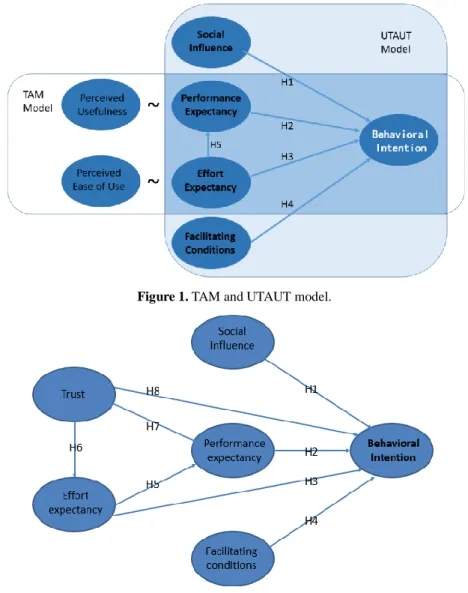
According to the Theory of Planned Behavior[17], behavioral intention is the most influential predictor of behavior. Thus, in this study we use behavioral intention to represent purchase behaviors. Based on UTAUT model, four hypoth-eses can be established from H1 to H4, as shown in Figure 1; meanwhile, TAM believes perceived easy of use (PEOU) directly affects perceived usefulness (PU). According to UTAUT, the performance expectancy (PE) is comprised of PU while effort expectancy (EE) is comprised of PEOU. Researchers found PEOU is the predictive factor of PU[29,30]. Fur-ther studies on the relationship proved that such relationship has a positive effect in s-commerce[8,31]. Thus, H5 hypoth-esis could be proposed:
H1: Social influence has a positive and significant effect on behavioral intention to use s-commerce.
H2: Performance expectancy has a positive and significant effect on behavioral intention to use s-commerce. H3: Effort expectancy has a positive and significant effect on behavioral intention to use s-commerce. H4: Facilitating conditions have a positive and significant effect on behavioral intention to use s-commerce. H5: Effort expectancy indirectly affects the behavioral intention to use s-commerce through the positive mediating and significant effect of performance expectancy.
As a matter of fact, trust is an ongoing problem in e-commerce, so is it in s-commerce. As e-commerce becomes popular, such worry is more common among consumers. In the application scenes of s-commerce, studies prove trust plays the key role in acceptance of s-commerce[8,25-27]. Actually, trust has a significant effect on the intention to partici-pate in s-commerce shopping with social network. Based on aforesaid research findings[21,22], we assume simultane-ously that:
H6: Trust indirectly affects the behavioral intention to use s-commerce through the positive mediating and signifi-cant effect of effort expectancy.
H7: Trust indirectly affects the behavioral intention to use s-commerce through the positive mediating and signifi-cant effect of performance expectancy.
H8: Trust has a positive and significant effect on behavioral intention to use s-commerce. The final model and hypotheses of this study can be seen in Figure 2.
Figure 1. TAM and UTAUT model.
4. Research methodology
The scale design is made for the six variables and eight hypotheses in aforesaid research model. Questionnaires are designed and released at random. After collecting relevant data of questionnaires, the data is cleared up and dealt with necessarily. This study adopts PLS-SEM to check the hypotheses one by one and finally verify the overall model.
4.1 Scale and questionnaire design
This study is based on TAM and UTAUT model. Specific measurement of PE (the same as PU in TAM model), SI and BI in the UTAUT model is on account of relevant research findings, and shown through the three questions in the questionnaire for three measurement indexes; EE (the same as PEOU in TAM model) and FC are reflected through the four questions in corresponding questionnaire of four measurement indexes; trust is reflected through five questions of the five measurement indexes. To validate the Chinese version of the questionnaire a double translation in Chinese was performed. For every question, Likert 1-7 points system scale is designed referring to mature scales. 1-7 respectively shows the degree from “strongly disagree” to “strongly agree”. Specific questions can be seen in Table 1.
4.2 Data collection and sample characteristics
The questionnaire for this study was designed by a popular online survey website (www.wjx.cn) in China, and posted online to QQ groups, WeChat groups and WeChat moments. Users were encouraged to forward the link of the questionnaire. Through the questionnaire-based investigation for two weeks, totally 702 were collected including 501 effective questionnaires, accounting for 71.37% of total recovery. The ones eliminated are filled by respondents ran-domly for example respondents only selected fixed numbers as answers from beginning to end, or finished in 30s, or showed contradictions.
Constructs Code Measurement items Sources
Performance Expectancy (PE) of UTAUT Model and Perceived Useful-ness(PU) of TAM model
PE1 I would find social commerce useful in my daily life Venkatesh et
al.[18], Davis[13] PE2 Using social commerce enables me to accomplish tasks more
quickly PE3
Using social commerce increases my productivity Effort Expectancy
(EE) of UTAUT model and Perceived Ease of
Use(PEOU) of TAM
model
EE1 My interaction with social commerce would be clear and under-standable
Venkatesh et
al.[18], Davis[13] EE2 It would be easy for me to become skillful at using social
com-merce
EE3 I would find social commerce easy to use
EE4 Learning how to use social commerce is easy for me
Social Influence (SI)
SI1 People who influence my behavior think that I should use social commerce
Venkatesh et
al.[18] SI2 People who are important to me think I should use social
com-merce
SI3 In general, people whose opinion I value has supported the use of use social commerce
Facilitating Conditions (FC)
FC1 I have the resources necessary to use social commerce Venkatesh et
al.[18]
FC2 I have the knowledge necessary to use social commerce
FC3 Social commerce is not compatible with other systems I use FC4 I can get help from others when I have difficulties using social
Table 1 (continued).
Constructs Code Measurement items Sources
Trust T1 Social media are trustworthy Pavlou[21],
Gefen et al.[22] , Han&Windsor[32] T2 Social media give the impression that they keep promises and
commitments
T3 I trust social media because they have my best interests in mind T4 Based on my experience with social media, I know they are honest
T5 Based on my experience with social media, I know they care about
consumers Behavioral Intention
(BI) of both UTAUT and TAM model
BI1 I intend to use social commerce in the future Venkatesh et
al.[18] BI2 I predict I would use social commerce in the future
BI3 I plan to use social commerce frequently
Table 1. Measurement items
Option Frequency Percentage
Gender Male 115 22.95%
Female 386 77.05%
age 18-22 437 87.23%
23-35 41 8.18%
36-45 18 3.59%
Over 45 5 1.00%
Education Secondary 1 0.20%
High school 13 2.59%
College or Bachelor 453 90.42%
Master or above 34 6.79%
Table 2. Sample characteristics
Table 2 shows, among the 501 effective questionnaires, the female respondents are the majority, accounting for 77.05%, while male respondents are 22.95%. In terms of age, most respondents are at the age of 18-22, accounting for 87.23%, while the proportion of those at the age of 23-35 is 8.18%; as for educational background, most respond-ents are bachelors, accounting for 90.42%, followed by masters or above, accounting for 6.79%.
5. Results
SEM is a powerful statistical technology, and it integrates multiple regression and factor analysis process into one single method[33]. Hulland[34] believed PLS contains two stages: the first is to evaluate reliability and validity of the model, and the second is to evaluate the structural model. Therefore, this study established SEM with PLS method, and carried out statistical analysis with the latest version Smart PLS 3.2.8 software to gain relevant results.
5.1 Reliability and construct validity
PLS algorithm is applied to TAM and UTAUT model and their two extension model with trust variable to get
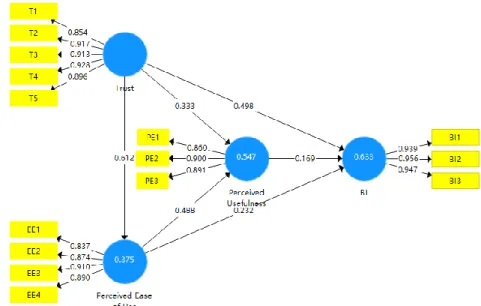
Figure 3 to Figure 6. Results show the standard factor loading coefficient of every variable is larger than 0.7. It means the measurement questions could favorable explain variables. Meanwhile, the contrast of each variable’s path coeffi-cient in each structural model can be seen in Table 7.
Figure 5. TAM +Trust model: outer loadings, path coefficient and R2.
Figure 6. UTAUT +Trust model: outer loadings, path coefficient and R2.
Figure 3. TAM model: outer loadings, path coefficient and R2.
Figure 4. UTAUT model: outer loadings, path coeffi-cient and R2
According to Figure 3 to 5, in UTAUT model, the original path coefficients of TAM model such as PU and PEOU to BI are reduced to different degrees, in which, the path coefficient of PEOU to BI dropped more from 0.401 to 0.161 than the path coefficient of PU to BI dropped to 0.189 from 0.336. While in TAM +Trust model, the original path coef-ficients of TAM model such as PU and PEOU to BI are reduced to different degrees, in which, the path coefficient of PU to BI dropped more from 0.366 to 0.169 than the path coefficient of PEOU to BI dropped to 0.232 from 0.401. Simultaneously the path coefficient of PEOU to PU dropped to 0.488 from 0.692. In the TAM model extended with trust the biggest influencing factor to BI changed into trust whose path coefficient is 0.498.
From Figure 4 to Figure 6, in UTAUT +Trust model, the original path coefficients of UTAUT such as EE, FC, PE and SI to BI are reduced to different degrees too, in which, the path coefficient of FC dropped the most from 0.237 to 0.076, then the path coefficient of Trust to BI also becomes the largest and the path coefficient of EE to PE is also dropped to 0.448 from 0.692. Comparing the results of UTAUT and TAM models after expanding the trust variable, the increase of SI and FC variables reduce the path coefficient of trust variable to BI, and the path coefficient of PE (PU in TAM model) and EE (PEOU in TAM Model) to BI also decreases.
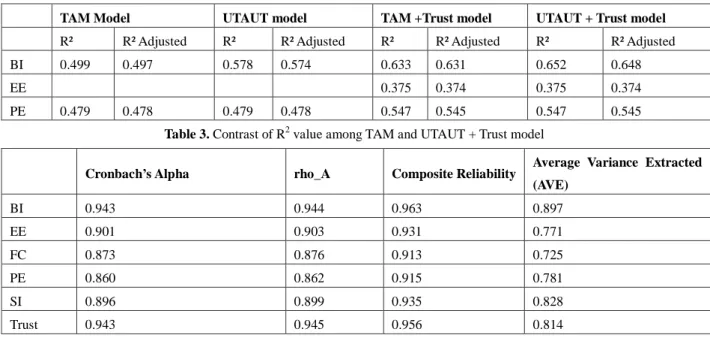
From Figure 3 to Figure 6 the results of R2 value in different models are listed in Table 3.
R2 means the explanation degree of independent variable to dependent variables. In user ’s behavior research, R2 larger than 0.25 or 0.5 means the variable can be explained or highly explained. According to the calculation results shown in Table 3, the R2 value of BI in UTAUT + Trust model is 0.652, and the value adjusted is 0.648, both larger than 0.5. Thus, the fitting degree of the mode is favorable, and the model has high prediction ability. Meanwhile, the R2 value of BI in UTAUT + Trust model is the largest in the four different models. Moreover, the R2 value of EE and PE is the same high as in TAM + Trust model and the R2 value of PE in UTAUT + Trust model is 0.547, larger than the value 0.479 in UTAUT model. So the two factors in UTAUT + Trust model can be highly explained as well. Thus, the ex-tended UTAUT model with Trust as new variable can better explain the behavioral intention of s-commerce than the other three models.
Table 4 is the construct reliability and validity. Based on the calculation results, the values of Cronbach’s Alpha are between 0.860 and 0.943, showing a favorable internal reliability. The AVE value is above 0.6, showing acceptable coefficient of convergence of the model. The composite reliability CR value is larger than 0.7 and higher than 0.8, which means the variables have highly favorable internal consistency.
TAM Model UTAUT model TAM +Trust model UTAUT + Trust model
R² R² Adjusted R² R² Adjusted R² R² Adjusted R² R² Adjusted
BI 0.499 0.497 0.578 0.574 0.633 0.631 0.652 0.648
EE 0.375 0.374 0.375 0.374
PE 0.479 0.478 0.479 0.478 0.547 0.545 0.547 0.545
Table 3. Contrast of R2 value among TAM and UTAUT + Trust model
Cronbach’s Alpha rho_A Composite Reliability Average Variance Extracted
(AVE)
BI 0.943 0.944 0.963 0.897
EE 0.901 0.903 0.931 0.771
FC 0.873 0.876 0.913 0.725
PE 0.860 0.862 0.915 0.781
SI 0.896 0.899 0.935 0.828
Trust 0.943 0.945 0.956 0.814
BI EE FC PE SI Trust
BI 0.947
EE 0.654 0.878
FC 0.686 0.700 0.851
PE 0.644 0.691 0.671 0.884
SI 0.701 0.735 0.779 0.689 0.910
Trust 0.747 0.612 0.715 0.631 0.679 0.902
Table 5. Discriminant validity of UTAUT + Trust model
The latent variable coefficients in Table 5 shows the average square root of each latent variable is larger than 0.8, and also larger than relevant coefficients among other latent variables. It means the latent variables have enough dis-criminant validity.
On the whole, the selected hypotheses capture sufficient variance related to measurement errors in the underlying constructs[35].
5.2 Significance testing
The results of bootstrapping inspection can be seen in Table 6. On that basis, in UTAUT + Trust model, only one (H4) out of the eight hypotheses is insignificant. The P value of H5, H6, H7 and H8 is smaller than 0.001, i.e., the hy-pothesis is highly significant; H1 is very significant, and H2 and H3 are significant. Trust has positive and very signifi-cant effect (*** P<0.001) on BI, PE and EE. In addition, SI has positive and very signifisignifi-cant effect on BI, while PE and EE also have positive and significant effect on BI.
Table 7 summarizes the calculation results of all models with respect to R² value, P value and path coefficient.
Original sample (O)
Mean value
(M)
Standard
devia-tion(STDEV)
T statistics
(|O/STDEV|)
P value UTAUT+Trust Significance
H1:SI -> BI 0.185 0.185 0.064 2.910 0.004 **Significant
H2:PE -> BI 0.111 0.112 0.050 2.224 0.026 *Significant
H3:EE -> BI 0.134 0.132 0.058 2.314 0.021 *Significant
H4:FC -> BI 0.076 0.078 0.058 1.312 0.190 Rejected
H5:EE -> PE 0.488 0.489 0.048 10.191 0.000 ***Significant
H6:Trust -> EE 0.612 0.613 0.032 19.126 0.000 ***Significant
H7:Trust -> PE 0.333 0.332 0.050 6.630 0.000 ***Significant
H8:Trust -> BI 0.415 0.415 0.051 8.088 0.000 ***Significant
Table 6. Bootstrapping inspection of UTAUT + Trust model
Note: significance level of path coefficient: * P<0.05, ** P<0.01, *** P<0.001
Path Coefficients TAM UTAUT TAM +Trust UTAUT +Trust
R² 0.499 0.578 0.633 0.652
H1:SI -> BI 0.268*** 0.185**
H2:PE(or PU) -> BI 0.366*** 0.189*** 0.169*** 0.111*
H3:EE(or PEOU) -> BI 0.401*** 0.161* 0.232*** 0.134*
H4:FC -> BI 0.237*** 0.076ns
H5:EE -> PE 0.692*** 0.692*** 0.488*** 0.488***
H6:Trust -> EE 0.612*** 0.612***
H7:Trust -> PE 0.333*** 0.333***
H8:Trust -> BI 0.498*** 0.415***
Table 7. Results of various models
Pursuant to calculation results in Table 7, the R2 value of BI in all considered models except TAM model are all larger than 0.5, showing a good fitting degree and higher predictability of the models. In the meantime, the R2 value of UTAUT + Trust model is larger than that in UTAUT, about 12.9% higher, and also larger than that in TAM + Trust model, about 0.019 more. Thus, the extended UTAUT model with Trust as a new variable could better explain the be-havioral intention to use s-commerce. If the Trust factor is considered the path coefficients for all 4 factors in the UTAUT model and both 2 factors in TAM model reduce. Data proves trust is the most important factor in e-commerce based on social platforms in China.
6. Discussion and conclusion
This study examined the effects of various characteristics of s-commerce and the effects of trust on behavioral in-tentions. More specifically, based on the TAM and UTAUT theoretical models, four hypothesis models constructed for different influencing factors were empirically compared and tested[18]. The results for the measurement model demon-strate sufficient reliability and validity for all constructs in the four research models. In addition, the results for the structural model demonstrate that all path coefficients (except for facilitating conditions in UTAUT + Trust model) were significant. In the social commerce scenario of WeChat in China, the most appropriate theoretical model is the UTAUT model extended by trust influencing factor variables. Consumers’ behavior intention is most affected by trust factors[5], followed by social influence (SI), effort expectancy (EE) and performance expectancy (PE) while Facilitating Conditions (FC) is insignificant.
The results of this study reject for the H4. Facilitating Conditions (FC) in UTAUT model has very significant ef-fect on BI, while in UTAUT + Trust model, FC is insignificant to BI. It means after Trust is added to UTAUT model, FC effect is not significant compared to the effect of Trust. According to the UTAUT model, the impact of FC will be significant only before technology is introduced into an organization or before any direct experience of the new system is carried out, this impact will disappear after the user obtains the system experience[36]. Such a fact may be used to make explanation under the background of popular s-commerce: almost every one can visit social media through inter-net without FC such as technical support.
The results provide support for H1. Based on the above calculation results, we find that Social Influence in UTAUT + Trust model is the only factor next to Trust variable, and its importance is greater than PE and EE in the model (corresponding to PU and PEOU in TAM model), and more significant. H2 and H3, as well as H5, H6, H7, have proved to be supported.
The eight hypotheses of extended UTAUT model with Trust are largely verified. Furthermore, compared to tradi-tional UTAUT model, the UTAUT + Trust model used in this study could better explain effect of various factors on behavioral intention to use s-commerce. Whereas the respondents of questionnaires are mainly at the age of 18-35 (totally accounting for over 95%), and have educational background of undergraduate or above, the results could reflect the current status and future trend of mainstream people’s acceptance of s-commerce on WeChat platform in China from a practical angle.
Without doubt, this study is limited in certain aspects. First of all, it is an inspection of the behavioral intention of s-commerce rather than actual application, and the further study shall focus on influence of actual application behaviors; secondly, this study orients at consumption behavior intention of consumers rather than enterprise organization, while further studies could explore possibility of enterprises’ use of s-commerce; last but not least, this study fails to consider influence of adjustment variables such as gender, age and educational background during specific data analysis.
Acknowledgement
This article is supported by the 2018 school level scientific research project of Foshan Polytechnic (Natural Sci-ence: KY2018Y11).
References
1. Zhao N, Li H. How can social commerce be boosted? The impact of consumer behaviors on the information dis-semination mechanism in a social commerce network. Electronic Commerce Research 2019.
2. CNNIC. The 43rd Statistical Reports on Internet Development in China [Internet]. 2019. Available from: http://www.cnnic.cn/hlwfzyj/hlwxzbg/hlwtjbg/201902/t20190228_70645.htm.
3. Han H, Xu H, Chen H. Social commerce: A systematic review and data synthesis. Electronic Commerce Research and Applications 2018; 30: 38-50.
4. Leung WKS, Shi S, Chow WS. Impacts of user interactions on trust development in C2C social commerce. Inter-net Research 2019.
5. Hajli N, Sims J, Zadeh AH, et al. A social commerce investigation of the role of trust in a social networking site on purchase intentions. Journal of Business Research 2017; 71: 133-141.
6. Yahia IB, Al-Neama N, Kerbache L. Investigating the drivers for social commerce in social media platforms: Im-portance of trust, social support and the platform perceived usage. Journal of Retailing and Consumer Services 2018; 41: 11-19.
7. Abed S. An empirical examination of Instagram as an s-commerce channel. Journal of Advances in Management Research 2018; 15(2): 146-160..
8. Hajli N. Social commerce constructs and consumer’s intention to buy. International Journal of Information Man-agement 2015; 35(2): 183-191.
9. Liang TP, Turban E. Introduction to the special issue social commerce: A research framework for social commerce. International Journal of Electronic Commerce 2011; 16(2): 5-14.
10. Huang Z, Benyoucef M. From e-commerce to social commerce: A close look at design features. Electronic Com-merce Research and Applications 2013; 12(4): 246-259.
11. Wang C, Zhang P. The evolution of social commerce: The people, management, technology, and information di-mensions. Communications of the Association for Information Systems 2012; 31(1): 5.
12. Grewal H, Shivani A. A study of ethical and social issues in e-commerce. International Journal of Advanced Re-search in Computer Science and Software Engineering 2012; 2(7): 167-174.
13. Fred DD. Perceived usefulness, perceived ease of use, and user acceptance of information technology. MIS Quar-terly 1989; 319-340.
14. Sarker P, Kizgin H, Rana NP, et al. Review of theoretical models and limitations of social commerce adoption lit-erature. Digital Transformation for a Sustainable Society 2019.
15. Ajzen I, Fishbein M. Attitude-behavior relations: A theoretical analysis and review of empirical research. Psycho-logical Bulletin 1977; 84(5): 888.
16. Ajzen I. From intentions to actions: A theory of planned behavior. Action Control 1985; 11-39.
17. Ajzen I. The theory of planned behavior. Organizational Behavior and Human Decision Processes 1991; 50(2): 179-211. doi: 10.1016/0749-5978(91)90020-T.
18. Venkatesh V, Morris MG, Davis GB, et al. User acceptance of information technology: Toward a unified view. MIS Quarterly 2003; 425-478.
19. Akman I, Mishra A. Factors influencing consumer intention in social commerce adoption. Information Technology & People 2017; 30(2): 356-370.
20. Chhonker MS, Verma D, Kar AK, et al. M-commerce technology adoption: Thematic and citation analysis of scholarly research during 2008-2017. The Bottom Line 2018; 31(3/4): 208-233.
21. Pavlou PA. Consumer acceptance of electronic commerce: Integrating trust and risk with the technology ac-ceptance model. International Journal of Electronic Commerce 2003; 7(3): 101-134.
22. Gefen D, Karahanna E, Straub DW. Trust and TAM in online shopping: An integrated model. MIS Quarterly 2003; 27(1): 51-90.
23. Mayer RC, Davis JH, Schoorman FD. An integrative model of organizational trust. Academy of Management Re-view 1995; 20(3): 709-734.
24. McKnight DH, Choudhury V, Kacmar C. Developing and validating trust measures for e-commerce: An integra-tive typology. Information Systems Research 2002; 13(3): 334-359.
25. Kang JY.M, Johnson KK. How does social commerce work for apparel shopping ? Apparel social e-shopping with social network storefronts. Journal of Customer Behaviour 2013; 12(1): 53-72.
26. Kim S, Park H. Effects of various characteristics of social commerce (s-commerce) on consumers’ trust and trust performance. International Journal of Information Management 2013; 33(2): 318-332.
27. Ng CSP. Intention to purchase on social commerce websites across cultures: A cross-regional study. Information & Management 2013; 50(8): 609-620.
28. Farivar S, Turel O, Yuan Y. A trust-risk perspective on social commerce use: An examination of the biasing role of habit. Internet Research 2017; 27(3): 586-607.
29. Rai A, Lang SS, Welker RB. Assessing the validity of IS success models: An empirical test and theoretical analysis. Information Systems Research 2002; 13(1): 50-69.
30. Chiu CM, Wang ET. Understanding Web-based learning continuance intention: The role of subjective task value. Information & Management 2008; 45(3): 194-201.
31. Shen J. Social comparison, social presence, and enjoyment in the acceptance of social shopping websites. Journal of Electronic Commerce Research 2012; 13(3): 198.
32. Han BO, Windsor J. User’s willingness to pay on social network sites. Journal of Computer Information Systems 2011; 51(4): 31-40.
33. Bentler PM. Theory and implementation of EQS: A structural equations program. BMDP Statistical Software Inc. 1985.
34. Hulland J. Use of partial least squares (PLS) in strategic management research: A review of four recent studies. Strategic Management Journal 1999; 20(2): 195-204.
35. Fornell C, Larcker DF. Evaluating structural equation models with unobservable variables and measurement error. Journal of Marketing Research 1981; 18(1): 39-50.
36. Venkatesh V, Thong JYL, Xu X. Consumer acceptance and use of information technology: Extending the unified theory of acceptance and use of technology. MIS Quarterly 2012; 36(1): 157-178.