Subgroup Variation in Diagnostic Tests: Sources
and Solutions
By
Daniel Nissman
A Master's Paper submitted to the faculty of the University of North
Carolina at Chapel Hill in partial fulfillment of the requirements for
the degree of Master of Public Health in the Public Health Leadership
Program
Chapel Hill
Subgroup Variation in Diagnostic Tests: Sources
and Solutions
Daniel Nissman
Abstract
Diagnostic tests are an essential component of clinical medicine today.
Like any other clinical study, the results of studies evaluating new diagnostic tests
must be interpreted in the context of underlying methodological problems and
generalizability. Subgroup variation in diagnostic test accuracy, the focus of this
paper, can arise in two ways: the test truly performs differently in the two
subgroups or it is an artifact. Real subgroup variation affects the generalizability
of the results. Artifacts, however, arise from biased measurement (e.g. an
imperfect reference standard) and affect the believability of the results. The
question is whether real subgroup variation can be separated from artifact.
Sources of subgroup variation and examples are presented with the
specific focus on true subgroup variation and spurious variation due to the use of .
imperfect reference standards. Both true variation and the use of imperfect
reference standards are shown to be quite common. Frequently used tests, such as
the urine dipstick for urinary tract infection, exhibit true subgroup variation.
Observed test characteristics derived from comparison to an imperfect reference
are shown to be prevalence-dependent. The effect of measurement reliability is
discussed as a third source of potential subgroup variation.
Two basic approaches for managing imperfect reference standards are
references. The emphasis is on the method ofHui and Walter, which provides a
closed form expression for identifYing the unknown characteristics of the new test
and the reference test in two populations. An alternate derivation is also provided
that may be more accessible to the non-statistician.
Methods for identifying true subgroup variation, simple stratification and
regression analysis, as well as methods for incorporating subgroup variation into
clinical decision making are presented to round out the general discussion of
subgroup variation. IdentifYing subgroup variation and accounting for covariates
in diagnostic test parameters is not significantly different from similar analyses in
studies of interventions. The use of likelihood ratios to measure the impact of
subgroup variation on decision making as well as a means for mitigating poor
generalizability ("spectrum bias") of a test when used in a population with a
different severity of disease completes the discussion.
The paper is concluded with a methodology for distinguishing true
subgroup variation from spurious subgroup variation due to an imperfect
reference standard.
I
Introduction
Diagnostic tests are an essential component of clinical medicine today.
Like any other clinical study, the results of studies evaluating new diagnostic tests
must be interpreted in the context of underlying methodological problems and
generalizability. Subgroup variation in diagnostic test accuracy can arise in two
Real subgroup variation affects the generalizability of the results. Artifacts,
however, arise from biased measurement (e.g. an imperfect reference standard)1
and affect the believability of the results. The question is whether real subgroup
variation can be separated from artifact.
Imperfect reference standards are a common problem2 Pathologists are
not 100% accurate and they may have reporting preferences dictated by where
they trained. Bacterial culture, a frequently used reference, is not 100% sensitive.
Pulmonary angiography for pulmonary embolism is not 100% sensitive. Under
idealized circumstances, the use of an imperfect reference results in
underestimation of one or both of a test's sensitivity, the proportion of diseased
cases that test positive, and specificity, the proportion of non-diseased cases that
test negative. First noted by Gart and Buck in 1966/ the effect on the observed
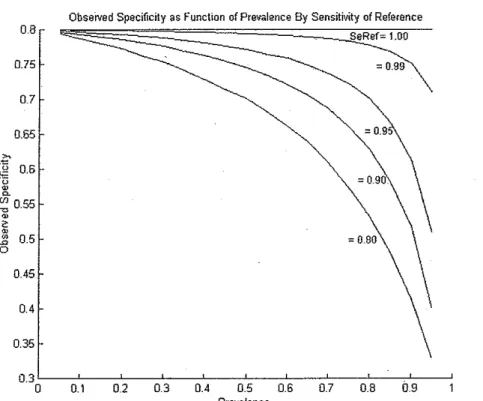
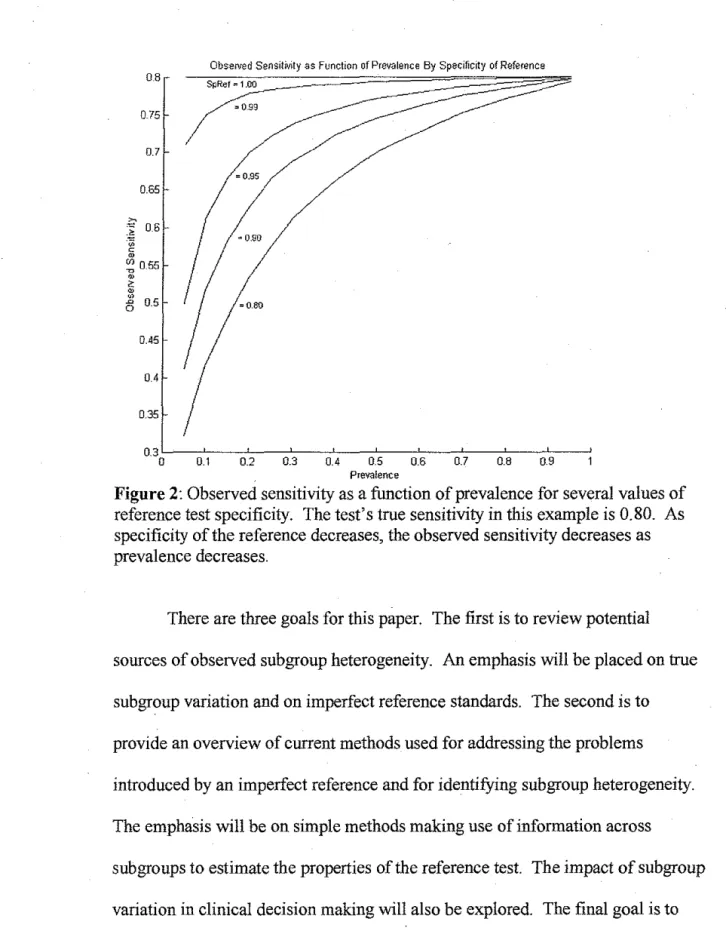
test characteristics is dependent on disease prevalence. See Figures 1 and 2. If
the performance characteristics of the imperfect reference are known, then the
new test's characteristics can be corrected algebraically. 4
When a test performs differently in two subgroups leading to different test
characteristics in the two groups, the test is said to exhibit "spectrum effect" or
"spectrum bias. "5 Diagnostic testing studies usually report the results for the
entire study sample leading to a weighted average of the sensitivities and
specificities for each of the subgroups. This is inappropriate as the weighted
average no longer applies to either group. In some cases, clear biological
differences can explain differential test performance. Tests relying on antibody
(decreased sensitivity). Similar tests performed in patients with autoimmune
diseases experience greater risk for antibody cross-reactivity, which leads to
decreased specificity.
An imperfect gold standard can mimic spectrum effect when the
prevalence of the disease or condition of interest is different in the subgroups. 1
Inappropriate assigmnent of true case/noncase can greatly affect the computed
performance characteristics of the test under study. This situation may arise when
studying symptomatic versus asymptomatic people. The prevalence of disease is
likely much greater among symptomatic individuals than in asymptomatic
individuals.
0.8
0.75
0.7
0.65 ~
i
0.6~
~ 055 ~ .
~ 2 ro 1? 0.5
0
0.45
0.4
0.35
Obseived Specificity as Function of Prevalence By Sensitivity of Reference SeRef= 1.00
= 0.99
=0.9
0.3 L_---,.L_-:":--:-':---:-'-:---::-':::---::-':---::'::---c-~---,L---"
0 0.1 0.2 0.3 0.4 0.5 0.6 0.7 0.8 09
Prevalence
Figure 1: Observed specificity as a function of prevalence for several values of reference test sensitivity. The test's true specificity in this example is 0.80. As
Obsemd Sensitivity .as Function of Prevalence By Specificity of Reference
08
SpRef"' 1.00
075 .. Q_gg
0.7
= 0.95 0.65
0.45
0.4
0.35
0.3L--~--'---~-~--'---'---~--'---'--~
0 0.1 0.2 0.3 0.4 0.5 0.6 0.7 0.8 0.9
Prevalence
Figure 2: Observed sensitivity as a function of prevalence for several values of reference test specificity. The test's true sensitivity in this example is 0.80. As specificity of the reference decreases, the observed sensitivity decreases as prevalence decreases.
There are three goals for this paper. The first is to review potential
sources of observed subgroup heterogeneity. An emphasis will be placed on true
subgroup variation and on imperfect reference standards. The second is to
provide an overview of current methods used for addressing the problems
introduced by an imperfect reference and for identifYing subgroup heterogeneity.
The emphasis will be on simple methods making use of information across
subgroups to estimate the properties of the reference test. The impact of subgroup
variation in clinical decision making will also be explored. The final goal is to
present a methodology for distinguishing true subgroup variation from spurious
II
Background
ll.l
Subgroup Variation
ll.l.l "Spectrum"
The use of the term "spectrum" in relation to biases and population
subgroups when discussing diagnostic tests is confusing. On the one hand, when
used in the phrase "adequate spectrum," it refers to the range of subjects against
which a test should be evaluated to arrive at a single set of test characteristics. On
the other hand, when used in the phrase "spectrum bias" or "spectrum effect," it
implies different test characteristics across subgroups. Subgroup variation among
tests has been recognized at least since the 1970s, yet the systematic exploration
of subgroup variation is still not a component of typical diagnostic test evaluation
studies. An unintended consequence of using the phrase "adequate spectrum,"
which is still a component of all guidelines for diagnostic test evaluations, may be
that subgroup analysis of diagnostic tests is not pursued to the extent they should
be. The following discussion tracks the evolution of the concept of spectrum
from its initial introduction to its current day usage.
Ransohoff and Feinstein first introduced the concept of"spectrum" in
19786 In their usage of the term, diagnostic tests need to be evaluated on a
sufficiently broad "range of features found in patients" to get a more accurate
depiction of the sensitivity and specificity of a test. This broad range should
include a broad range of pathologies, a broad range of symptomatic severity, and
using an inappropriate spectrum during the development or study of a test are that
the test performs poorly in practice.
Subsequently, in 1988, Miller, et al} subdivided Ransohoff and
Feinstein's "spectrum" into selection bias and "disease-based spectrum." In
selection bias, there is a spurious association between a patient characteristic and
the diagnosis of interest. In "disease-based spectrum" bias, a restricted range of patients is recruited into a study based on an intermediate to high probability of
disease. In other words, selection is based on a restricted range of disease severity. An example of such bias is the selection of patients for angiography.
These patients have already received several tests indicating a significant
likelihood for coronary artery disease (CAD). Generalization of test
characteristics derived from populations exhibiting these biases will be poor.
In 1990, the term "spectrum bias" was first used by Nardone, et al} to
refer to the use of an inappropriate spectrum of patients in past studies of the
diagnosis of anemia by skin pallor. In this case, an inappropriate spectrum appears to have been any study that did not have equal numbers of anemic and
normal patients. Although this is not exactly what Ransohoff and Feinstein meant
by appropriate spectrum, they did go to great lengths to design a study with equal
proportions of patients in 5 different hematocrit ranges. They find that the
sensitivity of skin pallor was greater the lower the hematocrit, which corroborates
many subsequent findings that test sensitivity is greater the more severe the
In 1992, Lachs, et al., 9 first associate the term "spectrum bias" with
different test characteristics in a pair of subgroups. In this study of diagnosis of
urinary tract infection by urine dipstick, the aggregate sensitivity and specificity
was found to be 83% and 71%, respectively. When divided into groups based on
high versus low pretest probability, the sensitivity and specificity was found to be
92% and 42%, respectively, in the high probability group and 56% and 78%,
respectively, in the low probability group. This paper is the firstto note caution
when aggregating test characteristics among subgroups. Unfortunately, they also
state that "spectrum bias will not produce misleading appraisal of test
performance if the groups recruited for the study are representative of the patients
in whom it will ultimately be used in clinical practice." This is incorrect because
there may be subgroup variation within the typical range of clinical practice
patients. An example of subgroup variation that is cited in their article that is
counter to their statement is the use of exercise stress testing for coronary
ischemia in men and women. Sensitivity of exercise stress testing for coronary
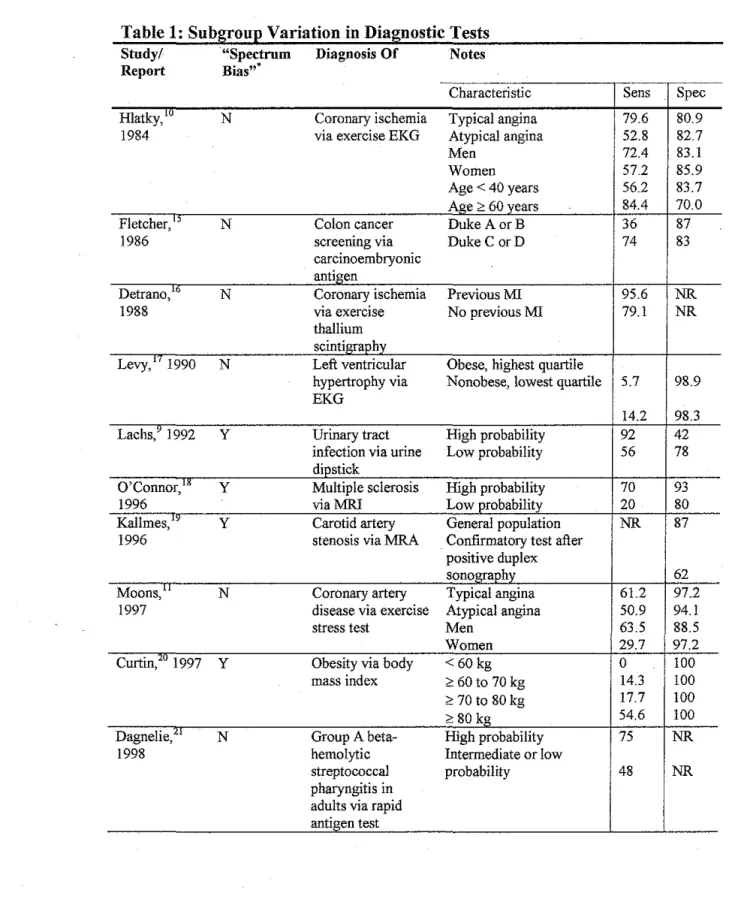
ischemia in men is 72.4% and in women it is 57.2%; 10 and, for the presence of
coronary artery disease, the sensitivity is 63.5% in men and only 29% in
women.11
Finally, in 2002, Mulherin and Miller5 refer to the variation of test
characteristics among subgroups as "spectrum effect." They argue that this is not
a systematic bias that needs to be controlled against. Rather, this is an example of
effect modification- the diagnostic test simply performs differently in different
Characteristics for each subgroup in which variation is found should be reported
separately.
The concept of appropriate spectrum in diagnostic tests as described by
Ransohoffand Feinstein's definition of spectrum as "the range of features found
in patients used to challenge a test's sensitivity and specificity"6 (p. 927) to be
reported as a single set of characteristics is now supplanted by the need for the
consideration of variation in test characteristics among subgroups. Although
subgroup differences have been recognized in the diagnostic testing literature for
specific tests (see Table 1), the formal discussion of the spectrum effect provides
a framework to explore subgroup variation in all diagnostic tests. The
consequence of this, however, is that greater effort must be made at adequate
representation of subgroups of interest in evaluation studies.
A further point regarding spectrum needs to be made. There are two
components to the evaluation of a diagnostic test prior to its introduction to
general use6 First, in evaluating the sensitivity of the test it is important to
provide adequate examples of disease across its many manifestations and in the
presence of co morbid conditions. Second, as many mimics of the condition of
interest as possible need to be presented to the test to properly evaluate the test's
specificity. It is inappropriate to only evaluate the specificity in a population of
normal individuals. (A possible exception to this is when the test is used for
screening purposes.) The concept of a broad range of evaluation conditions is the
original concept of spectrum as defined by Ransohoff and Feinstein. However,
range of manifestations or comorbid conditions and that this behavior should be
explicitly reported has only recently been formally recognized.
Ultimately, designing and evaluating studies of diagnostic tests should be
no different from designing intervention studies. In the classic 1987 paper by
Colin Begg, 12 he states that "it may seem anachronistic to caution statisticians to
consider adjustment for covariates ... given that covariate adjustment has been a
major topic of study in statistics for much of this century. However, in the
majority of test efficacy studies the issue is not addressed."(p 413l Consideration of
covariates, i.e. subgroups, is increasing, albeit slowly. Like intervention studies,
consideration of selection bias, subgroup analysis, and generalizability should be
fundamental aspects of study design and critical appraisal.
11.1.2 Examples
Table !lists all studies of diagnostic tests identified by searches on
"spectrum bias" and "spectrum effect" on PubMed. (There is no MeSH term for
this concept.) Included in this table are examples of other diagnostic testing
modalities reporting subgroup variation. A key point from examination of this
table is the presence of significant subgroup variation in frequently used tests.
Urine dipsticks and the rapid antigen test for "strep throat" are frequently used
tests in emergency departments and primary care offices. Electrocardiograms are
also frequently obtained. With the high prevalence of obesity today,
understanding that body mass index (BMI) does not perform well for people less
one editorial14 that specifically mention "spectrum bias," but got the definition
incorrect, are included in the list.
Table 1: Subgroup Variation in Diagnostic Tests Study/ "Spectrum Diagnosis Of Notes Report Bias""
Characteristic Sens Spec
Hlatky,'" N Coronary ischemia Typical angina 79.6 80.9 1984 via exercise EKG Atypical angina 52.8 82.7
Men 72.4 83.1
Women 57.2 85.9
Age < 40 years 56.2 83.7 Age > 60 years 84.4 70.0 Fletcher," N Colon cancer Duke A orB 36 87
1986 screening via Duke CorD 74 83
carcinoembryonic
antigen
Detrano,16 N Coronary ischemia PreviousMI 95.6 NR
1988 via exercise No previous MI 79.1 NR
thallium scintigraphy
Levy,'' 1990 N Left ventricular Obese, highest quartile
hypertrophy via Nonobese, lowest quartile 5.7 98.9 EKG
14.2 98.3 Lachs,' 1992 y Urinary tract High probability 92 42
infection via urine Low probability 56 78 dipstick
O'Connor," y Multiple sclerosis High probability 70 93
1996 viaMRI Low probability 20 80
Kallmes," y Carotid artery General population NR 87 1996 stenosis via MRA Confirmatory test after
positive duplex
sonography 62
Moons," N Coronary artery Typical angina 61.2 97.2 1997 disease via exercise Atypical angina 50.9 94.1 stress test Men 63.5 88.5
Women 29.7 97.2
Curtin,'" 1997 y Obesity via body <60kg 0 100
mass index <: 60 to 70 kg 14.3 100
<: 70 to 80 kg 17.7 100
<: 80 kg 54.6 100
Dagnelie," N Group A beta- High probability 75 NR
1998 hemolytic Intermediate or low
streptococcal probability 48 NR
Study/
Report
Barnhart, 14 1999
Colin, 22 2000
DiMatteo," 2001 Mulherin/ 2002 Huot," 2002 ,,
Lim, 2003
Hall," 2004
"Spectrum Diagnosis Of Bias"'"
Y Infertility via FSH
Y Hepatitis C via 'b d I
anti o y sera ogtes
(RIBA 3'• generation)
y Group A beta-hemolytic streptococcal pharyngitis in adults via rapid antigen test
y Chlamydia
· trachomatis
infection via
enzyme immunoassay
y Renal artery stenosis via
captopril renal scan
..
Y Cogmllve
impairment via two questionnaires
Y Group A beta-hemolytic streptococcal pharyngitis in children via rapid antigen test NR - not reported.
'study explicitly mentions "spectrum bias."
Notes
Characteristic
I
SensI
Spec Paper and editorials describe use of test with the same performance in populations with different prevalence of disease (older and already failed IVF versus younger patients)Qualitative consideration of antibody tests
. d. d' 'd I
m tmmunocompromtse m tvt ua s
Chronic liver disease 100 100 Hemodialysis
79 100 Modified Centor criteria:
0,1
2 61 NR
3 76
4 90
97
Age<24 75.9 99.5 Age;e24 58.3 99.2
With vascular disease
Without vascular disease 70 63
100 55 Different performance between two
screening instruments on same group
erroneously attributed to spectrum bias Modified Centor criteria:
0
I 47 NR
2 65
3,4 82
90
Two further areas of intense clinical interest where subgroup variation is
present are in the early detection of breast cancer via screening mammography
and in the diagnosis of pulmonary embolism (PE) via pulmonary angiography
and, possibly, the D-dimer assay. There has been a significant amount of
mammography is lower among younger women than in older women. In
pulmonary angiography, whether by computed tomography ( CT) or magnetic
resonance (MR), there is a clear difference in the ability of these techniques to
detect large vessel emboli and subsegmental emboli. 32•33.34.35
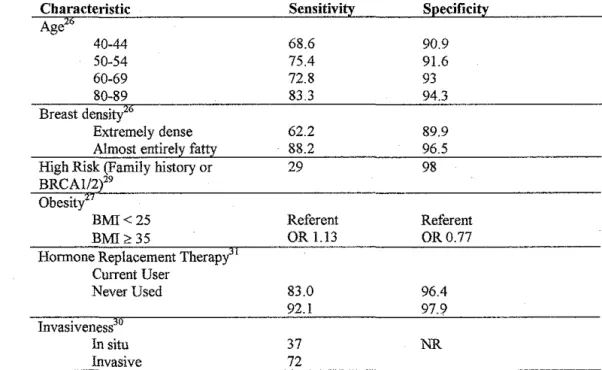
Table 2: Examples of Subgroup Variation in the Performance of Screening Mammography
Characteristic Sensitivity Specificity
Age26
40-44 68.6 90.9
50-54 75.4 91.6
60-69 72.8 93
80-89 83.3 94.3
Breast densi
Extremely dense 62.2 89.9 Almost entirely fatty 88.2 96.5 High Risk (Family history or 29 98 BRCAI/2 29
Obesity
BMI<25 Referent Referent
BMI>35 OR l.l3 OR0.77
Hormone Replacement Therapy" Current User
Never Used 83.0 96.4
92.1 97.9
Invasiveness
In situ 37 NR
Invasive 72
Considerable attention has been given to subgroup variation in the
screening mammography literature. Table 2 provides examples of published
variations in test characteristics among subgroups and is not meant to be an
exhaustive synthesis of the available data on each of the listed subgroups.
Conflicting data do exist, especially regarding the effect of hormone replacement
therapy,26•31 so the data serves for illustration only. As is common in studies of
interventions, some identified subgroups may in fact be proxies for other
b
1'
underlying characteristics. For example, age is most likely a proxy for breast
density. What is important is that subgroup variation is being explored, because
clinically important subgroups exist. In particular, mammography does not
perform well at all in women who are at high risk of breast cancer compared to
the woman at average risk.
The diagnosis ofPE is also subject to subgroup variation. In this case, subsegmental emboli seem to represent a different entity. Many may actually
represent incidental findings and, if truly associated with the event, do not carry
the same clinical significance that an embolism found in a larger pulmonary
vessel would have in the near term. 36•37 Regardless of this fact, angiographic
methods have difficulty with detecting emboli in the smaller vessels. The reason
for this difficulty is due to a combination of motion artifact and poor spatial
resolution.· Since fluoroscopic pulmonary angiography is the de facto gold
standard, one can only discuss inter-rater variability when discussing its accuracy.
Stein, et al.,32 using the degree of co-positivity between two observers, found that
co-positivity for presence of an embolus in a subsegmental artery was 66%
compared to a co-positivity of 90% and 98% in the segmental and central or lobar
arteries, respectively. For single-slice CT, Goodman, et al.,32 found a sensitivity
of 86% in the central arteries and only 25% in the subsegmental arteries for the
diagnosis ofPE. Modern multislice CT scanners perform significantly better and
are able to visualize the subsegmental arteries twice as well as single-slice
with the smaller vessels, has reported sensitivities of 40% for subsegmental, 84%
for segmental and 100% for central or lobar PE. 35
According to the study by De Monye, et al.,38 the D-dimer test for PE also
displays subgroup variation by location. The test had a sensitivity of93% for PE
located in the segmental or larger arteries and a sensitivity of only 50% when the
embolism was located in the subsegmental arteries. The D-dimer assay has good
performance for ruling out large vessel PE, but relatively poor performance for
ruling out smaller emboli. Since this assay is usually only obtained in a patient
with a low clinical suspicion ofPE and an individual with a large vessel PE is
unlikely to be asymptomatic, then a negative test would be falsely reassuring.
Subgroup variation in diagnostic test performance clearly exists for the
tests used for many common problems. The reporting of aggregate test
characteristics across all patients distorts the performance· of the tests in clinically
important subgroups. Hopefully, understanding this variation will lead to more
appropriate use of diagnostic tests, which will ultimately lead to better care for
patients.
ll.1.3 Does This Test Exhibit Subgroup Variation?
When considering the possibility that a subgroup may behave differently
from the larger group that a test is normally used in, there are some clues to
consider. These include biological plausibility and wide variations in published
test characteristics. By understanding the scientific basis for a given test,
erroneous test result. By examining the published literature for a given test, wide
variations in published test characteristics are clues to heterogeneity39 The
heterogeneity may be due to poor study design or it may be due to selection of
different sets or proportions of subjects.
Predicting subgroup variation on the basis oftest mechanism is not
difficult. Tests relying on the detection of antibodies do not perform as well in
people who are deficient in antibodies. Imaging fine anatomical structures, such
as small pulmonary arteries, will be difficult if the patient moves or if the spatial
resolution of the technique is not adequate. Visualizing abnormalities in dense
breast tissue is more difficult than in fatty breast tissue. On the other hand,
finding subgroup variation may lead one to rethink the disease and/or testing
process. Why does exercise stress testing not perform well in women compared
to men? Why does the rapid antigen test for Group A beta-hemolytic
streptococcal pharyngitis perform better the more severe the disease is?
Heterogeneity between studies of diagnostic tests can be due to a number
offactors: study design and conduct; population (and circumstances) under study;
and choice of reference test. 39 Many biases can be introduced in the conduct of a
diagnostic testing study. Unfortunately, proper design and conduct of diagnostic
testing trials has not received the attention that intervention trials have received.
Today, however, guidelines for the proper design and reporting of these studies
are available40·41 The choice of reference test can lead to different results. For
example, now that fluoroscopic pulmonary angiography is known not to be 100%
CT angiography plus lower extremity venous Doppler ultrasound to improve the
reference standard's sensitivity for diagnosing PE. In many cases, there is likely
to be selection bias in the evaluation of a test, where a particular subgroup is over
(or under) represented. If all other factors are equal, this is a strong clue that there
may be subgroup variation.
Systematic reviews of diagnostic tests are confronted with a particular
difficulty. Diagnostic test performance is reported as two quantities. The usual
tests for heterogeneity rely on the presence of only one quantity of interest. In a
review of the use of tests for heterogeneity in systematic reviews of diagnostic
tests, Dinnes, et a!., note that "the under use of statistical tests and graphical
approaches to identify heterogeneity perhaps reflect the uncertainty in the most
appropriate methods to use ... " 39 (p. iii)_ There is clearly more work that needs to
be done in this area.
As a final caveat, diagnostic tests based on dichotomizing continuous
outcomes may appear to have different test characteristics simply by using a
different threshold.12•39 The receiver operating characteristic (ROC) curve should
be examined in these cases as it provides a description of the separability of the
two classes, diseased and not diseased. If the curve is identical, the tests are the
ll.2 Imperfect Reference Standard
ll.2.1 Examples
Imperfect reference standards are common in many aspects of diagnostic
testing. Microbiological testing is an area that has struggled with imperfect
references for many years. Culture is never 100% sensitive. In a comparison of
diagnostic methods for chlamydia] urogenital infection by Biro, et aL,42 culture
sensitivity was in the range of 75% to 80%. Even PCR for detection of viral (or
other organism) RNA is not 100% perfect. The gold standard against which PCR
for hepatitis C virus was evaluated was through inoculation of chimpanzees. 22
Microscopy for the detection of malaria on thick blood smears is considered to be
the gold standard for diagnosing malaria in field trials. Unfortunately, when
compared with expert review, microscopy has a sensitivity of91% and a
specificity of 71%.43
Angiography is another area where imperfect reference standards exist.
Fluoroscopic pulmonary angiography, as noted before, is not perfect at imaging
the smaller pulmonary arteries. Angiography of the renal arteries also does not
have perfect sensitivity. In a study evaluating the accuracy of CT angiography
and MR angiography for the diagnosis of renal artery stenosis, three separate
observers evaluated the fluoroscopically obtained images to arrive at a consensus
diagnosis. 44
Finally, pathological examination of specimens is not 100% sensitive.
Sampling error is an obvious source of false negatives. A less obvious source of
definitions. While most pathologists can agree on the extremes of disease,
borderline cases cause a great deal of difficulty. Interobserver variability can be
quite high in some circumstances. For an interesting discussion with examples,
see the 2003 editorial by LiVolsi45 and the response by Ackerman46 Some
examples: from LiVolsi, agreement as to the benign or malignant nature of a
papillary lesion with a follicular pattern in thyroid tissue is around 50%; and, from
Ackerman, discordance among experts on the diagnosis of a melanocytic
neoplasm ranges from 26% to 80% depending on the panel.
The imperfect gold standard is a common problem in the evaluation of
diagnostic tests. The general effect of using an imperfect reference, especially
when the new test and the reference test are conditionally independent, is to cause
underestimation of the new test's performance. As noted previously, this
underestimation is dependent on the prevalence of disease and may, additionally,
produce spurious subgroup variation when subgroups have different prevalences
of disease.
II.2.2 . Is This Reference Test Imperfect?
When evaluating a test as a possible reference or when appraising an
article on a diagnostic test, there are some clues that may be useful in evaluating
the quality of the reference. Since there is no comparison for a "gold standard"
test, two features of a test may indicate less than perfect performance in practice.
First, if there is interobserver variation in the interpretation of the test, especially
to be perfect Second, if adjudication of the test requires differentiation of
borderline cases or requires grading on a continuum divided by a threshold, then
the test is unlikely to be perfect Many radiological and pathological tests suffer
both from interobserver variability and dichotomization of continua. Any test
making use of a human observer should be subject to considerable scrutiny. A
third category is the use of composite reference standards. Composite references
are composed of imperfect reference tests, which rarely make a perfect reference
in the aggregate.
ll.3 Measurement Error
The role of measurement error on subgroup heterogeneity will be
mentioned here. For tests based on dichotomization of a continuous measure,
measurement error causes degradation of test performance47'48 Confusion exists,
however, regarding the dependence of this performance degradation on
prevalence. In 1997, Brenner and Gefeller published a provocative paper that
suggested significant variation of sensitivity, specificity, positive predictive value,
and negative predictive value in the presence of noise with disease prevalence. 48
In a letter to the editor, Bender, et al., 49 took issue with their stance, arguing that
the model system in which Brenner and Gefeller arrived at their results was
outside the paradigm of what is normally considered to be "diagnostic testing"
and would be misleading to the clinicians making use of these tests. For the
traditional diagnostic testing paradigm, where test characteristics are evaluated
should not be related to prevalence. To paraphrase Brenner and Gefeller, they
would rebut by saying that many more diagnostic decisions are made based on
subdividing a single distribution of some characteristic in the population into
"diseased" versus "not diseased" .and that noise can have profound effects on test
performance as a function of prevalence. Furthermore, they argue that diagnostic
decision theory, as a field, needs to come to terms with this effect. As it turns out,
both points-of-view are correct. What follows is an illustration of how
measurement noise affects test characteristics under the two paradigms.
ll.3.1 Measurement Reliability
To provide a framework for discussing measurement noise, the concept of
measurement reliability is discussed here. An inherent amount of variation is
present in any measurement. This variation may be intrinsic to the process being
measured or it may reflect variation in the population and is typically accounted
for in descriptions of how this continuous measure varies in the population.
Unwanted variation, however, whether due to environmental conditions (e.g., heat
exposure during transport), observer variation, or other factors, can degrade the
reliability of one's measurement. Statistically, measurement reliability, p, is
conceptualized as the proportion of the variance due to the intrinsic processes,
cri
2,over the total variance,
cr?
+cr/,
wherecr/
represents the variance introduced bymeasurement error: p =
cr?/(cr?
+ o-/)47 High reliability coefficients indicate thatmeasurements. Low reliability coefficients indicated that unwanted variance
contributes significantly to the overall variance of observed measurements.
Measurement error does not only arise from unwanted environmental
intrusions, inherent limitations of laboratory equipment, or variations among
observers. Application of a measurement system with a particular underlying
assumption about the distributions of interest to a population with a different set
of distributions can also result in a significant degradation of the reliability of
one's measurements. When spectrum bias is viewed in terms of measurement
reliability, application of a test in a population in which the test was not evaluated
can result in a significant reduction in the reliability of the result.
The simulations presented in the next two sections make use of
measurement reliability to illustrate the effects of measurement error on test
performance. As a point of reference, a good reliability for laboratory tests is
ll.3.2 Two-Distribution Paradigm 018 0.16 0.14 -~0-12 • c ~ 0.1 D ~ .~
~ 0.08 -g
0: 0.06 Non-diseased +Noise ~
004
~/
~ ~
002 ~
Distribution ofT est Results for Diseased And Non-Diseased Individuals
Non-diseased
---
~ ' ~ ' ~ ~ ~ ~ ~ ~ ~ ~ ~ ' :Decision :Threshold ·-Diseased~... Diseased + Noise
--- I
---
~~-~~--6 8 10 12 18 . 20
Continuous Test Result
Figure 3: Two-distribution paradigm. Distributions of a continuous test result
for both diseased and non-diseased individuals are shown (solid lines). The addition of noise causes a broadening of the distributions (dotted lines). The ·increased overlap leads to increased false negatives (more area under the curve to
the left of the threshold for the diseased + noise distribution when compared to the diseased without noise distribution) and increased false positives (more area under the curve to the right of the threshold for the non-diseased + noise distribution when compared to the non-diseased without noise distribution).
In classic diagnostic testing, test characteristics are derived by comparing
the results of a test to a gold standard. In this case, the distributions of values for
a particular measure are known and separate for both diseased and healthy
individuals. Since two distributions are involved, I have termed this the
"two-distribution paradigm."
Selection of a decision threshold, and its position relative to the two
distributions, determines the sensitivity and specificity of the test. The addition of
noise affects each distribution separately. Noise typically adds variance to any
diseased individuals and the location of a threshold, sensitivity is only affected by
alterations of the distribution. The relative number of samples of a population
from the diseased distribution does not affect this process. Thus, sensitivity is not
dependent on prevalence. The same is true for specificity.
Figure 3 illustrates distribution functions for diseased and non-diseased
individuals and then, superimposed, the same distributions with noise added in.
By examining the graphs, one can see that the number of false positives and false
negatives are increased in the presence of noise. The probability of this occurring
is only dependent on whether the subject is diseased or non-diseased. The actual
number in a sample does not affect this probability. Therefore, noise degrades
performance in this paradigm, but it is not dependent on the prevalence of disease.
Figure 4 shows the ROC curve for varying levels of measurement reliability.
ROC CuJVe
OL---~--~~
0 0.2 0.4 0.6 0.8
False Posrtive Fraction (1 - specificity)
Test Characteristic Versus Reliability Coefficient
0.9,----~---,
<.> 0.85
~ 1~
t;
~ 0.8 m
.c <.> 1ii
"'
,_ 0.75 .
0.7L_-~---~--'
1 0.9 0.8 0.7 0.6
Reliability Coefficient, rho
Figures 5 and 6 show the results of simulations designed to evaluate the
effect of prevalence on test characteristics at varying levels of measurement
reliability. The distributions are both normal with variance 4. The mean of the
non-diseased distribution is 6 and the mean of the diseased distribution is I 2. The
simulation was run for six values of p, ranging from 0.1 to 1.0, and 19 values of
prevalence, ranging from 0.05 to 0.95 at 0.05 increments. Two hundred thousand
subjects contributed to the estimates at each data point. Variance of the noise in
F . tgure 5 . IS COmpute d as O"noise -2 - ( O'comb -2 p
*
O'comb 2)/ p, W h ere Ocomb -2 -O'non-diseased 2+ 0diseasel To investigate the effect of differential noise, which, for example, is
seen with blood pressure measurements, 50 the simulations were run again (Figure
6) using different quantities of noise for measurements drawn from the
non-diseased and non-diseased distributions. Since variance is additive, the noise variance
derived above was divided among the two populations proportional to their
means: Onoise; non-diseasel = )lnon-diseased
*
<inoise 2/( Jlnon-diseased + J...ldiseased) and <>noise;disease/ = J.ldiseased
*
0noise 2/( !lnon-diseased + ).!diseased). From these figures, one sees thatprevalence has no effect on test characteristics even in the prevalence of noise. In
the simulation involving differential noise, we note that sensitivity is degraded
more by decreasing reliability than specificity as it was affected by a greater
Sensitivity vs. Prevalence By Reliability
0.95 P"" LO 0.95
0.9 _..-·----~~~--- p=0.9 0.9
·-"' 0.85 >
:lii 0.8
0
ID
r.n 0.75
0.7
---~---~
/'---·--·
p = 0.1 :>.. 0.85
:~
p=0.5 ~ 0.3
~ ~
p=0.3 ({.1 0.75
0.7
Specificity vs. Prevalence By Reliabillly
---~-.
--~---.
p= 1.0
p=0.9 p-<>0.7
p = 0.5
p =0.3
065
- - - · · p=O.t 0.65 - - - _ , - _ . . . . • , p=O.l
06'---~-~-~----0 0.2 0.4 0.6 0.8 .
06L_ _ _ _ _ _ _ _ _ _
0 0.2 0.4 0.6 0.8
Prevalence Prevalence
Figure 5: Sensitivity versus prevalence for varying levels of reliability. Noise
was applied equally to measurements from diseased and non-diseased individuals. Note that both sensitivity and specificity are degraded equally and without
dependence on prevalence.
0.95 0.9
» 0.85
-~
-~
·~ 0.8
c
00
(/) 0.75 0.7 0.65
Sensitivity vs. Prevalence By Reliability
...
---~---
----~---·-·-·-·-
~,-·-·---~-·-,---
-·-·-·---0.6 ~---::-'::---:Cc---::->::--::"::--~
0 0.2 0.4 0.6 0.8
Prevalence
Specificity vs. Prevalence By Reliability
0.95 p = 1.0
P"'09
p=0.1
0.9 - - - - -- - - - ~
-p "'0.5 » 0.85 'G
1j 0.8
P"'0.3 2;_
(IJ 0.75
---~-~·~·-·-·-'~·-,---,~
p= 1.0
p=0.9 p=0.7
p:0.5
p•0.3
_ . . - - - · - - - · - - · - ' - · - . . , - p=>O.t
0.7
p=O.l
0.65
0.6L_-~-~-:->::--~-~
0 0.2 0.4 0.6 DB
Prevalence
Figure 6: Sensitivity versus prevalence for varying levels of reliability, but with
differential noise. In this model of differential noise, measurements from
diseased individuals experienced greater amounts of noise with a resulting more
ll.3.3 Single-Distribution Paradigm
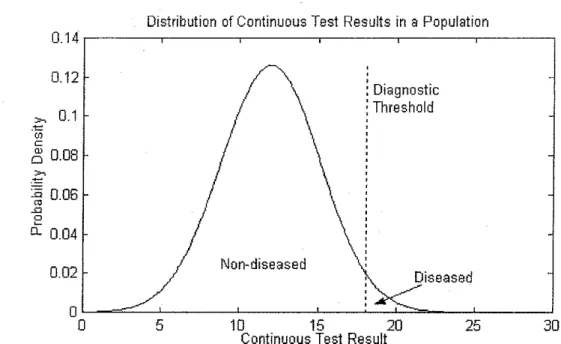
Distribution of Continuous Test Results in a Population
0.14 , - - - , - - - , - - - , - - - , - - - - , - - - ,
0.12
""' 0.1
·"§
c
~ 0.08
}5
"'
006.
-" 0
0: 0.04
0.02 Non-diseased
: Diagnostic :Threshold
Diseased
OL-~~~--~----~--~--~=---~----~
0 5 10 15 20 25 30
Continuous Test Result
Figure 7: Single-Distribution Model. A diagnostic threshold is used to subdivide
a single distribution into diseased and non-diseased individuals. Since this
distribution represents the known population of interest, selection of the threshold also determines the prevalence of disease.
Decisions are frequently rriade in clinical medicine based on continuous
distributions where the "diseased" distribution is unknown. Serum cholesterol
and systolic blood pressure, for example, represent measurements that have
defined diagnostic offs that divide patients into two groups. Yet, these
cut-offs are not easily determined by a comparison of the distributions of these
measures between diseased and non-diseased individuals. These cut-offs are
typically determined by consensus expert opinion in relation to the distribution of
values in the "normal" population. The difficulty arises because the underlying
diseases which these measures may reflect are continuums in and of themselves.
Diagnostic decisions are also frequently made on whether a laboratory value falls
the "single-distribution paradigm." This is also the paradigm that Brenner and
Gefeller used for their investigations.
Conceptually, a more useful view of the single-distribution paradigm may
be to think of the decision threshold as dividing individuals into "low-risk" and
"high-risk" groups for an underlying disease, such as coronary artery disease,
rather than "non-diseased" and "diseased." The motivation for this view is that
although we know the distribution of values in the population as a whole,
individuals with higher values are more likely to develop disease than those with
lower values. We also know that low values do not mean the individual is
without risk.
Figure 7 illustrates the single-distribution paradigm. The known
distribution, which is typically that of healthy individuals, is subdivided into
"diseased" and "non-diseased" on the basis of a decision threshold. Unlike the
classic paradigm, the threshold is both an integral part of the definition of
"disease" and determines the prevalence of"disease" in the population in this
paradigm. The two distributions are also no longer independent. In the absence
of noise and assuming no intra-subject variability, sensitivity and specificity are
both 100%.
Since the distribution of"diseased," or "high-risk," individuals and the
distribution of"non-diseased," or "low-risk," individuals are dependent on each
other, the addition of measurement uncertainty will affect test characteristics
based on the position of the threshold. Since the threshold also determines the
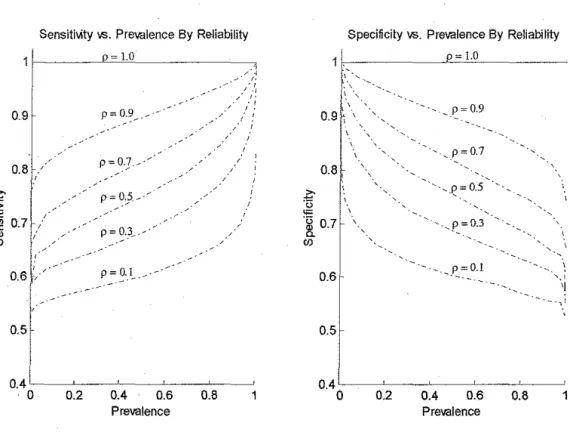
of noise. Figure 8 illustrates the affect of measurement noise on test
characteristics as a function of prevalence. This figure illustrates that even a
modest amount of noise can not only dramatically degrade the value of the test, it
does so extremely strongly as a function of prevalence. Since the reliability of the
measurement can be degraded by making measurements from an individual from
a subgroup with a different distribution, modest subgroup variation can still result
in significant degradation of test characteristics. For example, measurements of
liver enzymes are affected by BMI, age, and gender 51 Brenner and Gefeller also
show similar patterns for positive and negative predictive values and likelihood
SensitMty vs. Prevalence By Reliability Specificity \1'5. Prevalence By Reliability
= LO p= 1.0
0.9 p=0.9
~·--~--·
0.8
~
""
-~ 0.7(f)
'· ' 0.6
0.5
0.4'----~-~-~--~-~ 0.4L--~-~--~-~-~
·0 0.2 0.4 0.6 0.8 0 0.2 0.4 0.6 0.8 1
Prevalence Prevalence
Figure 8: Variation of test characteristics in the single-distribution model versus
prevalence by varying levels of measurement reliability. There is a significant dependence of the test characteristics on "disease" prevalence in the presence of reduced measurement reliability. 1bis simulation was based on a normal
distribution with variance 4. Variance of the noise was computed as O"noU<e2 = ( O"di,tribution2- p*O"di,tribution2)/ p. Two hundred thousand samples contributed to each data point.
II.3.4 Discussion
Two paradigms exist in diagnostic testing. In the classic "two-distribution
paradigm," the characteristics of diseased and non-diseased individuals are
known. Based on this knowledge, optimal decision thresholds can be set after
taking into account the relative costs of false positives and false negatives.
Inherent in the "two-distribution paradigm" is the idea of separability. In general,
the farther apart the two distributions are the better the performance of the test.
The task in designing diagnostic instruments is to find the measure or set of
"non-diseased" distributions. A significant amount of attention has been devoted to this
paradigm, both in the design and analysis of such diagnostic systems. The ROC
curve, for example, is a construct that allows rapid assessment of the separability
of two distributions.
By contrast, the "single-distribution paradigm" makes use of a kuown
distribution and makes diagnostic decisions regarding individuals at the tails of
the distribution. Very little is kuown about the diagnostic characteristics of this
system, yet this paradigm is used on a daily basis in every medical practice.
Adverse event monitoring in clinical trials uses this paradigm as well. For
example, studies of tacrine for Alzheimer 's disease monitor alanine
aminotransferase levels in relation to multiples of the upper limits ofnormal52
Brenner and Gefeller have made a major contribution by highlighting the
problems with this system. As the simulations in the previous section show, even
small decreases in measurement reliability can have dramatic effects on test
characteristics. Since this paradigm is used on a daily basis, the implications for
health care resource use can be enormous. Simply by conceptualizing individuals
as "low-risk" or "high-risk" (for coronary artery disease, for example), there are
major implications in terms of resource use.
Perhaps the greatest flaw with the "single-distribution paradigm" is that
there is no way of telling how useful a particular measure is for diagnosing
individuals or for quantifying error rates. Since there is no second distribution
with which to compare normal and diseased individuals, measures of separability
Furthermore, withoutthe second distribution, one cannot calculate sensitivity and
specificity for a test and know how it relates to the disease of interest. Simply, the
truth about disease state is unknown and, therefore, no inferences based on
disease state can be made.
From the standpoint of subgroup variation, measurement noise does not
create spurious prevalence-dependent subgroup variation when present in the
classic "two-distribution paradigm" and it does in the "single-distribution
paradigm." However; if measurements from the two subgroups in the classic
paradigm are subject to different reliabilities, then one can have
prevalence-independent subgroup variation. Diabetics, for example, have lower variability in
cholesterol measurements than non-diabetics. 53
III
Current Approaches
A significant amount ofliterature has been devoted to the problem of
imperfect reference standards and, increasingly, to analysis of subgroup variation.
Methods for addressing the imperfect reference range from correction and
estimation procedures to methods for augmenting less than perfect references in
the hope of improving their accuracy. Since the focus of this paper is on
subgroup variation, the focus here will be on methods that use subgroup variation
to arrive at estimates of both the reference and the new test's characteristics.
Emerging methods for handling covariates affecting test characteristics are
these methods. In addition, an interesting paper addressing subgroup variation in
clinical decision making will also be discussed.
III.l
Imperfect Reference Standards
As illustrated earlier, the imperfect reference is a common problem. Even
if a perfect reference exists, it may be too expensive or invasive to be used on a
scale that would provide accurate estimates of a new test's characteristics. Since
new tests continue to be developed, and these tests need to be evaluated, methods
for addressing this problem are required. Approaches for handling this problem
have proceeded on two fronts: estimation procedures and augmentation methods
for improving the accuracy of available reference tests. A brief description of
estimation approaches and augmentation procedures will be given. This will be
followed by a consideration of the usefulness of subgroups in test parameter
estimation.
Ill.l.l Estimation Procedures
Estimation methods range from very simple algebraic methods to very
complex iterative methods. Gart and Buck in 19663 and Staquet, et al.,4 in 1981
described simple algebraic procedures for correcting reference test bias. Hui and
Walter54 published a procedure based on maximum likelihood estimation in 1980,
which served as a starting point for many of the more statistically rigorous
techniques is driven by the need to account for conditional dependence between
tests. See En0e, eta!., for a review of these methods55
Conditional independence, the property of two tests where the probability
of one test's result for a given disease state is not related the probability of the
other test's result for the same state, is difficult to satisfy in reality. If both tests
rely on blood sampling, then sampling error would affect both tests. If an
imaging test is used as a reference for another imaging test, then anatomical
features influencing diagnosis are likely to be present in both. Independence of
tests is more likely when the physical basis of the tests is very different. An
example would be the diagnosis of cancer by immunofluorescence of a tumor
specimen and the detection of a mass on cross-sectional imaging.
Early methods, such as those by Staquet, eta!., and Hui and Walter
assumed conditional independence. Unfortunately, significant biases can be
introduced when methods depending on conditional independence are used to
evaluate conditionally dependent tests. See Torrance-Rynard and Walter for an
analysis of this effect56 As a result, these simpler methods are not widely applicable.
Latent class methods represent a special case. In this approach, there is no reference test and true disease state is considered latent, or unobservable. The
results from multiple tests are used together to arrive at an estimate of the true
state via iterative maximum likelihood estimation procedures. In the case of
conditional independence, a minimum of three tests is required. Methods that
simultaneously applied tests. 57 Like other approaches, using a three-test method
that is intended for use when the tests are conditionally independent when the
tests are actually conditionally dependent will result in biased estimates. 58 Albert
and Dodd demonstrated that incorrectly specifYing the nature of the dependence
also results in biases. 57
Finally, Bayesian approaches exist for the estimation of test parameters as
well. These require selection of prior probability distributions that model already
known characteristics of tests. An overview is also given in Enoe, eta!. 55
ill.1.2 Augmentation Methods
Augmentation methods typically make use of a series of additional tests to
improve the accuracy of the imperfect reference. Two methods will be mentioned
here: discrepant analysis and composite references. Since these methods rely on
imperfect reference tests, observed test characteristics vary with prevalence.
Their use, therefore, does not eliminate the possibility of spurious subgroup
variation. Discrepant analysis was used frequently in the evaluation of
microbiological tests, but its use has since declined with recognition that this
method has inherent limitations. Composite references seek to address the
problems with discrepant analysis in a more bias neutral way.
Discrepant analysis is a method for improving the estimates of a new
test's characteristics via the resolution of discrepancies58·59•60 Discrepant analysis
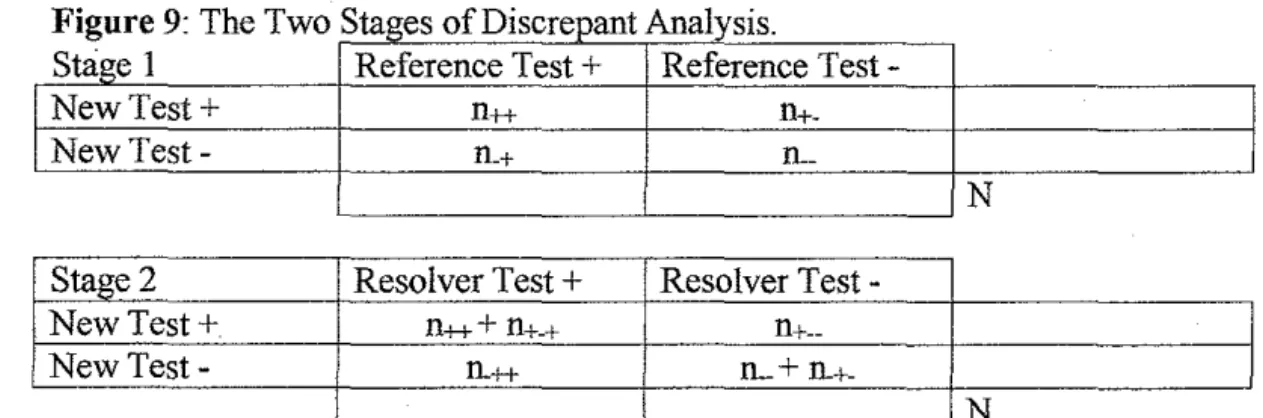
is a two-stage process, which is illustrated in Figure 9. In stage one, both the new
corresponding to each combination of test results is denoted nij, where i and j refer
to the test result (+ or-) for the new and reference tests, respectively. In the
second stage, individuals with discrepant results, represented by the n+. and n.+
cells, are tested again with the resolver test. The results of the resolver test trump
the result of the reference in the first stage. Therefore, a proportion of subjects
classified as false negatives in the first stage are reclassified as true negatives.
Likewise, a proportion of subjects classified as false positives are reclassified as
true positives. The effect of these two reclassifications is that the sensitivity and
specificity observed for the new test in the first stage is improved in the second
stage. This process is inherently biased.
Figure 9: The Two Stages of Discreoant Analysis.
Stage 1 Reference Test+ Reference Test
-New Test+ n++
n+-New Test- n.+ !L
N
Stage 2 Resolver Test+ Resolver
Test-New Test+ ll+++ ll+-+
ll+--New Test- ll.++ lL +
ll.+-N
The number of subJects occumng wtth each combmatwn of test 1s giVen by nijk, where i, j, and k represent the test results ( + or-) for the new, reference, and resolver tests, respectively. A third subscript is present only when the resolver is invoked. In the second stage, discrepant results are resolved by the resolver test. The resolver trumps the reference for purposes of assigning subjects with
discrepant results to a cell in the second stage.
Hadgu,61 Miller,60 and Lipman and Astles62 have described the bias
inherent in discrepant analysis when the resolver is 100% accurate. Since there is
negative, discrepant analysis falsely improves the new test's sensitivity and
specificity. Since an imperfect reference is involved, the magnitude of the bias is
dependent on prevalence.60 Thus, spurious subgroup variation is possible when
using discrepant analysis in subgroups with differing prevalences. When the
resolver is not 100% accurate biases may be larger in magnitude, but may be in
either direction. 63 When the new test and resolver test are not conditionally
independent, biases can also be significantly larger. 60
Composite reference tests address the shortcomings in discrepant analysis
in two ways. First, the reference test is a combination of tests that are chosen for
their complementary characteristics. Several highly specific tests with less than
perfect sensitivities but with differing underlying technologies, such as culture
and polymerase chain reaction (PCR), are combined such that the sensitivity of
the composite is greater than for each test alone. Second, unlike discrepant
analysis, evaluation ofthe "true" state of a subject is independent of the new test.
All subjects have the opportunity to be evaluated by all tests in the reference
independent of the result of the new test.
The execution of the composite reference can be done sequentially or all at
once. In sequential testing, tests are performed in a set order. The idea is to select
the initial tests to have perfect specificity. These tests are performed until one of
the tests is positive. Since a perfectly specific test does not make false positive
errors, the sequence can be stopped64 Alternatively, perfectly sensitive tests
could be chosen and the sequence executed until a negative test result is achieved.
PCR, for the evaluation of an enzyme immunoassay (EIA) for Chlamydia
trachomatis58 Sequential testing also has the potential to save resources by
limiting the total number of actual tests performed.
Although sequential application of the reference tests is attractive, there is
one potential problem. Delay in obtaining the additional tests in the sequence could result in interim changes in a subject's disease state. Thus, the new test and
one or more of the initial reference tests are making measurements on one disease
state while subsequent measures are measuring a different disease state.
Implementation of sequential testing procedures should ensure that all tests be
performed within a relatively small time window.
The evaluation of tests intended for screening applications is a special case
where a composite reference is required. For example, finding an abnormality on
screening mammography initiates further testing, including additional imaging
and potentially biopsy. For evaluation of negatives, it is not feasible or ethical to
subject every woman with a negative mammogram to additional studies.
Long-term follow-up is, therefore, required to adjudicate the "true" state. Another
example would be the comparison of thin-prep and liquid-based cytological
methods for cervical cancer detection. Follow-up is the only way to ascertain true
ll.1.3 Using Subgroup Variation For Test Characteristic Determination
To this point, prevalence-dependent subgroup variation due to an
imperfect reference has been presented as something to be avoided. Here,
however, the use of this type of subgroup variation to determine the
characteristics of the reference test is presented. Since imperfect reference tests
are commonly employed, it would be helpful to know what the actual
characteristics of the reference are in the populations being studied. Even
augmented references should be evaluated in this retrospective fashion to have an
idea of how much bias may be present in the data.
The use of subgroup variation to help with estimation of test
characteristics when the characteristics of the reference test are unknown was first
developed by Hui and Walter in 198054 Under the assumption that variation is
due only to differences in disease prevalence between the groups and that both the
reference test and the new test have the same, albeit unknown, characteristics in
both subgroups, they derived closed form expressions for estimates of both test's
sensitivity and specificity and the actual disease prevalences in each group. As
noted previously, a significant amount of work has been done to extend Hui and
Walter's original work However, the active use of subgroups to quantify the
effects of an imperfect reference is quite limited in the diagnostic test literature.
Two examples are Shaw et al65 and Berger et al66 in the human literature. See
En0e et al55 for additional examples from the human and veterinary medicine
In this section, Hui and Walter's closed-form estimation equations and an
alternate derivation based on Staquet et a!.' s work resulting in a somewhat
different set of equations will be presented. Simulations are presented to
understand the behavior of these equations under a variety of situations. Figure
10 shows the 2x2 contingency tables for the two subgroups and the notation used
in the formulas.
Figure 10· 2x2 Contingency Tables for 2 Subgroups with Different Prevalences
Subgroup 1 Reference Test+ Reference
Test-New Test+ a1 bl
New Test- C! dl
e1 =a1+c1 fl = bl+dl
Subgroup2 Reference Test+ Reference
Test-New Test+ a2 b2
New Test- c2 d2
ez-a2+c2 fz- b2+d2
..
SensRef, SpecRer- SensitiVIty and specifiCity of the reference SensNew, SpeCNew- Sensitivity and specificity of the new test
ID.1.3.1 The Equations of Hui and Walter
gl = a1+b1 h1 = C1+d1 N1
gz = a2+b2 h2 = Cz+d2 N2
Starting with a multinomial model, Hui and Walter derived closed form
expressions for the sensitivities and specificities of both the reference and new
test and the disease prevalences in the two subgroups via the method of maximum
Figure 11· Cell Probabilities Used in the Multinomial Model
Reference Test+ Reference
Test-New Test
+ Previ * SensNew * SensRef Previ*SensNew *(1-SensRef) + (1-Prev;)*(1-SpecN,w)*(1-SpecR,r) + (1-Prev;)*(1-SpecN~,)*SpecR,f
New Test
-
Previ*(l-SensNew)* SensRef Prev; *(1-SensNew)*(l-SensRor)+ (1-Prev;)*SpecN,w *(1-SpecR,r) + (1-Prev;)*SpecN,w *SpecRef
P mu tmomra I • . I ==
n' "
1v1. -1 :_P-:.( R::eeflcce:c.s:....l+:.:_, N.,.:-ewc..T,:....e.:.:st_:_+ )'-"-,P_,( R:c.ecc'fl:....e.:.:st-:-,.:.:N..:._ew:_::'J,.::.:es::_t+"')_•;,1 ad bd
* P(Re/fesl+, NewTest-)"' P(Rejrest-,NewTest-l'
cd dd
Using the notation used by Enoe et al.,55 tbe equations they derived are:
S ensRq
=
(g,e,- e,gJINN, + aJN,- a/N, + F,
2(gJN,- g/NJ
S peCR<if = (fih,-hfJINN,+d/N,-dJN,+F . , 2(gJM- g/NJ
Prev,
=
0_5 _ [(g/NJ(e/N,- eJNJ
+
(e/NJ(g/N,- gJNJ+
aJM- a/N,]'. 2F
Prev,
=
0_5 _ [(g,/N,)(e/N,-eJNJ+(e,/N,)(g/M- g/NJ+aJM-a/M]'
2F
Where,
it is unlikely that a worthwhile reference test will have a sensitivity or specificity
less than 0.5, it should be easy to select the appropriate solution. Prior knowledge
about the test should also be helpful in selecting the appropriate solution. Another
difficulty is that division by zero is encountered in the test parameter formulas
when the new test's parameters (SensNew and SpeCNew) are being calculated and
the measured prevalences as determined by the reference test are equal between
the two subgroups and vice versa. In situations were there is insufficient prior
information to help select the appropriate solution or one is near a singularity,
iterative methods will be required.
III.1.3.2 Direct Algebraic Approach
III.1.3.2.1Reference Test Characteristics Known
Figure 12: 2x2 Contingency Matrix Showing Cell Count Corrections For Imperfect Gold Standard With Known Characteristics
Reference Test+ Reference
Test-New Test+ (a-b*(l/SpecRe~·-1))/SensR,f (b- a*(l/SensRer- 1))/SpecRef
New Test- (c- d*(l/SpecRer- 1))/SensRef (d- c*(1/SensR,r-1))/SpeCRef
As preamble to the derivation for the case with unknown reference test
characteristics, formulas for the estimates of the new test's characteristics when
the reference test characteristics are known are given here. Both Staquet et a!. 4
and Gart and Buck3 provide algebraic methods for correcting observed test results
shows the corrections for known reference test characteristics to the observed cell
counts. Formulas for sensitivity, specificity, and prevalence follow from these
corrections:
S enSNew = (a+b)*Spec&J-b ,
N* SpeC&J-(b+d)
S ~eCNew
=
(c+d)*SenSReJ-C,
N* SenSReJ-(a +c)
Prev= N*(SpecR<J-l)+(a+c). N
*
(SensRef+
SpeC&f -1)With these equations, special cases can be considered. First, we note that
the correction for sensitivity is dependent only on the specificity of the reference
and the correction for specificity is dependent only on the sensitivity of the
reference. Thus, in the event that the reference test is known to have 100%
specificity, the observed sensitivity is no longer biased:
a
SensNew
=
~-, SpeCReJ= 1.0 a+cSimilarly, if the reference test is known to have 100% sensitivity, then the
observed specificity is no longer biased:
d
SpeCNew
= - - ,
SenSRej= 1.0 b+dIfboth tests have 100% specificity, then the sensitivities of the two tests are:
a a
SensNew