Prostate Cancer Screening
Do I or Don't I Participate?
Identifying Predictors of Sustained Participation in Screening Programs
Roxanne Smith
University of North Carolina at Chapel Hill School of Public Health
A Master's Paper submitted to the faculty of The University of North Carolina at Chapel Hill in partial fulfillment of the requirements for the degree of Master of Public Health in
the Public Health Leadership Program
Abstract:
Background: Prostate cancer is the most common cancer in American men and is now the second leading cause
of cancer death in men, exceeded only by lung cancer. It is estimated that in 2003, approximately 220,900 new cases and 28,900 prostate cancer related deaths will occur in the United States. The natural history of prostate cancer in not very well understood, although three main risk factors have been identified; age, African American race and family history.
Survival in men with prostate cancer is related to many factors, one of the most important being
extension of the tumor beyond the prostate capsule at the time of diagnosis. Therefore, a screening program for prostate cancer should ideally identi.ty those men with more aggressive tumors that have not spread beyond the prostate capsule. One ofthe most controversial topics of discussion in prostate cancer has been regarding the efficacy of screening. The goal of screening is to detect disease early enough that intervention can be applied so as to reduce mortality, however this has not been proven in regards to the modalities used for prostate cancer
screening.
Despite the variations in recommendations for screening, some clinicians and researchers believe there
is benefit to screening at risk men, particularly African Americans and those with a family history of prostate
cancer. However, many men in these high-risk categories, for a variety of reasons, do not participate in prostate cancer screening. Men who have been identified as least likely to participate in prostate cancer screenings are
African American, 50-59 years of age, and those with low SES. Predictors of participation in health promoting behaviors such as cancer screening that have been documented in the literature include demographlcs and perceived benefits. Demographlcs include age, race and socioeconomic status. Perceived benefits are described as beliefs about the effectiveness of the recommended action in reducing the health threat. The purpose of this work is to identifY fuctors associated with sustained participation in free prostate cancer screening programs among hlgh risk men.
Methods: Thls is a case-control study of participants in a free prostate cancer screening program database. The men volunteered for screening at the annual free screening program at least one year during the study period from 1998-2001. Demographlc data was collected from all screening participants and entered into a database. The participants were also asked to include the most important reason they chose to participate in a free prostate cancer screening program. Analysis of the demographic data includes identification of predictors of men who
are non-sustainers, and how they compare to sustainers. Non-sustainers are idenitified as men who participated in screening one year, but did not participate in subsequent years.
Results: There were I 024 participants in the free prostate cancer screening program. Thirty-six percent were identified as sustainers. Whites were more li.ke than African Americans to be sustainers, however this was not significant. Those with some college education or more were more li.kely to participate in the free screening program however when compared to those with higher levels of education, all other groups were more li.kely to be sustainers; though only high school graduates were significantly different. Employment status, having a regular physician or havi.ng a close acquaintance with prostate cancer does not significantly influence sustained participation in the free screening prognnn. The most important reasons reported for participation the screening
program were convenience and cost.
Conclusions: Demographic cannot be used as predictors for participation in a free prostate cancer screening
prognnn.
,_ __
~-Introduction:
Prostate cancer is the most common cancer in American men and is now the second
leading cause of cancer death in men, exceeded only by lung cancer.1 It is estimated that in
2003, approximately 220,900 new cases and 28,900 prostate cancer related deaths will occur
in the United States. Prostate cancer comprises approximately 30% of all cancer cases
diagnosed among Native Americans and Asian Americans, 37% for Caucasians and
Hispanics, and half of all cancers in African Americans? A man's lifetime risk of
developing prostate cancer is 1 in 6.
The natural history and pathophysiology of prostate cancer is not very well
understood, although three main risk factors have been identified; age, race and family
history.3 Prostate cancer is rare in men under age 50, but the incidence increases
exponentially each decade thereafter. One's risk of developing prostate cancer increases
with age such that men 39 years old or younger have less than a 1 in 10,000 chance, men
40-59 years old have a 1 in 55 chance and men 60-79 have a 1 in 7 chance in developing
prostate cancer. In this older age category African American men have a 60% higher
incidence of prostate cancer than Caucasian men.1,2·4
.s
The age-adjusted incidence is higherin African American males (243.2 per I 00,000) compared with white males (144.6 per
100,000).2 African American males have a higher mortality from prostate cancer even after
d . . "' "' 56
a JUSting >Or access to care .actors. ,
Men with a family history of prostate cancer are at increased risk compared to men
without a family history of the disease.1 Non-hereditary familial clustering is estimated to
L
L
;
__cancer have a threefold increased chance of developing it by age 70 compared to the average
individua1.2
Survival in men with prostate cancer is related to many factors, one of the most
important being extension of the tumor beyond the prostate capsule at the time of diagnosis.
The ten-year survival among men with cancer confined to the prostate is 75%, compared
with 55 and 15% respectively, among those with regional extension and distant metastases. 4
Therefore, a screening program for prostate cancer should ideally identify those men with
more aggressive tumors that have not spread beyond the prostate capsule. One of the most
controversial topics of discussion in prostate cancer has been regarding the efficacy of
'i---screemng. The goal of screening is to detect disease early enough that intervention can be
applied so as to reduce disease-related mortality, 7 however this has not yet been proven in
regards to the modalities used for prostate cancer screening. Digital rectal exam (DRE) and
measurement of serum prostate specific antigen (PSA) are the most widely used screening
tests for prostate cancer.4 A current review of the literature gives a very mixed picture in
regards to the efficacy of prostate cancer screening, with some studies showing a beneficial
impact of screening, where others do not4•8•9•10.li,IZ.J3
Although mortality rates for prostate cancer in the United States have declined by
4.5% since the introduction ofPSA testing in 1994,4 it is possible that screening programs
are not solely responsible for this improvement. It is not certain whether lead time and
length time biases may also account for some of these changes in survival. Alternative
explanations such as improved treatment also cannot be ruled out. Other significant
arguments against screening are centered on the issue of overdiagnosis; specifically the
indolent disease and older men are more likely to die from some other cause. 4 Similarly, a
positive screening test may lead to large numbers of men having significant side effects, such
as impotence or urinary incontinence, from therapy for prostate cancer with little or no
benefit in cancer morbidity and mortality.
Given this ambiguous evidence and the significant burden of disease, current
recommendations for DRE and PSA screening vary. The American Cancer Society
recommends that both PSA testing and DRE be offered annually, beginning at age 50, to men
who have at least a 10-year life expectancy. Men at high risk, such as African Americans,
should begin testing at age 45. Men at even higher risk, due to multiple first-degree relatives
affected at an early age, could begin testing at age 40.14 The American Urological
Association recommends annual screening with PSA and digital rectal exam beginning at age
40 for African American men and those with a family history of the disease and age 50 for all
other men,15 whereas the US Preventive Services Task Force earlier this year changed their
recommendations against screening to a rating of"I"- meaning there is insufficient to
recommend for or against screening.16
Despite the variation in recommendations for screening, several researchers
and clinicians believe there is benefit to screening at risk men, particularly African
Americans and those with a family history of prostate cancer. However, many men
in these high-risk categories, for a variety of reasons, do not participate in prostate
cancer screening. Men who have been identified as least likely to participate in
prostate cancer screenings are African American, 50-59 years of age, and
socioeconomically disadvantaged.17 Attempts to explain this phenomenon have
The Health Belief Model as formulated by Rosenstock is a predictor of preventive
health behavior. This model is based on values and expectations. It hypothesizes that
people will generally not attempt to diagnose or prevent a condition unless they
possess minimal levels of relevant health motivation and knowledge, perceive
themselves as potentially vulnerable and the condition as threatening, are convinced
of the efficacy of intervention, and see few difficulties in undertaking the
i'--recommended action.
Predictors of participation m health promoting behaviors such as cancer
t
screening that have been documented in the literature include demographics and
perceived benefits. Demographics include age, race and socioeconomic status.
l
Increasing age has been shown to be a predictor of decreased participation in cancer ~
I
f
screening. This observation is important in regards to prostate cancer, as it is known
that the risk of developing prostate cancer increases with age. However Tingen et a!
and Weinrich et a! have shown in their work that the opposite occurs with prostate
.
cancer. Tingen has documented that men age 60 - 70 years old are more likely to
L
participate in prostate cancer screening than men age 50- 59 years old.19•20,21 Race is
also a predictor of participation as it has been shown that white men are more likely
to participate in prostate cancer screenings. This low participation among African
Americans is of concern since African Americans have the highest incidence of
prostate cancer in the United States, have higher rates of metastatic disease, and have
decreased survival rates.1,2,J9•20 Similarly, a 1986 report by the American Cancer
participation, with those earning more than $50,000 per year being more like to
participate in prostate cancer screening.19•20,21
Perceived benefits are described as beliefs about the effectiveness of the
recommended action in reducing the health threat.18 This variable has direct impact on
whether or not one chooses to participate in screening. Important benefits that have been
documented include "early detection", "early treatment", "know if I have cancer", "know
that I am well", "so I can live longer", "stop cancer from growing", "learning the truth"?0
Perceived benefits that are specific to African Americans include "prevention of illness" and
"prevention of complications".22 Also important to consider are specific motivators of health
seeking behavior. Weinrich eta! identified age, family history of prostate cancer, urinary
symptoms and previous history of prostate cancer screening as motivators for participation in
prostate cancer screening.21 For African Americans, Plowden eta! identified resource
availability and the influence of significant others such as family and friends to be external
motivators. Internal motivators were identified as perceived disability and death from a
disease and unrelieved symptoms. Specifically health seeking behavior was linked to
perceived outcome of a specific event, i.e. disability or death?2 Nivens et a! have also
proposed that a relationship exists between overall exposure to prostate cancer information
and prostate cancer screening. In this Cue to Participation in Prostate Cancer Screening
Theory, Nivens suggests that men who recently have heard or read about prostate cancer
screening are more likely to participate in screening.17
Barriers to prostate cancer screening is defined as a conflict between two opposing
factors that prevents a behavior from occurring.22 Barriers as described by Weinrich et al
include embarrassment, sexual difficulty as complication of surgery, mistrust, cost, concern
L
r-
,-
J--'
about abnormal test results or cancer, lack of knowledge ofthe health care system, not
having a regular doctor, inconvenient doctors hours, lack of cultural sensitivity programs,
and fatalism.21 Plowden et al also described the following barriers, which are of particular
importance among African Americans: lack of resources - money for special diets or
facilities that provide primary prevention interventions, transportation, inconvenient office
hours, limited knowledge of the health issues affecting African American men and
community based resources available to respond to those health issues, and perceived lack of
sensitivity and understanding by health care providers.22 Myers et al also described several
barriers to follow-up of abnormal prostate cancer screening results. Theses barriers included
concern about physical discomfort, time involved in going for further testing, worry that
further testing would cause health problems or that further testing may find prostate cancer
and concern that further testing would upset family members. 6
These studies and many others have attempted to evaluate predictors for participation
in prostate cancer screening, however, most of these studies have involved asking men of
their intent to participate in screening.19•20.21.22•23.24 Because a self-reported expression of
intent to have a screening exam has not been correlated with actual behavior18, the study
presented in this article will attempt to determine the predictors, motivators and barriers of
participation in men who are actively participating in screening. Men who participated in a
free prostate cancer screening program where given surveys to complete while at the
screening site, demographic information was collected as well as information on the reasons
Methods:
This is the first part of a larger case- control study whose overall objective is to
determine factors associated with regular participation of prostate cancer screening among
high-risk men. The purpose of this work is to identifY facilitators and barriers to PSA and
DRE prostate cancer screening among men in a southeastern city. Participants in the study
come from a free prostate cancer screening database. The men volunteered for prostate
cancer screening at an annual free screening program conducted at both a major academic
health system and a community health center in one southeastern city during the time period
from 1998-2001. Participants volunteered for screening on at least one occasion during the
study period. Demographic data was collected from all screening participants at the time of
screening and entered into a database. Data includes: date of birth, race, educational
attainment, employment, acquaintance with someone who has prostate cancer, having a
regular physician and PSA value. The participants were also asked to write in the most
important reason they chose to participate in a free prostate cancer screening program. This
researcher then organized these reasons into the following categories based on the 1997 pilot t
study and facilitators described by Weinrich eta!: (A) I believe at my age I should get the
digital rectal exam and PSA blood test done each year, (B) The free prostate cancer screening
program is convenient, (C) I believe in protecting my health, (D) My doctor encouraged me
to be screened, (E) If I had signs of prostate cancer I want to find out early so treatment
decisions can be made early, (F) My wife, family member or someone else close to me
encouraged me to be screened, (G) I believe that I am in control of what happens to my
health, (H) Getting prostate cancer screening gives me peace of mind, and (I) Other. This
screenmg programs. Analysis of the questionnaires will focus on identifYing facilitators and
barriers for men who are non-sustainers, and how they compare to sustainers. Sustainers are
men who participated in the screening program two or more years. Non-sustainers are
identified as men who participated in screening one year, but did not participate in
subsequent years. For example, a non-sustainer is one who participated in the free screening
program in 1998, but did not return for screening in 1999, 2000 or 2001.
Data was entered and validated by this researcher and analyzed by SAS. 8.2. The
analysis includes descriptive statistics and logistic regression. The purpose of the logistic
regression model is to determine if participant demographics have a predictive effect on the
primary outcome. The primary outcome examined in this study was sustained participation of
an annual free prostate cancer screening for two or more years. The variables for the model
are the baseline demographic variables of the participants collected at the time of initial
presentation in the free screening program. There are eight variables entered in the model;
age, race, education, employment, physician, family/friend (with prostate cancer), reason for
participation, and PSA. All variables are categorical; physician and family/friend are
dichotomized. Comparison is made of the characteristics of sustainers and non-sustainers in
free prostate cancer screening programs.
t
~--L
!
;
I
Results:
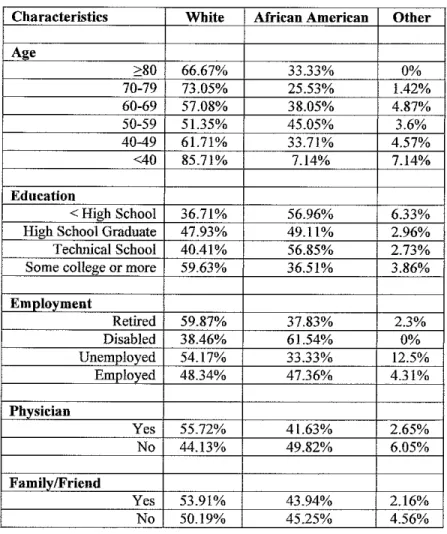
There were 1 024 participants in the free prostate cancer screening program between
1998 and 2001. Table 1. Forty four percent (n=454) of participants self-identified as
Black/African American and 51% (n=524) described themselves as White. Participants were
generally between the ages of 50-59, 36% (n=333), at the time of their initial screening.
Most participants of the program were well educated with 55% (n=513) having some college
education or more. An additional19% (n=175) and 16% (n=152) graduated high school and
attended technical school, respectively. Fifty nine percent (n=530) were employed and 36%
(n=322) were retired. Mrican Americans were of approximately the same age and
educational level as whites. Of those with a high school education, 49% were African
American and 47% were White. Within the 50-59 age category, 51% were White and 45%
were African American. The majority of participants had a regular physician, 68% (n=626)
and most did not have someone close to them with prostate cancer, 58% (n=546).
Ninety-two percent (n=931) of participants had a normal PSA value (less than 4ng/ml) at the time of
the initial screening. In summary the average participant was aged 50-59, employed, had
some college or more of education and had a regular physician.
Thirty-six percent (n=364) were identified as sustainers of the screening program.
Table 2. Whites were more likely than Blacks to be sustainers, however this was not
significant; OR=I.079 (CI 0.831- 1.401). Hispanics and Asians (referent group) were
significantly less likely to be sustainers, OR 0.344 (CI 0.150- 0.790). In a comparison of all
age groups, with those under the age of 40 used as the referent group, age was not found to
significantly influence sustaining in the program. Those with a high school or technical
school education were more likely to sustain than those with less than a high school
t
~--L
r---L
E
education, and those with some college education or more (referent group) were less likely to
sustain than those with less than a high school education. These results, however, were not
significant. Those with some college education or more were more likely to participate in the
free screening program, however when compared to those with higher levels of education, all
other educational groups were more likely to be sustainers; though only high school
graduates were significantly different, OR 1.501 (CI 1.054- 2.138).
In the under 40 age category participants were most likely to be Black. All of the
Black participants in this age category had some college education or more. Participation
among Blacks decreased with age, whereas participation increased with age among Whites.
Graph 1. Retirees and the disabled were more likely than employed people to be sustainers,
but this was not significant. Having a regular physician or having a close acquaintance with
prostate cancer does not significantly impact whether one will have sustained participation in
a free prostate cancer screening program. A PSA value between 4ng/ml and 10 ng/ml was
shown to significantly influence sustaining in the free screening program; OR 0.526 (CI
0.291 - 0.949). A logistic regression model was done as an exploratory analysis. This was
done to determine if any of the baseline demographic variables had an effect on sustaining in
the free screening program for this dataset. After controlling for race and education among
the educational categories, graduating from high school continued to significantly influence
sustaining in the program; p < 0.020. At an oc = 0.05 significance level, controlling for all
variables, only education was found to have an a significant effect on sustaining; p<0.0317.
The most important reasons reported for participation in the free prostate cancer screening
program were convenience and cost. Table 3.
t
~--Discussion:
Consistent with the literature, this study found that whites, 50-59 years old, and with
higher levels of education are active participants of prostate cancer screening. However, the
literature to date has suggested that African Americans, 50-59, were least likely to participate
in screening. This study, to the contrary, demonstrated a participation rate of 44% among
Blacks compared to 51% for whites. Blacks were of approximately the same age and
educational level as whites. It is difficult to pinpoint what may have attributed to the
excellent rate of participation among blacks, but advertisement of the screening program may
well have played a contributory role. Advertisement for this free screening was broad based
and involved newspaper, radio, mailed postcards and neighborhood flyers. Other studies have
shown that whites are most likely to hear of screening programs through newspapers and
blacks through the radio. Many participants in our study also reported they received a
postcard in the mail. Further research needs to be done to assess whether personalized
recruitment (i.e. postcard in the mail) rather than mass recruitment is a motivator for
participation among blacks.
The most interesting finding of this study was that participation decreases with age
among blacks, but increases with age among whites. Prior research reports that increasing
age is a predictor for decreased participation in cancer screening. However, Tingen et a1
revealed that among 60-70 year olds there was in an increase in participation as compared to
50-59 year olds.19 Additionally, previous studies in this region have shown no significant
difference in perception of risk for prostate cancer between blacks and whites, with both
groups reporting their risk as the "same as the average man", and similarly black men
white men.25• 26 However, other studies have shown that blacks were significantly less likely
to be knowledgeable of prostate cancer risk factors, including race and family history .26•27
Although no significant difference was found between education level and race, or education
and age, we did not assess the prostate cancer risk factor knowledge among participants. We
did note however that younger African American participants were more highly educated,
specifically all of the African American men in the under 40 age group had graduate or
professional education. We hypothesize that the younger black participants have an
increased knowledge base of prostate cancer risk factors and perhaps represents a new cohort
of African American participants. This group of men could also represent the phenomenon
seen in many primary care settings of the "worried well". These are individuals who are in
good health and are at low risk for certain disease entities, yet insist upon being screened or
tested for these diseases. It will be of interest to see whether this trend of increased
participation continues over time as this group of men ages to the appropriate screening age.
This study also found that education was significant predictor for sustained
participation in the free screening program. Education often serves a proxy for certain
factors related to health behaviors. In this case education may serve as a proxy for literacy
and one's ability to understand the controversies surrounding prostate cancer screening such
that one is able to make an informed decision. Or it may serve as a proxy for skill level and
suggest employability and therefore indicate whether one is able to have health insurance and
access to care. Additional research on predictors of health behaviors, especially among men,
will help to determine which is at play when we say education has a significant effect on
Based on education levels, employment status and number of participants reporting
they have a regular physician, one would expect that the majority of these men have health
insurance and therefore access to primary (preventive) health care services, yet the most
common reason for participation in the prostate cancer screening program was because it was
free. In prior research, the major barrier to participation in prostate cancer screening was
cost.19 In another study of knowledge, attitude and beliefs about prostate cancer screening in
African Americans, the authors found 88% if the subjects believed it would be best to
participate in prostate cancer screening, with 80% agreeing to have annual screening
provided it was free.23 One hypothesis is that "free" carries additional value besides
monetary. More work will have to be done to assess what connotation "free" carries in
regards to the importance of health care services, but perhaps because health care services
traditionally carry a cost, when it is offered to the public as free it implies some increased
level of magnitude or consequence. In other words these men may think "health professionals
must believe this disease is so significant that they offer a free screening to make sure I have
access to it".
Also important to get more understanding of is the reason that these highly educated
men who seemingly have access to the health care system would choose to participate in
mass prostate cancer screening, including both a DRE and PSA, rather than having these tests
done in the privacy of their physician's office. While little is known about the motivators for
men in regards to participation in cancer screening, the participants in this study listed
convenience high among their reason for participation. The men reported that they preferred
not having to take off from work or make an appointment. There is conflicting data in the
most popu1ar among whites, whereas private appointment in a prostate cancer-screening
program was the preferred method for blacks. To some extent there is also a certain degree
of anonymity when one participates in a mass screening program, conceivably this as well
may be a motivating factor for men.
Limitations of this study include that is the study was conducted in one single
geographic location. It may be difficu1t to generalize the resu1ts of this study to other areas in
the United States. Similarly, the study involves a self-selected popu1ation of men who chose
to attend prostate cancer screening events. Our resu1ts are encouraging however, because this
region is known to have one of the highest prostate cancer rates in the nation and the fact that
we had such a high participation rate among African Americans suggests that these men are
becoming more knowledgeable about their risk factors. Also the fact that demographics were
not predictors of sustained participation suggests that participation cannot be attributed to
race or socioeconomic status alone. Helpful information will gathered in the remainder of
this study that addresses barriers to participation among those who did not sustain in the
program. Another limitation is that information obtained was by self-report and thus there is
not way to validate the accuracy of the information collected. And finally, participants came
to this event because it was free and convenient. As of now there is no information collected
on how the men are following up if they have an abnormal result. If cost is a primary
motivator of participation it is prudent that follow up care is also free and convenient.
Figure 1.
Perceived Suseptibility to Disease X Perceived Severity of Disease X
Demographic variables (age, sex, race,
ethnicity, etc.)
Sociopsychological variables (personality, social class, peer and reference group pressure)
Perceived Threat of
Disease X
Cues To Action
Mass media Campaigns Advice from others
Reminder postcard from physician
or dentist
Illness of family member or friend
Newspaper or magazine article
The Health Belief Model
Perceived benefits
of preventive action
minus
Perceived barriers to
preventive action
Likelihood of Taking
Recommended Preventive
Health Action
t
L
.
l
= '
r
~-Table 1.
Characteristics White
A"e
>80 66.67% 70-79 73.05% 60-69 57.08% 50-59 51.35% 40-49 61.71% <40 85.71%
Education
<High School 36.71% High School Graduate 47.93% Techoical School 40.41%
Some college or more 59.63%
Employment
Retired 59.87% Disabled 38.46% Unemployed 54.17% Employed 48.34%
Phvsician
Yes 55.72% No 44.13%
Family/Friend
Yes 53.91% No 50.19%
t-Table 2.
Sustainers Non Sustainers OR(95 %CI)
A-~
N*~364 N*~660 (95%
A2e n*-358 n*-574
>80 3.63% 2.44% 2.32 (0.76 -7.08) 1.68 (0.43 6.64)
70-79 15.64% 14.81% 1.65 (0.68- 3.99) 1.30 (0.44- 3.83)
60-69 29.05% 21.43% 2.11 (0.89- 4.99) 1.38 (0.51-3.75)
50-59 32.68% 37.63% 1.35 (0.58- 3.17) 0.96 (0.37- 2.50)
40-49 16.76% 20.21 % 1.29(0.53-3.11) 0.91 (0.34- 2.44)
<40 2.23% 3.48%
Race n~357 n-573
White 53.50% 50.79% 2.65 (1.12- 6.13) 2.98 (0.98- 8.94)*
Black 44.54% 44.33% 2.50 (1.06- 5.87) 2.85 (0.95- 8.59)*
Other 1.96% 4.89%
Education n-323 n-566
<High School 9.60% 8.48% 1.32 (0.81- 2.16) 1.08 (0.59- 1.96)
High School Graduate 21.98% 17.31% 1.49 (1.04 -2.13) 1.75 (1.17 -2.64)*
Technical School 18.27% 15.55% 1.37 (0.94- 2.01) 1.62 (1.05- 2.50)
Some college or more 50.15% 58.66%
Employment n-317 n-587
Retired 39.12% 33.73% 1.24 (0.92 -1.65) 1.03 (0.67- 1.59)
Disabled 3.15% 2.73% 1.24 (0.55 -2.78) 0.86 (0.35- 2.13)
Unemployed 1.58% 3.58% 0.47 (0.18- 1.27) 0.58 (0.18- 1.82)
Employed 56.15% 59.97%
Physician n-327 n-595
Yes 71.56% 65.88% 1.30 (0.97 -1.75) 1.16 (0.82 -1.64)
No 28.44% 34.12%
Family/Friend
Yes 45.37% 39.50% 1.27 (0.97- 1.67) 1.30 (0.96- 1.78)*
No 54.63% 60.50%
PSA n-356 n-660
>10 1.97% 1.82% 1.04 (0.41-2.67) 0.562 (0.16- 1.95)
4-10 4.21% 7.73% 0.53 (0.29 - 0.95) 0.340 (0.16- 0.71)
<4 93.82% 90.45%
..
N differs from n at each vanable because not all participants responded to that questiOn
t Each factor is adjusted for all other factors: age, race, education, employment, physician, family/friend, reason and PSA
Table 3.
Other Important Reasons for Participation in the Free Prostate Cancer
Screening Program
Reason for participation
Free/Insurance/Financial
Participated in this screening program in the past Heard about program/Received flyer in the mail Time for a "check up"
Cancer center reputation
Second opinion/additional check No regular doctor
Urological Symptoms
Family history/Know someone with prostate cancer Regular Doctor does not recommend screening To learn more information about prostate cancer Regular doctor unavailable/schedule conflict PSA test (blood work)
Never screened before
Doctors here are more knowledgable than personal doctor Volunteer in screening program
Previous diagnosis of prostate disease Did not know which urologist to go to PSA results confusing
Less embarrassing
Free screening program will be more truthful Community committed to the health of its citizens More comfortable
Hesitant to see regular doctor Enjoy fellowship with friends No Urologist
AARP
Support the Cause
Frequency
368 115 66 53 53 48 31 20 16 15 12 12 9 7 3 2 2 1 1 1 1 1 1 1 1 1 1 1These reasons were written in by participants at the time of screening- includes reasons from all visits not just
baseline.
i
L
Graph I.
Age Distribution of Participants in Free Prostate Screening Program by Race
90
80
70
60
50 'E
w
"
-w
a.
40
30
20
10
0
<40 40-49 50-59 60-69 70-79 ?80
Age
References:
1. Screening for Prostate Cancer. National Cancer Institute. http://cancer.gov Last accessed July 1, 2003
2. Sakr W A, Ward C. Epidemiology of Prostate Cancer, Prostate Cancer Screening. Edited by Thompson IM, Resnick MI, Klein EA. HumanaPress. New Jersey 2001; 1-23
3. Key T. Risk Factors for Prostate Cancer. Cancer Surveys. 1995;23: 63-74
4. Brawely 0, Garnick MB. Risk factors and Screening for Prostate Cancer. UpToDatel1.2. http://www.utdol.com. Last accessed July 23, 2003.
5. Brawley OW, KnopfK, Merrill R. The Epidemiology of Prostate Cancer Part I: Descriptive Epidemiology. Seminars in Urological Oncology. 1998; 16: 187-192
6. Myers RE, Hyslop T, WolfTA, Burgh D, Kunkel EJS, Oyesanmi 0, Chodak GJ. African American Men and Intention to Adhere to Recommended Follow-Up for an Abnormal Prostate Cancer Early Detection Examination Result. Urology. 2000;55: 716-20
7. Prostate-Specific Antigen (PSA) Best Practice Policy. From the American Urological Association. Oncology. 2000;14
8. Friedman GD, Hiatt RA, Quesenberry CP, Selby N. Case-control study of screening for prostatic cancer by digital rectal examinations. Lancet. 1991;337:1526-1529
9. Jacobsen SJ, eta!. Screening digital rectal examination and prostate cancer mortality: A population-based case-control study. Urology. 1998;52:173-179.
10. Concato J, et al. A nested case-control study of effectiveness of screening for prostate cancer: research design. J Clin Epi. 2001;54:558-564.
II. Hankey, BF eta!. Cancer surveillance series: interpreting trends in prostate cancer-part I: Evidence ofthe Effects of Screening in Recent Prostate Cancer Incidence, Mortality, and Survival Rates. JNCI. 1999;91: 1 017-24.Gann PH, Hennekens CH, Stampher MJ. A Propsective Evaluation of Prostate-Specific Antigen for Detection of Prostatic Cancer. JAMA. 1995; 273:289-94.
12. Gann PH, Hennekens CH, Stampher MJ. A Prospective Evaluation of Prostate-Specific Antigen for Detection of Prostatic Cancer. JAMA. 1995 ;273: 289-94
13. Catalona WJ, Smith DS, RatliffTL, Basler JW. Detection of organ confined prostate cancer is increased through prostate-specific antigen-base screening. JAMA.
1993;270: 948-54
t--F
.
14. ACS Cancer Detection Guidelines. http://www.cancer.org. Last retrieved July 23, 2003
15. Causes, Natural History & Diagnosis of Prostate Cancer. American Urological Association. http://www.urologyhealth.org. Last retrieved July 23, 2003
16. Harris R. Updated USPSTF Recommendations Table. Lecture- Prevention Strategies for Clinicians, UNC-Chapel Hill, School of Public Health. December 2002.
17. Niven AS, Herman JH, Weinrich SP, Weinrich MC. Cues to Participation in Prostate Cancer Screening: A Theory for Practice. Oncology Nursing Forum. 2001;28: 1449-56
18. Becker MH, Mairnan LA. Sociobehavioral Determinants of Compliance with Health and Medical Care Recommendations. Medical Care. 1975;13: 10-24
19. Tingen MS, Weinrich SP, Boyd MD, Weinrich MC. Prostate Cancer Screening: Predictors of Participation. Journal ofthe American Academy of Nurse Practitioners. 1997;9: 557-67
20. Tingen MS, Weinrich SP, Heydt DD, Boyd MD, Weimich MC. Perceived Benefits: A Predictor of Participation in Prostate Cancer Screening. Cancer Nursing.
1998;21 :349-57
21. Weinrich SP, Reynolds W A, Tingen MS, Starr CR. Barriers to Prostate Cancer Screening. Cancer Nursing. 2000;23: 117-21
22. Plowden KO, Miller JL. Motivators of Health Seeking Behavior in Urban African American Men: An Exploration of Triggers and Barriers. Journal ofNational Black Nurses Association. 2000; II: 15-20
23. Myers RE, WolfTA, Balshem AM, Ross EA, Chodak GW. Receptivity of African American men to prostate cancer screening. Urology 1994; 43:480-7