ABSTRACT
Objective: This paper evaluates the effect of the 2009 revisions to the Special
Supplemental Nutrition Program for Women, Infants, and Children (WIC) food packages
intended to increase access and consumption of a varied, healthy diet.
Methods: This paper uses methodological triangulation to addresses whether the WIC
program achieved its stated goals of improving access to healthy foods within the first
year of implementing new food packages. I provide a synthesis of the current state of the
field, a secondary analysis of a large nationally representative survey, and a limited
review of economic evaluations of the WIC program.
Results: The revisions to the WIC food packages in part reflect a political movement to
respond to the growing obesity epidemic in the United States. A series of Congressional
hearings followed by reports from the Government Accountability Office and the Institute
of Medicine provide the groundwork for a change in WIC program policy. The review of
recent studies of the effect of the food package changes suggests that implementation
was successful, as stores succeeded in adjusting inventories to comply with new
regulations and participants are, in general, eating a healthier diet compared to before
the revisions. I conducted a pre-post analysis of NHANES data comparing food item
availability, food security, and BMI among WIC participants, and found that even within
one year after implementation, WIC participants were on average more likely to have
access to healthy foods (fruits, vegetables, low-fat milk) after the food package revisions,
than before. Food security also improved for children after the policy change, though
within this short time frame no reduction in obesity was observed. My literature review of
economic evaluations found few published articles addressing WIC program costs as
government documents shows that researchers acknowledge the lack of cost outcomes,
and provide guidelines for future research.
Conclusion: These findings demonstrate that the WIC program has responded to
growing national concern about nutrition and health, and has successfully adapted the
program to respond to the higher prevalence of obesity, particularly among children. The
policy changes implemented in 2009 are largely successful in reaching one of its stated
goals - increasing access to a more varied and healthier diet for participants. I provide
specific recommendations for future research emphasizing the importance of multi-state
ACKNOWLEDGEMENTS
I would like to thank everyone who has supported me in completing this project. Dr. Sue
Tolleson-Rinehart, my advisor and first reader, from whom I was inspired to pursue
research in policy and who has provided me with instrumental guidance and expertise to
help me visualize the scope and focus of my research. Thank you to my second reader,
Dr. Cindy Feltner, whose guidance particularly with evaluating program costs was
essential to this project. I also would like to thank Dr. Russ Harris who has been a great
mentor this year and from whom I learned to critically appraise literature which was key
to the completion of this research. I also thank my fellow students in the Health Care and
Prevention cohort, who have welcomed me to the Carolina Family and have shared with
me their passion for public health. Finally, I would like to thank my supportive family and
especially my fiancé, Luis Torres, whose constant encouragement and motivation were
invaluable to completing this project and having a rewarding and successful experience
TABLE OF CONTENTS
ABSTRACT! II
!
ACKNOWLEDGEMENTS! IV
!
LIST OF TABLES AND FIGURES! VI
!
INTRODUCTION! 1
!
THEORETICAL PERSPECTIVES! 3
!
WICPROGRAM:HISTORICAL BACKGROUND 3
!
WICPROGRAM:STRUCTURE AND ELIGIBILITY 4
!
POLITICAL MOMENTUM LEADING TO POLICY CHANGE 8
!
METHODS! 16
!
POLICY ANALYSIS:STATE OF THE FIELD 16
!
SECONDARY CROSS-SECTIONAL DATA ANALYSIS 17
!
LIMITED REVIEW OF COST LITERATURE 19
!
FINDINGS! 20
!
POLICY IMPLEMENTATION 20
!
SECONDARY CROSS-SECTIONAL DATA ANALYSIS 22
!
LIMITED REVIEW OF COST ANALYSES 25
!
CONCLUDING THOUGHTS ABOUT WIC EFFECTIVENESS! 28
!
REFERENCES! 32
!
TABLES AND FIGURES! 42
!
APPENDIX 1: LIMITED SYSTEMATIC REVIEW! A1,1
!
KEY QUESTIONS A1-1
!
METHODS A1-1
!
RESULTS A1-2
!
STUDIES INCLUDED IN REVIEW A1-2
!
DISCUSSION A1-10
!
LIMITATIONS OF THIS REVIEW A1-12
!
CONCLUSIONS A1-13
!
LIST OF TABLES AND FIGURES
TABLE 1.WICFOOD PACKAGES PRIOR TO 2009REVISIONS BY PARTICIPANT CATEGORY 33
TABLE 2.POLITICAL TIMELINE LEADING TO WICREVISION 34
TABLE 3.DEMOGRAPHIC CHARACTERISTICS OF NHANESPARTICIPANTS 35
TABLE 4.ASSOCIATION OF FOOD PACKAGE REVISION WITH DIETARY AND HEALTH 36
INTRODUCTION
The Special Supplemental Nutrition Program for Women and Children, also
known as WIC, was established in 1972 as a pilot program to provide supplemental
foods to poor pregnant women and small children who were at nutritional risk. Since its
inception, participation in WIC has grown rapidly, and the scope of services offered
through the program has also expanded. In addition to paying for select foods through a
monthly voucher or special electronic benefit (EBT) card,, WIC provides education to
participants about nutrition, healthy dietary choices, and child development, it also
provides support for breastfeeding, and serves as a medical referral center. WIC often
becomes a gateway for participants to enter the health care system, by facilitating
preventive services such as vaccinations, and providing resources for participants to
seek appropriate medical care when necessary.
In the fall of 2009, the WIC program underwent the first revision to its food
packages since 1980. The food package revisions changes the content of food provided
to participants to include a more varied and healthier selection of food items. For the first
time, the packages were required to include fruits, vegetables, and whole grains, and
allowed for cultural dietary preferences among participants. The new food packages
were designed to be in line with the American Academy of Pediatrics recommendations
and the US Dietary Guidelines1 for healthy pregnancies and child growth and
development.
This study triangulates methods to address this recent policy revision, I will first
provide a historical context and describe the development of the policy that ultimately led
to the food package revisions. Then, I will present a secondary analysis of National
Disease Control and Prevention2. To my knowledge, this analysis is the first evaluation
of the effect of the new food packages on a national sample of WIC participants. Finally,
I review literature describing WIC program costs. These three methodological
approaches allow me to provide a more complete and multi-dimensional description of
the development of the WIC policy changes and the subsequent effect these changes
had on WIC participants. Finally, this study will conclude with specific recommendations
THEORETICAL PERSPECTIVES
WIC Program: Historical Background
The Special Supplemental Nutrition Program for Women, Infants, and Children
(also known as WIC), was created as a two-year pilot program in 1972 by an
amendment to the Child Nutrition Act of 1966. This amendment was a response to a
growing concern among the American public during the mid 1960s about the prevalence
of malnutrition among low-income Americans. This public concern was stimulated by
events such as the Poor People’s March on Washington and a television documentary
titled “Hunger in America” 3. The White House Conference on Food, Nutrition, and Health
convened in 1969 and concluded with recommendations to pay careful attention to the
nutritional needs of low-income pregnant women and young children 4. In 1969, the US
Department of Agriculture (USDA) established a food program called the Supplemental
Food Program that would become the predecessor for WIC; this earlier incarnation
provided food supplementation to low-income pregnant women, infants, and young
children3. It was soon determined, however, that, even taken together, the Supplemental
Food Program and the existing Food Stamp Program were not meeting the nutritional
needs of women and children.
On September 26, 1972 the WIC program was formally authorized as a pilot
program modeled on a clinic and commissary voucher program developed at Johns
Hopkins University in 1968. Although initially the program was not structured to include
formal nutrition education or health care referrals, a clinical link was set in place by
requiring that beneficiaries have a nutritional risk assessment performed by health care
site did not open until January 1974 in Pineville, Kentucky. However, by the end of 1974
WIC had sites in 45 states 3.
In October 1975, WIC was permanently established as a federal nutrition
assistance program by PL 94-105 to amend the National School Lunch Act and Child
Nutrition Act of 1966. As written in the law, the purpose of the program is to “provide
supplemental nutritious food as an adjunct to good health care during such critical times
of growth and development in order to prevent the occurrence of health problems” 5. In
the following years, adjustments were made to WIC in order to provide more clarity and
standardization. In 1978, nutrition risk was defined, income eligibility standards were
linked to standards used in the school lunch program, and the program was linked to
clinical referral services including immunizations and family planning6. In 1980, the
USDA adjusted the contents of the food package so there would be a maximum of 6
grams of sugar per dry ounce for adult cereals 3. This was the last time the WIC food
packages were revised until the changes finalized in 2009.
WIC Program: Structure and Eligibility
WIC is a discretionary program funded by cash grants from the USDA
appropriated yearly to WIC State agencies. Congress appropriated $6.522 billion for
WIC in FY 2013 7. The program relies on a multi-tiered administrative model that
integrates Federal, state, and local agencies to administer and deliver services to
participants. Currently there are 90 WIC State agencies, including Washington DC, U.S.
territories, and Indian Tribal Organizations 8. The Federal agency is responsible for
providing the majority of WIC funds. As a discretionary spending program, WIC provides
provided by the federal government. State matching is not required; however States can
use their own funds to supplement the federal grant. In addition to providing funds, at the
Federal level, the Food and Nutrition Services department within the USDA and its
associated regional offices provide program administration and support services, set
nutritional risk eligibility standards, issue regulations, and monitor compliance with these
regulations 9.
State agencies coordinate program operations and have the option to adjust
program design within pre-determined bounds. States can adjust income eligibility
requirements and can specify certain brands or price requirements for foods purchased
with WIC funds. This flexibility can help contain overall program costs, and allow more
participation in the program. The 90 WIC state agencies contract with more than 10,000
local WIC agencies that provide services to WIC participants.
Local agencies are mostly state and county health departments, but can also be
public or private service agencies; they may be located in clinics, hospitals, community
centers, mobile vans, and schools 3. Services that are required to be provided in WIC
centers include nutrition risk assessment, breastfeeding promotion, health care referrals
when necessary, and access to the appropriate Food Package. Food Packages are
provided by sending participants the appropriate WIC vouchers or an EBT card so that
they may purchase the food at local WIC-approved stores.
Eligibility criteria for the WIC program include categorical, income, and residency
requirements. The categorical groups are infants (age 0 to 1 year), children (up to the
child’s fifth birthday), and three categories of eligible women: pregnant (during
pregnancy, up to 6 weeks after delivery), postpartum (up to 6 months after the birth of
the child or end of pregnancy), breastfeeding (up to the infant’s first birthday). Income
income level set by the State agency to which they are applying. Income standard must
be between 100 percent to 185 percent of the Federal poverty income guidelines.
Applicants who also participate or have family members who participate in other federal
welfare programs (e.g. Food Stamps, “welfare,” formerly Aid to Families with Dependent
Children, and since 1996 the more restrictive Temporary Assistance for Needy Families,
Medicaid, or free or subsidized school lunch programs) are deemed to meet income
eligibility criteria automatically. Residential criteria require the applicant to show proof of
residency in the state or territory in which they are applying for WIC services. Applicants
do not have to meet duration or length-of-residency requirements in order to meet the
WIC residency requirement10.
Participant Characteristics. The most recent WIC report, released in
2013, says that in April 2012, 9.7 million women, infants, and children were enrolled in
WIC. Enrollment occurs within a six or twelve month period and enrollment figures are
measured on a monthly basis. Half (53.4%) of enrollees were children, about a quarter
(23.0%) were infants, and the rest were women, most of whom were pregnant (10.1% of
all participants) 9. Most pregnant women enrolled in WIC during their first trimester
(56.9%), and only 7.8% enrolled in the third trimester.
Racial and ethnic characteristics of WIC beneficiaries are collected separately to
fulfill Office of Management and Budget requirements, and “Hispanic or Latino” is not
offered as a racial identification choice, although multiple race identifications are
permitted. Hispanic origin is queried in a separate indicator of ethnicity. In 2012, 58.2%
of all participants reported their race as White, 19.8% reported as African American
Only, and 3.9% reported either as Asian, Native Hawaiian, or Other Pacific Islander
Only, the remaining 8% identified as another racial group or mixed race. Forty-one
Household income was not reported by 8.3 percent of WIC participants in 2012.
However, among the vast majority of those who reported, the average annual income of
WIC participant families in April 2012 was $16,842. Among participant groups, families
of breastfeeding women reported the highest income at $17,958, and postpartum
women had the lowest income at $12,9629. WIC participants come from households
significantly poorer than the average US household. In 2012, 73.1% of WIC participants
had incomes below the Federal Poverty Level (100% FPL), while only 15% of the
general population that had incomes below this level.
Food Packages. As described above, WIC participants receive several
program services intended to provide supplemental food, health education, and health
care referrals. The food packages were one of the services established at the program’s
inception. With the exception of the sugar limit set in 1980, almost no modifications had
been made to the original food packages offered to WIC participants since 1972 until the
recent revision that went into effect in 2009. Prior to this revision, the food packages
included food products that contain “nutrients known to be lacking in the diets of
populations at nutritional risk,” and it was specified in the law that these foods contain
“high-quality protein, iron, calcium, vitamin A, and vitamin C” 5. The foods included in the
packages were iron-fortified infant formula, iron-fortified infant and adult cereal, vitamin
C-enriched fruit and/or vegetable juice, eggs, milk, cheese, and peanut butter.
Breastfeeding women were eligible to also receive carrots and canned tuna3. Packages
were determined by categorical groupings, as outlined in Table 1.
As the table above shows, the original food packages lacked fresh produce for all
participants, except that a small monthly allowance of carrots was available to some
breastfeeding women. In 1992, a separate program called the Farmer’s Market Nutrition
program was established by the WIC Farmers' Market Nutrition Act of 1992 (PL
102-314). This small program is associated with the WIC program but functions separately
and is not available in all States or Territories that offer WIC. Before the WIC food
packages were revised in 2009, the Farmer’s Market program was the only program that
could provide access to fresh fruits and vegetables to some eligible WIC participants.
The 2009 revisions ultimately led to the inclusion of fresh fruits and vegetables, along
with other changes to the food packages. Below, I describe the political momentum
changes of the 1990s and early 2000s that led to these changes in the content of the
food packages.
Political Momentum Leading to Policy Change
From its inception, WIC has benefitted from strong bipartisan congressional
support that has allowed the program to continue to grow over the last thirty years. In
1976 the federal appropriations for WIC was $106 million and the program served
approximately 344,000 women and children11,12. The program received expanded
funding over the next decades allowing the program to grow rapidly, although its budget
may not have grown as rapidly as did its number of participants. By 1994, the program
received $3.2 billion in federal grants, almost a 12-fold increase in constant dollars, and
had approximately 7 million participants, a twenty-fold increase12. This period of rapid
growth witnessed disproportionate expansion in Western states like California, growing
growth and the diversification of the general population resulted in a change in overall
WIC demographics. This was particularly evident in the proportion of Hispanic
participants which grew from 21% in 1988 to 32% in 199813.
With the diversification of the participant population, the program began to
receive criticism that the food provided by the program did not provide culturally
appropriate foods14. Other complaints about the food packages throughout the 1980s
included the lack of fresh produce, over reliance on high-calorie foods like whole milk,
cheeses, and fruit juices, and the lack of breastfeeding promotion. Gradually, increasing
interest in nutrition and the growing prevalence of obesity contributed to a political
environment favorable to revising the WIC food packages in order to address these
concerns.
Concerns about the content of the food packages, however, had begun soon
after the program was fully implemented in 1974. In 1978, PL 95-627 required the
Secretary of Agriculture to assure that the fat, sugar, and salt content of the foods
provided by WIC “were appropriate,” however the law did not define appropriate levels of
these ingredients. Two years later, the USDA set a cap on the sugar content of cereals
at 6 gram per ounce in response to concern from health advocates about the effect of a
high sugar diet particularly on dental health 15.
The concern over the low rates of breastfeeding among WIC participants resulted
in the USDA enhancing their breastfeeding promotion strategies in several different
ways16. Early on, the USDA responded to the low breastfeeding rates by including
increased promotion of breastfeeding in The Child Nutrition and WIC Reauthorization Act
of 1989 (PL 101-147). Later, a Congressional Hearing specifically to discuss
breastfeeding was held in May 1992 at which Catherine Bertini, the Assistant Secretary
funding increase by any President to date for the WIC program ($223 million) and
delineated how the USDA was to make breastfeeding a priority. Assistant Secretary
Bertini described forthcoming changes to the WIC food packages for breastfeeding
women including enhanced benefits for exclusively breastfeeding mothers, additional
grants to promote breastfeeding, and increasing education and support17.
In 1992, WIC rolled out a new food package (Package VII) for mothers who
breastfeed that included the first vegetable option for participants: fresh, frozen, or
canned carrots. This new package demonstrated an acknowledgment by the USDA and
WIC that the program needed to take more action to promote breastfeeding. Studies
conducted in the late 1980s and early 1990s found that WIC participants had lower
breastfeeding rates than did women in the nation as a whole, with only half of all WIC
mothers initiating breastfeeding at the hospital 18.
While WIC was enhancing breastfeeding promotion, the program’s cost became
a central issue. As a discretionary spending program, WIC can only provide services to
eligible participants with funds the USDA provides. To provide services to more
participants, WIC looked for ways to reduce costs. Infant formula purchases were by far
the largest food-purchasing expense within the program; therefore, in an attempt to
lower costs WIC used the large purchasing power it had with infant formula
manufacturers to negotiate rebates. In 1986, Tennessee was the first state to
successfully receive infant formula rebates and in the WIC Reauthorization Act of 1989,
all WIC agencies were required to do the same19. The infant formula rebate program
continues to provide substantial savings for the WIC program.
Two years after this cost-containment measure began, pursuant to a
congressional request, the Government Accountability Office (GAO) conducted a review
USDA and state WIC programs had noticeably improved their breastfeeding promotional
efforts since 1989 and noted that there had been an increase in breastfeeding among
WIC participants. However, it reported that the GAO could not confirm whether this
increase was directly caused by increased promotion and education by WIC.
Additionally, it noted that the infant formula rebate program was successfully lowering
the total cost of food expenditures for the program and that the new breastfeeding
promotional efforts were not found to reduce program costs, as some had proposed (via
reduction of infant formula purchases) because of the additional benefits provided in the
new enhanced food package (supplemental infant formula, carrots, and tuna)20.
Introduction of a larger variety of fresh produce was also made available to WIC
participants at this time when the WIC Farmer’s Market Nutrition Act of 1992 established
the Farmer’s Market program to work alongside but independently from WIC (PL
102-314). Women and children who were eligible - and lived in the few states that offered this
small program - received vouchers to purchase uncooked produce directly from farmer’s
markets. Few studies have analyzed the benefits of this program and the degree to
which it improves access to fresh produce. However, a study in 1991 on the initial pilot
program found that women were more likely to shop at farmer’s markets if they were
program participants3. The Farmer’s Market program continues to be a small adjunct
program not available in all US States or Territories.
Instead of expanding and integrating the Farmer’s Market program to all WIC
sites, there was a growing call to change the existing WIC program to respond to the
largest nutrition problem facing Americans: obesity. The concern over the growing
prevalence of obesity became more pronounced throughout the 1990s and spurred
consider ways in which the WIC program could potentially reduce the burden of
overweight and obesity early in life. A CDC study published in 1998 found that
approximately 10% of children enrolled in WIC were overweight, an increase of 20
percent from 1983 21. Some scholars began to call attention to the low nutritional content
of the food packages and the overrepresentation of high-fat foods in the packages as
well as the lack of culturally diverse food items available to participants 22. Concerns also
arose about the definition of “nutrition risk” to determine program eligibility, and whether
the non-specific criteria could be contributing to fraud and abuse of the program 3.
Although “nutrition risk” was defined by law in 1978 there was considerable ambiguity in
the language used to describe the term 6:
A) detrimental or abnormal nutritional conditions detectable by biochemical or anthropometric measurements,
(B) other documented nutritionally related medical conditions, (C) dietary deficiencies that impair or endanger health, or
(D) conditions that predispose persons to inadequate nutritional patterns or nutritionally related medical conditions, including, but not limited to, alcoholism and drug addiction. (PL 95-627 Sec.17(b)(8))
Therefore, during the late 1990s there was again support to provide greater specificity
for eligibility, now with the added focus on food nutrition and obesity prevention. In 1996,
the Institute of Medicine (IOM) released a study that reported inconsistencies in nutrition
risk criteria among State agencies and prompted Congress to hold hearings to discuss
potential changes to the program. A joint National Association of WIC Directors
(NAWD)/FNS workgroup called the Risk Identification and Selection Collaborative (RISC)
Subcommittee on Early Childhood, Youth and Families held a hearing in Washington to
discuss child nutrition and focused on the WIC program 23. Continued dialogue about the
program prompted a change in WIC policy in 1999 to develop standardized nutrition risk
criteria. Prior to the new rule’s implementation, each State agency was tasked to develop
its own nutrition risk criteria, which resulted in the broad inconsistencies noted by the
GAO. The rule from the USDA in 1999 changed this by requiring WIC State agencies to
use consistently defined nutrition risk criteria selected from a list of nearly 100 risk
factors, including hemoglobin and hematocrit levels, weight, and height 3.
Redefining the nutrition risk criteria, however, did not address to the growing
problem of obesity among WIC participants. Studies at this time found that WIC
participants had higher rates of obesity than did non-participants, and although the
USDA noted that these trends were likely associated with the higher rates of obesity
among the low-income minorities overrepresented in the program, no substantive
changes were initiated within WIC to address the problem. The academic community
continued to call on the USDA to act on both the nutritional quality and cultural diversity
of the food packages, and in 2000 the National Association of WIC Directors (NAWD,
now titled National WIC Association) formally called on the USDA to revise its food
packages 24-26.
In the NAWD report, the association recommended revising the food packages
so that they are consistent with dietary recommendations made in the "Dietary
Guidelines for Americans." They requested that WIC include fresh fruits and vegetables
in the food package, provide lower-fat milk, and allow for a greater variety of nutritious
and culturally appropriate food choices24. This revision would likely increase the scope
and required funding of the program. There were other groups who believed that WIC
greatest need. One of these groups was the conservative think tank, American
Enterprise Institute, which published its own study of the WIC program in 2001. In this
report the Institute claimed that most of the health outcomes attributed to WIC come
from studies that were at that point nearly twenty years old and suffered from selection
bias, because there were no randomized studies to provide data to differential the
eligible low-income women and children who participate in the program and those who
do not 25. The concern that WIC studies were outdated and at high risk for selection bias
was echoed by other scholars and Congress members. However, at this time the priority
for the USDA and WIC was to address the issue of nutritional value offered in the food
packages, and it was not until 2011, ten years after the AEI first published their
methodological concerns, that the IOM published its own report addressing the issue of
selection bias and proposed strategies for future WIC research 27.
Following the recommendations made by NAWD in 2000, the GAO published a
report titled “WIC faces challenges in providing nutrition services.” Here, the GAO
recommend evaluation of WIC’s nutrition services, and provided 16 specific
improvement strategies including standardizing the professional staffing requirements,
providing staff educational development, and allowing food packages to be more flexible
to suit the needs of participants 28. In response to this report, the Food and Nutrition
Services (FNS) published yet another report of the WIC program in which it provides an
extensive history of the program, and describes several issues of concern including low
breastfeeding rates, content of food packages, and cost containment3. The report
concludes that the WIC program serves as an important gateway for many low-income
Americans into the health care system and therefore it is important to the Department
that WIC be as effective in providing services as possible. It also notes that additional
both the USDA’s Economic Research Service and the Food and Nutrition Service were
at that time, the late 1990s and early 2000s, conducting several research projects to help
shed light on potential strategies 3. Over the next three years, the information from these
government-commissioned studies, other independent analyses, and a Congressional
Hearing titled “Food for Thought: How to Improve Child Nutrition Programs” provided the
momentum necessary to move forward with policy change. In 2004, the WIC program
was reauthorized without any changes to the food packages. It was also in 2004 when,
at the congressional hearing, the Undersecretary of the USDA Eric Bost, announced that
the IOM had been requested to analyze the food packages and make recommendations
on potential change 29.
Table 2 about here
In its landmark report, “WIC Food Packages: Time for a Change,” the IOM
provides strategies by which WIC can revise the contents of the food packages so that
they are in line with the Dietary Guidelines for Americans (over age 2), while allowing
flexibility to provide foods that are culturally appropriate for the diverse population WIC
serves, all while remaining cost-neutral, as specified by the USDA14. After the publication
of this report, other advocacy and health professional groups supported the proposed
changes, including the American Academy of Pediatrics and the American Heart
Association 30. The following year the USDA proposed a set of revised rules that largely
reflected the recommendations of the IOM report, and opened the proposals for public
comments 1. In 2007 these proposals were implemented as an interim rule to take effect
no later than August 2009 31. The remainder of this analysis is devoted to determining
successful. Specifically, I ask whether the changes achieved the stated goals of
improving health outcomes and health behaviors, as well as asking whether we have
evidence of the cost benefit of the program before and after the revisions.
METHODS
To provide a comprehensive analysis of the WIC policy revisions and the
subsequent effect of these changes, this paper involves a triangulation of methodological
approaches. First, I completed a literature review and analysis of the political “state of
field” in order to describe the political context and influence of stakeholders that led to
policy change. A second portion of the literature review focused on the success of the
policy implementation, and is included in the “Findings” section of this paper. Second,
using data from the NHANES database available through the Centers for Disease
Control and Prevention, I performed a secondary cross-sectional analysis of interview
and physical examination data before and after the WIC change. This data analysis
describes the effect of food package changes on the health and dietary behaviors
among a national sample of participants. Third, I completed a limited literature review of
program cost evaluations. Analyzing the effect of the WIC policy changes through these
three different methodological lenses provides a more complete picture of the context
that ultimately lead to the policy change and a better understanding of the success of the
implementation to date.
Policy Analysis: State of the Field
Given the intersection of public policy, nutrition, and health influencing WIC’s
policy analysis of the WIC program, including searching both traditional academic
literature and grey literature. For peer-reviewed literature, I primarily used the PAIS
(Public Affairs Information Service) database for literature of public policy and social
sciences. Additionally, I used the Google Scholar search engine which provided access
to a greater variety of peer-reviewed literature than was otherwise accessible through
medical databases like PubMed. In both of these search sites, I used the following key
search terms to find literature about the development of the revised food package policy
and its implementation: WIC, 2009, policy. To search literature describing the WIC
program in general and the political climate leading up to the policy change, I used the
following key search terms: WIC, nutrition, USDA.
By definition, locating key grey literature resources was more challenging 32.
However, thanks to the digitalization of government documents, much of the relevant
literature is accessible through government websites. To find relevant articles and
reports, I used a modified snowball method to include sentinel reports and reports cited
in the peer-reviewed literature. For example, to find the Institute of Medicine’s landmark
2005 report WIC Food Packages: Time for a Change I searched the National Academy
Press’ website; I retrieved congressional hearings through the U.S. Government Printing
Office website, and official U.S. Government Accountability Office reports from the GAO
website. I located individual documents were located by using key terms such as “WIC,”
“nutrition,” and “food packages” at each of these websites.
Secondary Cross-sectional Data Analysis
The key question guiding this analysis of NHANES data is whether the revised
food packages implemented in fall 2009 led to an immediate and measurable change in
an indirect, aggregate look at this question I used data the CDC’s National Health and
Nutrition Examination Survey (NHANES) database. NHANES is a series of surveys that
examine a nationally representative sample of approximately 5,000 people each year.
NHANES data are compiled and reported biannually and include de-identified
demographic, socioeconomic, food consumption behavior, and health-related data 33.
The NHANES project also provides clinical and laboratory data on survey
respondents, including anthropomorphic measures like weight and BMI. The CDC
encourages the use of these data for further research and provides free access to
datasets, questionnaire forms, documentation, and codebooks for all NHANES data on
the NHANES website (http://www.cdc.gov/nchs/nhanes.htm).
For this paper, I used two survey sessions of the NHANES data (2007-2008 and
2009-2010) to examine the effect of the food package revisions in 2009 on the health
and behavior of WIC participants. I conducted the statistical data analysis using R
(version 3.1.0) by first importing and converting the original SAS data format into the R
statistical package. I included datasets in which the key outcome variables relate to
nutrition, food purchasing behavior, WIC enrollment, demographics, food security
measures, and body measurements. These aforementioned variables constitute the
inclusion criteria for the data analysis. The data file names from NHANES included in
this analysis are
“Consumer Behavior” - Questionnaire
“Food Security” - Questionnaire
“Demographic Variables and Sample Weights” – Demographic
I merged these four datasets by study year (either 2007-2008 or 2009-2010) creating
two large datasets, one for each period. I then eliminated columns of variables that
would not be used in the final analysis and eliminated rows of survey respondents who
did not answer “yes” to receiving WIC services in the last twelve months. By limiting the
data in this way, I was able to retain only WIC participants in the data, in order to perform
the pre-post analysis of the effect of the revised food packages.
I compared bivariate analyses by WIC status using chi-square tests and
independent t-tests. Means for each variable of interest excluded missing data and
included only self-reported WIC participants.
For further details regarding the NHANES database, including questionnaires,
and the statistical data analysis please refer to Appendix 2 – Methods.
Limited Review of Cost Literature
The purpose of this limited review of cost literature is to provide a description of
the current cost literature and where potential gaps in research lie. In order to find
relevant documents for this search I search both grey literature and peer-reviewed
academic publications. For peer-reviewed academic literature, I searched the PAIS
database and Google Scholar search engine. To ensure the articles were cost reviews
or cost analyses the search limitations for all three search databases were the inclusion
of the words “WIC” and “Cost” in the abstract or title. Articles were excluded if the focus
of the article was not participant health outcomes and instead infant formula rebate costs
or the farmer’s market program.
For grey literature, I searched the U.S. GAO exclusively for cost evaluations of
specific studies of WIC’s costs. Documents included in this review are those that provide
national evaluations of program costs and benefits.
FINDINGS
Policy Implementation
At the time WIC authorized revisions to their food packages, there were
increasingly more calls to action from public health scholars to respond to the childhood
obesity epidemic in the United States. In 2010, Thomas Frieden, Director of the CDC,
wrote an article in Health Affairs describing the pressing public health concerns caused
by the childhood obesity epidemic, and delineated policy initiatives that may hold
promise for reducing this health burden35. Frieden suggests key components that could
reduce obesity among children include lowering the price of healthy foods, making
healthy food more accessible by providing them in neighborhood stores, expanding
access to farmer’s markets, and reducing access to less healthy foods. The WIC
program aims to address aspects of all of those components. However, few studies have
measured the degree to which the policy revision has led to changes in diet, food
access, and health among participants.
The first published analyses of the WIC food package revisions were authored by
researchers at the Rudd Center for Food Policy and Obesity at Yale University. Between
2011 and 2013, the Center published eight articles analyzing aspects of the
implementation of the new WIC policy, with a focus on the effects on the local food
economy36-43. These studies show that small corner stores in New England accepted the
greater selection of healthy foods to their customers. Other studies from the Center show
that participants responded to the new WIC packages by purchasing more whole grain
products and less fruit juice, as was intended 41,42. The Center conducted studies in
small corner stores and large supermarket chains, conducting vendor interviews, and
various inventory analyses to show that the WIC program is increasing access to healthy
foods and that the WIC-approved vendors who were required to adjust their inventory
were able to do so with general success. However, the overarching limitation in the
Center’s research is the geographic centralization of their work. The research
overrepresents the North Eastern region of the United States, particularly Connecticut
where the Center is based. The geographically limited distribution of studies reflects the
location of the researchers and is not necessarily related to other variables of interest
such as areas of greatest potential change in food accessibility or significant nutritional
deficiency.
Researchers also found that WIC participants were adjusting their dietary
behavior and consuming the healthier food now available through WIC. Whaley and
colleagues recorded statistically significant changes in the dietary habits of WIC
participants in California to include healthier foods 44. Similarly, Chiasson, Findley,
Sekhobo, Scheinmann, Edmunds, Faly, McLeod 45 as well as Odoms-Young, Kong,
Schiffer, Porter, Blumstein, Bess, Berbaum, Fitzgibbon 46 measured positive dietary
changes in participants in New York state and Chicago, respectively. The degree to
which participants adjusted their dietary behavior in response to the changes in the WIC
food packages varied across studies, and also varied by racial/ethnic groups, types of
food, and ages. For a detailed review and critical appraisal of the literature please refer
There is consensus in the literature that the WIC policy changes were
successfully implemented and led to measureable improvements in access to healthy
foods for WIC and non-WIC consumers, particularly in low-income neighborhoods
36,38,40,41,47-49
. The evidence also shows a consistent trend of increased healthy food
(vegetables, fruit, whole grains) consumption among WIC participants after the policy
change 44-46. These initial results provide evidence that the WIC program is reaching its
intended goals, though the magnitude of effect is varied. There are several important
limitations in this evidence base.
I identified no study that used a representative multi-state or national sample of
WIC participants to analyze the changes in health behavior, diet, food purchases, or
health measures (like BMI). Although several studies investigate the effect of the WIC
policy changes on store inventories and perceived successes and challenges of
implementation, they are limited geographically and by store type. There is a high risk of
selection bias among these studies partly because stores that were WIC-eligible before
the food package revisions but were no longer WIC-eligible at the time of the
post-interview or inventory review were excluded from the studies. A description of the
experience of these store owners and the potential failure to meet new eligibility
requirements would provide a more complete picture of the challenges faced in
implementing this policy, or reveal potential confounding variables that differentiate
stores associated with WIC and those that are not.
Secondary Cross-sectional Data Analysis
Overall, NHANES respondents who self-identified as WIC participants in
ethnicity, and household income (Table 3). Mean age differed among WIC participants
from the two survey cycles (13.5 vs. 25.1 years); this may indicate a greater proportion
of children captured in the first survey compared to the second. Comparing WIC
participants to non-WIC participants, there were large differences in household income,
as can be expected because low-income is an eligibility requirement for enrollment in the
program. Gender and citizenship were similar between the two groups, while proportions
of racial groups among WIC participants and the general public differed greatly. Among
WIC participants, Mexican Americans are overrepresented, comprising 40% of all WIC
participants in both surveys compared to approximately 20% in the non-WIC cohort.
Table 3 goes about here (characteristics)
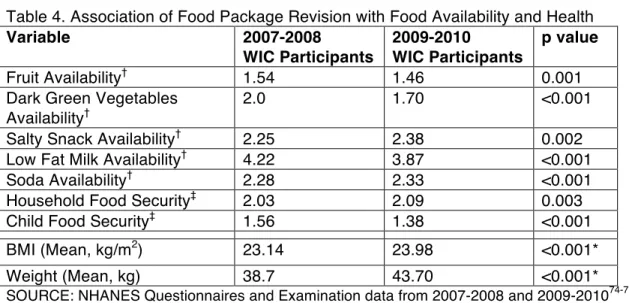
Pre-post bivariate analyses of WIC participants show statistically significant
differences among all variables of interest. After the WIC food package revisions, WIC
participants were on average more likely to have fruit, dark green vegetables, and low-fat
milk available in their homes. Food item availability was coded on a scale from 1 to 5, 1
meaning always available, and 5 meaning never; therefore, a lower availability score
represents greater food availability. Fruits and vegetables could be fresh, frozen,
canned, or dried. Low-fat milk includes only 1%, skim, or fat-free milk, and does not
include 2% milk. Soda includes sugary drinks such as any soft-drinks, fruit-flavored
drinks, or fruit punch; this excludes diet drinks, 100% juice, and sports drinks. Salty
snacks were defined as foods “such as chips or crackers” excluding nuts. All food types
measured in the survey that were newly added to the WIC food packages (fruits,
revisions than before (Table 4). Foods that were less healthy were less likely to be
available among WIC participants after 2009.
Mean body measurements (BMI and weight) among WIC participants increased
slightly after 2009. BMI increased from a mean of 23.14 to 23.98, and weight increased
by a mean of 5kg. The relative stability of mean BMI could be explained by the short time
period between surveys in which little change in body mass would be expected to occur
for WIC participants receiving new food packages. The larger difference in average
weight is likely a reflection of the difference in average age between the two surveys.
Children are likely overrepresented in 2007-2008 and the mean weight in this group is
lower, as expected.
Table 4 goes about here
Food Security score is a composite (range = 1-4) of several questions in the
survey, 18 if children live in the homes or 10 in homes without children, related to
availability of food and need for emergency food assistance. Full food security, a score
of 1, is defined as having no composite questions answered affirmatively. This score
represents households with constant availability of adequate amounts of food for all
persons living in the home. Very low food security, a score of 4, describes households
with inadequate amounts of food, where family members may go without eating for a
whole day, or frequently skip meals. Among WIC participants, after the 2009 food
package revisions, the average household food security score increased (worsened)
slightly, from 2.03 to 2.09, though it remained in the “marginal food security range.” Child
food security scores fell (improved) by 0.18 score points, towards greater average food
be associated with the economic recession that occurred in the United States in 2008;
this recession may have led many families to seek emergency food sources or have
lapses in food availability. However, because NHANES is a cross-sectional sample of
the US population the changes for both household and child food security cannot be fully
explored as individual family cohorts are not followed or compared.
Limited Review of Cost Analyses
Government publications rely heavily on a report presented to the USDA by
Devaney, Bilheimer, and Schorein in October 199050. The report concludes that for every
dollar spent on WIC, Medicaid saves between $1.77 and $3.1350. This figure has been
cited in congressional hearings29,51 in support of the program and has been used in
numerous scholarly publications as the evidence for the program’s cost effectiveness
52-55
. Since that report was published, other government agencies reviewed various
aspects of WIC program costs and benefits, including the GAO56.
In a 1992 report, the GAO assessed the potential effect on Medicaid costs of
expanding WIC to include all income-eligible pregnant women. The report reviewed 17
cost-benefit analyses of the WIC, including results from the 1990 Devaney report, and
aggregated the data to determine the average cost-savings associated with WIC benefits
in the first sixty days of life. Using estimated reductions in low birth weight rate and
prorated Medicaid costs, the report states that serving all income-eligible pregnant
women who were to give birth in 1990 would have cost about $111 million more than
was spent by WIC that year, but could have returned more than $1.3 billion in avoided
expenditures over the next 18 years56. This review, therefore, supports the findings
In 1998, the William F. Goodling Child Nutrition Reauthorization Act of 1998 (PL
105-336) asked the GAO to help Congress better understand the costs of delivering
services through WIC. To fulfill this request the GAO published a series of four
reports28,57-59. One report reviewed literature from 1995 to 2000 that examined the
effectiveness of the WIC program. Nineteen studies were included in the review, though
only one study specifically addressed potential costs of new interventions. The report
concludes, in part, by recommending that the USDA improve demonstration research by
incorporating relevant cost information59. According to the GAO website, where this
report is now published, this recommendation was only partially implemented; the USDA
agreed “in principle with the recommendation” but considering limited resources, the
USDA would “endeavor to obtain the cost information whenever it is practical to do so”60.
I found little evidence to suggest that researchers are performing economic evaluations
of the WIC program.
In PubMed and PAIS, I identified eleven articles meeting inclusion criteria. The
PAIS database resulted in 7 books and no journal articles. PubMed returned 51 articles
with “WIC” and “cost” in the title of the publications. The majority of these did not
evaluate WIC cost outcomes, or were specifically focused on the effect of the infant
formula rebate program or the farmer’s market program on program costs. The majority
(81%) of the articles I include in this review focus on the effect of WIC participation on
infant health outcomes, largely birth weight and prematurity. All studies, save one,
analyze the effect of WIC participation on downstream Medicaid costs, primarily
extended hospitalization costs, emergent care, and medications required to care for
underweight or premature infants 53,55,61-69. In addition to infant health outcomes, studies
also measured changes in immunization rates70, breastfeeding initiation62, pediatric
Figure 1 goes about here
Among these studies, the average time since publication is 14 years; I found no
recent relevant systematic reviews of this literature. There is significant heterogeneity
across studies in the outcomes used to measure Medicaid costs. Some describe
Medicaid cost savings as relative differences in annual Medicaid expenditures per
child55, and others use prorated annual Medicaid costs and calculate Medicaid savings
based on equivalent cost for measured reductions in certain health outcomes55,61,69. Only
three studies conduct secondary data analyses of cost outcomes for multiple
states52,53,66; all others conduct studies within a single state. Due to the heterogeneity of
cost outcomes, it is not possible to create a succinct summary of the magnitude of
Medicaid savings associated with WIC participation in this limited review.
Reports from the GAO and IOM provide guidelines to help improve the quality
and expand the content of future studies. In 1992, the GAO described a framework to
analyze costs and benefits of early intervention efforts by the WIC Program71. The
four-part framework involves identifying program outcomes, quantifying program outcomes,
estimating and apportioning cost savings, and conducting sensitivity analyses. This
framework can guide future WIC research, helping investigators use a systematic
approach to assess costs of the program. Similarly, the IOM conducted a WIC research
workshop in which different approaches to improving WIC research were discussed,
including approaches to improve economic evaluations of the program 27. Although the
panelists in this workshop, including Barbara Devaney, Sally Findley, and Paul
Buescher– prominent WIC researchers – emphasized the need to assess
do not provide a framework to do so. Instead, the workshop outlines specific research
priorities including the foreseeable benefits and challenges of research topics such as
the effect of WIC participation on long term outcomes related to health care utilization
and participant health.
CONCLUDING THOUGHTS ABOUT WIC EFFECTIVENESS
Overall, the WIC food package revisions have been successfully implemented.
My review of the state of the field suggests that this policy change was the culmination of
nearly two decades of debate over and discussion of the evolving role of the WIC
program, as it grew from primarily providing supplemental foods to women and children
to providing a broad range of educational, nutritional, and health care services and
support.
The secondary analysis of NHANES data show that even in a very short time
period, WIC’s revised food packages can be said to have resulted in meaningful
changes in the food availability and, potentially, the diets of WIC participants. The
NHANES data show modest and statistically significant increases in availability of foods
previously not included in the food package, including fruits, vegetables, and low-fat milk.
A reduction in household availability of less healthy foods like soft drinks and salty
snacks may reflect a national trend towards healthier foods, but among low-income
household this finding is particularly important. The findings in this analysis demonstrate
important trends that have not been presented elsewhere in the literature, the analysis is
and not limited to a small geographic region, as is true of most other studies. However,
this analysis should be interpreted within its limitations.
As a large national randomly sampled survey, NHANES does not represent each
State and Local WIC agency equally. Instead, larger states with a bigger share of WIC
participants, like Texas and California, are likely overrepresented. The two sessions of
the NHANES data (2007-2008 and 2009-2010) used for this analysis were selected for
their proximity to the WIC food package implementation in the fall of 2009, and the
2009-2010 survey is the most recent survey currently publicly available through the CDC.
Therefore, I could not conduct a longer search for the effects of post-food package
implementation. Since the data were collected immediately after the policy change, the
magnitude of change reflected in the survey is likely to be lower than is the actual
change, particularly change in participants’ weight and BMI. These changes may appear
to be larger after a longer period of exposure to the new food packages. Additionally, it is
possible that some data points in the second session represent responses from WIC
participants in 2009 before the new packages were implemented nationwide in the fall of
that year, further underestimating the effect size across all variables. Finally, in the future
similar survey analyses would benefit not only from a longer study period by
incorporating data from more recent surveys, but also adjusting for potential confounders
such as age.
The limited literature review of economic evaluations found a relatively small
number of studies that analyze WIC program costs beyond formula rebate programs or
other cost-containment measures. The literature, in general, is outdated, with an average
time since publication of approximately 14 years, and most studies are limited
geographically to one state. This geographic limitation was also present in more recent
changes among participants (Appendix 1 – Limited Systematic Review). Although
smaller studies conducted in only one state are likely considerably less expensive to do,
having data on WIC effects in multiple states for WIC is important. This is particularly
true because WIC varies administratively at the state and local level; trends in one state
may not be the same across other states.
Recommendations for future research. The limitations of this research
provide a guide to recommendations for future WIC research. First, studies should aim to
encompass expanded study populations from broader geographically distributions to
capture a more nationally representative sample of WIC participants. If a larger study is
not possible, studies should provide justification for the limited geographic sampling and
in the case where only smaller studies are feasible, attempt to study participants in areas
that are diverse, racial/ethnically, and economically representative of the WIC
population, and avoid sampling areas simply for researcher convenience. Second, future
analyses should strive to collect data over longer lengths of time to provide information
about the long-term effects of the program. Longer study periods are particularly
important when measuring health outcomes, such as weight and BMI, health care
utilization, and system costs. Finally, the inclusion of program costs should become a
research priority. This will continue to be an important outcome for the WIC program,
particularly as the health system continues to integrate services and provide more
patient-centered care. WIC will likely grow in its capacity as a gateway to the health care
system and as a referral center for participants. Additionally, with the expansion of
Medicaid in many states, public service programs will continue to expand, and careful
cost outcomes to better assess the benefits of the WIC program and how to improve
service delivery in the future.
The WIC policy revisions implemented in 2009 have the potential to
benefit millions of low-income children and women. Through the policy changes, the
USDA and WIC have addressed the unique dual challenge of hunger and obesity facing
poor Americans today. As I have shown in this paper, these policy changes are a result
of decades of political momentum leading to food package revisions, and through the
secondary analysis of cross-sectional data and a review of recent literature I conducted,
the first key years of implementation were a success. Going forward, WIC has the
opportunity to help shape the health of the country by ensuring that the program fulfills
its goals of increasing access to healthy foods, education, and health referrals to women,
infants and children.
REFERENCES
1. U.S. Department of Agriculture. Special Supplemental Nutrition Program for
Women, Infants and Children (WIC): Revisions in the WIC Food Packages
[Proposed Rules]. Federal Register Vol. 71, No. 151. . Department of Agriculture.
Food and Nutrition Services.; 2006.
2. Centers for Disease Control and Prevention (CDC). National Center for Health
Statistics (NCHS). National Health and Nutrition Examination Survey Data.
Hyattsville, MD: U.S. Department of Health and Human Services, Centers for
Disease Control and Prevention; 2010.
3. Oliveira VJ, Racine E, Olmstead J, Ghelfi LM. The WIC program: background,
trends, and issues. Washington, DC: U.S. Dept. of Agriculture, Economic
Research Service;2002.
4. White House Conference on Food, Nutrition, and Health. Final Report:
Washington, DC: Government Printing Office; 1970.
5. Public Law No. 94-105. National School Lunch Act and Child Nutrition Act of
1966, Amendments of 1975. Washington, DC: US Government Printing Office;
1975.
6. Public Law No. 95-627. Child Nutrition Amendments of 1978. 1978.
7. Women, Infants, and Children (WIC). Food and Nutrition Service.
http://www.fns.usda.gov/wic. Accessed April 10, 2014.
8. WIC State Agencies by Region. 2013;
http://www.fns.usda.gov/wic/Contacts/state.HTM. Accessed May 18, 2014.
9. Johnson B, Thorn B, McGill B, et al. WIC Participant and Program Characteristics
10. Women, Infants and Children (WIC). WIC Eligibility Requirements. 2014;
http://www.fns.usda.gov/wic/wic-eligibility-requirements. Accessed April 10, 2014.
11. Owen AL, Owen GM. Twenty Years of WIC: A review of Some Effects of the
Program. Journal of the American Dietetic Association. 1997;97(7):777-782.
12. NWA. WIC By the Numbers 1974 - 2014. National WIC Association; 2014.
13. United States Department of Agriculture. National Survey of WIC Participants:
Final Report. Office of Research and Analysis; October 2001 2001.
14. Institute of Medicine. WIC Food Packages: Time for a Change. The National
Academies Press; 2005.
15. United States Department of Agriculture. Special Supplemental Food Program for
Women, Infant and Children. Supplemental Foods. Proposed Rule. In: Service
FaN, ed. Vol 44. Washington DC: Federal Register; 1979:69254.
16. Kramer MS. Poverty, WIC, and Promotion of Breast-feeding. Pediatrics. March 1,
1991 1991;87(3):399-400.
17. Breastfeeding in the US: hearing before the Select Committee on Hunger
Washington DC: Government Printing Office; 1992.
18. Schweers N. WIC and breastfeeding: some background information and an
invitation. Journal of human lactation : official journal of International Lactation
Consultant Association. 1992;8(3):176-176.
19. Public Law No. 101-147. Child Nutrition and WIC Reauthorization Act of 1989.
Washington DC: US Government Printing Office; 1989.
20. Office USGA. Breastfeeding: WIC's Efforts to Promote Breastfeeding Have
Increased. Washington DC1993.
21. Mei Z, Scanlon KS, Grummer-Strawn LM, Freedman DS, Yip R, Trowbridge FL.
the Centers for Disease Control and Prevention pediatric nutrition surveillance,
1983 to 1995. Pediatrics. 1998;101(1):e12-e12.
22. Dillinger SCJ, Martha J. Macri, Louis E. Grivetti, Teresa. Feast or famine:
Supplemental food programs and their impacts on two American Indian
communities in California. International Journal of Food Sciences and Nutrition.
1999;50(3):173-187.
23. House Congressional Hearing. Committee on Education and the Wokforce.
Subcommittee on Early Childhood, Youth and Families. second session ed.
Washington DC: US Government Printing Office; 1998.
24. National Association of WIC Directors. NAWD WIC Food Prescription
Recommendations. National Association of WIC Directors;2000. 00-001.
25. Besharov DJ. Rethinking WIC : an evaluation of the Women, Infants, and
Children Program. Washington, D.C.: AEI Press; 2001.
26. King BM. Separating Food from Culture: The USDA's Failure to Help Its
Culturally Diverse WIC Population. Drake J. Agric. L. 2001;6:223.
27. Institute of Medicine. Planning a WIC research agenda: workshop summary.
Washington, D.C.: National Academies Press; 2011.
28. U.S. Government Accountability Office. Food Assistance: WIC Faces Challenges
in Providing Nutrition Services: Report to Congressional Committees. 2001.
29. Food for Thought: how to improve child nutrition programs. Subcommittee on
Education Reform of the Committee on Education and the Workforce. first
session ed. Washington DC: US Government Printing Office; 2004.
30. Gidding SS, Dennison BA, Birch LL, et al. Dietary Recommendations for Children
American Heart Association. Circulation. September 27, 2005
2005;112(13):2061-2075.
31. U.S. Government Accountability Office. Department of Agriculture, Food and
Nutrition Service: Special Supplemental Nutrition Program for Women, Infants
and Children (WIC): Revisions in the WIC Food Packages. 2007.
32. Luzi D. Trends and evolution in the development of grey literature: a review.
International Journal on Grey Literature. 2000;1(3):106-117.
33. About the National Health and Nutrition Examination Survey. 2014;
http://www.cdc.gov/nchs/nhanes/about_nhanes.htm. Accessed June 9, 2014.
34. R Core Team. R: A Language and Environment for Statistical Computing.
Version 3.1.0. Vienna, Austria: R Foundation for Statistical Computing; 2014.
35. Frieden TR, Dietz W, Collins J. Reducing Childhood Obesity Through Policy
Change: Acting Now To Prevent Obesity. Health Affairs. March 1, 2010
2010;29(3):357-363.
36. Andreyeva T, Luedicke J, Middleton AE, Long MW, Schwartz MB. Changes in
Access to Healthy Foods after Implementation of the WIC Food Package
Revisions. Rudd Center for Food Policy and Obesity, Yale University; April 2011
2011. Contractor and Cooperator Report No. 66.
37. Andreyeva T, Middleton AE, Long MW, Luedicke J, Schwartz MB. Food retailer
practices, attitudes and beliefs about the supply of healthy foods. Public Health
Nutrition. Jun 2011;14(6):1024-1031.
38. Ayala GX, Laska MN, Zenk SN, et al. Stocking characteristics and perceived
increases in sales among small food store managers/owners associated with the
Nutrition Program for Women, Infants, and Children. Public Health Nutrition. Sep
2012;15(9):1771-1779.
39. Gittelsohn J, Laska MN, Andreyeva T, et al. Small Retailer Perspectives of the
2009 Women, Infants and Children Program Food Package Changes. American
Journal of Health Behavior. 2012;36(5):655-665.
40. Andreyeva T, Luedicke J, Middleton AE, Long MCW, Schwartz MB. Positive
Influence of the Revised Special Supplemental Nutrition Program for Women,
Infants, and Children Food Packages on Access to Healthy Foods. Journal of the
Academy of Nutrition and Dietetics. Jun 2012;112(6):850-858.
41. Andreyeva T, Luedicke J. Federal food package revisions: effects on purchases
of whole-grain products. Am J Prev Med. Oct 2013;45(4):422-429.
42. Andreyeva T, Luedicke J, Tripp AS, Henderson KE. Effects of Reduced Juice
Allowances in Food Packages for the Women, Infants, and Children Program.
Pediatrics. May 2013;131(5):919-927.
43. Andreyeva T, Luedicke J, Henderson KE, Tripp AS. Grocery Store Beverage
Choices by Participants in Federal Food Assistance and Nutrition Programs.
American Journal of Preventive Medicine. 10// 2012;43(4):411-418.
44. Whaley SE, Ritchie LD, Spector P, Gomez J. Revised WIC Food Package
Improves Diets of WIC Families. Journal of Nutrition Education and Behavior.
May-Jun 2012;44(3):204-209.
45. Chiasson MA, Findley SE, Sekhobo JP, et al. Changing WIC Changes What
Children Eat. Obesity. Jul 2013;21(7):1423-1429.
46. Odoms-Young AM, Kong A, Schiffer LA, et al. Evaluating the initial impact of the
revised Special Supplemental Nutrition Program for Women, Infants, and