ISSN 1479-4403 49 ©Academic Conferences Ltd
Benchmarking Method
Jim Petch, Gayle Calverley, Hilary Dexter, and Tim Cappelli University of Manchester, UK
[email protected] , [email protected], [email protected], [email protected]
Abstract: As part of a national e-learning benchmarking initiative of the UK Higher Education Academy, the University of Manchester is carrying out a pilot study of a method to benchmark e-learning in an institution. The pilot was designed to evaluate the operational viability of a method based on the e-Learning Maturity Model developed at the University of Wellington, New Zealand, which, in turn was derived from Carnegie Mellon’s widely accepted Capability Maturity Model. The method is based on gathering evidence about the many and interdependent processes in the e-learning and student lifecycles and takes a holistic view of maturity, addressing multiple aspects. This paper deals with the rationale for the selected method and explains the adoption of a process based approach. It describes the iterative refinement of the questionnaire used to elicit evidence for measures of five aspects of maturity in a range of e-learning processes, in five process areas. The pilot study will produce a map of evidence of e-learning practice across the processes matrix and a measure of the degree of embedding in a sample of faculties within the institution expressed as capability and maturity. To provide a useful measure of where an organisation is with respect to a particular aspect of e-learning, it needs to be able to act on that measure, finding any new activities required or modifying current activities to improve its processes. The pilot study aims to evaluate the potential for improvement inherent in the capability maturity model and to examine the resource implications of obtaining useful evidence. A successful benchmarking effort should be able to inform an institution’s planning and resourcing processes and the outcomes of this pilot should lead to an informed decision about a method for benchmarking the embedding of e-learning, both for the particular institution and for the sector, which in turn can lead to operational suggestions for improvement.
Keywords: embedding, e-learning, process, maturity, benchmarking
1. Introduction
A recurring issue in e-learning is the barriers to its successful embedding within an institution. What is more problematic is the persistence of this issue in spite of better project management and greater knowledge of the aspects of e-learning. Suwardy, Ratnatunga, Sohal, and Speight (2003) report similar findings more generally for embedding IT, suggesting that the experience is not unique to the educational sector. Remeyni, Sherwood-Smith, and White (1997) argue that to realise business benefits, technology must be carefully integrated with the business strategy of the enterprise and its corporate culture, a process known as Active Benefit Realisation. They describe how this involves continuous participative evaluation to manage inevitable changes in the business, and a shifting of the focus of information systems to be the shared responsibility of a group of the main information systems stakeholders. However, Alshawi, Irani and Baldwin (2003) record that managers across different sectors continue to struggle to come to terms with the socio-technical (human and organisational) aspects of IT deployment. They note that the benefits from expenditure on IT systems continue to be considerably less than expected, and that managers continue to find it
difficult to determine how to evaluate investments and realise maximum benefits in IT.
The same problem exists in the UK Higher Education sector. Here most e-learning initiatives exist as projects with a finite life. This means that single projects or developments can operate only as enablers, each of which offers an individual focus that can be harnessed to create greater organisational change. Success in an organisation is however integrally linked to the structure and organisation of its environment. It cannot be entirely the objective of a limited duration project. To be successful a project must have impact on the organisation, on the people within it and on the way they work. This requires detailed knowledge of the organisation and engagement with key stakeholders as well as an understanding of how project outcomes can be brought in to an existing structure. It also requires an organisation that is capable of being sufficiently responsive and able to accommodate successfully designed developments into its structure within normal resource constraints. For change to be engineered successfully from projects therefore requires an organisation-wide approach that encompasses all aspects of e-learning. Methods for describing and investigating e-learning processes within an organisation are not well
developed. There is little development of systems and processes that are managed across product or service lifecycles. In UK HE, teaching and learning design, development and delivery are generally the product of piecemeal, unconnected processes with multiple operators and stakeholders, and no consistent quality assurance mechanisms. There is need therefore for developing the means of describing and analysing processes in the e-learning domain that meet the requirement of what we might call next generation e-learning. That is, e-learning that has moved away from cottage industry types of operation to those that are scalable, quality assured and responsive to market demand. One solution is benchmarking processes (Hirumi, 2005) and in particular those that provide a guide to change and improvement.
2. Application of a capability maturity
model to e-learning processes
The e-Learning Maturity Model (eMM) model was developed in New Zealand based on two complementary models, the Capability Maturity Model (CMM) from the Software Engineering Institute (SEI 2002) and SPICE (Software Process Improvement and Capability Determination) (El Emam, Drouin, and Melo, 1998). The Capability Maturity Model for Software characterises a mature, capable software process and the progression from an immature, ad hoc software process to a mature, well-managed software process. This model is currently applied to a number of industry sectors (Griffiths 2005). SPICE, which is a joint effort by the International Standards Organisation (ISO) and International Electrotechnical Commission (IEC) to create an international standard for software process assessment adds the approach for organising the e-learning provision practices and processes into process areas. The CMM has five levels of maturity, ranging from ‘initial’ to ‘optimised’. Each level of maturity in the CMM has a corresponding set of key practices. The practice descriptions are an elaboration of what is meant by maturity at each level of the CMM. From the first phase of his work in New Zealand, Marshall has come to a more holistic view of process maturity in which there are five dimensions of maturity. There is not necessarily a linear progression of capability from one to the next. That is, it is not necessary to reach full capability in one dimension before progressing to the next. It is possible for organisations to develop different patterns of capability across the five dimensions that are to some extent independent (Marshall 2006b). The combination of CMM with SPICE as a basis for eMM provides a means for an institution to appraise their ability to perform their key businessprocesses, such as those required for e-learning provision. It also provides the mechanism for giving guidance to improve process capability. The eMM also offers the means to create the underlying reference model for measuring process maturity from multiple aspects and assessing capability within each aspect. Implementing the CMM determines the state of an organisation's current software process, the high-priority software process-related issues facing an organisation, and obtains the organisational support for software process improvement. Implementing the eMM should similarly create a picture of the current e-learning provision processes across the institution and highlight issues facing the HEI.
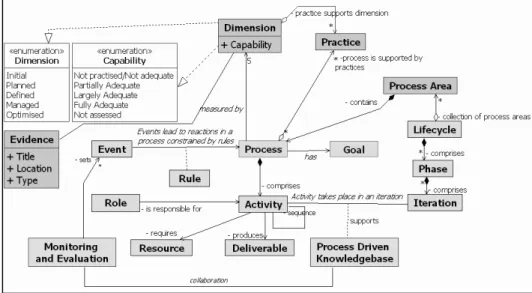
In order to succeed with the implementation of eMM it is important first to reach an understanding of the terms ‘process’ and ‘practice’. A process is usually taken to mean the ‘who’, ‘what’, ‘how’ and ‘when’ of doing something in a context (Kruchten, 2004). A process in eMM is a description of the goal of a set of activities, each of which will be the responsibility of some role(s) and carry constraints concerning the timing and manner of their execution. The activities carried out to achieve the five maturity dimensions of that process goal are captured in descriptions of practices. Figure 1 shows how a process has a goal, comprises activities, has maturity dimensions that are supported by a set of practices and belongs to a process area. It may be seen that the practices are organised according to which dimension of a process they support. eMM seeks to identify the dimension and capability of processes from evidence about practices. These measures, for a set of processes, form the basis for assessing institutional (or other level) capability and maturity. The processes of interest are those concerned with the management of the lifecycles of e-learning products, the student experience, and the management of the teaching and learning context. Figure 1 is a conceptual model of the elements of eMM and their connection to the e-learning lifecycle which allows a whole system view of e-learning provision. We need to understand how the eMM processes and practices fit together with the e-learning lifecycle and with a process driven knowledgebase to support people in their roles (Dexter and Petch 2006). Also in this whole system view is a monitoring and evaluation framework that is required for useful-time response to measurements of process and product quality which in turn is required to enable HEIs to act on the measurement results and make the eMM an ongoing process improvement mechanism. Future work will be on creating a model of the mapping of capability assessment into a monitoring and evaluation reference model
for the institution’s key processes in teaching and learning and their support.
Figure 1 Conceptual Model of the eMM and its links to the e- Learning Lifecycle
3. Characteristics of the eMM method
The eMM method is a process of assigning values to the capability and maturity attributes of the process array based on documented and oral evidence. eMM considers the whole life cycle of e-learning from planning to delivery and evaluation. In each of the five process areas that make up the life cycle between six and twelve processes are identified as key indicators of the process area. This process set is, of course, not universally fixed. Its selection is a matter of judgement and experience and it is subject to revision. For each process, a set of practices is identified at each level of maturity. Much of the work on applying eMM has been on refining and adding to this list of practices both from the literature and from local instances of practices. In applying eMM, evidence on the practices undertaken in each process area is collected from the variety of sources that exist
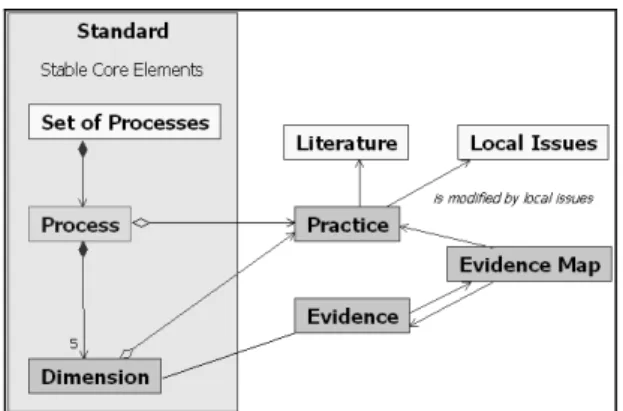
within an institution. These include quality assurance procedures, quality assurance reports, course logs, policy and strategy documents, course documentation, and a host of other documents as well as evidence gained from interviewing staff and students. Marshall (2006) indicates the breadth and variety of sources that are gathered in a typical university. These evidence sources are then analysed to determine the practices that they provide evidence for so that a matrix of evidence against practices can be constructed. From this, judgements are made of the practices carried out in each of the process areas and the levels of maturity of the indicator processes. The resultant assessments of maturity are then presented in the same form as figures 2 and 5. The relations between these elements of the method are shown in Figure 3.
Figure 2 Snapshot of eMM scoring across multiple institutions (from Marshall 2005b) The relations between the various elements of the
method are illustrated in Figure 3 in which it may be seen that the set of processes and their dimensions form a stable core or standard, and
the associated practices which are initially drawn from the literature may vary according to local issues. The evidence collection and mapping for
process capability in a particular dimension is informed by the practices.
Figure 3 Core eMM components and their relationship to local issues that can modify the practices
The method is intrinsically general. General aspects are evident based on first principles and on fact that practice matrices come from established body of knowledge from the field of e-learning. The initial development of eMM by Marshall and Mitchell (2004) was based on a survey of the literature relating to e-learning, quality assurance and benchmarking. Each aspect of the metrics, processes and criteria is based on an extensive and critical appraisal of the literature and as such the method represents the best available and widely agreed criteria for benchmarking. In choosing eMM, it was recognised that the details of the processes, practices and evidence needed to be determined for each major new instance of use, so that they are appropriate to the circumstances of the application. In first developing eMM Marshall and Mitchell (2004) culled an extensive set of practices from the literature. Subsequently, these were refined and extended as the method was applied to successive cases. A major part of developing the application at Manchester was a detailed analysis of practices and questions in the first version of eMM to produce a version that was valid for the university.
The University of Manchester provides an instance of a large research intensive university, one of the Russell Group. It has four faculties, twenty three schools, over 100 discipline areas and 3500 academic and related staff. It has recently undergone major reorganisation with a merger in 2004. It has high ambitions to be world leading site not only in research but also in education, based especially on e-learning. It is clear that this requires a radical approach to managing quality. A stated objective of the institution is to establish quality assurance processes that are embedded in all aspects of education and are not ‘event driven’ as at present.
Quality is seen as a continuous part of operations both to apply and to monitor. Additionally Quality Assurance and Enhancement is envisaged as an integral part of a planning-review-evaluation cycle that is the basis for resource allocation and for both operational and strategic planning. This requires a method and a toolset that gives not only detailed operational intelligence on aspects of operations and performance but also provides a means of achieving planned and managed improvements in aspects of performance. It has in other words to be the means to change practice. eMM is not a method intended for a one-off snapshot of the state of things, but to drive change to find where improvements may be made and to track change and improvement over time. It is a method to allow a visualisation of the state of the organisation and compare parts of the organisation, or to view state change over time. This is an essential aspect for engaging operational managers and strategic managers as well as academics. Additionally, the value of the method as developed by Marshall et al. is in its ability to handle and display large amounts of data in single graphics (Tufte, 1990). The development of rich visual design by Marshall et al. is a valuable development of eMM that makes it an effective management and communication tool. Figure 2 shows how within one display, and this only a partial one, around 150 data items are received synoptically. The density of data prompts a focus on patterns which are the appropriate level for institutional analysis and comparison. The eMM rationale focuses on the progressive changes to achieve optimal performance. At the core of the method as it is applied is the set of practices that ensure such progression and improvement. These are context specific and have to be designed and developed for each application but there are generic elements relating both to HEIs and to e-learning. In particular the method cannot be seen simply as applying only to e-learning but in reality to all teaching and learning. Metrics within the method are designed to identify whether or not particular practices that may be associated with any level of development of processes are followed or not and the extent to which they are followed. The practices observed in the method are those identified for a particular institution, or type of institution, that are ‘indicator’ practices. Those, in other words, that give the most sensitive indication of differences and change. The process of developing the metrics of the method is one of fine tuning the indicator metrics so as best to reflect the real processes involved in design, development and delivery of e-learning. This fine tuning is based on understanding of processes, on the availability of evidence and on the likelihood that evidence is reliable. Additionally, the metrics and the criteria
used with them are designed to be progressive, that is to be sensitive to and indicate changes that are real in the ways indicated by the rational of the approach, viz. in terms of increasing maturity and capability.
4. Method development: The
Manchester case
eMM in its early versions has been developed and tested in a limited context outside the UK only on project-type operations, and within a limited time-frame. In adopting the method at Manchester, there was a need to extend eMM to the whole institutional level with coverage for the whole e-learning lifecycle and to tailor the method to a UK HEI. In assessing how eMM can be practically applied within a UK HEI, the key components to be considered were:
The process list
The database of related practices
The definition of dimensions created through assigning practices to the dimensions
The evidence map that defines where information on what is being carried out in relation to practices can be found
Marshall’s approach presumes a particular set of evidence that should be sought for each organisation, and uses questionnaires as a tool to locate that evidence. Once a preliminary assessment of the available evidence is made, interviews can be used to clarify actual circumstances against what might be suggested from documentation collected up to that point. In UK HEIs, the form of evidence and where it may be located is less clear. Other local and specific factors also contribute to the need for a revised approach to guide evidence collection for the pilot to be successful in the Manchester case:
A need to assess the scalability potential for the eMM methodology,
The ‘newness’ of the organisation under pilot and its related structures
The combined impact of old and new structures working together in the early stages of the organisation
Staff familiarity and day-to-day knowledge in a period of extensive change
A requirement to minimise the workload in making the methodology repeatable as a precursor to long-term viability.
In collecting evidence, prior contact with organisational staff is needed to build an evidence matrix to help locate where particular material and/or documentation may lie and in what forms it may be found. For this purpose, the pilot has identified a series of process-based questions capable of guiding interview-based discussion. In
contrast to Marshall’s approach, interviews are a first-contact point for locating evidence, rather than a follow up to evidence already identified. Questions are used to guide discussion around evidence for the processes in eMM. The interview process also allows a communication channel to be developed with key staff. However, for this approach to work, the question set must elicit the full set of possible information against all the processes listed in the five process areas. Otherwise gaps will exist due to the data gathering process itself. To achieve such a question list requires a multi-dimensional matrix mapping of the proposed questions back to the eMM process list. It may be that some processes and their dimensions may be over-represented, in which case the question set can be adjusted. Some process dimensions may not be represented, which will require questions covering these areas to be added. Alternatively, it may be found that gaps in questions are in fact covered by the evidence. Where questions exist that represent a process not already listed in eMM, that process may be added for future eMM iterations. This set of activities is non-trivial. An equivalent exercise is also necessary for deriving evidence-based practices appropriate to the pilot situation and from which assessments of a process can be made.
The pilot approach developed at Manchester should yield a self-contained, comprehensive set of questions for producing a structured evidence matrix for a UK HEI. What is described here is the basis of a transferable technique for adapting eMM to take account of differences in local structuring and availability of evidence when a whole institution is considered. This can be done without compromising the integrity or comparability of any results generated by this method. Initially eMM may not appear to cover some issues of immediate concern to UK HE. However, there are a number of ways that specific educational issues can be investigated within the framework:
A process can be identified for inclusion in the master process list.
The place of specific issues in individual processes can be assessed through the practices assigned to each process dimension. The question list can be modified to include
specific questions related to the issue.
Each of these has its own implications for continued long-term comparability and integrity of eMM and to address this there is a need for a continuing dialogue between eMM practitioners. To preserve the integrity of eMM as a method, the master process list should be subject only to minimal changes. In general, practices that reflect
specific issues gradually become absorbed. Additionally, it is common that practices that at one time are regarded as diagnostic of particular dimension or levels of maturity may become absorbed and then regarded as the norm across the sector. They therefore lose their discriminating and diagnostic power. Additionally, it is possible that as a novel practice becomes part of a routine it in fact ceases to indicate any particular level of maturity. Given the fluidity of the practice model, it is a good approach for specific issues to be appropriately aligned and represented within the practice database, and continually reviewed. This also supports the role of benchmarking as a key tool for driving change in practice within an organisation. However it is important that the
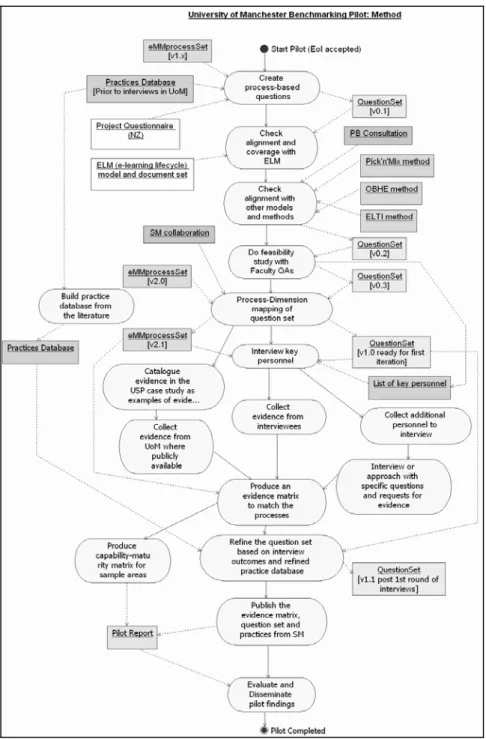
integrity of the mapping of a question set to processes array is not compromised by random addition and removal of questions, which can result in gaps and incomplete analysis. Therefore it is preferable if changes to the question set are done in a version-controlled manner that is accompanied by a full re-mapping exercise. Figure 4 summarises the pilot project process. It identifies each activity (ellipse) in the process of piloting the method from initial collection of process information and associated practices through to the final refined method based on evidence from Manchester. The figure shows also the artefacts (rectangles) used at each stage as well as those produced by the pilot project activities.
The principle documented outputs from the pilot are:
A set of processes organised into five process areas
A set of process related questions used to elicit evidence
For each process, a set of practices that are used to describe and distinguish level of capability at each of its dimensions
For the set of processes, a corresponding matrix of evidence that is available for
determining the nature and status of practices across the dimensions.
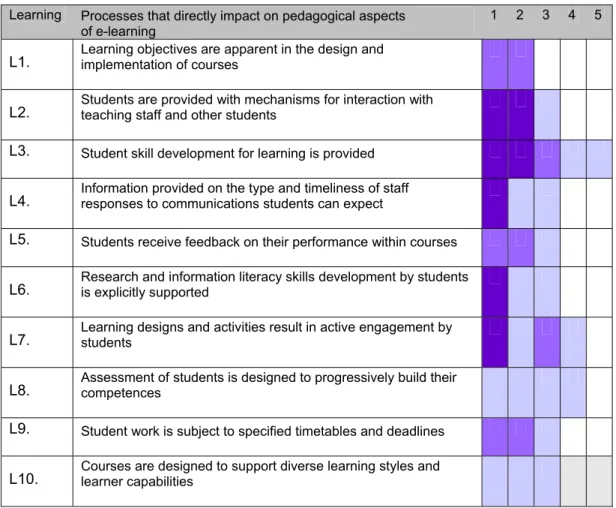
Figure 5 illustrates the nature of the processes within one of the process areas, that of Learning. Ten processes are used to cover this process area. Figure 5 also shows an anonymised set of results of capability levels for an institution. A quick visual inspection reveals those processes which are relatively strong or weak and those processes where unusual patterns of capability are evident.
Learning Processes that directly impact on pedagogical aspects of e-learning
1 2 3 4 5
L1. Learning objectives are apparent in the design and implementation of courses
L2. Students are provided with mechanisms for interaction with teaching staff and other students L3. Student skill development for learning is provided
L4. Information provided on the type and timeliness of staff responses to communications students can expect L5. Students receive feedback on their performance within courses
L6. Research and information literacy skills development by students is explicitly supported
L7. Learning designs and activities result in active engagement by students
L8. Assessment of students is designed to progressively build their competences L9. Student work is subject to specified timetables and deadlines
L10. Courses are designed to support diverse learning styles and learner capabilities Figure 5 Patterns of capability across the processes
An example of the sorts of practices that are used to determine such capability levels is given in Figure 6 which shows practices relating to the Learning process area.
An example of the evidence that is used to reach a judgement about a practice that relates to two processes in the Learning Process Area is shown in Figure 7.
5. Reflections on the plot
The pilot had two related aims. First was to provide a vehicle for change management within the institution so that it can move to a continuous process of improvement in teaching and learning.
There are already indications of the opportunities and challenges in doing this. It is clear that institutional buy-in to the change is needed across the institution from executive level to course development and administration level. Not only do practices relate to each level but the whole philosophy of the approach assumes a move to a connected organisation. The cultural, interpersonal, procedural, educational and technical aspects of teaching and learning are all the subject of change and for the method to be effective these aspects of an organisation have to be managed. Adopting eMM is not a soft or quick option. he second aim was to inform the HE sector as part of the sector-wide initiative on benchmarking e-learning. The key point here is to get over the idea the eMM is one method that has
a particular purpose and function. That purpose serves well the ambitions of a large university seeking radical change and seeking to align operational aspects of processes in a systematic manner. It will not answer all needs and applied
inappropriately will be an expensive mistake. For those institutions for which it is appropriate the pilot will provide a robust, thorough and rational method.
Figure 7 A sample of evidence in the Learning Process Area One of the merits of the method is the intrinsic life
cycle approach. No doubt the method could be developed to address only limited aspects of the lifecycle and especially for the purpose of comparison with other benchmarking methods it could be applied either partially or redeveloped to focus on particular areas with additional metrics and criteria. However, this would in some ways abandon the logic of the method which is firmly rooted within a lifecycle concept. One of the characteristics of e-learning that has emerged has
been a realisation that a lifecycle approach is necessary if we are to manage the complex array of issues and processes required for successful delivery (Dexter, Petch and Wilcox, 2004). The eMM method aligns well with this philosophy for educational engineering and in fact is seen as one part of the repertoire of tools that must underpin such an approach. A mapping of eMM on to an e-learning lifecycle model based on the Rational Unified Process model (Dexter et al. 2004) shows that all the main elements of the lifecycle are in fact covered by eMM.
References
Alshawi S.; Irani Z.; Baldwin L. (2003) Benchmarking information technology investment and benefits extraction, Benchmarking: An International Journal, 10(4), 414-423.
Dexter, H and Petch, J. (2006) “Managing Student Support: A Holistic Approach”, Proceedings of the Fifth International Conference on Networked Learning, Lancaster University, UK
Dexter, H., Petch, J. and Wilcox, P. (2004) “e-Learning: the End-to-End Process, a Domain Specific Language and the Role of UML”, Research Proceedings of the Association for Learning Technology Conference (ALT-C), Exeter, U.K. El Emam, K. Drouin, J-N. and Melo, W. (1998) SPICE: The Theory and Practice of Software Process Improvement and
Capability Determination. IEEE Computer Society, California, USA. Griffiths, A. (2005), Capability model mature–or is it?, IT Now, Oxford Journals,
http://itnow.oxfordjournals.org/cgi/content/abstract/47/5/18 last accessed 11.5.2006
Hirumi, A. (2005) In search for quality: A review of educational guidelines and industry standards. Quarterly Review of Distance Education, 6(4).
Kruchten P. (2004) The Rational Unified Process: An Introduction, 3rd Edition, Addison-Wesley Marshall, S (2006)
(a) E-Learning Maturity Model Capability Determination Workbook,
http://www.utdc.vuw.ac.nz/research/emm/documents/workshop/v2/20060327%20Workshop%20Manual.p df last accessed 11.5.2006
(b)NZ E-Learning Capability Determination, Literature Review ,
http://www.utdc.vuw.ac.nz/research/emm/documents/20060320LiteratureReview.pdf last accessed
11.5.2006 Marshall, S. (2005)
(a) Determination of New Zealand Tertiary Institution E-Learning Capability: An Application of an E-Learning Maturity Model: Report on the E-Learning Maturity Model Evaluation of the New Zealand Tertiary Sector. Report to the New Zealand Ministry of Education. 132pp. http://www.utdc.vuw.ac.nz/research/emm/documents/SectorReport.pdf last accessed 2.5.2006
(b) Handout from eFEST 2005, Wellington, New Zealand
http://www.utdc.vuw.ac.nz/research/emm/documents/eFestHandout.pdff last accessed 2.5.2006
Marshall, S.J. and Mitchell, G. (2004), “Applying SPICE to e-Learning: An ELearning
Maturity Model?” in Proceedings of the Sixth Australasian Computing Education Conference (ACE2004), Dunedin. Conferences in Research and Practice in Information Technology, Vol. 30. R. Lister and A. Young, Eds.
Remenyi, D., Sherwood-Smith, M., White, T. (1997) Achieving Maximum Value from Information Systems: A Process Approach, John Wiley and Sons
Software Engineering Institute (2002) CMMISM for Systems Engineering and Software Engineering (CMMI-SE/SW, V1.1). Staged Representation, CCMI Product Team. www.sei.cmu.edu/cmmi last accessed 11.5.2006 Suwardy T.; Ratnatunga J.; Sohal A.S.; Speight G. (2003) IT projects: evaluation, outcomes and impediments,
Benchmarking: An International Journal, Volume 10, Number (4), 325-342. Tufte, E. R. (1990). Envisioning information. Cheshire, CT: GraphicsPress.