Editorial for the ECEL 2011 Special Issue of EJEL
The Brighton ECEL conference in November 2011 was a vibrant and exciting experience, not least for
ourselves as its local organisers, the Business eLearning research group at Brighton Business School.
With 200 delegates visiting, three great keynotes and a large range of parallel sessions, not to mention
our murder mystery game and conference dinner at the Brighton Corn Exchange, we welcomed the
variety and volatility of ideas, applications, pedagogies and technologies on offer.
This special issue of EJEL is an attempt to tell the story of the conference, at the same time offering you,
the reader, a taste of that variety of ideas and contexts we experienced there. We had a choice of three
major stories at the conference as papers clustered around the themes of e assessment, teaching role
change and social and informal learning and its relationship to formal planned learning. We have chosen
the last theme for this special issue, as the other two gain much exposure elsewhere. Our chosen papers
take you on a journey through transitions to Higher Education (HE), moving on to explore Web 2.0 in HE
learning and teaching and specific applications put to the test. The story concludes with papers
conceptualising the ethics debates relating to Technology Enhanced Learning and Web 2.0, closing with
a paper on dignity in this context.
These papers are mostly case studies of innovation and change but each takes a different perspective of
social and informal learning for academic but also social purposes for example supporting the social
and emotional difficulties of entering HE. Many tools are used in these papers to explore learning and
teaching such as Facebook, wiki, blog, lifeworlds, VLEs, e portfolios. There are tiny sample studies and
large ones, such as the 600 students in the Bournemouth study. If you read from start to finish, you will
also experience a range of qualitative research methods from phenomenography and phenomenology
to action research.
L
K
R
“
H
E
ffer a case study of Startonline, a social
HE T
Higher Education institutions as they experiment with Facebook and other social media sites to build
bridges for students to cross before they turn up to study. This study used Ning as a platform and found
strong acceptance from students for social and informational dimensions of the environment, but much
less for the academic elements offered. It is easy to suggest from an academic perspective that the
latter would have proved more useful to the students in transition, but exciting interest in academic
skills among students is an ongoing battle.
“
G
M
m Higher National to degree level
F
A
case focus on a later transition from HNC or HND into second or third year university study. This action
research study tracked the progress of a project designed to use voices and experience of existing
students to reassure new students and staff through timely podcasts, DVD and SMS. This study used
F
Martin and Noakesoffer a case study of the Web 2.0 learning ethos firmly located within a Learning
M
“
LM“ H
which combines both the security and simple navigation afforded by an LMS and multiple options in
terms of how the students wish to study and share learning using Web 2.0 tools with the aim to provide
transformative e learning. This study offers hope to all teachers who want to leave behind the role of
didactic fount of knowledge and move towards the offer of expertise as and when learners seek it. That
We stay with social media in the next paper, bu
T
HE C
H
E
A
C
Ferreira and evaluates the use of Twitter to drive polling and interaction within a lecture format. The
authors discuss this as an impact on cognitive communication. There is much potential impact of social
media on learning which affects both learner and teacher behaviour; this is one further example of the
258
way technology may be used to enhance teaching as well as learning, moving the teacher away from the
straitjacket of the large volume passive lecture towards a more meaningful engagement with learners.
Nerantzi then takes us further on the journey of education with a focus on working with multiple
A
A
open online problem based learning. This phenomenographic study analyses an example of social media
used to foster collaborative learning across institutional barriers. The extreme version of such
collaborative learning is likely to be a MOOC (massive online open course) which is discussed in
Esposit
R
MOOC I
tests the usual research ethics framework against the emerging context of public open online courses,
facing up to questions of informed consent and overt/covert observation in a virtual less controlled
environment than traditional research studies.
In the final stages of our educational journey we explore beyond practical content and delivery issues in
technology enhanced learning and focus on duty of care for children who learn in a virtual environment,
the need for personalised and personal approaches in blended learning and issues of empathy and
dignity in virtual w
L
K
L
C
C
E
“
G
O
A
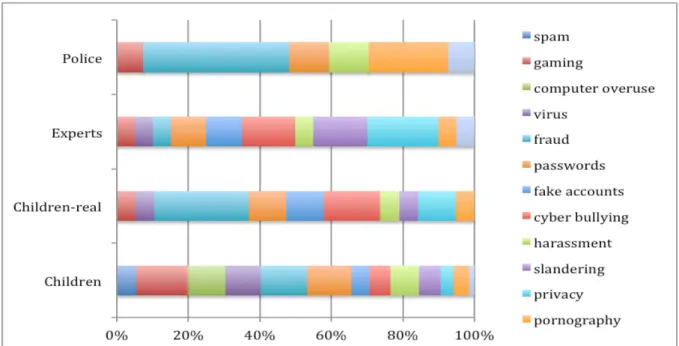
maps behaviour patterns and beliefs about privacy among schoolchildren. The paper raises some
considerable concerns about contemporary legislation in this area which merits urgent attention for e
learning in schools.
M
D
A
B
L
“
W H
E
should have come last in this selection but this paper offered by Soeiro, de Figueiredo and Ferreira
discusses a different kind of ending, one which builds emotional bridges not between students and
teachers but among diverse groups of students. Students with hearing difficulties face more than just
the usual culture barriers when attending new courses and this participatory action research project
details the affection which can be built online for these students through a blended learning
environment supported by Moodle.
O
E
D
Bournemouth University led by Andy Pulman, explores human dignity in a transprofessional curriculum
for health and social work disciplines. This ambitious project not only pulled related disciplines together
but aimed to integrate undergraduate teaching with research and exposed students to evidence not just
from traditional academic and clinical contexts but also qualitative personal and creative accounts of
social and clinical human experience. Again we meet problem based learning, a pedagogy designed to
engage learners in real world complexity rather than fragmented academic blocks. Again we meet
technology as an ennabler of such learning, and again we find students encouraged to share and
collaborate in learning.
“
ECEL
eady
M
social media for learning and seek to make connections among learners, between existing and new
learners, and between learners and teachers. With social media and Web 2.0 as a whole we are moving
towards a new perspective of mainstream education; one which values collaboration and no longer
safe space
T
are keen to reach.
Sue Greener and Asher Rospigliosi
[email protected]
[email protected]
ISSN 1479-4403 259 ©Academic Publishing International Ltd Reference this paper as: Knight,J and Rochon R. “Starting Online: Exploring the use of a Social Networking Site
Starting online: Exploring the use of a Social Networking Site to
Facilitate transition into Higher Education
John Knight, Rebecca Rochon
Bucks New University, High Wycombe, UK
[email protected]Abstract: It has been widely recognised that transition into higher education (HE) can be challenging for incoming students. Literature identifies three main areas where students may benefit from support: social, practical and academic. This paper discusses a case study that explores the potential of a social networking environment to provide support in these areas during students’ transition into HE.
The Learning Development Unit (LDU) at Bucks New University has previously addressed transitional issues through pre-sessional campus-based programmes. However, to provide opportunities for a wider range of students, the LDU launched Startonline in 2010. This online pre-sessional environment used the social networking platform Ning to provide new students with access to non-subject-specific academic activities (e.g., critical thinking), social networking tools and practical information. As a pilot, the aim was to observe where students focussed their attention and explore the affordances of a social networking environment for facilitating transition.
Startonline ran for the month leading up to the beginning of the academic year, during which time around 300 students signed up and participated. Quantitative analysis of platform user data was conducted and student and staff participants were interviewed, providing useful qualitative data. Findings highlighted that students’ engaged intensely in social and informational aspects of the environment, but remained resolutely uninterested in generic academic activities. There was, however, considerable self-directed interest in finding subject-specific information and learning activities. Direct, personal involvement of subject-teaching staff seemed the determining factor in take up of these aspects.
Social networking platforms are already used by students to maintain social capital and access emotional support from existing social networks when leaving secondary school. This project highlights that, equally, such environments also provide powerful opportunities for students to establish social networks as they transition into higher education. Lessons have also been learned with regard to effective pedagogical strategies for engaging students academically in social networking environments and areas identified for future research.
Keywords: Transition, social networking, social capital, affordances, engagement
1. Introduction
A review of theories related to student retention by Braxton and Hirschy (2005) suggests that while the issue of retention is complex, two models remain important in understanding: Tinto’s (1975, 1993) Academic and social integration and Astin's (1977, 1985) Theory of Involvement. Both these models suggest that the more engaged a student is with the institution, the higher likelihood of student retention. By focussing on the “known” elements, such as academic, social and practical information, it is possible for universities to contribute actively and positively during the transition phase to facilitate this engagement. This case study considers the use of a social networking site (SNS) to provide support to students in their transition into higher education.
The Learning Development Unit (LDU) at Bucks New University (Bucks) has been addressing transitional issues for a number of years through face-to-face pre-sessional campus-based programmes. These programmes have been highly successful in terms of providing students with opportunities to develop academic skills and engage socially. However, these programmes are necessarily limited in the number of students that can participate. This short paper reviews Startonline, a bespoke SNS based on the Ning platform, launched in 2010 to provide opportunities for a wider range of students. The environment included video, podcasts, discussion forums and web pages, including:
non-subject-specific academic activities: critical thinking; logical reasoning, writing skills social networking tools: profiles, ‘friending’, messaging and chat
Electronic Journal of e-Learning Volume 10 Issue 3 2012
www.ejel.org 260 ©Academic Publishing International Ltd
In total, just over 300 people became members (took the steps of registering to access information on all pages). Of these, 25 were staff. While not all users provided information of their geographic location, 10% of the total self identified as being from outside the United Kingdom.
Quantitative analysis of platform user data was conducted using the site itself and Google Analytics as well as qualitative review of the exchanges. This was complemented with interviews with students as well as one staff member.
2. Emphasising the social in social networking
Establishing friendships and social networks has been described as key to transition (Lowe and Cooke, 2003; Maunder et al., 2010). A study of undergraduate students at Bucks noted that first-year students depend on their network of friends for everything from moral support to more general guidance, concluding that universities should do more to ensure that students have the opportunity to create these networks as soon as they start their studies (Wickens et al., 2006).
SNSs are well-placed to provide students with opportunities for establishing contact with each other; they are well established as part of students’ existing communication systems (Phipps, 2007) and play an acknowledged role in the ways in which they manage and maintain their ‘social capital’ (Ellison et al., 2007). Indeed, it was clear from Startonline activity and from interviewees that students were keen to use the technology to lay the groundwork for future university-based relationships.
I like how it was set up so that students that were just starting could like get to know people that could be on their course or who they might be living with things like that... so that you don’t feel too scared or anything when you come in to the Uni thinking “Oh no I don’t know anyone.” (Excerpt from student interview)
Statistical data demonstrated that the most popular areas were member profiles and discussion forums. Approximately 60% of discussions initiated by students related to finding others who were either studying on the same course or living in or near the same accommodation (see Fig.1, below). This highlights that building social capital was the primary concern of users, and that there was interest in transferring these beyond the Startonline environment.
Theme Threads Replies
Total (threads and replies)
% of total
discussion activity
Social 37 173 210 63
Practical 7 24 31 9
Academic 0 0 0 0
Figure 1: Summary of student discussion forum activity (threads and replies)
Using a bespoke SNS solution rather than building on students existing online profiles (e.g., in Facebook), allowed Startonline to circumvent those privacy issues identified in other studies (Ribchester, 2009; Sturgeon and Walker, 2009) and located control firmly with the students in terms of the extent to which they could choose to make links between their personal online ‘spaces’ and their more public university ‘faces’. Interestingly, there is clear evidence of students establishing initial contact in Startonline and then moving out into the private domain by exchanging profile information and ‘friending’ each other on Facebook. Similarly, there is also evidence of interest and intention of meeting within the physical University environment at an event just prior to induction
3. Managing practicalities
Managing the practicalities of living away from home in an unfamiliar environment and obtaining information related to the university was another focus for concern. The most popular thread was called “Ask any question”, and enabled students to find out information accordingly. Students were also pro-active in starting their own discussion threads if they needed information. Indeed, almost 20% of all student-initiated threads were requests for information. Equally, students seemed content to answer one another, or direct others to information. In the case where specialised information was needed, the Students Union or appropriate staff member provided information. These interactions highlight that the students were both interested in practical information and pro-active in obtaining it:
John Knight and Rebecca Rochon
I’m disabled. So I was a bit unsure about how I was, you know, how I’d go about finding the Disabled Unit and what I could do, and what sort of help they’d give[...] I did ask a few questions I wasn’t sure about. So, I asked those myself. (Excerpt from student interview)
4. Learning
Student problems during first year are often related to a lack of study skills (Winterson and Russ, 2008; Cook and Leckey, 1999). However, none of the three learning generic activities were engaged with by students. Reasons for students’ lack of engagement in this area remain unclear, but a possible cause is suggested in the way that SNSs can be said to afford interaction and provide opportunities for learning. Where the technology was used in a way that ‘played to its strengths’ (i.e., to connect with others and convey information) learning opportunities seemed to occur spontaneously. Where subject-related teaching staff members were available (and seen to be available), students self-directedly sought information and engaged with materials in a way that could be usefully built on within the physical teaching environment. Students also showed interest in finding subject-specific information and learning activities.
It is telling that this learning-related activity took place solely via direct messages to staff profiles, rather than in the public discussion forum, perhaps reflecting Greenhow’s (2009) assessment of the usefulness of SNSs to afford useful academic behaviour. Direct, personal involvement of subject-teaching staff seemed the determining factor in encouraging this. Staff who engaged with students directly, providing subject-related content, found the experience rewarding and were able to draw on shared Startonline experiences during initial face-to-face contact:
...[it] was very useful in terms of that engagement: breaking it down rather than being just a cold lecture [...] it became something that was a little bit more vibrant, really.(Excerpt from staff interview)
5. Lessons learned
One of the main points of learning relates to the appropriateness of the participants’ engagement with this type of environment in relation to their role as learners. ‘Learning to learn’ is fundamental to students’ transition to HE; a key element is fostering the students’ understanding of their own role within the experience (Wingate, 2007). However, in most cases, the first contact with the new environment that students experience is an instructor-led setting where they passively receive information. The provision of resources that students can access, manipulate, control and question is a positive model for their introduction to HE. Results suggest that this is the case: many students modified their profiles, while others started discussion threads or answered questions for one another. Notably, almost 80% discussions in the discussion forum were started by students. The use of an SNS allows them, in many cases, to use tools that they are already confident and competent in using in these interactions.
Staff, however, proved less comfortable with or attuned to the affordances of the SNS environment. While some expressed excitement at the opportunity to develop their own presence and resources within Startonline, and some evidentially did so, many did not participate, or participated only partially, registering but failing properly to engage with the SNS ‘spirit’, including no personal photograph, giving no indication of subject expertise and teaching interests and making little effort to attempt to connect with their future students. Based on this experience, it is suggested that a university-wide strategy and set of explicit guidelines on how staff might best engage with SNSs are needed in order to promote an equal opportunity for all students to engage with their tutors and to provide tutors with the benefits of engaging with their students prior to arrival.
One section of staff that provided essential support to the environment was administrative personnel. The “Ask any question” thread that proved so popular with students was initially maintained by academic staff responsible for the project. However, it was quickly apparent that the most effective host for this area would be an administrative assistant. The active involvement of administrative staff
Electronic Journal of e-Learning Volume 10 Issue 3 2012
www.ejel.org 262 ©Academic Publishing International Ltd
provided necessary practical information, and in doing so contributed to the success of one of the most popular areas of the site.
6. Ways forward
Following initial success with Startonline in 2010, a further iteration of the environment was made available in 2011 and another planned for 2012. While it is beyond the scope of this brief paper to discuss in detail the results of Startonline 2011, two aspects of the experience were notable and cast an interesting light upon this discussion. First, the adoption of SNS-appropriate approaches to using the environment by staff was clearly seen to be instrumental in creating opportunities for student engagement. In particular, personal and personable approaches accompanied by staff photographs were seen to be effective in creating space for staff-student interaction. Second, and to our surprise, student numbers and the amount of social interaction in the SNS were much reduced in comparison to 2010. This may have been due in part to changes in which the university marketed its pre-sessional activities in 2011, but it may also result from students finding or creating opportunities for social interaction elsewhere via existing tools such as Facebook. This would cast an interesting light on those concerns relating to students’ management of their personal and public identities in SNS (Ribchester, 2009; Sturgeon and Walker, 2009) and how we might usefully provide opportunities for such interactions in the future. Clearly, further research into student use of SNS and other tools in self-directedly and proactively attending to their transitional needs will be required in order better to identify appropriate strategies for supporting them in the future.
At the same time, however, it would be a mistake to assume that all new students conform entirely to Prensky’s stereotype of the ‘digital native’ (Prensky, 2001) with their innate understanding of the affordances of the online environment and its tools and willingness to engage with them. Transition is an area of challenge, too, for mature students, indeed, in many ways, it is an issue of even greater importance for them than it is for those students fresh from the pre-university educational system (McGivney, 1996; Reay et al, 2002). The same also applies for the increasing numbers of international students entering the UK university system, for whom environments such as Startonline represent a useful opportunity to begin the process of engaging with a new educational culture, establishing networks of future friends and finding useful information about their soon-to-be new homes before they leave their existing ones. Further research is required into the uses such ‘non -traditional’ students make of SNS and related tools and how best these learners may also be supported in their transitional journeys.
7. Conclusion
Using SNSs has the potential to widen access to useful pre-entry information and allow students to engage easily and at a distance with other students and members of staff. Issues of privacy do not preclude the use of this type of environment, as these may be avoided by adopting a bespoke solution, allowing students to manage the degree of overlap between academic and private social networks.
It is apparent that the usefulness of the SNS is at its most beneficial when it is employed for its intended purpose. Using SNSs empowers students to engage in the useful activity of developing friendships, something that they are demonstrably interested in doing. Attempting to manipulate the affordances of the platform to provide generic pre-entry learning activities was not successful. However, the social engagement of staff members encouraged engagement with subject specific resources. Moreover, the development of students as self directed learners, who take responsibility for their own engagement, is a key benefit of using SNSs that could be effectively exploited.
Future research into students’ use of the full range of SNS possibilities available to them and ways of supporting non-traditional students in their use of such tools will be useful in developing the range of resources available to new students in their transition into higher education.
References
Alcock, J. (2009) “Using Facebook Pages to reach users: the experiences of University of Wolverhampton”, Association of Libraries and Information Professionals in the Social Sciences (ALISS) Quarterly, Vol. 4, pp.2-6.
John Knight and Rebecca Rochon
Astin, A.W. (1993) What matters most in college: Four critical years revisited, San Francisco, Jossey-Bass. Braxton, J. M. and Hirschy, A. S. (2005) “Theoretical Developments in the study of college student departure”. In
Seidman, A. (Ed.). College student retention: Formula for student success, Westport, CT, Praeger Press, pp.61-87.
Cook, A. and Leckey, J. (1999) “Do Expectations Meet Reality? A survey of changes in first year student opinion”, Journal of Further and Higher Education, Vol.23, No. 2, pp.157-171.
Ellison, N. B., Steinfield, C., and Lampe, C. (2007) The benefits of Facebook friends: Social capital and college students use of online social network sites. Journal of Computer-Mediated Communication. Vol.12, No.4, pp.1143-1168.
Greenhow, C. (2009). Social network sites and education: emerging research within CSCL, in A. Dimitrakopoulou (Ed.), CSCL 2009: Proceedings of the International Society of the Learning Sciences Computer-supported Collaborative Learning Conference, Rhodes, Greece, June 10-12.
Lowe, H. and Cook, A. (2003) “Mind the Gap: Are students prepared for higher education?”, Journal of Further and Higher Education, Vol. 27, No.1, pp.53 -76.
Maunder, R., Mjali, S. and Cunliffe, M. (2010) “Exploring transition in HE for first and second year undergraduate psychology students: the role of expectations, personal growth and social identity in shaping experiences”. Paper read at 2nd Annual Aim Higher West Yorkshire Symposium: What is Transition?, University of Leeds, England, 16 July 2010.
McGivney, V. (1996) Staying or leaving the course: non-completion and retention of mature students in Further and Higher Education, Leicester, NIACE.
Phipps, L. (2007) “Web 2.0 and social software: an introduction”, [online], JISC. http://www.jisc.ac.uk/publications/publications/web2socialsoftwarev1.aspx. Prensky, M. (2001) “Digital natives, digital immigrants”. On the horizon, Vol.9, No.5.
Ribchester, C. (2009) “Enhancing the student experience through the use of online social networks, with particular reference to induction and employability”. Proceedings of the ‘Hitting the Ground Running’ Conference at Glasgow Caledonian University, Glasgow.
Reay, D., Ball, S. and David, M. (2002) “’It’s taking me a long time but I’ll get there in the end’: mature students on access courses and higher education choice, British Educational Research Journal, Vol.28, No. 1, pp. 5-19.
Sturgeon, C.M. and Walker, C. (2009) “Faculty on Facebook: Confirm or Deny?” Paper read at the Annual Instructional Technology Conference (14th, Murfreesboro, TN, Mar 29-31, 2009)
Tinto, V. (1975). “Dropouts from higher education: a theoretical synthesis of recent research”, Review of Educational Research, Vol. 45, pp.89-125.
Tinto, V. (1993) Leaving college: rethinking the causes and cures of student attrition, 2nd ed, Chicago, University of Chicago Press.
Wickens, E. Forbes, A. and Tribe, J. (2006) “Listening, understanding and responding to leisure and tourism undergraduates”. Journal of Hospitality, Leisure, Sport and Tourism Education, Vol. 5, No. 2, pp.4-13. Winterson, J. and Russ, M. (2008) “Understanding the transition from school to university in music and related
subjects” [online]. Project Report. University of Huddersfield. http://eprints.hud.ac.uk/3692/ Wingate, U. (2007) “A framework for transition: supporting ‘learning to learn’ in higher education”. Higher
ISSN 1479-4403 293 ©Academic Publishing International Ltd Reference this paper as: Andrade, A., Castro, C., and Ferreira, S. A.. “Cognitive communication 2.0 in Higher Education: to tweet or not to tweet?” The Electronic Journal of e-Learning Volume 10 Issue 3 2012, (pp293-305), available online at www.ejel.org
Cognitive communication 2.0 in Higher Education: to tweet
or not to tweet?
António Andrade
1, Cornélia Castro
2and Sérgio André Ferreira
2 1School of Economics and Management, Portuguese Catholic University,
Porto, Portugal
2
School of Education and Psychology, Portuguese Catholic University, Porto,
Portugal
Abstract: Research has been fertile in producing studies on pedagogical change and innovation through technology in Higher Education Institutions, namely the integration of the social media in pedagogical practice. However, there is a lack of studies on the integration of the social media in the particular field of lectures. In this context, commonly practiced, the teacher faces a wide audience and feels the need to activate mechanisms of direct instruction, for reasons of economy of time and because it is the most dominant pedagogical model. As a result there is a communication paradigm 1.0 (one-way communication, one-to-many, low or non-existent interaction). In this study, exploratory and quantitative in nature, an approach to the thematic of the exploration of the social media in order to upgrade the cognitive communication from 1.0 to 2.0 (many-to-many, interaction between all the participants) in lectures was made. On the approach to the problem, we explored a PowerPoint presentation with the integration of the micro blogging tool Twitter, as a basis for addressing the characteristics of cognitive communication 2.0. For data collection a questionnaire was designed, based on literature, and intended to evaluate several dimensions of the resource used, namely: i) pedagogical issues, ii) technological aspects, iii) cognitive learning; iv) interactions in the classroom; v) positive behavior in the classroom and vi) negative behaviour in the classroom. The results indicate that students recognize the potential of this tool in the dimensions assessed. Twitter integration in PowerPoint allowed the teacher and the students to read each other’s views and each had the opportunity to contribute to the debate. It also allowed the release of multiple choice questions to the audience, with answers via Twitter and projection of results via PowerPoint. This way, a true cognitive communication 2.0 took place.
Keywords: classroom; cognitive communication; learning; micro blogging; Twitter; web 2.0
1. Introduction
The new forms of communication are inextricably linked to the imposition of new forms of teaching and learning, which have resulted in the redefinition of political and pedagogical models. In this context of profound social changes imposed by the increasingly presence and transformative nature of technology, the Higher Education Institutions (HEIs) are confronted with new challenges which require their reorganization so that they can respond effectively.
Information Technologies (IT), specially the “web phenomena”, have contributed to changing the way people work together, share resources, co-produce, co-act and get involved in activities that benefit all (Fuchs et al., 2010). Nowadays, expressions such as “collaborative learning”, “learning communities”, “media in education”, “social media” and other similar ones, are essential in educational investigation. However, research on these topics focuses on online environments or face-to-face groups of limited size. Studies in which these principles are applied to a classroom with dozens of students are rare.
In fact, research shows that the classroom has been losing its historic centrality in favour of new agglutinating poles such as the Personal Learning Environment (PLE) and the Social Learning Network (SLN), usually associated with spaces outside the classroom – Cloud Learning Environment. However, despite the development of on-line learning systems and b-learning, classroom learning is still largely dominant, and the organization of activities continues to have the classroom learning as
Electronic Journal of e-Learning Volume 10 Issue 3 2012
the nucleus.Hence the importance of designing activities and creating resources that,in conjunction with this new paradigm, promote the exploration of the potential of the new ways of learning that dominate the Cloud Learning Environment.
This paper aims to contribute to the study of the issues related with the cognitive communication morphology in classroom lectures, in Higher Education, where often the communication is done from one-to-many. This study takes an exploratory nature, since the bibliographic review has revealed a lack of studies about the exploitation of the social media, as a means of enhancing cognitive communication 2.0 in the specific context of lectures to large groups. So, taking an approach to this issue and helping to open a new field of study are also the goals of this study. To do so we started with a PowerPoint presentation with the integration of micro blogging tool Twitter, as a basis for addressing the characteristics of communication 2.0 in classroom in lectures of a more expository nature.
The methodology of data collection used was a questionnaire built based on literature review, with which we intended to assess various dimensions of the resource used in classroom lectures and to verify if the integration of Twitter in the presentation contributes to the upgrading of a cognitive communication 1.0 (one-way communication, one-to-many, low or non-existent interaction) to cognitive communication 2.0 (many-to-many, interaction between all the participants). This study has a quantitative approach, since the data of the questionnaire was processed using the basic procedures of descriptive statistics. The results of this study are preliminary and intended to serve as an exploratory approach to the subject.
2. Related work: change challenges and pedagogical innovation in institutions
of higher education through technology
Throughout this study, we employ the expressions "cognitive communication 1.0 and 2.0" as an analogy to the rupture in the paradigm of web 1.0 to 2.0, proposed by O'Reilly (2005). In web 1.0, users are limited to passive viewing of content others have created. In contrast, web 2.0 is a space for interaction, dialogue and collaboration, where users assume the role of not only consumers but also producers (prosumers) of content.
Figures 1-3 represent lectures at universities at three times in history: in Figure 1 a picture of the 13th century is reproduced, which shows Henry of Germany delivering a lecture to university students in Bologna (Voltolina, 1233); figure 2 depicts the influential British scientist Michael Faraday in the nineteenth century, delivering a Christmas lecture at the Royal Institution (Blaikley, ca1856); figure 3 (uniinnbruck, 2008) depicts a lecture today. What emerges from the analysis of the images is the immutability of the communication process in lectures: a masterful communication, in which the teacher exposes the contents to a wide audience of students. In fact, communication 1.0 in lectures has perpetuated throughout time. The communication upgrade from 1.0 to 2.0 is something that has not yet been materialized.
Figure 1: 13th century lecture Figure 2: 19th century lecture Figure 3: Nowadays lecture
Therefore, although the current lines of investigation are based on a more constructivist approach, the model where students are physically present, especially in lectures in HEIs is still organized in the same traditional way, of a more behavioral and cognitive type, which favours syllabus content and several teaching strategies in order to promote student learning (Miranda, 2009). A. D. Figueiredo (2009) states that the HEIs face-to-face model is also the most traditional one and, in essence, it is
António Andrade, Cornélia Castro and Sérgio André Ferreira
org 295 ISSN 1479-4403
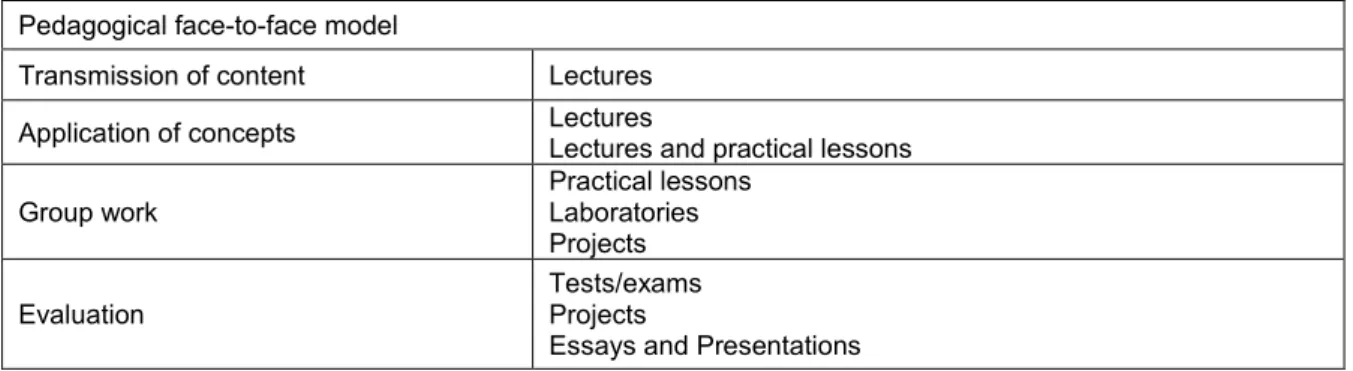
based on four functions: i) transmission of content provided by lectures, often masterful, ii) application of concepts, iii) group work and iv) evaluation. These functions are shown in table 1.
Table 1: Pedagogical face-to-face dominant model in the HEIs (Figueiredo, 2009) Pedagogical face-to-face model
Transmission of content Lectures Application of concepts Lectures
Lectures and practical lessons Group work
Practical lessons Laboratories Projects Evaluation
Tests/exams Projects
Essays and Presentations
This way, it can be proven that the lectures are a central aspect in the way the teaching activity is organized in HEIs. 1.0 communication of lectures collides with the new ways of communicating and interacting in a society immersed in technology that is intrinsically linked to the imposition of new ways of teaching and learning, which results in the redefinition of political and pedagogical models. Social and economic factors call for the use of technology as pedagogical support. Mark Prensky (2001) was the first to use the term "digital natives", which is associated with expressions such as "residents", "Generation Y" or "Net Generation”. These students grow up in environments immersed in technology and have different preferences and skills in key areas related to education, particularly in making use of the immense potential of web 2.0 (Castañeda & Soto, 2010; Kennedy et al., 2009), especially social software tools (blogs, micro blogs, sites of video sharing, social media, wikis or podcasts), which facilitate not only the emergence of communities of users, but also the involvement in social media.
The "Horizon Report: 2012 Edition Higher Education" (Johnson, Adams, & Cummins, 2012) makes a prospective analysis of the integration of technologies in HEIs, highlighting the need for fundamental change in fields such as: i) the architecture of training models: "Education paradigms are shifting to include online learning, hybrid learning and collaborative models. Budget cuts have forced Institutions to re-evaluate their education strategies" (p. 4-5), ii) the educators’ role: "The abundance of resources and relationships made easily accessible via the Internet is increasingly challenging us to revisit our roles as educators" (p. 4) or iii) Adequacy of pedagogical activity in the HEIs to how people communicate, learn and work in modern societies; "The world of work is increasingly collaborative, driving changes in the way student projects are structured. Because employers value collaboration as a critical skill, silos both in the workplace and at school, are being abandoned in favour of collective intelligence" (p. 4).
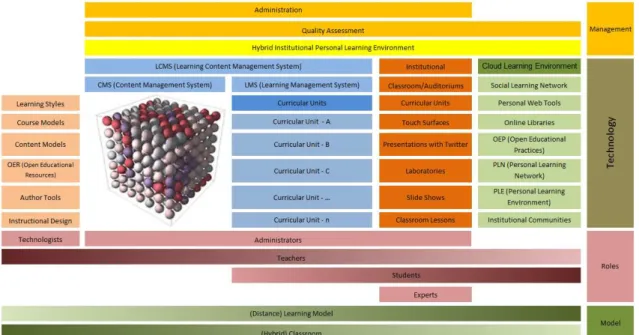
In the current scenario, it matters that HEIs reconcile their conception of the educational process with new ways of learning and student expectations. The HEIs should not overlook the fact that IT offers thestudents the opportunity to control and manage their own learning beyond the institutional vision. The globalization of the sources of knowledge, that brings the world to the school and the growing importance of social media and collaborative work of smart mobs (Tapscott & Williams, 2008) emphasize the value of the Social Learning Network (SLN), which creates the need for the HEIs to evolve to a Hybrid Institutional Personal Learning Environment (HIPLE) architecture, as a bridge between the vision of the institution and the Personal Learning Environment (PLE) of the student. In Figure 4 a possible architecture for the integration of IT in cognitive communication is shown, in which there is a link between the student’s PLE and the institutional vision, hence the resulting HIPLE. The Personal Learning Environment (PLE) of the student consists of the exploration of a multiplicity of skills available in the Cloud Learning Environment, which may go beyond the institutional vision. In fact, learning takes place increasingly through the social media, communities, institutions, exploring web tools, libraries of digital resources, repositories of Learning Objects, among other environments, tools and resources, which together result in the construction of the student’s PLE outside the HEIs.
Electronic Journal of e-Learning Volume 10 Issue 3 2012
Figure 4: Hybrid Institutional Personal Learning Environment (HIPLE)
Despite the characteristics of this new generation of students, we cannot assume that all who reach higher education already possess the necessary skills to use web 2.0 technologies such as learning tools (Castañeda & Soto, 2010). On the other hand, it is also observed that the HEIs are still inadequately prepared to work with students who have completely different technical skills and learning preferences (Bennett, Maton, & Kevin, 2008).
To address this complex situation, the HEIs must create programmes and define methodologies that enhance the use of the enormous educational potential of web 2.0. Thus, it is expected that students will develop learning skills in this context and increase their motivation and, as a result, will increase the chances of achieving good academic results.
The introduction of technology in the facilitation of cognitive function in education means a challenge for applied research with very complex and slow progress. Among the changes that have been introduced in training models under e-learning, b-learning and face-to-face, it is in the latter where the pace of change is slower. Therefore, the classroom continues to be a place of excellence in the communication of knowledge. In this context, highly practiced, it is pertinent to introduce mechanisms of interaction mediated by technology, since research shows a significant correlation between the use of technology and time spent with social media and students engagement (Chen P., 2010; Junco, Heiberger, & Loken, 2010). In this line, the Horizon Report: 2012 Edition Higher Education, states that: "There is a new emphasis in the classroom on more challenge-based and active learning (...) The active learning approaches are decidedly more student-centered, allowing them to take control of how they engage with the subject and to brainstorm and implement solutions" (Johnson et al., 2012, p. 5).
In this study we focus on the institutional context, particularly in the lectures, where teachers are faced with numerous students and have the need to activate mechanisms of direct instruction, either to save time, or because this is the teaching model that they are comfortable with. Electronic presentations as a way to transmit knowledge are a means commonly used in these classes (James, Burke, & Hutchins, 2006).This is a reusable resource, a facilitator of discourse organization and an integrator of multiple media which can serve different learning styles, as well as becoming a stepping stone of motivation and it is also conducive to note taking by students.
These presentations are massively materialized on technologies such as PowerPoint and Prezi which have mechanisms to support text, video, image, flash animation and sound, but they also have the ability to interact with the so-called web 2.0 systems, such as the micro blogs. A PowerPoint or a Prezi presentation can therefore be linked with the micro blogging application Twitter, allowing the teacher the opportunity to speak to his students.
António Andrade, Cornélia Castro and Sérgio André Ferreira
org 297 ISSN 1479-4403
Recent research about the use of Twitter in academic work shows that although 85 % of undergraduates have a Facebook account, teachers prefer to integrate Twitter into the process of teaching and learning (Junco et al., 2010). In the category of micro blogs, Twitter, designed in 2006 by Jack Dorsey, allows users to share messages up to 140 characters. This system also allows sending messages to a direct channel specifically created to exchange information (# hashtags) and the vote for alternative options which are placed under review (by vote tweet @ x key_word).
Individual or business initiatives (Elliot, 2011) have developed ADD-INS for Prezi and PowerPoint, allowing the following dynamics for those who have a Twitter account (teachers and students): Creation of a channel (not compulsory) for comments on the presentation that is being made; Students can comment directly on Twitter what they see and listen in the classroom as well as
what they read from sharing with peers (virtual classroom);
The teacher may have prepared additional comments for each slide, that hidden in "notes", can be sent to Twitter whenever it is projected;
The teacher can capture and project in all, or in some of the screens, what is being shared on Twitter;
The teacher can ask multiple-choice questions that are answered on Twitter, and the percentages of the responses for each option can be projected in a slide.
This model of communication in the classroom will increase the level of participation by: i) providing voice and turn to all the students, ii) facilitating and asking for the participation of more reserved students in oral participation iii) engaging the learning community in discussions about the theme and iv) exploring the acuity of young people to use IT.
3. Evaluation methodology
In the previous chapter some studies on the use of the social media for pedagogical purposes in various social contexts of the educational process, apart from lectures, were reported. However, as already mentioned, the literature reveals a lack of studies on the theme of exploitation of the social media to foster cognitive communication 2.0 in the context of lectures to large groups in higher education. Thus, this study assumes the characteristics of an exploratory study.
Considering, therefore, the nature of the study we did not seek to establish correlations between variables, but only to identify trends. It is expected that the results obtained will contribute to the articulation of web 2.0 tools with traditional cognitive communication in the classroom, in such a manner that positive impacts will result in pedagogical and technological effectiveness and thus in students learning achievements.
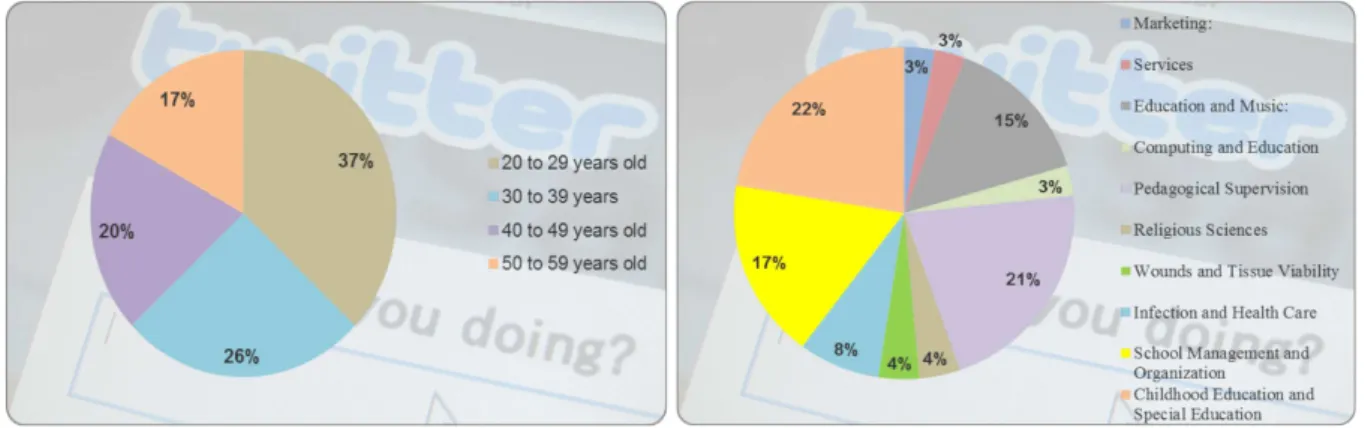
As a methodological approach to the problematic of the morphology of cognitive communication 2.0 in the context of the classroom, we used a PowerPoint presentation with the integration of Twitter. The exploitation of this resource was made during lectures to several masters classes, at the Portuguese Catholic University – Regional Center of Porto (Catholic – Porto). The number of participants in this study was n = 122. Of these, 29 % were male and 71 % female. In Figures 5 and 6 the age distribution and the master courses attended by respondents are represented, respectively.
Electronic Journal of e-Learning Volume 10 Issue 3 2012
The way the operationalization of the resource was made is represented, in schematic form, in Figure 7: the integration of Twitter in PowerPoint, with reference to a hashtag #, through which students could ask and answer questions, vote on matters presented and answer multiple choice questions. Thus, the electronic presentation, not only had the traditional function of transmitting information from one to many, but it was also intended to foster interaction content-students, teacher-students and students-students. The integration of Twitter in an electronic presentation, enables, potentially, a paradigm shift in teaching: to the one-way communication teacher-class is added the value of the interaction teacher-student-content. The feedback given by students is an important item because it allows the teacher to suit his speech to the class and answer students' questions and comments that appear in real-time presentation.
Figure 7: Integrating cognitive technologies in communication
At the end of the sessions, the participants were asked to fill a questionnaire to evaluate the resource. The convenience sampling technique was our choice. Although not representative of the population, this sampling technique had the advantage of being a fast and simple one and, therefore, suitable for preliminary studies, as in this case.
The questionnaire was made based on literature review (Hu, 2011; James et al., 2006; Kurilovas, 2007; Nesbit, 2007; Nokelainen, 2006) and consisted of 41 items spread across six dimensions: i) pedagogical aspects, ii) technological aspects, iii) cognitive learning, iv) interactions in the classroom, v) positive behaviour in the classroom and vi) negative behaviour in the classroom. The six evaluated dimensions include: issues that students identify as central in the quality of digital learning resources associated to more direct teaching and the perceived effects by students in the field of learning, behaviour and attitudes. A Likert scale of five points was used.
4. Presentation of results
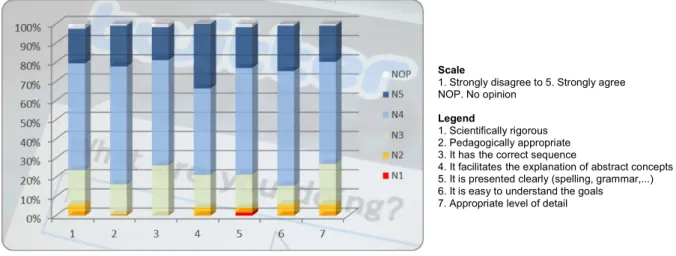
The overall results of the questionnaire indicate that the respondents recognize the pedagogical and technological potential of the resource in the six assessed dimensions, as well as its positive effects on the quality of learning and type of interaction. In Figure 8 the assessment on pedagogical aspects is presented. In the seven analyzed items, the large majority of respondents evaluated the pedagogical aspects of the course with level four, "agree" and level 5 "strongly agree." The global average of the seven items corresponds to 55 % of responses at level 4 and 22 % at level 5, and the importance of level 1 and 2 is negligible (0 % and 4 %, respectively).
Figure 8: Pedagogical aspects
As far as the "technological aspects" is concerned (Figure 9), the respondents commented on the appropriateness of the use of technology, design, usability, interface, added value compared to printed material, the potential of technology in facilitating learning, building concepts and skills
Scale
1. Strongly disagree to 5. Strongly agree NOP. No opinion
Legend
1. Scientifically rigorous 2. Pedagogically appropriate 3. It hasthe correct sequence
4. It facilitatesthe explanation of abstract concepts 5. It is presented clearly (spelling, grammar,...) 6. It is easy to understand the goals 7. Appropriate level of detail
António Andrade, Cornélia Castro and Sérgio André Ferreira
org 299 ISSN 1479-4403
development. The average of the eight items of this dimension indicates that 52 % of students "agree" and 32 % "strongly agree" that the technology used was appropriate and that potentiated learning. Like in the previous dimension, the number of respondents that gave unfavourable levels of answers (levels 1 and 2) is negligible.
Figure 9: Technological aspects
Regarding "cognitive learning" (Figure 10), if one considers the average of the 11 items on this dimension: 82 % of the respondents said that they "agree" (47 %) or "strongly agree" (35 %) that the resource has positive effects. In the average of the 11 items, the value of the terms "strongly disagree" and disagree" is located at 2 %. However, 7% of the respondents "disagree" and 1 % "strongly disagree" that the resource facilitates taking notes (item 3).
Figure 10: Cognitive learning
Figure 11: Interaction in the classroom
Scale
1. Strongly disagree to 5. Strongly agree NOP. No opinion
Legend
1. Use of technology appropriate to the content 2. The design is appealing
3. The design facilitates the clarification of the content
4. The resource is easy to use 5. The interface facilitates navigation
6. The resource is an added value compared to printed material
7. The used technology facilitates learning 8. The technology helps building concepts and developing skills
Scale
1. Strongly disagree to 5. Strongly agree NOP. No opinion
Legend
1. It helps to improve understanding 2. It facilitates memorizing information 3. It facilitates note taking
4. It favours a more appropriate pace of presentation
5. It facilitates fluency when transferring information in the classroom
6. The examples presented become clearer 7. It fosters a better coordination between the
classroom activity and the texts 8. It makes learning more motivator
9. It allows the definition of several ways of learning
10. It favours the immersion in learning and encourages further learning of contents 11. Mobilizes prior knowledge
Scale
1. Strongly disagree to 5. Strongly agree NOP. No opinion
Legend
1. It leads to a better knowledge of classmates in the classroom
2. Promotes the will to participate in class 3. It facilitates a closer relationship with the teacher and classmates
4. It facilitates discussion in the classroom 5. It allows participation via a technological channel
Electronic Journal of e-Learning Volume 10 Issue 3 2012
The potential of the evaluated resource in the "interactions in the classroom" are also recognized by the students. The average of the five presented items in Figure 11 indicates that 70 % of respondents "agree" (40 %) or "strongly agree" (30 %) with the positive effects of the resource on this dimension. The item 1 is the one that meets the highest percentage of negative and neutral answers: 2 % "strongly disagree" 11 % "disagree" and 35 % "do not agree nor disagree" that the resource leads to a better knowledge of the classmates in the classroom.
The results in the dimension "positive behaviour in the classroom" (Figure 12) are in agreement with those of the other dimensions. Considering the average of the 7 items, 75 % of respondents "agree" (49 %) or "strongly agree" (26 %) that the resource has positive effects on behaviour in the classroom. The item 1, which states that the resource helps taking better notes in class, holds the highest number of negative evaluations (1 % "disagree" and 15 % "strongly disagree"). This result is aligned with item 7 "it stimulates coming to class to take notes (15 % of respondents answered "disagree") as well as with item 3 in Figure 10.
Figure 12: Positive behaviour in the classroom
In the dimension "negative behaviours in the classroom", the scale should be read in reverse: the more favourable views about the resource are located on level 1 and the less favourable in level 5. Looking at Figure 13 we can conclude that: i) 36 % "agree" and 19 % "strongly agree" that the resource increases the possibility of keeping side conversations while the teacher presents the subject, ii) 8 % "agree" and 8 % "strongly agree" that the resource reduces the motivation to be present in class. This figure (16 %), although low in percentage terms, assumes an important meaning and is not aligned with the very positive evaluation made to other dimensions and iii) 24 % "agree" and 7 % "strongly agree" that they are more likely to skip school if they know that the resource will be available on the web.
Figure 13: Negative behaviour in the classroom
Table 2 shows the average of responses in each dimension for each course attended. Only courses with 10 or more students were taken into consideration as it was assumed that courses with fewer students didn’t have any statistical significance. However, it is important to state that the same class
Scale
1. Strongly disagree to 5. Strongly agree NOP. No opinion
Legend
1. It helps taking better notes during the lectures 2. The visual images presented in the resource help to remember the contents during exams 3. It allows a better understanding of the key-points highlighted during lessons
4. It enhances attention in the classroom 5. This resource is used as a support to group work, negotiation and dialogue in classroom 6. It helps keeping interest alive during lectures 7. Encourages coming to class to take notes on important topics
Scale
1. Strongly disagree to 5. Strongly agree NOP. No opinion
Legend
1. It increases the possibility of keeping side conversations while the teacher presents the subject
2. It reduces the motivation to be present in class 3. The probability to miss class is higher if the students know that the resource will be available on the web
António Andrade, Cornélia Castro and Sérgio André Ferreira
org 301 ISSN 1479-4403
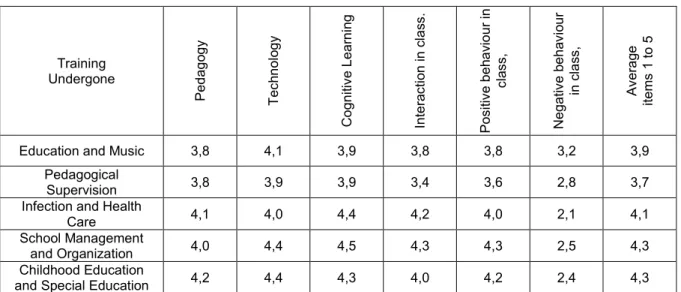
could integrate students from various courses, which increases the dimension of students in each session. What was meant by this analysis was to identify possible differences in opinions according to the type of training. The students from School Management and Organization and Childhood Education and Special Education courses are the ones that, overall, make a more positive assessment of the resource used. On the same scale of 1 to 5, the average score for items 1 to 5 (item 6 was not considered in this average as it presents a reverse scale) was 4,3. The less favourable reviews were noted in the course Pedagogical Supervision, with an average of 3,7. Although the type and size of the sample do not make it possible to establish correlations between variables, the results of this preliminary study indicate that there is material for further analysis in this field.
Table 2: Average of results in each dimension per course
Training Undergone P e d a g o g y T e c h n o lo g y C o g n it iv e L e a rn in g In te ra c ti o n i n c la s s . P o s it iv e b e h a v io u r in cl a ss, N e g a ti v e b e h a v io u r in cl a ss , Av e ra g e it e ms 1 t o 5
Education and Music 3,8 4,1 3,9 3,8 3,8 3,2 3,9
Pedagogical
Supervision 3,8 3,9 3,9 3,4 3,6 2,8 3,7
Infection and Health
Care 4,1 4,0 4,4 4,2 4,0 2,1 4,1
School Management
and Organization 4,0 4,4 4,5 4,3 4,3 2,5 4,3
Childhood Education
and Special Education 4,2 4,4 4,3 4,0 4,2 2,4 4,3
An analysis of differences in various dimensions, by gender, was made in this study. In dimensions 1 to 5 no significant differences are visible. Gender disparities are only visible in dimension 6, which refers to negative behaviour in the classroom (Table 3). As shown in the three items considered, male respondents considered that the resource has more negative effects.
Table 3: Significant differences per gender
Men Women
1. It increases the probability to keep side conversations while the teacher
presents the subject 3,7 3,2
2. It reduces motivation to be present in class 2,7 2,2 3. The probability to miss classes is higher if it is known that the resource
will be available on the web 3,1 2,5
5. Results discussion
5.1. Implications
Constructivism as a philosophy and pedagogy is now widely accepted and is close to most contemporary theories of teaching and learning: "constructivism", "situated learning", "social cognition", "activity theory", "distributed cognition", "ecological psychology", and "case-based reasoning" (Jonassen, Howland, Moore, & Marra, 2003). Education policies, including the Bologna process, give expression to these pedagogical models of constructivist nature. In line with this perspective is the way new generations of students learn: in a more flexible way, not just playing the role of passive consumers of information, but as active builders in their learning process. The social media provided by web 2.0 support this new philosophy of learning based on community building, participation and sharing.
In fact, it has been observed that the social media – a collection of Internet web sites, services and practices that support collaboration, community building, participation and sharing – has attracted the interest of academics more likely to use technology in education and who seek new ways to motivate their students to a more active way of learning (Junco et al., 2010). In this exploratory study, promising indicators that suggest that web 2.0 tools can be integrated efficiently in the cognitive communication process of lectures emerged, with positive impacts in terms of teaching and
Electronic Journal of e-Learning Volume 10 Issue 3 2012
technology effectiveness, the encouragement of learning, the fostering of interaction and positive behaviors in the classroom.
There are several studies about the use of the web 2.0 tools potential as an approach to more constructivist philosophies. However, few are the studies focused on classroom lectures, where the teacher faces a class-group, consisting of several dozen of students with the need for direct instruction, to be able to present a large volume of information in the minimum time. In this context, which occurs often in higher education, dialogue and interaction are limited.
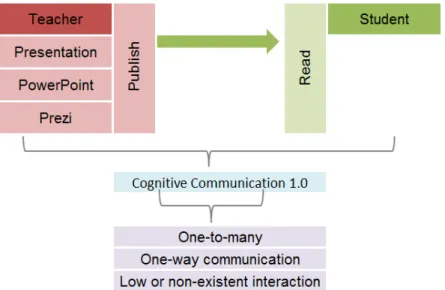
Figure 14 depicts the morphology of the communication process in a lecture to large groups, in which the electronic presentation only allows one-way communication, the interaction is not favored and the student is sent to a more passive role.
Figure 14: Cognitive communication morphology 1.0 in the context of a lecture
Mayer admits the possibility of using resources more
associated with direct instruction to achieve more constructivist approaches. In this study we sought to determine whether the integration of the web 2.0 tool Twitter micro blogging in a PowerPoint presentation contributed to the upgrade of a cognitive communication 1.0 to a cognitive communication 2.0 in the context of a lecture (Hu, 2011). The applied questionnaire allowed to assess various dimensions of the resource used in the classroom and to verify the changes in the morphology of cognitive communication. The results indicate that students recognize the potential of the resource used in the dynamics and dimensions of a cognitive communication situation 2.0, in particular with regard to: i) pedagogical aspects, ii) technological aspects, iii) cognitive learning; iv) interactions in the classroom and v) positive behaviour in the classroom.
In Figure 15 the results of the resource at interaction level and the direct effects on the student’s activity are summarized. Twitter integration favours a multidirectional communication and an increase of the interaction between teacher-student, student-student and student-content.
This leads to an upgrade of the level of cognitive communication from version 1.0 to 2.0. The findings corroborate the results obtained when applying this questionnaire to a smaller sample (Ferreira, Castro, & Andrade, 2011) and are aligned with other studies, namely: i) the positive effects on learning (Balanskat, Blamire, & Kefala, 2006; James et al., 2006; Junco et al., 2010) and ii) the relation between the use of technology and the student involvement in school activities (Balanskat et al., 2006; Chen P., 2010; Junco et al., 2010).
There are still significant sectors of conservatism and resistance to change in HEIs through technology: “Institutional barriers present formidable challenges to moving forward in a constructive way with emerging technologies. Too often it is education’s own processes and practices that limit broader uptake of new technologies. Much resistance to change is simply comfort with the status quo” (Johnson et al., 2012, p. 6). Only with more research can the potential of technology be demonstrated, namely in the exploration of the social media and in the upgrade of the cognitive
António Andrade, Cornélia Castro and Sérgio André Ferreira
org 303 ISSN 1479-4403
process of communication from version 1.0 to 2.0, in order to align it with the way the Net Generation thinks and learns.
Figure 15: Morphology of cognitive communication 2.0 in the context of a lecture
5.2. Limitations
The main limitation of this study relates to the fact that it was done with a specific sample, consisting of a small number of masters students at Catholic – Porto, which is not necessarily representative of all HEIs. In addition, only master's students belong to the sample, which requires some conservativism in the transposition of the reading of the results for other levels of education, particularly for undergraduate students. Aspects such as maturity and experience of students in the use of the social media were not manipulated and can be crucial in explaining the results.
6. Conclusions
The pedagogical change and innovation in higher education through technology, namely through the exploration of social media in teaching activities, is a hot topic in research. However, the literature reveals lack of studies on this subject in the context of lectures. Despite the loss of centrality of lectures on research, they remain a fundamental element in the organization of teaching activity. Mandatory time-saving and teaching organization lead teachers to rely upon mechanisms of direct instruction in lectures, which contributes to the immutability and conservatism in cognitive communication. As a result we have a model of communication 1.0, where the communication is predominantly from one-to-many, in which the student plays a passive role in receiving the information. This communication model is opposed to the communication model 2.0, closer to the constructivist philosophy, which reflects the way students learn in the Information Society, where they assume an active role, interactive and collaborative in the construction of their knowledge.
As an approach to the theme of cognitive communication 2.0 in the context of lectures, with the integration of the social media, we have developed an exploratory study, which consisted of the use of a PowerPoint presentation with the integration of the micro blogging tool Twitter. This feature allowed students to comment, question and debate the subject in real time. The comments, visible in PowerPoint, allowed the teacher to re-orientate his speech, without interrupting it, and enabled the students to read their peers’ views and to contribute with their own perspective to the debate. It also allowed the release of multiple choice questions to the audience, with answers via Twitter and the projection of results via PowerPoint. This way, a true cognitive communication 2.0 took place.
The results obtained through a questionnaire distributed at the end of the session, indicate that students recognize the potential of this tool in the dimensions evaluated: i) pedagogical aspects, ii) technological aspects; iii) cognitive learning, iv) interactions in the classroom and v) positive