Research Article
a
August
2017
Computer Science and Software Engineering
ISSN: 2277-128X (Volume-7, Issue-8)
An Improved Image Restoration Technique for GIF Images
Geetanjali Jain, Supreet Kaur
Punjabi University Regional Centre for Information Technology and Management, Punjab, India
DOI:10.23956/ijarcsse/V7I8/0161
Abstract— Image restoration is used to emphasize and sharpen image features for display and analysis. Image restoration is the process of applying these techniques to facilitate the development of a solution to a computer imaging problem. Image restoration is an important issue in high level image processing which deals with recovering of an original and sharp image using a degradation and restoration model. During image acquisition process degradation occurs. Image restoration is used to estimate the original image from the degraded data. Aim of this research work is to provide a concise overview of most useful restoration models. Using the proposed approach the features of the neighboring pixels are calculated and on basis of these features image is restored. In this research work we use canny edge detection technique to find edges and use probability recovery method to find distortion in each pixel. Using thresholding value restore the distorted pixels and filter restored image. In the end performance evaluation of proposed method is performed based on various parameters like MSE, PSNR, contrast, and coefficient of correlation.
Keywords— Include at least 5 keywords or phrases
I. INTRODUCTION
Image editing encompasses the processes of altering images, whether they be digital photographs, traditional photochemical photographs, or illustrations. Traditional analog image editing is known as photo retouching, using tools such as an airbrush to modify photographs, or editing illustrations with any traditional art medium. Graphic software programs, which can be broadly grouped into vector graphics editors, raster graphics editors, and 3D modelers, are the primary tools with which a user may manipulate, enhance, and transform images. Many image editing programs are also used to render or create computer art from scratch.
Image Restoration is the operation of taking a corrupt/noisy image and estimating the clean, original image. Corruption may come in many forms such as motion blur, noise and camera mis-focus.[1] Image restoration is performed by reversing the process that blurred the image and such is performed by imaging a point source and use the point source image, which is called the Point Spread Function (PSF) to restore the image information lost to the blurring process.
Image restoration is different from image enhancement in that the latter is designed to emphasize features of the image that make the image more pleasing to the observer, but not necessarily to produce realistic data from a scientific point of view. Image enhancement techniques (like contrast stretching or de-blurring by a nearest neighbor procedure) provided by imaging packages use no a priori model of the process that created the image.
With image enhancement noise can effectively be removed by sacrificing some resolution, but this is not acceptable in many applications. In a fluorescence microscope, resolution in the z-direction is bad as it is. More advanced image processing techniques must be applied to recover the object.
II. LITERATURE SURVEY
Sasirooba Thirumavalavan and Sasikala Jayaraman [1] presented an improved Teaching Learning Based Optimization (TLO) and a methodology for obtaining the edge maps of the noisy real life digital images. TLO is a population based algorithm that simulates the teaching–learning mechanism in class rooms, comprising two phases of teaching and learning. The ‗Teaching Phase‘ represents learning from the teacher and ‗Learning Phase‘ indicates learning by the interaction between learners. This paper introduces a third phase denoted by ‗‗Avoiding Phase‖ that helps to keep the learners away from the worst students with a view of exploring the problem space more effectively and escaping from the sub-optimal solutions. The improved TLO (ITLO) explores the solution space and provides the global best solution.
Gursharan Kaur et al. [2] discussed various technologies as well as their filters to detect and remove the noise. Image may corrupt due to the noise. To remove this noise, in this paper, techniques and various filters are described. Noise reduction is the main focus to retain the quality of the image. Image quality reduces because of the image acquisition or transmission. Before applying further processing on the image, noise should remove from the image.
ISSN(E): 2277-128X, ISSN(P): 2277-6451, DOI: 10.23956/ijarcsse/V7I8/0161, pp. 313-317
Prabhishek Singh and Raj Shree [4] focused on the noise issues that changes image pixels value either on or off. To get an enough efficient method to remove the noise from the images is a greater challenge for the researchers. Noise plays an important role in degrading the image at the time of capturing or transmission of the image. There are many algorithms and filtering techniques available which have their own assumptions, merits and demerits depending upon the prior knowledge of the noise. Image smoothening is one of the most significant and widely used procedure in the image processing. Here, apart from noise a model, the light is also thrown on comparative analysis of noise removal techniques is done.
D. Saranya and V. Radha [5] focused on the noise in an image and filtering used to remove the noise. The noise in an image is a disturbance while performing operations in the image processing. Medical images plays vital role in digital image processing. In dermoscopic images, the unwanted hairs on skin lesion, air bublles etc., are considered as noise. Noise can be removed in the preprocessing stage through filtering. Filtering is the technique used in preprocessing to make the image a clear and eligible manner so that other process can be further continued without any disturbances.
Ankita Soni and Rajdeep Shrivastava [6] presented the results of applying different noise types to an image model and investigated the results of applying various noise reduction techniques. Noise removal is one of the greatest challenges among the researchers, noise removal algorithms vary with the application areas and the type of images and noises. Noise can degrade the image at the time of capturing or transmission of the image. Before applying image processing tools to an image, noise removal from the images is done at highest priority. Ample algorithms are available, but they have their own assumptions, merits and demerits. The kind of the noise removal algorithms to remove the noise depends on the type of noise present in the image.
Milind kumar V. Sarode and Prashant R. Deshmukh [7] proposed filtering techniques for the removal of speckle noise from the digital images. Quantitative measures are done by using signal to noise ration and noise level is measured by the standard deviation. Reducing noise from the medical images, a satellite image etc. is a challenge for the researchers in digital image processing. Several approaches are there for noise reduction. Generally speckle noise is commonly found in synthetic aperture radar images, satellite images and medical images.
Jannath Firthouse.P et al. [8] defined that image denoising is a utmost challenge for Researchers. Image Denoising evaluates the image data to create a visual quality image. The original pixel values is mislay when the noise is miened. Noise is the effect of error,the pixel value does not affect the original intensity of the real scene in the image. Exceptionally Medical images are interrupted by a variety of noises depending on their devices through acquisition and transmission. In this work to denoise Gaussian noises and Speckle noises in MR Images undergo a contourlet domain for decomposition of input images. Contourlet is used to preserve the edges and contours. After decomposition some threshold methods are applied such as Bayes Shrink, Neigh Shrink, and Block Shirnk. These Threshold methods are used to unfasten the noises.
III. CLASSIFICATION OF IMAGE RESTORATION
Image restoration techniques are methods which attempt the inversion of some degrading process. Image restoration technique can be broadly classified into two types depending upon the knowledge of degradation. If the prior knowledge about degradation is known then the deterministic method of image restoration can be applied. If it is not known then the stochastic method of image restoration has to be employed. Restoration often exhibits arte-facts near the edges, as linear methods are unable to recover missing frequency components which lead to Gibbs effect.
1. Blind Image Restoration: This Technique allows the reconstruction of original images from degraded images even when we have very little or no knowledge about PSF. Blind Image Deconvolution (BID) is an algorithm of this type.
2. Non-Blind Restoration: This Technique helps in the reconstruction of original images from degraded images when we know that how image was degraded.
IV. PROPOSED WORK
In this paper hybrid filling-in technique is used to restore the corrupted or damaged images. In the hybrid technique first Probabilistic Recovery Filling-in technique is implemented to find out the distortion in the pixels. In this density based approach, density of each pixel is measured. Low density pixels are considered as corrupted or missing pixels.
Image Restoration Technique
Deterministic Methods Stochastic Method
ISSN(E): 2277-128X, ISSN(P): 2277-6451, DOI: 10.23956/ijarcsse/V7I8/0161, pp. 313-317
Recovery Probability of each pixel is founded. For corrupted pixels, if probability of recovery pixel is < threshold then matching of pixel from surrounding is done. For corrupted pixels, if probability of recovery pixel is > threshold then matching is done from the remaining part of the pixel. If the pixel is missing, finding the missing block process is carried and matching with surrounding is done. Pixel matching is judged by color map and based on good observations. After this proposed filling-in technique is implemented in which GLCM (Gray level co-occurrence matrix) is used to scan the properties of image. First window size is set according toGLCM. Each pixel is traced in window block. Features of pixels are scanned and best matching pixels is founded through scanning. Values of corrupted pixel are replaced by best matching pixel. The research will provide better quality of image after recovery. This paper describes the benefit of using two filling-in techniques. There are some distortions left after applying Probabilistic Recovery Filling-in technique which is removed to large extent by implementing proposed filling-in technique.
V. METHODOLOGY
In the hybrid technique density based approach is implemented to find out the distortion in the pixels. After this approach the proposed technique is implemented to restore the noisy and distorted image. First of all GUI window is created in MATLAB. Image is loaded in it. Then noise and blur is added into it. After adding distortion canny edge detection technique is implemented to detect the edges. Then hybrid filter is applied to remove distortion from image. After filtration, proposed image restoration technique is applied. Low density pixels are considered as corrupted or missing pixels. Recovery Probability of each pixel is founded. For corrupted pixels, if probability of recovery pixel is < threshold then matching pixel from surrounding is done .For corrupted pixels, if probability of recovery pixel is > threshold then matching is done from the remaining part of the pixel. For completely missing pixels, finding the missing block process is carried and matching with surrounding is done. Pixel matching is judged by color map and based on good observations. After this proposed filling-in technique is implemented in which GLCM (Gray level co-occurrence matrix) is usedto scan the properties of image. First window size is set according to GLCM. Each pixel is traced in window block. Features of pixels are scanned and best matching pixels is founded through scanning. Values of corrupted pixel are replaced by best matching pixel. After all the operations defined above two filters namely median filter and lee filter is applied. Median filter is better able to remove these outliers without reducing the sharpness of the image. Output of median filter is given to Lee Filter. Lee filter further filters the image.
Flow Chart
VI. RESULTS AND DISCUSSION
In this section the results of the proposed approach is defined so that we can compare it with existing system and validate it.
Start
Input Image
Introduce Noise in image
Apply Teaching Phase
Apply learning Phase
Implement fuzzy based approach
Generate and validate results
ISSN(E): 2277-128X, ISSN(P): 2277-6451, DOI: 10.23956/ijarcsse/V7I8/0161, pp. 313-317
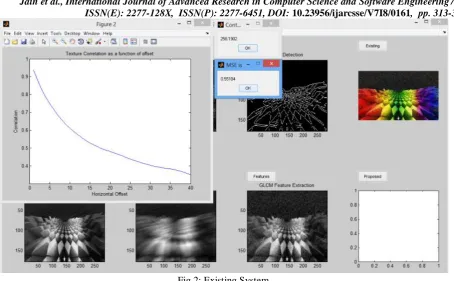
Fig 2: Existing System
Figure 2 is the presentation of the existing system which restore the image and values generated using this approach are defined as MSE is: 0.55184 and that of contrast is: 258.1902.
Fig 3: Proposed System
Figure 3 is the presentation of the proposed system which restore the image and values generated using this approach are defined as MSE is: 0.46169 and that of contrast is: 286.4909. A comparison table for both the approaches is defined as follows:
Table 1: Comparative Study
Technique Parameters
Existing Proposed
MSE 0.55184 0.46169
Contrast 258.1902 286.4909
ISSN(E): 2277-128X, ISSN(P): 2277-6451, DOI: 10.23956/ijarcsse/V7I8/0161, pp. 313-317
VII. CONCLUSION
Image Restoration is the process of removal or reduction of degradation in an image through linear or non-linear filtering. Degradations are usually incurred during the acquisition of the image itself. The aim of image restoration is to bring the image what it would have been if it had recorded without degradation. In the current research the drawback of the existing restoration methods are reduced. In the proposed research the a method is developed for restoration in which the image can resist to the noise and any other distortion, so that it can contains the property that it possessed in the original stage. In the proposed research if any distorted image is uploaded then it restores the image to near to its origina l stage using the proposed thresholding concept. Using the defined approach the results are much better than that of existing approach as defined and validated in the results and discussion section. This paper describes the benefit of using two filling-in techniques.
REFERENCES
[1] Combettes P. T. and Pesquet J. C., ―Image Restoration Subject to a Total Variation Constraint‖, IEEE Transactions On Image Processing, Vol. 13, No. 9, September 2004.
[2] Gulhane P. R. and Gaikwad V. T., ―Image Restoration Using Filling-In Technique for Missing Blocks of Image‖, International Journal of Advanced Research in Computer Science and Software Engineering, Vol. 2, Issue. 5, May 2012.
[3] Mark R.Banham and Aggelos K. Katsagglos,―Digital Image Restoration‖, IEEE Signal Processing Magazine,
1997.
[4] Charu Khare, Kapil Kumar Nagwanshi ,‖ Implementation and Analysis of Image Restoration Techniques‖,
International Journal of Computer Trends and Technology, May-June 2011.
[5] Charu Khare and Kapil Kumar Nagwanshi,‖ Image Restoration Technique with Non Linear Filter‖,
International Journal of Advanced Science and Technology, Vol. 39, February, 2012.
[6] Celia A . Zorzo Barcelos and Marcos Aure ́lio Batista ,‖ Image restoration using digital in-painting and noise removal, Image and Vision Computing Journal, 2007
[7] Rani R., Singh S. and Malik A., ―Image De-noising Using Hybrid Filter,‖ International Journal of Innovative
Technology and Exploring Engineering (IJITEE) , Volume 1 , Issue 1 , pp. 10-13, (June 2012)
[8] Kaushik P. and Sharma Y., ―Comparison Of Different Image Enhancement Techniques Based Upon Psnr & Mse‖ ,International Journal of Applied Engineering Research,Vol.7, No.11 (2012)
[9] Chaahat and Bahl M., ―Probabilistic Recovery Filling-in Technique For Image Restoration,‖ International Journal of Advanced Research in Computer Science and Software Engineering, Volume 3, Issue 3, pp. 545-547, (March 2013)
[10] Goyal S. R.,―Digital In-painting Based Restoration‖, International Journal of Computer Science &