Proceedings of the
Sixth International Workshop on
Graph Transformation and Visual Modeling Techniques
(GT-VMT 2007)
Adding Recursion to Graph Transformation.
Esther Guerra, Juan de Lara
14 pages
Guest Editors: Karsten Ehrig, Holger Giese
Managing Editors: Tiziana Margaria, Julia Padberg, Gabriele Taentzer
Adding Recursion to Graph Transformation.
Esther Guerra1, Juan de Lara2
1[email protected] Dep. Ingenier´ıa Inform´atica Universidad Carlos III de Madrid (Spain)
2[email protected] Escuela Polit´ecnica Superior Universidad Aut´onoma de Madrid (Spain)
Abstract: In this paper we define recursive rules in the double pushout approach (DPO) to graph transformation. Classical DPO rules are extended with abase case conditionand a recursion condition. Mechanisms are provided to pass the match from both conditions to the rule’s left hand side, and also between two consecutive steps in the recursion. The approach is useful when recursive structures (such as in-heritance hierarchies, nested component hierarchies, networks of functional blocks, etc.) have to be processed. Although we present the recursion for DPO, it can also be adapted to other approaches to graph and model transformation. We present examples for model transformation, model simulation and model optimization in different application domains.
Keywords:Graph Transformation, Double Pushout, Recursion.
1 Introduction
Graph transformation [Roz97] is becoming increasingly popular to express computations on graphs due to its formal, declarative and graphical nature. One of the most popular formal-izations of graph transformation is the double pushout approach (DPO) [EEPT06], which uses category theory to model rules and derivations. Graph transformation has been used in many application areas, such as modelling with visual languages [Min02], visual simulation [LV04], model transformation [EGL+05] and refactoring [EJ04]. The manipulation of structures with
nested, iterated or recursive elements is common in many of these areas.
The formal nature of DPO graph transformation allows interesting analysis techniques, for example to investigate confluence, termination and rule independence [EEPT06]. Moreover, the categorical framework has lifted the results from graphs to any (weak) adhesive HLR cate-gory [LS04,EEPT06] (short AHLR category). However, compared to other approaches [BV06,
Usually, there are two options when processing a recursive structure with DPO rules. As each element has to be consecutively processed, a solution is encoding helper control elements in the graph, which guide the application of the rules. However, this is sometimes undesirable or im-possible, as it implies modifying the meta-model (or type graph) of the model to be transformed. Another possibility is to flatten the structure. For example, performing the transitive closure (by adding ancestoredges) can flatten an inheritance hierarchy. Again, this solution implies a modification of the type graph as well as pre- and post- processing phases.
In this paper we propose recursive rules, which enhance the expressive power of DPO rules in order to make the recursive processing of structures easier. We extend classical DPO rules with mechanisms for passing matching information between consecutive rule applications, and to guide rule execution by traversing structures recursively, where the rule’s action is executed at each step in the recursion. We present our approach in the AHLR framework, in such a way that it becomes valid for any AHLR category. In particular, we show an instantiation for attributed typed graphs. Our approach has several benefits. On the one hand, there is no need to add extra elements to process the recursive structure. This usually leads to simpler and higher-level rules as we abstract from “accidental details”, concentrating on the essence of the problem. On the other hand, the execution of a recursive rule can be more efficient than several DPO simple rules, as the matches are guided through the structure. Moreover, the framework can be adapted to other graph and model-transformation approaches.
Paper organization. Section2gives an overview of transformation formalisms that consider the processing of recursive structures. Section3introduces the DPO approach. Section4presents our proposal for recursive rules. Section5shows additional examples for model simulation and transformation. Finally, section6ends with the conclusions and future work.
2 Related Work
Some approaches to model transformation are found in the literature to handle recursive appli-cations of a rule. Usually, they are based on the use of some control flow language that guides the transformation execution. For example, GReAT [KASS03] provides hierarchical data flow diagrams for control execution, where rules can be placed on blocks and participate in recursive calls. Control flow in VIATRA [BV06] is specified by means of Abstract State Machine (ASM) programs, while in Fujaba [NNZ00] it is done by means of story diagrams. In the OMG’s QVT [OMG] specification, complex transformations can be implemented by using the Opera-tional Mapping Language either in an imperative or in an hybrid approach.
Other model transformation languages embed control mechanisms in the rules. One example is UMLX [Wil03], which provides rule encapsulation, thus allowing composition and some de-gree of recursion. However, traversing a structure can be incomplete if a match of the rule is not found in some recursion step. MOLA [KBC05] incorporates mainly loopings in the rules as graphical control structure, and allows the transitive closure and the traversal of the recursive structure in a single rule. However, the recursion semantics is not formally defined.
expressions. Thus, given an initial match, edges can be matched by testing their existence or by traversing them. Another example is VIATRA, where queries on graphs can be expressed by generalized (recursive) graph patterns, which may contain a nesting of positive and negative patterns of arbitrary depth. However, neither path expressions nor recursive patterns can guide the rule execution. That is, they are expanded by a recursive evaluation, but the rule that contains them is applied once. Consecutive rule applications require the use of a control language and a mechanism to pass the elements matched in previous executions to the next execution step.
With respect to approaches based on DPO, there are some attempts to increase the expressive-ness of DPO rules for refactoring [EJ04]. However, these do not consider recursive application of rules. In parallel graph transformation [Tae96], standard DPO rules are extended by allowing certain parts of the rules to be instantiated an arbitrary number of times, and providing synchro-nization mechanisms controlling the way the matching should occur. Thus, the approach is a way to describe in a concise way a (possibly infinite) number of rules in which a certain part is replicated. Again, this is a mechanism for rule expansion, where the rule is applied once.
3 The Double Pushout Approach
In this section we give a brief overview of the double pushout approach (DPO) to graph trans-formation. See [EEPT06,Roz97] for a more extensive presentation.
Graph grammars are made of rules with a left and right hand side (LHS and RHS). When a rule is applied to a graph G (the host graph), an occurrence of the LHS (a matching mor-phism) has to be found inG, which can be then substituted by the rule’s RHS. DPO uses cate-gory theory to model rules and derivations, and its theory has been lifted from graphs to (weak) AHLR categories [LS04, EEPT06]. These categories are based on a distinguished classM of monomorphisms. Examples of AHLR categories are graphs, typed graphs, P/T nets (indeed a weak AHLR category) and attributed typed graphs. Thus, not only graphs, but also objects in any (weak) AHLR category(C,M)can be rewritten using DPO rules.
DPO rules are modelled using three components: L, KandR. Lcontains the necessary ele-ments to be found in the object to which the rule is applied. K (the gluing object) contains the elements that are preserved andRthose that should replace the identified part in the object being rewritten. Roughly,L−Kare the elements that should be deleted by the rule application, while R−K are the elements that should be added. We present these two concepts in the following definitions, taken from [EEPT06].
Definition1 (DPO rule) Given a (weak) AHLR category (C,M), a DPO rulep= (L←l K→r R) consists of three objects L, K and R called left hand side, gluing object and right hand side respectively, and morphismsl:K→L,r:K→Rwithl,r∈M.
L
m
²
² (1)
K
l
o
o r //
d
²
² (2)
R
m∗
²
²
X
/ ..
p
L
x
o
o
m
²
² (1)
K
l
o
o r //
d
²
² (2)
R
m∗
²
²
Goo l∗ D r∗ //H Goo l∗ D r∗ //H
Figure 1: DPO Direct Derivation (left). Direct Derivation by DPO Rule with NAC (right).
Sometimes, rules are equipped with application conditions [EEPT06] constraining their ap-plicability. For simplicity, we only deal with negative application conditions (NACs). These have the formNAC(x), wherex:L→X is a morphism. Morphismm:L→GsatisfiesNAC(x) if there is no morphism p:X →GinM0 with p◦x=m(see right of Fig.1). M0 is an addi-tional class of distinguished morphisms than can beM if the latter is the class of all monomor-phisms [EEPT06]. Next, we define the concepts of AHLR system, grammar and language.
Definition 3 (AHLR system, grammar and language) An AHLR system AHS= (C,M,P) consists of a (weak) AHLR category (C, M) and a set of productionsP. An AHLR grammar AHG= (AHS,S)is an AHLR system together with a distinguished start objectS. The language Lof an AHLR grammar is defined byL={G| ∃S⇒∗ G}.
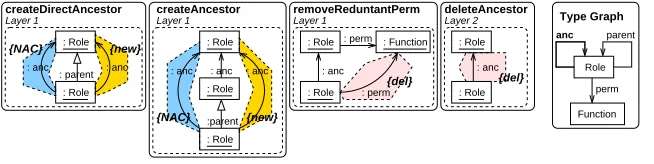
Example and Motivation. Fig. 2 shows some DPO rules in the category of typed graphs GraphTG, where objects are tuples (G,typeG). The first element is a graph, and the second one a typing functiontypeG: G→T GfromGto a distinguished graph called the type graph. The type graph in the example is taken from a Role Based Access Control system. It models hierarchies of roles (through relation parent), which can be granted permission (relationperm) to execute certain functions. The rules present together in a single graph theL, K, R and X components. Elements inL−K are marked as “del”, elements inR−Kas “new” and elements inX−Las “NAC”. We follow a UML-like notation, where the types are shown after a colon.
Rules in the example are used to eliminate redundant permissions in role hierarchies. A per-mission is redundant for a role if an ancestor already defines it. The rules first calculate the tran-sitive closure of relation parent by adding helper edges of typeanc. RulecreateDirectAncestor creates such edge to a direct parent. The iterated execution of rulecreateAncestorperforms the transitive closure. Rule removeRedundantPermissionremoves relation perm from a role if an ancestor already has the same permission. We use an execution control structure for rules based on layers. The three previous rules are assigned the layer one and are applied as long as possible. Once no rule in this layer can be applied, the next layer is executed. The second layer contains ruledeleteAncestor, which deletes the helperancedges (i.e. a post-processing step).
: perm : anc
: perm : Function
{del}
Layer 1
removeReduntantPerm
: Role
: Role : anc
{del}
Layer 2
deleteAncestor
: Role
: Role
: Role
Layer 1
createAncestor
:parent : anc : anc : anc
{NAC} {new}
Role
Function parent
anc
Type Graph
perm : Role
: Role : parent : anc : anc
createDirectAncestor
Layer 1
{new}
{NAC} : Role
: Role
Figure 2: Example DPO Rules.
matching information between consecutive derivations. Hence, control information has to be encoded in the data or, as in this case, the recursive structure has to be flattened.
The solution of adding helper edges (ancin the example) is not optimal. First, we have to modify the type graph (see Fig.2). This is undesirable or even impossible in real applications, if the type graph is a standard meta-model of some modelling language (such as UML), and is being used by other users and tools. Moreover, if several computations have to be performed, it is not feasible that each one of them adds different helper structures to the type graph. Second, there is a pre-processing phase in which helper edges are explicitly added, and a post-processing phase in which the edges have to be removed. These two phases produce a computation overload. In the next section we propose a solution to alleviate these problems.
4 DPO Recursive Rules
In this section we extend DPO rules with several artefacts to modelconditionsfor the base and recursive cases, as well as a mechanism to pass part of the match between the base and recursive cases, and between two consecutive steps in the recursion.
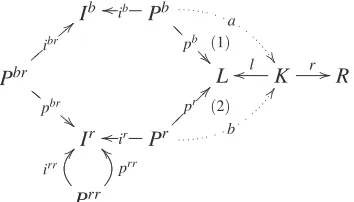
Definition 4 (DPO recursive rule) A DPO recursive rule pr= (L←−l K−→r R,Ib,Ir,(Ij i
j
←− Pj−→pj L)
j∈{b,r},(Ij i jr
←−Pjr p−→jr Ir)
j∈{b,r})is made of:
• A DPO ruleL←−l K−→r R, a base conditionIband a recursion conditionIr.
• The relations between the base (j=b) and recursion (j=r) conditions andLby means of their common elements (objectPj),(Ij←−ij Pj−→pj L)
j∈{b,r}, withij,pj∈M.
• The relation between the base and the recursion conditions by means of their common elements (objectPbr),Ib i←−br Pbr p−→br Ir, withibr, pbr∈M.
Iboo ib Pb pb > >
Â
Â
> >
a
¼
¼
(1)
Pbr ibr { {
=
=
{ {
pbr D D
!
!
D D
Loo l K r //R
Iroo ir Pr pr Ä Ä
?
?
Ä Ä
b
D
D
(2)
Prr irr
?
?
prr
_
_
Figure 3: Formalization of a DPO Recursive Rule.
Fig.4shows a recursive rule that eliminates redundant permissions in role hierarchies, equiv-alent to the set of standard DPO rules in Fig.2. To the left, the rule is shown according to the theory, to the right using a more compact and intuitive notation that will be used throughout the paper.
: Role : Function
{del}
: Role r2: Role 2
r1: Role 1
: Role 2 : Role 1
: Role 2 : Role 1 rb: Role
ra: Role
rc: Role 2
Pr
: Role 2 : Role 1
Prr
: Role 2 : Role 1
Pbr
Ir Ib
Pb
: perm
: perm
1
2
: parent
DPO Rule
: parent
1 3
(1, 1) (2, 2)
(1, 1) (2, 2)
(1, 1) (2, 2)
(1, 1) (2, 2)
(1, 1) (2, 2) (1, 1) (2, 2) (1, 1)
(2, 2)
(2, 3) (1, 1)
removeRedundantPermissionRecursive
(a)
r2: Role 2
Next: Recursion(r1, r2)
rb: Role ra: Role
rc: Role 2
Next: Recursion(ra, rc)
: Role : Function
{del}
: Role r1: Role 1
: parent : parent
1 : perm
: perm
1
2 Recursion(ra, rb: Role)
Base DPO Rule
removeRedundantPermissionRecursive
(b)
Figure 4: A DPO Recursive Rule Example (a) Theoretical Notation. (b) Compact Notation.
thereforeibr) is given by the actual parameters of the recursion call from the base case (that we depict using the identities of nodes and edges, shown before the colon). Note also that morphism pbr is given by the assignment of the formal parameters in the recursive condition (i.e. raand rb). In a similar way,Prr(andirr) is given by the actual parameters of the recursion call from the recursive case andprrby the assignment of the formal parameters in the recursive condition (i.e. raandrb). Note how some formal parameters of the recursion may become unused by one of the two recursive calls, and in this case they are just ignored.
4.1 Derivation by DPO Recursive Rule
A DPO recursive rule derivation is made of three steps, each composed by several sub-steps. First step. The rule is executed for the base case (see Fig.5). A matcheb:Ib→G(calledbase match) has to be found for thebase condition Ib, identifying the starting point in the recursive structure to be processed. Then, arule match mb
1: L→Gis sought for L, such thateb◦ib= mb
1◦pb, and which has to make (Pb,ib: Pb →Ib,pb: Pb→ L) the pullback of (G,eb:Ib→ G,mb
1: L→G), as square (1) in Fig. 5shows. Then, ruleL l
←−K−→r Ris applied once inG, yielding graphH1. As Proposition 1 shows, matcheb still exists inH1. If a matchmb2:L→H1 is found such that square (2) in Fig.5 is pullback, we apply again the rule at that match. The operation is repeated until no match fromLis found makingPb a pullback object. The output of this step is the base match eb, together with graphH
n, obtained as a result of the repeated applications of the DPO rule. The execution of the recursive rule finishes if@eb such that (1) is pullback. The execution continues at step 2 even if the DPO rule is not applied.
Pb ib¢¢
¡
¡
¢¢ pb ;;
À
À
; ; (1)
Pb
(2)
ib¢¢
¡
¡
¢¢ pb <<
À
À
< <
Ib eb = =
Á
Á
= =
L
mb 1 ££
¢
¢
££
K
l
o
o r //
k1
²
²
R
r1 M M M M M
&
&
M M M M
Ib eb = =
Á
Á
= =
L
mb 2 ££
¡
¡
££
K r //
l
o
o
k2
²
²
R
r2
²
²
· · ·
Goo f1 D1 g1 //H1oo f2 D2 g2 //H2 · · ·Hn Figure 5: Application of Recursive Rule. Step 1: Base Case.
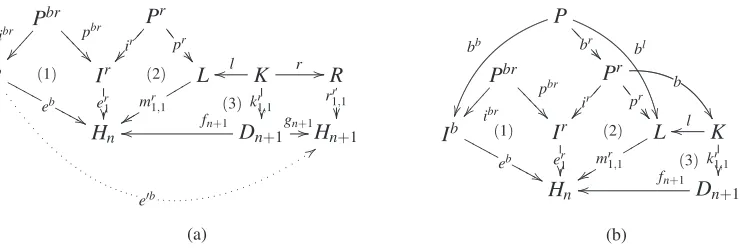
Second step.The rule is executed for the first step in the recursion. Thus, a matcher
1:Ir→Hn (calledrecursive match) is sought such that square (1) in Fig.6commutes (i.e.eb◦ibr=er1◦pbr) and makesPbra pullback object. As in the base case, a rule matchmr
1,1:L→Hnis sought for L such thater
1◦ir=mr1,1◦pr and makes Pr a pullback object, as square (2) shows. If match mr
1,1 satisfies the constraints given by Proposition 2 (which guarantee the preservation of eb), the DPO rule is executed at that match yieldingHn+1. As Proposition 1 shows, matcher1 still exists inHn+1. If an additional matchmr1,2: L→Hn+1 is found such that square (3) in Fig.6 is pullback (and that satisfies Proposition 2), we apply the rule at that match. The operation is repeated until no such rule match is found. In addition, the process is repeated for additional recursive matchese01rcommuting witheband makingPbra pullback object. This can be done as ebis preserved by the DPO rule applications. The output of this step is a graphH
mresulting from the DPO rule executions, together with the set of recursive matches:{er
of the recursive rule stops if@er
1such that (1) is pullback. Even if the DPO rule is not applied, the recursive rule continues in step 3.
Pbr ibr¦¦
£
£
¦¦ pbr :: À À : : (1) Pr ir§§
£ £ §§ p r 55 ½ ½ 55 (2) Pr (3)
ir££
¡ ¡ ££ p r ; ; À À ; ; Ib eb L L L L % % L L L L Ir er 1 ² ² L mr 1,1
ttt z z ttt K l o
o r //
kr 1,1
²
²
R
rr 1,1 K K K % % K K K K Ir er 1 < < Á Á < < L mr 1,2¤¤
¢
¢
¤¤
K r //
lr
o
o
kr 1,2
²
²
R
rr 1,2
²
²
· · ·
Hn oo fn+1 Dn+1 gn+1 //Hn+1oo fn+2 Dn+2gn+2//Hn+2 · · ·Hm Figure 6: Application of Recursive Rule. Step 2: First Recursive Call.
Third step. We execute the following steps in the recursion. The idea is similar to step 2, but starting fromIr i←−rr Prr p−→rr Irinstead ofIb i←−br Pbr p−→br Ir. Recursive stepi+1 is applied for each recursive match provided by previous recursive step,{er
i,e0ir, ...}. Each DPO rule
appli-cation must preserve all these matches, thus each rule matchmri+1,j must satisfy the conditions of Proposition 2 for each match provided by previous recursive step. The recursive steps are executed as long as a matcher
j+1is found for the next step in the recursion such that square (1) in Fig.7is pullback.
Prr
irr¥¥
£
£
¥¥ prr = = Á Á = = (1) Pr
ir¤¤
¢
¢
¤¤ pr 77 ¾ ¾ 77 (2) Pr (3)
irÄÄ
Ä
Ä
ÄÄ pr > > Â Â > > Ir er i L L L L % % L L L L Ir er
i+1
²
²
L
mr i+1,1
ttt y y tt K l o
o r //
kr i+1,1
²
²
R
rr i+1,1 L L L % % L L Ir er
i+1
Á
Á
> >
> mr L i+1,2
¢¢
¡
¡
¢¢
K r //
l
o
o
kr i+1,2
²
²
R
rr i+1,2
²
²
· · ·
Hmoo fm+1 Dm+1 gm+1 //Hm+1oo fm+2 Dm+2gm+//2Hm+2 · · ·Hp Figure 7: Application of Recursive Rule. Step 3: Successive Recursive Calls.
Definition5 (DPO recursive rule derivation) Given a DPO recursive rule pr= (L←−l K−→r R,Ib,Ir,(Ij←−ij Pj p−→j L)
j∈{b,r},(Ij i jr
←−Pjr p−→jr Ir)
j∈{b,r}), an objectG, and a morphismeb:Ib→
G. A DPO recursive rule derivation G pr,e
b
+3Hp is built as follows:
1. The first step is given by the diagram in Fig. 5, yielding graph Hn and base matcheb.
(written G (e
b,mb 1)+3
H1 ∗ +3Hn).
2. The second step is given by the diagram in Fig. 6, yielding graph Hm and (a possibly
empty) set of recursive matches{er
1,e01r, ...}(written Hn
(er 1,mr1,1+3)
Hn+1 ∗ +3· · ·Hk (e0r
1,m01r,1+3)
· · ·Hm)
3. The third step is given by the diagram in Fig.7, for each recursive match coming from the previous application{er
j,e0jr, ...}, yielding graphHpand a (possibly empty) set of recursive
matches{er
j+1,e0j+1r , ...}(written Hm
(er j,mrj,1+3)
Hm+1 ∗ +3· · ·Hs (e0r
j,m0jr,1)+3
This third step is repeated until the set of newly found recursive matches is empty.
Remarks:The recursive rule execution starts at a unique matcheb. However, in each recursive step, the execution considers all morphismse0r
n. In a recursive step, the match is passed between Ib and Ir, and between Ir and Ir. This is because we want to continue the traversal of the structure, even if no rule match forLis found at some step. As the DPO rule is executed as long as possible in every step, and as we seeker
i+1 morphisms as long as possible1, it is possible to
have non-terminating derivations, written G pr,e
b
+3∞. The DPO recursive rule is applied if the
DPO rule is applied at least once.
Definition3is modified in a straightforward way, by allowing productions in setPto be either standard DPO rules, or DPO recursive rules. In a derivation, each step can be given by a standard derivation or a recursive one.
Next, we show that morphismebcan be extended to the resulting graph of applying the DPO rule. The discussion for morphismeris similar, so we only present the case foreb.
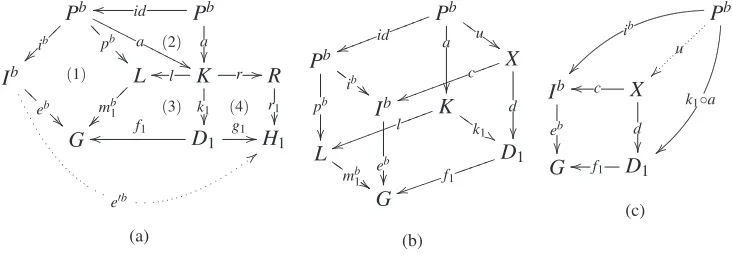
Proposition 1 (Morphism Extension for Recursive Rule) Given the diagram in Fig.8(a) (with (1) pullback, (3) and (4) pushouts, ib, pb, l and r∈M), morphism ebcan be extended to H
1.
Pb
ibÄÄ
Ä
Ä
ÄÄ pb > >
Â
Â
> >OOa
O O O ' ' O O O O O O (1) Pb id o o a ² ² (2) Ib eb @ @ Â Â @ @
e0b
; ; L mb 1 ÄÄ Ä Ä ÄÄ (3) K (4) l o
o r //
k1 ² ² R r1 ² ²
Goo f1 D1 g1 //H1
(a) Pb idkkkk k u u
kkkkk u
H H $ $ H H a ² ² Pb ib G G # # G G pb ² ² X ckkk u u kkkkkkkk d ² ² Ib eb ² ² K lkkkk u u
kkkkkkk k1 H H $ $ L mb 1 H H $ $ HH D1
f1jjjjj
u u jjjjj G (b) Pb u ~ ~ ib ¢ ¢
k1◦a
| | Ib eb ² ² X c o o d ² ²
Goo f1 D1
(c)
Figure 8: (a) Extension of eb Morphism. (b) Showing that (3) is a van Kampen Square. (c)
Universal Pullback Property.
Proof:First, note that (2) is a pullback. In order to show the existence of a morphisme0b:Ib→ H1, we use the fact that pushout (3) is a van Kampen square. For that purpose, we build a cube taking (3) at the bottom, and pullbacks (2) and (1) as back-left and front-left faces (see Fig.8(b)). We close the cube by calculating the pullback ofeb:Ib→Gand f
1:D1→G, given by(X,c:X →Ib,d: X→D
1). By the universal property of pullbacks (see Fig.8(c)), there is a unique arrowu:Pb→X (aseb◦ib= f1◦k1◦a). Pb is the pullback object ofk1andd by the pullback composition and decomposition lemma. The four lateral faces are pullbacks, and (3) is a pushout alongM (l,f1∈M), and therefore a van Kampen square by definition of AHLR
1 Due to the possible presence of cycles in the graph to be traversed. This can be controlled with NACs in the
category. Thus the top square is a pushout as well. In particularc:X→Ibis an isomorphism as the oposite arrow is also an isomorphism. Therefore, we obtaine0b=g1◦d◦c−1 2 Note that in the first and successive recursive steps, the DPO rule can be applied as long as possible. Moreover, after such rule applications, an additional matche0r
i is sought in order to repeat the rule applications. Therefore, a DPO rule application in the first recursive step has to preserve eb (see Figure 6). In a similar way, in recursive stepi+1 a DPO rule application has also to preserve matcher
i (see Figure6) as well as the set of matches output by previous recursive step. The conditions for this preservation are stated in next proposition. We only show the preservation of the base morphismebin the first recursion step, as the other cases are similar.
Proposition 2 (Preservation of Base Match in First Recursive Step) Match eb: Ib →Hn is preserved after a standard rule application through match mr
1,1:L→Hn(as Figure9(a) shows) if∃br:P→Prwhere(P,bb:P→Ib,bl:P→L)is the pullback of eb:Ib→Hnand mr1,1:L→Hn (as Figure9(b) shows).
Pbr ibr ¢ ¢ ££££ pbr Á Á > > > > > (1) Pr ir¤¤
¢
¢
¤¤ pr 88 ¿ ¿ 88 (2) Ib eb N N N N & & N N N N
e0b
: : Ir er 1 ² ² L (3) mr 1,1
rrr y y rrr K l o
o r //
kr 1²²,1
R
rr 1,1
²
²
Hnoo fn+1 Dn+1gn+1//Hn+1
(a) P bb bl ¶ ¶ br = = Á Á = = Pbr ibr ¢ ¢ ££££ pbr Á Á > > > > > (1) Pr ir¤¤
¢
¢
¤¤ pr 88 ¿ ¿ 88 (2) b » » Ib eb N N N N & & N N N N Ir er 1 ² ² L mr 1,1rrr
y y rrr (3) K l o o kr 1²²,1
Hnoo fn+1 Dn+1
(b)
Figure 9: (a) Extension ofebin Recursive Step One. (b) Condition for Standard Rule Derivation.
Proof: Using the fact that (3) is a van Kampen square, by using the pullback square spawned by P as front left face, taking b◦br: P→ K, and then following the construction shown in
Proposition1. 2
Remarks:In the general casePis not isomorphic to the pullback object ofpbr:Pbr→Irand ir:Pr→Ir. If the conditions stated in this proposition are not satisfied, then the DPO rule cannot be applied.
Application DPO rule
Case Ir
Recursive
Case Ir
Recursive
Application DPO rule
through Ir
LHS Match
Application DPO rule through Ir
LHS Match : Function : Role : Role : Role : Role : Function 2 1 : perm : perm : perm G : parent : parent : parent
: perm : perm
: Role : Role : Role Match b Base : perm : perm : parent : parent : parent 2 H2 : perm
: Role : Function
: Role : Role : Role : Function 1 : perm : perm : parent : parent : parent 2 H3 through I LHS Case I : Role : Function : Function 2 1 : perm : parent : parent : parent H1 : perm : perm : perm : Role : Role : Role : Role : Function : Function 2 1 : perm : perm : perm G : parent : parent : parent
: perm : perm
b : Role : Role : Role : Function : Role : Function 1 : perm : perm : parent : parent : parent H1 2
: perm : perm
: Role : Function
: Role : Role : Role : Function 1 : perm : perm : parent : parent : parent H1 2
: perm : perm
: Role : Function
: Role : Role : Role : Function 1 : perm : parent : parent : parent H1 2
: perm : perm : perm
: Role : Function
: Role : Role : Role : Function 1 : perm : perm : parent : parent : parent 2 H2 : perm
: Role : Function
: Role : Role
: Role
: Function
1
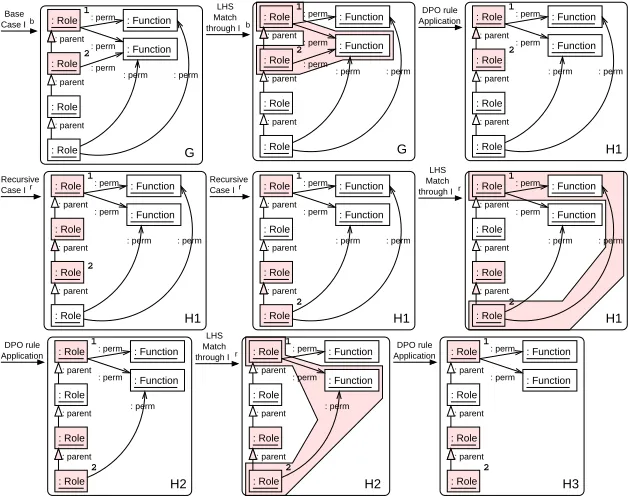
Figure 10: A DPO Recursive Derivation.
of the LHS is sought on the graph through the roles newly labelled “1” and “2”, but none is found. Thus, a new step in the recursion starts. A new match ofIris searched in the graph that maintains the match for role “1” and identifies role “2” with its direct child. Now, two matches of the LHS are found (i.e. the parent role has two permissions which role “2” also defines). In a first application of the DPO rule, one of the permissions is deleted yielding graph H2. A second application of the DPO rule at the other match deletes the second redundant permission yielding graph H3. Since neither matches of the LHS nor matches of the recursive condition are found, the derivation concludes.
Application Conditions.Previous derivation has started in the top-most role in the hierarchy. However, the initial matchebcould also have identified other roles as base condition. In order to identify the top-most role, we need a NAC associated toIb, which forbids the match if the role has some parent. We extend recursive rules with NACs forIb,Irand the DPO rule.
Definition6 (DPO recursive rule with NACs) A recursive rule with NACs pr= (L←−l K−→r R,NACL,Ib,NAC
Ib,Ir,NACIr,(Ij i j
←−Pj −→pj L)
j∈{b,r},(Ij i jr
←−Pjr p−→jr Ir)
j∈{b,r}) is made of a
a recursive rule(L←−l K−→r R,Ib,Ir,(Ij ←−ij Pj −→pj L)
j∈{b,r},(Ij i jr
←−Pjr p−→jr Ir)
j∈{b,r}) and
three setsNACJ={(XJ,xJi:J→XiJ)}(forJ∈ {L,Ib,Ir}) of NACs forL,IbandIr.
Previous definition modifies the concept of derivation in the following way. A valid match eb:Ib→Ghas to satisfyNAC(xIb
j),∀(XI
b
j ,xI
b
5 Additional Examples
This section shows further examples in the category of attributed typed graphs [EEPT06] (also an AHLR category). In this category, objects are typed graphs, with edge and node attribution.
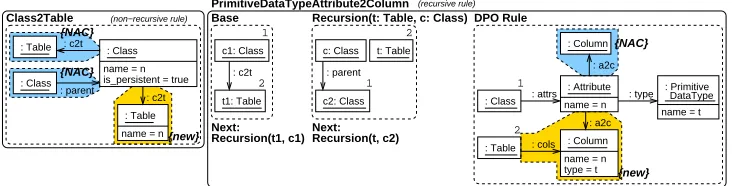
Model Transformation. Transforming class diagrams into relational data base models is a common case study when studying the expressivity of model transformation languages [EGL+05].
It requires handling complex structures such as inheritance hierarchies. This transformation im-plies mapping each persistent class to a table, and all its attributes and associations to columns in this table. However, only top-most classes in the inheritance hierarchy have to be mapped into tables; additional attributes and associations of subclasses result in additional columns of the top-most classes. For the present example, we only consider this excerpt of the problem and restrict to transformation of attributes with a primitive data type.
: c2t : Table name = n : parent
: c2t : Table
: Class
{new} {NAC}
{NAC}
(non−recursive rule)
Class2Table
t1: Table c1: Class
1
2
: c2t
Next: Recursion(t1, c1)
c2: Class c: Class t: Table
1 2
: parent
Next: Recursion(t, c2)
: Table : Class
: Attribute name = n
: Primitive name = t
DataType
{NAC}
2
: attrs
1
: type
: cols : a2c : Column name = n type = t {new}
: a2c : Column
DPO Rule Base Recursion(t: Table, c: Class)
(recursive rule)
PrimitiveDataTypeAttribute2Column
: Class name = n is_persistent = true
Figure 11: DPO Recursive Rules for Model Transformation.
Using standard DPO rules to perform the transformation would possibly imply the flattening of the hierarchy (see the solutions proposed in [EGL+05]). This is not optimal as it requires modifying the type graph (the meta-model), together with pre- and post-processing rules. We can avoid this flattening by using a DPO recursive rule as the one shown in Fig.11. The first rule in this figure is a DPO standard rule that creates a table for each top-most class in the hierarchy. The second rule is recursive. The base condition identifies a top-most class in the hierarchy (the one with an associated table). The DPO rule maps a column to each attribute of this class, if such column has not been created before. The column is added to the table mapped to the class. The recursive condition goes down the class hierarchy, maintaining the match of the table. In this way, the application of the rule in the recursive steps creates a column in the table for each attribute of the descendant classes of the base class.
Model Simulation.Fig.12shows a recursive rule that updates a network of two-input logical gates when one of the inputs changes. The network of gates can be seen as a recursive structure, which must be traversed to update the output of the gates in each step. The type graph contains a node Bit, connected to aGateby relations inandout. Bits have a self-loop to indicate that their value has been changed externally, and an attributevalue of typebit. Gates have attribute operation, an enumerate type with valuesorandand, indicating the operation it performs.
In the DPO recursive rule, the base condition looks for a bit that has been changed (i.e. it has a self-loop). The DPO rule updates the output of the gate2. An application condition makes the
DPO rule applicable only if the value of the output bit has to be updated. We add this attribute
Recursion(bi: Bit)
: Gate bi: Bit
: Gate operation = op : Bit
value = b value = a bo: Bit
: Bit value = c CONDITION: c != op(a,b) : out
: in
: in : in
: out
1
Next: Recursion(bo)
b: Bit
1
Next: Recursion(b) Base
: Bit value = a
: Bit value = b
: Gate operation = op
: Bit value = [c, op(a,b)]
DPO Rule
CONDITION: c != op(a,b) : in
: in
1
: out
propagateChange
Figure 12: DPO Recursive Rule for Model Simulation.
condition as we may have loops in the network, so the rule must not be applicable if a bit has already the correct value. The recursive condition advances through the network of gates and has a condition which prohibits finding a match if the output gate already has a correct value. Thus, rule application ends when all the bits dependent on the changed bit are updated.
Solving this problem using DPO simple rules would probably imply encoding control ele-ments in the graph to guide rule application. These control eleele-ments have to mark the bits to be recalculated, and take care that this calculation occurs in the right order.
6 Conclusions and Future Work
We have presented a novel approach for modelling recursive rules in the DPO approach. The main idea is to provide DPO rules with base and recursive conditions, together with mechanisms to pass the matching between successive recursion steps. The execution mechanism performs a width-first traversal of the recursive structure, while guaranteeing its preservation by the DPO rule applications. We have shown the utility of the approach for structures that can be recursively dealt with, such as inheritance hierarchies, networks of components, etc. We have presented several examples in the areas of model simulation, model optimization and model transformation. The solution of the presented problems using DPO simple rules would imply either theflattening of the structure by adding helper edges, or encoding control elements in the host graph to guide rule execution. As we showed, both solutions are not optimal as they imply modifying the type graph and defining pre- and post-processing rules. We believe our DPO recursive rules are a solution to this problem. Moreover, the presented techniques may serve as the basis for a formal rule execution control language with parameter passing.
There are several useful extensions to this approach. The first one is having more than one recursive condition (i.e. more than oneIr). This is useful if the structure to be traversed is not uniform, but it is made of different edge types. The second one is having more than one DPO rule in a recursive rule. This is useful if slightly different actions have to be performed at each step in the recursion, and allows for indirect recursion. It is also worth studying termination and conflicts of DPO recursive rules, as well as different execution policies. Moreover, given a recursive rule, we are investigating the construction of a (possibly infinite) set of standard DPO rules, such that the execution of one of them is equivalent to the execution of the recursive rule.
2006-09678). The authors gratefully thank the referees for their useful suggestions.
References
[BV06] A. Balogh, D. Varr´o. Advanced Model Transformation Language Constructs in the
VIATRA2 Framework. InProc. ACM SAC’06. Pp. 1280–1287. 2006.
[EEPT06] H. Ehrig, K. Ehrig, U. Prange, G. Taentzer.Fundamentals of Algebraic Graph
Trans-formation. Springer, Berlin, Heidelberg, New York, 2006.
[EGL+05] K. Ehrig, E. Guerra, J. de Lara, L. Lengyel, T. Levendovszky, U. Prange, G. Taentzer,
D. Varr´o, S. Varr´o-Gyapay. Model Transformation by Graph Transformation: A Comparative Study. InMTiP 2005, (Satellite Event of MoDELS 2005). 2005.
[EJ04] N. V. Eetvelde, D. Janssens. Extending Graph Rewriting for Refactoring. InProc.
ICGT’04. LNCS 3256, pp. 399–415. Springer, 2004.
[KASS03] G. Karsai, A. Agrawal, F. Shi, J. Sprinkle. On the Use of Graph Transformation in
the Formal Specification of Model Interpreters.JUCS9(11):1296–1321, 2003.
[KBC05] A. Kalnins, J. Barzdins, E. Celms. Model Transformation Language MOLA:
Ex-tended Patterns. InProc. DB&IS’2004. Volume 118, pp. 169–184. IOS Press, 2005.
[LS04] S. Lack, P. Sobocinski. Adhesive Categories. In Walukiewicz (ed.), FoSSaCS.
LNCS 2987, pp. 273–288. Springer, 2004.
[LV04] J. de Lara, H. Vangheluwe. Defining visual notations and their manipulation through
meta-modelling and graph transformation.JVLC15(3-4):309–330, 2004.
[Min02] M. Minas. Concepts and realization of a diagram editor generator based on
hyper-graph transformation.Sci. Comput. Program.44(2):157–180, 2002.
[NNZ00] U. Nickel, J. Niere, A. Z¨undorf. The FUJABA environment. In Proc. ICSE ’00.
Pp. 742–745. ACM Press, 2000.
[OMG] OMG. QVT Specification at:http://www.omg.org/docs/ptc/05-11-01.pdf.
[Roz97] G. Rozenberg (ed.).Handbook of graph grammars and computing by graph
trans-formation: volume I. foundations. World Scientific Publishing Co., Inc., 1997.
[SWZ99] A. Sch¨urr, A. J. Winter, A. Z¨undorf.The PROGRES approach: language and
envi-ronment. World Scientific Publishing Co., Inc., 1999.
[Tae96] G. Taentzer. Parallel and Distributed Graph Transformation. Formal Description and
Application to Communication-Based Systems. Shaker Verlag, 1996.
[Wil03] E. D. Willink. A concrete UML-based graphical transformation syntax: The UML to