Proceedings of the
Second International Workshop on
Graph and Model Transformation
(GraMoT 2006)
Towards Translating Graph Transformation Approaches by Model
Transformations
Frank Hermann, Harmen Kastenberg and Tony Modica
14 pages
Guest Editors: Gabor Karsai, Gabriele Taentzer
Managing Editors: Tiziana Margaria, Julia Padberg, Gabriele Taentzer
Towards Translating Graph Transformation Approaches by Model
Transformations
Frank Hermann1, Harmen Kastenberg2and Tony Modica1
1(frank,modica)[at]cs.tu-berlin.deDepartment of Electrical Engineering and Computer
Science, Technical University of Berlin, D-10587 Berlin, Germany2
h.kastenberg[at]cs.utwente.nlDepartment of Computer Science, University of Twente, The Netherlands
Abstract: Recently, many researchers are working on semantics preserving model
transformation. In the field of graph transformation one can think of translating graph grammars written in one approach to a behaviourally equivalent graph gram-mar in another approach. In this paper we translate graph gramgram-mars developed with the GROOVE tool to AGG graph grammars by first investigating the set of core graph transformation concepts supported by both tools. Then, we define what it means for two graph grammars to be behaviourally equivalent, and for the regarded approaches we actually show how to handle different definitions of both - applica-tion condiapplica-tions and graph structures. The translaapplica-tion itself is explained by means of intuitive examples.
Keywords: graph transformation, bridging languages, preserving semantics, tools
1
Introduction
Models in general are representations of certain structures, fulfilling some properties, which may be given by a specification. Transforming those models can be defined in many ways, e.g. by XSLT style sheets [W3C] developed by the W3C to keep the format but possibly change the internal structure or semantics. Furthermore the finalization of OMG’s language QVT [QVT] is underway; there are also implementations, e.g. for Eclipse: GMT [Ecl]. Besides, there is also graph transformation, putting model transformation on a formal basis. The transformation is defined by rules, which are defined by pure mathematical constructs, but using a very intuitive visual notation. During the last three decades there has been much interest in developing suit-able approaches and analysing their properties in means of correctness, concurrency, termination and confluence. Most of them consider categorical constructs like the single, double, and triple pushout approach, single and double pullback, but also triple graph grammars [Sch94] being especially suitable for specifying the connections between a source and target model. Trans-forming UML models by graph transformation rules is especially supported by the tool VIATRA [CHM+02], which is part of the mentioned GMT project.
import such a model in a tool, which uses a different approach. Even if an import is possible, then the behaviour of the system is not necessarily equal.
Two existing graph transformation tools are GROOVE [Ren04], which is mainly developed for state space generation and model checking, and AGG [TER99] supporting simulation and analysis of graph transformation systems. The translation between them shows on the one hand, how to bridge gaps between their differences in the formal approaches, and on the other hand it facilitates the elaboration of core concepts of graph transformation in general. The main goal of the translation is the possibility to combine the features of both tools.
There are already special file formats to exchange graphs and whole graph transformation systems between tools. GXL supports the exchange of graphs, which is used e.g. between FUJABA [NNZ00] and PROGRES [Sch91]. However, its extension GTXL [Tae01] for graph transformation systems stores graph transformation systems syntactically, but the behaviour in other tools is often far from equivalent. Special attention is asked to encode rules in a different approach, as the tools base on different approaches in general.
In this paper we describe the translation between the mentioned tools GROOVE and AGG and define what it means for graph grammars in both approaches to be behaviourally equivalent. Despite the fact that these tools look quite similar when comparing the approaches – both use SPO – there have been interesting challenges. As GROOVE handles simple graphs, i.e. graphs with simple edges only, we had to ensure that AGG will not create parallel edges, which it allows in general. Additionally, the definitions of (negative) application conditions are different, slightly when looking at the mathematical definitions, but complex when trying to translate them while preserving the semantics.
The paper is structured as follows. Sect. 2gives a short introduction to the basics of graph transformation. In Sect.3we introduce the two approaches playing a central role in this paper, discuss their differences and define an equivalence relation. In Sect.4and Sect.5we elaborate on the translation from one approach to the other and vice versa, illustrating the necessary steps using simple examples. We will conclude with a short discussion and some remarks about further work.
2
Preliminaries
The foundations of graph transformation were developed in the early seventies, e.g. in [EPS73], to extend the common formalisms of one-dimensional textual rewriting to a more complex level. In the following years various approaches were defined keeping one big advantage in common – they automatically preserve the specified graph structure.
In general, a graph G=hN,E,src,tgticonsists of a set N of nodes and a set E of edges, with
source and target functionssrc,tgt: E→N. The global set of graphs is denotedG and ranged
over by G, H.
Modelling system states as graphs facilitates the specification of system evolution. Graph transformation rules are used to intuitively define in what sense the system state changes. Such a rule p : L→R consists of a graph Lp (the left-hand-side, or LHS) and a graph Rp (the
right-hand-side, or RHS) together with a graph morphism rpmapping nodes and edges of Lpto those
application of a graph transformation rule p transforms a graph G, the source graph, into a graph
H, the target graph, by looking for an occurrence of Lp in G (specified by a graph matching
m that satisfies the extension conditions of all ACp) and then replacing that occurrence with Rp,
resulting in H. Such a rule application is denoted as G=p=,m⇒H. Here we present the most general
definitions using the SPO approach, which can be restricted to the DPO approach by adding two conditions to the application of a rule: (1) identification and (2) dangling condition. The former requires that every element that should be deleted in the source graph has only one pre-image in the LHS of the rule; the latter requires that if a node n is deleted, the rule must specify the deletion of all edges incident to n. In both approaches transformation rules can be equipped with appropriate application conditions, which is described in [HHT96]. For formal analysis and a concurrent semantics definition by processes we refer to [Roz97].
Definition 1 (Graph Production System) A graph production system P=hR,Giconsists of a
setR={p : L⇀R|L,R∈G}of graph transformation rules and a graph G; G is said to be the
initial graph.
As rules of a graph production system (or GPS for short) may delete nodes and edges of a graph, the defining morphism consists of two partial functions, which is indicated by a halved arrow head.
Each graph production system P specifies a (possibly infinite) state space which can be gener-ated by repegener-atedly applying the graph transformation rules on the graphs, starting from the initial graph GP. This results in a graph transition system.
Definition 2 (Graph Transition System) The graph transition system T =hS,→,Ii generated by a graph production system P=hR,Giconsists of a set S of states which are actually graphs
(S⊆G); a transition relation→⊆S×R×[G →G]×S, such thathG,p,m,Hi ∈→iff there is a
rule application G=p=,m⇒H′with H′ isomorphic to H; and an initial state I.
3
Approaches
The two approaches for which we define a semantics preserving translation are discussed in this section. We will mention the formalisms used for representing models and for specifying their transformations.
3.1 The GROOVE Approach
The Formalism. In GROOVE we support the use of non-typed attributed graphs, where graphs are set-based models consisting of three distinct sets: a set N of nodes, a global set L of labels, and a set E⊆N×L×N of edges. Nodes are non-structured elements having a unique
identity; edges, on the other hand, are identified by means of their end-points and their label, i.e. for an edge e=hn1,l,n2i ∈E we distinguish its source, label, and target, denoted bysrc(e),
lab(e), andtgt(e). As a consequence, it is not possible to have parallel edges, i.e.
∀e1,e2∈E :src(e1) =src(e2)∧lab(e1) =lab(e2)∧tgt(e1) =tgt(e2)⇒e1=e2
Currently, GROOVE supports the use of negative application conditions (or NAC for short) in conjunctive form, but one NAC cannot contain more than one connected component. The rule morphism may be non-injective as well as the matchings to the host graphs. GROOVE does not support typing, but uses the edge-labelling as a typing-mechanism instead.
For performing graph transformations, GROOVE applies the SPO-approach.
Input/Output. A GROOVE graph grammar is saved in the GXL [SSHW] XML-format. Rules are saved as single graphs, in which the rule-roles (preserve, create, delete, and NAC) are en-coded in edge-labels by adding structure to the labels. A graph production system consists of all the rules in a single directory (as well as its subdirectories). In the future we plan to support the special-purpose format GTXL.
Special features. The main feature of the GROOVE engine is its ability to generate state spaces from graph grammars. During state space generation, it checks for the occurrence of isomorphic states. Furthermore, a CTL [CE82] model checking algorithm has been implemented checking temporal properties in which graph structures can be used as atomic propositions. In the future we plan to implement partial order reduction techniques based on confluence properties of transformation rules as well as abstraction techniques which enable the verification of larger (or possibly infinite) system models.
3.2 The AGG Approach
According to the complete formalization of the SPO approach by Michael L¨owe [L¨ow90] in 1990 the AGG tool [TER99] was developed to support an editor for graph grammars, which also offers simulation and analysis capabilities by certain criteria including termination and conflu-ence as the most important ones. Further developments integrated high level features being for instance attribution and typing. Therefore, AGG builds a basis for various fields, e.g. formal model transformation controlled by graph transformation, but also the definition of visual mod-elling languages with the possibility of an automatic editor generation, using Tiger [EEHT05].
node and edge types and for each graph G there is a graph morphism t : G→T to this type graph.
In this way, the type graph defines the general structure of all instances. Rules are visualized by separate graphs for the left and right hand side as well as for the application conditions. The morphisms of a rule, which define the deletion, preservation, creation and forbidden parts, are indicated by a unique naming of the nodes. Additionally, negative application conditions are handled differently in comparison to GROOVE.
N!!
∄i ! ! C C C C C C C C L n o o m (=) G
(a) Simplified definition of NACs
N n′ L n o o m x x PO =
N′##
∄i # # G G G G G G G
G m(L)
? _ o o _ (=) G
(b) Complete definition of NACs
Figure 1: NACs in AGG
Fig.2(a) explains a simplified view to NACs in AGG. The LHS L is embedded in the NAC
N, where identifications of parts in LHS are possible. Given a match m for the rule, a negative
application condition N is satisfied, if there is no morphism i with additional restrictions from
N to the G making the triangle commutative. This means that the condition forbids a certain
structure around the image of L in G. The morphism i has to be injective on the part of N, which is not reached by n and of course identifies the same things as m does. In other words,
i is m extended injectively by the remaining elements. Fig. 2(b) shows the complete formal version, where N′is created at runtime, if it exists. It represents N after identifying the elements in N according to the identifications by m for the corresponding elements in L. Now the rule is applicable at m, if there is no injective morphism i making the outer arrows commuting: i◦ n′◦n=m. It is sufficient that the bottom left triangle commutes, because L→m(L) is just m restricted to its image and therefore surjective. In comparison to GROOVE, where the morphism
i is not necessary injective, this definition of NACs is a restriction, but also an extension as
multiple forbidden identifications of elements in L cannot be handled in one GROOVE NAC.
Input/Output. AGG features several XML-based file formats to exchange graphs and trans-formation systems. Internally, AGG uses the GGX format. It can import and export graphs in GXL, also used by GROOVE. AGG can also export graph grammars using the special format GTXL which is an extension of GXL for storing entire graph transformation systems. Finally, models generated by Eclipse modelling plug-in Omondo (in OMONDO XMI) can be imported by AGG.
help to show confluence, while termination can be checked, which can be supported by the us-age of levels. Finally the simulation part allows applying formal model transformation with the certainty to reach a valid result in means of typing in the target language.
3.3 Behavioural Equivalence
In this paper, graph production systems in the different approaches are related to each other by defining a bi-directional equivalence (or simulation) relation between the graph transition systems generated by them.
Definition 3 (Behavioural Equivalence) Given two graph production systems P1=hR1,G1iand
P2=hR2,G2i, their generated graph transition systems T1=hS1,→1,I1iand T2=hS2,→2,I2i,
respectively, and the translation function tr, we say that P2 is behaviourally equivalent to (or
simulates) P1if:
si=p=,m⇒T1si+1 iff ∃sequence hp
′
1, . . . ,p′ni ∈tr(p):tr(s1) = p′1,tr(m)
====⇒T2. . .=
p′n,mn
===⇒T2 tr(si+1)
where si=p=,m⇒Tj si+1⇔ti=hsi,p,m,si+1i ∈→j
Restrictions. In the translation from graph production systems in GROOVE to behaviourally equivalent ones in AGG, and vice versa, we restrict to those GPSs not using node or edge-attribution. Typing in AGG is flattened to labelled-edges in GROOVE. For both approaches we require injective rule-morphisms, while non-injective rule matchings are allowed. When translating GPSs from AGG to GROOVE we require n : L→N (see Fig.2(b)) to be an inclusion, because in GROOVE it is only possible to express so called merge-embargoes pair-wise.
Translation Issues. When translating between GROOVE and AGG, we need to pay special attention to: (1) parallel edges and (2) application conditions. In the GROOVE approach parallel edges are not supported. For rules it is allowed to specify the creation of specific edges without requiring their absence. The application of such rules identifies the freshly created edges with the already existing ones.
On the other hand, when translating AGG rules to GROOVE we need to introduce a mecha-nism which enables the creation of parallel edges. Therefore, we will create a ’structured edge’ in GROOVE to reflect the original AGG edges (see Fig.6in Sect.5).
4
GROOVE to AGG
When translating GROOVE rules to AGG, the basic idea is to keep track of edges being created by rules not having a negative application condition which forbids this edge to be present already between the incident nodes. In general, we have to create a number of AGG rules together describing the same behaviour as the original rule. This number is (in the worst case) exponential in the number of edges created by the GROOVE rule.
The Algorithm. Given a GROOVE rule p, we first take the nodes of Lp and Rp and create
counterparts in Lp′ and Rp′ for each node and build up the rule-morphism. When translating the
edges we have to deal with preserved, deleted, and created edges. The first two types can be translated easily. Before taking care of the created edges we first translate the NACs. Every NAC in a GROOVE rule, in general, results in a set of NACs in the AGG rule, in such a way that the AGG NACs are all possible identifications of the NAC-only elements with other NAC elements from the GROOVE rule.
For the edges that are created we need to perform some additional checks. If at least one of the incident nodes of the created edge is also created, we can do the translation straightforward. The same holds for the case when the rule contains a NAC prohibiting this edge. In all other situations, we have to copy the AGG rule created so far. The rules will create a subset of those edges, contain a corresponding NAC prohibiting them and the rest of those edges are preserved, instead of creating parallel edges.
Example 4 Consider the GROOVE rules depicted in Fig.2, modelling a person who can get a driving licence by attending driving school, but possibly lose it again. The first rule applied to a person object creates the edge gotDLicence at it. As in real life, applying this rule to a person who already has a driving licence will not create another edge because of GROOVE not supporting parallel edges, i.e. one can not gather several driving licences.
RHS LHS
1 : Person
gotDLicence
attend_driving_school
NAC RHS
LHS
1 : Person 2 : Officer
gotDLicence
1 : Person 2 : Officer
caught
1 : Person 2 : Officer
goodFriend
get_caught 1 : Person
Figure 2: Rules specifying a person getting and losing a driving licence.
The second rule states that a police officer can catch a person with a driving licence breaking some law. The person will lose his licence in this case. The negative application condition pro-hibits the rule to be applied when the person is a good friend of the police officer. In GROOVE
NACs can be non-injectively matched. In this example, the officer himself could be the driving person and assuming most people like themselves, the officer would not fine himself, i.e. the rule would not be applicable.
right rule represents the case in which AGG must preserve the edge when it is already there, instead of creating a parallel edge.
attend_driving_school[2]
LHS gotDLicence
1 : Person
RHS gotDLicence
1 : Person
NAC gotDLicence
1 : Person
LHS
1 : Person
attend_driving_school[1]
RHS gotDLicence
1 : Person
Figure 3: AGG rules created for the rule attend driving school
Fig.4shows the two rules together behaving equivalent to the right rule of Fig.2. The upper rule creates thecaught-edge, the lower rule preserves it.
NAC RHS
1 : Person 2 : Officer
caught
1 : Person 2 : Officer
goodFriend get_caught[2]
LHS
1 : Person 2 : Officer
caught gotDLicence
NAC1 RHS
LHS
1 : Person 2 : Officer
gotDLicence
1 : Person 2 : Officer
caught
1 : Person 2 : Officer
goodFriend get_caught[1]
NAC2
1 : Person 2 : Officer
caught
Figure 4: AGG rules created for the rule get caught
Simulation. In order to prove the correctness of the translation we show behavioural equiva-lence as defined in Definition3, i.e. a derivation can be performed in AGG if and only if there is a corresponding derivation in GROOVE. The next theorem also shows that this simulation starts with the same graph, consists of one step, and ends with the same resulting graph.
Theorem 5 Given a derivation G=r=,m⇒G′of a grammar in GROOVE there is exactly one cor-responding derivation starting at G, which can be performed in AGG. Furthermore, the resulting graph in AGG is again G′ and if the rule is not applicable in GROOVE it is not in AGG via the corresponding match.
GROOVE:
N[i] L // r /
m ni o o PO R o
G1 // p /G2
−→AGG:
N′[k] L′ // r
′
/
m′
n′k
o o PO R o
G1 // p /G2
Proof. (Sketch). Let G1=r=,m⇒G2be a derivation in GROOVE as depicted above. The type graph
L r / m (=) R n mc { x v t q
pdfgi b
G
p /G ′
(a) Construction of m′
N[i]
L ? _ ni o o ˆ ni l l (=) (=) n(L)ttiiiiiin1
iii 7 W j j UUUUUUU Gg n2 t t iiiiii i ˆ
N[i]
(b) Construction of NACs ˆN
Figure 5: Creation of m′and NACs
A NAC N[i]is transformed to a set of NACs for each possible overlapping of NAC only el-ements with elel-ements in N[i], which are allowed to be identified. This is shown in Fig. 6(b), where ˆN[i]is one of the new NACs with ˆni: L→Nˆ[i]. Additionally, for each merge embargo
NAC between two nodes in L, one separate NAC is created, forbidding this identification. In the
following, the new NACs are denoted by ˆN[j].
Additional edges have to be created when preserving edges found in a graph instead of creating parallel ones. Therefore, we consider the edges Ec, which are created by the rule r between two
existing nodes, and which are not forbidden by any NAC:
Ec={e∈ER\r(EL)|src(e)∈r(VL), tgt(e)∈r(VL), ∀Nˆ[j]: e∈/ENˆ[j]}
For each subset Ec′ ⊆Ec containing the edges to be preserved, a new rule is created, which
extends the identical rule by the following regulations.
• EL′=EL⊎Ec′, s.t. this rule can be applied if the new edges occur in G, • EN′[j]=ENˆ[j]⊎Ec′, therefore, the NACs are extended by the new edges,
• ∀e∈Ec\Ec′: create an extra NAC NC,VNC=VL, ENC=EL′⊎ {e}, so adding an extra NAC
to prevent the application of the rule, if more edges of Ec are present in G, and
• r′=r∪idE′
c, n
′
j=nˆj∪idE′
c, this way the rule morphism r
′ and the morphisms to ˆN[i]are
extended by the new edges.
• If edges are added, the functionssrcandtgtfor L′ and the NACs are extended according to the morphisms r, nifor the nodes andsrc,tgtof R.
The partial morphism mc will be used to extend the original m and it is defined for all edges
of the biggest E′⊆Ecand their source and target nodes, s.t. the triangle in Fig.6(a)commutes:
mc◦r=m. All rule instances, which contain an edge e∈E′ in a new NAC are not applicable
and cannot produce a parallel edge. Only the rule with E′as an extension of L′in L is applicable and as theses edges are preserved, no parallel edge is produced. Note that this holds also, if m is not injective. The matching is extended by the new edges: m′=m∪(mc◦r). When applying
this rule via m′ the result is the same as in GROOVE, because the rule deletes and produces the same, except that the preserved edges in E′are not created. The transformation G=r==′,m⇒′ G′
5
AGG to GROOVE
In the translation from AGG to GROOVE we need to introduce a mechanism in GROOVE to simulate the parallel edges that are possible in AGG. Next to that, we need to handle the injec-tivity of NAC-only elements and NACs consisting of several components. Since the latter cannot be simulated in GROOVE by one rule with separate NACs, we have to create a set of GROOVE rules, which together behaving equivalent (see Definition3). The number of GROOVE rules together describing the equivalent behaviour is exponential in the number of NACs.
The Algorithm. From an AGG rule p, we can first simply iterate over the nodes of Lpand Rp
just as we described in the above algorithm. When iterating over the edges, we need to create the structure shown in Fig.6for every edge we encounter. For every NAC N in the AGG rule we have to perform some computations. First of all, the set CN of connected components of
N needs to be determined, since for every ci∈CN (with 0≤i≤n and n being the number of
connected components in N) we have to create a separate rule pi, such that Lpi=Lpand Rpi=Rp
and NACpi =ci. Furthermore, we have to ensure that every element in NACpi\Lpi is mapped
injectively. This is achieved by creating NACs for all possible identifications of NAC-only nodes with all other nodes in that NAC. Finally, we have to add an extra NAC for each original node, forbidding it to match to a proxy node.
: A : B
x
: A : B
: x
src tgt
x src : x tgt
Figure 6: Graph structure in GROOVE to represent parallel edges
We have to admit that representing parallel edges as shown in Fig.6has one serious drawback. Since we use the SPO approach to perform graph transformations, deleting the source (or target) node of the original edge in AGG, will not result in the deletion of the entire edge-structure in GROOVE. This means that in such cases, the resulting graph in GROOVE still contains some garbage. However, since these ‘dead-edges’ will never be involved in derivations they can actually be ignored or collected and removed by special rules.
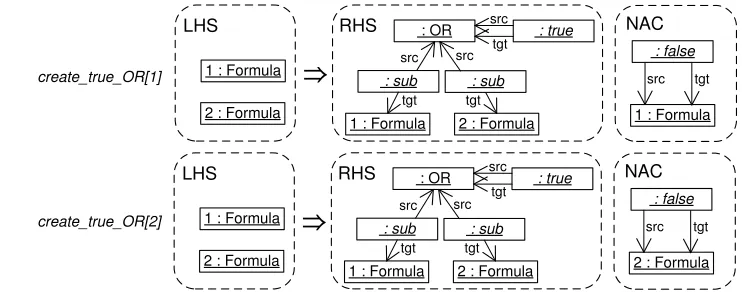
Example 6 The rule in Fig.7creates a node OR with antrue-edge for two formulae 1 and 2. It can only be applied, if not both of the matched formulas have afalse-edge. Logically, this could be expressed as¬(¬1∧ ¬2)which is equivalent to 1∨2.
1 : Formula
2 : Formula
LHS RHS
1 : Formula 2 : Formula : OR true
sub sub
1 : Formula 2 : Formula
NAC
false false
create_true_OR
Figure 7: AGG rule for disjunctive formulae
on solving the NAC with two components and possibilities of creating parallel edges. The NAC is split meaning that a disjunction of two formulae 1 and 2 is evaluated totrue, if one of them istrue. Naturally, if both are, both generated rules are applicable, but lead to the same result:
¬(¬1∧ ¬2)≡ ¬(¬1)∨ ¬(¬2).
1 : Formula
2 : Formula
LHS RHS
create_true_OR[1]
1 : Formula 2 : Formula : OR src : true
tgt
: sub : sub tgt
tgt
src src
1 : Formula tgt : false src NAC RHS create_true_OR[2]
1 : Formula 2 : Formula : OR src : true
tgt
: sub : sub tgt
tgt
src src
2 : Formula tgt : false
src
NAC
1 : Formula
2 : Formula
LHS
Figure 8: GROOVE rules created for the rule create true OR
Simulation. Analogue to the previous section the next theorem shows the behavioural equiva-lence of a system in AGG and its translation in GROOVE, according to Definition3. Therefore, a derivation can be performed in AGG if and only if there is a corresponding derivation in the translated system in GROOVE. Again this simulation is stronger as it starts and ends with the same graph (up to the different edge-structure) and it consists of only one step.
Theorem 7 Given a derivation G=r=,m⇒G′of a grammar in AGG there are corresponding deriva-tions starting at the translated graphtr(G), which can be performed in GROOVE. Furthermore, all resulting graphs in GROOVE are againtr(G′)and if the rule is not applicable in AGG it is not in GROOVE via the corresponding match.
AGG:
N′[k] L′ // r
′ / m′ ? _
n′k
o o PO R o′
G′1 //
p′
/G′
2
−→GROOVE:
N[i] L // r /
m ? _ ni o o PO R o
G1 // p /G2
Proof. (Sketch). Let G1=r=,m⇒G2be a derivation in AGG with type graph T G. The set of labels
L=VT G⊎ET G⊎ {p,src,tgt}contains all node and edge types and a special flag p indicating that
a node in GROOVE is a proxy for modelling parallel edges as visualized in Fig.6. Let G′ be one of N′[k], L′, R′ and G′1from AGG, its corresponding graph G in GROOVE is constructed as follows:
• VG=VG′⊎EG′, nodes are all original nodes and edges,
• EG⊆VG×L×VG,EG={(n,l,n)|n∈VG,l=type(n)}∪{(e,p,e)|e∈EG′}∪{(e,src,src(e))|e∈
EG′} ∪ {(e,tgt,tgt(e))|e∈EG′}, new naming edges and new edges with source and target
The rule morphism r= (rV,rE)is constructed as follows: rV(v) =r′(v),v∈VL,
rE(e) =
(r′(e),l,r′(e)) , e= (e,l,e),l∈ {/ src,tgt}
(rE′(e),src,rV′ (n)) , e= (e,src,n) (rE′(e),tgt,rV′ (n)) , e= (e,tgt,n)
The morphisms ni and m are created analogously. For each node in VL′ a NAC is generated,
which forbids a proxy edge(e,p,e)on such a node in L. To prevent identification of NAC only elements, new NACs are created by putting merge embargo edges between all NAC only nodes. Finally the NACs of AGG containing several components are divided and distributed to identical rules using each combination of components of the different NACs. Therefore, several new rules may be applicable along m, but all lead to G2=tr(G′2). If a NAC in AGG forbids the application
there is no rule applicable via the corresponding match in GROOVE, because the NACs of a specific rule imply that all NACs in AGG are satisfied.
6
Discussion and Conclusion
Discussion. In this paper we have shown that rules cannot be translated one-to-one between GROOVE and AGG rules behaving equivalent. In particular cases, however, the semantic do-main may not allow to create parallel edges of a particular kind. Take for example a file access protocol, where processes can have different rights for accessing a file. In such systems it does not make sense to store an access right twice. GROOVE automatically ensures this constraint, while in AGG one can include a type graph in a graph production system to which all graphs and rules must have a typing morphism. In this setting, the type graph could constraint the number of specific edges. Then, applying a rule could make the graph invalid, but in such cases that rule is not applicable.
Conclusion. By comparing two graph transformation approaches, one comes to the roots of both approaches. In this paper we have shown how to transform particular graph production systems specified in GROOVE to behaviourally equivalent ones in AGG and vice versa, by transforming their building blocks: the transformation rules. We have explained how to deal with two concepts on which both approaches differ essentially, being parallel edges and application conditions. Furthermore, we have illustrated how to apply the mentioned algorithms on simple and intuitive examples. The major part of the translation has already been implemented.
motivation for this work was, eventually, to be able to make optimal use of the features provided by both approaches, i.e. the analysis techniques implemented in AGG and the model checking algorithm(s) implemented in GROOVE. In order to reach this, both tools need to be extended to support export and import to GXL, or better GTXL.
Acknowledgements: This work is partially supported by the SegraVis Research Training Network. The second author is employed in the GROOVE-project funded by the Dutch NWO (project number 612.000.314).
Bibliography
[CE82] E. M. Clarke, E. A. Emerson. Design and Synthesis of Synchronization Skeletons using Branching Time Temporal Logic. In Proceedings of the IBM Workshop on
Logics of Programs. Lecture Notes in Computer Science 131, pp. 52–71. Springer,
1982.
[CHM+02] G. Csert´an, G. Huszerl, I. Majzik, Z. Pap, A. Pataricza, D. Varr´o. VIATRA – Visual Automated Transformations for Formal Verification and Validation of UML Mod-els. In Proc. of the 17th IEEE Int. Conf. on Automated Software Engineering (ASE
2002). Pp. 267–270. IEEE Computer Society, 2002.
[Ecl] Eclipse GMT. The Generative Modeling Tools.
http://www.eclipse.org/gmt/.
[EEHT05] K. Ehrig, C. Ermel, S. H¨ansgen, G. Taentzer. Generation of visual editors as eclipse plug-ins. In Redmiles et al. (eds.), Proc. of the 20th IEEE/ACM Int. Conf. on
Auto-mated Software Engineering (ASE 2005). Pp. 134–143. ACM, 2005.
[EPS73] H. Ehrig, M. Pfender, H.-J. Schneider. Graph Grammars: An Algebraic Aapproach. In Proc. of the 14th Annual IEEE Symposium on Switching and Automata Theory.
Pp. 167–180. IEEE, 1973.
[HHT96] A. Habel, R. Heckel, G. Taentzer. Graph Grammars with Negative Application Con-ditions. Special issue of Fundamenta Informaticae 26(3,4):287–313, 1996.
[KR06] H. Kastenberg, A. Rensink. Model Checking Dynamic States in GROOVE. In Val-mari (ed.), Proc. of the 13th Int. SPIN Workshop on Software Model Checking (SPIN’06). Lecture Notes in Computer Science 3925, pp. 299–305. Springer, 2006.
[L¨ow90] M. L¨owe. Extended Algebraic Graph Transformation. PhD thesis, Technical Uni-versity of Berlin, 1990.
[NNZ00] U. A. Nickel, J. Niere, A. Z¨undorf. Tool demonstration: The FUJABA environment. In Proc. of the 22ndInt. Conf. on Software Engineering (ICSE). Pp. 742–745. ACM
[QVT] QVT-Merge Group. Query/View/Transformations.http://www.omg.org/.
[Ren04] A. Rensink. The GROOVE Simulator: A Tool for State Space Generation. In Pfaltz et al. (eds.), Applications of Graph Transformations with Industrial Relevance
(AG-TIVE’03). Lecture Notes in Computer Science 3062, pp. 479–485. Springer, 2004.
[Roz97] G. Rozenberg (ed.). Handbook of Graph Grammars and Computing by Graph
Transformation. Volume I: Foundations. World Scientific, 1997.
[Sch91] A. Sch¨urr. PROGRES: A VHL-Language Based on Graph Grammars. In Ehrig et al. (eds.), Proc. of the 4thInt. Workshop on Graph-Grammars and Their Application to Computer Science. Lecture Notes in Computer Science 532, pp. 641–659. Springer,
1991.
[Sch94] A. Sch¨urr. Specification of Graph Translators with Triple Graph Grammars. In Tin-hofer (ed.), Proc. of the 20thInt. Workshop on Graph-Theoretic Concepts in Com-puter Science (WG’94). Lecture Notes in ComCom-puter Science 903, pp. 151–163.
Springer, 1994.
[SSHW] A. Sch¨urr, S. E. Sim, R. Holt, A. Winter. The GXL Graph eXchange Language.
http://www.gupro.de/GXL.
[Tae01] G. Taentzer. Towards Common Exchange Formats for Graphs and Graph Transfor-mation Systems. In Padberg (ed.), Proc. of the Workshop on Uniform Approaches
to Graphical Process Specification Techniques (UNIGRA’01). Electronic Notes in
Theoretical Computer Science 44. 2001.
[TER99] G. Taentzer, C. Ermel, M. Rudolf. The AGG Approach: Language and Tool Envi-ronment. In Ehrig et al. (eds.), Handbook of Graph Grammars and Computing by
Graph Transformations. Volume II: Applications, Languages and Tools, pp. 163–
246. World Scientific, 1999.