Volume 10 (2008)
Proceedings of the
Seventh International Workshop on
Graph Transformation and Visual Modeling Techniques
(GT-VMT 2008)
Interaction nets: programming language design and implementation
Abubakar Hassan, Ian Mackie and Shinya Sato
16 pages
Guest Editors: Claudia Ermel, Reiko Heckel, Juan de Lara
Managing Editors: Tiziana Margaria, Julia Padberg, Gabriele Taentzer
Interaction nets: programming language design and implementation
Abubakar Hassan, Ian Mackie and Shinya Sato
1Department of Informatics, University of Sussex, Falmer, Brighton BN1 9QJ, UK
2LIX, CNRS UMR 7161, ´Ecole Polytechnique, 91128 Palaiseau Cedex, France
3Himeji Dokkyo University, Faculty of Econoinformatics, 7-2-1 Kamiohno, Himeji-shi, Hyogo
670-8524, Japan
Abstract: This paper presents a compiler for interaction nets, which, just like term rewriting systems, are user-definable rewrite systems which offer the ability to spec-ify and program. In the same way that theλ-calculus is the foundation for functional programming, or horn clauses are the foundation for logic programming, we give in this paper an overview of a substantial software system that is currently under devel-opment to support interaction based computation, and in particular the compilation of interaction nets.
Keywords:Interaction Nets, programming languages
1
Introduction
The purpose of this article is to describe an on-going project to build a programming environment for interaction nets. We give an overview of the entire project, and then focus on the specific parts that are now complete: programming language design and implementation.
Interaction nets [7] are a graphical, visual, programming language. Programs are expressed as graphs, and computation is expressed as graph transformation. They are a general graph rewriting system, where both the nodes of the graph (the signature) and the rewrite rules are user-defined; in a very similar way to how a term rewriting system would be defined. One key factor that distinguishes interaction nets from other forms of graph rewriting is that the rules are highly constrained, and in such a way to obtain confluence of rewriting by construction.
From another perspective, interaction nets are a low level implementation language: we can define systems of interaction nets that are instruction sets for the target of compilation schemes of other programming languages (typically functional languages, based on theλ-calculus). They have proven themselves successful for application in computer science, most notably with the coding of theλ-calculus, where optimal reduction (specifically Lamping’s algorithm [8]) has been achieved [6].
particular formalism (or model), some examples of languages that have been created for it:
• λ-calculus: functional programming languages, such as Haskell [12], Standard ML [11], OCaml, etc.
• Horn clauses: logic programming languages, such as Prolog.
• Term rewriting systems: OBJ, Elan, Maude [4].
• π-calculus: PICT [13].
The first goal of this paper is to add interaction nets to this list by providing a corresponding programming language that we call Pin. In the list above, the programming language on the right is there to provide not only some syntactical sugar, but also to provide features that the theory does not offer. For instance, if we look in detail at the analogy with the λ-calculus and functional programming languages, functional languages allow the definition of functions such as: twice f x = f(f x), which is a significant improvement overλf x.f(f x) as a programming language, as programs can be reused for instance. In addition languages provide a module system, data-types (built-in and a mechanism for user-defined data-types), input/output, etc.
The language Pin can be considered as an object language for (interaction net) tools such as INblobs [2]. We can write programs in this language, but consider that it shares the same advantages/disadvantages of assembly language. As a diagram, we can see how the whole pro-gramming system comes together:
L1
.. .
Ln
XML Pin AM
@ @ R
-
-Here,L1, . . . ,Lnare graphical tools that emit an XML [3] representation of the nets. We translate
the XML file into the Pin language, then compile it to our abstract machine (AM) instruction set. When executed, the generated instructions will build the corresponding graph and execute it to normal form. The result of the computation is translated back into an XML file and visualised in the front end. We use XML as an intermediate language to keep Pin and the toolsLi somewhat
independent.
The motivation for this line of compilation is that interaction nets have been implemented very efficiently (there are also parallel implementations [15]): by providing a compiler to interaction nets we potentially obtain parallel implementations of programming languages (even sequential ones) for free. However, this is not reported in the current paper: we are simply setting up the foundations and the framework for this development.
We have implemented this language, and we report on this at the end of the paper. In particular, we show that the new techniques developed for implementing interaction nets improve upon existing implementations. We also remark that the ideas used in this paper could be extended to work with other rewriting systems through translations to interaction nets. Finally, we remark that this is the first attempt in this area, there is now a need to develop tools and optimisation techniques for this paradigm.
Related work. There are several implementations of interaction nets in the literature: a graphi-cal one [9] and a textual, parallel one [15]. These are interpreters for interaction nets and the goal of those works was to investigate interaction nets: our focus is on explicitly extending interaction nets to a rich programming language.
Structure. The rest of this paper is structured as follows. In the next section we recall some background information about interaction nets. In Section3we define a programming language for interaction nets. In Section4we define an abstract machine for interaction nets (IAM) and give the compilation schemes in Section5. Section6gives details of the implementation. Finally, we conclude the paper in Section8.
2
Background
An interaction net system is a setΣof symbols, and a setRof interaction rules. Each symbol α ∈Σhas an associated (fixed)arity. An occurrence of a symbolα ∈Σis called anagent. If the arity ofα isn, then the agent hasn+1ports: a distinguished one called theprincipal port depicted by an arrow, andn auxiliary portslabelledx1, . . . ,xncorresponding to the arity of the
symbol. We represent an agent graphically in the following way:
α
? @
· · ·
x1 xn
y
If n=0 then the agent has no auxiliary ports, but it will always have a principal port. We represent agents textually as:y∼α(x1, . . . ,xn), and we omit the brackets if the arity of an agent
is zero.
A net N built on Σis a graph (not necessarily connected) with agents at the vertices. The edges of the net connect agents together at the ports such that there is only one edge at every port, although edges may connect two ports of the same agent. The ports of an agent that are not connected to another agent are called the free ports of the net. There are two special instances of a net: a wiring (a net with no agents) and the empty net.
A pair of agents(α,β)∈Σ×Σconnected together on their principal ports is called anactive pair, which is the interaction net analogue of a redex. An interaction rule((α,β) =⇒N)∈R
α β -@ @ .. . ... x1 xn ym y1
=⇒ ... N ...
x1 xn
ym
y1
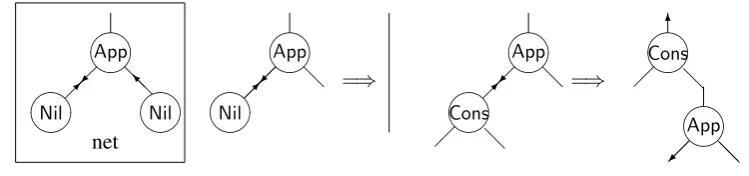
Figure1shows an example of a system of interaction nets, which is an append operation of two lists. net Nil App Cons @ App @ @ Cons 6 @ App @ @ =⇒ =⇒ Nil App @ Nil @ I
Figure 1: Example net and rules
An implementation of this rewriting process has to create the right-hand side of the net, and make all the connections (re-wirings). Although it may not be the most trivial computation step, it is a known, constant time operation. It is for this reason that interaction nets lend themselves to the study of cost models of computation.Allaspects of a computation are captured by the rewrit-ing rules—no external machinery such as copyrewrit-ing a chunk of memory, or a garbage collector, are needed. Interaction nets are amongst the few formalisms which model computation where this is the case, and consequently they can serve as both a low level operational semantics and an object language for compilation, in addition to being well suited as a basis for a high-level programming language. We refer the reader to other papers on interaction nets for properties and additional theory.
An example: encoding the integers. Many simple examples of systems of interaction nets can be found in the literature, for instance the encoding of arithmetic expressions, etc. However, interaction nets are well suited for alternative representations of data-structures and algorithms. Any integerncan be represented (non-uniquely) as a difference of two natural numbers: p−q. Using this idea, we can represent integers in the following way:
Here, the agentS(of arity 1) is interpreted assuccessor. A linear chain ofSagents of length nis used to give a representation of a natural numbern. The representation of an integer simply takes two chains of length pandq, and connects them together as shown, using the agentI(of arity 2). Although this representation is not unique, we can talk aboutcanonical forms when p=0 orq=0 (or both), and there are interaction rules that can compute this. The integer zero is a net where p=q, in particular when p=q=0: we can encode addition, subtraction and negation, for which we need several interaction rules. We just detail the encoding of addition. If N1andN2are the net representations ofz1= (p1−q1)andz2= (p2−q2)respectively, then we can use the following configuration to encode the addition:
I
6
I∗
I∗
? ?
N1 N2
The interaction rules for the agents are:
I
I∗
6 ? @
@
=⇒
S
S
6 ? =⇒
To see how this works, there will be two interactions between the agentsI (of netsN1andN2) andI∗ which concatenate the two chains. Ifz1 andz2 are both in canonical form and moreover both positive (or both negative) then the addition is completed with the two interactions. Other-wise there will be an additional min{q1,p2}interactions between twoSagents to obtain a net in normal form.
3
Programming Language
Nets are written as a comma separated list of agents, corresponding to a flattening of the graph. There are many different (equivalent) ways we could do this depending on the order we choose to enumerate the agents. Using the net on the left-most side of Figure1as an example, we can generate a representation as the following list:
x∼App(r,a),a∼Nil,x∼Nil
This can be simplified by eliminating some names:
App(r,Nil)∼Nil
In this notation the general form of an active pair isα(. . .)∼β(. . .). We assume that all variable names occur at most twice. If a name occurs once, then it corresponds to one of the free ports of the net (ris free in the above). If a name occurs twice, then this represents an edge between two ports. In this latter case, we say that a variable is bound. The limitation on at most two occurrences corresponds to the requirement that it is not possible to have two edges connected to the same port in the graphical setting.
We represent rules by writingl=⇒r, wherelconsists of two agents connected at their princi-pal ports. Therefore rules can be written asα(..)∼β(..) =⇒N, and as such we replace the ‘∼’ by ‘><’ so that we can distinguish an occurrence of a rule from an occurrence of an active pair. The two rules on the right of Figure1(append) can be represented as:
App(r,y) >< Nil =⇒ r∼y
App(r,y) >< Cons(v,u) =⇒ r∼Cons(v,z),u∼App(z,y)
The names of the bound variables in the two nets must be disjoint, and the free variables must coincide, which corresponds to the condition that the free variables must be preserved under reduction. Under this assumption, these two rules can be simplified to:
App(y,y) >< Nil =⇒
App(Cons(v,z),y) >< Cons(v,App(z,y)) =⇒
In this notation we observe that the right-hand side of the rule can always be empty. In this case we will omit the ‘=⇒’ symbol. This notation therefore allows sufficient flexibility so that we can either write nets in a compact way (without any net on the right of the ‘=⇒’) or in a more intuitive way where the right-hand side of the net is written out in full to the right of the arrow. During compilation, all rules are transformed into this compact notation.
In Figure2, we give the syntax for the core language discussed above.
hPini::= { hruleDefi | hnetDefi }
hruleDefi::= hagenti‘><’hagenti[ ‘=>’hruleEquationi {‘;’hruleEquationi }]
hruleEquationi::= htermi ∼ htermi
hnetDefi::= hequationi {‘;’hequationi}
hequationi::= hagenti ∼ hagenti
htermi::= hagenti | hvari
hagenti::= hagentNamei[hportsi]
hportsi::= ‘(’htermi[ ‘,’htermi] ‘)’
hagentNamei::= hNamei
hvari::= hNamei
Figure 2: Syntax of the core language
Modular construction of nets. We allow nets to be named so that they can be built in a mod-ular way. Named nets contain as their parameters a list of the net’s free ports. Using this mech-anism, we can build a new net byinstantiatinga named net with some argument nets. As an example, we can represent the example net in Figure1as:
Append x,r,a:App(r,a)∼x Applist r:Append Nil,r,Nil
Agent Variables. Some rules have the same structure and only differ in the agent names used. Agent variables act as a place holder for agents in the rules. An instance of a rule with a set of agent variables A will create a new rule with elements of A replaced by the actual agents. In the example below, Templ has agent variables A1,A2. The instance of this rule creates App(x,x) >< Nilwhere the agent variables have been replaced withApp, Nilappropriately.
Templ A1,A2:A1(x,x) >< A2 Templ(App,Nil)
Further extensions. We have designed a module system and a set of built-in agents and rules that perform input/output and arithmetic operations—these are reported in [1].
4
The Abstract Machine
Definition 1(Memory model) LetAdr⊆Nbe a set of memory locations. Agents of an in-teraction net system areagent=name×arity×W, wherearity∈N,nameis an identifier, and W models connectivity betweenagent ports: W ={((l,p),(l0,p0))|l,l0∈Adr,p,p0∈N}. An element((l1,p1),(l2,p2))in the setW is ordered if eitherl1<l2orl1=l2, p1<p2. If an agent stored at locationlk has it’s auxiliary port pi connected to the port pj of some agent at location
lm, then((lk,pi),(lm,pj))∈W.
We next define two functions to operate on the machine state:
Definition 2 • La:Adr×N→Adrreturns the locationl∈Adrpointed to by a given port of someagent:La(lk,pi) =lmsuch that((lk,pi),(lm,pj))∈W.
• Lp:Adr×N→Nreturns a port number that is connected to a port of someagentnode: Lp(lk,pi) =pj such that((lk,pi),(lm,pj))∈W.
We define the function ϒ:name×name→Instthat given a pair ofnamesfor an active pair (α,β)of a rule(α,β) =⇒N, returns a sequence of IAM instructions that will build and rewire the netN. The mappings inϒare constructed during the compilation of a rule.
Machine configuration components. The IAM machine consists of rules that transform con-figurations. A configuration is given by a 5-tuplehC,ς,F,A,HiwhereCis a sequence of instruc-tions,ς is a stack of frames. Each frame has an array of local variables and an operand stack.F is a set of pointers to the variable agents of the net,Ais a stack of active pair agents, andHis the heap.
An IAM programCis a sequence of instructions that we summarise in Figure3. We write ‘−’ for the empty sequence andi,v,p,ar∈N.
The component ς is a stack of frames. Each frame f = (L,S)where Lis a partial function with a finite domain of definition, mapping memory locations to their contents. IfLis defined, thenL[i7→l]means thatL(i) =l.Sis an operand stack produced by the grammar: S:= − |v:S wherevis any value representing a constant or a memory location, and−is the empty stack.
The componentFis a mapping from identifiers to a pair of natural numbers defined by:F(x) = (l,p). Intuitively, it is used to hold the interface of the net.
The heap H:Adr→agent returns anagent node given some locationl∈Adr. The special tokennext is used to hold the next free locationl∈dom(H). Intuitively, H is a memory area filled with agent nodes. Whenever a new node is put into the heap, the unused area marked by nextis updated.
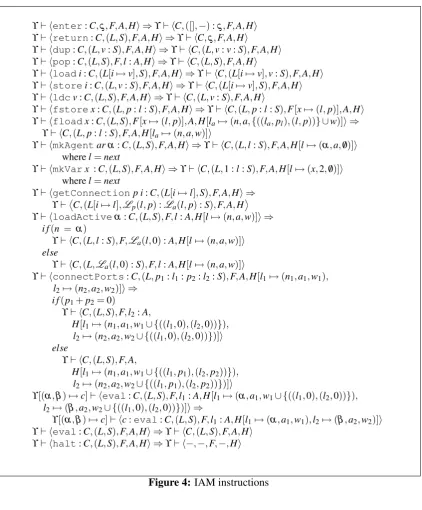
Figure 4gives the IAM instructions as a set of transition rules. Each transition rule takes the form:
ϒ` hC,ς,F,A,Hi ⇒ϒ`C0,ς0,F0,A0,H0
which indicate how the components of the machine are transformed. We abbreviate(L,S):ς to (L,S)in a configuration with only one frame inς.
is executed with the configurationϒ` h−,−,F,−,Hi or prematurely if a pre-condition of an instruction is not satisfied. In this case, the final configuration is the one obtained after the last instruction that has been executed successfully.
The evaluation mechanism. The evaluation of the net is started by executing the eval in-struction. This instruction is appended at the end of the code sequence for the start active pair or initial expression. Thus, before the evaluation of the net, there is at least one active pair in the machine’s active pair stackA. The pair in the stackAis examined and the code sequence of the rule for the pair is appended to the code componentCof the machine (see semantics ofevalin Figure4).
The code for a rule will load one of the active agents into the stack S using the instruction loadActive, then start to build and rewire the right hand side net of the rule to the auxiliary agents connected to the interacting agent in the stack. The instructionpoppops the active agent from the componentA. Evaluation is terminated whenAis empty and execution jumps to the instruction sequence aftereval.
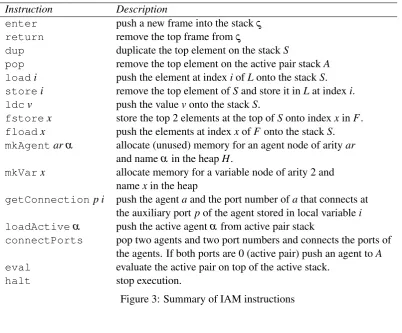
Instruction Description
enter push a new frame into the stackς return remove the top frame fromς
dup duplicate the top element on the stackS
pop remove the top element on the active pair stackA loadi push the element at indexiofLonto the stackS. storei remove the top element ofSand store it inLat indexi. ldcv push the valuevonto the stackS.
fstorex store the top 2 elements at the top ofSonto indexxinF. floadx push the elements at indexxofFonto the stackS. mkAgentarα allocate (unused) memory for an agent node of arityar
and nameα in the heapH.
mkVarx allocate memory for a variable node of arity 2 and namexin the heap
getConnectionp i push the agentaand the port number ofathat connects at the auxiliary portpof the agent stored in local variablei loadActiveα push the active agentα from active pair stack
connectPorts pop two agents and two port numbers and connects the ports of the agents. If both ports are 0 (active pair) push an agent toA eval evaluate the active pair on top of the active stack.
halt stop execution.
ϒ` henter:C,ς,F,A,Hi ⇒ϒ` hC,([],−):ς,F,A,Hi ϒ` hreturn:C,(L,S),F,A,Hi ⇒ϒ` hC,ς,F,A,Hi ϒ` hdup:C,(L,v:S),F,A,Hi ⇒ϒ` hC,(L,v:v:S),F,A,Hi ϒ` hpop:C,(L,S),F,l:A,Hi ⇒ϒ` hC,(L,S),F,A,Hi
ϒ` hloadi:C,(L[i7→v],S),F,A,Hi ⇒ϒ` hC,(L[i7→v],v:S),F,A,Hi ϒ` hstorei:C,(L,v:S),F,A,Hi ⇒ϒ` hC,(L[i7→v],S),F,A,Hi ϒ` hldcv:C,(L,S),F,A,Hi ⇒ϒ` hC,(L,v:S),F,A,Hi
ϒ` hfstorex:C,(L,p:l:S),F,A,Hi ⇒ϒ` hC,(L,p:l:S),F[x7→(l,p)],A,Hi ϒ` hfloadx:C,(L,S),F[x7→(l,p)],A,H[la7→(n,a,{((la,pl),(l,p))} ∪w)]i ⇒
ϒ` hC,(L,p:l:S),F,A,H[la7→(n,a,w)]i
ϒ` hmkAgentarα:C,(L,S),F,A,Hi ⇒ϒ` hC,(L,l:S),F,A,H[l7→(α,a,/0)]i wherel=next
ϒ` hmkVarx :C,(L,S),F,A,Hi ⇒ϒ` hC,(L,1 :l:S),F,A,H[l7→(x,2,/0)]i wherel=next
ϒ` hgetConnectionp i:C,(L[i7→l],S),F,A,Hi ⇒ ϒ`C,(L[i7→l],Lp(l,p):La(l,p):S),F,A,H
ϒ` hloadActiveα:C,(L,S),F,l:A,H[l7→(n,a,w)]i ⇒ i f(n = α)
ϒ` hC,(L,l:S),F,La(l,0):A,H[l7→(n,a,w)]i
else
ϒ` hC,(L,La(l,0):S),F,l:A,H[l7→(n,a,w)]i
ϒ` hconnectPorts:C,(L,p1:l1:p2:l2:S),F,A,H[l17→(n1,a1,w1), l27→(n2,a2,w2)]i ⇒
i f(p1+p2=0)
ϒ` hC,(L,S),F,l2:A,
H[l17→(n1,a1,w1∪ {((l1,0),(l2,0))}), l27→(n2,a2,w2∪ {((l1,0),(l2,0))})]i else
ϒ` hC,(L,S),F,A,
H[l17→(n1,a1,w1∪ {((l1,p1),(l2,p2))}), l27→(n2,a2,w2∪ {((l1,p1),(l2,p2))})]i
ϒ[(α,β)7→c]` heval:C,(L,S),F,l1:A,H[l17→(α,a1,w1∪ {((l1,0),(l2,0))}), l27→(β,a2,w2∪ {((l1,0),(l2,0))})]i ⇒
ϒ[(α,β)7→c]` hc:eval:C,(L,S),F,l1:A,H[l17→(α,a1,w1),l27→(β,a2,w2)]i ϒ` heval:C,(L,S),F,A,Hi ⇒ϒ` hC,(L,S),F,A,Hi
ϒ` hhalt:C,(L,S),F,A,Hi ⇒ϒ` h−,−,F,−,Hi
5
Compilation
The compilation of Pin into IAM instructions is governed by the schemes: Cpin compiles a
program,Ca compiles an agent,Ct compiles a term,Cncompiles a net andCrcompiles a rule.
For correctness purposes, the list of functions generated during compilation must be unfolded in the following ordered way: if C1;. . .;Ck are the schemes generated by Cpin, then the next
function to be unfolded isCisuch that all functionsCp,p<i, have already been unfolded.
The compilation of a program generates the following code:
CpinJ(Σ,hu1∼v1, . . .un∼vni,R)K=
CnJu1∼v1, . . . ,un∼vnK;eval;halt;CrJr1K;. . .CrJrnK;
wherer1, ...,rn=Rare instances of rules.Σis a set of symbols and eachui∼viis an active pair.
The compilation schemeCnJu∼v, . . . ,un∼vnKcompiles a sequence of active pairs. We use the schemeCrJriKto compile a ruleri∈R:
CrJriK=Inst=CrJα(t1, . . . ,tn) >< β(u1, . . . ,un)=>u1∼s1, . . . ,un∼snK, ϒ[(α,β)7→Inst,(β,α)7→Inst].
Compilation of a rule creates a mapping from active agent names to the instruction sequenceInst generated in the rule tableϒ.
Figure 5 collects together the compilation schemes Cn and Cr, that generate code for the
input source text. The schemes use a setN of identifiers to hold all free variables of the net. Compiling a variable that already exists inN means that the variable is bound. The auxiliary functionar(α)returns the arity of the agentα∈Σ.
We end this section with a concrete example of compilation, and give the code generated for the simple system given below:
Eps >< Eps Eps∼Eps
This system contains just one agent and one rule, and the net to be compiled is an instance of that rule. The output of the compiler is given below.
enter
mkAgent 0 Eps ldc 0
mkAgent 0 Eps ldc 0
connectPorts eval
halt
enter
loadActive Eps store 0
loadActive Eps store 0
pop return
CtJxK=
i f(x∈N ) floadx; N \ {x} else
fstorex; mkVarx; N ∪ {x}
CtJα(t1, . . . ,tn)K=
mkAgentar(α)α; for 1≤i≤n
CpJtiKi;
ldc0;
CrJα(t1, . . . ,tn)
>< β(v1, . . . ,vk)
=>u1∼s1, . . . , um∼smK=
enter;
CrtJα(t1, . . . ,tn)K; CrtJβ(v1, . . . ,vk)K;
for 1≤i≤m CeJui∼siK;
pop; return;
CrtJα(t1, . . . ,tn)K=
loadActiveα; store0; for 1≤i≤n
CrrJtiKi0;
CeJt∼sK=
CtJtK; CtJsK;
connectPorts;
CrrJtKj i=
getConnectionj i; CtJtK;
connectPorts;
CnJu∼v, . . . ,un∼vnK=
enter; CeJu∼vK;
.. .
CeJun∼vnK;
CpJtK j=
dup; ldc j; CtJtK;
connectPorts; Figure 5:Compilation schemes
• represents the active pair stackAof the machine.
•
top
represents the stackS.
•
n 0
... represents the local variable arrayL.
mkAgent0E ps Eps
ldc0 Eps 0
mkAgent0E ps 0
Eps Eps
ldc0 0
0
Eps Eps
connectPorts Eps Eps
loadActiveE ps Eps Eps
store0
n 0
...
Eps Eps
loadActiveE ps
n 0
...
Eps Eps
store0
n 0
...
Eps Eps
pop
n 0
...
Eps Eps
return Eps Eps
Observe that after the execution of connectPorts, a pointer to the newly created active pair is pushed into the stackA. Since the rule for this active pair contains an empty right hand side net, there is no re-wiring that is performed. After evaluation, the active pair stack becomes empty. After the last instructionreturnof the rule, remaining active pair agents in the heap are unreachable from any of the machine’s components, and can be garbage collected or reused. We do not address the issues of heap garbage collection or agent reuse in this paper.
6
The implementation
Here we give a brief overview of the pragmatics of the language. We have implemented the compiler, and here we show example programs, the use of the system, and also some benchmark results comparing with other implementations of interaction nets.
The prototype implementation of the compiler and abstract machine can be downloaded from the project’s web page. The compiler reads a source program and outputs an executable with the extension ‘.pin’. The pin file can then be executed by the abstract machine. Various examples and instructions on how to compile and execute a program are provided on the webpage.
are given in [10]. The next programs compute the Ackermann function defined by:
A(m,n) =
n+1 ifm=0
A(m−1,1)ifn=0 andm>0
A(m−1,A(m,n−1))ifm>0 andn>0
The following rules are the interaction net encoding of the Ackermann function:
Pred(Z) >< Z, Dup(Z,Z) >< Z,
Pred(x) >< S(x), Dup(S(a),S(b)) >< S(Dup(a,b)), A(r,S(r)) >< Z, A1(Pred(A(S(Z),r)),r) >< Z,
A(A1(S(x),r),r) >< S(x), A1(Dup(Pred(A(r1,r)),A(y,r1)),r) >< S(y),
and A(3,8) means computation ofA(S(S(S(S(S(S(S(S(Z)))))))),r)∼S(S(S(Z))).
Input Pin Amine SML Interactions
322II 0.002 0.006 2.09 383
245II 0.016 0.088 1355 20211
A(3,8) 3 16 0.04 8360028
A(3,10) 51 265 0.95 134103148
We can see from the table that the ratio of the average number of interactions/sec of Pin to Amine is approximately 3 : 1. Interaction nets are by definition very good in sharing computation thus more efficient than SML in the first two programs. However, interaction nets do not perform well in computations that benefit from sharing data - interacting agents are consumed. Our short term goal is to extend interaction nets with data sharing mechanisms.
7
Acknowledgment
We thank our anonymous referees and all our colleagues at the workshop for their helpful com-ments.
8
Conclusions
In this paper we have given an overview of a programming language design and compilation for interaction nets. Experience with the compiler indicates that the system can be used for small programming activities, and we are investigating building a programming environment around this language, specifically containing tools for visualising interaction nets and editing and debugging tools.
Current research in this area is focused on richer programming constructs and higher level languages of interaction that do not burden the programmer with some of the linearity and pattern matching constrains. The compiler presented in this paper is a first attempt to compile interaction nets, and issues such as compiler optimisations are very much the subject of current research.
Bibliography
[1] http://www.informatics.sussex.ac.uk/users/ah291/.
[2] J. B. Almeida, J. S. Pinto, and M. Vilaa. A tool for programming with interaction nets. In J. Visser and V. Winter, editors,Proceedings of the Eighth International Workshop on Rule-Based Programming. Elsevier, June 2007. to appear in Electronic Notes in Theoretical Computer Science.
[3] J. Berstel and L. Boasson. XML grammars. InMathematical Foundations of Computer Science, pages 182–191, 2000.
[4] M. Clavel, F. Dur´an, S. Eker, P. Lincoln, N. Mart´ı-Oliet, J. Meseguer, and J. Quesada. A Maude Tutorial. SRI International, 2000.
[5] M. Fern´andez and I. Mackie. A calculus for interaction nets. In G. Nadathur, editor, Proceedings of the International Conference on Principles and Practice of Declarative Programming (PPDP’99), volume 1702 ofLecture Notes in Computer Science, pages 170– 187. Springer-Verlag, September 1999.
[6] G. Gonthier, M. Abadi, and J.-J. L´evy. The geometry of optimal lambda reduction. In Proceedings of the 19th ACM Symposium on Principles of Programming Languages (POPL’92), pages 15–26. ACM Press, Jan. 1992.
[7] Y. Lafont. Interaction nets. InProceedings of the 17th ACM Symposium on Principles of Programming Languages (POPL’90), pages 95–108. ACM Press, Jan. 1990.
[8] J. Lamping. An algorithm for optimal lambda calculus reduction. InProceedings of the 17th ACM Symposium on Principles of Programming Languages (POPL’90), pages 16–30. ACM Press, Jan. 1990.
[9] S. Lippi. in2 : A graphical interpreter for interaction nets. In S. Tison, editor, Rewrit-ing Techniques and Applications (RTA’02), volume 2378 of Lecture Notes in Computer Science, pages 380–386. Springer, 2002.
[10] I. Mackie. YALE: Yet another lambda evaluator based on interaction nets. InProceedings of the 3rd International Conference on Functional Programming (ICFP’98), pages 117– 128. ACM Press, 1998.
[11] R. Milner, M. Tofte, R. Harper, and D. MacQueen. The Definition of Standard ML (Re-vised). MIT Press, 1997.
[12] S. Peyton Jones. Haskell 98 Language and Libraries. Cambridge University Press, 2003.
[14] J. S. Pinto. Sequential and concurrent abstract machines for interaction nets. In J. Tiuryn, editor,Proceedings of Foundations of Software Science and Computation Structures (FOS-SACS), volume 1784 of Lecture Notes in Computer Science, pages 267–282. Springer-Verlag, 2000.