ISSN-L: 2501 - 1235 Available on-line at: www.oapub.org/edu
doi: 10.5281/zenodo.3692663 Volume 6 │ Issue 2 │ 2020
EFFECTS OF A PLYOMETRIC SUPPLEMENTAL TRAINING
ON VERTICAL JUMP HEIGHT AND AESTHETIC JUMPING
ABILITY IN ADOLESCENT FEMALE DANCERS
Mariateresa De Leonardis1,
Gianpiero Greco2i 1MSc, Sport Science,
University of Study of Bari, Italy
2orcid.org/0000-0002-5023-3721
PhD, Sport & Exercise Scientist, University of Study of Bari,
Italy
Abstract:
Dance is an artistic discipline that requires precision, artistry, grace, strength and power. Previous studies indicate that plyometric training has positive effects on fitness performance measures in ballet and modern dancers. However, many dancers are wary of engaging in supplementary training out of fear of excessive muscle hypertrophy that could change the aesthetics of body appearance, technique and general, dance artistry. Therefore, the purpose of this study was to investigate the effects of an 8-week supplementary plyometric intervention on vertical jump height, aesthetic jumping ability and anthropometric measures in female contemporary dancers. Sixteen females (12-18 years) were randomly assigned to an 8-week experimental group (EG, n=8) that performed a supplementary plyometric training twice a week or a control group (CG, n=8) that continued regular dance regimen. At baseline and after 8 weeks all participants were tested on the subjective aesthetic jumping ability, anthropometrics and vertical jump.The EG group showed significant (p<0.05) improvements in the subjective ability to hang suspended in the air during a jump (+21.4%) and the subjective jump height
(+43.3%) following the intervention. Also, a significant ‘Time x Group’ interaction was
found for countermovement jump and countermovement jump free arms (p<0.05), with the EG that showed significant improvements of 36.8% and 47.9%, respectively. No significant changes were seen in the CG for all measures from pre- to post-testing. There were no significant changes in any group for body weight and body fat. Our findings suggested that an 8-week supplementary plyometric training program twice a week had a significantly beneficial effect on both physical fitness indices and aesthetic jumping
ability for female contemporary dancers. Therefore, it is suggested that the way a dancer is trained needs to be reviewed and the concept of supplementary training must be deepened.
Keywords: contemporary dance; body fat; stretch-shortening cycle
1. Introduction
Dance is an artistic discipline that requires precision, artistry, grace, strength and power. All forms of dance are mentally and physically rigorous. Dancers in both ballet and modern dance endlessly practice and drill basic movements, combinations, variations/choreography, and partner work. Previous research indicates that both ballet
and modern dancers are fit compared to sedentary controls (Koutedakis & Jamurtas,
2004). Despite these above-average fitness levels, dancers do not always measure as
physiologically robust as age-matched sports athletes (Koutedakis & Jamurtas, 2004; Koutedakis, Stavropoulos-Kalinoglou, & Metsios, 2005). There is also no consensus on
the physiological or fitness requirements of ballet and modern dance. Twitchett,
Koutedakis, and Wyon (2009) reported that scientific evidence examining the strength,
power and agility demands of ballet and modern dance is lacking. Although most dance training requires rigorous physical exercise and has been found to enhance physiological parameters, it is not fully known if dancers would benefit from supplementary training
(Koutedakis & Jamurtas, 2004; Koutedakis et al., 2005; Twitchett et al., 2009). However, some dancers engage in forms of supplementary training such as strength and plyometric training (Koutedakis et al., 2005).
It must be known that many dancers have been traditionally wary of engaging in supplementary plyometric training out of fear of excessive muscle hypertrophy that could change the aesthetics of body appearance, technique and general, dance artistry (Koutedakis & Sharp, 2004). However, in some studies that measured thigh/calf girth or body fat, pre-and post-intervention, there was no significant change in any
anthropometric measures (Angioi, 2012; Brown et al., 2007; Koutedakis et al., 2007; Twitchett, 2011). This information could positively affect dancers by decreasing hesitation in engaging in supplementary plyometric training. Nevertheless, classical ballet is still dictated largely by artistic and aesthetic principles, and ballet teachers, choreographers, and artistic directors appear reticent to include regular supplemental training into a dancers’ schedule. Although it has been hypothesized that increased physical fitness, there are still concerns that supplemental training will affect the
aesthetics of classical ballet dancers and their performance.
So, previous studies broadly indicate that plyometric training methods generally have positive effects on fitness performance measures in ballet and modern dancers (Chmelar et al., 1988; Harley et al., 2002; Koutedakis et al., 2007; Padfield, Eisenman, Luetkemeier, & Fitt, 1993). However, there is a paucity of data regarding the effectiveness of supplementary conditioning training on aesthetic competence and fitness levels in contemporary dance. To our knowledge, only one study has investigated via appropriately designed interventions the effects of increased fitness levels on selected aspects of contemporary dance. These available data suggest that increases in muscular strength and power have beneficial effects on jump ability (Brown et al., 2007). For this reason, it is necessary to further investigate the effects of supplemental conditioning training on contemporary dance performance. Furthermore, plyometric regimes do not negatively appear to affect the dancer's anthropometric measures (Angioi, 2012; Brown et al., 2007; Koutedakis et al., 2007; Twitchett, 2011). However, many of these studies had small sample sizes, heterogeneity of interventions and referred to adult dancers only.
Therefore, the purpose of this study was to investigate the effects of a plyometric training program on the functional dance performance in adolescent female dancers. We hypothesized that an 8-week supplementary plyometric intervention would promote great gains on selected fitness-related parameters, such as lower body muscular power, and aesthetic jumping ability in female contemporary dancers. Furthermore, we do not expect any change in anthropometric measures.
2. Material and Methods
2.1 Participants
statistical power) was calculated for measures of fitness performance and revealed that 8
participants per group would be sufficient to observe medium ‘Time x Group’ interaction
effects. Due to limited subject availability, only female dancers participated. After baseline testing, participants were assigned to a plyometric training group (EG) or a control group (CG) using a pre-test matched-pairs approach.
Participants were ranked according to their baseline age, paired, and randomly allocated to either the EG (n = 8; age: 15.0 ± 2.3 years; BMI: 23.4 ± 4.2 kg·m-2; practice: 9.6 ± 2.8 years) or CG (n = 8; age: 14.3 ± 1.3 years; BMI: 20.2 ± 1.4 kg·m-2; practice: 6.6 ± 4.5 years). This approach reduces the bias associated with randomization because it decreases the likelihood of differences between study groups at baseline. Furthermore, this approach takes into account the effect of biological maturation in the subjects studied. Dancers were excluded from the study if: 1) they presented a confirmed injury and/or eating disorder, or 2) they were undertaking other forms of sports activities. Each of the inclusion criteria was determined by responses to a specifically modified medical questionnaire (Par-Q). A parent/guardian provided a signature of consent before participation and after full verbal and written explanation of the data collection procedures, and in the case of those 18-year-old, consent was provided by the participant. The study was conducted in accordance with the Declaration of Helsinki. All participants were recruited from a local dance school in April 2019 and the study was conducted from May to June 2019.
2.2 Procedures and Measures
Testing was completed in three sessions in the following order: 1) subjective dance evaluation, 2) anthropometry and 3) lower body power assessment. A minimum of two days separated each testing sessions. Pre- and post-testing sessions occurred within one week before and after the eight-week intervention period.
A. Subjective Dance Evaluation
wear dance clothing with the feet visible. After a self-directed warm-up, the subjects were taught the jump combination and they have been given time to practice it. Each subject entered the studio individually and performed the combination once. One of the evaluators kept the beat throughout the combination and attempted to keep the tempo constant for each subject. The evaluators were blind to the group designation of each subject and to the content of the training programs. The scores for each subject by each evaluator were averaged for each aspect of jumping. A very good interobserver agreement was reported for ballon, jump height and overall ability, k = 0.89, 0.92 and 0.90, respectively, whereas a good agreement was reported for feet point, k = 0.78.
B. Anthropometric Measurements
To assess possible changes in body composition with the imposed intervention, anthropometric measurements were obtained. Bodyweight was measured to the nearest tenth of a kilogram using a Tanita® digital scales. Percent body fat was determined using the skinfold method and calculated by following two-site (triceps and calf) prediction equation referred to white girls aged 6-17 years: [%BF = 0.610(∑2SKF) + 5.1] (Slaughter et
al., 1988). All measurements were taken on the right side of the body and to ensure the reliability of the measurement, the same experienced technicians performed all skinfold measurements on the same subjects. The gauge was read to the closest 0.2 mm using a Harpenden (Baty International, Burgess Hill, United Kingdom) calliper. The measurements were taken at each skinfold site in 2 rotations. If any of the measurements differed by more than 1 mm, a third measurement was taken and the mean value was used to determine the sum of skinfold (SKF).
C. Vertical Jump
The Vertical jump was performed through the 1) Squat jump, 2) countermovement jump and 3) countermovement jump free arms tests, and the jump height was measured using
an App installed on an iPhone 5 s (Apple Inc., USA), named “My Jump” and validated by Balsalobre-Fernández, Glaister, and Lockey (2015). This app was designed for analysing vertical jumps to allow the calculation of the time (in ms) between two frames selected by the user and subsequently to calculate the height of the jump using the equation described in the literature (Bosco, Luhtanen, & Komi, 1983): h = t2 x 1.22625, with
h being the jump height in metres and tbeing the flight time of the jump in seconds.The participants completed a standard 10-min warm-up composed of jogging, lower-body dynamic stretches and vertical jumps. Then the squat jump test was performed from a
a quick upward vertical movement, as high as possible for the subject, all in one sequence. The test was performed with hands-on-hips. Whereas during the countermovement jump free arms test the use of the arms during take-off was allowed.Each participant was given three trials, which were separated by 1-minute intervals, to complete their highest jump. The highest jump in the trials was recorded as the dependent variable and used in subsequent analyses. The intraclass correlation coefficient for the three Vertical Jump tests has been ranged between 0.85 and 0.93 reporting a reliability from good to high.
2.3 Plyometric Training
Dancers in the experimental group participated in supplementary plyometric training protocols twice a week. If the subjects were not warm from a dance class before the training session, they either jogged or cycled at a low intensity for five minutes. Each training session lasted from 30 to 45 minutes and there was a minimum of one recovery day between sessions. All training sessions were supervised by research assistants graduates in the Sport Sciences and experts on plyometric training. The control group was asked to participate in no additional training beyond the regular dance regimen.
increasing the explosiveness of the jumps. Froggies were performed at a low intensity for the first and second weeks, a medium intensity for the third and fourth weeks, and were done at a high intensity for the last four weeks.
2.4 Statistical Analyses
All analyses were performed using SAS JMP® Statistics (Version <14.1>, SAS Institute Inc., Cary, NC, USA, 2018), and the data are presented as group mean values and standard deviations. A multivariate analysis of variance (MANOVA) was used to detect differences between the study groups in all baseline measures. A Mann–Whitney U test was performed to search differences between the groups in the baseline subjective dance evaluation and compare the differences pre-post intervention. Also, a Wilcoxon signed-rank test was used to identify the significant changes within the groups in the subjective dance evaluation scores after 8-weeks of training. An analysis of variance (ANOVA) was used to determine the interaction between the two independent variables of training (pre/post; within-subjects factor) and group (EG and CG; between-subjects factors) on the
continuous dependent variables. When ‘Time x Group’ interactions reached the level of significance, group-specific post hoc tests (i.e., paired t-tests) were conducted to identify the significant comparisons. Percentage changes were calculated as [(post-training value
– pretraining value)/pretraining value] x 100.
The reliabilities of the Vertical jump measurements were assessed using intraclass
correlation coefficients; scores from 0.8 to 0.9 were considered as good, while values
above > 0.9 were considered as high (Vincent & Weir, 2012). Instead, the inter-rater agreement, for the scores given by the two experienced dance teachers on the aesthetic jumping ability, was calculated using a weighted Cohen's Kappa; values of 0.8 or above indicated a very good strength of agreement and values between 0.6 and 0.8 represented a good strength of agreement (Altman, 1991). We accepted p < 0.05 as our criterion of statistical significance, whether a positive or a negative difference was seen (i.e., a 2-tailed test was adopted).
3. Results
All participants received the treatment conditions as allocated. Sixteen subjects completed the training program, and none reported any training-related injury. The plyometric training group and control group did not differ significantly at baseline either in anthropometric characteristics, fitness measures and subjective dance evaluation (p > 0.05).
There were no significant changes in any group for body weight and body fat (p > 0.05). Significant main effects for ‘time’ were observed on squat jump and
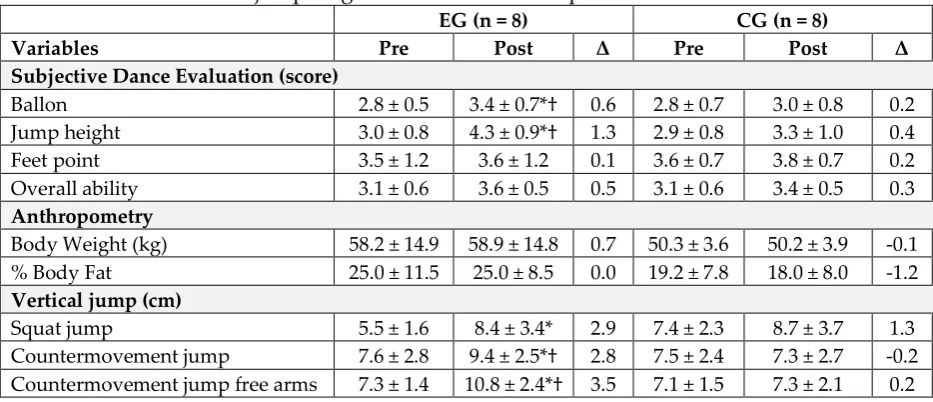
countermovement jump free arms, F1,14 = 11.9 and 49.4, respectively, p < 0.01. The plyometric training group showed a significant increase in vertical jump height from pre- to post-testing for squat jump (52.7%, p = 0.0049) and countermovement jump free arms (47.9%, p < 0.001), whereas the control group showed no changes in the same variables after 8 weeks.
Significant ‘Time x Group’ interaction was found for both countermovement
jumps, the one with the hands-on-hips and the one with the free arms, F1,14 = 6.2 and 36.3, respectively, p < 0.05, with the plyometric training group that showed significantly greater improvements in the countermovement jump (36.8%, p < 0.001) and countermovement jump free arms than control group. There were no significant interaction effects between groups for the squat jump, F1,14 = 1.6, p > 0.05. Pre- and post-intervention results for all outcome measures are presented in Table 1.
Table 1: Changes in subjective dance evaluation scores, anthropometric measures
and vertical jump height after 8 weeks. Data presented as mean ± SD
EG (n = 8) CG (n = 8)
Variables Pre Post Δ Pre Post Δ
Subjective Dance Evaluation (score)
Ballon 2.8 ± 0.5 3.4 ± 0.7*† 0.6 2.8 ± 0.7 3.0 ± 0.8 0.2 Jump height 3.0 ± 0.8 4.3 ± 0.9*† 1.3 2.9 ± 0.8 3.3 ± 1.0 0.4 Feet point 3.5 ± 1.2 3.6 ± 1.2 0.1 3.6 ± 0.7 3.8 ± 0.7 0.2 Overall ability 3.1 ± 0.6 3.6 ± 0.5 0.5 3.1 ± 0.6 3.4 ± 0.5 0.3
Anthropometry
Body Weight (kg) 58.2 ± 14.9 58.9 ± 14.8 0.7 50.3 ± 3.6 50.2 ± 3.9 -0.1 % Body Fat 25.0 ± 11.5 25.0 ± 8.5 0.0 19.2 ± 7.8 18.0 ± 8.0 -1.2
Vertical jump (cm)
Squat jump 5.5 ± 1.6 8.4 ± 3.4* 2.9 7.4 ± 2.3 8.7 ± 3.7 1.3 Countermovement jump 7.6 ± 2.8 9.4 ± 2.5*† 2.8 7.5 ± 2.4 7.3 ± 2.7 -0.2 Countermovement jump free arms 7.3 ± 1.4 10.8 ± 2.4*† 3.5 7.1 ± 1.5 7.3 ± 2.1 0.2
Score range: 1 = Poor, 2 = Fair, 3 = Average, 4 = Good, 5 = Excellent. EG = Experimental group (plyometric training); CG = Control group (regular dance regimen). Δ = individual absolute change. *Significantly
different from baseline (p < 0.05). †Significant effect of the plyometric training program (p < 0.05).
4. Discussion
controlled study aimed to examine the effects of an 8-week supplementary plyometric intervention on fitness-related parameters and aesthetic jumping ability in female contemporary dancers. The main result for the conditioning group was that supplementary exercise training significantly increased selected fitness components (lower body muscular power) with simultaneous increases in the aesthetic jumping ability of the dancers, without causing any changes in anthropometric measures.
Previously published data revealed that plyometric training methods have positive effects on fitness performance measures in ballet and modern dancers (Chmelar et al., 1988; Harley et al., 2002; Koutedakis et al., 2007; Padfield, Eisenman, Luetkemeier, & Fitt, 1993). Furthermore, a study of Brown et al. (2007) demonstrated the effects of 6-weeks of plyometric training versus traditional strength training on power and aesthetic jumping ability in collegiate dancers. The functional outcomes of interest were vertical jump height and an aesthetic jump assessment, which consisted of an evaluation by three dance faculty members using a standard rubric of dance technique. The results indicated
that the plyometric group significantly increased the vertical jump height and improved
the subjective dance evaluation for subjective jump height. No significant changes were
observed for these outcome measures in the control group. So, given that extreme neuromuscular control is required to create aesthetically pleasing jumps, it is plausible that supplementary training geared toward improving the power of the musculature required for jumping may improve aesthetics.
or jumping ability in this population. Similar results have been repeatedly demonstrated in previous investigations (Grossman & Wilmerding, 2000; Koutedakis & Sharp, 2004).
In a systematic review of Girard et al. (2015) was broadly indicate that strength and plyometric training methods generally have positive effects on functional performance measures such as jump-height or subjective, aesthetic performance in elite ballet and modern dancers. Furthermore, strength and plyometric regimes from trials did
not negatively affect the dancer’s anthropometric measures. This review supports our previous finding mentioned above and also that supplementary plyometric training no affects the dancer's anthropometric measures as has been demonstrated in other previous studies (Angioi, 2012; Brown et al., 2007; Koutedakis et al., 2007; Twitchett, 2011). However, in the present study was used the skinfold measurements which are generally considered the least accurate (Yannakoulia, Keramopoulos, Tsakalakos, & Antonia-Leda, 2000). But a study found that skinfold measurements were positively correlated with both BIA and DXA measurements demonstrating their effectiveness (Eliakim, Ish-Shalom, Giladi, Falk, & Constantini, 2000). Also, this study had a large sample size (n = 59 female) and was conducted on adolescent (age 14–17 years) dancers, as in our research.
A major limitation of the present study is related to the subjective dance evaluation on aesthetic jumping ability. Although a high level of agreement was demonstrated between the two judges and the coding was deemed reliable, which means that the qualitative research displayed rigour, the results should be treated with extreme caution.
Also, our findings were limited to 12-18-years-old female contemporary dancers. Another threat to external validity is the small sample size, that may cause a decreased of the statistical power and a greater risk for a Type II error. So, larger randomised
controlled studies, with a continued focus on specific dance disciplines of ballet and
modern dance, are needed to ascertain which dance disciplines will benefit from specific
plyometric training intervention.
5. Conclusion
Funding
No sources of funding were used to assist in the preparation of this manuscript.
Conflicts of interest
The author declared no potential conflicts of interest with respect to the research, authorship, and/or publication of this article.
Authors’ contribution
Mariateresa De Leonardis designed the study, collected data and wrote the manuscript. Gianpiero Greco carried out the statistical analysis, interpreted the data, wrote and revised the manuscript. Both authors contributed intellectually to the manuscript, and have read the manuscript and approved the submission.
References
Altman, D. G. (1991). Practical statistics for medical research. London: Chapman & Hall. p. 404.
Angioi, M. (2012). Effects of supplemental training on fitness and aesthetic competence parameters in contemporary dance: a randomised controlled trial. Medical problems of performing artists, 27(1), 3-8.
Balsalobre-Fernández, C., Glaister, M., & Lockey, R. A. (2015). The validity and reliability of an iPhone app for measuring vertical jump performance. Journal of Sports Sciences, 33(15), 1574-1579.
Bosco, C., Luhtanen, P., & Komi, P. V. (1983). A simple method for measurement of mechanical power in jumping. European journal of applied physiology and occupational physiology, 50(2), 273-282.
Bosco, C., Tarkka, I., & Komi, P. V. (1982). Effect of elastic energy and myoelectrical potentiation of triceps surae during stretch-shortening cycle exercise. International Journal of Sports Medicine, 3, 137–140.
Brown, A. C., Wells, T. J., Schade, M. L., Smith, D. L., & Fehling, P. C. (2007). Effects of plyometric training versus traditional weight training on strength, power, and aesthetic jumping ability in female collegiate dancers. Journal of dance medicine & science, 11(2), 38-44.
Chmelar, R. D., Schultz, B. B., Ruhling, R. O., Shepherd, T. A., Zupan, M. F., & Fitt, S. S. (1988). A physiologic profile comparing levels and styles of female dancers. The Physician and sports medicine, 16(7), 87-96.
Faul, F., Erdfelder, E., Lang, A. G., & Buchner, A. (2007). G*Power 3: A flexible statistical power analysis program for the social, behavioral, and biomedical sciences. Behavior Research Methods, 39, 175-191.
Fischetti, F., & Greco, G. (2017). Multilateral methods in Physical Education improve physical capacity and motor skills performance of the youth. Journal of Physical Education and Sport, 17(3), 2160-2168.
Fischetti, F., Vilardi, A., Cataldi, S., & Greco, G. (2018). Effects of Plyometric Training Program on Speed and Explosive Strength of the Lower Limbs in Young Athletes. Journal of Physical Education and Sport, 18(4), 2476-2482.
Girard, J., Koenig, K., & Village, D. (2015). The effect of strength and plyometric training on functional dance performance in elite ballet and modern dancers. Physical Therapy Reviews, 20(4), 233-240.
Greco, G., Settimo, M., & Fischetti, F. (2018). Relationship between the correct running technique and lower back well-being perceived by the practitioner. Journal of Physical Education and Sport, 18(3), 1796-1800.
Grossman, G., & Wilmerding, M. (2000). The effect of conditioning on the height of dancer's extension in a la seconde. Journal of dance medicine & science, 4(4), 117-121. Harley, Y. X., Gibson, A. S. C., Harley, E. H., Lambert, M. I., Vaughan, C. L., & Noakes, T. D. (2002). Quadriceps strength and jumping efficiency in dancers. Journal of dance medicine & science, 6(3), 87-94.
Komi, P. V. (2003). Stretch-shortening cycle. Strength and power in sport, 2, 184-202.
Koutedakis, Y., & Jamurtas, A. (2004). The dancer as a performing athlete. Sports medicine, 34(10), 651-661.
Koutedakis, Y., & Sharp, N. C. (2004). Thigh-muscles strength training, dance exercise, dynamometry, and anthropometry in professional ballerinas. Journal of strength and conditioning research, 18(4), 714-718.
Koutedakis, Y., Hukam, H., Metsios, G., Nevill, A., Giakas, G., Jamurtas, A., & Myszkewycz, L. (2007). The effects of three months of aerobic and strength training on selected performance-and fitness-related parameters in modern dance students. The Journal of Strength & Conditioning Research, 21(3), 808-812.
Koutedakis, Y., Stavropoulos-Kalinoglou, A., & Metsios, G. (2005). The significance of muscular strength in dance. Journal of dance medicine & science, 9(1), 29-34.
Markovic, G., Jukic, I., Milanovic, D., & Metikos, D. (2007). Effects of sprint and plyometric training on muscle function and athletic performance. The Journal of Strength & Conditioning Research, 21(2), 543-549.
Martel, G. F., Harmer, M. L., Logan, J. M., & Parker, C. B. (2005). Aquatic plyometric training increases vertical jump in female volleyball players. Medicine and science in sports and exercise, 37(10), 1814-1819.
Meylan, C. M. P., Cronin, J. B., Oliver, J. L., Hopkins, W. G., & Contreras, B. (2014). The effect of maturation on adaptations to strength training and detraining in 11–15‐ year‐olds. Scandinavian journal of medicine & science in sports, 24(3), e156-e164. Padfield, J. A., Eisenman, P. A., Luetkemeier, M. J., & Fitt, S. S. (1993). Physiological
profiles of performing and recreational early adolescent female dancers. Pediatric Exercise Science, 5(1), 51-59.
Slaughter, M. H., Lohman, T. G., Boileau, R. A., Horswill, C. A., Stillman, R. J., Van Loan, M. D., & Bemben, D. A. (1988). Skinfold equations for estimation of body fatness in children and youth. Human Biology, 60, 709-723.
Tricoli, V., Lamas, L., Carnevale, R., & Ugrinowitsch, C. (2005). Short-term effects on lower-body functional power development: weightlifting vs. vertical jump training programs. The Journal of Strength & Conditioning Research, 19(2), 433-437. Twitchett, E. A. (2011). Do increases in selected fitness parameters affect the aesthetic
aspects of classical ballet performance? Medical problems of performing artists, 26(1), 35-38.
Twitchett, E. A., Koutedakis, Y., & Wyon, M. A. (2009). Physiological fitness and professional classical ballet performance: a brief review. The Journal of Strength & Conditioning Research, 23(9), 2732-2740.
Vincent, W., & Weir, J. P. (2012). Statistics in Kinesiology (4th Ed). Champaign, IL: Human Kinetics.
Creative Commons licensing terms