359
© 2018 by the Serbian Biological Society How to cite this article: Láng DL, Bíró Z, Heltai M, Patkó L. Bird-nest analysis: A rarely tested noninvasive survey method for monitoring mammals. Arch Biol Sci. 2018;70(2):359-64.
Bird-nest analysis: a rarely tested noninvasive survey method for monitoring mammals
Dávid L. Láng1,*, Zsolt Bíró1, Miklós Heltai1 and László Patkó2
1Institute for Wildlife Conservation, Szent István University, Páter K. str. 1., H-2100 Gödöllő, Hungary
2CIC International Council for Game and Wildlife Conservation, Teleki str., topographical number 0178/9, H-2092
Budakeszi, Hungary
*Corresponding author: [email protected]
Received: August 21, 2017; Revised: November 2, 2017; Accepted: November 30, 2017; Published online: December 20, 2017
Abstract: Surveys of mammals can be difficult to carry out due to their elusive lifestyle and nocturnal behavior. In order to minimize the disturbance to target species, indirect or noninvasive methods are recommended. These techniques can enable the collection of samples without disturbing the animals. Active methods (e.g. hair traps) are based on artificial devices, and passive methods (e.g. scat collecting) entail the collection of samples directly from the environment. The aim of this study was to survey the mammal fauna of the Natura 2000 site of Sár-hegy in the North Hungarian Mountains based on noninvasive bird-nest analysis through the identification of hairs found in nests, based on macroscopic and microscopic features of the guard hairs. Eight out of the twelve (67%) collected nest and cavity lining materials contained good quality guard hairs. In total, 55 hair samples were found that could be analyzed, and 52 of these samples have been classified. Ten species and two twin-species were identified. The most common species was wild boar, and the most common taxa was the ruminant. There were three samples of protected species: the Eurasian beaver, the edible dormouse and the hazel dormouse-forest dormouse twin-species. The obtained findings suggest that this method can be used for monitoring the spread of species. The methodology proved to be a cheap way to collect reliable data on mammal fauna. More studies are needed to test this promising method, since gathering faunistical data can be important, especially for monitoring Natura 2000 sites.
Key words: mammal; noninvasive; bird; nest; hair
INTRODUCTION
Due to their elusive lifestyle and often nocturnal behavior it is difficult to collect occurrence data on mammal species. Different methods can be used to gather this information. Invasive methods, such as live trapping [1], net capture [2] or chemical immo-bilization [3], always affect the natural behavior [4-6] of the animals, which can result in a reduced chance of survival [7]. By altering specimen behavior, these methods could also bias the research outcomes. In or-der to minimize the effect of human disturbance on target species, indirect or noninvasive methods are recommended. With these techniques, different signs (e.g. scat, urine, hairs) of mammals can be collected as samples. In mammal surveys, the most frequently used sources for DNA are scat and hair samples [8]. Based on scat or hair, samples can be identified not only with regard to species, but also on an individual level [9].
Bird-nest analysis is a relatively new noninvasive method. This technique aims to collect abandoned bird nests or artificial cavities that might contain mammal hairs, which could be prepared and identi-fied under laboratory conditions [10,11]. The method has already been used to gather basic occurrence data [12], identify endangered carnivores [10] and to suc-cessfully survey urban mammal fauna [11]. The re-sults of studies like this could provide important data for conservation and wildlife biologists.
MATERIALS AND METHODS
Study area
The examined lining materials are from the Sár-hegy SAC (site number: HUBN20046) Natura 2000 site near the city of Gyöngyös, northern Hungary. The area of the site is 352.68 ha and the highest elevation is 500 m. Climate and flora are determined by the North Hungarian Mountains that extend from the north to the Great Hungarian Plain in the south, which results in turkey oak-sessile oak forests, thermophilous oak forests, steppe grasslands and rocky grasslands. Gen-erally, the area has various habitats (e. g. Prunetum tenellae), but deciduous forests (Quercetum petrae-ae-cerris) [13] are the most dominant habitat types (Supplementary Fig. S1).
Field sampling
We examined 12 nests and cavity lining materials (lin-ing material from Sár-hegy Natura 2000 site). The cavi-ties are cleaned by the national park rangers on a yearly basis after the breeding period of song birds. Lining materials were collected on 17.11.2014. The reason for the late autumn sampling is that in this period breed-ing is already over, and thus no harm will be inflicted on songbird fauna. Cavities and nests belonged to the great tit (Parus major) and the Eurasian blue tit ( Cya-nistes caeruleus). This method provides data mainly from the spring period, since songbirds collect hairs in their breeding period as nesting materials. The lin-ing material for this study was put into separate paper bags with unique codes, which included the location and the date of sample collection. Prior to laboratory examination, the samples were stored in a deep freeze (-20°C). Before analyzing the field samples, a reference collection was compiled based on dorsal guard hairs of the following species: fallow deer (Dama dama), red deer (Cervus elaphus), roe deer (Capreolus capreolus), golden jackal (Canis aureus), red fox (Vulpes vulpes), beech marten (Martes foina), weasel (Mustela nivalis), ferret (Mustela putorius), brown bear (Ursus arctos), wild boar (Sus scrofa), wolf (Canis lupus), domestic dog (Canis lupus familiaris), Eurasian lynx (Lynx lynx), black rat (Rattus rattus), house mouse (Mus musculus), wood mouse (Apodemus sylvaticus), bank vole (Myodes glareolus), hazel dormouse (Muscardinus avellanarius),
edible dormouse (Glis glis), brown hare (Lepus euro-paeus), mouflon (Ovis aries musimon), wildcat (Felis silvestris), feral cat (Felis catus), horse (Equus caballus), sheep (Ovis aries), human (Homo sapiens). Most of these species are known to occur in the sample area or in adjacent territories [14,15]. The goal of the reference work was to recognize hairs presumed to be from the sampling area and to acquire practice in morphological identification. At least three guard hairs were tested in this collection from the dorsal or lateral body region, since these are the best for species determination [16].
Laboratory examination
The frozen samples were treated with UV light (Bieffe Italia SRL BF G15 Germicidal Lamp) for 5 min to avoid potential contamination. After the UV treat-ment, the guard hairs were laid on white paper for separating them into five, easily manageable, large cat-egories (wild boar, ruminant, domestic, carnivore-like, random). We sorted out the guard and under hairs by their shape, color, thickness and strength. These cate-gories have typical attributes that can provide accurate identification based on macroscopic parameters. Wild boar samples are typically dark, thick, rough, strong and have a fragmented peak. Ruminant samples are typically straight but have small undulations in the line of hair. Within the ruminants, further species-specific identification can sometimes prove to be dif-ficult. Domestic animal samples are typically long, unicolored, often brightly colored and have no stripes. Every sample from the carnivore-like category was examined further with a microscope. Carnivore-like macroscopic hair attributes are the stripes and the thicker shield of the hair. From the random category, 1-6 samples were picked randomly and were examined with a microscope. Hairs in this category were similar to each other based on their macroscopic features, but they could not be sorted into any other category. All the above-mentioned morphological characters were based on our reference collection and identification keys [16,17]. The samples were sorted further and only whole hairs were investigated in order to obtain more accurate identifications [10,11,].
color, thickness and presence of stripes) were recorded [10,11,].
For further microscopic analysis, the cuticle and medulla patterns were recorded. To obtain a cuticle pattern, the hairs were placed into a 20% gelatin fix. The preserved cuticle imprints of the hair samples were examined under microscope at 100x and 400x magnification. After the gelatin was fixed, we removed the hairs and stuck them with nail polish to another slide. Hairs were cut across and immersion oil was dripped onto the samples so that the medulla became clear under the microscope [11,16,17].
Data analysis
The materials found in the linings were sorted in ran-dom order and identified categories were summed (repeated categories were removed). Statistical analysis was performed on these two data series. Microsoft Of-fice Excel 2007 software was used for tables, diagrams and explorative statistics, while SPSS Statistics version 20. was used to perform the statistical analysis.
RESULTS AND DISCUSSION
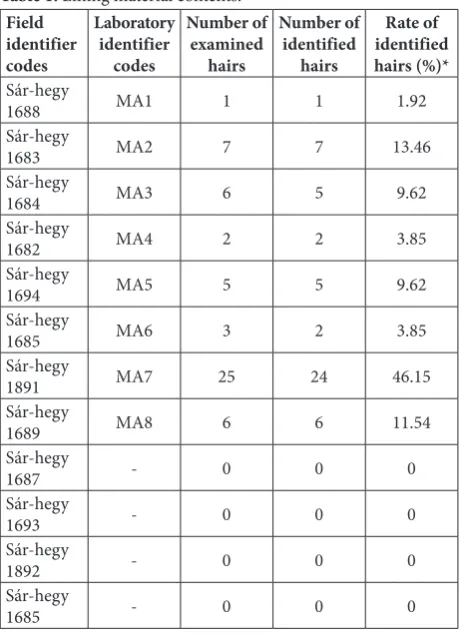
Twelve lining materials were examined from the sam-pling area, of which eight samples (66.67%) contained guard hairs that were whole or minimally damaged. In total, 55 hair samples (average=4.58/lining material; SD=6.69) were examined from the lining materials (Table 1, Fig. 1).
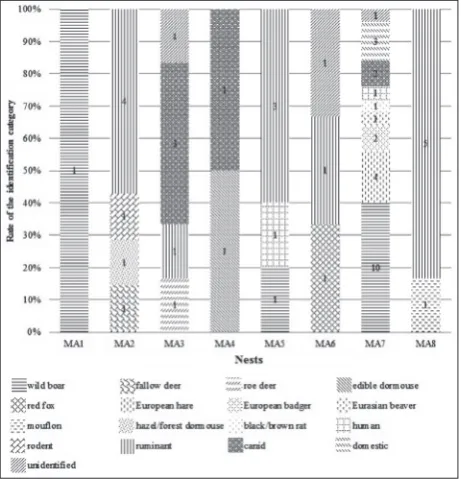
Of the 55 examined hair samples, 52 (94.55%) were identified; 28 samples were identified on a spe-cies level, which included: Sus scrofa, Dama dama, Capreolus capreolus, Glis glis, Vulpes vulpes, Lepus europaeus, Meles meles, Castor fiber, Ovis aries musi-mon, Homo sapiens. Two twin-species (Muscardinus avellanarius-Dryomys nitedula, Rattus rattus-Rattus norvegicus) were also identified. Twenty-one samples were identified at a higher taxonomic level and three samples came from “domestic” animals. Samples from higher taxonomic levels included one order ( Roden-tia), one suborder (Ruminantia) and a family ( Cani-dae). The most common species was wild boar (n=12), 21.82%, the most common higher taxonomic category was the ruminant (n=14), 25.45%. In two samples,
the most common carnivore was the European bad-ger (3.64%). However, most carnivore samples came from canids (n=6), 10.91%. Three samples belonged to protected mammals: these were the Eurasian bea-ver (n=1; 1.82%), the edible dormouse (n=1; 1.82%)
Table 1. Lining material contents. Field
identifier codes
Laboratory identifier
codes
Number of examined
hairs
Number of identified
hairs
Rate of identified hairs (%)* Sár-hegy
1688 MA1 1 1 1.92
Sár-hegy
1683 MA2 7 7 13.46
Sár-hegy
1684 MA3 6 5 9.62
Sár-hegy
1682 MA4 2 2 3.85
Sár-hegy
1694 MA5 5 5 9.62
Sár-hegy
1685 MA6 3 2 3.85
Sár-hegy
1891 MA7 25 24 46.15
Sár-hegy
1689 MA8 6 6 11.54
Sár-hegy
1687 - 0 0 0
Sár-hegy
1693 - 0 0 0
Sár-hegy
1892 - 0 0 0
Sár-hegy
1685 - 0 0 0
*Compared to the total number of identified hairs from all nests
and the hazel dormouse-forest dormouse twin-species (n=1; 1.82%) (Fig. 2).
Both the linear and logarithmic functions sig-nificantly fit our data (ANOVA, linear F1.10=59.955; p<0.001; logarithmic F1.10=130.917; p<0.001). How-ever, comparison of the determination factors (linear R2=0.857; logarithmic R2=0.929) revealed that the logarithmic function fitted better, forming a saturation curve. The correlation between the number of lin-ing materials and the number of identified categories along with the logarithmic function are shown in Fig. 3. The correlation between the number of lining ma-terials and the number of identified categories and the fitted logarithmic function display a saturation curve. The saturation curve shows us that the optimum point between the minimum and maximum required num-ber of samples is efficient. In this study we did not reach the saturation point, but similar surveys with higher sample sizes will probably reach it.
A survey in Merzse Swamp (Hungary) and the parks of Gödöllő (Hungary) found nearly the same number of lining materials (n1=12; n2=13; n3=15) [11]. When compared to the work of Patkó et al., the pres-ent survey [11] resulted in 1.5 times more idpres-entified hair samples (n1=52; n2=34), two times more identi-fied species (n1=10; n2=5) and the same number of higher taxonomic level samples (n1=3; n2=3) (Mer-zse Swamp). The reason for this difference may be environment-related (Patkó et al. [11] examined ur-banized habitats, whereas in the current study natural habitats were examined). In these habitats, different species might occur. A survey of the area in Eastern Sudetes, Czech Republic [12] sampled 4.5 times more lining materials than this survey (n1=12; n2=54). Re-sults from the Czech Republic are based on 102-fold more identified hair samples (n1=52; n2=5317), but just 1.24-fold more identification categories than our survey (n1=17; n2=21). Most common species are also shown in this survey but at different rates (e.g. Sus scrofa, Vulpes vulpes, Capreolus capreolus); 29.6% of the lining materials from the Eastern Sudetes con-tained hair samples, while at Sár-hegy 66.67% of the lining materials contained hair samples. With this method, it seems that the occurrence of many species can be proven even from a relatively low sample size (n=12). Sár-hegy, our sample area, seems to be rath-er divrath-erse as regards mammal fauna (species n=12,
including twin-species). A survey of mammal hair diversity in nest-lining materials [19] concluded that the blue tit (Cyanistes caeruleus) and great tit (Parus major) prefer the hair of roe deer (Capreolus capreo-lus). In this study, we gathered only one hair sample of roe deer from blue tit and great tit nests, and the most common hair samples were from wild boar (Sus scrofa; n=12). This suggests that the hair preference of these birds varies between different habitats.
There are 25 documented mammal species on the sampling area [14]. Our survey identified 10 species and 2 twin-species. There are 3 species from the IUCN Red List in the area [14,18]; of these, we identfied the edible dormouse and the hazel dormouse as members of the hazel dormouse-forest dormouse twin-species. These species cannot be identified species based solely on the macroscopic and microscopic feature of their fur [11,20,21]. Our method proved to be successful in detecting potential target mammals of the area; how-ever, for a more detailed study, the use of other nonin-vasive methods would be useful (e.g. remote cameras). Material cost was about 1-2 € per cavity and 0.2-0.3 € per examined hair sample. We were able to col-lect reliable data on mammal fauna during songbird breeding and the nest-building period. Presumably, identification based on DNA (e.g. mtDNA, STR mark-ers) would be more expensive since it requires labora-tory kits.
Common species are identified more often with hair collection-based methods [11,12]. Due to their low densities, species from edge populations are rarely identified by noninvasive methods [22]. These results are also supported by our survey. The most common-ly identified group was the ruminant. Species from this group (e.g. roe deer, wild boar) are abundant in the area [15]. However, we also identified a rare and protected species, the Eurasian beaver. Three bea-vers were introduced 10 km from the sampling area in 2005 [23]. Considering that beavers are spreading [23] and that Lake Szent Anna at Sár-hegy might be a suitable wetland habitat, there is a chance that the spe-cies appeared near the sampling area. These findings suggest that this method can be used for monitoring the spread of this species, as well as many others in Hungary and other European countries. The method might also be efficient for monitoring invasive species.
Our study showed that bird-nest analysis is a cost-efficient method for surveying the mammal fauna of Natura 2000 sites, and presumably other areas as well. Using this methodology, we can identify rare species on the sampling area and the procedure can be applied for monitoring the spread of invasive species. Further application of this method will enhance our knowl-edge about the cost efficiency of bird-nest analysis. The creation of a compilation of reference collections is advised before similar surveys in order to improve the reliability of the method. The effectiveness of bird-nest analysis could be enhanced by the addition of mito-chondrial DNA tests to make underhairs and damaged hairs identifiable, although this would raise the overall cost of the study. Further, one could also investigate the differences in sample quality and quantity between nest-builder and cavity-user birds. Information on the songbird distance of travel for nest-building material would help to understand the habitat use of the identi-fied mammals. It would also be beneficial to know if birds have preferences in terms of hair collection (e.g. over-represented mammal hairs in the lining materi-als) as this information would help in clarifying biases.
Acknowledgments: We would like to express our gratitude to Dr. Mária Tóth whose suggestions helped this research. We also wish to express our gratitude to the two anonymous reviewers for their valuable suggestions. This research was supported by the “Sustain-able Conservation on Hungarian Natura 2000 Sites” (SH/4/8) and the Research Centre of Excellence (9878/2015/FEKUT). Author contributions: Dávid L. Láng was responsible for data col-lection, laboratory work and drafting the article. Zsolt Bíró guided the statistical approaches and systematized the data. Miklós Heltai supervised the project, proof-read the article in English and con-tributed to the logical structure of the manuscript. László Patkó had the original project idea, supervised the fieldwork, performed the lab analysis and contributed to the final version of the manu-script.
Conflict of interest disclosure: The authors declare no conflict of interest.
REFERENCES
1. Nichols JD, Pollock KH, Hines JE. The Use of a Robust Cap-ture-recapture Design in Small Mammal Population Studies: A Field Example with Microtus pennsylvanicus. Acta Theriol (Warsz). 1984;29(30):357-65.
3. Talbot LM, Talbot MH. Flaxedil and Other Drugs in Field Immobilization and Translocation of Large Mammals in East Africa. J Mammal. 1962;43(1):76-88.
4. Linnell JDC, Swenson J, Landa A, Kvam T. Methods for Monitoring European Large Carnivores - A Worldwide Review of Relevant Experience. NINA Oppdragsmelding. 1998;549:1-38.
5. MacKay P, Zielinski WJ, Long RA, Ray JC. Noninvasive research and carnivore conservation. In: Long RA, MacKay P, Ray JC, Zielinski WJ, editors. Noninvasive survey methods for carnivores. Washington DC: Island Press; 2008. p. 1-8. 6. Long RA, Zielinski WJ. Desinging effective noninvasive
car-nivore surveys. In: Long RA, MacKay P, Ray JC, Zielinski WJ, editors. Noninvasive survey methods for carnivores. Washington DC: Island Press; 2008. p. 8-45.
7. Möstl E, Palma R. Hormones as Indicators of Stress. Domest Anim Endocrinol. 2002;23:64-74.
8. Schwartz MK, Monfort SL. Genetic and endocrine tools for carnivore surveys. In: Long RA, MacKay P, Ray JC, Zielin-ski WJ, editors. Noninvasive survey methods for carnivores. Washington DC: Island Press; 2008. p. 238-62.
9. Waits L, Paetkau D. Noninvasive Genetic Sampling Tool for Wildlife Biologists: A Review of Application and Recom-mendation for Accurate Data Collection. J Wildl Manag. 2005;69(4):1419-33.
10. Tóth M. A New Noninvasive Method for Detecting Mam-mals from Birds’ Nests. J Wildl Manag. 2008;72(5):1237-40. 11. Patkó L, Ujhegyi N, Heltai M. A Madárfészek-analízis
Alkalmazásának Tesztelése Városi Élőhelyeken. Tájökológiai Lapok. 2014;12(1):197-205.
12. Ondrušová K, Adamík P. Characterizing the Mammalian Hair Present in Great Tit (Parus major) Nests. Bird Study. 2013;60(3):428-31.
13. Baráz Cs, editor. A Mátrai Tájvédelmi Körzet. Eger: Bükki Nemzeti Park Igazgatóság; 2010. 431 p.
14. Magos G, editor. Gyöngyösi Sár-hegy Természetvédelmi Terület és bővítése természetvédelmi kezelési terve. Bükki Nemzeti Park Igazgatóság; 2014. 55 p.
15. Csányi S, editor. A 2014/2015. vadászati év vadgazdálkodási eredményei valamint a 2015. tavaszi vadállomány becs-lési adatok és vadgazdálkodási tervek. Gödöllő: Országos Vadgazdálkodási Adattár; 2015. 152 p.
16. Tóth M. A magyar emlősfauna szőrtani kézikönyve. Buda-pest: Magyar Természettudományi Múzeum; 2015. 208 p.
17. Teerink BJ. Hair of West-European mammals. Cambridge: Cambridge University Press; 1991. 224 p.
18. The IUCN Red List of Threatened Species Version 2017-2 [Internet]. Cambridge: IUCN Global Species Programme and IUCN Species Survival Commission. 1994 – [cited 2017 Oct 19]. Available from: http://www.iucnredlist.org. 19. Harničárová K, Adamík P. Mammal Hair in Nests of Four
Cavity-nesting Songbirds: Occurrence, Diversity and Sea-sonality. Bird Study. 2016;63(2):181-6.
20. Tóth M. Az emlősök szőrmintáinak információtartalma, a szőrhatározás módszertana és a módszer gyakorlati alkalmazása [dissertation]. [Budapest]: Eötvös Lóránd Uni-versity; 2003. 142 p.
21. Tóth M. Identification of Hungarian Mustelidae and Other Small Carnivores Using Guard Hair Analysis. Acta Zool Hung. 2002;48(3):237-50.
22. Patkó L, Ujhegyi N, Heltai M. More Hair than Wit: A Review on Carnivore Related Hair Collecting Methods. Acta Zool Bulg. 2016;68(1):5-13.
23. Haarberg O. Amit a hódról tudni érdemes. Budapest: WWF Magyarország; 2007. 30 p.
Supplementary Data