Available online throug
ISSN 2229 – 5046A SURVEY ON MULTI CHANNEL FUZZY QUEUEING MODEL
USING α - CUT AND DSW ALGORITHM
S. SHANMUGASUNDARAM
*AND K. THAMILSELVI
***Assistant Professor, Department of Mathematics, Government Arts College, Salem-7, TamilNadu, India.
**Assistant Statistical Investigator,
District Rural Development Agency, Karur-639007, TamilNadu, India.
(Received On: 19-02-19; Revised & Accepted On: 08-03-19)
ABSTRACT
I
n this paper we study FM/FM/3 Queueing Model using DSW algorithm based on α – cut representation in triangularization method. The numerical example also given to test the efficiency of the model.Keywords: Inter arrival time, Service time, Membership function, Triangular fuzzy numbers, α-cuts, DSW algorithm, and Interval analysis.
1. INTRODUCTION
Queueing theory is a branch of mathematics that studies and models the act of waiting lines. The first paper on Queueing theory, “The theory of probabilities and Telephone conversation” was published in 1909 by Anger Krarup Erlang [4], as consider the father of field.
A queue is formed whenever the demand for service exceeds the capacity to provide service at that point in time. (eg: bank, hospital, reservation counter, ration shop). A queueing system is composed of customers or units needing some kind of service who arrive at a service facility where such service is provided join a queue of service is not immediately available and eventually leave after service.
Queueing theory can be applied the imperfect matching between the customer and service facilities is caused be one’s inability to predict accurately the arrival and service time of customers. It tries to answer the questions like average number of customer waiting in the system and queue and average time of customer spends in the system and queue. These questions are mainly investigated by Queueing Model
Our aim of this paper discussed about multi server queueing model and first come first served discipline using
triangular fuzzy numbers under α-cut represented through DSW algorithm. Here fuzzy set decompose into distinct
eleven points through α-cut method.
Fuzzy queueing model have been developed by researchers George J Klir and Bo Yuan [5] in 1995.Negi.R.S and Lee.E.S [8] in 1992, S.P. Chen [3] in 2005, R.Srinivasan[11] in 2014 and Shanmugasundram.S and Venkatesh.B[10] in 2015. Traditional Queueing Model will be more realistic if it is converted into Fuzzy queueing model.
2. PRELIMINARIES
2.1 Fuzzy Set
Let X be a nonempty set. A fuzzy set A in X is characterized by its membership function µA :X → [0,1] and µA(x) is interpreted as the degree of membership of element x in fuzzy set A for each x∈X.
Corresponding Author: K. Thamilselvi**,
**Assistant Statistical Investigator,
2.2 α - Cuts
If a fuzzy set is defined on for any α
∈ [0, 1] the cuts is represented by the following crisp set.
Strong α cuts:
αA* = { x∈X/ µA(x) > α: α
∈ [0,1]}
Weak α cuts:
αA = { x∈X/ µA(x) ≥ α: α
∈ [0,1]}
Therefore, it is inferred that fuzzy set A can be treated as crisp set αA in which all the members have their membership
values greater than or at least equal to α .
2.3 Triangular Fuzzy Number
A triangular fuzzy number
A
~
is defined by (a1, a2, a3) where ai ƐR and a1≤ a2 ≤ a3.Its membership function is x - a1a2 - a1 for x< a1 µA~(x) = a3 - x
a3 – a2 for a2≤ x ≤a3 0 otherwise
The graph of µA~ (x) is
3. INTERVAL ANALYSIS
Let I1 and I2 be two interval numbers defined by ordered pairs of real numbers with lower and upper bounds. I1 = [a, b], a ≤ b, I2 = [c, d], c ≤ d
To define a general arithmetic property with the symbol *, where * = [+, -, ×, ÷] (i.e.) I1 * I2 = [a,b] * [c,d]
Where I1 * I2 represents another interval. The interval calculation depends on the magnitudes and signs of the element a, b, c, d.
[a, b] + [c, d] = [a + c, b + d] [a, b] − [c, d] = [a −d, b −c] [a, b] . [c, d] = [min (ac, ad, bc, bd), max (ac, ad, bc, bd ) ]
[a, b] ÷ [c, d] = [a,b].
c
d
1
,
1
provided that
0
∉
[c, d][ ]
a
,
b
α
= [α a, α b] for α> 0 [α b, αa] for α < 04. DSW Algorithm
The DSW algorithm consists of the following steps: 1) Select a 𝛼 cut value where 0 ≤ 𝛼≤ 1.
2) Find the intervals in the input membership functions that correspond to this 𝛼.
3) Using standard binary interval operations compute the interval for the output membership function for the selected𝛼 cut level.
5. DESCRIPSITION OF THE MODEL
If we consider a traditional queueing system with number of server Three, calling population is infinite and queue discipline is first in first out discipline. In technically (i.e.) (M/M/C:
∞
/FIFO).Arrival rate and service rate are fuzzy numbers denoted by
λ
~
andµ
~
. The inter arrival time (A) and service times (S) are represented by the following fuzzy sets.A= {(a,
µ
~
A (a))/ a∈X}S = {(s,
µ
~
s (s))/ s∈Y}Where X and Y are crisp universal sets of the inter arrival time and service time.
The membership functions of A and S are A(
α
) = { a∈X /µ
~
A (a) ≥α
} S(α
) = { s∈Y /µ
~
s (s) ≥α
}Where A(α ) and S(α) are crisp sets using
α
cuts, the inter arrival time and service time are represented by different levels of confidence intervals.The triangular membership function P(A,S) is x - a1 for x< a1
a2 - a1
µ P(A,S)(x) = a3 - x for a2≤ x ≤a3
a3 – a2
0 otherwise
Multi server Fuzzy queue infinite calling source and First In First Out discipline. In technically (FM/FM/3): (FIFO/∞/∞)
The queue has two or more service facility in parallel providing identical service. The customer in the waiting line can get service at any one of three servers. The arrival and service distribution follows Fuzzy Markovian distribution.
The performance of the Multi server queueing system is, 1. The Expected number of customers in the system
𝐿𝑠 = 𝜆µ�
𝜆 𝜇�
3
2!(3𝜇−𝜆)2𝑃𝑂 +𝜆µ
2. Expected number of customers waiting in the queue
𝐿𝑞= 𝜆µ�𝜆𝜇�
3
2! (3𝜇 − 𝜆)2𝑃𝑂
3. Average waiting time of a customer spends in the system
𝑊𝑠= µ�
𝜆 𝜇�
3
2!(3𝜇−𝜆)2𝑃𝑂 + 1 µ
4. Average waiting time of a customer in the queue
𝑊𝑞= µ�𝜆𝜇�
3
2! (3𝜇 − 𝜆)2𝑃𝑂
𝐻𝑒𝑟𝑒𝑃𝑂 = 1
∑ �𝜆𝑛�!µ�
𝑛
�𝜆3!�µ�
3
. 3µ3µ− 𝜆
2 𝑛=𝑜
6. NUMERICAL EXAMPLE
6.1 Triangular fuzzy number
Consider (FM/FM/3) queue, where the both the arrival rate and service rate are triangular fuzzy numbers represented
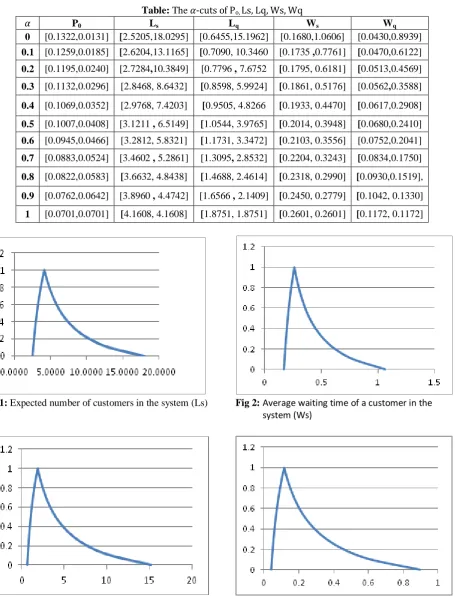
Table: The 𝛼-cuts of Po, Ls, Lq, Ws, Wq
𝛼 P0 Ls Lq Ws Wq
0 [0.1322,0.0131] [2.5205,18.0295] [0.6455,15.1962] [0.1680,1.0606] [0.0430,0.8939] 0.1 [0.1259,0.0185] [2.6204,13.1165] [0.7090, 10.3460 [0.1735 ,0.7761] [0.0470,0.6122]
0.2 [0.1195,0.0240] [2.7284,10.3849] [0.7796 , 7.6752 [0.1795, 0.6181] [0.0513,0.4569]
0.3 [0.1132,0.0296] [2.8468, 8.6432] [0.8598, 5.9924] [0.1861, 0.5176] [0.0562,0.3588]
0.4 [0.1069,0.0352] [2.9768, 7.4203] [0.9505, 4.8266 [0.1933, 0.4470] [0.0617,0.2908]
0.5 [0.1007,0.0408] [3.1211 , 6.5149] [1.0544, 3.9765] [0.2014, 0.3948] [0.0680,0.2410]
0.6 [0.0945,0.0466] [3.2812, 5.8321] [1.1731, 3.3472] [0.2103, 0.3556] [0.0752,0.2041]
0.7 [0.0883,0.0524] [3.4602 , 5.2861] [1.3095, 2.8532] [0.2204, 0.3243] [0.0834,0.1750]
0.8 [0.0822,0.0583] [3.6632, 4.8438] [1.4688, 2.4614] [0.2318, 0.2990] [0.0930,0.1519],
0.9 [0.0762,0.0642] [3.8960 , 4.4742] [1.6566 , 2.1409] [0.2450, 0.2779] [0.1042, 0.1330]
1 [0.0701,0.0701] [4.1608, 4.1608] [1.8751, 1.8751] [0.2601, 0.2601] [0.1172, 0.1172]
Fig 1: Expected number of customers in the system (Ls) Fig 2: Average waiting time of a customer in the
system (Ws)
Fig 3:Expected number of customer in the queue (Lq). Fig 4:Average wating time of a customer in the queue (Wq)
We find the arrival rate and service rate by taking 𝛼 as 0, 0.1, 0.2, 0.3, 0.4, 0.5, 0.6, 0.7, 0.8, 0.9, 1. From the above table:
1) Expected number of customers in the system is 4.1608 (α =1) which is in the interval [2.5205, 18.0295] 2) Expected number of customers in the queue is 1.8751 (α =1) which is in the interval [0.6455, 15.1962]
3) Average waiting time of a customer in the system is 0.2601 (α =1) which is in the interval [0.1680, 0.0606]
7. CONCLUSION
The arrival time and service time follows fuzzy variable. In the numerical example we calculate the values of P0, Ls, Lq, Ws, Wq at the point 0.0701, 4.1608, 1.8751, 0.2601, 0.1172 using DSW algorithm. It shows the efficiency of the model.
REFERENCES
1. Bark.S and Fallahnezhad M.S.., “Cost Analysis of Fuzzy Queuing Systems”, International Journal of Applied Operational Research, Vol. 2, No. 2 , pp. 25 – 33, 2012.
2. Buckely., J.J. “Elementary Queuing Theory based on Possibility Theory”, Fuzzy Sets andSystems 37, 43 – 52, 1990.
3. Chenn S.P., “A Mathematics programming approach to the machine interference problem with fuzzy parameters”, Applied Mathematics and Computation 174, 374 – 387, 2006. [3]
4. Erlang. A.K. “The theory of probabilities and telephone conversation”- 1909.
5. George J Klir and Bo Yuan, Fuzzy Sets and Logic, Theory and Applications, Prentice HallPTR upper saddle river, New Jersey, 1995.
6. Gross D.. and Haris. C.M., Fundamentals of Queuing Theory, Wiley New York, 1965. 7. Jadeh L.A.., Fuzzy sets, Information and control 8, 338 – 353, 1965.
8. Negi. D.S. and Lee E.S.., “Analysis and Simulation of Fuzzy Queue”, Fuzzy Sets and Systems 46, 321 – 330 , 1992.
9. Premkumar Gupta and Hira., D.S.Operation Research, 884 – 885, 2007.
10. Shanmuugasundaram.S and Venkatesh.B, “Fuzzy Multi Server Queuing Model through DSW algorithm,
Global Journal of Pure and Applied Mathematics , Vol.11,Number 1, pp. 45 – 50, 2015.
11. Shanmugasundaram.S and Thamilselvi.K, ‘A study on single server queueing model using DSW algorithm with Heptagonal and Octogonal Fuzzy number’, Global Journal of Pure and Applied Mathematics, Vol 14, 927-936,2018.
12. Srinivasan.R, “Fuzzy Queuing Model using DSW algorithm”, International Journal ofAdvanced research in Mathematics and Application. Vol 1, Issue 1, pp. 57 – 62, 2014.
13.
Timothy Rose, Fuzzy Logic and its Applications to Engineering, Wiley Eastern Publishers, 2005.Source of support: Nil, Conflict of interest: None Declared.