JEEECCS, Volume 6, Issue 22, pages 29-38, 2020
An Approach towards the Development of a
Hybrid Chatbot for Handling Students’
Complaints
Fidelis Odinma Chete
Department of Computer Science, University of Benin, Benin City, Nigeria
Godswill Oshiobugie Daudu
Department of Computer Science, University of Benin, Benin City, Nigeria
Abstract–The communication between students
and staff in most university system is done manually. This is strenuous and time-consuming with the lecturers having to answer same type of questions over and over again with same answers. This problem can be solved partially if students are availed the opportunity to interact with a chatbot which would be able to respond to their questions. Chatbots are artificial intelligence programs that are able to act and maintain a certain level of conversation with real people. The study develops a chatbot system- CSC StudentBuddy (hosted using Facebook Messenger Platform with A Facebook Page acting as the bridge), to reduce these challenges in the Department of Computer Science, University of Benin, Benin City. Data was collected by the interview method. The respondents were 400 level/final year students and lecturers in the department.The chatbot was built with an easy-to-understand non-coding bot building platform- Chatfuel. The build-up of the chatbot was then conceptualized and birthed into a functional prototype. Then, usability validation testing and analysis were conducted with the respondents and feedback was received in form of surveys. The feedback generated was used to improve the bot.
Keywords-chatbots, communication, conceptualized, usability testing, prototype, artificial intelligence
I. INTRODUCTION
Today is the age of smart machine intelligence. Machines have begun to impersonate different human traits with the advances in Artificial Intelligences. A good example of such robots is artificial intelligence conversational agents, also called Chatbots. Chatbots are computer programs having the capability to carry out near - natural conversation with people. It is software used to engage in human conversations, implementing one varies with the use of keyword matching and basic natural language processing techniques or string similarity [1].
Chatbots are Artificial Intelligence agent that participates in conversations with a user; most are fitted with an interface of a messenger type with a user input and a chatbot output. The chatbot receives feedback from the users and provides a response
based on what the user has just submitted. It could be a welcome message, a picture, or even a topic of conversation [2].
Although the traditional method, otherwise known as the one-to-one conversation between students of Computer Science and lecturers could sometimes prove effective, it can be tiring, time consuming for the lecturers to respond to the complaints of every student. In addition, the lecturers could sometimes be inaccessible or unavailable for the students to meet at certain period of times (due to them lecturing other students and sometimes travelling for official assignment). This problem, however, could be partially solved if students are availed the opportunity to talk to a convincing Chatbot which is able to respond to their complaints/requests. This research develops a hybrid chatbot that would be used for handling students’ complaints and answering frequently asked questions for the Department of Computer Science, University of Benin. To achieve this, the research develops a database were all information relating to the students such as questions, answers and feedback will be stored and thereafter a matching keyword and a string distance comparison algorithm respectively would also be setup to retrieve the best possible answer.
This research utilizes a bot building platform-Chatfuel (www.chatfuel.com), that would aid in the creation of this responsive Chatbot and would be hosted using Facebook Messenger Platform (A Facebook Page acting as the bridge). The same type of platform (chatfuel) was used by [3] to develop a chatbot as a facilitator for new hires onboarding.
II. BRIEF REVIEW OF RELATED LITERATURE
The following are some of the existing chatbots that are fast growing with the tide currently in Nigeria:
• Leo (UBA Chatbanking): is an Artificial Intelligence (AI)-powered Facebook Messenger bot that allow customers perform banking transactions or payment right from the chatbot. It was launched in September 1st, 2018 by The United Bank for
Africa (UBA)
(https://www.messenger.com/t/134602110609609)
• Kudi.ai: is a financial chatbot which allows its customers to purchase mobile data/airtime, transfer money and pay TV Bills(StarTimes, DSTV etc.) via chat using Messenger, Telegram or through its web browser
(https://www.messenger.com/t/1809238702640892)
• Loystar NG Bot: Loystar is a chatbot developed to help anyone locate local brands within Nigeria and also users of the chatbot can shop for food/groceries, fashion items, book flights and hotel reservations
(https://www.messenger.com/t/917436621715396).
Other existing chatbot applications in Nigeria include: Sami (Stanbic IBTC bot), Ada (Diamond Bot), and Oxygen (Keystone bank bot) [5].
Artificial intelligent chatbots, according to [6], makes use of machine learning to understand the context and intent of a question asked by the user before formulating a response and consequently generate their own answers to more complicated questions using natural-language responses. The following chatbots, Leo (UBA Chatbanking), Kudi.ai, Loystar NG fall under this category.
Hybrid chatbots, however, are rule-based chatbots and use a series of defined rules as basis for the types of problems the chatbot is familiar with, they can use simple/complicated rules but cannot however answer any questions outside of the defined rules [6]. In addition, they are generally faster to train, unlike the A.I. Chatbot, though the latter learn from information gathered, unlike the former that replies the users based on pre-defined rules [7]. They, like flowcharts, map out conversations in anticipation of what the individual might ask, and how the chatbot should respond [6]. For the purpose of handling students’ complaints, the hybrid chatbot is best suited and if the user has further questions to ask outside the scope of the chatbot, the option is speaking with “A Human Agent” is provided to the user.
The CSC StudentBuddy chatbot designed for this study fall under this category of chatbots since it works on pre-defined rules set.
III. PRESENT SYSTEM
Students are required to visit the department on a regular basis just to get information. They are faced
with the challenge of inaccessibility to administrators (Course Advisers, Student Advisers, Heads of Department etc.) within the department because they may be attending official meeting, teaching some other classes, or away on official assignment.
A. Proposed System
The proposed solution is to create a Chabot to simulate a human conversation, to assist students with their questions/complaints and to provide a more personal experience. Students would be able to ask questions related to the Computer Science Department in natural language that they are comfortable using. The chatbot will identify and understand what the user is asking and generate an appropriate response based on the conversational context. Immediate responses will be provided by the chatbot to reduce the need for the user to have to visit the department on regular basis.
B. Methodology
The proposed chatbot would simulate a human conversation, to assist the 400level Computer Science students with their questions/complaints and to provide a more personal experience. As mentioned by [8], advancements in artificial intelligence, machine learning techniques and improved aptitude for decision making have increased the practicality of integrating a chat bot into applications. For response generation, the selected approach is the Rules-Based chatbot - in other words, a mostly linear, hard-coded system of questions and answers. “CSC StudentBuddy” will understand a series of questions in the domain of the respondents, and provide answers that have been pre-programmed. Facebook Messenger is the selected messaging platform for “CSC StudentBuddy”; it houses more than 1 billion users and currently surpasses whatsApp as the most interacted messaging platform in the world [9]. The study, in addition, adopted the methodological approach used by [3] in developing a chatbot as a facilitator for new hires onboarding.
C. Design Aims And Conversational Flow
One of the most challenging parts of designing a chatbot, is making the conversation flow as natural and efficient as possible because human interaction is non-linear, messy and mostly unpredictable[3]. [10], however, submitted that a well-structured dialogue reduces the user’s fear and stress by smartly addressing the issue and providing relevant answers
The study sets the following conversation goals for the user:
• how to register courses online;
• details about the Head of Departments office hours and available facilities.
• information about course registration processes and requirements needed by the students;
• who are the course lecturers in the department
• Information about lecture/faculty timetable/class venues.
To design the chatbot flows from scratch, the study selected same tool- XMind, used by [3]. The study also adapted the same colour legend defined by [3], according to the categories of the possible types of input and output the chatbot might interact with. The color legend, as given by [3] is described in figure 1.
Figure 1. Color Legend for Flow Mapping (Adapted from [3])
The user, in order to start a conversation with CSC StudentBuddy, is required to search “CSC StudentBuddy” from within the Facebook Messenger application (app) or otherwise accessing the bot link via m.me/cscstudentbuddy2019. When CSC StudentBuddy is found, the user is greeted with a short introduction as suggested by [11], [12], [13], [14], [15] and [16] and cited in [3] along with a button “Get Started”, to start the conversation.
[3], while discussing interactions in chatbots, submitted that “a clear welcoming message seems to be fundamental, centering the expectations of the user and explaining the purpose, functionality and problems that the chatbot can solve” [3]. Figure 2 depicts an excerpt flow of the chatbot initial interaction mapping.
Figure 2. Excerpt of the chatbot initial interaction mapping (Adapted from[3]).
D. Chatbot Flow For “Course Registration”
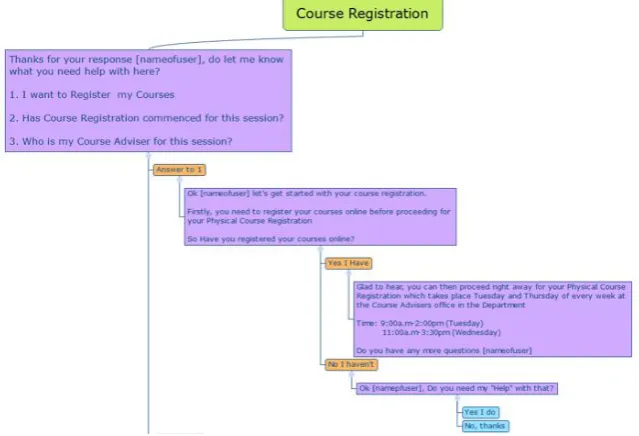
This particular flow allows the users to get information about how to register for their session
the physical registration. Figure 3 depicts an excerpt of the “Course Registration Flow” from the chatbot.
Figure 3. Excerpt of the “Course Registration Flow” from the chatbot
E. Chatbot Flow For “Examinations”
This flow avails the students access to get information about their semester examination
timetable schedule (1st, 2nd and Faculty Timetable) etc. This is depicted in figure 4.
Figure 4. Examination flow for “CSC Studentbuddy” chatbot
F. Chatbot Flow For “Frequently Asked Questions” (F.A.Q.)
This flow allows users to get answers to frequently asked questions. Some of this questions include: name of the course adviser, has course
of Departments office hours. An excerpt of the F.A.Q. flow from the chatbot is presented in Figure 5.
IV. DEPLOYMENT AND TESTING
This section describes the efforts expended during the phase of deployment and usability studies, which were completed by a survey following the usage of CSC StudentBuddy. The chatbot can publicly be
accessed on m.me/cscstudentbuddy2019. The demo video can be found on https://youtu.be/UunT6Xzj6qo.
A. Initial Deployment
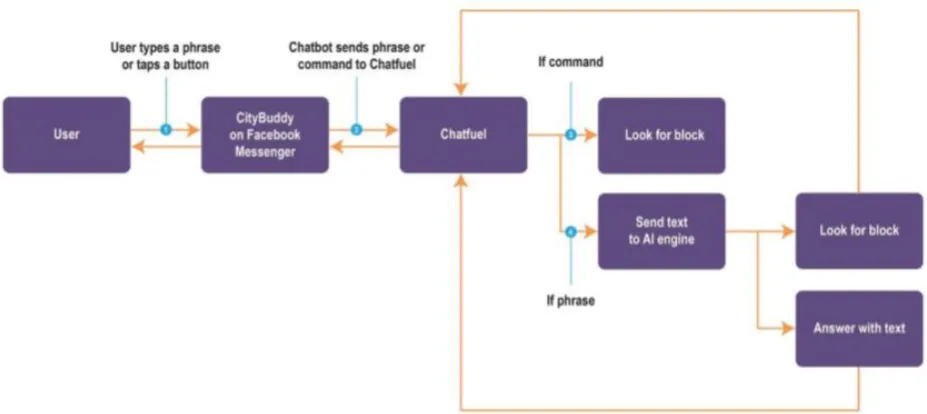
[3] explained the way conversations are structured in Chatfuel using a simple diagram depicted in Figure 6.
Figure 6. Conversation Structure with Chatfuel and Facebook Messenger [3]
A Facebook page for CSC StudentBuddy and a bot in Chatfuel is created, to commence implementation and thereafter linked together so that the Facebook page, which only acts as a bridge, hosts the chatbot.
After creating the CSC StudentBuddy facebook page and linking the chatbot to it, all relevant blocks in Chatfuel are then created. as depicted in figure 7.
JEEECCS, Volume 6, Issue 22, pages 29-38, 2020
The relevant block structure designed for the “CSC Studentbuddy” is depicted in figure 7. Embedded in each of these blocks are responses that attend to the respective users input. For example, a user that clicks on the “Examinations” block while interacting with the chatbot, is greeted with the following response-Hello [nameofuser], kindly click that which you need to see. Thereafter, the user would be shown the other
sub-blocks which correspond to the main block “Examinations”
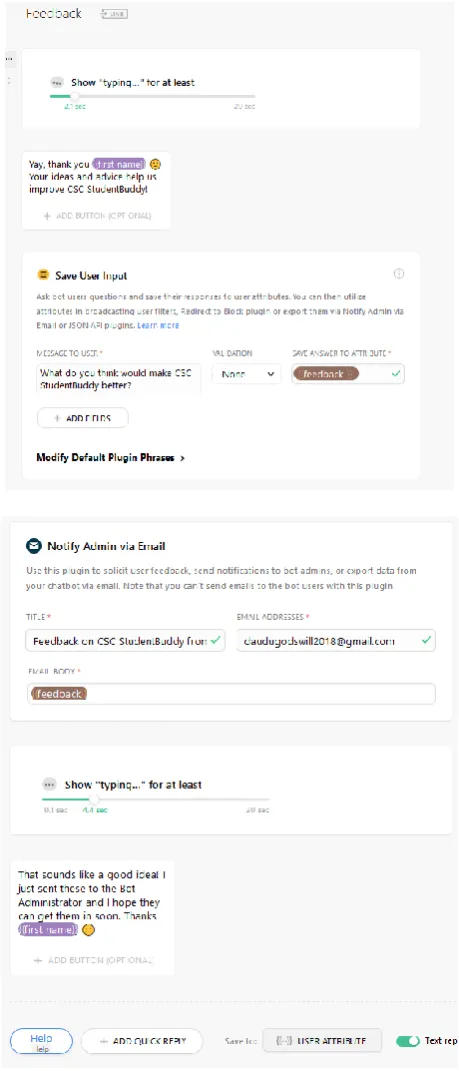
There is also an optional user feedback module as shown in figure 8, which is integrated into the “CSC Studentbuddy” chatbot build-up. This feedback structure is designed to solicit ideas/responses from user(s) on how best to improve the bots user experience/functionality. Responses garnered here are sent across to the administrator via email.
B. Usability Validation and Analysis
For the chatbot usability validation, five (5) 400level full-time final year students from the Department of Computer Science, University of Benin were reached.
In order to get feedbacks from the target users, a survey form was created with the use of Typeform, a simple and aesthetic service that is perfectly adapted to web and mobile which is used to create online
forms for free.[3] The same type of form was used by [3]. The results from the usability testing are discussed below.
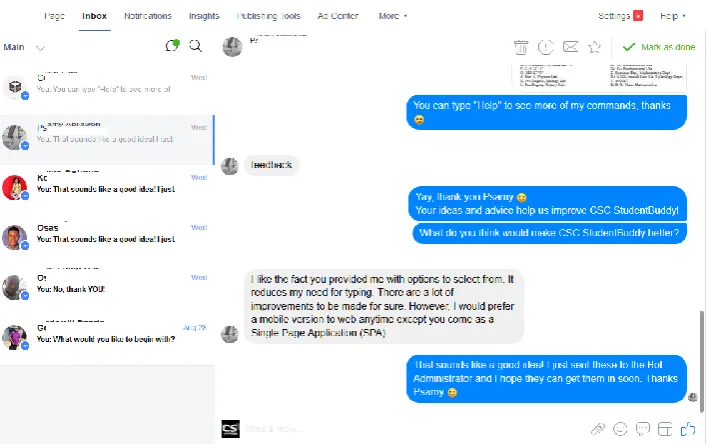
The conversations between the users and the Chatbot are allowed by Facebook and Chatfuel to be viewed by page/bot administrators. Figures 9 and 10 depict the interfaces for these conversations.
Figure 9. A user’s feedback of “CSC StudentBuddy” chatbot (Source: screenshot from Facebook.com)
Figure 10. A user’s feedback of “CSC StudentBuddy” chatbot (Source: screenshot from Facebook.com)
As depicted in Figure 9, feedbacks/responses were received from the users of the “CSC Studentbuddy” chatbot at the testing stage. These feedbacks aided for further improvement to the chatbot build-up. From the survey form sent out to selected users, suggestions/ideas were received. All five (5) users agreed that the chatbot contained relevant information related to almost every sphere that a 400-level student of the Department of Computer Science would need. Users also acknowledged the bots responses have been straightforward and not too smarty.
On the downside, most users said that the chatbot understanding of free text questions was a bit limited. Some users said the chatbot did not include features about lecturer’s availability for classes, daily lecture schedule and list of all lecturers within the department and their designation.
C. Chatbot Improvement Phase Based On Usability Validation
The following improvements were made on the chatbot:
a. The CSC Stuentbuddy is a hybrid (rule based chatbot), its scope of design is to answer the basic/intermediate/repetitive questions asked by the 400level students of the Department of Computer Science; consequently, not all “free-text” questions inputted by users would come back with a favourable response. So in order for this to be limited , “A Live Chat” feature had to be integrated into the chatbot which availed users the opportunity to talk directly with an “Available Live Chat Agent” for the department, from the comfort of their homes.
b. Also the features about lecturer’s availability for classes, daily lecture schedule and list of all lecturers within the department and their designation were fed into the chatbot for improved usage.
CONCLUSION
The study demonstrated that chatbots, like “CSC StudentBuddy” are an effective way to provide students of the Department of Computer Science, University of Benin, Benin-City with fast, real time unlimited access to relevant information at their convenience. The primary design need of the chatbot was to mitigate the rate at which students had to visit the department to have some basic/intermediate answers to their questions, when responses to such questions could be provided to the users directly from the comfort of their homes.
This chatbot is in no way perfect as it is a rule based chatbot that give responses to questions asked by the users based on certain rules/replies inputted in it by the administrators, although it covered reasonably the scope for which the bot was designed. However, for further improvements to the bots learning functionality, an appropriate and suitable Artificial Intelligence framework can be integrated into the current build-up, This would aid the chatbot in learning from the users free-text input and giving favorable responses in the future.
ACKNOWLEDGMENT
The authors appreciate the methodological approach used by [3] in developing a chatbot as a facilitator for new hires onboarding, which was adapted in this work.
REFERENCES
[1] Kar, R., & Haldar, R. (2016). Applying Chatbots to the Internet of Things: Opportunities and Architectural Elements. International Journal of Advanced Computer
Science and Applications. Retrieved July 8th
2020 from https://doi.org/10.14569/IJACSA.2016.071119
[2] Klopfenstein L., Delpriori S., Malatini S., & Bogliolo A. (2017). The Rise of Bots: A Survey of Conversational Interfaces, Patterns, and Paradigms. In: Proceedings of the DIS, pp. 555-565, ACM.
[3] Asher, N. (2017). A Warmer Welcome: Application of a chatbot as a Facilitator for New Hires Onboarding. Masters Thesis, Linnaeus University Sweden. Retrieved June
13, 2020 from
https://www.diva-portal.org/smash/get/diva2
[4] Yinka A. (2018). How Nigerian brands and startups are creatively using Chatbots to improve customer experience. Retrieved
August 28, 2019 from
https://techpoint.africa/2018/02/21/chatbots-in-nigeria/
[5] Wasulu, H.O. (2018). The Rise of Chatbots in Nigeria. Retrieved August 28, 2019 fromhttps://chatbotslife.com/the-rise-of-chatbots-in-nigeria-55490cc58484
[6] Jenna A. (2020). Rule-Based Chatbots vs A.I. Chatbots: Key Differences. Retrieved
June,12, 2020 from:
https://www.hubtype.com/blog/rule-based-chatbots-vs-ai-chatbots/
[7] Christopher C. (2018). Customer Service Secret Weapon: Hybird Chatbot, Artsper.com success story. Retrieved June, 12, 2020 from https://chatbotslife.com/customer-service- secret-weapon-hybrid-chatbot-artsper-com-success-story-cf59b07e1bbe
[8] Dole, A., Sansare, H., Harekar, R. & Athalye, S. (2015). [online] www.ijettcs.org. Retrieved
August 27, 2019 from
http://www.ijettca.org/Volume4Issue5(2)/IJET TCS-2015-10-09-16.pdf
[9] Dale, R. (2016). The return of the chatbots. Natural Language Engineering, . Retrieved
June 13, 2020 from
http://doi.org/10.1017/S1351324916000243. [10] Beer, A. (2016). Writing the Script:
Conversation Mapping. Botdesign.ai. Retrieved August 30, 2019 from:
http://botdesign.ai/thesis/conversation-mapping/46
[11] Chatbotics (2016). The 7-Laws of Chatbotics
for human-chatbot interactions.
TenEightyBots. Retrieved June 14, 2020 from:
http://ecommerce-chatbots.com/7-laws-chatbotics-human-chatbot/
[13] Kong, A. (2017). Chatbots in HR: Improving the Employee Experience [PowerPoint slides]. Retrieved August 31, 2019 from: http://www.slideshare.net/Amy_Kong/awbp-combinedv4public-version
[14] Yao, M. (2016). When Bots Go Bad: Common UX Mistakes in Chatbot Design. TopBots. Retrieved August 28, 2019 from: https://medium.com/topbots/when-bots-go- bad-common-ux-mistakes-in-chatbot-design-c60b252a6abf
[15] Bushtruk, S., & Skorniakov, A. (2016). Conversational Design Essentials: Tips for Building A Chatbot. Smashing
Magazine. Retrieved August 29, 2019 from:
https://www.smashingmagazine.com/2016/12/c onversational-design-essentials-tips-for-building-a-chatbot/
![Figure 2. Excerpt of the chatbot initial interaction mapping (Adapted from[3]).](https://thumb-us.123doks.com/thumbv2/123dok_us/7805085.2084912/3.595.89.540.173.245/figure-excerpt-chatbot-initial-interaction-mapping-adapted.webp)