Reference & User Services Quarterly, vol. 58, no. 1, pp. 28–39
© 2018 American Library Association. All rights reserved.
Permission granted to reproduce for nonprofit, educational use.
Despite the persisting notion that rec-reational reading does not have a place in the academic mission of college and university libraries, these libraries have a long history of providing pleasure reading for their patrons. During the latter half of the twentieth century, the idea of academic libraries meeting the recreational reading needs of students seems to have fallen out of favor, but a literature review of that time period shows that the collections them-selves still existed. Discussion of—and jus-tifications for—these collections, however, has enjoyed a resurgence in the library literature over the past decade. Given this renewed interest, this study seeks to assess just how common these collections are in US academic libraries today, and whether or not they are, in fact, enjoying a come-back from previous decades. This study surveyed the thirty-nine academic libraries that make up the Orbis Cascade Alliance in the Pacific Northwest, a diverse group of libraries in terms of size, type, budget, and student populations. The results of the survey show that a majority of librar-ies have a recreational collection and that these collections are valued by patrons and librarians alike. Recommendations are made for shifting the perspective on popular reading collections and their place in academic libraries, as well as for how to study them in the future.
R
ecreational reading collec-tions and activities designed to encourage patrons to read for pleasure are generally con-sidered the domain of public libraries in today’s library landscape. This was not always the case. The library literature has well established that in the early part of the twentieth century, recre-ational reading collections and readers’ advisory activities were common and important parts of the collections and services of academic libraries. Examples of outreach efforts included book lists, book talks, articles in student newspa-pers, book displays, campus book clubs, and lists of new pleasure reading acqui-sitions that were sent to faculty.1 The collections were generally housed and displayed in browsing rooms, which were common and prominent elements of academic library buildings during this time.2 There are even examples of librarians teaching college courses in recreational reading.3Attitudes toward recreational read-ing in academic libraries began to change during the 1950s and 1960s.4 Some explanations for this include trends in building and remodeling that eliminated the separation between lei-sure collections and other books in academic libraries, a decline in time
Elizabeth Brookbank,
Anne-Marie Davis, and
Lydia Harlan
Elizabeth Brookbank (brookbanke@ mail.wou.edu) is Instruction Librarian, Hamersly Library, Western Oregon University. Anne-Marie Davis ([email protected]) is Collection Development Coordinator, Odegaard Undergraduate Library, University of Washington. Lydia Harlan (lharlan@ uoregon.edu) is Acquisitions Budget and Receiving Coordinator, Knight Library, University of Oregon.
Don’t Call It a Comeback
spent by students reading for pleasure, and a lower likeli-hood that counter-culture young people in the 1960s would trust the recommendations of authority figures. There was also an effort by some in the library community to make aca-demic librarianship more “serious” by putting an emphasis on their “traditional” role supporting the college curriculum and student research and less effort into recreational read-ing activities.5 As Elliot notes, however, “perhaps the larg-est issue in the decline is something academic librarians of today can also relate to—ever-increasing demands on one’s professional time and library resources.”6
It is vital that we, as a profession, know our own history when it comes to pleasure reading and non-academic collec-tions in academic libraries. When we learn that something we think of as “traditional”—such as the idea that academic libraries do not get involved in the non-academic side of their students’ reading lives—is actually not traditional at all, it can open up possibilities. The three authors of this article are librarians at three different universities of different sizes and focus—University of Washington (~46,000 students), Uni-versity of Oregon (~24,000 students), and Western Oregon University (~5,000 students)—that all have pleasure reading collections in their libraries. The discovery of this common feature that is generally thought to be uncommon in aca-demic libraries led the authors to ask several questions: Are recreational reading collections in academic libraries actu-ally so uncommon after all? Are they enjoying a resurgence in popularity after falling out of favor in the mid-twentieth century, as the library literature asserts? Or have they been there all along, as some past surveys suggest? Though there are several recent articles in the literature that passionately and convincingly make the case for the value of pleasure reading collections in academic libraries, there are far fewer contemporary assessments of the actual prevalence of these collections.
This article presents and analyzes the results of a survey administered to a consortium of academic libraries in the United States—the Orbis Cascade Alliance in the Pacific Northwest—with the goal of assessing these numbers and finding if, in fact, recreational reading collections are cur-rently enjoying a renaissance of sorts. Further, the results illuminate how libraries that have established (or re-estab-lished) these collections are creating, managing, promoting, and sharing them with one another, and how successful the collections are with campus communities. The goal of these concrete, practical takeaways is to assist libraries that either have these collections now or that are considering creating them. For the purposes of the survey and of this article, rec-reational reading collections, also sometimes called popular collections, leisure collections, etc., are defined as collec-tions that
z fulfill the role of reading for entertainment, not related to
curriculum (though some books may have been bought to support curriculum initially, their inclusion in this collection is for recreational purposes); and
z are selected by the library (i.e., not a “take one, leave one”
situation where the library has no control over what is in the collection).
It should also be noted that the survey defined popular reading collections as collections built through individual purchases, leased through a vendor, begot by donations, or any combination thereof, as long as they were physi-cally separate from the general collection and considered a recreational reading collection by the library wherein they were held.
LITERATURE REVIEW
The literature dealing with recreational reading collections was examined in order to answer the question of how the current state of recreational reading collections compares to their prevalence and place in academic libraries in the past. What was discovered, however, was a somewhat contradic-tory narrative that makes it difficult to say for sure whether these collections are more or less popular now than they once were. The first complicating factor is the dearth of research on the topic during several decades of the twenti-eth century. As Behler noted, from the 1960s through to the 1990s there were very few articles published on the topic in the library literature.7 The prevailing opinion is that these collections fell out of favor in the 1960s, and so too did research on them. Articles on the subject began to appear again in the 1990s and an increased number have been pub-lished in the past decade. The majority of these articles made the case, in one way or another, for creating or maintaining these collections in academic libraries.
imperative for academic libraries to play a role in reversing this trend.11 Pauline Dewan, who has written extensively on the topic of recreational reading collections, even recently made the case that pleasure reading serves to promote social justice outcomes that benefit our society as a whole and that many academic libraries embrace.12
Other authors used evidence of user demand, in the form of campus community opinions and circulation data of exist-ing collections, to make the case for recreational readexist-ing col-lections. Librarians at the University of Northern Colorado and the University of British Columbia conducted surveys to gauge the interest of students in recreational reading col-lections. In both surveys the campus community—students, faculty, and staff—showed strong support for these collec-tions at their university libraries.13 This should perhaps not be surprising since, as Dewan pointed out in her 2010 article, students expect their university library to meet all their needs and will simply “turn to another activity if reading material is not conveniently located.”14 Studies of circula-tion statistics also provided clear evidence of user demand, with several showing that recreational collections enjoyed a high level of use.15
Many authors analyzed their own collections as case studies to demonstrate that these collections, and the pro-motion and outreach activities surrounding them, are suc-cessful, and to provide ideas to other librarians with such collections. Such case studies were often paired with circula-tion statistics or reading-related research, but the case study element, either as a standalone or complement, was common enough that it bears mentioning here. Virginia Common-wealth University Libraries described encouraging a culture of pleasure reading by participating in university and com-munity reading initiatives, a book review blog, book swap, and book bulletin board.16 Librarians at California State University, Monterey Bay, developed a virtual recreational reading collection “that allow[s] library users to browse and discover fiction while maintaining the books in their original shelf locations.”17 New Mexico State University participated in two successful, large-scale community events each year— El día de los ninos/El día de los libros (El día), or Children’s Day/Book Day, and NEA’s The Big Read—with a wide range of activities including reading promotion, readers’ advisory, and community outreach.18 In 1985, Christensen published a case study on the popularity of the recreational reading collection at Brigham Young University—one of the few articles on the subject published during the “dark” period of the 1960s–1990s. These are just a few examples. Many of these authors, no matter what basis they used to make the case for a recreational reading collection, also discussed the logistics of creating and managing such a collection in order to demystify it for libraries that are interested in establishing or reviving one.19
Still other authors hinged their argument for recreational reading collections on current philosophical and practical changes in academic libraries, most commonly the user-centered model, and the “library as place” philosophy.20 As
Behler pointed out, in the twenty-first century, academic libraries have changed to be more focused on the user and on information literacy, which is why it makes perfect sense that our collections and services would change “to focus on reading as a lifelong habit rather than simply a research stop along the way.”21 After all, becoming a lifelong learner is part of becoming information literate. There is also a movement to add value to the library as a physical place on campus, as many libraries strive to demonstrate their worth and relevance given the fact that most of our collections are accessible online. This has led to many libraries adding user-centered “commons” spaces and cafes. Recreational reading collections can serve this need too and revitalize the library in the process, as Dewan pointed out, by showing students that “libraries offer more than just online resources” and getting them into the building when they might not other-wise come.22
Common among the majority of this category of article that made a case for why academic libraries should have recreational collections was the assessment, either explicitly stated or implied, that these collections are not common among academic libraries currently, and have not been for some time. These articles presented arguments for the addi-tion or reestablishment of something that used to be present and important in academic libraries, but at some point in the past was deemed to be less important and largely discarded. This narrative was further supported by another category of article on the topic of recreational collections in the literature, which, in addition to stating reasons why an academic library should have a recreational reading collection, addressed and attempted to troubleshoot the various common reasons a library may not have one. These reasons included practical barriers such as a lack of funding, staff time, and physical space in the library, as well as philosophical obstacles such as the perception (or concern about the perception) that recre-ational reading is not in line with the mission of an academic library, the fear that it will “detract from [academic librar-ians’] image as research and information specialists,” and skepticism that students will use the materials.23
twelve Southeastern states and found that 45 percent had some form of recreational reading collection.26 In 2001, Kerns and O’Brien conducted a survey of academic librar-ies in the state of Tennessee and found that 70 percent had recreational reading collections.27 Then, in 2007, Elliot found in a national survey that 71 percent of those surveyed had a “browsing area” in their library. However, Elliot pointed out that her survey may have been fundamentally skewed by the fact that the only people who were sent the survey were “a group with a positive bias on the subject.”28 Two years later, in 2009, Sanders surveyed public, four-year universities in North Carolina, South Carolina, and Georgia and found that 64 percent of the libraries who responded to the sur-vey “offer a separate collection of books for patrons’ leisure or recreational reading.”29 As spotty as this data is, it seems to suggest that many US academic libraries (perhaps even a majority of them) do have recreational reading collections, and have had them throughout the twentieth century and into the twenty-first. This presents a contradiction to the narrative presented by much of the literature that recre-ational collections had gone away in academic libraries and needs to be recovered. Given the wide range of the data, the fact that at least one almost certainly skews high based on the audience for the survey, and that even the most recent is nearly ten years old, the authors of this study wanted to add another, more contemporary data point to this aspect of the research on recreational reading collections in order to attempt to get a clearer picture of the state of these collec-tions in academic libraries.
METHODOLOGY
A survey was sent in March 2017 to libraries in the Orbis Cascade Alliance, a large consortium of academic libraries in the Pacific Northwest of the United States. The survey of twenty questions was a mix of closed (multiple choice, Lik-ert scales, drop down menus, etc.) and open questions. The survey was created and administered in SurveyMonkey and the data was analyzed in Microsoft Excel. All three of the libraries where the authors work are part of this consortium, making it a natural universe for the study. Given the varia-tion in size, type, and mission of the academic libraries in the alliance, however, the data from the survey about the simi-larities and differences in treatment of recreational reading collections is generalizable, at least partially, for a national audience. Limiting this assessment to the library consortium of the authors’ own institutions also allowed for the survey to include questions about the specific data and issues related to consortial sharing of the items in these collections.
The authors identified an individual at each of the con-sortium libraries—either through author relationships or by scanning library websites—as someone who would be likely to work with a popular reading collection, and then sent each of these individuals an email with an invitation to participate and a link to the survey. The survey results were
anonymous, although respondents could voluntarily add their email address to receive follow-up questions. Recipients of the survey invitation were asked to complete the survey whether or not they had a recreational reading collection in an effort to make the sample as random as possible given the limited audience. Four of the responses were determined to be duplicates. The anomaly was discovered immediately, and IP address information provided in the survey results was used to identify the duplicate responses. In one case the answers were identical and one set of response data was randomly discarded. In the second case the information was not identical, but survey participants provided information in their responses that the authors used to verify which set of response data was more accurate. After removing the dupli-cates, there were eight distinct responses out of thirty-nine Orbis Cascade Institutions—an excellent response rate.
The qualitative data from the open-ended survey ques-tions was coded in order to quantify and visually represent it, specifically to look more closely at the benefits and chal-lenges surrounding these collections. The coding was done using an inductive method that identified themes in the responses.30 The resulting codes summarize the primary topic of the excerpt they represent in the authors’ words, but where possible the participants’ own language was retained. The full survey can be found in the appendix.
RESULTS
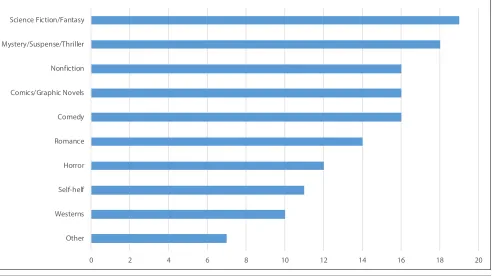
In the makeup of these twenty-six rec-reational reading collections there are some common threads and some fairly stark dif-ferences. The collections within the alli-ance come in all sizes. The most popular response received for the question about size of collection was that the collections are large, which was defined on the sur-vey as collections holding more than four hundred books. Ten respondents, or 38 percent, indicated that their collection is at least four hundred books, and only three, or 12 percent, reported having fewer than one hundred books in their collec-tion. Survey respondents were also asked to indicate which genres are included in their collections and were allowed to select all that applied from a list of options. His-torical fiction, literary fiction, and science fiction/fantasy are the most commonly held genres (see figure 3). An “other” cat-egory was included, and respondents noted that they also select biography/memoir (1), cookbooks (1), local authors (1), street lit (1), and young adult (3) materials for their popular reading collections. In terms of the currency of the collections, there was some variety. Almost half (46 percent) have col-lections that are kept quite current, with eight respondents answering that their collections only include books published in the last five years, and four saying their collections only include books from the last two years. Nine respondents (35 per-cent), however, stated that their collections include books from either the last ten years or that they have not defined this in their collection development policy. Most librar-ies collect books in more than one format for their popular reading collections, and for most this includes the traditional for-mats of hardback or paperback. Twelve libraries (46 percent) purchase both paper-back and hardpaper-back books, but hardpaper-back is a little more popular, with seventeen total libraries, or 65 percent, purchasing in that format, and fourteen total libraries, or 54 percent, purchasing in paperback. Very few libraries reported purchasing e-books
(1), audiobooks on CD (2), digital audiobooks (0), or books on Kindles that circulated (1) for their recreational reading collections. The library that reported purchasing the Kindle collection did not report collecting in any other format for this collection.
While there is divergence in the makeup of these collec-tions, there is much more commonality in their management.
Subject librarians typically select for recreational reading collections, but other librarians or library staff may select as well. In some cases, patrons make contributions, or students, faculty, or staff make recommendations that are then vet-ted by a librarian or a committee. Most of the libraries with recreational reading collections reported that they do weed their collections. Fifteen (58 percent) said they use circulation Figure 1. Orbis Cascade Libraries with and without Popular Reading Collections, by Institution Type
0 2 4 6 8 10 12 14 16 18
Community College Public University Private College
Does not have PRC Has PRC
Figure 2. The percentage of Orbis Cascade Libraries with Popular Reading Collec-tions, by Institution Type
Community College, 5,
19%
Public University, 10,
39%
Private College, 6,
23%
statistics to make these decisions and nine of those fifteen said they also weed their collections based on year published. Four respondents gave “it’s complicated”-type answers, ranging from “we do no weeding,” to moving them to the main stacks after they age out, to removal when there are zero loans and they have owned the book for at least five months. Seventy-three percent of respondents reported that their recreational reading collections are discoverable in Primo, the public dis-covery interface of the Orbis Cascade Alliance’s shared ILS, and 23 percent did not respond to this question. Only one respondent indicated that their library does not make their collection discoverable in Primo. When asked whether the libraries loan their collections to other libraries in the Orbis Cascade Alliance, ten said “yes,” nine said “no,” and one said “it’s complicated.” This last response was explained to mean that they do loan the owned items, but not the leased items in their mixed recreational reading collection.
There are many different names and ways of describing these collections both in the library literature and in librar-ies themselves. In this survey the word “popular” was, well, popular as a way to both describe the materials in the col-lection and as a name for the colcol-lection. Half of the twenty-six libraries that reported having recreational collections used the word “popular” in the name of their collection, with “Popular Reading” being the most common name. The survey also found that the majority of the recreational col-lections in Orbis Cascade libraries were created or re-estab-lished relatively recently. Sixteen of the twenty-six libraries (61 percent) with recreational collections said the collections were created within the last ten years.
Survey respondents were asked a number of open-ended questions that were then coded into various categories. When asked to describe in their own words what prompted the decision to create their popular reading collection, “fills user need/demand” was the most popular category described with eleven responses (42 percent) (see figure 4). All of the other reasons described combined do not equal the number of responses received for “fills user need/demand,” which underscores the importance libraries place on their response to user demand. Study participants were also asked to describe in their own words what barriers or resistance they had to overcome in implementing a popular reading collection at their library. Respondents most often described concerns coded as “budgetary concerns” as a barrier to implementing a popular reading collection at their library. One respondent relayed the concern from fellow librarians about the potential genres that would be included, specifi-cally romance. The same respondent wrote that some people were resistant to the idea because “we’re an academic library, if people want that kind of stuff, they should go to the public library.” Another survey participant stated that they “had to use circulation figures to justify [the collection] for several years in a row, and show majority of student use.”
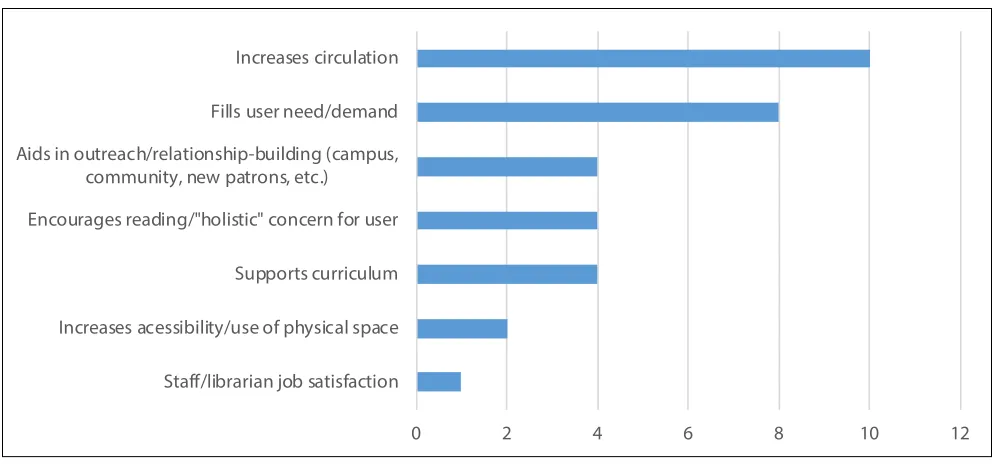
When asked to describe in their own words the benefits of having a recreational reading collection in their libraries, responses coded as “increases circulation” and “fills user need/demand” were the most commonly described, with ten and eight responses respectively (see figure 5). Survey respondents were then asked to describe the challenges of curating a recreational reading collection in their libraries Figure 3. What Genres does Your Recreational Reading Collection Include?
0 2 4 6 8 10 12 14 16 18 20
(as opposed to implementing a collection, discussed earlier). Responses coded as “difficulties managing the collection and technical challenges” were the top answers received, noted in half (thirteen) of survey responses from libraries with popu-lar reading collections. Among these, respondents described that the leasing programs sometimes involved more work than anticipated; the constant work of balancing the collec-tion with limited resources; and one outlier response that
the “proprietary nature of Kindle and need to maintain the Kindle format upgrades” proved challenging.
A set of the open-ended questions on the survey applied only to participants who said their library does not have a recreational reading collection, and concerns about library budgets was a dominant theme in the answers to these questions. Only two participants responded that they for-merly had a collection that was discontinued. The reasons Figure 4. What Prompted the Decision to Create Your Current Collection?
0 2 4 6 8 10 12
Increases circulation Increases acessibility/use of physical space Encourages reading/"holistic" concern for user Fills user need/demand
0 2 4 6 8 10 12
Staff/librarian job satisfaction Increases acessibility/use of physical space Supports curriculum Encourages reading/"holistic" concern for user Aids in outreach/relationship-building (campus,
community, new patrons, etc.)
Fills user need/demand Increases circulation
both gave for ending the program were coded as being due to “budgetary concerns.” When study participants who answered that they do not have a recreational collection were asked to describe in their own words whether or not they would consider starting one and why or why not, “budget-ary concerns” remained the top answer for why they would not, with six responses indicating this issue. The barriers respondents perceive as preventing them from starting a recreational reading collection were again dominated by responses coded as “budgetary concerns,” with seven respondents noting this topic in their answer.
There were a variety of responses to an open-ended question allowing respondents to “tell us more” about their library’s collection. One person said, “we are investing another 1,500 dollars in popular reading titles this year. We continue to build the collection. We want to entice reluctant readers.” Another explained that their library had subscribed to a leasing service for approximately six years, but the deci-sion was made to terminate the lease agreement because “we found that the circ[ulation] stats didn’t justify the high cost.” Elsewhere in the survey, this respondent indicated that their library does currently have a popular reading collection, so it is assumed that they switched from the leased program to some type of in-house management of their collection.
At twenty questions, the survey was rather lengthy, and some respondents stopped answering partway through, especially since most of the questions were not required. Most unrequired questions were not answered by all the respondents. The length of the survey may have contributed to the low response rate for the question about the librar-ies’ shared discovery platform, Primo, and other questions, though the questions the authors deemed most essential were strategically placed in the beginning.
DISCUSSION
The intent of this survey was to determine whether or not popular reading collections are making a comeback in aca-demic libraries. This question was formulated on the com-mon assumption that these collections had fallen out of favor in academic libraries. The results of the survey seem to indicate that these collections are on the rise in academic libraries, with 61 percent of participating libraries that have recreational collections having created their collections within the past ten years. The data provided by the literature review, however, shows that recreational reading collections have been present in the majority of various subsets of aca-demic libraries all along. A part of this discrepancy can be explained through the difference in survey samples: most of the surveys conducted, including the authors’ own survey, have been geographic in nature, making it possible that these collections have been or are more popular in certain states or regions of the country. Another part of this seem-ing contradiction can be attributed to the narrative that has been constructed around popular reading collections.
They simply have not been acknowledged as an important or vital part of academic libraries since the early part of the twentieth century and the resulting narrative in the litera-ture has overstated their rarity. Even though the majority of the collections from this survey of Orbis Cascade Alliance institutions in the Pacific Northwest were created in the past ten years, the trend based on the rest of the surveys in the literature seems to be moving only slightly upwards: from around 50–60 percent in the 1970s–1990s to somewhere in the range of 60–70 percent in the new millennium. The over-all trend of a slight increase, despite a higher rate of increase in the authors’ region, does not seem significant enough to justify calling our current time a renaissance for recreational collections, but we do seem to be in a time of renewed aware-ness of, and conversation about, them.
One reason that there have been more articles about pop-ular reading collections in the library literature over the past several years seems to be that we as librarians are trying to convince some unnamed skeptic out there (Administrators? Other librarians? Faculty and students?) of what we already know and have always known: these collections belong in academic libraries and are worthy of investment even in tight budget situations. If popular reading collections in academic libraries have always been common to some extent, however, then the bigger issue for us to ponder is why there is the perception that they are uncommon or that their existence in our libraries needs to be justified. Furthermore, how do we overcome this perception? When asked about barriers or obstacles to the collections, “budget” was the most common response, but survey respondents also often mentioned that other librarians thought they were inappropriate or “unaca-demic,” and/or that the public library should fill that role. One respondent mentioned they would likely start a collec-tion once a few people retired. The authors interpreted this comment to mean that there were individuals at the institu-tion that did not approve of popular reading collecinstitu-tions, and their opinions were creating a roadblock. It seems clear that at least part of the issue some libraries and librarians have with recreational reading collections is a perception that these collections somehow do not fit in academic libraries, when the reality is that many academic libraries already have them and have had them for a long time. With the persis-tence of this perception about them, it is no wonder that they would not be prioritized when budgets are tight.
The literature review found that older articles tended to use the terms “leisure” and “browsing” far more often than was found to be the case in recent articles or in the survey responses. In fact, none of the responding libraries used “leisure” to describe or name their collections, and only one used “browsing.” The word “recreational” or “recreation” was used quite a bit in both the literature and in the survey respondents’ descriptions of their materials, but only one library reported using it in the name of their collection. This issue of changing terminology makes it fairly difficult to conduct a thorough literature review on the topic as some of the terms are not in common usage today, or may be used in the literature, but not in libraries, or vice-versa. It will be important for future researchers to be aware of the different terms used and to make an effort to stay up to date on new terminology that may take the place of some of the current terms, both in order to ensure literature reviews are complete, and for communicating with study participants.
In this study, confusion about the definition of “rec-reational reading collection” was a possible limitation. Even though the authors included a definition at the very beginning of the survey, some of the respondents were still confused as to what exactly was meant by the phrase “rec-reational reading collection.” In one case, two people from the same institution both answered the survey (one of the instances of duplication discussed in the Methodology sec-tion of this article) and gave different answers to the quessec-tion of whether they had a collection that qualified based on their own interpretation of what a popular reading collection is. E-books will only further muddy the waters, as books that might fit the type of popular bestseller that is bought for pleasure reading are no longer physically located together and browsable. Will it really be a popular reading collection at that point? Another issue that needs clarification in future surveys is the size of collections. The size options presented in this survey, which were chosen somewhat anecdotally based on the size of the collections at the authors’ own libraries, turned out not to be ideal. Thirty-eight percent of respondents chose the largest option presented, saying that their collection contained more than four hundred titles. This was the most popular response and as such leaves a great deal of ambiguity over exactly how big the larger col-lections are.
Despite the differences in the types of collections, some themes were common among many of the schools surveyed. The genres that were purchased tended to be literary fic-tion, historical ficfic-tion, and science ficfic-tion, while few librar-ies purchased romance or women’s fiction. Four librarlibrar-ies specifically mentioned in their comments that they either did not buy romance novels or it was controversial that they did, which is not surprising given the historic “scorning” of genres like romance.31 None of the respondents cited any data for this decision, however, and instead in their answers to follow-up questions gave explanations such as simply not being interested in the genres, not thinking there is a market for it, or specifically trying to avoid collecting “beach reads.”
One library mentioned in follow-up comments that they do not buy Christian fiction even though they are a faith-based school. The fact that these biases against certain genres at academic institutions exist is problematic, since the 2017 Library Journal Materials Survey found that romance was the third most popular genre in public libraries, and Chris-tian fiction was the fifth most popular.32 Even though this data is specifically from public libraries, it stands to reason that there are likely students, staff, and faculty patrons who would like to read those genres. Furthermore, biases are not limited only to certain genres. Four schools reported that the belief that popular reading collections are not appropriate for academic libraries was a barrier to creating a collection at all. Concern over budget was the most commonly mentioned challenge or barrier to popular reading collections in this survey. Only nine libraries had a discrete, dedicated budget for the collection, but quite a few appear to be keeping their collections going through the most frugal and creative of measures. Respondents reported using alternative methods to populate the collection, including donated books, donated funds, books purchased at garage sales, or free or inexpen-sive copies picked up at conferences. This dedicated creativ-ity in keeping their collections going indicates that librarians realize these collections are truly wanted, needed, used, and valued by patrons and are therefore worth the effort despite the fact that their library or institution is either unwilling or unable to dedicate a budget to them. Benefits mentioned by participants included encouraging reading, increasing circulation, and building campus relationships. Several respondents mentioned that the collection often earned compliments and brought in faculty and other members of the campus community, who might otherwise not come to the library, to find something to read for pleasure during the academic year breaks. Other respondents mentioned specific events or partnerships that the collection supported, such as an engineering class tie-in and a pop-up library at an annual writers series. Multiple librarians mentioned that managing the popular reading collection increased their job satisfaction and one librarian said that it was their favorite thing to do.
CONCLUSION
article after article in recent years attempting to justify the inclusion of popular reading collections in academic librar-ies. The truth of the matter is that these collections have a long history in academic libraries, and they never truly went away; they have existed in many academic libraries through-out the twentieth and into the twenty-first century, to a much larger degree than is commonly understood. The possible reasons for this false impression about their existence vary from trends in academic library buildings over the decades to the effort by some to change the perception of academic libraries and librarians by focusing more singularly on the curriculum. Further, it is tempting to speculate that the move of higher education in recent decades—and academic libraries along with it—toward an emphasis on measurable, quantitative outcomes around student academic success, graduation rates, etc. has further devalued the concept of recreational reading in an academic context.
Given the actual prevalence of popular reading collec-tions in academic libraries, it is the hope of the authors that as a profession we can move away from the perception of them as rare and outside the mission of the academic library. Even more to the point, the authors hope that we can move away from questioning and justifying the place of these col-lections in academic libraries in our literature, and focus instead on how to leverage them to better serve our campus communities. They are a valuable service the majority of aca-demic libraries offer to our patrons, and arguments justifying their existence have been made time and time again in the literature, ranging from the benefits of pleasure reading to individuals and society to documented user demand to the growing popularity of the user-centered, library-as-place model for academic library buildings. If the narrative can be shifted to embrace these established arguments then we, as academic librarians and researchers, can stop spending time justifying their existence and move on to conducting richer and more meaningful research on them, just as we do on other services academic libraries offer, such as instruction, curriculum collections, or reference services. There are many interesting questions that studies of recreational reading col-lections could ask: How do students use these colcol-lections? Are some students more likely to use them than others, and why? How can academic libraries make them better and even more responsive to user need and demand? If students do not use these collections, how can libraries help make them more likely to do so? What are some of the benefits for stu-dents when their college or university library has one of these collections—academically, but also for their lives outside of and beyond academia? The authors of this study hope to see such questions, and more, answered in the future.
References
1. Meagan Lacy, “Slow Books in the Academic Library,” in The Slow Book Revolution: Creating a New Culture of Reading on College Campuses and Beyond, ed. Meagan Lacy (Santa Barbara, CA: Libraries Unlimited, 2014), 19; Heather Nicholson, “How to Be Engaging: Recreational Reading and Readers’ Advisory
in the Academic Library,” Public Services Quarterly 8, no. 2 (2012): 180.
2. Janelle Zauha, “Recreational Reading in Academic Browsing Rooms: Resources for Readers’ Advisory,” Collection Building 12, no. 3/4 (1993): 57–58; Lacy, “Slow Books in the Academic Library,” 19.
3. Julie Elliot, “Academic Libraries and Extracurricular Reading Promotion,” Reference & User Services Quarterly 46, no. 3 (2007): 35.
4. Lacy, “Slow Books in the Academic Library,” 20–21; Elliot, “Academic Libraries and Extracurricular Reading Promotion,” 35–36; Susan Marks, “Browsing Rooms Redivivus,” American Libraries 7, no. 2 (1976): 94.
5. Elliot, “Academic Libraries and Extracurricular Reading Promo-tion,” 37; Rochelle Smith and Nancy J. Young, “Giving Plea-sure Its Due: Collection Promotion and Readers’ Advisory in Academic Libraries,” Journal of Academic Librarianship 34, no.6 (2008): 521; Lacy, “Slow Books in the Academic Library,” 21. 6. Elliot, “Academic Libraries and Extracurricular Reading
Promo-tion,” 36.
7. Anne Behler, “Leisure Reading Collections in College and University Libraries: Have Academic Librarians Rediscovered Readers’ Advisory?” in Reference Reborn: Breathing New Life into Public Services Librarianship, ed. Diane Zabel (Santa Barbara, CA: Libraries Unlimited, 2011), 135.
8. Barbara MacAdam, “Sustaining the Culture of the Book: The Role of Enrichment Reading and Critical Thinking in the Under-graduate Curriculum,” Library Trends 44, no. 2 (1995): 246; Stephen D. Krashen, Power of Reading: Insights from the Research, 2nd ed. (Westport, CT: Libraries Unlimited, 2004), 17; Kathryn E. Kelly and Lee B. Kneipp, “Reading for Pleasure and Creativ-ity among College Students,” College Student Journal 43, no. 4 (December 2009): 1141–42; Raymond A. Mar, Keith Oatley, and Jordan B. Peterson, “Exploring the Link between Reading Fiction and Empathy: Ruling Out Individual Differences and Examining Outcomes,” Communications: The European Journal of Communication Research 34, no. 4 (2009): 420–21, 424.
9. Jude D. Gallik, “Do They Read for Pleasure? Recreational Read-ing Habits of College Students,” Journal of Adolescent & Adult Lit-eracy 42, no. 6 (1999): 484; “To Read or Not to Read,” National Endowment for the Arts, last modified February 28, 2008, https://www.arts.gov/sites/default/files/ToRead.pdf.
10. Krashen, Power of Reading: Insights from the Research, x.
11. Behler, “Leisure Reading Collections in College and University Libraries,” 134; Renée Bosman, John Glover, and Monique Prince, “Growing Adult Readers: Promoting Leisure Reading in Academic Libraries,” Urban Library Journal 15, no. 1 (Spring 2008): 3; Pauline Dewan, “Why Your Academic Library Needs a Popular Reading Collection Now More Than Ever,” College & Undergraduate Libraries 17, no. 1 (January 2010): 48.
12. Pauline Dewan, “Economic Well-Being and Social Justice through Pleasure Reading,” New Library World 117, no. 9/10 (2016): 561–64.
13. Bailey Diers and Shannon Simpson, “At Your Leisure: Estab-lishing a Popular Reading Collection at UBC Library,” Evidence Based Library and Information Practice 7, no. 2 (2012): 58–59; Bette Rathe and Lisa Blankenship, “Recreational Reading Col-lections in Academic Libraries,” Collection Management 30, no. 2 (2006): 79.
14. Dewan, “Why Your Academic Library Needs a Popular Reading Collection Now More Than Ever,” 45.
Reference & User Services Quarterly 53, no. 2 (Winter 2013): 98; Ann W. Hallyburton, Heidi E. Buchanan, and Timothy V. Carstens, “Serving the Whole Person: Popular Materials in Academic Libraries,” Collection Building 30, no. 2 (2011): 110–11; Lydia Harlan and Miriam Rigby, “What’s Old Is New Again: The Popular Reading Collection at University of Oregon Libraries,” Oregon Library Association Quarterly 21, no. 2 (2015): 21–22; John O. Christensen, “Management of Popular Reading Collec-tions,” Collection Management 6, no. 3–4 (1985): 77–79. 16. Bosman, Glover, and Prince, “Growing Adult Readers,” 5–8. 17. Dahlen and Watkins, “A ‘Novel’ Approach to Recreational
Read-ing,” 95.
18. Mardi Mahaffy, “In Support of Reading: Reading Outreach Pro-grams at Academic Libraries,” Public Services Quarterly 5, no. 3 (2009): 166–70.
19. Rachel Gladwin and Anne Goulding, “Recreational Reading in University Libraries in the United Kingdom,” New Review of Academic Librarianship 18 (2012): 149–58; Hallyburton, Buchanan, and Carstens, “Serving the Whole Person,” 111–12; Harlan and Rigby, “What’s Old Is New Again,” 19–20; Nichol-son, “How to Be Engaging,” 183–85; Smith, “Giving Pleasure Its Due,” 522–24; Connie Van Fleet, “Popular Fiction Collections in Academic and Public Libraries,” The Acquisitions Librarian 15, no. 29 (2003): 75–80; Behler, “Leisure Reading Collec-tions in College and University Libraries,” 137–41; Rathe and Blankenship, “Recreational Reading Collections in Academic Libraries,” 77–78.
20. Cynthia Hsieh and Rhonelle Runner, “Textbooks, Leisure Read-ing, and the Academic Library,” Library Collections, Acquisitions, & Technical Services 29 (2005): 200–201; Behler, “Leisure Read-ing Collections in College and University Libraries,” 139–40; Dewan, “Why Your Academic Library Needs a Popular Reading Collection Now More Than Ever,” 46–47, 59; Elliot, “Academic
Libraries and Extracurricular Reading Promotion,” 37; Zauha, “Recreational Reading in Academic Browsing Rooms,” 57. 21. Behler, “Leisure Reading Collections in College and University
Libraries,” 133.
22. Dewan, “Why Your Academic Library Needs a Popular Reading Collection Now More Than Ever,” 47.
23. Elliot, “Academic Libraries and Extracurricular Reading Pro-motion,” 39; Gladwin and Goulding, “Recreational Reading in University Libraries in the United Kingdom,” 154; Nicholson, “How to Be Engaging,” 181.
24. Marks, “Browsing Rooms Redivivus,” 95.
25. Paul Wiener, “Recreational Reading Services in Academic Libraries: An Overview,” Library Acquisitions 6 (1982): 60. 26. Linda Morrissett, “Leisure Reading Collections in Academic
Libraries: A Survey,” North Carolina Libraries 52 (1994): 123. 27. Katherine Kerns and Debbie O’Brien, “Recreational Reading
Collections: A Survey of Tennessee Academic Libraries,” Tennes-see Librarian 52, no. 2 (2001): 8.
28. Elliot, “Academic Libraries and Extracurricular Reading Promo-tion,” 37.
29. Mark Sanders, “Popular Reading Collections in Public Univer-sity Libraries: A Survey of Three Southeastern States,” Public Services Quarterly 5, no. 3 (2009): 177.
30. For a further explanation of thematic analysis when coding qualitative data, see Virginia Braun and Victoria Clarke, “Using Thematic Analysis in Psychology,” Qualitative Research in Psychol-ogy 3, no. 2 (2006): 77–101.
31. Denise Adkins et al., “Promoting Romance Novels in American Public Libraries,” Public Libraries, 49, no. 4 (2010): 41.
32. Barbara Hoffert, “Under the Surface: Materials Survey 2017,” Library Journal, last modified February 23, 2017, http://reviews .libraryjournal.com/2017/02/collection-development/under -the-surface-materials-survey-2017/.
APPENDIX. COMPLETE TEXT OF SURVEY
Definition
These collections are called many things, including “popu-lar,” “recreational,” and “leisure” collections. For the pur-poses of this survey we will call them “recreational reading collections.” We define them as collections that:
Fulfill the role of reading for entertainment, not related to curriculum (though some books may have been bought to support curriculum initially, their inclusion in this collection is for recreational purposes).
Are selected by the library (i.e., not a “take one, leave one” situation where the library has no control over what is in the collection).
1. Does your library have a recreational reading collection? a. Yes
b. No
2. [If the answer to #1 is Yes]: What is the type and size of your institution?
a. Type
i. Private College ii. Public University iii. Community College b. Size
i. Small (Fewer than 5,000 students) ii. Medium (5,000–15,000 students) iii. Large (More than 15,000 students)
3. How big is your library’s recreational reading collection? (approximate number of titles)
a. Fewer than 100 books b. 100–200 books c. 200–300 books d. 300–400 books e. More than 400 books
4. What genres does your recreational reading collection include? (Choose Yes, No, or Don’t know for each):
a. Mystery/Suspense/Thriller b. Romance
c. Horror d. Comedy e. Literary Fiction f. Non-fiction
g. Comics/Graphic novels h. Science Fiction/Fantasy i. Historical Fiction j. Western
k. Self-help
5. How current are the books in your recreational read-ing collection?
a. All published within the past 2 years b. All published within the past 5 years c. All published within the past 10 years d. All published more than 10 years ago e. A mix of different years
f. Don’t know
6. Who selects the books for your recreational reading col-lection? (check all that apply)
a. Subject librarian b. Other librarian c. Library staff d. Donors
e. Other (please specify)
7. What are the formats of the books in your recreational reading collection? (check all that apply)
a. Hardback b. Paperback c. Ebooks
d. Audiobooks on CD e. Digital audiobooks
f. Ebook readers loaded w/recreational titles g. Other (please specify)
8. Has the format of the books presented any technical issues within the library? (e.g., because of covers, e-book technology, paper, etc.) If yes, please elaborate.
a. [free-response answer]
9. What factors are used when weeding the collection at your library? (check all that apply)
a. Year published b. Circulation statistics
c. Format (i.e., whether it is a print book, e-book, audiobook, etc.
d. Please elaborate if you can (e.g., what is your cutoff for age? For circulation? etc.)
10. What is your recreational reading collection called? a. [free-response answer]
11. How is your recreational reading collection populated/ funded? (check all that apply)
a. Leasing program
b. Separate budget (e.g., annual budget at a set amount, whatever is leftover in the book budget at the end of the year, other)
c. Donations d. Existing collection e. Other (please specify)
12. Are the books in your recreational reading collection discoverable in Primo?
a. Yes b. No
13. [If the answer to #12 is No]: Why aren’t the books in the collection discoverable in Primo?
a. [free-response answer]
13b. [If the answer to #12 is Yes]: Do you lend the books in your recreational reading collection to other Summit libraries?
a. Yes b. No
c. It’s complicated (please specify)
14. [If the answer to #13b is No]: Why don’t you lend your recreational reading books to other Summit libraries?
a. [free-response answer]
15. What year was your current recreational reading collec-tion created?
a. [free-response answer]
16. Tell us more. What prompted the decision to create your current collection? Were there any barriers or resistance you had to overcome?
a. [free-response answer]
17. What have been the benefits of the collection to your library?
a. [free-response answer]
18. And what have been the challenges associated with cre-ating or managing the collection, if there have been any?
a. [free-response answer]
19. [If the answer to #1 is No]: Has your library ever had a recreational reading collection?
a. Yes b. No
c. Don’t know
20. [If the answer to #19 is Yes] Why was the past collec-tion discontinued?
a. [free-response answer]
21. [If the answer to #1 is No]: Would your library consider having a recreational reading collection now? Why or why not?
a. [free-response answer]
22. [If the answer to #1 is No]: What barriers, if any, do you see to having a recreational reading collection at your library specifically?
a. [free-response answer]
23. Is there anything you want to tell us that we didn’t ask? a. [free-response answer]
24. Would you be willing to answer follow-up questions and/or provide circulation data related to your recre-ational reading collection?
a. Yes b. No