ISSN: 2347-7474
International Journal Advances in Social Science and Humanities
Available online at: www.ijassh.com
RESEARCH ARTICLE
Haslinda Abdullah et. al.| December 2015 | Vol.3 | Issue 12 |40-46 40
Community Attitude, Knowledge and Awareness on Disaster
Management: A Case of a Selected Village Community in Malaysia
Haslinda, Abdullah*; Mohammad Nizar Zailan, Ahmad Azan Riduan
Faculty of Defence Studies and Management, National Defence University of Malaysia.
*Corresponding Author: Email: [email protected]
Abstract
In any disaster event, the community is the hardest affected. A disaster can cause lose of lives in the community as well as property. Therefore, the people in the community must be ready in preparing for disaster. The objective of this study is to examine community attitude, knowledge and awareness in disaster management. A total of 150 people in a selected village community that has been affected by flood in Malaysia were involved as respondents in this study. The quantitative method was used in this study in which data were collected through questionnaire survey. Statistical analyses were used in this study are descriptive analysis, Pearson correlation and multiple linear regressions. It is found that the community understands the importance on taking precaution for disaster and they have somewhat good knowledge and attitude in handling disaster. Indeed, both attitude and knowledge of the community have a relationship with awareness on disaster management. A basic knowledge on disaster management should be known by all the society in a community. In addition, the attitude of the society in managing disaster can show the moral and values of the community, particularly during crisis and disaster.
Keywords: Community attitude, Knowledge, Awareness, Disaster management, Malaysia.
Introduction
Disasters are unpredictable and can strike at any time. Classic definition of disaster by United Nations International Strategy for Disaster Reduction (UNISDR) [1], is a serious disruption of the functioning of a community or a society causing widespread human, material, economic or environmental losses which exceed the ability of the affected community or society to cope using its own resources. Disasters as an event that cause people loss their life, properties, resources and also give a psychological impact. Disaster Management is a process which implemented in any type of catastrophic event to save people from the disaster impact. Disaster management is not only a government obligation but it is also the obligation of the community [2]. Community has a good local knowledge of the region so that the disaster management conducted by the local community will be more effective and
efficient [2]. It has suggested that public education as the core of any disaster planning because individuals are the basic units of communities [3]. The Priority 3 of the Hyogo Framework of Action was set as to use knowledge, innovation and education to build a culture of disaster awareness and resilience at all levels [4].
Available online at: www.ijassh.com
environment and in human communities, intent, belief resources, preferences, needs, risks and a number of other conditions may be affecting the identity of the participants and their degree of cohesiveness. Different communities experience disasters differently. Often the poorest and most vulnerable are hit the hardest by disaster events because they lack the community infrastructure or personal resources to protect themselves [7].
Effective disaster planning requires communities to be alert to areas of vulnerability, including specific populations who may be at greater risk following a disaster [8].
Community awareness is one of the main components of national disaster management strategy of Malaysia to develop a national approach to fostering and enhancing the community’s awareness of risks, and encourage involvement in prevention/mitigation, preparedness, and response and recovery strategy [9]. According to [10], public awareness is the extent of common knowledge about disaster risks, the factors that lead to disasters and the actions that can be taken, individually and collectively, to reduce exposure and vulnerability to hazards. Communities are aware of vulnerable elements of the community and consider their needs in the development of programs and plans. Local communities are engaged and have knowledge and expertise of local risk, how a disaster resulting from that risk would affect the local community, and how potential treatments can be harnessed, to mitigate the risks. According to [11] state that community education, engagement, and awareness are the most important factors in improving warnings in Australia.
There is a need to address public attitudes of reliance on the government, on others in general, and to enhance the public‘s sense of responsibility for both reducing risks and helping in the case of a disaster [12]. If individuals and communities understand the impacts of their behaviors on themselves as well as their families, their communities and the environment, this can help to improve their capacity to make informed decisions based on assessed risks. Better education leads to better information, which in turn has
been associated with higher levels of environmental awareness [13].
Members of the public are of the attitude that the government will help them in times of crisis, and is responsible for reducing risks. People do not take sufficient measures to assess and reduce risks in their own homes or communities.
Knowledge is widely believed to be a function of history and interlinking of people with people, people with knowledge, and knowledge with knowledge [14]. United Nations [15] described community knowledge of risk as the starting point for reducing disaster risk and for promoting a culture of disaster resilience lies in the knowledge of the hazards and the physical, social, economic and environmental vulnerabilities to disasters that most societies face, and of the ways in which hazards and vulnerabilities are changing in the short and long term, followed by action taken on the basis of that knowledge. Community knowledge is fundamental to enabling everyone in the community to determine their hazards and risks, and to inform preparation and mitigation measures. It is also crucial to communicate all relevant and available information during the response and recovery phases of a disaster. Sharing knowledge, including lessons learned from previous events, is also important in promoting innovation and best practice [7].
relationship between community’s attitude, knowledge and awareness on disaster.
Literature Review
Awareness in Disaster Management
Disaster management can be defined as the organization and management of resources and responsibilities for dealing with all humanitarian aspects of emergencies, in particular preparedness, response and recovery in order to lessen the impact of disasters. In short, disaster management is more than just response and relief as it assumes a more proactive approach. Ultimately, disaster management aims to reduce the impact of disasters. The ways of achieving this have varied and evolved over time. The earliest and still predominate approach is for agencies to provide relief to those affected once a disaster has happened. Rescue assistance, medical support, food and water supply are vital for saving lives which prevent further harm. However, responding to a disaster can only do so much, and a level of loss is almost inevitable before a rescue operation can even arrive. As well as wasting precious time, relying on external support is not desirable for communities at risk of a disaster, particularly as they often have a capacity to deal with a disaster already [17]. Disaster management has their principles which are comprehensive and progressive. Comprehensive shows that emergency or disaster managers consider and take all impact relevant to disasters and anticipate future disasters and take preventive to build disaster resistant communities. Integrated is also one of the principles which need managers to ensure unity of effort among all level of government. Last principles that can be concluded in disaster management is professional which is value a science and knowledge based approach by the emergency managers based on the training, education, experience and ethical practice.’
Knowledge
In moving to new cities, individuals lose their knowledge of local hazards and must learn new strategies to deal with new phenomena. At the same time, they re-build their networks in the new community. Development of housing and facilities on river and beach frontages is putting some of
these people at even greater risk. Trends suggest that this kind of migration and development is set to continue for many more years [18]. The deficit perspective of public knowledge might be usefully contrasted with a ‘contextualize perspective’, which emphasizes the way in which expert information is likely to be evaluated within ‘varying practical and social contexts’ [19].
For instance, publics are likely to appraise information on flood risk in the context of factors such as their experience of floods and their degree of trust in those who supply them with such information.
Attitude
The vulnerability of a country can be aggravated by their own attitude of the community and the development that did not concern about their disaster management and problems. For example, changes in land use, primarily deforestation in upstream countries have had detrimental impacts on the dynamics of recent floods which may occur in the country or state. Local authorities who do not possess sufficient funding and expertise to meet these responsibilities also the reason that is identified. While the goal of decentralization was to generate a more adaptable system, the new system is lacking the efficiency of the former one without having become sufficiently flexible [20]. Lacking a strong direction by water management authorities, both local people and municipalities were unprepared to organize emergency management. There were serious problems with early warning, communication, and mobilization [21]. A number of conflicts emerged, for example, when certain areas were flooded in order to save others, and when funds were diverted from state budget to compensate flood victims.
Methods
This study used a cross-sectional research method which allowed the researchers to integrate the related literature, the semi structured interview, the pilot study and the actual survey as the main procedure for data collection. The use of this method would contribute to accurate, less bias and high quality data [22-24].
Available online at: www.ijassh.com
This village has a mix of traditional villages and new villages, as well as a number of residential areas. At the initial stage of data collection, the researchers begin with a semi structured interview that asking three issues: community roles (community attitude, community knowledge) and level of disaster awareness in the community. A purposive sampling technique was used to identify five experienced interviewees that include five head of the villages who have more than five years of experience with adequate knowledge living the study area. The interviews were conducted to obtain clear understanding about the nature of community attitude, community knowledge and community awareness, as well as the relationship between such variables in the studied area.
The population for this study is household communities in a selected Village in Malaysia. Prior to conducting the survey, a meeting requesting permission was held with all head of the villages and head of residential areas of the studied areas were. About 380 survey questionnaires were distributed using a convenience sampling technique to household communities. Of the total distributed questionnaire, 150 usable questionnaires were returned, yielding 39.5 percent response rate. This figure met the acceptable requirements for parametric statistical tests [24-26]. The survey questionnaires were answered by participants based on their consents and a voluntarily basis. The number of sample exceeds the minimum sample of 30 participants as required by probability sampling technique, showing that it may be analysed using inferential statistics [27-28]. Subsequently, these questionnaires were analysed descriptively for descriptive findings, Pearson Correlation and multiple linear regression for significant relationship analysis
Findings
Community’s Awareness
Finding shows that a majority of the communities agreed that the awareness about floods is important and need to be embedded within all parties and they should take precaution about the danger of flood and to be emphasized among them. But only half of the respondents are aware of the danger of
flooding in Malaysia (53.3%) as well as prepared to mitigate the effects of flooding as (64.0%). However, majority of the community (87.3%) agree that they should take precaution about the danger of flood. Luckily, about half of the respondents had exposure on flood awareness through television. Meanwhile, 42.7% agree that the village organization had already made public awareness campaigns about the flood to increase their awareness. In addition, the community agreed that they should mutually remind each other of the dangers of flooding (82.7%) and have to work together to ensure the smooth management of flood (86.0%). But it was indicated that the opportunity to grow in self-awareness in all segments of society is somewhat poor (58%). Indeed, the community was constantly on the alert in case of flood (72%) and take serious concern on the dangers of flooding (84%). However, only 64.6% of the communities are well prepared for any oncoming floods. Indeed, warning on the danger of flooding is essential and they realize the danger of flooding to their children and properties and the general impact of the flood as a whole.
Community’s Attitude
The findings of this study suggest that the respondents love their community (85.3%) and believe that they can contribute during disaster (71.3%), but only half of the respondents indicated that are willing to be involved in flood management (53.3%). This divided scenario is also seen in which only around 60% of the respondents agree that they will immediately take action and inform the nearest organization or government agency in the event of flood. Indeed, the community agrees that involvement in flood management is part of their responsibility (74.6%) and they have high regards for anyone involved in helping flood victims (79.3%). However, only 44% agree that they should organize a campaign on flood exposure. It is also found that about half of the respondents are unwilling to spend their income in managing flood and sacrificing their comfort during floods and disaster.
Community’s Knowledge
(66%). This is because the community has been given awareness and training on the steps to be taken during flood (70%). Indeed the community has the knowledge on what to do in case of flooding (74.7%) and able to priorities actions taken (70%) and also priorities those living in low-lying areas as they are the first to be affected by flood (75%). Indeed this community understands the importance of information sharing among the community members (80%). However, talking about the dangers of flooding among family members is somewhat less (60%). This is also seen in which, information and knowledge passed through the generation is somewhat minimal (40.7%). In addition, not many of the community knows the channel to find the latest information on flood (46%) and involved in activities related to safety and security such as flood hazards and management organized by the various agencies in Malaysia (50.7%). Nevertheless, they know that flood will hit their community at any time when heavy rain occurs (60%).
Relationship between Attitude, Knowledge and Community Awareness
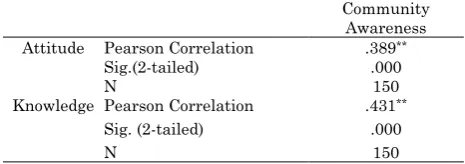
From the Pearson Correlation coefficient, it is found that attitude and community awareness is moderate and significant where r = 0.389 and p = 0.0001. Pearson Correlation coefficient (r = 0.389) show that there is a linear relationship between those two variables and the relationship is positive moderate. This finding also shows that there is significant relationship between attitude and community awareness where it is significant value is 0.0001. This value is smaller than alpha value which has been setup (p= 0.05). Table 1 shows the result for correlation analysis between attitude and community awareness. It is identified that knowledge and community awareness is moderate and significant where r = 0.431 and
p = 0.0001. Pearson Correlation coefficient (r = 0.431) show that there is a linear relationship between those two variables and the relationship is positive moderate. This finding also shows that there is significant
relationship between knowledge and community awareness where it is significant value is 0.0001. This value is smaller than alpha value which has been setup (p= 0.05). Table 1 also shows the result for correlation
analysis between knowledge and community awareness.
Table 1: Correlation between variables
Community Awareness Attitude Pearson Correlation .389**
Sig.(2-tailed) .000
N 150
Knowledge Pearson Correlation .431**
Sig. (2-tailed) .000
N 150
Influence of Attitude and Knowledge towards Community Awareness
To determine the best set of predictor variable in predicting community awareness in, a Multiple Linear Regression (MLR) by enter regression method was used. Based on the enter method used, the findings show that both predictor variables to be of significance in explaining community awareness. The predictor variables are attitude (X1) and knowledge (X2). Both
attitude (X1) and knowledge (X2) contributed
in significance [attitude (X1) (t=2.748; p=0.07)
and knowledge (X2) (t=3.736; p=0.000). As
depicted in the coefficients table (Table 2), the estimates of the model coefficients for b0
is 1.687, b1 is 0.262 and b2 is 0.335. The
Available online at: www.ijassh.com
This followed by attitude where the beta coefficient 0.262. This means that this variable makes the smaller contribution in explaining the dependent variable (community awareness), when the variance explained by all other predictor variables in the model is controlled for. It suggests that
one standard deviation increase in attitude is followed by 0.262 standard deviation increase in community awareness.
From two independent variables in this study, both attitude and knowledge were found to be significance in explaining community awareness.
Table 2: Influence of attitude and knowledge towards community awareness
Model
Unstandardized
Coefficients Standardized Coefficients t Sig.
Beta Std. Error Beta
1 (Constant) 1.687 .340 4.967 .000
Attitude .262 .095 .231 2.748 .007
Knowledge .335 .090 .314 3.736 .000
Notes: R = 0.474; R2 = 0.255; Adj. R2 = 0.215
Conclusion
Community plays an important part in responding, mitigating and management of disaster. In order to undergo a seamless disaster management, high commitment is required. The chief of the village is the one who responsible in this matter. A basic knowledge on disaster management should be known by all the society in a community. This basic knowledge includes the information and action to be taken during disaster management. Knowledge can be gain by many ways such as campaign, mass media and also information by the previous residents. The community is seen to be having a balanced population of low-level knowledge and high-level knowledge society. Hence, many efforts need to be done in order to improve their knowledge which result to a better disaster management. Besides that, the attitude of the society can show what the community is capable in implementation of disaster management. This covers on the
willingness of the society throughout the disaster management in terms of their time, energy and financial assistance for the disaster management. Although the result on this role is not so high, but it still meet its requirement for a community in disaster management. Thus, community activities need to be improved to increase the relationship which will result to better attitude that needed for disaster management.
The limitations of this study are the use of quantitative analysis, target population and sample size. Therefore, for future research, it is recommended to use qualitative research method. By using the qualitative method, the answer obtained by the interview could be used to support the analysis. In addition, since the target population and sample size is a selected community, it is recommended that a larger scale research encompassing the whole of Malaysia be conducted.
References
1.UNISDR (2004) United Nations International
Strategy for Disaster Reduction. Terminology of Disaster Risk Reduction. Geneva: UNISDR, 2004.
Available at:
www.unisdr.org/eng/library/lib-terminology-eng%20 home.htm
2.Binja Anjasni (2013) SWOT Assessment of the community potency to determine the strategic planning for volcano eruption disaster management (Case Study in Cangkringan, Yogyakerta Province). Procedia Environmental Science 17:337-343. 3.Davoodi M, Balali MR, Rasekhjam A, Navidi A (2004)
Public Education for Preparedness in Earthquake. The Second International Congress of Disaster
Management and Health Proceedings, Shokravi Publication, Tehran.
4.UNISDR (2005) Hyogo Framework For Action
2005–2015: Building The Resilience Of Nations And Communities To Disasters (HFA). Kobe, Japan: United Nations International Strategy for Disaster Reduction (UNISDR).
5. Buckle P (2004) A Comparative Assessment of Community Based Recovery Management in England and Australia. Coventry Centre for Disaster Management, Coventry University. 6.Civil Defence (2010) Community Engagement in the
Haslinda Abdullah et. al.| January 2016 | Vol.4 | Issue 01 |27-46 46
Ministry of Civil Defence & Emergency
Management, New Zealand.
7.COAG (2009) National Disaster Resilience
Statement, Excerpt from Communiqué, Council of Australian Governments, Brisbane, 7 December. 8.Adams LM (2008) An exploration of vulnerability
models: The road to effective disaster planning with the community. Journal of Theory Construction & Testing, 12:25-27.
9.Ahmad Azan R, Ungku Azly UA, Mohd Juraimy HK
(2011) Disaster basics: The life cycle of the disaster management and roles of agencies in Malaysia. Journal of Occupational Safety and Health, 8(1):21-32.
10.IFRC (2011) Public Awareness and Public
Education for Disaster Risk Reduction: A Guide. International Federation of Red Cross and Red Crescent Societies. www.ifrc.org
11.Elliott J, Handmer J, Keys C, Tarrant M (2003) Improving Flood Warning-Which Way Forward?, Paper presented at the Australian Disaster Conference, Canberra.
12.Martin M, Bastienne L, Vel T (2009) Final Report on Public Awareness of Disaster & Risk Issues. A report compiled by Sustainability for Seychelles for the Department of Risk and Disaster Management Government of Seychelles. 15th July.
13.Arcury T (1990) Environmental attitude and environmental knowledge. Human Organization, 49(4):300-304.
14.Rooney D, Hearn G, Mandeville T, Joseph R (2003) Public Policy in Knowledge-Based Economies. Edward Elgar Publishing Limited, United Kingdom. 15.United Nations (2005) Hyogo Framework for Action 2005-15: Building the Resilience of Nations and Communities to Disasters.
16.Twigg J, Benson C, Myers M (2000) NGO Initiatives in Risk Reduction: a summary of the research studies for the British Red Cross Society funded by
the Department for International Development. November.
17.Kathmandu N (2010) (Understanding Disaster Management in Practice) 90.
18.King D (2000) You’re on Your Own. (Community Vulnerability and the Need for Awareness and Education for Predictable Natural Disasters) , 8(4):223-228.
19.Sturgis P, Allum N (2004) Science in society: Re-evaluating the deficit model of public attitudes. Public Understanding of Science, 13(1):55-75 20.Vari A (2002) Public involvement in flood risk
management in Hungary, 5(3), 211–224.
doi:10.1080/1366987011004260
21.Rozgonyi T, Tamas P, Tamasi P, Vari A (eds) (2000) The Tisza Flood: Views, Risks, Strategies. Budapest: Hungarian Academy of Sciences, Institute of Sociology. Hungarian.
22.Creswell JW (1998) Qualitative Inquiry and Research Design: Choosing Among Five Traditions. London: SAGE publications.
23.Davis D (1996) Business Research for Decision Making. (4th ed.) Belmont: Duxbury Press.
24.Sekaran U (2000) Research Methods for Business: A Skill Building Approach. New York: John Wiley & Sins, Inc.
25.Krejcie RV, Morgan, DW (1970) Determining sample size for research activities. Educational and Psychological Measurement, 30:607-610.
26.Zamalia Mahmud (2009) Handbook of Research Methodology: A Simplified Version. University Publication Centre.
27.Chua YP (2006) Kaedah Penyelidikan. Kuala Lumpur: McGraw Hill.