International Journal of Advances in Management and Economics
Available online at:
www.managementjournal.info
RESEARCH ARTICLE
Exchange Rates Regime and Anchor-peg theory: Estimation
Models and Econometric Problems on the Chinese Basket Peg
Marco Mele
University of Teramo. Department of Economics. Italy.
Abstract: This work aimed to analyze the problem of exchange rate regimes of the backet-peg type. After the end of the Bretton Woods system, the exchange rate regime was almost flexible by international convention. However, to ensure price stability and cool down the economy, developing countries have implemented exchange rate regimes anchored to international currencies. As a result, they used a dollar-peg regime, since the dollar is a currency that rises to the role of international currency. The abandonment of this system has led some countries to implement a basket-peg regime. Therefore, we tried to analyze the Chinese exchange rate regime after criticism of the estimation models. In the end, we concluded that it is still anchored to the US dollar.
Keywords:Exchange Rate Regime, Chinese Basket Peg, Anchor-peg, Armax model.
Article Received: 15 June 2019 Revised: 24 June 2019 Accepted: 29 June 2019
Introduction the Reasons for Anchor-peg
Despite the abundance of literature, in 2006 a new paper by Ronald McKinnon and Gunther Schnabl was published which explains optimally the answer to the reasons that lead countries, especially in development, to choose an anchor-peg policy and in particular, the study interested Asian countries. These reasons, also referring to other emerging and developing countries in the dollar area, mainly relate to the microeconomic role of the dollar, as a promoter of international trade between emerging countries; to the macroeconomic role of the dollar, as a nominal anchor for emerging countries' national prices; to the so-called original sin syndrome, from which many emerging countries are affected.As regards the first aspect, McKinnon and Schnabl [1-2] underline how the logic underlying the anchoring to the dollar is centered on the widespread use of the American currency as a vehicular currency in most of the international trade of the emerging countries. The discriminating element, which leads the countries on the periphery of the dollar to anchor their currencies to that of the United States, consists not so much in the commercial links between these countries and the United States, but rather by the relationships between the emerging countries, which employ the dollar.
Moreover, the centrality of the US currency in the foreign trade of emerging countries in the dollar area also affects the second reason underlying the anchoring of local currencies to the US. In fact, when a significant share of the international commercial transactions of emerging countries uses dollars, the common anchorage to the US currency ends up also fixing national prices to the US.
study by the title “Exchange Rates and Financial Fragility”. In their exposition, the two economists define the original as a situation deriving from the incompleteness and fragility of the national financial markets of emerging countries, in which the national currency cannot be used to borrow abroad, or to borrow for a long time term, not even internally. National investors will necessarily have to choose between being indebted in foreign currency - essentially in dollars - or short-term debt.
Consequently, they will find themselves suffering from a currency mismatch - investments that generate local currency will be financed in dollars - or a debt mismatch of debt - long-term investments will be financed through short-term loans. These mismatches do not derive from a lack of prudence on the part of national banks and companies, which makes them indifferent to hedging against exchange rate risk.
The problem is that a developing country whose liabilities are denominated in foreign currency is, by definition, unable to cover itself against the currency risk. Similarly, at the root of the mismatches there is not a lack of farsightedness of the companies, which do not take care to match the expiration of their credits to that of their debts. The point, also in this case, is that they are in the impossibility of making them fit together. The original sin makes the national authorities of emerging countries unwilling to let the exchange rate fluctuate, for several reasons. First, dollar liabilities increase macroeconomic instability, increasing credit risk for the national budget. When the debt is denominated in foreign currency, exchange rate fluctuations significantly affect the cost of servicing the debt in terms of national currency. Strong depreciations can force companies and financial institutions indebted to default, putting at risk the survival of the entire national financial system.
Secondly, the incompleteness of the national financial markets of emerging countries implies the absence of efficient forward foreign exchange markets, and, therefore, the difficulty of realizing forward transactions for risk-averse operators who intend to protect their open positions in foreign currency. This difficulty, which is considerable if the country is not a net debtor, becomes practically impossible if it is. Given that the economies with net short-term debts, denominated in
dollars and not covered, offer very high risk premiums in the interest rates of national currencies, the individual holders of liabilities in dollars will deem the cost of the hedging forward - ie the premium for the forward purchase of dollars in exchange for national currency - too high. As a result, they will not be able to protect themselves.
This situation leads the governments of the emerging countries to intervene: in order to compensate for the absence of private forward foreign exchange markets, they offer an informal coverage of the exchange rate risk, keeping the exchange rates of the national currencies anchored to the dollar. In this way, banks and companies can repay their short-term debts in dollars, facing minimal risks. The reasons mentioned above contribute to explaining why, in the new millennium, numerous emerging and developing countries continue to anchor, de jure or de facto, their national currencies to the dollar.
Literature Review
The role of anchor for currency peg of the US currency - as well as any other currency holding the peg feature - is proven by a series of econometric studies. The study of McKinnon and Schnabl on East Asia - previously mentioned - in particular contains an estimate of the volatility of the exchange rates of local currencies compared to the dollar, in a period between February 1994 and December 2003.
However, it is with the econometric model introduced in 1993 and 1994 by Frankel first and Frankel-Wei after subsequently from other contributions, McKinnon and Schnabl resort to an "external" currency, the Swiss franc, as a numerary through which to measure the exchange rate volatility of Asian currencies, in order to assess the weight assigned to the dollar in Asian countries' peg baskets compared to the weights of the other currencies that are supposed to compose them, the yen and the euro (the German mark before introduction of the single European currency).
mainly by changes in the dollar against the Swiss franc, it can be seen that the Asian currency in question is pegged to the dollar. Alternatively, it could be anchored to the Japanese yen or the euro (German mark). Concerning the estimation models, in recent years, numerous studies have been conducted which have made use of the most varied analysis models. Among these, as we mentioned earlier, the pioneer study can be traced back to that of Frankel [3], Frankel and Wei [4-5] as the authors proposed an original regressive technique.Starting from a logarithmic equation of the type: lnhomecurrencyt +1- lnhomecurrencyt = a+Σw(j)lnx(j,t,s)-lnx(j,t)(1) if the national currency (home), the dependent variable of the model, is associated with a series of values x1, x2, ..., xn multiplied by the respective weights w1, w2, ..., wn it will be possible to estimate through a generic model of the minimums OLS squares, the weight of each value –value- within a hypothetical basket-peg.
However, the impossibility of defining the actual value of each currency, in particular in the absence of a rigid anchorage, induces the model to linearly become a recession in which the term error will, therefore, be present: Δlnyhome/k= α+β1ΔlneUSD/k+ β2ΔlneJPY/k+ β3 Δ lne Euro / k + μt (2) Referring, therefore, the OLS system, it will be possible to estimate the weight of each currency (measured by coefficients) that multiply the logarithmic variations of the corresponding changes using a k numerario. The estimate, in reality, must comply with two simple analysis criteria: standard error close to zero and R2 close to the unit. On a purely technical level, Frankel's intuition has allowed and allows us to respond effectively to the following question: in a country whose exchange rate does not fluctuate freely from what has influenced its exchange rate?
In particular, in the hypothesis that the monetary authorities of an X country do not declare the effectiveness of their exchange rate, the macroeconomic study of the conjuncture could determine the independent variables of the econometric model. Suffice it to say that the same analysis and observation of the main trading partners of our country would carry out the function of identifying the basket of basket peg currencies. In other words, if you trade more with a certain number of countries, with the use of the dollar and the euro as
international exchange currencies, the remaining partners could invoice in their own currency determining a change in the inter-national reserves of the country X. One could, in other words, generate a sequence of coins that can be traced back to those present in the basket of currencies to which the national currency is still, to a greater or lesser extent.Therefore, recalling the original formulation in (1) it is possible to carry out an estimation analysis using the most used econometric software: STATA, Gretl, Eviews etc ...
The Case of the Chinese Exchange Regime: an Empirical Analysis
The Chinese exchange rate policy has been, especially in recent years, a topic of great interest and debate within the international academy. This is because, to the choices of monetary policy conducted by the Chinese authorities, it is possible to bring back one of the determinants that have helped China's economic growth. Now, to analyze the management of the exchange rate in China, one must start necessarily from 1979, the year in which the new political course gave way to a gradual reform work based on the enhancement of private initiative and openness towards abroad.
This has led to a new and greater importance of the role of the exchange rate and consequently also of international trade. Before 1979, in fact, the foreign trade system was characterized by three predominant aspects: monopoly, central planning, and national accounting. These three aspects were responsible for the significant inefficiencies of the system that existed in the pre-reform period, an apparatus in which a limited number of state-owned companies supported the international film trade. This monopoly regime was set up to facilitate isolation against external shocks and to ensure that the central government could use foreign currency resources for its industrialization programs.
used this income to finance policies related to those of public spending. National importers and exporters, in other words, we're forced to sell all their profits in national currency to the central state budget. Because of this mechanism - which we can define as automatic tax subsidies - exchange rates could be set at an arbitrary level, thus misaligning it with the other macroeconomic aggregates.
These three institutional aspects, although considered suitable for economic growth, were the leading causes of inefficiency of the pre-reform system. Suffice it to say that in this system, the exchange mainly performed the sole function of accounting to determine the profits or advantages in the event of losses. The exchange rate, therefore, did not play a significant role in foreign trade and therefore, as a determinant of growth.
The reform, instead, which began in 1979, involved at the same time all three interrelated themes: the downsizing of the national monopoly; the abandonment of centralized planning to allow market forces to play a more important role in the distribution of resources; the financial independence of companies operating in the foreign trade sector.
In the reforms that over the years affected China's economy, a role of primary importance is attributable to that of the exchange rate regime. In particular, from 1997 to 2005, the Chinese government anchored the exchange rate of the national currency with the US dollar at the rate of 8.3 RMB, generating a real peg-policy in order to keep inflation levels stable (Fig.1).
Fig.1 :Tasso di cambio USD/RMB 1997-2004
Fonte: our elaboration -4 gg- Pacific Exchange rate, 2015.
In fact, as we can see from the figure, the variations between the Chinese currency compared to the US currency remained almost stable until the end of 2004. For every appreciation or depreciation of the dollar, the same trend as the Renminbi was to be countered. However, this situation nullified the exchange rate policies implemented by the rest of the world and in particular from the United States of America: the depreciation of the dollar deemed necessary to encourage exports was followed by a greater one, in terms of relative prices, of China. The impossibility of supporting this
Fig.2: Tasso di cambio USD/RMB 2005-2013
Fonte: our elaboration -4 gg- Pacific Exchange rate, 2015
The Problem About the Estimation
Since the Renminbi is no longer operating in an anchored exchange regime, numerous contributions [6-7-8-9-10-11-12-13-14-15-16-17-18-19-20-21-22-23-24-24-25-26-27]over the years they have tried to answer the question about who and what now influenced the Chinese exchange rate. It was therefore necessary, in expectation of official declaration by the Chinese governmental authorities, to understand which currencies were present in the famous basket-peg in order to be able to stabilize the effects of international trade on the exchange rate of the cine.
In particular, given the predominant role of the Asian giant in the global economy, the money that had recorded over time a growing pre-without - in weight - in the currency basket, could have risen over time to an international currency role le, typical only of the US dollar. It was therefore necessary to use the intuitive approach of Prof. Jaffrey Frankel (1993-1994) who, through regression (2) allowed to estimate the Chinese exchange rate regime.
Using the aforementioned approach, we build a model able to estimate Chinese peg basket-peg from 2005 to 2017, using monthly dataset by Pacific Exchange rate. First and foremost, we need to delimit the number of currencies
based on the commercial weight that the country of the chosen currency has with China and then opt for a number in order to generate the exchange rate. The choice of the latter was usually attributed to the Swiss Franc since it is not very sensitive to the variations and effects that the financial market has on this currency. In the example that we are going to formulate and recalling the contribution of the author (Mele, 2010) we have chosen three currencies as independent variables of the regression: dollar, euro and yen.
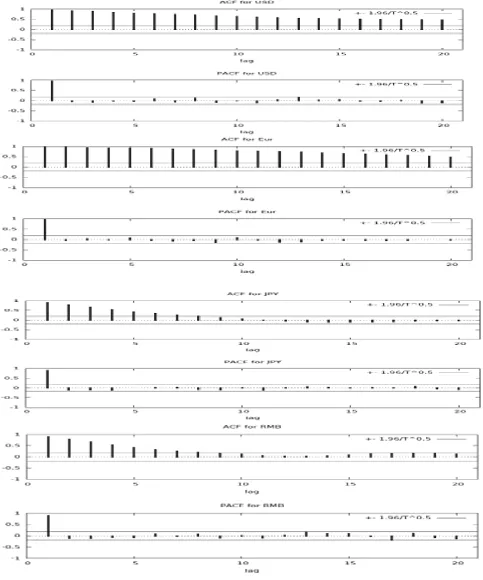
Fig. 3:Correlogram USD,Eur,JPY,RMB
As we have seen from the correlogram analysis, the historical series considered in our work present autocorrelation effects over time. A result of this kind is the need for the use of logarithmic transforms, which will compress the data making the series of our dataset homogeneous. Once this transformation has been carried out, and the number of delays has been chosen, it is possible to perform the econometric analysis
avoided that the time series built in a STATA dataset were different in trend and presented profoundly different points of variation able to create distortions in our analysis. The problem underlying the economic literature on this type of econometric examination is precisely the consideration of the trends and the error message of autocorrelation between the variables.
Therefore, through the transforms mentioned above, we have solved this difficulty of analysis.
Results
The model chosen for our analysis is an Armax with the standard deviation based on the Hessian formula.
As we can see from our analysis carried out and for the period considered, not all the variables considered and that serve as significant result regressors in our model. In fact, apart from the constant and the end of the phi1 model delay, only the US dollar was found to be significant. The other regressors, on the other hand, turned out to be all meaningless, namely: the euro, and the Japanese yen. This result is significant. The theory of consent in the use of an international currency coincides with the de facto or de jure decision by the country and to use this currency.
It will be international currency when it greatly influences its weight even in a basket peg regime. However, at this point, to speak of a basket exchange rate regime, in our opinion would be wrong in our opinion. In fact, the results we have obtained do not confirm the economic theory and the statements of the Chinese government regarding the presence in China of a basketball peg regime. Since only the US dollar is significant in our model and with a coefficient of more than 90%, we can safely say that the Chinese exchange rate regime is, more than anything else, a dollar-peg-type regime. The other currencies present in the basket, in fact, despite respecting the
economic theory of their presence in China’s international trade, however, were not found to be significant in the model. In other words, they do not influence the performance of the RMB in the foreign exchange market.
Conclusion
Internationally, although the end of Bretton Woods gave rise to the establishment of a regime with almost fluctuating exchange rates, the currency area known as the "dollar" has such an extension that exchange independence flexible is struggling to verify itself completely. From the United States, which constitutes its center, it radiates to include the emerging countries of East Asia and the oil-producing countries - essentially concentrated in the Persian Gulf area - which form its periphery.
Korea, and China, of Ma-lesia, and of Thailand. In this work, following what was previously stated, we analyzed the exchange rate exchange rate anchored to an international currency (the dollar mainly uses) and in particular those exchange rates which, instead, are based on a basket-peg system. After analyzing the difficulty of estimating these schemes and analyzing the
reference literature, we estimated the presence or not of a peg basket exchange regime in China. From the results obtained, it emerged that only the dollar was significant in our model. This result recommended the presence, in reality, of a dollar-peg regime in China, refuting economic theory [28-30].
References
1. McKinnon R, Schnabl G (2004) The East Asian Dollar Standard, Fear of Floating, and Original Sin. Review of Development Economics, 8(3):331-360.
2. McKinnon R, Schnabl G (2006) China’s Exchange Rate and International Adjustment in Wages, Prices, and Interest Rates: Japan Déjà Vu? CESifo Studies, 52 (2): 276-303.
3. Frankel J (1993) Is Japan Creating a Yen Bloc in East Asia and the Pacific? In: J. Frankel and M. Khaler (Eds.), Regionalism and Rivalry: Japan and the US in Pacific Asia, University of Chicago Press, Chicago.
4. Frankel J, Wei S (1994) Yen Bloc or Dollar Bloc? Exchange Rate Policies of the East Asian Economies. In: T. Ito and A. O. Krueger (Eds.), Macroeconomic Linkages: Savings, Exchange Rates and Capital Flows, University of Chicago Press, Chicago.
http://ideas.repec.org/h/nbr/nberch/8537.ht ml.
5. Frankel J, Wei S (1995) Emerging Currency Blocs. In H. Genberg (Ed.), The International Monetary System: it’s Institutions and its Future, Springer, Berlin. http://www.nber.org/papers/w4335. 6. Schnabl G (2006) The Russian Currency Basket: Recent Developments in Russia’s Exchange Rate Policies and the Role of the Euro. Intereconomics, 40 (3):135-141. 7. Ogawa E (2006) the Chinese Yuan after
the Chinese Exchange Rate System Reform. China and World Economy, 14:39-57. http://dx.doi.org/10.1111/j.1749-124X.2006.00044.x.
8. Eichengreen B (2006) China’s Exchange Rate Regime: The Long and Short of It. Paper for Conference on Chinese Money and Finance; 2–3 February, Columbia University, New York.
9. Yamazaki K (2006) Inside the Currency Basket. Columbia University and Mitsubishi UFJ Trust and Banking.
10.Frankel J, Wei S (2007) Assessing China’s Exchange Rate Regime. Economic Policy 51:575-614.
11.Goldstein M, Lardy N (2006) China’s exchange rate policy dilemma. American Economic Review, 96(2):422-426.
12.Laurenceson J (2008) China’s Exchange Rate Policy: The Case against Abandoning the Dollar Peg. EAERG Discussion, 0105. 13.Zeileis A (2009) Exchange Rate Regime
Analysis for the Chinese. Department of Statistics and Mathematics, WU Wirtschaftsuniversität Wien, Research Report Series.
14.Evenett S (2010) the US-Sino Currency Dispute: New Insights from Economics, Politics and Law. Available from: http://www.VoxEU. Org eBook.
15.Mele M (2010) a “time series” approach on the Chinese exchange rate regime. Hrack Economic Research, 23(3):1-13.
16.Marzovilla O, Mele M (2010) From Dollar Peg to Basket Peg: The Experience of Kuwait in View of the GCC Monetary Unification. Global and Local Economic Review, 14(1).
17.Mele M (2012) The Dollar as an International Currency: Towards a New Bretton Woods?. Interdisciplinary Journal of Research in Business, 2:1-6, ISSN: 2046-7141.
18.Mele M, Baistrocchi A (2012) A Critique of the Gravitational Model in Estimating the Determinants of Trade Flows. International Journal of Business and Commerce, 2:13-23, ISSN: 2225-2436. 19.Mele M, aistrocchi A (2012) Still on China’
role as an anchor currency. Asian Journal of Finance and Accounting, 4:205-215. 20.Yi G (2013) Exchange Rate Arrangement:
Flexible and Fixed Exchange Rate Debate Revisited. IMF Rethinking Macro Policy II, 1-8.
21.Cui Y (2014) China’s exchange rate regime reform: Implications from the experiences of Japan, Korea and Taiwan. China Economic Journal, 8(2):1-17.
22.Mele M (2014) On China’s Exchange Rate Regime: Is Euro outside?. International Economics Letters, 3:49-58, ISSN: 1805-7306.
23.Marzovilla O, Mele M (2014) Euro crisis or European governance crisis? Rivista Italiana di Economia, Demografia e Statistica, 1:191-199, ISSN: 0035-6832. 24.Marzovilla O, Mele M (2015) Remittances,
Economic Growth, Exchange Rate Regime: The Case of Morocco. European Journal of Economics, Finance and Administrative Sciences, vol. 71, p. 106-123, ISSN: 1450-2275.
25.Mele M, Quarto A (2017) A Gravitational Model for Estimate the Determinants of Chinese’s FDI. International Journal of
Economics and Financial, 7:1-5, ISSN: 2146-4138.
26.Mele M (2019) On the Chinese’s Exchange Rate Regime: A Different Approach. International Journal of Economics and Financial, 9:1-7, ISSN: 2146-4138, doi: https://doi.org/10.32479/ijefi.6539.
27.Boccella N, Mele M, Quarto A (2019) On the Chinese Exchange Rate Regime: An Attempt to Flexibility During 2015. International Journal of Economic Research, 16:73-81, ISSN: 0972-938. 28.Eichengreen B, Hausmann R (1999)
Exchange Rates Financial Fragility. NBER Working, 7418.
29.Frankel J (2006) On the Yuan: The Choice Between Adjustment Under a Fixed Exchange Rate and Adjustment under a Flexible Rate. In G. Illing (Ed.), Understanding the Chinese Economy. CESifo Economic Studies, Munich.
http://dx.doi.org/10.1111/j.1468-0327.2007.00185.x.