Research Article
a
April
2019
Computer Science and Software Engineering
ISSN: 2277-128X (Volume-9, Issue-4)
A Review Paper on the Study of Augmented Reality and Its
Applications
Monika Singh Patel, Kajol Mittal
Computer Science and Engineering & AKTU University, Uttar Pradesh, India [email protected], [email protected]
Abstract— In today’s world, augmented reality has been a subject of great interest among the scientific community. [2]However, most studies have focused on hardware and software development without giving special emphasis on the authorization phase. As a result, the authoring process of augmented reality applications is completed today through the hard-coding of a specific application. There are many different ways to educate and train people who train them with the necessary knowledge and skills. [7] AR technology in science education, which is named as image-based AR and location-based AR. Combining image-based and location- based AR technology may bring new possibilities for supporting science learning. These methods include classroom lectures with textbooks, computers, handheld devices, and other electronic equipment. There are various theories that include mental models, spatial cognition and social constructivist learning are suggested for the development of AR research in science education. [15] Games in augmented reality teaches the today’s world such as explanation, multidimensional thinking, management of information, teamwork, flexibility and diverse areas. In this paper, we present an immersive authoring tool and applications of augmented reality in various disciplines, where applications authorized by our devices interact with the user to increase the interest of the learner and reflect the various desires of the dynamic environment. In a fast-changing society where there is a great deal of information available and knowledge, adaption and application information on the right time and the right place for the main effects in both school and business settings is required.
Keywords— Mental model, spatial cognition, Authoring phase, Authoring tools, handheld devices , multidimensional thinking , adaption
I. INTRODUCTION
Since talking about the development in the field of education, it tells about how technology assists students where learning is an important issue. It is gaining popularity in society and becoming more ubiquitous in nature. According to Ajuma in the year 1997, Augmented reality systems can be defined as those who allow real and virtual objects coexistence in one place and are negotiated with real-time Also, in science education, researchers have continued to devote their efforts to exploring technology-aided learning. According to Billing Hurst, Kato, and Poppy, 2001 The process of combining virtual data with real-world data can allow users to access the rich and meaningful multimedia content that is contextually relevant and can be worked on it easily and immediately. [16] How can we teach the rapidly global digital economy and the skills required for democratically involved citizenship? Many teachers are searching for ways to integrate the coming era different skills into creative, innovative, effective and appropriate activities in K-12 teaching. In this letter, I evaluate the potential of augmented reality (AR) where, we present an immersive authoring tool and applications of augmented reality in various disciplines, where applications authorized by our devices interact with the user to increase the interest of the learner and reflect the various desires of the dynamic environment. Therefore, activities should not only support learning the skills of the 21st century but rather emphasize and depict these materials. . Since in the era of combination of digital technologies with real world, AR technology could engage learners in order to determine the accuracy and also learn the new technologies according to this fast moving world., collect data outside a classroom, interact with an avatar, or communicate face-to-face with peers. According to milgram augmented reality is to identify systems that are mostly synthetic with some real-world imagery added such as texture mapping video onto virtual objects. Regions Virtual objects used in the Augmented Reality system may include text, still image, video clips, sound, 3D models and animations. Ideally, these virtual objects will be considered as co-existence in real-world environments.
ISSN(E): 2277-128X, ISSN(P): 2277-6451, pp. 73-79
II. BACKGROUND
Over the past few decades, many professionals and researchers are developing practical principles and applications to adopt AR in both educational and corporate settings. Apart from this, a large number of studies are underway to improve the compatibility and applicability of AR in real life. Augmented reality (AR) game gaming environments that embedded virtual, location-specific and relevant information in one physical site. These games require mobile or ubiquitous computing devices, such as handheld computers or cellular phones, to help game participants reach this virtual information. One, the increasing penetration of mobile devices in educational settings: Wireless handheld devices such as PDAs and mobile phones are becoming more ubiquitous in classes due to their relatively low cost, reach, flexibility, networking capabilities, and portability [Cloofier]. 2003; Dade 2004; Dietary 2005]. MIT's Teacher Education Laboratory has developed and tested a suite of AR games, each of which enables students to work collaboratively on issues from within the real world location. In this game, a team of participants, together with unique roles and responsibilities, should work together to take virtual measurements and medical examinations to split resources, gather information and solve the epidemiological mystery.
III. APPLICATIONS OF AR IN DIFFERENT DISCIPLINES
Augmented astronomy
In an astronomy class, students learn about the connection between the Earth and the Sun. For the understanding of students, teachers can employ AR technology with 3D rendered earth and sun-shaped.
Enhanced Chemistry
Enhanced Chemistry is an interactive educational field that can show students how and how a nuclear or molecule occurs through AR.[4] To apply this task with both hands, three elements, booklet, gripper and cube are required. Users then move Gripper next to aCube, a platform, called a molecule. As a result, by rotating the cube powered by the cube. On the other hand, users can determine where and how the element adds to the molecule.
Figure 2. A view of student can determine where and how the element adds to the molecule.
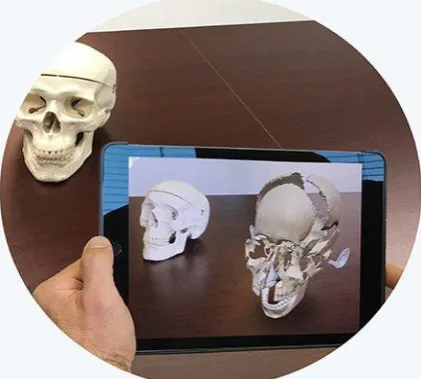
Enhanced biology
In biology, AR can be used to study the anatomy and structure of the body. [7]The Expert Schools and Academies Trust (SSAT) demonstrated that teachers can demonstrate that what is in the organs of humans and how to see 3D computer-generated models in actual classes using AR techniques.
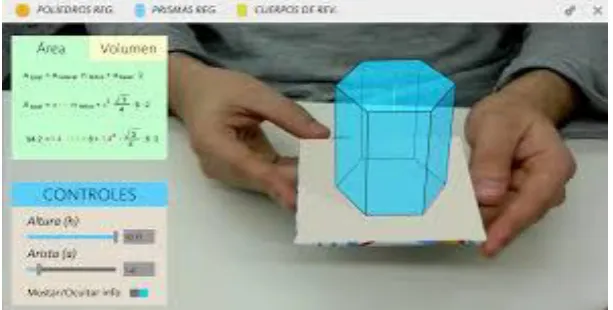
ISSN(E): 2277-128X, ISSN(P): 2277-6451, pp. 73-79 Math and Geometry Education
AR technology, teachers and students can collaborate with each other for some issues on shapes or arrangements. [22] For example, using AR application, teachers and students can discover interesting curves, surfaces, and other geometrical properties and Shapes .
Figure 4. A view of student can discover interesting geometrical properties and Shapes.
Physics education
Physics is another area where AR can be used for various displays. [15]An object that changes in time, such as velocity and acceleration.AR is now academically relevant in gaming car gaming and is particularly relevant for both education and training. Corporate locations Horizon Report (2010) said, "AR games based on real-world Enhanced teachers with network data can give powerful new ways to show relationships and the connection between real life and augmented reality. "In addition, AR games enable users to express new identity through role play and encourage individuals to know more deeply an actual site by interacting between the real and enriched world. Another approach to AR.[12] The Theories Guiding AR Research in Science Education By examining the theoretical or conceptual frameworks used in the selected articles, four theories including mental models, spatial cognition, situated cognition, and social Constructive learning. For example, when reading a book, an individual’s mental models about paper book reading may be different from his/her mental models about book reading with the aid of AR technology. The game enables users to create their own virtual people or objects, places them in a specific location .in the real world place, and interact with them in real time to solve the given problems.
Figure 5. Students who participated in the history playing role, "Revolving the Revolution" with AR technology (Sky, 2005). The image Karen L. Courtesy of Shearer
IV. HOW AR WORKS IN EDUCATION AND VARIOUS DOMAINS
According to Johnson , in the year 2010 , "AR has the strong potential of relevant nature of information in the real world, on-site learning experience and the ability to provide serious search and discovery." In addition, wireless mobile devices, such as smart phones, tablet PCs, and other electronic innovations, are rapidly taking AR to a mobile location, where the application specifically makes a lot of promise in education and training.
ISSN(E): 2277-128X, ISSN(P): 2277-6451, pp. 73-79
Figure 6. (a) A mechanic wearing a tracked head-worn display performs a maintenance task inside an LAV-25A1 armored personnel carrier. (b) The AR condition in the study: A view through the head-worn display captured in
a similar domain depicts information provided using augmented reality to assist the mechanic (Henderson & Feiner, 2009).Image by courtesy of Steven Henderson and Steven Feiner.
A.R. In corporate locations, AR is a collaborative, skill-learning, interpretable and guiding tool worker, manager and client. Regarding the cost and cost of AR applications, there is a better environment in businesses than educational settings. [5] Recording Evaluation of Shelton (2002), for example, The enterprise can imagine designing a house in three dimensions in which they can make immediate changes but they can be made Virtual Remarks that tells architect What To Need To Decide. In the recent study of augmented reality it shows that it aimed to contribute to the gap in the AR acceptance literature by the identification of external dimensions. In corporate locations, AR is a collaborative, skill-learning, interpretable and guiding tool worker, manager and client. Regarding the cost and cost of AR applications, there is a better environment in businesses than in educational settings. The analysis of various research work has revealed that there are seven external dimensions that influence the young British female tourists’ acceptance of mobile AR applications. The analysis of various external dimensions are important as this research area is still new and more focus.
Figure 7. (a) The enterprise can imagine designing a house in three dimensions in which they can make immediate changes but they can be made Virtual Remarks that tells architect What To Need To Decide. (b)AR in science
education
[1] The basic hardware requirements of an augmented reality system include (Ajuma, 1997; Billillst et al., 2001): [2] The presence of video cameras to capture live images, important storage space for virtual goods . A powerful
processor that combines either virtual and real objects or displays a 3D-simulated environment in real time.
_ An interface that allows a user to interact with both real and virtual objects. However, these are basic requirements for running an augmented reality system, other techniques can be used to enhance the overall experience for the user (Johnsonetal.)2010). [3]Gps Technology - Allows the system to keep the user's real-world location in mind, ensuring that geographically important places are provided contextually relevant virtual data to the user. [4]Image recognition software - enables real-world images and objects to act as "triggers" for multimedia and model overlays, and also to give a virtual look to the environment. Speaker and sound system - enables to play relevant sounds and audio recordings
[1] Internet access - Provides a means to store, retrieve, and share content using social media and Web 2.0 technologies. [2] Intuitive interface - progress in a touch screen, gyroscope, and haptic input technologies provide more natural means
ISSN(E): 2277-128X, ISSN(P): 2277-6451, pp. 73-79
AR Interfaces/Displays
• Head Mounted Displays (HMD) • Hand-Held Displays
• Spatial Displays (environmentally integrated)
Monitors
Projectors
Figure 8. (a) students experimenting with Head Mounted Displays (b) students experimenting with Hand-Held Displays (c) students experimenting with Spatial Displays
Use of augmented reality
[5] Since the 1990s, after investigating the use of augmented reality systems in a range of industries which includes the fields of medicine, manufacturing, aeronautics, robotics, entertainment, tourism and more recently, social networking and education have gone. [7]Many state-of-the-art AR Applications have been developed mostly for location-based information, social network services, and entertainment. For other purposes such as education and training, new AR devices will continue to grow because technology has become more advanced and advanced than ever before.
[3] By overlaying media elements in the context of users' real world, augmented reality can provide cognitive support for difficult tasks.
V. AR'S FUTURE IN EDUCATION AND IT’S SECURITY Mutual education
It is highly probable that AR can make the educational environment more Productive, enjoyable and more interactive than before. [9]AR to attach In a variety of interactive ways, a learner who was never possible before but could also provide it Everyone with a unique search path with computer-rich content .
Simplicity
As shown in a great deal of past research and professional opinion, AR Perhaps the simplicity and the ease of providing education and training experience can be focused on,[10]So that learners can accept knowledge and skills with the 3D simulation generated by the computer.
Other Electronic Equipment efficiency and effectiveness.
There is a capability that AR can promote its efficiency.[12]By providing information on education and training in academic and corporate environment Offering rich content.
AR keywords in the future
There are many keywords about AR referenced in the future In the field of education, by a large number of professionals and researchers in the field of AR and In the years to come, it is considered as the developmental results of AR.[13]In the future training has been developed with AR.AR systems and applications and AR has applied for many academic areas such as chemistry, biology, maths, and history in K-12 education and mechanical engineering.
Security inspection with AR
ISSN(E): 2277-128X, ISSN(P): 2277-6451, pp. 73-79
The future of security consulting and training.
As stated in this letter, it is a probability that security inspections and training are potential Fields that can be applied to AR techniques and in education are almost identical to AR and there are likely to be other business settings. [10] In conclusion, further study is needed to examine the solutions. For issues related to cost and efficiency and to attract more attention to the government Corporate settings with financial support for AR in education and training.
VI. CONCLUSION
As a visual technique, AR's future looks bright, as shown by the interest generated. Papers in education and training areas discussed in business and industrial areas as well as popular periodicals and research. [9]Many questions are still sluggish in terms of efficiency and when compared to traditional methods, especially considering the investment required in research and design. However, there is much optimism of AR in the future for education and training.[15]New technologies and information communications are not only powerful and compact enough to provide AR experience through personal computers and mobile devices but it has also been well developed. And sophisticated ways to combine the real world with intuitive, enhanced information.
ACKNOWLEDGEMENTS
I would like to thank my guide Ms.. Kajol Mittal for this review paper on Augmented reality and the rest of the professor of Abes institute of technology (Aktu university ). I would also like to thank Ajuma, R. T., Duarte, M., Cardoso, A., c. D. Midbanger and many more researchers for their excellent research work in this field .
REFERENCE
[1] Ajuma, R. T. (1997). A survey of augmented reality. Attendance: Telecommunication and virtual environments 6, 4 (August)1997), 355-385. Cambridge, MA: The MIT Press. (Nd.). Retrievehttps: //www.ssatrust.org.uk/achievement/future/pages/AugantedRetityaspx
[2] Billingshurst, M. (2002). Augmented reality in education. New horizons for learning Taken from http://www.newhorizons.org/strategies/technology/billinghurst.html
[3] Che, C., and Ko, K. (2008). Introduction to Physics Simulation in Augmented Reality ISUVR 2008 International Seminar on Bisexual Virtual Reality, 37-40
[4] Chang, G., Morrell, P., and Madicherla, p. (2010). Applications of enhanced reality systems in education. D. In. [5] Gibson and B. Dodge (EDS), Proceedings of Society Foreunization Technology and Teacher Education
International Conference 2010, 1380-1385. Chesapeake, VA: AACE
[6] Duarte, M., Cardoso, A., and Lemonier Jr., E. (2005). Use reality to teach physics. WRA'2005 – II Workshop on Augmented Reality, 1-4.
[7] Han, D. I., Jung, T., & Gibson, A. (2014a). Dublin AR: Implementing augmented reality in tourism. In Z. Xiang, & I. Tussyadiah (Eds.), Information and communication technologies in tourism (pp. 511–523). Vienna: Springer.
[8] Dunker, A., Steinbugle, K., Kaufman, H., and Gluc, J. (2006). Virtual and augmented reality as the spatial capacity training tool. Proceedings of the International Conference on 7th ACM Syachai New Zealand Chapter on Computer-Human Interaction: Design Centered HCI, 125332 Christchurch, New Zealand
[9] Fjold, M., and Vogtali, B. M. (2002). Enhanced Chemistry: An Interactive Educational Sector. Action of International Seminar on Mixed & Augmented Reality (ISMAR'02) Darmstadt, Germany
[10] Fritas, R., and Campos, p. (2008). Smart: A system of augmented reality to teach second class students.Proceedings of the 22nd British Computer Society Conference Human-Computer Interaction (HCI 2008), 27-30 Liverpool John Moores University, UK
[11] Henderson, J., and Feyner, S. (2009). Evaluation of the benefits of augmented reality for localization of work in maintenance An armored person of the turret Proc. Int. Seminar On Mixed and Augmented Reality (ISMAR)'09), 2009, 135-144.
[12] Han, D. I., Jung, T., & Leue, M. C. (2014b). A user experience model for augmented reality applications in the urban heritage context. Paper presented at the 12th APacCHRIE Conference, Kuala Lumpur.
[13] Shelton, B. E., and Headley, N.R. (2004) Finding a cognitive basis for learning spatial relationships with Augmented Reality Technology, Instruction, Cognition and Teaching, 1 (4), 323-357. Philadelphia, PA: Outdated City Publishing, Inc.
[14] Sutherland, I (1968). Three-dimensional mounted on a head The proceedings of collapse joint computer conference,1968, 757-764.
ISSN(E): 2277-128X, ISSN(P): 2277-6451, pp. 73-79
(Distance Learning)DEDE, C. 2004. Enabling Distributed-Learning Communities emerging technologies. In the proceedings of the 2004 conference Society for Information Technology in Teacher Education(Site), 3-12. [16] DIETERLE, E. 2005. Handheld devise for universal learning and ornamentation. NECC 2005, Philadelphia, PA [17] GEE, J. 2003. What video games do we have to teach about learning video literacy? Palgrave Macmillan, New
York, NY
[18] Jung, T., Chung, N., & Leue, M. C. (2015). The determinants of recommendations to use augmented reality technologies: The case of a Korean theme park. Tourism Management, 49, 75–86. Jung, T., & Han, D. (2014). Augmented Reality (AR) in urban heritage tourism. e-Review of Tourism Research, 5, 1–5.
[19] Yovcheva, Z., Buhalis, D., & Gatzidis, C. (2014). Empirical evaluation of smartphone augmented reality browsers in an urban tourism destination context. International Journal of Mobile Human Computer Interaction, 6(2), 10–31
[20] KLOPFER, E., Square, K., & Jenkins, H. 2003. Augmented reality simulations on handheld computers. In AERA 2003,Chicago,IL.
[21] McKay, W. E. 1996. Enhancing Reality: A New Paradigm for Communication with Computers For Rentership, La Center.21croresrent,D.2003.
[22] Learning for the 21st century. SQUIRE, K., and BARAB, S. Rereading History: Engaging students in urban simulations learning world history through world-class simulation games.
[23] Secretary de Educacion Publica. Programmatic National de Educacion (2001-2006). Mexico: Banco de Mexico [23] Diedrichsen-Takyanagui A la Universalida del Futura: Relaisiones Entre la Adicione superior, La Sinnesia y la
technologa Mexico: UNAM, 2000
[24] UNESCO, International Standard Classification of Education - ISCED. Montreal, Quebec: UNESCO Institute for Statistics, 2012
[25] Minio de de Agucio de Caltura y Depotte, Datos y Sifras Curso Ascollar 2014/2015, Madrid: Mino de de Adución, Cultura y. Deporte,2014.
[26] Tsai MJ, Hou HT, Lai ML, Liu WY, Yang FY (2012) Visual attention for solving multiple-choice science problem: an eye-tracking analysis. Comput Educ 58(1):375–385
[27] O’Shea P, Dede C, Cherian M (2011) The results of formatively evaluating an augmented reality curriculum based on modified design principles. Int J Gaming Comput Mediat Simul 3(2):57–66