Original Research Article
Association of classical symptomatology with actual thyroid disease and
the assessment of variations observed in thyroid profile: a comparative
study between the elderly and the young adults
Lissa Abraham, Sajit Varghese*
INTRODUCTION
The classical symptoms of thyroid dysfunction have been shown to be qualitatively and quantitatively linked to the occurrence of actual thyroid disease and with the values of TSH(thyroid stimulating hormone).1 There are significant variations seen in the clinical presentation of
thyroid disorder in elderly patients, when compared to young adults, namely in the frequency and sensitivity of classical signs and symptoms.2 The biochemical parameters of thyroid function(namely serum TSH, free T4 and T3 levels) also vary according to age and gender, especially in the older population.3 The present study has included a substantial number of patients who present
ABSTRACT
Background: The classical symptoms of thyroid dysfunction are valuable in being related to the value of TSH (thyroid stimulating hormone) and the occurrence of actual thyroid disease. There are significant variations seen in the clinical presentation of thyroid disorder in elderly patients, when compared to young adults, and the biochemical parameters of thyroid function also vary according to age and gender. Authors aimed to study the association of classical symptomatology of thyroid dysfunction with the presence of actual biochemically proven thyroid disorder, separately in two groups: one comprising elderly patients (≥60 years)-Group A and other comprising young adult patients (25-50 years)-Group B.
Methods: Patients attending the General Medicine out-patient department at Pushpagiri Medical College Hospital, Tiruvalla, Kerala, from December 2019 to January 2020 having any of the classical symptomatology as described in the inclusion criteria, were enrolled. Clinical assessment and data collection was followed by statistical analysis after sorting out the patients into two groups.
Results: In Group A, the symptoms which turned out non-significant for biochemical thyroid disease were chronic constipation, menorrhagia, pedal edema and pallor. In Group B, the picture was somewhat similar, but importantly, chronic constipation turned out to be significant for hypothyroidism while menorrhagia, pedal edema and pallor were insignificant with actual disease. Overt hypothyroidism was the most common thyroid disorder detected in both the groups.
Conclusions: appreciating the variability and importance of clinical symptoms of thyroid disorders helps in correctly diagnosing them, especially in the vulnerable elderly population.
Keywords: Elderly, Symptomatology, Thyroid, Thyroid stimulating hormone
Department of Emergency Medicine, Pushpagiri Medical College Hospital, Tiruvalla, Kerala, India
Received: 24 February 2020 Accepted: 28 February 2020
*Correspondence: Dr. Sajit Varghese,
E-mail: [email protected]
Copyright: © the author(s), publisher and licensee Medip Academy. This is an open-access article distributed under the terms of the Creative Commons Attribution Non-Commercial License, which permits unrestricted non-commercial use, distribution, and reproduction in any medium, provided the original work is properly cited.
with symptoms which are classically or traditionally defined for thyroid disorders – either hypothyroidism or hyperthyroidism, dividing them into two groups based on age, while collecting the demographic and clinical data, and comparing these with the detection of actual thyroid disorder in them, proven by standard laboratory testing.
Authors aims and objectives was to study the association of classical symptomatology of thyroid dysfunction with the presence of actual biochemically proven thyroid disorder, separately in two groups :- one comprising elderly patients (≥60 years) and other comprising young adult patients (25-50 years) and also to study the profile of thyroid hormone abnormalities, namely TSH (thyroid stimulating hormone), FT4 (free T4) and T3 levels, based on age and gender.
METHODS
Patients attending the General Medicine outpatient department at Pushpagiri Medical College Hospital, Tiruvalla, Kerala, from December 2019 to January 2020, having any of the classical symptomatology of thyroid dysfunction (easy fatiguability, weight gain/loss, decreased cognition, chronic constipation/diarrhea, dry skin, hyperhidrosis, intolerance to heat/cold, voice hoarseness, palpitations, recession of frontal hair/eyebrows, menorrhagia, proximal muscle weakness, fine tremors, goiter, bradycardia/tachycardia, delayed ankle jerk relaxation time, bilateral pedal edema, pallor) were sorted into two groups:
GROUP A (age ≥60) and GROUP B (age 25-50), following the written informed consent and ruling out exclusion criteria(unwilling patients/patients with any acute illness or known case of thyroid disease/patients on thyroid-altering drugs or with history of thyroid surgery or radioactive iodine/contrast media exposure). Serum TSH, FT4 (free T4) and T3 levels were done for all patients as a routine along with other tests deemed necessary by clinical examination, since early detection of underlying thyroid disorder is of utmost importance for the patient’s health and the presenting symptoms may be a part of actual thyroid disease.
The association, sensitivity, specificity, and predictive values of the classical symptoms, individually and together, for actual biochemical thyroid dysfunction in these patients were obtained and analysed. The thyroid function profile of patients who turn out to be biochemically non-euthyroid (clinical or subclinical hypothyroidism or hyperthyroidism) will be compared in between the groups and inside each group. An age-wise and gender-wise variation assessment was done with the above data, using statistical analysis. Prior ethical approval was obtained from Institutional Review Board (IRB) of Pushpagiri Group of Institutions (IRB study reference no.27/2019). This is a single centre observational study done over a period of 2 months. Serum TSH, FT4 and T3 level were done at Pushpagiri
Medical College Hospital Laboratory by ELFA (Enzyme linked Fluorescent Assay) and CLIA (Chemiluminescence Immunoassay) methods using advanced technology machines (Siemens Advia Centaur CP for CLIA and BioMerieux MINI VIDAS for ELFA). Normal values are: TSH 0.35-5.5 mIU/ml, T3 - 0.92-2.79 nmol/L and FT4 - 58-141 nmol/L. Overt hypothyroidism was defined as TSH value more than 5.5 with low FT4 and/or T3 levels while clinical hyperthyroidism was defined as TSH less than 0.35 with high FT4 and/or T3 levels. Subclinical hypothyroidism was defined as high TSH values with normal range FT4 and T3 values.
Subclinical hyperthyroidism was defined as low TSH values with normal range FT4 and T3 values. Euthyroid meant persons with normal thyroid hormone profile. Since the primary objective of the study is to assess the predictive efficacy of classical symptomatology to actual biochemically proven disease, the reference study for calculating sample size was taken from the work of Canaris GJ et al, taking the symptom of chilliness(cold intolerance) as reference for comparing in young adults and elderly, in view of its statistical significance. The commonly used formula for calculating the sample size for two proportions was used in the present study to derive at a minimum sample size of 45 in each group (Group A and B).
Age, values of TSH, T3, FT4 and other quantitative variables are analysed and expressed as mean±standard deviation. Data was digitized using Microsoft Excel and analysed using SPSS 23.0. Sensitivity, specificity and positive predictive value of each symptom in case of young adults and elderly (Group A and B) was separately studied. Chi-square test was used to find the association between thyroid symptomatology and thyroid disease. Independent sample t-test was used to compare the biochemical parameters of thyroid profile, in both the groups. A p value of <0.05 was considered statistically significant.
RESULTS
Association of gender with actual biochemically proven thyroid disorder
Figure 1 shows that in Group A comprising of patients aged atleast 60 years, out of total 129 patients, we had 77 males and 52 females. Of these, 32 males (41.6% of males) had overt hypothyroidism while among females, only 15 (28.8%) had overt hypothyroidism. 13 males and 9 females were found to have subclinical hypothyroidism, which turned to be average 17% in each gender. Overt hyperthyroidism was seen in 9 males (11.7%) and 8 females (15.4%). Among all these patients with classical symptoms of thyroid disease, no biochemical thyroid abnormality was observed in 23 males (29.9%) and 20 females (38.5%).
males and 51 females. Of these, 32 males (42.1% of males) had overt hypothyroidism while among females, only 14 (27.5% of females) had overt hypothyroidism. 12 males (15.8%) and 9 females (17.6%) were found to have subclinical hypothyroidism. Overt hyperthyroidism was seen in 9 males (11.8%) and 8 females (15.7%). Among all these patients with classical symptoms of thyroid disease, no biochemical thyroid abnormality was observed in 23 males (30.3%) and 20 females (39.2%).
Figure 1: Association of gender with actual biochemically proven thyroid disorder for
participants of age>=60 (Group A).
Combining the data from Figures 1 and 2, authors get the analysis of Table 1, where 41.8% of males and 28.2% of females, irrespective of age, presenting with symptoms traditionally defined for thyroid disease, turned out to be having actual overt hypothyroidism. An average 17% patients in males and females each, were found to have subclinical hypothyroidism. Biochemically euthyroid status was observed in 30.1% males and 38.8% females.
Figure 2: Association of gender with actual biochemically proven thyroid disorder for
participants of age 25-50 (Group B).
Table 1: Association of gender with actual biochemically proven thyroid disorder for participants irrespective of age.
Gender Subclinical
hypothyroidism
Overt
hyperthyroidism
Overt
hypothyroidism Euthyroid
2 p
Male 25 (16.3) 18 (11.8) 64 (41.8) 46 (30.1)
5.28 0.152
Female 18 (17.5) 16 (15.5) 29 (28.2) 40 (38.8)
Association of classical symptomatology of thyroid dysfunction with the presence of actual biochemically proven thyroid disorder
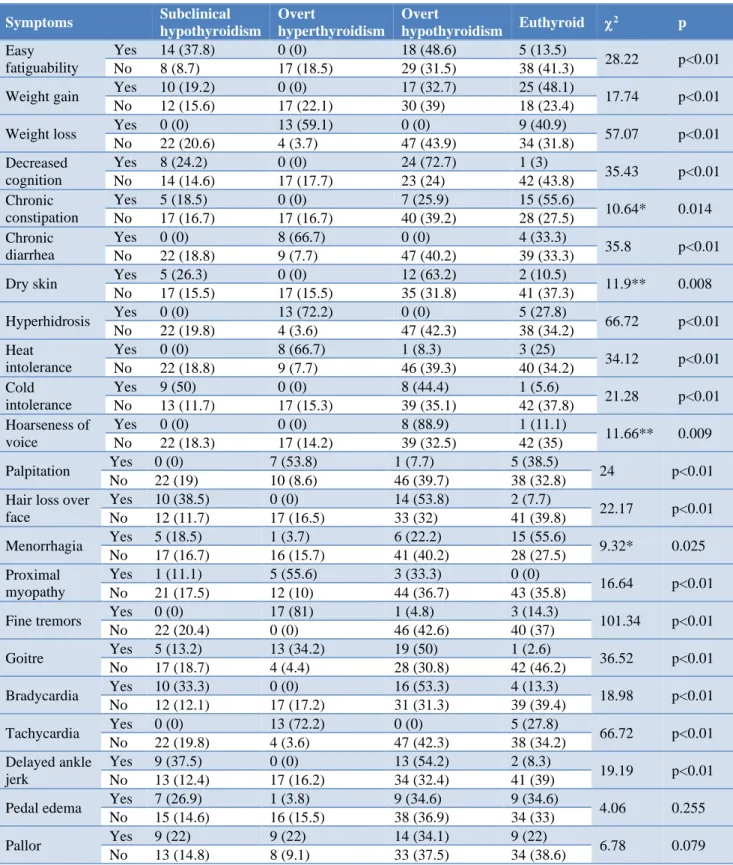
Table 2 depicts the association of each of the classical symptoms for the patients in Group A to the actual biochemical evaluation done in them, revealing the percentage of each symptoms culminating into thyroid profile abnormality, hence leading to a definite thyroid disorder(subclinical or clinical). Hence the predictive association of each of these symptoms is calculated and significance is noted for all, except for chronic constipation, menorrhagia, pedal edema and pallor, at p<0.01.
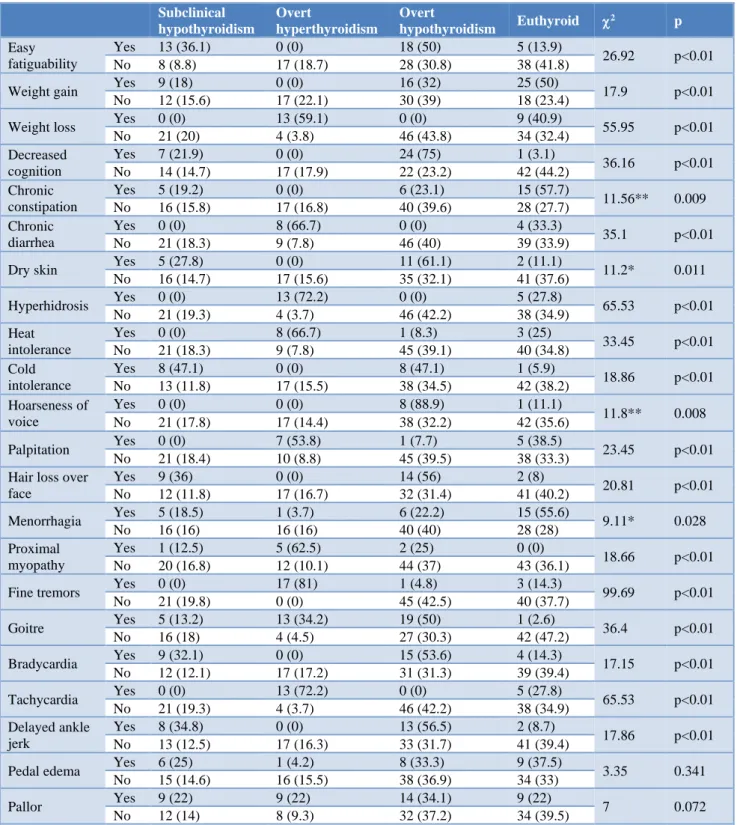
Table 3 depicts the association of each of the classical symptoms for the patients in Group B to the actual biochemical evaluation done in them, revealing the percentage of each symptoms culminating into thyroid
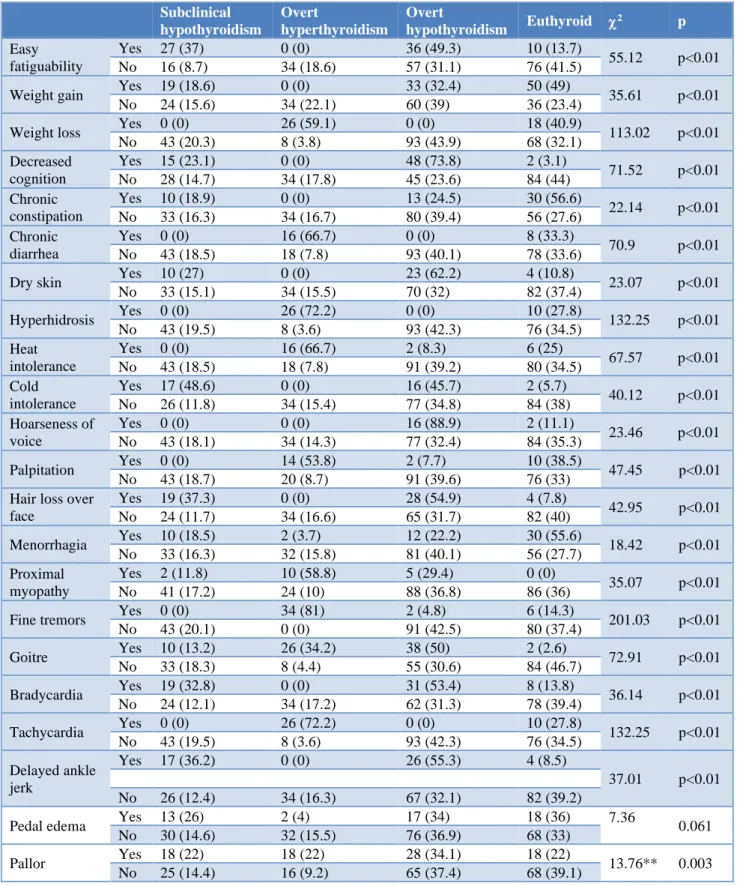
profile abnormality, hence leading to a definite thyroid disorder(subclinical or clinical). Hence the predictive association of each of these symptoms is calculated and significance is noted for all, except for menorrhagia, pedal edema and pallor, at p<0.01. Table 4 depicts the association of individual symptom, irrespective of age, combining the data from both the groups, with actual biochemically proven thyroid disorder. Only pedal edema was inconclusive or not significant in predicting actual thyroid profile abnormalities (p<0.01).
DISCUSSION
This study enrolled a total of 129 patients in Group A and 127 patients in Group B by using the inclusion and exclusion criteria. In Group A, 77 males and 52 females participated while there were 76 males and 51 females in Group B.
0 10 20 30 40 50
Male Female
15.8 17.6
11.8 15.7
42.1
27.5 30.3
39.2 Subclinical hypothyroidism
Overt hypothyroidism Overt hypothyroidism Euthyroid
0 10 20 30 40 50
Male Female
15.8 17.6
11.8 15.7
42.1
27.5 30.3
39.2 Subclinical hypothyroidism
Overt Hypothyroidism was the most common disorder noted. This turned out to be in 47 patients in Group A of which 32 were males, while the same in Group B was 46 with 32 males. Subclinical Hypothyroidism was found in
22 patients in Group A and 21 patients in Group B. 43 patients in each group turned to be euthyroid. The rest patients were found to have hyperthyroidism.
Table 2: Association of classical symptomatology of thyroid dysfunction with the presence of actual biochemically proven thyroid disorder for participants of age>=60 (Group A).
Symptoms Subclinical
hypothyroidism
Overt
hyperthyroidism
Overt
hypothyroidism Euthyroid 2 p
Easy fatiguability
Yes 14 (37.8) 0 (0) 18 (48.6) 5 (13.5)
28.22 p<0.01
No 8 (8.7) 17 (18.5) 29 (31.5) 38 (41.3)
Weight gain Yes 10 (19.2) 0 (0) 17 (32.7) 25 (48.1) 17.74 p<0.01
No 12 (15.6) 17 (22.1) 30 (39) 18 (23.4)
Weight loss Yes 0 (0) 13 (59.1) 0 (0) 9 (40.9) 57.07 p<0.01
No 22 (20.6) 4 (3.7) 47 (43.9) 34 (31.8)
Decreased cognition
Yes 8 (24.2) 0 (0) 24 (72.7) 1 (3)
35.43 p<0.01
No 14 (14.6) 17 (17.7) 23 (24) 42 (43.8)
Chronic constipation
Yes 5 (18.5) 0 (0) 7 (25.9) 15 (55.6)
10.64* 0.014
No 17 (16.7) 17 (16.7) 40 (39.2) 28 (27.5)
Chronic diarrhea
Yes 0 (0) 8 (66.7) 0 (0) 4 (33.3)
35.8 p<0.01
No 22 (18.8) 9 (7.7) 47 (40.2) 39 (33.3)
Dry skin Yes 5 (26.3) 0 (0) 12 (63.2) 2 (10.5) 11.9** 0.008
No 17 (15.5) 17 (15.5) 35 (31.8) 41 (37.3)
Hyperhidrosis Yes 0 (0) 13 (72.2) 0 (0) 5 (27.8) 66.72 p<0.01
No 22 (19.8) 4 (3.6) 47 (42.3) 38 (34.2)
Heat intolerance
Yes 0 (0) 8 (66.7) 1 (8.3) 3 (25)
34.12 p<0.01
No 22 (18.8) 9 (7.7) 46 (39.3) 40 (34.2)
Cold intolerance
Yes 9 (50) 0 (0) 8 (44.4) 1 (5.6)
21.28 p<0.01
No 13 (11.7) 17 (15.3) 39 (35.1) 42 (37.8)
Hoarseness of voice
Yes 0 (0) 0 (0) 8 (88.9) 1 (11.1)
11.66** 0.009
No 22 (18.3) 17 (14.2) 39 (32.5) 42 (35)
Palpitation Yes 0 (0) 7 (53.8) 1 (7.7) 5 (38.5) 24 p<0.01
No 22 (19) 10 (8.6) 46 (39.7) 38 (32.8)
Hair loss over face
Yes 10 (38.5) 0 (0) 14 (53.8) 2 (7.7)
22.17 p<0.01
No 12 (11.7) 17 (16.5) 33 (32) 41 (39.8)
Menorrhagia Yes 5 (18.5) 1 (3.7) 6 (22.2) 15 (55.6) 9.32* 0.025
No 17 (16.7) 16 (15.7) 41 (40.2) 28 (27.5)
Proximal myopathy
Yes 1 (11.1) 5 (55.6) 3 (33.3) 0 (0)
16.64 p<0.01
No 21 (17.5) 12 (10) 44 (36.7) 43 (35.8)
Fine tremors Yes 0 (0) 17 (81) 1 (4.8) 3 (14.3) 101.34 p<0.01
No 22 (20.4) 0 (0) 46 (42.6) 40 (37)
Goitre Yes 5 (13.2) 13 (34.2) 19 (50) 1 (2.6) 36.52 p<0.01
No 17 (18.7) 4 (4.4) 28 (30.8) 42 (46.2)
Bradycardia Yes 10 (33.3) 0 (0) 16 (53.3) 4 (13.3) 18.98 p<0.01
No 12 (12.1) 17 (17.2) 31 (31.3) 39 (39.4)
Tachycardia Yes 0 (0) 13 (72.2) 0 (0) 5 (27.8) 66.72 p<0.01
No 22 (19.8) 4 (3.6) 47 (42.3) 38 (34.2)
Delayed ankle jerk
Yes 9 (37.5) 0 (0) 13 (54.2) 2 (8.3)
19.19 p<0.01
No 13 (12.4) 17 (16.2) 34 (32.4) 41 (39)
Pedal edema Yes 7 (26.9) 1 (3.8) 9 (34.6) 9 (34.6) 4.06 0.255
No 15 (14.6) 16 (15.5) 38 (36.9) 34 (33)
Pallor Yes 9 (22) 9 (22) 14 (34.1) 9 (22) 6.78 0.079
No 13 (14.8) 8 (9.1) 33 (37.5) 34 (38.6)
The classical symptomatology for thyroid disease was compared individually for each group and also as a combined analysis. Easy fatiguability, weight gain, decreased cognition, dry skin, cold intolerance, hoarseness of voice, hair loss over face, proximal myopathy, goiter, bradycardia, delayed ankle jerk were
all found to be significantly associated (p<0.01) in Group A patients with biochemically proven hypothyroidism. Chronic diarrhea, weight loss, hyperhidrosis, heat intolerance, palpitation, tachycardia, and fine tremors were found to be significantly associated with biochemically proven hyperthyroidism.
Table 3: Association of classical symptomatology of thyroid dysfunction with the presence of actual biochemically proven thyroid disorder for participants of age 25-50 Years (Group B).
Subclinical hypothyroidism
Overt
hyperthyroidism
Overt
hypothyroidism Euthyroid
2 p
Easy fatiguability
Yes 13 (36.1) 0 (0) 18 (50) 5 (13.9)
26.92 p<0.01
No 8 (8.8) 17 (18.7) 28 (30.8) 38 (41.8)
Weight gain Yes 9 (18) 0 (0) 16 (32) 25 (50) 17.9 p<0.01
No 12 (15.6) 17 (22.1) 30 (39) 18 (23.4)
Weight loss Yes 0 (0) 13 (59.1) 0 (0) 9 (40.9) 55.95 p<0.01
No 21 (20) 4 (3.8) 46 (43.8) 34 (32.4)
Decreased cognition
Yes 7 (21.9) 0 (0) 24 (75) 1 (3.1)
36.16 p<0.01
No 14 (14.7) 17 (17.9) 22 (23.2) 42 (44.2)
Chronic constipation
Yes 5 (19.2) 0 (0) 6 (23.1) 15 (57.7)
11.56** 0.009
No 16 (15.8) 17 (16.8) 40 (39.6) 28 (27.7)
Chronic diarrhea
Yes 0 (0) 8 (66.7) 0 (0) 4 (33.3)
35.1 p<0.01
No 21 (18.3) 9 (7.8) 46 (40) 39 (33.9)
Dry skin Yes 5 (27.8) 0 (0) 11 (61.1) 2 (11.1) 11.2* 0.011
No 16 (14.7) 17 (15.6) 35 (32.1) 41 (37.6)
Hyperhidrosis Yes 0 (0) 13 (72.2) 0 (0) 5 (27.8) 65.53 p<0.01
No 21 (19.3) 4 (3.7) 46 (42.2) 38 (34.9)
Heat intolerance
Yes 0 (0) 8 (66.7) 1 (8.3) 3 (25)
33.45 p<0.01
No 21 (18.3) 9 (7.8) 45 (39.1) 40 (34.8)
Cold intolerance
Yes 8 (47.1) 0 (0) 8 (47.1) 1 (5.9)
18.86 p<0.01
No 13 (11.8) 17 (15.5) 38 (34.5) 42 (38.2)
Hoarseness of voice
Yes 0 (0) 0 (0) 8 (88.9) 1 (11.1)
11.8** 0.008
No 21 (17.8) 17 (14.4) 38 (32.2) 42 (35.6)
Palpitation Yes 0 (0) 7 (53.8) 1 (7.7) 5 (38.5) 23.45 p<0.01
No 21 (18.4) 10 (8.8) 45 (39.5) 38 (33.3)
Hair loss over face
Yes 9 (36) 0 (0) 14 (56) 2 (8)
20.81 p<0.01
No 12 (11.8) 17 (16.7) 32 (31.4) 41 (40.2)
Menorrhagia Yes 5 (18.5) 1 (3.7) 6 (22.2) 15 (55.6) 9.11* 0.028
No 16 (16) 16 (16) 40 (40) 28 (28)
Proximal myopathy
Yes 1 (12.5) 5 (62.5) 2 (25) 0 (0)
18.66 p<0.01
No 20 (16.8) 12 (10.1) 44 (37) 43 (36.1)
Fine tremors Yes 0 (0) 17 (81) 1 (4.8) 3 (14.3) 99.69 p<0.01
No 21 (19.8) 0 (0) 45 (42.5) 40 (37.7)
Goitre Yes 5 (13.2) 13 (34.2) 19 (50) 1 (2.6) 36.4 p<0.01
No 16 (18) 4 (4.5) 27 (30.3) 42 (47.2)
Bradycardia Yes 9 (32.1) 0 (0) 15 (53.6) 4 (14.3) 17.15 p<0.01
No 12 (12.1) 17 (17.2) 31 (31.3) 39 (39.4)
Tachycardia Yes 0 (0) 13 (72.2) 0 (0) 5 (27.8) 65.53 p<0.01
No 21 (19.3) 4 (3.7) 46 (42.2) 38 (34.9)
Delayed ankle jerk
Yes 8 (34.8) 0 (0) 13 (56.5) 2 (8.7)
17.86 p<0.01
No 13 (12.5) 17 (16.3) 33 (31.7) 41 (39.4)
Pedal edema Yes 6 (25) 1 (4.2) 8 (33.3) 9 (37.5) 3.35 0.341
No 15 (14.6) 16 (15.5) 38 (36.9) 34 (33)
Pallor Yes 9 (22) 9 (22) 14 (34.1) 9 (22) 7 0.072
No 12 (14) 8 (9.3) 32 (37.2) 34 (39.5)
Table 4: Association of classical symptomatology of thyroid dysfunction with the presence of actual biochemically proven thyroid disorder for participants irrespective of age.
Subclinical hypothyroidism
Overt
hyperthyroidism
Overt
hypothyroidism Euthyroid
2 p
Easy fatiguability
Yes 27 (37) 0 (0) 36 (49.3) 10 (13.7)
55.12 p<0.01
No 16 (8.7) 34 (18.6) 57 (31.1) 76 (41.5)
Weight gain Yes 19 (18.6) 0 (0) 33 (32.4) 50 (49) 35.61 p<0.01
No 24 (15.6) 34 (22.1) 60 (39) 36 (23.4)
Weight loss Yes 0 (0) 26 (59.1) 0 (0) 18 (40.9) 113.02 p<0.01
No 43 (20.3) 8 (3.8) 93 (43.9) 68 (32.1)
Decreased cognition
Yes 15 (23.1) 0 (0) 48 (73.8) 2 (3.1)
71.52 p<0.01
No 28 (14.7) 34 (17.8) 45 (23.6) 84 (44)
Chronic constipation
Yes 10 (18.9) 0 (0) 13 (24.5) 30 (56.6)
22.14 p<0.01
No 33 (16.3) 34 (16.7) 80 (39.4) 56 (27.6)
Chronic diarrhea
Yes 0 (0) 16 (66.7) 0 (0) 8 (33.3)
70.9 p<0.01
No 43 (18.5) 18 (7.8) 93 (40.1) 78 (33.6)
Dry skin Yes 10 (27) 0 (0) 23 (62.2) 4 (10.8) 23.07 p<0.01
No 33 (15.1) 34 (15.5) 70 (32) 82 (37.4)
Hyperhidrosis Yes 0 (0) 26 (72.2) 0 (0) 10 (27.8) 132.25 p<0.01
No 43 (19.5) 8 (3.6) 93 (42.3) 76 (34.5)
Heat intolerance
Yes 0 (0) 16 (66.7) 2 (8.3) 6 (25)
67.57 p<0.01
No 43 (18.5) 18 (7.8) 91 (39.2) 80 (34.5)
Cold intolerance
Yes 17 (48.6) 0 (0) 16 (45.7) 2 (5.7)
40.12 p<0.01
No 26 (11.8) 34 (15.4) 77 (34.8) 84 (38)
Hoarseness of voice
Yes 0 (0) 0 (0) 16 (88.9) 2 (11.1)
23.46 p<0.01
No 43 (18.1) 34 (14.3) 77 (32.4) 84 (35.3)
Palpitation Yes 0 (0) 14 (53.8) 2 (7.7) 10 (38.5) 47.45 p<0.01
No 43 (18.7) 20 (8.7) 91 (39.6) 76 (33)
Hair loss over face
Yes 19 (37.3) 0 (0) 28 (54.9) 4 (7.8)
42.95 p<0.01
No 24 (11.7) 34 (16.6) 65 (31.7) 82 (40)
Menorrhagia Yes 10 (18.5) 2 (3.7) 12 (22.2) 30 (55.6) 18.42 p<0.01
No 33 (16.3) 32 (15.8) 81 (40.1) 56 (27.7)
Proximal myopathy
Yes 2 (11.8) 10 (58.8) 5 (29.4) 0 (0)
35.07 p<0.01
No 41 (17.2) 24 (10) 88 (36.8) 86 (36)
Fine tremors Yes 0 (0) 34 (81) 2 (4.8) 6 (14.3) 201.03 p<0.01
No 43 (20.1) 0 (0) 91 (42.5) 80 (37.4)
Goitre Yes 10 (13.2) 26 (34.2) 38 (50) 2 (2.6) 72.91 p<0.01
No 33 (18.3) 8 (4.4) 55 (30.6) 84 (46.7)
Bradycardia Yes 19 (32.8) 0 (0) 31 (53.4) 8 (13.8) 36.14 p<0.01
No 24 (12.1) 34 (17.2) 62 (31.3) 78 (39.4)
Tachycardia Yes 0 (0) 26 (72.2) 0 (0) 10 (27.8) 132.25 p<0.01
No 43 (19.5) 8 (3.6) 93 (42.3) 76 (34.5)
Delayed ankle jerk
Yes 17 (36.2) 0 (0) 26 (55.3) 4 (8.5)
37.01 p<0.01
No 26 (12.4) 34 (16.3) 67 (32.1) 82 (39.2)
Pedal edema Yes 13 (26) 2 (4) 17 (34) 18 (36) 7.36 0.061
No 30 (14.6) 32 (15.5) 76 (36.9) 68 (33)
Pallor Yes 18 (22) 18 (22) 28 (34.1) 18 (22) 13.76** 0.003
No 25 (14.4) 16 (9.2) 65 (37.4) 68 (39.1)
In Group A, the symptoms which turned out non-significant for biochemical thyroid disease were chronic constipation, menorrhagia, pedal edema and pallor. In
edema and pallor were insignificant with actual disease. Combining the analysis of both groups, only pedal edema turned out to be insignificant.
Biochemical abnormalities in thyroid parameters are seen more in elderly patients due to multiple physiological and pathological reasons.4 Age and gender have a significant role in the development of subclinical thyroid disease and its progression to overt thyroid disease.5 The differences observed in elderly patients regarding thyroid dysfunction when compared to young patients are a consequence of aging, decrease in peripheral conversion of T4 to T3, decrease in the physiological function of thyroid gland, decrease in thyroid hormone receptor sensitivity and many other histo-pathological factors.6,7 The Framingham study showed a significant prevalence of hypothyroidism (clinical and subclinical) in an unselected cohort of elderly people.8 The study done by Natasha and Raju Badiger in 2017 covering 100 elderly patients with clinical symptoms similar to thyroid disease showed a 28% prevalence of thyroid disorders with the most common being hypothyroidism.9 Samuels MH in 1998 showed that subclinical hypothyroidism occurs in 5-10% of elderly subjects.10
This study covers a larger random sample of patients who were compared based on age (Group A and B) and gender (in each group and combined). The most common disorder found was overt hypothyroidism which was found in a larger percentage in male patients with symptoms than females with similar symptoms. There was a considerable percentage of subclinical hypothyroidism patients in each group, thus supporting the literature data.
CONCLUSION
Clinical examination followed by laboratory confirmation form the cornerstone in the diagnosis of subclinical and clinical thyroid disease. This study tries to find the significance of each of the classical symptoms of hypothyroidism and hyperthyroidism in associating with actual biochemically proven thyroid disease. The thyroid profile alterations based on age and gender is a complex process and may need further studies on a larger scale, to enhance the knowledge on this subject.
ACKNOWLEDGEMENTS
Authors would like to thank Department of General Medicine, Pushpagiri Medical College Hospital, Tiruvalla and the patients who co-operated with authors for the smooth completion of this study.
Funding: No funding sources Conflict of interest: None declared
Ethical approval: The study was approved by the Institutional Ethics Committee
REFERENCES
1. Canaris GJ, Steiner JF, Ridgway EC. Do traditional symptoms of hypothyroidism correlate with biochemical disease?. J General Int Med. 1997 Sep;12(9):544-50.
2. Doucet J, Trivalle CH, Chassagne PH, Perol MB, Vuillermet P, Manchon ND, et al. Does age play a role in clinical presentation of hypothyroidism?. J Am Geriatr Soc. 1994 Sep;42(9):984-6.
3. Leng O, Razvi S. Hypothyroidism in the older population. Thyroid Res. 2019 Dec;12(1):2.
4. Van den Beld AW, Visser TJ, Feelders RA, Grobbee DE, Lamberts SW. Thyroid hormone concentrations, disease, physical function, and mortality in elderly men. J Clini Endocrinol Metab. 2005 Dec 1;90(12):6403-9.
5. Pratap A, Tilak MA, Phalak P. Thyroid profile in geriatric population. Ind J Basic Appl Med Res. 2014;3(4):297-303.
6. Da Costa VC, Moreira DG, Rosenthal D. Thyroid function and aging: gender-related differences. J Endocrinol. 2001 Oct 1;171(1):193-8.
7. Natasha RB. A Prospective Study of Thyroid Function Test in Geriatric Population and its Clinical Correlation. J Assoc Physici India. 2019 Oct;67:33.
8. Sawin CT, Castelli WP, Hershman JM, McNamara P, Bacharach P. The aging thyroid: thyroid deficiency in the Framingham study. Arch Int Med. 1985 Aug 1;145(8):1386-8.
9. Rehman SU, Cope DW, Senseney AD, Brzezinski W. Thyroid disorders in elderly patients. Southern Med J. 2005 May 1;98(5):543-50.
10. Samuels MH. Subclinical thyroid disease in the elderly. Thyroid. 1998;8(9):803-13.