Vol. 8, No. 4, 2015, 469-477
ISSN 1307-5543 – www.ejpam.com
!
-cycle Compatible Splitting Signed Graphs
S
(
S
)
and
Γ
(
S
)
Rashmi Jain
1,∗, Sangita Kansal
1, Mukti Acharya
21Department of Applied Mathematics, Delhi Technological University, Delhi, India
2Department of Mathematics, Kalasalingam University, KrishnanKoil, India
Abstract. Asigned graph(or, in short,sigraph)S= (Su,
σ)consists of an underlying graph
Su:=G= (V,E)and a function
σ:E(Su)−→{+,−}, called the signature ofS. AmarkingofSis a
functionµ:V(S)−→{+,−}. Thecanonical markingof a signed graphS, denotedµσ, is given as
µσ(v):=
!
vw∈E(S) σ(vw).
Thesplitting signed graphS(S)of a signed graphSis formed as follows:
• Take a copy ofSand for each vertexvofS, take a new vertexv&. Joinv&to all verticesu∈N(v)
by negative edge, ifµσ(u) =µσ(v) =−inSand by positive edge otherwise.
Thesplitting signed graphΓ(S)of a signed graphSis formed as follows:
• Take a copy ofSand for each vertexvofS, take a new vertexv&. Joinv&to all verticesu∈N(v)
and assignσ(uv)as its sign. Here,N(v)is the set of all adjacent vertices tov.
A signed graph is calledcanonically consistent (or!-consistent)if its every cycle contains even number of negative vertices with respect to its canonical marking. A marked signed graphS is called cycle-compatibleif for every cycleZinS, the product of signs of its vertices equals the product of signs of its edges. A signed graphSis!-cycle compatibleif for every cycleZinS,
!
e∈E(Z) σ(e) =
!
v∈V(Z)
µσ(v).
In this paper, we establish a structural characterization of signed graphSfor whichS(S)andΓ(S)are
isomorphic and!-cycle compatible.
2010 Mathematics Subject Classifications: 05C22; 05C75
Key Words and Phrases: canonical marking, splitting signed graph,!-consistent,!-cycle compatible,
!-sign compatible
∗Corresponding author.
Email addresses:[email protected](R. Jain),[email protected](S. Kansal),
[email protected](M. Acharya)
1. Introduction
A graphis an ordered pairG = (V,E), where V = V(G)is a set ofvertices or points ofG
and E = E(G) is a collection of pairs of vertices of G, called edges or lines ofG. For graph theoretical terminology, we refer to[2]. All graphs considered in the paper are finite, simple and connected.
Asigned graphis an ordered pairS= (Su,σ), whereSu:=G= (V,E)is a graph called the
underlying graph ofSandσ:E(Su)−→{+,−}is a function, called thesignatureofS. In other
terms, we say that the edges aresignedbyσ. In a pictorial representation of a signed graph
S, its positive edges are shown as bold line segments (‘Jorden curves’ drawn on the plane) and negative lines as broken line segments as shown in Figure 1. E+(S) ={e∈E(Su):σ(e) = +}
and E–(S) = {e ∈ E(Su) : σ(e) = −}. The elements of E+(S) (E–(S)) are called positive
(negative)edgesofS and the setE(S) =E+(S)∪E–(S)is called the edge set ofS.
S:
(S):
1
2
3 4
1
2
3 4
1'
2'
3' 4'
1
2
3 4
1'
2'
3' 4'
(S): (S):
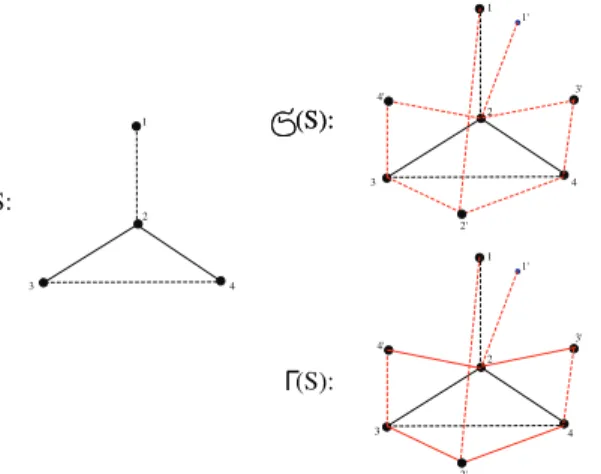
Figure 1: A signed graphS and its splitting signed graphsS(S)andΓ(S)
A signed graph in which all the edges are positive, is calledall-positive signed graph( all-negative signed graphis defined similarly). A signed graph is said to be homogeneousif it is either all-positive or all-negative andheterogeneousotherwise. Byd(v), we denote degree of
v∈V(S),d(v) =d+(v) +d−(v), hered+(v) (d−(v))denotes the positive (negative) degree of
v.
A markingofS is a function µ: V(S) −→{+,−}. Sampathkumar in[4] introduced the idea of marking derived from the signs of edges incident to vertices, given as
µσ(v):=
!
vw∈E(S)
σ(vw).
This marking is called canonical marking. Clearly,µσ(v) = +if d−(v)is even and
Signed graphs S1 and S2 are called isomorphic, written as S1 ∼= S2, if there is a graph isomorphism f :Su1→S2uthat preserves edge signs.
A cycle in a signed graph is said to bepositive (negative) cycleif the product of the signs of its edges is positive (negative), i.e., its an even (odd) number of edges are negative. A signed graph is said to bebalancedif every cycle in it is positive (see[3]).
A cycle in a marked signed graph is said to beconsistentif its an even number of vertices are negative and a marked signed graph is called consistent if its all cycles are consistent (see
[6]). Similarly, a cycle in a signed graph is said to becanonically consistent (or!-consistent)
if for every cycle inS, the product of signs of its vertices with respect to canonical marking, is positive, i.e., its an even number of vertices are negative and a signed graph is called ! -consistent if its all cycles are!-consistent.
A marked signed graph S is called cycle-compatibleif for every cycle Z inS, the product of signs of its vertices equals the product of signs of its edges. A signed graph S is called
canonically cycle(or!-cycle)compatibleif for every cycleZ inS,
!
e∈E(Z)
σ(e) =
!
v∈V(Z)
µσ(v).
A signed graphS= (Su,σ)is said to besign-compatible[6]if it has a vertex markingµsuch that every edgee=uvhasσ(e) =−if and only ifµ(u) =µ(v) =−. If the canonical marking µσhas this property, thenS is said to becanonically sign-compatible (or!-sign-compatible).
2. Splitting Signed Graphs
Sampathkumar and Walikar introduced the concept of splitting graph of a graph in [5]. The splitting graph of a graphG, denoted hereS(G), is formed as follows:
Take a copy of G and for each vertex vofG, take a new vertex v&. Join v&to all adjacent vertices ofv.
There are two notions ofsplitting signed graphsof a signed graphS= (Su,σ)in the
liter-ature, viz.,S(S)andΓ(S), both of which haveS(Su)as their underlying graph; only the rule to assign signs to the edges ofS(Su)differ. An edgeuv&inS(S)is negative wheneveruandv are negative vertices ofS and an edgeuv&inΓ(S)is negative wheneveruvis a negative edge ofSas reported in[1]and[7]respectively.
A signed graphS is called aS-splitting (Γ-splitting) signed graph if there exists a signed graphT such thatS is isomorphic toS(T)(Γ(T)).
Theorem 1(Acharyaet al.[1]). Following statements hold:
(i) If v∈V(S)is a positive vertex then v,v&∈V(S(S))are positive.
(ii) If v ∈ V(S) is a negative vertex having an even (odd) number of negative vertices in its neighbourhood then v∈V(S(S))is negative (positive) vertex and v&is of opposite sign to v.
Theorem 2(Acharyaet al.[1]). S(S)is balanced if and only if the following conditions hold in
S:
(i) S is balanced and;
(ii) S does not contain a homogeneous path P3of marking+, -, - and the marking of a
hetero-geneous path P3 is+, -, - only.
Lemma 1(Sinhaet al. [7]). The following statements hold inΓ(S): (i) If v∈V(S)is any vertex then v∈V(Γ(S))is positive.
(ii) If v∈V(S)is a negative vertex then v&∈V(Γ(S))is negative.
Theorem 3(Sinhaet al. [7]). The splitting signed graphΓ(S)of a signed graph S is balanced if and only if S is balanced.
Figure 1 illustrates a signed graphS and its splitting signed graphsS(S)andΓ(S).
3. Main Results
Theorem 4. For a signed graph S,S(S)∼=Γ(S)if and only if S is any one of the following: (i) All-positive or;
(ii) All-negative in which degree of each vertex is odd or;
(iii) Heterogeneous in which end vertices of every negative (positive) edge are (are not) negative. Proof. Necessity: Let, for a signed graphS, S(S)∼=Γ(S). SinceS is a subsignedgraph of S(S)andΓ(S), we concentrate our attention only on the sign of edgeuv&in S(S)andΓ(S). By the definition ofS(S),uv&∈E−(S(S)) if and only ifu,v ∈V(S)are negative and by the definition of Γ(S), uv& ∈ E−(Γ(S)) if and only ifuv ∈ E−(S). Therefore, we have following three possible cases:
Case I: If S(S) ∼=Γ(S) and bothS(S) andΓ(S) are all-positivethen no edge ofS will be negative. Hence,(i)follows.
Case II: IfS(S)∼=Γ(S)and both are all-negativethen every edge and every vertex ofSwill be negative. Hence,(ii)follows.
Case III: IfS(S)∼=Γ(S)and both are heterogeneousthenSwill be heterogeneous and edge
uv& in bothS(S)andΓ(S)must be of the same sign. This implies that end vertices of every negative (positive) edge ofSare (are not) negative. Hence,(iii)follows.
Thus, the necessity follows.
(ii) All-negative in which degree of each vertex is odd or;
(iii) Heterogeneous in which end vertices of every negative (positive) edge are (are not) negative.
then by the definitionsS- andΓ- splitting signed graphs, we obtain following results: Case I: IfS is all-positivethenS(S)andΓ(S)will be all-positive andS(S)∼=Γ(S).
Case II: IfS is all-negative in which degree of each vertex is oddthenS(S)andΓ(S)will be all-negative andS(S)∼=Γ(S).
Case III: IfSis heterogeneous in which end vertices of every negative (positive) edge are (are not) negativethenS(S)andΓ(S)will be heterogeneous asSbe a subsignedgraph ofS(S)andΓ(S)and edgeuv&in bothS(S)andΓ(S)will be of the same sign. Hence, S(S)∼=Γ(S).
This completes the proof.
Corollary 1. For a signed graph S,S(S)∼=Γ(S)if and only if S is!-sign compatible. Theorem 5. S(S)is!-cycle compatible if and only if the following conditions hold in S:
(i) if Z is a positive (negative) cycle then an even (odd) number of negative vertices of cycle Z contain even numbers of negative vertices in their neighbourhoods and;
(ii) for a path P3= (u,v,w), any one condition holds:
• it is homogeneous of marking+,+,+;
• it is heterogeneous of marking+, -,+;
• it is homogeneous (heterogeneous) of marking -,+,+or -, -,+and N(u)contains an
odd (even) number of negative vertices;
• it is homogeneous (heterogeneous) of marking -,+, - and vertices u,w are (are not)
of same parity (i.e., N(u)and N(w)contain even number of negative vertices or odd number of negative vertices);
• it is homogeneous (heterogeneous) of marking -, -, - and vertices u,w are not (are) of the same parity.
Proof. Necessity: LetS(S)be!-cycle compatible. Therefore, every cycle inS(S)is either positive and!-consistent or negative and!-inconsistent. By Theorem 1, every positive vertex ofSis positive inS(S)and every negative vertex ofShaving an even (odd) number of negative vertices in its neighbourhood is negative (positive) inS(S). SinceSis subsignedgraph ofS(S), if Zis a positive (negative) cycle ofS thenZ must be!-consistent (!-inconsistent) inS(S), i.e., an even (odd) number of negative vertices of cycle Z must contain an even numbers of negative vertices in their neighbourhoods. Thus,(i)follows.
1. +,+,+ 2. +, -,+ 3. -,+,+ 4. -, -,+ 5. -,+, - 6. , , -Hence, the following cases arise:
• if marking of pathP3 = (u,v,w)is+,+,+ then by Theorem 1, verticesu,v,w,v& have signs+,+,+,+respectively inS(S). Thus, pathP3 induces a!-consistent cycleC4in S(S). By Theorem 2, this cycleC4is positive (negative) if and only ifP3is homogeneous (heterogeneous). SinceS(S)is!-cycle compatible,P3will be homogeneous.
• if marking of path P3 = (u,v,w)is+, -, +then by Theorem 1, vertices u,v,w,v& have signs+, -,+,+or+,+,+, - respectively inS(S). Thus, pathP3induces a!-inconsistent cycleC4 inS(S). By Theorem 2, this cycleC4 is positive (negative) if and only if P3 is homogeneous (heterogeneous). SinceS(S)is!-cycle compatible,P3will be heteroge-neous.
• if marking of pathP3 = (u,v,w)is -,+,+andN(u)contains an odd (even) number of negative vertices then by Theorem 1, verticesu,v,w,v&have signs+,+,+,+(-,+,+,+) respectively inS(S). Thus, pathP3induces a!-consistent (!-inconsistent) cycleC4in S(S). By Theorem 2, this cycleC4is positive (negative) if and only ifP3is homogeneous (heterogeneous). SinceS(S)is!-cycle compatible, for homogeneous (heterogeneous)
P3,N(u)must contain an odd (even) number of negative vertices.
Similarly, if marking of pathP3= (u,v,w)is -, -,+andN(u)contains an even (odd) num-ber of negative vertices then by Theorem 1, verticesu,v,w,v&have signs -, -,+,+or -,+,
+, - (+, -,+,+or+,+,+, -) respectively inS(S). Thus, pathP3induces a!-consistent (!-inconsistent) cycleC4 inS(S). By Theorem 2, this cycleC4 is positive (negative) if and only ifP3 is heterogeneous (homogeneous). SinceS(S)is!-cycle compatible, for heterogeneous (homogeneous)P3,N(u)will contain an even (odd) number of negative vertices.
• if marking of pathP3= (u,v,w)is -,+, - and verticesuandware (are not) of the same parity, i.e.,N(u)andN(w)contain even number of negative vertices or odd number of negative vertices, then by Theorem 1, verticesu,v,w,v&have signs -,+, -,+or+,+,+,
+(-,+,+,+or+,+, -,+) respectively inS(S). Thus, path P3 induces a!-consistent (!-inconsistent) cycleC4 inS(S). By Theorem 2, this cycleC4 is positive (negative) if and only ifP3 is homogeneous (heterogeneous). SinceS(S)is!-cycle compatible, for homogeneous (heterogeneous)P3, verticesuandwwill (will not) be of the same parity; • if marking of path P3= (u,v,w)is -, -, - and verticesuandware (are not) of the same parity, i.e.,N(u)andN(w)contain even number of negative vertices or odd number of negative vertices, then by Theorem 1, verticesu,v,w,v&have signs -, -, -,+; -,+, -, - or
+, -,+, +;+,+, +, - (-, -,+,+; -, +,+, - or+, -, -,+;+,+, -, -) respectively inS(S). Thus, pathP3induces a!-inconsistent (!-consistent) cycleC4inS(S). By Theorem 2, this cycle C4 is positive (negative) if and only if P3 is homogeneous (heterogeneous). SinceS(S)is!-cycle compatible, for homogeneous (heterogeneous)P3, verticesuand
Thus, the necessity follows.
Sufficiency: A cycle inS(S)is induced due to a cycle or a pathP3 or their combinations in S. If conditions hold then it can be easily seen that every cycle in S(S) is positive and !-consistent or negative and!-inconsistent, i.e,S(S)is!-cycle compatible. This completes the proof.
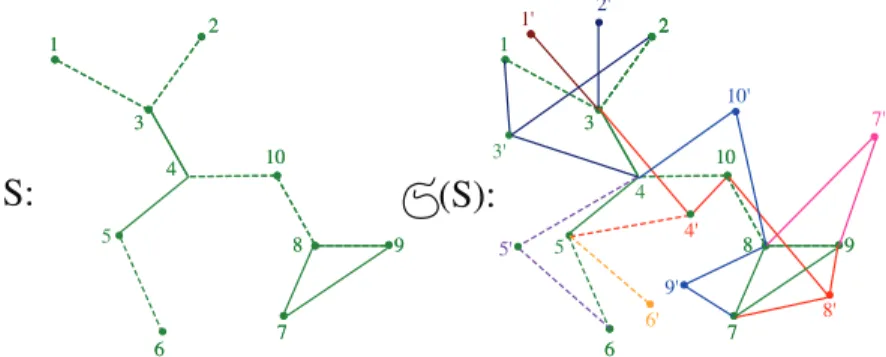
Signed graphS shown in Figure 2 does not satisfy conditions(i)and(ii)of Theorem 5, S(S)is!-cycle incompatible.
3 10
S:
6 7 8 2 1 4 9 3 10 5 6 7 8 2 1 4 9 3 10 6 7 8 2 1 9 3 10 5 6 7 8 2 1 4 91' 2' 22
3' 4' 5' 6' 7' 8' 9' 10'
(S):
Figure 2: A signed graphS and its!-cycle incompatibleS(S)
Signed graphS shown in Figure 3 satisfies conditions (i)and(ii)of Theorem 5,S(S)is !-cycle compatible.
S:
3(S):
4 5 1' 2' 3' 4' 2 1 3 2 1 3 2 1 5' 4 5
Figure 3: A signed graphSand its!-cycle compatibleS(S)
Theorem 6. For a signed graph S,Γ(S)is!-cycle compatible if and only if the following condi-tions hold in S:
(i) S is balanced;
(ii) each non-pendant vertex of S is positive.
By the definition ofΓ(S), a pathP3= (u,v,w)ofSinduces a positive cycleC4= (u,v,w,v&)
inΓ(S)and by Lemma 1, verticesu,v,w,v&have signs+,+, +,+ or+, +,+, - inΓ(S)if v is a positive (negative) vertex ofS. Thus, this cycleC4 is!-consistent if v∈V(S)is a positive vertex. Since Γ(S) is!-cycle compatible and cycle C4 is positive, C4 must be !-consistent. Hence, every non-pendant vertex ofSwill be positive. Thus, the necessity follows.
Sufficiency: A cycle inΓ(S)is induced due to a cycle or a path P3 or their combinations in S. If conditions hold then it can be easily seen that every cycle in Γ(S) is positive and !-consistent, i.e,Γ(S)is!-cycle-compatible. This completes the proof.
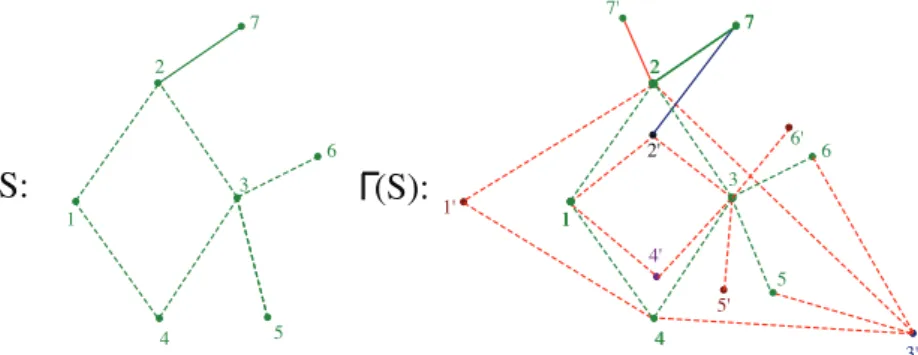
Signed graph S shown in Figure 4 satisfies conditions (i)and (ii)of Theorem 6,Γ(S)is !-cycle compatible.
2
3
S:
1
2'
1'
3'
4'
4 5
5'
7
2
1
4 7'
7
6
2
3
1
4 7
6
5 6'
(S):
Figure 4: A signed graphS and its!-cycle compatibleΓ(S)
ACKNOWLEDGEMENTS The authors are thankful to Dr B. D. Acharya who always nurtured but could not witness the same. The corresponding author is thankful to the University Grants Commission (UGC), Govt. of India, for granting her research fellowship.
References
[1] M. Acharya, R. Jain, and S. Kansal. Some results on the splitting signed graphs S(S), Journal of Combinatorics, Information and System Sciences, 39(1-2), 23-32. 2014.
[2] F. Harary.Graph Theory, Addison-Wesley Publishing Co., Reading, Massachusetts, 1969.
[3] F. Harary.On the notion of balance of a signed graph, Michigan Mathematical Journal, 2, 143-146. 1953.
[4] E. Sampathkumar.Point-signed and line-signed graphs, National Academy Science Letters, 7(3), 91-93. 1984.
[5] E. Sampathkumar and H.B. Walikar.On the splitting graph of a graph, Karnatak University Journal of Sciences, XXV-XXVI, 13-16. 1980-1981.