Hungarian Association of Agricultural Informatics European Federation for Information Technology in Agriculture, Food and the Environment
Journal of Agricultural Informatics. Vol. 7, No. 1 journal.magisz.org
Building E-Agriculture Framework in Kenya
Fredrick Awuor1, George Raburu2, ArvinLucy Onditi3, Dorothy Rambim4
I N F O
Received 28 Sep. 2015 Accepted 23. Mar. 2016 Available on-line 30 Apr. 2016 Responsible Editor: M. Herdon
Keywords: eAgriculture, ICT-in-Agriculture, stakeholders, framework, model
A B S T R A C T
Arguably, poverty is concentrated in developing countries due to poor capacity to develop, to access and to manage agricultural information and knowledge. This is owed to disconnect that exist between the eAgricultural products available in the market and the information needs of the farmers. To address this challenge, there is need to integrate information required by the farmers from the diverse to a single information access point. Such an access point need to be pervasive enough to provide anywhere, anytime and any device information access while meeting the need to avail timely, relevant, accurate and consumable information to farmers. In this paper we attempt to build such an information access point. Specifically, we establish information needs of farmers in Kenya and strategies to bridge these needs in attempt to improve agricultural productivity. We then illustrate that addressing these needs require strict considerations to interests of stakeholders in agriculture as we show that it is critical that the agricultural stakeholders cooperate and collaborate, that is working jointly toward maximizing whole-some agricultural output and individual benefits. And consequently we develop an integrated framework for eAgriculture adoption based on the agriculture-stakeholder consortium that models stakeholders’ interests.
1. Introduction
The importance of agricultural growth to poverty alleviation and stimulation of economic growth and development in developing countries such as Kenya cannot be over emphasized. Available evidence reveals that sustainable poverty reduction can only be possible through economic growth and development strategies with agriculture being a key driver (FAO, 2012a). There are many factor (including policy, legal framework, technology, knowledge, markets, research among others) to be considered when addressing food security, but in all of them ICT can act as catalyst (Zhou Y., 2010). ICT can contribute to poverty reduction, if it is tailored to the needs of the poor and boost economic growth. Like all other technologies, ICT offers tools and applications but no solutions. The solutions to the problem of poverty are what they have always been: economic growth, enabling infrastructure, the creation of livelihoods, education and healthcare, and sufficient democratic government to ensure that economic benefits do not accrue mainly to the powerful elites (Munyua & Adera, 2009). By providing cheap and efficient media for the exchange of information, ideas and knowledge, ICT can become an enabling tool for wider socio-economic development. When properly used, ICT can greatly increase the ability of the poor to benefit from development programs meant to help them for economic development (Kelles-Viitanen, 2003; Lotter, 2007). Nonetheless, efforts to employ ICT have not been uniform or sufficiently widespread (Romero A. F. & Adolph M., 2009; Zhou Y., 2010). (Awuor F. & Kimeli K., 2013) illustrates the contribution of ICT to food security and sustainable agriculture in developing countries and argues that developing eAgriculture framework gives farmers access to the much needed information (for instance, pre-harvest and post-harvest information, pricing and weather conditions) that assist to boost agricultural productivity, if only such a framework would accommodate the dynamic trends in ICT tools, applications, adoption and usage.
1 Kisii University, and Jaramogi Oginga Odinga University of Science and Technology
2 Jaramogi Oginga Odinga University of Science and Technology
3 Jaramogi Oginga Odinga University of Science and Technology
4 Masinde Muliro University of Sci. & Tech., and Jaramogi Oginga Odinga University of Sci. & Tech.
Most farming activities in Africa are on small scale (Lotter, 2007) and the problems of these farmers are multifaceted including (Munyua & Adera, 2009; Tiamiyu, Bankole, & Agbonlahor, 2012): sub-divisions and small farm sizes, leading to diseconomies of scale and low productivity; inadequate knowledge and skills in modern farming techniques and optimum methods of management; storage difficulties and inadequate farmer experience with the marketing of produce; poor linkages between farmers, processors, markets, researchers and extension workers. (Munyua & Adera, 2009) also notes that African farmers often lack adequate information on inputs, markets, credit, improved technologies, commercial farming and other aspects of rural development, and that the use of ICT to deliver training and information is a critical ingredient for improving access to markets, production and productivity. Farmers need information on trending cropping techniques for pre-harvest, harvest and post-harvest activities in an integrated and comprehensive platform to assist farmers in making decision. ICT in agriculture (eAgriculture) framework to address farmers’ concerns need to be developed by incorporating all the stakeholders in agriculture. Main objective is to provide cheap and efficient media for the exchange of information and knowledge supported by ICT. Achieving this relies on developing eAgriculture framework for ICT-in-agriculture in addition to ensuring collaboration among the agricultural stakeholders. Specifically, this approach transforms solution to food security problem from less resource and labour intensive to more knowledge intensive that makes information accessible to the farmers in addition to integrating all the diverse interests of the stakeholders.
Main challenge facing developing nations is to restore agricultural growth, food security, and rural development. To achieve this goal, these countries need to; extend the area under sustainable land management and reliable water control systems; access to healthcare through eHealth; improve rural infrastructure and trade-related capacities for improved market access; increase food supply and reduce hunger; and perform agricultural research, technology dissemination and adoption (FARA, 2006; Singh J.V., Nagatsuka T., & Ninomiya S., 2008). The poor performance of the agricultural sector explains much of the slow progress towards reducing poverty and hunger in Africa. Increasing agricultural productivity implies a transformation from traditional to modern agriculture, which involves both technical challenge and lack of input, seasonal finance and marketing systems to increase farm production and to deliver products to consumers at competitive prices. Sustainable agricultural development through ICT-in-agriculture is only realistic when all the stakeholders’ interests are considered and effectively addressed. There is an urgent need to bring all technological development, available information, market sources, government policies and actions, research work, international efforts and other stakeholders to a common table with a view to formulate policies for agriculture. In order to exploit the contribution of ICT in sustainable agricultural development, countries have two tasks, that is, to empower poor farmers with information and communication assets and services that will increase their productivity and income as well as ensure food security and livelihoods, and; to harness ICT effectively to compete in complex, ever rapidly changing global markets that is, avoiding falling behind the technology curve.
The goal of this research is to model and develop single access point eAgriculture framework for sustainable development of agriculture in Kenya. The contribution of this paper are to:
i. Establish information needs of farmers in Kenya and to develop mechanisms to address these needs in attempt to improve agricultural productivity.
ii. We illustrate that addressing these needs require strict considerations to interests of stakeholders in agriculture. Specifically, we show that it is critical that these stakeholders cooperate and collaborate, that is working jointly toward maximizing whole-some agricultural output and individual benefits.
iii. We then develop an integrated framework for eAgriculture adoption based on the agriculture-stakeholder consortium modelled in objective (ii) above for the case of Kenya.
For the sake of clarity, we define eAgriculture as the conceptualization, design,
development, evaluation and application of innovative ways to use information and
communication technologies (ICT) in the rural domain, with a primary focus on agriculture.
The term ICT-in-Agriculture and eAgriculture are used interchangingly.
2. Literature Review
2.1. ICT as enablers of agricultural innovation systems
Farmers make critical decisions throughout the year. These decisions include those based on choice of inputs (crop varieties and seeds, water, power, fertilizers and pesticides) and market transactions related to them, farm operations (tillage, sowing, water management, fertilizer management, pest management, harvest), post-harvest operations and transactions (including storage, transport, marketing and processing) and others. Further, at the level of households, a number of non-farm decisions are made related to consumption, savings, investments, education, health, among others, which impact farm operations. Typically, farmers rely on accumulated experience and the support of local organizations (for instance, input suppliers, rural credit agencies, extension services, NGOs) for information related to both farm and non-farm decisions. They also receive information from radio and television broadcasts by experts and professionals from more distant sources. Together, these form the local knowledge system accessible to a small farmer for making decisions. Often, this system is inadequate and many decisions are made with limited information. The decisions are also subject to high transaction costs and time delays. The role of ICT in such a scenario is to provide timely information, increase choice, reduce transaction costs, and contribute to improving the efficiency of decision making to raise rural incomes and improve the quality of life of the rural populations (Rao N.H., 2007).
ICT appears ideally suited to the task of enhanced interaction because they can expand communication, cooperation, and ultimately innovation among the growing array of actors in agriculture. ICT, especially mobile phones, can and do drive participatory communication, including communication from those on the margins of traditional research-extension processes, and they are often the key instruments that organizations use to deliver services to larger numbers of rural people than they could reach before. ICT is fundamental to the business models of the “infomediaries” and “brokers,” public and private - extension agents, consultants, companies contracting farmers, and others - emerging to broker advice, knowledge, collaboration, and interaction among groups and communities throughout the agricultural sector. Numerous electronic tools increase interaction among the actors involved in agriculture. On a micro level, m-Agriculture, powered by increasingly affordable mobile digital devices such as phones, laptops, and sensors, connects millions of rural people to sources of information. In these cases, ICT empower individuals and institutions to create, access, and use knowledge and to communicate in unprecedented ways. In agricultural extension and education, from universities to farmers’ fields, ICT facilitate learning (World Bank, 2011).
it (World Bank, 2011). The problems with this approach has been widely acknowledged. It can encourage research and extension to act independently of one another and of farmers, to the extent that each group becomes relatively isolated. A linear approach can exclude other stakeholders in the agricultural sector such as universities, agribusiness, traders, and nongovernmental and civil society organizations. It does not reflect the many well-documented ways that agricultural innovation actually occurs, such as experimentation by individual farmers, informal networking among farm communities, private sector participation, collaboration among extension workers interested in a particular idea, collaboration between researchers and farmers, and the adaptation by all of these actors of knowledge and practices from domains outside agriculture (World Bank, 2011).
2.2. Challenges in ICT adoption by farmers to support Agriculture in Kenya
There are nmberous challenges that have hindered penetration of ICT in agrciuture in Kenya and below are group them into three caterories: policy environment, rural setting, infrastructure and capacity problem, and the nature of local communities. This is definitely not the exhaustive list but key barriers.
First is the policy environment. In (Asenso-Okyere & Mekonnen, 2012) argues that the national objectives of achieving universal and affordable access to the full range of communications services in most African countries have been undermined either by poor policies constraining market entry and the competitive allocation of available resources; weak institutional arrangements with a death of technical capacity and competencies; and, in some instances, regressive taxes on usage. It is observed in (Tiamiyu, et al., 2012) that one of the key factors affecting use of ICT in agriculture is inappropriate ICT policies, especially those targeting rural communities and rural development, language barriers, poor information sharing culture, and the fact that not all people in rural areas have even the low-end ICT such as radio and television. Although there have been various attempts to introduce ICT to small-scale farmers in Africa to provide effective communication and information services, these efforts have been mostly through uncoordinated projects. It would also entail the optimal integration and use of ICT with other productive inputs in all aspects of agricultural value chains. There is an urgent need to bring all technological development, available information, market sources, government policies and actions, research work, international efforts and other stakeholder to one table and formulate policies for agriculture (Singh J.V., et al., 2008). Effective design and consistent, transparent implementation of appropriate policies and regulations guiding a country’s investment in and provision of ICT infrastructure, tools and services are keys to enabling ICT interventions. In creating a supportive environment for ICT innovation and service provision, effective policies and regulations in a number of other key areas are equally important, such as public and private financing of infrastructure, the business environment, support for innovation, and intellectual property. ICT-in-agriculture interventions require a strong, but flexible, regulatory environment; the policy environment is further strengthened by incentives for the private sector to make investments.
Second is the rural setting, infrastructure and capacity problem. Rural people mostly live sparsely and this would make provision of infrastructure and public utilities such as electric power, water, health facilities and some devices of modern ICT very difficult to deploy in rural areas. Private companies invest their resources in areas where they would get good returns. In addition, provision of ICT services would require electricity which is limited in most places of rural Africa. However, this is easily addressed by tapping solar energy since most of African countries have intense sunshine all year round. Authors in (Patil V.C. et al., 2008) argues that since commercial investments including ICT are driven by profit motive, ICT operators may not be willing to cover the rural areas unless there are strong incentives to do so. This is because of the high cost of start-up, operating and programming costs given the capacity of the rural people to pay for the services offered.
facilities and systems. Other challenges identified are poor involvement of women and other disadvantaged groups, inappropriate local content, weak institutions and inadequate collaboration and awareness of existing ICT facilities and resources, a poor information sharing culture and low awareness of the role of ICT in development at all levels. In fact (Asenso-Okyere & Mekonnen, 2012; Patil V.C., et al., 2008; Taragola N. & Gelb E., 2005) in their independent studies found that the diffusion of ICT is highly uneven, concentrated in urban areas and leaving some rural areas almost untouched. Access to these technologies is constrained by income as is usage, and as they become more complex, they are increasingly constrained by literacy and education. Further disaggregating the data by gender, the study by (Asenso-Okyere & Mekonnen, 2012) revealed that women are not equally able to access and use even the more prevalent forms of ICT. The study also reported that important factors such as income, education and social position played a major role in explaining ICT access and usage.
2.3. Why the future of agriculture in Kenya will depend much on ICT
Knowledge, information and data - and the social and physical infrastructures that carry them - are widely recognized as key building blocks for a more sustainable agriculture, effective agricultural science, and productive partnerships among the global research community. Study by (Ballantyne, Maru, & Porcari, 2010) argues that the processes by which knowledge, information and data are generated and shared are being transformed and reinvented - especially enabled by ongoing developments in the area of ICT - and that these transformations provide massive opportunities for agricultural research. Catching and successfully harnessing these ‘waves’ requires strategic investments in capacities, bandwidth and infrastructure, skills, tools and applications, and the adoption of an ‘open innovation’ mindset that breaks barriers, links data and knowledge, and guarantees the public accessibility of goods generated and captured through science. Some of the trends and changes in eAgriculture predictable in the future include (Ballantyne, et al., 2010):
Increasingly ‘ubiquitous’ connectivity along value chains – It is expected that all farmers will increasingly make use of a range of devices and platforms to access and share knowledge: from the web to phones, radio, video and text messaging. Most scientists will work in knowledge-rich environments; farming communities, probably using different devices, will be far more connected than at present. Multiple connectivity paths widen the potential reach of science.
Increasingly ‘precise’ applications and tools – ICT and digital signatures or labels of various types will be used to track products from producer to consumer; to monitor local soil, weather and market conditions; to tailor data and information services to the demands of a specific audience or individuals. Applications will come in many shapes and sizes, to suit even the most specialized needs.
Increasingly ‘accessible’ data and information – Vast quantities of public data and information held by institutions and individuals will become visible and re-usable at the click of a device. More intermediary skills and applications will be needed to help harvest, make sense of, and add value to these layers of data and information.
Increasingly ‘diverse’ set of applications available across digital clouds – The digital ‘identities’ of scientists and their collaborators will give them access to a wide range of online tools and applications, accessible from any location and across different devices, enabling collaboration across boundaries as never before. Local firewalls and server configurations conditions will not restrict global sharing.
Increasingly ‘inter-connected’ tools and knowledge bases – Different communities and their knowledge will be able to connect and share with each other, along the research cycle and across disciplines, including people with different engagement in science such as farmers, traders, politicians among others. A whole new breed of products and services will emerge to inter-connect and re-present diverse knowledge.
services of acceptable quality (World Bank, 2011). With private investment, public service provision can be more sustainable. Technical experts with experience in various subsectors; IT teams for technological maintenance, design, and troubleshooting; multi-level policy makers; and farmers and farmers’ organizations that can provide local know-how, are needed in one way or another.
According to (Winrock International, 2003), developing eAgriculture should support “participatory content development,” as a method, merging participatory methodologies with content development activities. In the participatory content development model, local intermediaries convene rural farming groups to identify and rate the type of information they need, then go about finding it, creating it, distributing it, and readapting support in content development, but community intermediaries ultimately own the product. The beauty of the participatory content development model is that it meets several development objectives simultaneously that is, it identifies gaps in needed content, develops it in language and terminology accessible to target users, increases demand for rural ICT access, builds individual and organizational ICT skills in rural communities, and strengthens the capacity of communities to engage in democratic dialogue and contribute to regional and global knowledge societies. In many cases, the content is likely to retain its value to users long after a project’s closeout.
Ensuring effective participation of women and girls in eAgriculture initiative is very essential. It is easy for well-intentioned programs to assume that women and men will benefit equally from ICT deployed in agriculture, but the history of agricultural development shows that agricultural and other assistance programs can easily overlook women’s needs. Women need to be an explicit focus for connectivity, capacity building, and content development approaches to ICT in rural areas. The study by (Winrock International, 2003) notes a particular gap in developing ICT content for rural women. Content and applications are crucial because they drive demand for ICT and information services. Without content that addresses women’s needs, evaluations may erroneously conclude that women are uninterested, unable, or unwilling to take advantage of ICT, even when they have access to connectivity and training to use it. The absence of content that addresses women’s needs can reduce overall demand for ICT services by as much as 50% or more, threatening the sustainability of access centers.
2.4. Developing an Information-driven eAgriculture Framework
Agriculture in Kenya and Africa in general is currently at its lowest agricultural productivity level and cannot be rejuvenated unless we change the present farming practices. This requires that farmers are empowered with information in regard to these new farming techniques, finances educating farmers on best farming practices among others. This is implies that farmers need access to relevant, timely and accurate information all the time to enable them to make informed decisions. In early sections of this section, it has been illustrated that the only tool to avail information to farmers is using ICT. This has led to call for ICT-in-Agriculture, the so called e-Agriculture is attempt to support the information needs of the farmers. To this end, there is essential need to structure how farmers can use ICT tools to access information which has led call for development of e-Agriculture frameworks.
A number of attempts have been made to develop systems which deliver customizable information to farmers to assist in their decision making in terms of crop choices (Vaghl Y., et al., 2010). For instance, the framework proposed by (Armstrong L. & Diepeveen D., 2008) considers general information flow which takes inputs, processes and collates these inputs and outputs as a decipherable data set. The framework comprises a series of steps which include data capture, analysis and data processing and which precede the delivery of integrated information to the farmer. Information is collected from disparate sources, collated and validated according to defined rules. It is then processed and further integrated, by using data mining tools and other technologies, into a format that may be readily used by the farmer. The framework illustrates how new technologies, such as the use of the Internet and data mining techniques, fits into the agricultural management process.
eAgriculture models proposed by (Armstrong L. & Diepeveen D., 2008; Vaghl Y., et al., 2010) quantify the processes involved in a farmers seeking information and making decisions about farming practices to be employed during the season. It attempts to help growers manage the increasing amounts of information needed to manage and run their operations in the most effective and efficient manner. Decision making theory initially provided frameworks that suggested that the process of making a decision was a series of sequential steps; identify the problem, generate alternative solutions, evaluate and choose, implement. However, more recently, these ideas have been replaced by a more complex chaotic cycle based decision making process.
(Smart Farm Flagship, 2011) proposed an eAgriculture framework that integrates all ICT applications to farming from an ambitious perspective founded on the Internet of Things (IoT) paradigm. This approach, also called smart farm or smart agriculture, connects knowledge management with sensor data and data as a service (DaaS) in desire to create IT enabling farming environment. The cyber brain layer collects data from the various sensors such as the geo-social network and sensors on the mobile devices. This forms a foundation for building environmental and situation specific agricultural applications, that is, context-aware agriculture. Smart devices such as robots and radio frequency identifiers (RFIDs) have also been incorporated into this lower layer coupled with the power of cloud computing. The latter is noted to give the users ubiquitous access to information supported by large storage capacity while the former is need to enrich the information collected to support data mining and knowledge discovery. At the upper layer, the framework considers need to learn and train the system while at the top most, every user is given access to the extracted information. This is the peak at which new usage and applications need to be built upon. This framework was founded on the need to collect massive data from various sources such as sensors and to leverage the power of large data to inform the development of farming. Such an approach has well know problems that the authors have assumed such as: (i) how to fusion data from the numerous independent sensing sources; (ii) ensuring data quality from the various sensors and the need to ensure data quality and validity; and (iii) how to manage the heterogeneous data, that is integrating information from diverse data sources.
Far from data mining issues, the framework was built on the premise that farmers are technical engineers and computer scientists and therefore will always know how to access the needed data and mine the required knowledge. The framework has not addressed the role of stakeholders in eAgriculture adoption yet this is the core contributor to success or failure of any ICT initiative. Therefore, the proposed framework may have a sound theoretical bound but it is not practical and applicable. For instance, how the framework would support rolling out of eAgriculture initiatives cannot be explained from the framework.
assumed erroneously that stakeholders are not key components of ICT-in-Agriculture adoption to the extent that they can be neglected.
According to (Deloitte, June 2011), transforming agriculture in Africa requires involvement and participation of all stakeholders due to their unique interests and contributions to agriculture. This is particularly important when we need to leverage the capacity and capability of these stakeholders as each has unique strengths. In (Deloitte, June 2011), these stakeholders are grouped into four categories, that is, farmers, researchers, government and business. In this architecture, farmers (referring to both the livestock breeders and croppers) may either form associations or operate as individual and use their capacity to access farm inputs. The government refers to relevant ministry of agriculture, parastatal entities working under the ministry and other government ministries that directly or indirectly get involved in agriculture. The third unit is the researchers that represents all the entities working to train and educate the public on agricultural issues and to carry research on new farming techniques among others. The fourth entity is the business that specifically represents the need for market accessibility and using agricultural associations to earn economy of scale and to control the market. The study by (Deloitte, June 2011) has highlighted the need to identify and involve all the agricultural stakeholders when considering incorporating ICT-in-agriculture. However, the study has not been exhaustive to illustrate all the agricultural stakeholders therein assuming some key stakeholders and their contribution. For instance, the framework needed to appreciate the contribution from the policy makers (that is, the legislators and the county assemblies) that make and amend laws and bills that directly affects adoption and usage of ICT. Another key player that has been neglected is the financial institutions and the donor agencies that are always keen to invest on viable agriculture. Also, the roles of international community and research centers have not been consider while these play key roles in standardization and providing a key platform for comparison. (Deloitte, June 2011) has also not illustrated how and why these stakeholders would wish to work together.
Naturally, these stakeholders may have common interest of achieving high agricultural productivity in the country, but since their contributions to this interest is variant and diverse, we can only expect conflicting motives and approaches to achieving this interest. Intuitively, there can be much contrast and opposition when stakeholders meet on the ground (with the famers) to push for their agendas. This implies that identifying and listing all stakeholders involved in farming is not sufficient enough to motivate them to work together or to promote their cooperation in attempt to achieve high agricultural productive, which is the ultimate goal in this case. Notably, these stakeholders can choose to work in contrast to each other while aiming at the same objective of increasing farm output that potentially leads to in fact decrease in productivity due to competing and unsynchronized interests lagged on the farmers. In this regard, there is need to exhaustively illustrate the roles of these stakeholders, their interests and contribution to agriculture in Africa (and Kenya in particular). In this paper, five stakeholders are identifies, that is, farmers, financial institutions, government (ministries, policy makers and county assemblies), international community and research centers, and local universities and research institutions. We then illustrate the contributions of each stakeholder and their interests in farming specifically in Kenya.
Our contribution is to propose a framework to promote cooperation and team work among the stakeholders. Specifically, this paper proposes need to form a consortium that can harmonize the interests and contributions of the stakeholders therein ensuring that the farmers access a synchronized information that reflects the interests of all the stakeholders without need to consult each stakeholder separately. Architecture for such a single information access point is presented in section 3. However, to achieve this objective, there is need to encourage the stakeholders to form and join agricultural consortium. Since the stakeholders interests are variant and not necessarily complementing, this problem is noted to exhibit properties of game theory (commonly used to model problems in economics) and therefore modelled as such (readers are refered to our previous work in (Awuor F. & Kimeli K., 2013) for the model). Therefore, the problem translates to building an eAgriculture framework grounded on the strength of the consortium that reflects the individual interests of the stakeholders.
3.1. Farmers’ information needs and how to meet them
Most of eAgriculture solutions have focused much on what technology can offer to the farmers as opposed to the demands and needs of the farmer. Farmers apparently have little interest, if any, on the type of technology used to meet their needs but so careful to adopt technologies that provide them timely information, appropriate advice on issues such as disease control, access to financial services among others. This is achievable only through farmers’ participatory centered approach while developing these solutions. This approach, also called user centered design, is so critical that most applications developed to serve farmers are simply not being adopted by them (Grewal, Grunfeld, & Sheehan, 2012; Prakash S., 2000). Choice of what technology to use in developing the applications need to be what the farmers can associate and relate to. It is noted in (Sitalakshmi V., 2010) that the technology used to develop most of eAgriculture applications are always new and current and this may impede farmers who are technophobic from adopting them. Besides, this problem widens digital divide as such technology may not meet affordance in terms of gender, literacy and culture just to name a few. The farmers may prefer a blend of the old and new technology, that is, the new technology need to be introduce gradually but first as part of the old familiar technology. Now, this problem coupled with poorly designed and poorly implemented technique is simply a recipe of rejection by the farmers. Human centered computing issues such as usability and user experience has to be taken into consideration while developing these applications. For instance, (Huarui, Chunjiang, & Baozhu, 2006) notes that a technology that is robust, scalable, and implemented to meet the need for local content, that is, able to interact with the farmers using local language has potential to improve usage by the farmers.
To be precise, farmers require information that is accurate, relevant, timely and consumable. The information provided by these systems need to be “just-in-time” solutions to the farmers to aid and support their decision making, for example information on credit evaluations or locating a remote specialist for disease (or pest) diagnosis and treatment has to be accurate and time. Besides, issues of literacy, use of local language, digital device, culture and gender must be considered while packaging the information to the farmers. Otherwise, it may just be inconsumable bearing in mind that these are smallholder farmers who are mostly based in the rural setup. Meeting these information needs of the farmers relies on two strategies, that is, community participation approach and collaborative approach. In community participation approach, the farmers need to be made part of the process of designing and developing these eAgriculture solutions. The farmers must not be seen as spectators that only become relevant when the solutions are ready. In the latter, the farmers are always going to reject the solution provide. However, in the former, the farmers will always feel part of the solution being developed and in fact this approach ensures that their interests are capture and addressed within the limits of the technology and resources available. Issues such as need to blend new and old technology, and to address relevancy and technophobia challenges get addressed at the initial stages of the solution development.
attempt to increase agricultural productivity. However, as illustrated in (Awuor F. & Kimeli K., 2013), these stakeholders always have divergent and probably competing interests that may not necessarily allow them to work together or as a team. Most times, these stakeholders have self-interests that they want to realize while they focus on agriculture. Fortunately, since all these stakeholders have interests in agriculture, we can always use this shared interest to beseech them to cooperate and in fact develop a single eAgricultural information center that meets all the needs of the farmers such that the farmers do not have to install or access separate numerous eAgriculture solutions. Designing this single eAgricultural information access point that incorporates all the involved stakeholders and to develop a framework that supports such an information access point is presented in our previour works (Awuor F. & Kimeli K., 2013; Awuor F. & Rambim D., 2014). In this paper, we build on this modelling to develop an eAgriculture framework for adoption of ICT in agriculutre that is consistent to the unique cases of developing nations like Kenya. The framework can however, be extended for all cases of ICT adoption in agriculture.
3.2. Role of Stakeholders in eAgriculture Adoption
From the discussion in section two, it is clear that any ICT-based support to farmers requires a framework that incorporates all the stakeholders in agriculture yet at the same time allows farmers to access accurate, timely, relevant and consumable information. The only way to achieve this is to develop an information source that collects information from all the stakeholders, processes this information and present it to the farmers in the format they can access it. The challenge lies on how to build a single information access point that is founded on information from different and variant stakeholders. Achieving this requires that stakeholders contribute there solutions to farmers but through the single information access point so that the farmers do not have to access so many information access points as discussed earlier in this section. This brings the need to have the stakeholders cooperate and work together in regard to ensuring that the farmers have access to much needed information. At the same time, the stakeholders need to put aside all their potentially conflicting interests and divergent interests.
Practically speaking, it is not always easy to have entities (in this case, stakeholders) with different, contradicting and may be selfish interests to work together. We therefore need to define a stakeholder consortium (or forum) that is able to bring all the stakeholders together amidst all the variant interests but with single focus of improving the agricultural productivity. That is, we need to develop a strategy that maximizes individual interests of the stakeholders such that the global interest realized is the maximization of agricultural productivity. In this case, the farmers will be having centralized access to information collected from the various stakeholders and sent to the farmer when needed. This is equivalent to a zero-sum game in game theory. We therefore need to formulate a model to illustrate such a consortium and to show that in there is always an ideal (strictly called optimal) point where all the stakeholders will consider global performance of the system important than individual performance. However, this is not to imply that the stakeholders stop to pursue individual interests within the system, otherwise, there can never be an optimal point to integrate the individual contributions of the stakeholders to aid in building an information maximization access point that can meet the intended needs of the farmers.
some data center. The data centre is a central database that collects and processes all the information collected from all relevant information sources and allows the farmers to access it at their convenience. This is presented in figure 1. Specifically, this model fosters collaboration and cooperation among all the information sources with objective of enrich the data centre to the benefit of the farmers.
Figure 1. Consortium of stakeholders in eAgriculture
Without loss of generality, the architecture’s sole objective is to illustrate how to integrate various information sources to a single central point such that the farmers can access information from them at a single point. For the sake of illustration (refer to figure 1), the architecture integrates services of agriculture extension officers, ministry of agriculture and agricultural support institutions (for example, soil nutrients scientist). In this model, farmers easily access with all the information they require to make decision on what crop to grow depending on the soil type, nutrients contents, market pricing and weather conditions among others. Making such informed decisions would definitely increase the production output of the selected product. The desire is that with such information, the farmer does not have to consult all the numerous information sources separately (for example, installing various applications form the providers), but simply having one access point (for example, single application) that can allow them to access information from all the other sources.
are going to remain loyal on the system and may not have any reason to be defiant from the desire to improve system performance (here being agricultural productivity). Individual stakeholder’s role towards this is to provide as much information as possible to the central data center for the farmer to access, and to use for making informed decision. We assume that this will always lead to high agricultural productivity. This is the global objective function. Assuming that we can assign monetary value to the contribution of stakeholders (Sexton R.J., 1994), the stakeholders can have slots of representation on the trustee board that is democratically assigned. That is, for example, a board of ten members can have three members representing farmers (farmers elect the three members among themselves). The bottleneck will be to have ideal representation of all the stakeholders enough to drive the interests of the group they represent. Deciding on the board representation is similar to a game where the players (stakeholders) strive to optimize (maximize) their interests (utility) with or with no interest of other players’ utilities (that is, cooperative and non-cooperative games). In our previous work (Awuor F. & Kimeli K., 2013), we model this problem as a game theory problem. This this paper, we use present the results from the model and use these results to build and eAgriculture framework presented in section 4.
4. E-Agriculture Model Evaluation and Framework Development
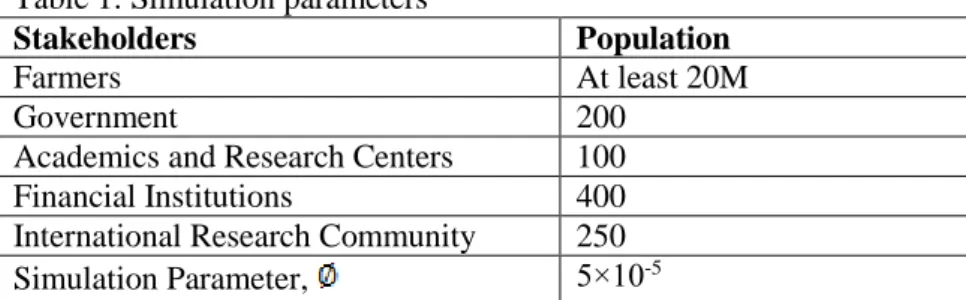
To illustrate the theoretical behavior and performance of the proposed mode, there was a need to perform simulations. This approach enabled us to visualize the practicality of the model with regard to properties in relatively shorter time compared to other model evaluation approaches such as building test beds. Let us consider a consortium composed of the following stakeholders; farmers, financial institutions, local research centers and academics, government and international research community. We assume that the population of these stakeholders are as shown in table 1. We may not need to get the exact figures to illustrate the utility of the model as a guided wild guess is good enough to demonstrate the desired objective of the model. We assume that all the stakeholders have enough interests to participate and to want to be represented in the consortium. That is, the stakeholders always have so much compelling reasons to join the consortium or to cooperate than the reasons to deviate. Since there is no sufficient reason for stakeholders to deviate from the desired objective, no form of penalty or cost function is included.
Table 1: Simulation parameters
Stakeholders Population
Farmers At least 20M
Government 200
Academics and Research Centers 100 Financial Institutions 400 International Research Community 250 Simulation Parameter, 5×10⁻⁵
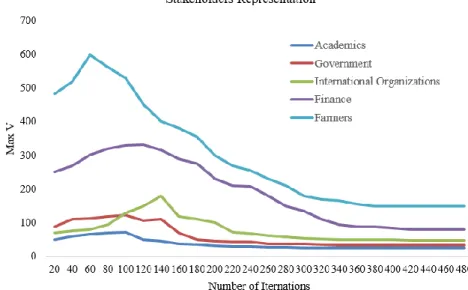
The value of V in the graph is the perceived optimal and ideal value for representing diverse interest of stakeholders as seen by the respective stakeholders themselves. Key observation made is that at the first few iterations, the max V value for each stakeholder tends to increase significantly with a factor of up to more than half of the total population from their respective pool. The value reaches its peak in the first 10th percentile of the graph and then begins to decrease gradually and later settles to
some low value in the last 20th percentile of the graph. In the first few iterations, the stakeholders tend
Figure 2. Individual stakeholders’ interests in the consortium
Figure 3 shows how the stakeholders would wish to be represented in the consortium on grounds that the slots they propose are adequate enough to bargain their agenda is ideally enough to always make their interests taken care of. Therefore, these stakeholders will always want to participate wholly and fully to ensure that the global objective of maximizing agricultural productivity is achieved. This is motivated by the fact that the stakeholders are aware that when the productivity of agriculture is at its highest peak, they are assured of high returns at individual level.
Figure 3. Consortium board members
4.2. Proposed eAgriculture Framework
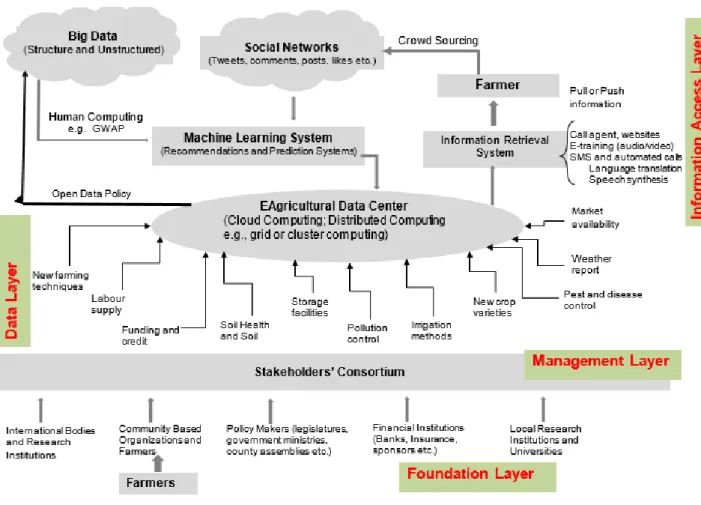
Figure 4. Proposed framework
i. Foundation Layer:
This layer contains all the stakeholders who participate in agriculture thus used to formulate the model, namely farmers, government, research institutions, international organizations and financial institutions. The objective of this layer is to identify all the stakeholders and their interests and contribution, categorize them into respective clusters for easy coordination and to agree with each other on the need to work together to support agriculture. Specifically, each stakeholder is expected to perform its role and together achieve desired high productivity in agriculture.
ii. Management Layer:
This being the second layer of the framework, its main objective is to coordinate and integrate the roles of each stakeholder towards increasing its contribution to agricultural productivity by enhancing cooperation among the stakeholders such that they complement each other. The objective of this layer is to develop a consortium or a board of trustees that can ensure that the individual interests of respective stakeholders are taken care of. Specifically, this layer ensures that stakeholders are brought together to work though individually but for the common goal, being to increase overall productivity of the system, while increasing individual output. Therefore this layer is crucial in the framework as it determines the sustainability and workability of the framework. It is the basis of ensuring that farmers have a single access point for agricultural information. In fact using this layer, all the stakeholders avail there services to farmers from a single point and not at individual level as it has been the case priori. How this layer is formulated and manage has been exhaustively discussed from view of resource allocation and maximization using game theory in section three. The end result at this layer is formation of the consortium.
iii. Data Layer:
farmers that have been shown to meet specific criterion such being timely, accurate, relevant and consumable. In most cases, stakeholders reach out to farmers at their own initiative by developing applications that they assume to meet the needs of the farmers and then push them to the farmers. Stakeholders then expected the farmers to use these applications to access information they needed from them. However, to the farmer, this could be a tedious and tiresome solution since there may exist so many services and solutions offered by one cluster of stakeholders and the farmers may need to access these solutions individually. Imagining so many entities (that is, ICT solutions) for all the clusters of stakeholders, then we are thinking of so many services some of which will be duplicating duties and functions of the others, yet the famer has to access them all. Being that they offer information separately, the task of collecting information from all of them before making a decision is very cumbersome to an average famer. The role of this layer is therefore to provide a single information access point where all the stakeholders can host their information and the farmer can access them from this one point. Given that the stakeholders had formed a consortium at layer 2, it is to their advantage that they share their resources with the farmer using a single information center. The other function of this layer is to provide secure data storage and to authenticate access, provide a way to integrate heterogeneous data from various stakeholder and to fusion from different stakeholders to support comprehensive information needs of farmers.
iv. Information Access Layer
This is the upper most layer of the framework and is used by the farmers to meet their information needs. Key functions of this layer is its ability to empower farmers to retrieve information from the data center that host information from all stakeholders therein giving farmers a single information access point. The information retrieval techniques is customized to the farmers’ needs based on their culture, gender, literacy level, digital divide, urgency just to mention a few. For instance, farmers can automatically call the stand by agents to get specific and relevant information on time as required. Besides, language translation, speech synthesis, automated SMSs and calls and dedicated websites for agriculture enables the farmers to access information ubiquitously.
Urgent information or any information meeting the farmers’ standing queries is automatically pushed to the farmers to their inboxes using SMSs or calls. Also, farmers can pull any relevant information they need from the system. The framework is well aware that farmers need to communicate and share information among themselves and to learn from others within the region and around outside the region. This layer handles this by incorporating social network, big data and human computing modules. In a nutshell, this layer is intended to empower the farmers to leverage the strength of the big data and the Internet to their advantage to support their decision making. Also, this layers helps the farmers to communicate among themselves using social media such as Facebook, Twitters as they comment, post, twit, like on these Web 2.0 applications.
The modules of proposed eAgriculture framework are as follows:
labour in the internet to do some task that require human beings’ ability. Example of such is Amazon mechanical turk.
Machine learning module: Machine learning algorithms are proposed to enable the framework extract what farmer relevant information from the Internet and social networks to enrich the agricultural data center. The ultimate goal is to make use the massive data available from the internet, labeled or unlabeled, to learn a concept and update the data center with the concept. Then the farmers is informed of the new concept whenever they need it. There are a lot of machine learning tools available ranging from supervised to unsupervised learning and even semi-supervised learning. The key idea is to cluster or classify concepts and use the learnt classification to make recommendations for current observation and even to predictions probable concepts based on the current observation. The task being done in this module can also be described as data mining.
Social networks and Web 2.0 module: Social networks such as Facebook, Twitter, Linkedin, Mettup, Whatsapp among others have brought new ways in which people interact and communicate. The traditional phone call, short message texting and letter writing is not so much used as these social network services. Computing and business society have realized this and they are currently using it to improve business sales and to give satisfactory user experiences. The proposed framework takes advantage of this to meet the needs of the farmers. This module therefore collects all the posts, comments, tweets, shares, likes, and tags etc. that are relevant to agriculture, processes them at the machine learning system, develops a new concept and updates the data center. As farmers and other users share information among themselves using some social network, for example photos of crop wilting in Uasin Gishu, other farmers (and social networks users) gets to comment or retweet these posts. This behavior has been called crowd sourcing. The work of the machine learning system is to extract all these relevant agricultural posts, deduce the concept and uprate the data center.
Information retrieval module: Now that the agricultural data center has been developed and the stakeholders’ forum is functional, the next task is to make this data center able to support the farmers’ informational needs. To achieve this, the framework has proposed an information retrieval system that is intended to crawl and search all the concepts in the data center to respond to the farmers’ queries. Farmers can decide to build information query and submit it to the information retrieval system. This query then gets executed periodically and all responses that meet the query needs are sent to the farmers, such as the Google alerts. Another option is that the farmers send their queries to the system when there is need. In such case, the data center is searched when there is a request from the farmers and not as periodically as before. This is a well-known task in computer science called information retrieval. In special cased, the retrieval system need to automatically send information to the farmers without farmers involvement particularly when there is an alert learnt in the data center. This is called push information.
However, when the request for information is triggered by the farmers themselves then the information retrieved by the system as response is referred in the system as pull request. Nevertheless, there is need to have the information availed to the farmers in a format and language that they can consume them. Call center agents who are able to speak the farmers native language may be needed in cases where the farmers cannot communicate in official languages like English or in even that the farmers are not literate and therefore cannot read text short messages or information displayed on webpages. Another option is to build a system a language translator plugin into the website that can change the website content to the language the farmers can access. Another option is to build a speech synthesis system that is able to convert text to audio and then translate it to the language of interest to the farmers. In this case, issues common problems in natural language processing such as disambiguation, parsing, among others become real issues. However, with intensive research currently on going in natural language processing, we can only hope that in the future, the systems would be able to query the data center and respond to the farmers using natural language tools. For now, we can only consider call agents, text language translation tools, short messages text and video tutorials for e-training.
The goal of this research was to empower the farmers with right and accessible information to make decisions anytime-anywhere in regard to improving their agricultural productivity. Specifically, there was a need to develop a single information access point that integrates all the agricultural solutions that farmers may need. In addition, the platform needed to allow the farmers to interact among themselves and with various stakeholders. In developing such a platform, a number of issues needed to be addressed such as potential conflicting interests among the users, developers and managers, and deriving a sustainable and optimal ground that meets all the interests of the concerned and interested stakeholders in agriculture. These two factors therefore informed the development framework. Farmers’ information need is precise and specific with the following characteristics; accuracy, relevant, timely and consumable. The information provided to the farmer need to be “just-in-time” to support farmers’ decision making, for example information on credit evaluations or locating a remote specialist for disease or pest diagnosis and treatment has to be accurate and timely. Besides, issues of literacy, use of local language, digital divide, culture and gender must be considered while packaging the information to the farmers in regard to their contexts. Otherwise, the information may just be inconsumable bearing in mind that these are smallholder farmers who are mostly based in the rural setup.
Meeting these farmers’ information needs relies on two strategies, that is, community participation approach and collaborative approach. In community participation approach, the farmers need to be made part of the process of designing and developing these eAgriculture solutions. While collaborative approach requires that since information needs of the farmers are vast and potentially cannot be provided by one source, there is need to ensure that all the information providers share a common goal of providing the information within their jurisdiction in a timely manner.
It was clear from the literature that there is a significant disconnect between the information needs of farmers and that which is provided by these trendy technologies offered by researchers community. Therefore there was a need to bridge this gap which in this thesis has been seen as a need to form a single point information access platform built on premise of formulating a consortium to harmonize the diverse and variant interests and contributions from all agricultural stakeholders. In such, farmers are enabled to access a synchronized information that reflects the interests of all the stakeholders without need to consult each stakeholder separately. This leads to a single information access point architecture.
A single point information access framework for eAgriculture was developed to promote innovative use of ICT to bridge the distance between the farmers and the stakeholders, and to bring transparency in agricultural market by discouraging middlemen in the market value chain. The framework is therefore an aggregation tool for farmers to leverage the collective bargain at both the supply and at the market ends. In addition, it enhance social interaction to promote community participation for instance using social media to assist crowdsource farmers’ needs besides encouraging organization of farmers into small groups at the community level. The key contribution of the framework is to that it bridges the gap between the information need of the farmer and that which is provided by the stakeholders by ensuring collaborative and cooperative participation among all the stakeholders.
In developing the framework, a number of issues and concerns arose in regard to eAgriculture implementation and adoption in Kenya that need a follow up research. Firstly, the integrated data center propose in the framework need to be hosted locally in a private cloud or with a trusted cloud service provider. However, it is critical to establish evaluation parameters to assist determine the latter as massive and sensitive data will be shared trusted to their hands. Besides, there is need to establish trust and reputation levels among the users of the framework as it is has an API to allow connection to Internet and web, and social media. Framework to evaluate these details is a potential future work coupled with the need to establish a robust data center back-up plan and recovery strategy.
specialists biased to agriculture (agricultural informaticians), who are able to interpret ICT solutions for agriculture based on agricultural needs and not technical needs. Most ICT specialists develop applications for agriculture with inclination to technological needs and less attention to the farmers’ needs.
Thirdly, there is need to integrate all ICT-in-agriculture tools motivated by wide spread ICT equipment within farmers’ reach (such as mobile phones, World Wide Web, smart devices - sensors among others). Moreover, successfully implementation of ICT-in-agriculture in Kenya should involve all the agriculture stakeholders and have their opinions and interests represented and catered for. Therefore, the Ministry of Agriculture and Livestock should be able to create agricultural consortium that has fair representation from these stakeholders as the country rolls out eAgriculture inititatives. At the basic level, farmers need to form groups at grassroots and regional level. The leaders of these groups need to members of the consortium. Using such initiative, farmers will get training on how to access information to improve their agricultural production using ICT devices within their reach. In addition, this will also support crowd-sourcing to assist spreading emergency information, for instance, an outbreak of highly infectious disease. In addition, the government needs to formulate robust eAgriculture policies to support the implementation of ICT-in-agriculture.
References
Armstrong L., & Diepeveen D. (2008). Developing an information-driven ICT framework for Agriculture. Asenso-Okyere, K., & Mekonnen, D. A. (2012). The importance of ICTs in the provision of information for improving agricultural productivity and rural incomes in Africa. African Human Development Report. UNDP
Sponsored research Series.
Awuor F., & Kimeli K. (2013). E-Agriculture framework: Modeling stakeholders’ competing and conflicting interests. International Journal of Agricultural Policy and Research, 1(6), 172-179.
Awuor F., & Rambim D. (2014). ICT4D: A Survey of ICT-in-Agriculture in Kenya and other Africa Nations.
Paper presented at the 9th Conference of the Asian Federation for Information Technology in Agriculture “ICT’s for future Economic and Sustainable Agricultural Systems”, Perth, Western Australia.
Ballantyne, P., Maru, A., & Porcari, E. M. (2010). Information and Communication Technologies— Opportunities to Mobilize Agricultural Science for Development. Crop Science, 50(Supplement_1), S-63-S-69. doi: 10.2135/cropsci2009.09.0527
Deloitte. (June 2011). Transformation-Ready: The Strategic Application of ICTs in Africa Impact of ICTs in
Agriculture: Deloitte
FAO. (2012a). Contribution of agricultural growth to reduction of poverty, hunger and malnutritionThe state of food insecurity in the world 28-35. Retrieved from www.fao.org/docrep/016/i3027e/i3027e04.pdf
FARA. (2006). Framework for African Agricultural Productivity / Cadre pour la productivité agricole en
Afrique. Paper presented at the [Forum for Agricultural Research in Africa], Accra, Ghana.
Grewal, B., Grunfeld, H., & Sheehan, P. (2012). The contribution of agricultural growth to poverty reduction: Australian Centre for International Agricultural Research (ACIAR).
Huarui, W., Chunjiang, Z., & Baozhu, Y. (2006). Research and Implementation on the Platform for Electronic
Agriculture with Web Application Server. Paper presented at the Semantics, Knowledge and Grid, 2006.
SKG'06. Second International Conference on. doi: 10.1109/skg.2006.75
Kelles-Viitanen, A. (2003). The role of ICT in poverty reduction. The Finnish Economy and Society, 82-94. Lotter, H. (2007). Are ICTs Prerequisites for the Eradication of Poverty? International Review of Information
Ethics, 7, 09.
Munyua, H., & Adera, E. (2009). Emerging ICTs and Their Potential in Revitalzing Small-Scale Agriculture.
Agricultural information worldwide, 2(1), 3-9.
Patil V.C., Gelb E., Maru A., Yadaraju N.T., Moni M., Misra H., . . . Ninomiya S. (2008). Adoption of
Information and Communication Technology (ICT) for Agriculture: An Indian Case Study. Paper presented at
the IAALD AFITA WCCA World Conference on Agricultural Information and IT.
Prakash S. (2000). Uganda-Information Technology and Rural Development: The Nakaseke Multi-Purpose Telecenter.
Rao N.H. (2007). A framework for implementing information and communication technologies in agricultural development in India. Technological Forecasting and Social Change, 74(4), 491-518. doi:
10.1016/j.techfore.2006.02.002
Romero A. F., & Adolph M. (2009). ICTs and food security ITU-T Technology Watch Report: International Telecommunication Union
Sexton R.J. (1994). A survey of noncooperative game theory with reference to agricultural markets: Part 1. Theoretical concepts. Review of Marketing and Agricultural Economics, 62(1), 11-28.
Singh J.V., Nagatsuka T., & Ninomiya S. (2008). Simplified e-Agriculture model implementation for developing
countries. Paper presented at the World conference on agricultural information and IT, IAALD AFITA WCCA
2008, Tokyo University of Agriculture, Tokyo, Japan, 24-27 August, 2008.
Sitalakshmi V. (2010). A Framework for ICT Security Policy Management. In E. A. Esharenana (Ed.),
Frameworks for ICT Policy: Government, Social and Legal Issues (pp. 1-14). Hershey, PA, USA: IGI Global.
doi: 10.4018/978-1-61692-012-8.ch001
Smart Farm Flagship. (2011). Smart Farm: services in agriculture. Hongkong: APAN Conference
Taragola N., & Gelb E. (2005). Information and Communication Technology (ICT) adoption in horticulture: A comparison to the EFITA baseline. ICT in agriculture: Perspectives of technological innovation. doi:
10.17660/actahortic.2009.831.8
Tiamiyu, M. A., Bankole, A. S., & Agbonlahor, R. O. (2012). Catalytic mechanisms for promoting ICT investment and use in cassava value chains in south-western Nigeria. Information Development, 28(2), 132-148. doi: 10.1177/0266666911431740
Vaghl Y., Armstrong L., & Diepeveen D. (2010). Application of a data mining framework for the identification
of agricultural production areas in WA. Paper presented at the Proceedings of the Knowledge Discovery for
Rural Systems 2010, Hyderabad, India.
Winrock International. (2003). Future directions in Agriculture and information and communication technologies (ICTs) at USAID. Retrieved from http://www.usaid.gov/info_technology/
World Bank. (2011). ICT in agriculture: connecting smallholders to knowledge, networks and institutions The ICT in Agriculture e-Sourcebook, Retrieved from www.ICTinAgriculture.org
Zhou Y. (2010). Smallholder agriculture, sustainability and the Syngenta Foundation. Syngenta Foundation for