A System for Speaker Detection and Tracking in Audio Broadcast News
Janez Žibert, Boštjan Vesnicer and France Miheliˇc University of Ljubljana, Faculty of Electrical Engineering Tržaška 25, SI-1000, Ljubljana, Slovenia
E-mail: [email protected]
Keywords:speaker diarization, speech detection, speaker clustering, audio indexing, speaker recognition, speaker track-ing
Received:May 22, 2007
A system for speaker-based audio-indexing and an application for speaker-tracking in broadcast news au-dio are presented. The process of producing an indexing information in continuous auau-dio streams based on detected speakers is composed of several tasks and is therefore treated as a multistage process. The main building blocks of such an indexing system include components for an audio segmentation, a speech detection, a speaker clustering and a speaker identification. We give an overview of each component of the system with emphasis to the approaches that are followed in each stage of building of our speaker-diarization and tracking system. The proposed system is evaluated on the audio data from the broadcast news domain, whereas we test each of the system’s component and measure their impacts to the over-all system’s performance. The evaluation results indicate the importance of an audio segmentation and a speech detection module to the reliable performance of the whole system. Based on an indexing informa-tion produced by our system we also developed an applicainforma-tion for searching target speakers in broadcast news. The application is designed in a way to be user-friendly and can be easily integrated in various computer environments.
Povzetek: Predstavljen je sistem za indeksacijo zvoˇcnih posnetkov glede na govorce in aplikacija tega sistema za iskanje govorcev v zvoˇcnih posnetkih informativnih oddaj.
1 Introduction
With the increasing availability of audio data derived from various multimedia sources comes an increasing need for efficient and effective means for searching and indexing through this type of information. Searching or tagging speech based on who is speaking is one of the more basic components required for dealing with spoken documents collected in large audio data archives, such as recordings of broadcast news or recorded meetings. In this paper, we focus on the indexing and searching of speakers in audio broadcast news (BN).
Audio data of BN shows present a typical multispeaker environment. The goal of searching and indexing of target speakers in such an environment is to find and identify the regions in the audio streams that belong to target speak-ers and produce an efficient way for accessing this regions from the audio data archives. The task of finding such speaker-defined regions is known as a speaker diarization task and was first introduced in the NIST1project ofRich
Transcription in’Who spoke when’evaluations, [7]. The task of identifying the regions according to given speakers is known as a speaker tracking task and was first defined in 1999 NIST Speaker Recognition evaluation, [14]. While diarization and tracking procedures serve for a detection of
1National Institute of Standards and Technology, http://www.nist.gov/speech/
speakers in audio data, is the purpose of speaker indexing an organization of audio data according to detected speak-ers for efficient speaker-based information audio-retrieval. In this paper, we present the approaches of speaker diariza-tion and tracking in multispeaker audio BN data.
2 Speaker diarization in continuous
audio streams
Speaker diarization is the process of partitioning input audio data into homogeneous segments according to the speaker’s identities. The aim of speaker diarization is to improve the readability of an automatic transcription by structuring the audio stream into speaker turns, and in cases when used together with speaker-identification systems by providing the speaker’s true identity. Such information is of interest to several speech- and audio-processing applica-tions. For example, in automatic speech-recognition sys-tems the information can be used for unsupervised speaker adaptation [1, 15], which can significantly improve the per-formance of speech recognition in large vocabulary contin-uous speech recognition (LVCSR) systems [10, 28, 4]. This information can also be applied for the indexing of multi-media documents, where homogeneous speaker or acous-tic segments usually represent the basic units for indexing and searching in large archives of spoken audio documents, [13]. The outputs of a speaker diarization system could also be used in speaker-identification and in speaker-tracking systems, [6, 20], which was also the case in our presented application.
Most speaker diarization systems for a detection of speakers in continuous audio streams have a similar general architecture, [3, 26]. First, the signal is chopped into homo-geneous segments. The segment boundaries are located by finding acoustic changes in the signal and each segment is expected to contain speech from only one speaker. Those segments, which do not represent speech data, are addi-tionally detected and discarded from a further processing. The resulting segments are then clustered so that each clus-ter corresponds to only one speaker. At the final stage, each cluster is labeled by a corresponding speaker iden-tification name or is left unlabeled, if the speech data in cluster do not correspond to any of the previously enrolled target speakers. As such, speaker diarization in continuous audio streams is a multistage process comprised by four main modules: an audio segmentation, a speech detection, a speaker clustering and a speaker identification.
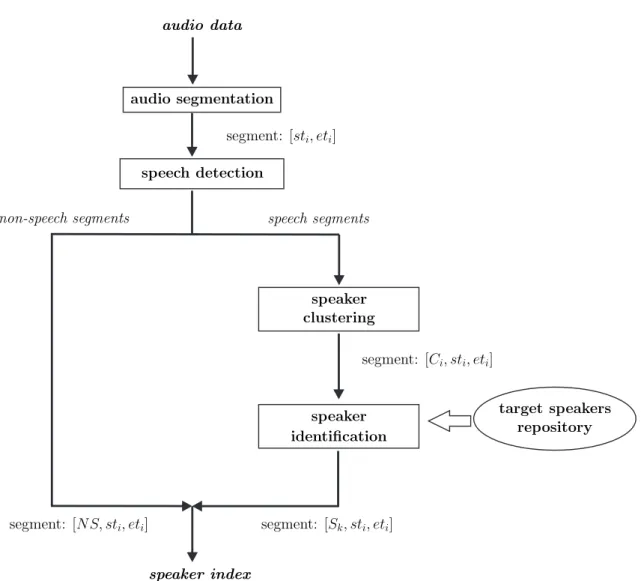
A baseline speaker-indexing system architecture, which was followed in this work, is shown in Figure 1. First, the audio signal is processed in an audio segmentation mod-ule, where time-stamps are produced at the locations of de-tected acoustic changes. Audio data are thus partitioned into small homogeneous segments labeled by starting and ending time of each segment (segments: [sti, eti]in Fig-ure 1). It is expected that each such segment should con-tain data from just one acoustic source, i.e. speech from one speaker or non-speech data corresponding to music, silence or other non-speech source. Therefore, the ob-tained segments should be additionally divided to those, which contain speech or non-speech data. This is done in a speech detectionmodule. Non-speech segments are marked as [N S, sti, eti] in Figure 1 and are discarded from further processing. Only speech segments are then
passed through aspeaker clusteringmodule. The aim of a speaker clustering is to merge speech segments from each speaker together, a major issue being that the information of speakers and the actual number of speakers are unknown
a prioriand need to be automatically determined. At this stage, just relative speaker labels are produced and seg-ments are marked with automatically derived cluster names (segments[Ci, sti, eti]in Figure 1). The true identities of the speakers are obtained in aspeaker identificationmodule in the next stage. Here, a multiple speaker verification of each cluster is performed. Speaker identification module is capable to recognize just those speakers, who are presented in the repository of the target speakers and are previously enrolled into the system. Speech data from clusters, which do not correspond to any of the speakers from target group, should be marked as unknown speaker data and are dis-carded from further processing.
Our speaker-indexing system [35] was designed in such a way, that all the modules include the standard approaches from similar state-of-the-art systems. In the following sub-sections each of the integrated module is described in more details.
2.1 Audio segmentation module
In general, spoken audio documents derived from BN shows include data from multiple audio sources, which may contain speech of different speakers as well as music segments, commercials and various types of noises, that are present in the background of BN reports. Another charac-teristic of BN audio documents is, that the data are deliv-ered in the form of continuous audio streams. In order to ef-ficiently process and extract the required information from such documents the continuously derived audio data should be adequately chopped into smaller portions of data, which are suitable for further processing. In the case of speaker-tracking applications the process of breaking the continu-ous audio streams into the homogenecontinu-ous regions based on speaker turns is done in an audio segmentation module.
audio data
speaker index
speaker identification
target speakers repository speaker
clustering speech detection
audio segmentation
speech segments non-speech segments
segment: [sti, eti]
segment: [Ci, sti, eti]
segment: [Sk, sti, eti]
segment: [N S, sti, eti]
Figure 1: Main building blocks of a typical speaker-indexing system. Most systems have modules to perform speech detection, audio segmentation, speaker clustering and speaker identification, which may include component for gender detection.
of the audio segmentation module were acoustic change detection points, which defined basic audio segments for further processing.
This procedure is widely used in most of the current audio-segmentation systems [26, 7, 23, 30, 12, 33], and performed the best in comparison to alternative audio-segmentation approaches [26].
2.2 Speech detection module
The aim of this module in a speaker diarization system is to find the regions of speech in an audio stream. Since the audio stream was in our case already segmented into homo-geneous regions of audio data based on acoustic changes, a speech detection module had to distinguish, which regions correspond to speech and non-speech data. The problem here represent non-speech data, which may consist of many acoustic phenomena such as silence, music, background noise or cross-talk.
au-dio data, [34], proved that a combination of acoustic fea-tures – modeled by mel-frequency cepstral coefficients (MFCCs) – and our proposed phoneme-recognition fea-tures constituted the most powerful representation of au-dio data, which were robust enough and relatively unsensi-tive to different training and unforseen conditions. Hence, we also implemented this kind of fusion of acoustic and phoneme-recognition representations in our speech detec-tion module. The speech detecdetec-tion was performed by using a standard maximum likelihood classification with just two GMMs (one model for speech and the other for non-speech data) on already segmented audio streams, which were ob-tained from the previously described audio segmentation module.
Detected speech segments were further passed to a speaker clustering module, while non-speech segments were discarded from further processing.
2.3 Speaker clustering module
The purpose of this stage is to associate or cluster segments from the same speaker together. The ideal clustering should produce one cluster for each speaker, which should include all segments of a given speaker.
The general clustering method, which was also followed in our speaker-indexing system, is to perform agglomera-tive clustering using bottom-up approach, [25]. The basic steps of the speaker-clustering algorithm based on this ap-proach can be described in the following steps [35]:
1. Initialization step: Model each segment by a single Gaussian distribution.
2. Merging step:Use a BIC measure to estimate whether to join two clusters or not. The candidates for merg-ing are those clusters, where the lowest BIC score is achieved.
3. Stopping step:Repeat the second step until some stop-ping criterion is not satisfied.
Since in our speaker-clustering approach a BIC mea-sure was used for merging, clusters should be modeled by Gaussian distributions. In the initialization step each seg-ment represents one cluster. In the merging step joining of clusters (segments) is performed by searching a mini-mum (or maximini-mum, depending on BIC measure) BIC score among all possible pair-wise combinations of clusters. A BIC measure is usually the same as one used for audio segmentation and also possesses the same philosophy. It measures the difference when modeling the data from two separate clusters with two normal distributions and when modeling with just one. The low differences speak in fa-vor of modeling the data with just one distribution, mean-ing that the data the most likely belong to just one audio source, i.e. one speaker in our case, while higher differ-ences support hypothesis that the data from separate clus-ters correspond to different speakers. The merging process is generally stopped when the lowest BIC score is greater
than a specified threshold, but there can be also applied other stopping criteria, [35]. The stopping criterion is criti-cal for a good performance and depends on how the output to be used [26]. In our speaker-tracking system a stopping threshold was used, which was estimated from the develop-ment data to optimize the speaker clustering performance.
The output of the speaker clustering module contains segments with relative labels, which join speech segments of the same speaker together. Non-speech segments are treated in this stage as separate cluster. The task of such labeling of continuous audio streams is known as a speaker diarization task and can be used in various audio processing applications.
In this stage, several improvements can be made to increase a speaker diarization performance, like joint segmentation and clustering [17] and/or cluster re-combination [31], but in the case of indexing information by speakers in our speaker-tracking system we found no additional gain in the performance when applying some of these methods.
2.4 Speaker identification module
Since speaker diarization systems only produce relative speaker labels (such as ’spk1’), additional modules for speaker identification has to be included into the system, when the true identities of the speakers are needed. This can be achieved in various ways. We decided to follow the standard approach of building speaker models for peo-ple who are likely to be in the news broadcasts (such as prominent politicians or main news anchors and reporters) and including these models in the last stage of the speaker-indexing system.
adaptation [8, 22], which was also applied in our speaker identification module.
In addition to that, we computed a new set of MFCC fea-tures, which were subjected to feature warping [21] to com-pensate different channel effects, and the log-likelihood scores normalization was performed at the end by apply-ing ZT-normalization technique [2].
At the output of this stage the audio streams are equipped with the segment-time boundaries together with true speaker identification labels. Those clusters of seg-ments, of which data do not belong to any of the enrolled speakers, get empty labels correspond to ’unknown’ speak-ers. The output from this module also present the final results of the speaker-based audio-indexing and can be used for a detecting speakers in speaker-tracking applica-tions. An application for speaker-tracking in BN shows, which was based on speaker’s information obtained from our speaker-indexing system, is described in the last sec-tion.
3 Evaluation experiments
Evaluation of our speaker-based audio-indexing system was performed on the SiBN database [32], which consisted of 32 hours of BN shows in Slovenian language. 20 hours were used for an estimation of all the open parameters in all of the components of our indexing system, and the rest 12 hours served for the assessment of the system’s perfor-mance.
The open parameters in the audio segmentation, the speech detection and the speaker clustering module corre-sponded to setting the thresholds to optimize the overall speaker diarization performance on the training data. In the audio segmentation module a threshold had to be es-timated in the penalty factor of the BIC measure. It was set so to detect as many true change-detection points in the audio streams, while in the same time preserve low rate of miss-detected segment boundaries. The emphasis was put more on a detection of true segment boundaries, even if additional segment boundaries were falsely detected. In that case the over-segmented audio streams were produced, but they had almost no influence on the overall speaker diarization results while using them as inputs in speaker clustering module. In the case of under-segmented audio data it was found, that they could heavily degrade speaker-diarization and tracking performance. The same phenom-ena was explored in our speaker clustering module. Here, a threshold for stopping criteria of a merging process in a bottom-up clustering procedure had to be estimated. By setting a proper threshold we could optimize the speaker-diarization performance on the training data, but it was found out that this did not necessary reflect in the overall best performance of the speaker tracking system. The op-timal performance was achieved in the case, when clusters did not contain speech from several speakers, i.e. a bet-ter performance was achieved in the under-clusbet-tering case,
where speaker data were distributed over several clusters, rather than in the over-clustering case where too many con-taminated clusters were produced containing speech from different speakers, which degraded a speaker-detection per-formance.
Another important issue was concerning a speech de-tection module. As was shown in [36] the impact of a speech detection in speaker diarization and tracking sys-tems is direct and indirect. Since, non-speech data are treated as data from one of the speakers in the speaker-tracking system, a speech detection has a direct influence on the speaker-tracking results. On the other hand, an erro-neous speech/non-speech classification of audio segments in the speaker-indexing system influences a speaker clus-tering and identification performance. Therefore, a good speech detection in continuous audio streams is a nec-essary pre-processing step for achieving a good speaker-diarization and tracking results. Since we decided to use a fusion of acoustic and phoneme-recognition features in a speech detection module, we had to apply a simplified version of a phoneme recognizer for deriving phoneme-recognition features. The recognizer was built on a stan-dard way, using Hidden Markov models (HMMs) trained on Slovenian data. In addition, we had to estimate two GMMs for detecting speech and non-speech data, which were estimated from the training part of the SiBN database. Since in a speaker identification module a true detection of speakers was carried out, GMM of each target speaker had to be provided. They were built from UBMs, which were trained on the speech data of the training part from the SiBN database. We were designed two UBMs corre-sponding to female and male speech data. All the models were constituted from 1024 Gaussian mixtures, which were estimated using Baum-Welch Expectation-Maximization (EM) algorithm. The GMM model for each target speaker was derived from corresponding UBM using MAP adapta-tion technique in a standard way, [22]. The evaluated sys-tem was capable to detect 41 target speakers, which were extracted from the training data in the enrollment phase. In the test phase, data from each cluster were compared against all of the models from target-speakers repository and LR score were produced. In the evaluation phase no additional score threshold was proposed, since we tried to evaluate the system in the whole range of all the possible operating points.
Note that gender-dependent UBMs were used for de-riving speaker-dependent GMMs, meaning that in the test phase a gender classification was performed at first by us-ing the same gender UBMs, which were also applied in the estimation of the target speaker models.
performing a Viterbi decoding on a classification network of speech and non-speech GMMs. The training of GMMs and decoding through the network was done by usingHTK Toolkit, [37], while the acoustic and phoneme-recognition features were produced by our own tools. The same set of acoustic features was then used in the speaker identification module, where all the training and testing procedures were also implemented by our own tools.
3.1 Evaluation results
Since several modules were included in the speaker-based audio-indexing system of BN shows, series of experiments were performed to measure the impact of each module to the overall speaker-tracking results.
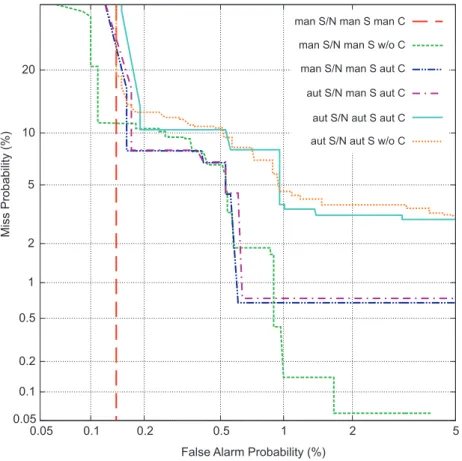
Overall results of the evaluated speaker-tracking sys-tems are depicted in Figure 2. The results are presented in terms of false acceptance (FA) and false rejection (FR) rates (false alarm and miss probabilities in Figure 2), mea-sured at different operating points in the form of Detection Error Trade-off (DET) curves, [14]. In our case, the eval-uated speaker tracking systems were capable to detect 41 target speakers from the audio data, which include 551 dif-ferent speakers. The performances of the evaluated systems were therefore assessed by including all 41 target speakers with the addition of non-speech segments and the results were produced by FA and FR rates measured at the time (frame) level.
Figure 2 presents the evaluation results from six tested speaker-tracking systems, whereas different versions of system’s components were combined. Only the speaker identification module was the same in all the evaluations, while other components (audio segmentation, speech de-tection and speaker clustering module) were combined by applying manual or automatic version of each procedure. In addition to that, two versions of speaker-tracking system without speaker clustering were also tested. In this way we tried to estimate the gain of each component to the over-all speaker-tracking results. In Figure 2, a procedure for speech detection is marked asS/N(referring to speech/non-speech detection), procedures for audio segmentation are marked asSand for speaker clusteringC. Manual versions of each procedure are abbreviated asman, automatic ver-sions as aut, and in systems, where one of the procedure was missing, an abbreviationw/ois used for that procedure. For example, a system where manual audio segmentation was used prior to automatic speech/non-speech detection and automatic speaker clustering is in Figure 2 marked as
(aut S/N man S aut C), a system, where everything was per-formed automatically, is marked as(aut S/N aut S aut C), etc.
The evaluation results in Figure 2 are displayed in terms of DET curves. They are ranging from the best performance of a system, where all procedures, except speaker identification, were preformed manually, to a sys-tem, where all the procedures were performed automati-cally.
The impact of speaker clustering were explored in series of experiments with systems(man S/N man S man C),(man S/N man S aut C), and(man S/N man S w/o C), where audio segmentation and speech detection were performed manu-ally, and with systems(aut S/N aut S aut C)and(aut S/N aut S w/o C), whereSandS/Nprocedures were performed automatically. Results from Figure 2 reveal expected per-formances of these systems. The best results were obtained in a system where everything was carried out manually, next to them are results from the system, where just speaker clustering procedure was applied automatically, and at the end are systems where all three procedures were done au-tomatically. A comparison of the system(man S/N man S man C)and the system(man S/N man S aut C)indicates that a proper speaker clustering can significantlly improve the overall performance of a speaker-tracking system. The same can be concluded for speech detection and audio seg-mentation tasks by expecting the performances of the sys-tems (man S/N man S aut C) and(aut S/N aut S aut C). When applying automatic versions of audio segmentation and speech detection into the speaker-tracking system (by using the same speaker clustering procedure), the overall results of the system dropped for around 3% in the whole range of the operating points. Another important issue can be observed by expecting the systems(man S/N man S aut C)and(man S/N man S w/o C), and the systems(aut S/N aut S aut C)and(aut S/N aut S w/o C). In this evaluations we investigated whether it is better to use a speaker cluster-ing procedure in speaker-trackcluster-ing systems or not. As can be seen from Figure 2 there is no so much difference in the performances of the systems, where clustering was ap-plied, to those without clustering. Our tracking results with automatic clusterings show that just a marginal gain could be obtained. This indicates that in our case the speaker-tracking system could not benefit from speaker clustering. The same was shown in the study of speaker tracking of radio broadcast news in [18], where it was concluded that a speaker identification can even help to improve a speaker clustering performance and not a vice versa.
er-Figure 2: The overall speaker-tracking results of six evaluated systems. Lower DET values correspond to better perfor-mance.
rors were therefore integrated into the overall results of the evaluated system(aut S/N aut S aut C).
Another evaluation perspective can be obtained by ex-ploring systems(man S/N man S aut C)and(aut S/N man S aut C). By comparing evaluation results of both systems we can estimate the gain of the speech detection proce-dure alone to the overall speaker-tracking results. As can be seen from the evaluation results in Figure 2, is the dif-ference in the overall performances of systems, when us-ing a manual and an automatic version of speech detec-tion procedure, minimal. This marginal difference in the DET results was achieved due to the usage of the manual audio segmentation procedure in both systems. By apply-ing a speech/non-speech detection procedure in a combina-tion with manual segmentacombina-tion (described in Seccombina-tion 2.2), a surprisingly high overall speech/non-speech accuracy of 99.38% was achieved, which resulted in the minimal differ-ence of both evaluated systems. Note, that we used our own method for speech/non-speech detection, which proved to be a better choice for the speaker-diarisation and tracking tasks, as it was shown in a comparison study in [36].
To sum up, the comparison of the evaluation results of the different versions of the speaker-tracking system provides valuable insights of how the system works and which components of the system have greater impact on the overall performance. The overall results reveal an
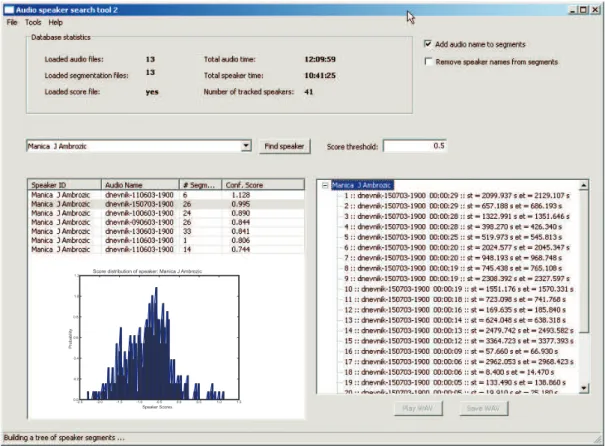
Figure 3: A graphical user interface of a speaker-tracking system.
4 Speaker tracking system
A derivation of indexing information by speakers is an im-portant step in applications, which are used for searching speakers in large archives of audio data. In this section we present one such application for a detection of speakers in continuous audio streams of BN shows, which are based on the system for a speaker-based audio-indexing presented in previous sections.
The application was designed in a way to separate pro-cesses of audio-indexing and searching of target speakers. This is also a standard approach in search engines based on text data. The indexing process is usually done once in a while, i.e. when new data arrive and index has to be up-dated, while searching of information is done all the time.
In our application the process of audio-indexing was performed once on the BN data from the SiBN database. The output of this process were time boundaries of speech segments with target-speaker’s scores. And in the search-ing process the audio segments correspondsearch-ing to a given speaker have to be provided and properly displayed to a user. A graphical user interface of our searching applica-tion is shown in Figure 3.
In the top pane of the application in Figure 3 are dis-played some base properties of an audio database, which is currently loaded into the system, i.e. the information of to-tal audio data time, of speech data time, how many speakers can the system detect, etc. In the middle pane is the search
form, which includes a list of all possible target speakers, which the system is capable to find, and the score threshold, that can be optionally set to return just those speech seg-ments, where speaker-detection scores are above the given threshold. The two bottom panes display information of the speaker, who has to be found by hitting theFind-speaker
button. The bottom-left pane are filled with cluster infor-mation corresponding to a searched speaker, which are in the case of BN data divided to each BN show. The clusters are by default sorted by a confidence score, but the applica-tion also provides other sort possibilities, i.e. sorting by BN show name, number of segments in cluster, speaker name, etc. At the bottom of this pane it is also showed a histogram of the LR scores of a given speaker from all possible clus-ters in the database. A speaker score-distribution displayed in a histogram can serve for estimating the optimal thresh-old for obtaining just speech data of the current speaker . In this way a user can control the amount of data that are displayed and can inspect how likely the current data cor-respond to a searched speaker. The right-bottom pane in Figure 3 displays a list of all segments of a target speaker’s cluster, which is marked in the left-bottom pane. A change in cluster (in the left-bottom pane) cause a fill of a new list with segments of that marked cluster. A user can listen or save the audio data by clicking on one of the displayed segments.
the application was designed by using wxPython cross-platform GUI Toolkit2. The application was implemented
to operate as a stand-alone process and currently works just for searching speakers in BN shows, but it can be easily ex-tended for other types of audio documents. Since the appli-cation expects that the audio-indexing is done beforehand, it is also independent of the methods used in the audio-indexing system. As such, it can be integrated in various types of computer applications and environments.
5 Conclusion
A system for speaker-based audio-indexing and an appli-cation for speaker-tracking in BN audio data based on this system were presented. We gave an overview of four main building blocks of such audio-indexing system and pro-vide an extensive evaluation of all of the system’s compo-nents. While they were modules for an audio segmentation, a speaker clustering and an identification implemented by using the latest state-of-the-art approaches, was in a mod-ule for speech detection followed our own approach of in-corporating phoneme-recognition features in a classifica-tion process. In the evaluaclassifica-tion experiments the impact of each module to the overall speaker-tracking performance was measured. It was found out that the most critical com-ponent of such a system is an audio segmentation module, since it is usually applied in the first processing stages of such system and its poor performance causes unreliable performances of all other components. Nevertheless, the evaluation results demonstrate an acceptable performance of the system, where all of the procedures were performed automatically. This system were later applied for an audio-indexing of BN shows in a speaker-tracking application. An application was designed to serve as a search tool for speakers, who are likely to be in the news broadcasts, but it could be easily extended for other types of audio docu-ments.
Acknowledgement
This work was supported by the two Slovenian Research Agency (ARRS), development projects: L2-6277 (C) en-titled “Broadcast news processing system based on speech technologies” and M2-0210 (C) entitled “AvID: Audiovi-sual speaker identification and emotion detection for secure communications.”
References
[1] T. Anastasakos, J. McDonough, R. Schwartz, J. Makhoul (1996) A Compact Model for Speaker-Adaptive Training, Proceedings of International Conference on Spoken Language Processing (IC-SLP1996), Philadelphia, PA, USA, 1996, pp. 1137-1140.
2http://www.wxpython.org/
[2] R. Auckenthaler, M. Carey, & H. Lloyd-Thomas (2000) Score normalization for text-independent speaker verification system, Digital Signal Process-ing, Vol. 10, No. 1, January 2000, pp. 42-54.
[3] C. Barras, X. Zhu, S. Meignier, & J.-L. Gauvain (2006) Multistage Speaker Diarization of Broadcast News,IEEE Transactions on Speech, Audio and Lan-guage Processing, Special Issue on Rich Transcrip-tion, Vol. 14, No. 5, September 2006, pp. 1505-1512.
[4] P. Beyerlein, X. Aubert, R. Haeb-Umbach, M. Har-ris, D. Klakow, A. Wendemuth, S. Molau, H. Ney, M. Pitz & A. Sixtus (2002) Large vocabulary continuous speech recognition of Broadcast News ˝U The Philip-s/RWTH approach,Speech Communications, Vol. 37, No. 1-2, May 2002, pp. 109-131.
[5] S. S. Chen & P. S. Gopalakrishnan (1998) Speaker, environment and channel change detection and clus-tering via the Bayesian information criterion, Pro-ceedings of the DARPA Speech Recognition Work-shop, Lansdowne, Virginia, USA, February 1998, pp. 127-132.
[6] P. Delacourt, J. Bonastre, C. Fredouille, T. Merlin & C. Wellekens (2000) A Speaker Tracking Sys-tem Based on Speaker Turn Detection for NIST Evaluation, Proceedings of International Confer-ence on Acoustics, Speech, and Signal Processing (ICASSP2000), Istanbul, Turkey, June, 2000.
[7] J. Fiscus, J. S. Garofolo, A. Le, A. F. Martin, D. S. Pallet, M. A. Przybocki & G. Sanders (2004) Results of the Fall 2004 STT and MDE Evaluation, Proceeed-ings of the Fall 2004 Rich Transcription Workshop, Palisades, NY, USA, November 2004.
[8] J. L. Gauvain & C.-H. Lee (1994) Maximum a pos-teriori estimation for multivariate Gaussian mixture observations of Markov chains,IEEE Trans. Speech, and Audio Processing, Vol. 2, No. 2, April 1994, pp. 291-298.
[9] J.-L. Gauvain, L. Lamel & G. Adda (1998) Partition-ing and Transcription of Broadcast News Data, Pro-ceeedings of the International Conference on Spoken Language Processing (ICSLP98), Sydney, Australia, December 1998, pp. 1335-1338.
[10] J. L. Gauvain, L. Lamel & G. Adda (2002) The LIMSI Broadcast News transcription system, Speech Com-munications, Vol. 37, No. 1-2, May 2002, pp. 89-108.
[11] T. Hain, S. E. Johnson, A. Tuerk, P. C. Woodland & S. J. Young (1998) Segment Generation and Clustering in the HTK Broadcast News Transcription System,
[12] D. Istrate, N. Scheffer, C. Fredouille & J.-F. Bonastre (2005) Broadcast News Speaker Tracking for ESTER 2005 Campaign,Proceedings of Interspeech 2005 -Eurospeech, Lisbon, Portugal, September 2005, pp. 2445-2448.
[13] J. Makhoul, F. Kubala, T. Leek, D. Liu, L. Nguyen, R. Schwartz & A. Srivastava (2000) Speech and lan-guage technologies for audio indexing and retrieval,
Proceedings of the IEEE, Vol. 88, No. 8, 2000, pp. 1338-1353.
[14] A. Martin, M. Przybocki, G. Doddington & D. Reynolds (2000) The NIST speaker recognition eval-uation - overview, methodology, systems, results, per-spectives,Speech Communications, Vol. 31, No. 2-3, June 2000, pp. 225-254.
[15] S. Matsoukas, R. Schwartz, H. Jin & L. Nguyen (1997) Practical Implementations of Speaker-Adaptive Training,Proceedings of the 1997 DARPA Speech Recognition Workshop, Chantilly VA, USA, February 1997, pp. 1137-1140.
[16] F. Mihelic & J. Zibert (2006) Robust speech detec-tion based on phoneme recognidetec-tion features, Proceed-ings of Text, speech and dialogue (TSD 2006), Brno, Czech Republic, September 2006, pp. 455-462.
[17] S. Meignier, J.-F. Bonastre, C. Fredouille & T. Mer-lin (2000) Evolutive HMM for Multi-Speaker Track-ing System,Proceedings of IEEE International Con-ference on Acoustics, Speech and Signal Processing (ICASSP 2000), Istanbul, Turkey, June 2000.
[18] D. Moraru, M. Ben & G. Gravier (2005) Experiments on speaker tracking and segmentation in radio broad-cast news, Proceedings of Interspeech 2005 - Eu-rospeech, Lisbon, Portugal, September 2005.
[19] P. Nguyen, L. Rigazio, Y. Moh & J. C. Junqua (2002) Rich Transcription 2002 Site Report. Pana-sonic Speech Technology Laboratory (PSTL), Pro-ceeedings of the 2002 Rich Transcription Workshop, Vienna, VA, USA, May 2002.
[20] B.Nedic, G. Gravier, J. Kharroubi, G. Chollet, D. Petrovska, G. Durou, F. Bimbot, R. Blouet, M. Seck, J.-F. Bonastre, C. Fredouille, T. Merlin, I. Magrin-Chagnolleau, S. Pigeon, P. Verlinde, & J. Cernocky (1999) The Elisa’99 Speaker Recognition and Track-ing Systems,Proceedings of IEEE Workshop on Au-tomatic Advanced Technologies, 1999.
[21] J. Pelecanos & S. Sridharan (2001) Feature warp-ing for robust speaker verification, Proceedings of the Speaker Odyssey Workshop, Crete, Greece, June 2001, pp. 213 ˝U218.
[22] D. A. Reynolds, T. F. Quatieri, & R. B. Dunn (2000) Speaker verification using adapted Gaussian mixture
models, Digital Signal Processing, Vol. 10, No. 1, January 2000, pp. 19-41.
[23] D. A. Reynolds & P. Torres-Carrasquillo (2004) The MIT Lincoln Laboratory RT-04F Diarization Sys-tems: Applications to Broadcast Audio and Tele-phone Conversations,Proceeedings of the Fall 2004 Rich Transcription Workshop, Palisades, NY, USA, November 2004.
[24] R. Sinha, S. E. tranter, M. J. F. Gales & P. J. Wood-land (2005) The Cambridge University March 2005 speaker diarisation system, Proceedings of Inter-speech 2005 - EuroInter-speech, Lisbon, Portugal, Septem-ber 2005, pp. 2437-2440.
[25] S. Theodoridis & K. Koutroumbas (2003) Pattern Recognition (2nd edition), Academic Press, 2003.
[26] S. Tranter & D. Reynolds (2006) An Overview of Automatic Speaker Diarisation Systems,IEEE Trans-actions on Speech, Audio and Language Processing, Special Issue on Rich Transcription, Vol. 14, No. 5, September 2006, pp. 1557-1565.
[27] A. Tritschler & R. Gopinath (1999) Improved speaker segmentation and segments clustering using the Bayesian information criterion,Proceedings of EU-ROSPEECH 99, Budapest, Hungary, September 1999, pp. 679-682.
[28] P. C. Woodland (2002) The development of the HTK Broadcast News transcription system: An overview,
Speech Communications, Vol. 37, No. 1-2, May 2002, pp. 47-67.
[29] C. Wooters, J. Fung, B. Peskin & X. Anguera (2004) Towards Robust Speaker Segmentation: The ICSI-SRI Fall 2004 Diarization System, Proceeedings of the Fall 2004 Rich Transcription Workshop, Pal-isades, NY, USA, November 2004.
[30] B. Zhou & J. Hansen, (2000) Unsupervised Audio Stream Segmentation and Clustering via the Bayesian Information Criterion, Proceedings of International Conference on Spoken Language Processing (ICSLP 2000), Beijing, China, October 2000, pp. 714-717.
[31] X. Zhu, C. Barras, S. Meignier & J.-L. Gauvain (2005) Combining Speaker Identification and BIC for Speaker Diarization,Proceedings of Interspeech 2005 - Eurospeech, Lisbon, Portugal, September 2005, pp. 2437-2440.
[33] J. Žibert, F. Miheliˇc, J.-P. Martens, H. Meinedo, J. Neto, L. Docio, C. Garcia-Mateo, P. David, J. Zdan-sky, M. Pleva, A. Cizmar, A. Žgank, Z. Kaˇciˇc, C. Teleki & K. Vicsi (2005) The COST278 Broadcast News Segmentation and Speaker Clustering Evalua-tion - Overview, Methodology, Systems, Results, Pro-ceedings of Interspeech 2005 - Eurospeech, Lisbon, Portugal, September 2005, pp. 629-632.
[34] J. Žibert, N. Paveši´c & F. Miheliˇc (2006) Speech/Non-Speech Segmentation Based on Phoneme Recognition Features, EURASIP Jour-nal on Applied SigJour-nal Processing, Vol. 2006, No. 6, Article ID 90495, pp. 1-13.
[35] J. Žibert (2006) Obdelava in analiza zvoˇcnih pos-netkov informativnih oddaj z uporabo govornih tehologij, PhD thesis, Faculty of electrical engineer-ing, University of Ljubljana, 2006.
[36] J. Žibert, B. Vesnicer & F. Miheliˇc (2007) Novel Ap-proaches to Speech Detection in the Processing of Continuous Audio Streams, Robust Speech Recog-nition and Understanding, M. Grimm, K. Kroschel (Eds.), I-Tech Education and Publishing, 2007, pp. 23-48.