Dynamic Distribution of Java Applications
Gita Alagbhand and David Gnabasik
University of Colorado at Denver and Health Sciences Center Department of Computer Science and Engineering
Campus Box 109, P.O. Box 173364, Denver CO 80217-3364, USA E-mail: [email protected] P:303-556-2940 F:303-556-8369 E-mail: [email protected] P:303-994-2740 F:303-617-7877
Keywords:Java, component streams, class loader, mobile devices
Received:April 10, 2007
This paper describes a streaming mechanism that distributes Java class bytecode streams to a client from a database server. The class server uses a 1st-order Markov probability model to effectively predict the client’s next class request. Experimental results demonstrate that class prediction can deliver a class cache hit ratio of up to 54% using a modest cache size of 64kb on the client, whereas a 16kb cache delivers a hit ratio of 37%. The model is designed to mitigate the distribution and deployment problems of monolithic application software and is useful for applications running on resource-constrained, mobile computing devices.
Povzetek: ˇClanek opisuje postopek dinamiˇcnega porazdeljevanja aplikacij v Javi.
1 Introduction and problem
description
Dynamic component streams can address several client software distribution and deployment issues, including the automated update of applications from a centralized soft-ware repository, as well as the delivery of application streams to resource-constrained mobile devices. We submit that the process of application deployment can take advan-tage of the dynamic linking and class loading [3] mecha-nisms in Java compilers to support a distributed component model that does not require the streaming of large mono-lithic applications to these devices. Java class hierarchies are stored as Java bytecode streams into database rows by a class author. A streaming mechanism then transmits a virtual application to a client’s process space from a class server. Our class server uses a 1st-order Markov transition probability model to effectively predict the client’s next class request based upon the statistical analysis of histori-cal application runs. This permits for the effective overlap-ping of client-server communication with client process-ing. The Java linking model and class file format are suited for managing this problem since the class file is analyzed and stored as the unit of compilation [2]. We manage and optimize system performance by:
– decomposing and storing class hierarchies into a database;
– defining an effective asynchronous streaming compo-nent model;
– retrieving the most probable class subgraphs to be ac-tivated next;
– effectively managing limited available client memory.
This paper is organized as follows. In section 2, we de-scribe each architectural component of the system and the underlying theory. Section 3 outlines its design and im-plementation. Section 4 describes our experimental mea-surements. Section 5 discusses related work, and section 6 presents our conclusions and summarizes the contributions of this paper.
2 System architecture
2.1 Class authoring and client access roles
The role of the class author is to correctly compile and store Java components or entire applications as binary streams of Java bytecode into a database. By doing so, the class authoring interface encapsulates much of the complexity of class relations and their distribution. The primary function of the interface is to scan each class for referenced classes and to store this list into the database as well. The authoring interface also manages the following information:
– appropriate class / application authorization and secu-rity measures;
– any class digital signatures or certificates;
– what foundation set of Java classes are required lo-cally on the client;
Consumer-Producer Channel (CPC) Client PC
Class Browser
Event Notification System JVM1 on Client1
ClassLoader-NameSpace 1 Connection 1A
ClassLoader-NameSpace 2 Connection 2AConnection 2B
Client Comsumer Buffer
Class Database
Class Streamer
Performance monitor Database
Security Interface Client1 Cache
Client2 Cache Common Cache
Class Name Resolution
Service Streaming Dsitribution
Monitor Thread Pool Connection
Pool
Database Server 1 TCP/IP Connection
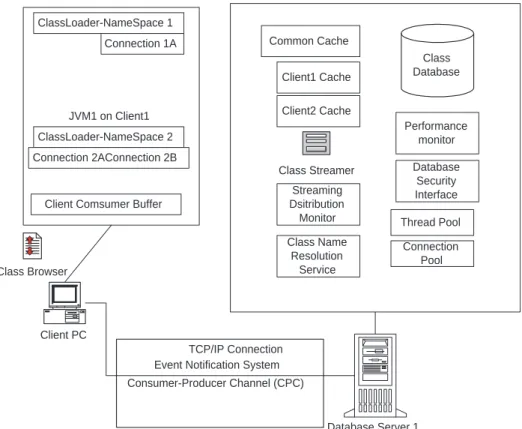
Figure 1: Overall architectural schema.
Clients use a class browser or the Java Naming Directory Interface (JNDI) to request a particular application through a well-known URL address. The client request establishes a consumer-producer channel with the class server. Once the client is authorized, the server retrieves and transmits a custom class loader to the client who loads it into his Java virtual machine (JVM). It is this custom class loader which initially loads an application’s main class and which makes any further class requests on behalf of the application. No other changes to existing Java classes are necessary. Figure 1 diagrams our system architecture.
2.2 The class loading and linking process
Class loaders are responsible for importing binary data that define a running program’s classes and interfaces. The JVM’s flexible class loader architecture provides for dy-namically extended applications. Linking a class stream into a JVM’s run time state is divided into three steps: ver-ification, preparation, and resolution [4]. Verification en-sures that the stream is properly formed, preparation allo-cates memory needed by the stream, and resolution trans-forms symbolic class references into direct machine refer-ences for the sake of run time speed and efficiency. During the class activation process, the JVM must give the impres-sion that it loads classes as late as possible, a process called
lazy activation[3]. This on-demand activation process per-mits the transmission of individual Java classes to a client by a class server.
2.3 Class transmission mechanism
The server retrieves a requested set of classes, or class sub-graphs, according to a class transition probability model. This model, which forms the basis for prediction, is de-scribed in section 1.4. Based on this model, the class server attempts to prefetch and transmit the next set of expected classes while the client is busy executing. Even though some classes are prefetched and delivered that may not be loaded by the client into his JVM, this network traffic oc-curs while the client is busy processing the current class, in effect, overlapping operations. Any successful access to a prefetched class is a measurable performance gain. Over-all system performance is maintained by an efficient class prefetching algorithm, client and server caching, a simple database schema, and judicious threading.
classes. The amount of data transmitted is limited by the size of the client’s cache, which is managed by the client’s JCL.
Classes from the Java libraries are loaded by the na-tive, primordial class loader. Classes in the class cache are loaded by the custom object class loader. The differ-ent class loaders are related by a policy calleddelegation. For each class it loads, the JVM keeps track of which class loader, whether primordial or object, loaded the class [4]. Our model uses a separately threaded class loader derived from the SecureClassLoader Java class to load all sub-sequent classes. SecureClassLoader extends ClassLoader with additional support for defining classes with an associ-ated code source and permissions. The protection domain in the model is the class server database itself, which has permissions assigned to it as a code source. It also uses theparent-delegation modelintroduced in Java 1.2 to deter-mine which class loader actually loads a given class. The rule is that the JVM uses the same class loader that loaded the referencing or calling class to load the referenced or called class. The custom class loader is the first class the client receives in an application stream.
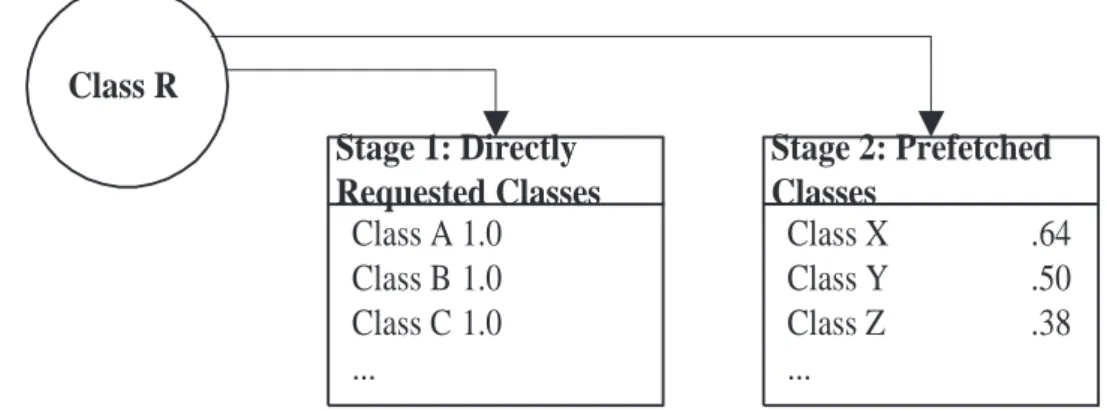
A Java class is initialized in a certain order. In stage I, all the class’s superclasses are recursively initialized, then the class itself, and then its inner classes, followed by the class’s static variables. Once the class is initialized for ac-tive use, then the class’s private variables are initialized fol-lowed by all classes referenced in any constructors. These references are necessary to initialize a class; therefore their invocation probability is 1. Class initialization is described in detail in the next section. Stage I classes are always transmitted to the client in their own package.
Stage II classes include any method argument classes, method return types, and all classes referenced in any method. These referenced classes are conditionally in-voked by an application. Stage II classes are retrieved from the database, ordered by invocation probability, and trans-mitted to the client in a separate package. This strategy allows the class server to act as a predictive look-ahead class feeder for the client. Figure 2 diagrams these sepa-rate stages.
2.4 Transition probability model and class
invocation
The delivery effectiveness ratioHis defined as the number of requests satisfied by a particular cache divided by the total number of requests during an entire application trace. Given thatCCis the number of class requests satisfied by
the client cache,SCis the number of class requests that had
to be satisfied by the server, andCRis the total number of
class requests made by the client’s class loader, such that
CC+SC=CR, thenHC=CC/CR. The effectiveness of
prediction is then the ratio of class requests satisfied by the CCC to requests satisfied by the class server. The model-ing question becomes: How can the server more effectively predict which classes to stream to the client?
The proposed model generates a set of invocation proba-bilities, one for each contextclassjthat invokes a
particu-larclassi. Given a class, the model enumerates all the
invo-cation probabilities of the classes that it symbolically refer-ences. Since the probability of transmitting a specific class depends upon the class that calls it, the model establishes a conditional probability vector of P(classi|classj) =
P(classi ∩classj)/P(classj)probability values, where
classjis the context class forclassi. Eachclassiinstance
may be invoked by different classes; hence each class has multipleclassj context classes. Each class also maintains
a total count of class invocations per context class. These class values are accumulated during the execution of an ap-plication. Class invocation prediction implies distributing both the globally most frequently accessed classes as well as the class most likely to be invoked next at any point in the program. Good prediction means transmitting those classes that are most likely to be consumed by the client. Given a particular context class, stage I classes are always transmitted, but stage II classes are transmitted according to their invocation probabilities.
To illustrate, Table 1 lists the set of classes that are in-voked by the class TelnetDriver over 20 program runs of a Telnet application. Stage I classes are DialerAccess, Plugin, Common and ReturnFocusRequest because Telnet-Driver always invokes them. The invocation probabilities for the other classes are lower because they were condi-tionally invoked depending upon the flow of execution. Clearly, TelnetDriver is a stage I class because it was also invoked the same number of times the application was run. Each invocation probability is calculated as the number of invocations divided by the number of program runs (e.g., 20). For example,P(invoking Class OnlineStatusListener within Telnet) = 2/20 = 0.1. The 103 total classes and interfaces in this Telnet application range in size from 124 to 26158 bytes, with an average size of 2083 bytes for all classes.
2.5 Markov chain modeling
Class A 1.0
Class B 1.0
Class C 1.0
...
Stage 1: Directly
Requested Classes
Stage 2: Prefetched
Classes
Class X
.64
Class Y
.50
Class Z
.38
...
Class R
Figure 2: Invocation probability stages.
Table 1: Conditional probability vector (CPV) for class TelnetDriver. Invoked Class Name Invocation Probability Number of Invocations
DialerAccess 1.0 20
Plugin 1.0 20
Common 1.0 20
OnlineStatusListener .10 2
FocusStatusListener .10 2
SocketRequest .80 16
VisualTransferPlugin .66 13
ReturnFocusRequest 1.0 20
respond to the sequential flow of class invocations and the "popularity distribution" corresponds directly to the proba-bility of invocation for a particular class.
Markov chains can dynamically model these class invo-cation patterns found in appliinvo-cations. A discrete Markov chain model is defined as the tuple< S, A, λ >whereS
corresponds to the state space,Aij is a matrix representing
the invocation probabilities from one state to another, and
λis the initial probability distribution of the states inS(0). In our model,Srepresents every possible application trace,
Aij represents the invocation probabilities for each class,
andλ is the initial class invocation distribution retrieved from the database. If the vectorscdenotes the probability
vector for all the subsequent possible class invocations dur-ing execution of a specific classc, wherec ∈ S, then the overall set of expected transition state values for classcis
ˆ
sc(j) =sc(i)Aij. TheAmatrix is recalculated during each
application trace and stored in the database. The class re-quest mechanism simply selects the largest probability val-ues from the vectorsˆc either until a threshold probability
value is reached or their cumulative class sizes are greater than the client’s class cache size. The conditional proba-bility vector for a class directly supports the calculation of
ˆ
sc.
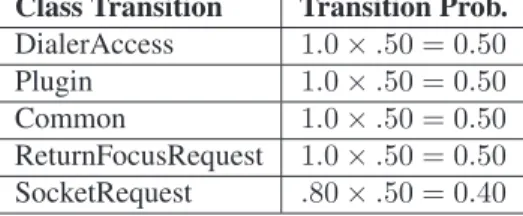
For example, table 2 calculates sˆc(j =TelnetDriver≥
.75)for sc(i =TelnetDriver= .50). It is these combined
stage I and II classes that are actually delivered to the client because the invocation probability forsˆc(j)is≥.75. ˆ
sc(i = .50) is the probability that the application would
invoke TelnetDriver in the first place.
Given the semi-hierarchical structure of nearly all appli-cations, this Markov chain model is notirreducible, that it is possible to get to any state from any other state. Some states would be transient, such that given a starting state there is a non-zero probability that the application would never return to that particular state. Most states would in-stead berecurrentorpersistent, that at some point in time the application would return to that state. Most applica-tion states also avoid the Markov property of absorbing, where it is impossible to leave a particular state. Since our Markov chain model is not irreducible, there is no guar-antee that the model provides a steady-state or equilibrium distribution. In practice, however, the probability transition matrix quickly approached a set of relatively stable values.
2.6 Threaded queue representation
Table 2: Expected transition state valuesscfor class TelnetDriver.
Class Transition Transition Prob. DialerAccess 1.0×.50 = 0.50 Plugin 1.0×.50 = 0.50 Common 1.0×.50 = 0.50 ReturnFocusRequest 1.0×.50 = 0.50 SocketRequest .80×.50 = 0.40
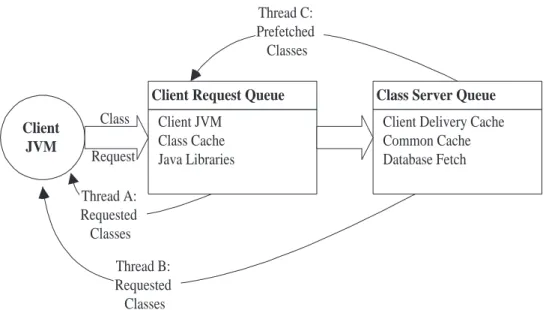
second thread for receiving predicted, prefetched classes. The third client thread accesses locally referenced classes. The same queuing components are managed by each thread including a common cache, a client delivery cache, and a database fetch component. Figure 3 diagrams the funda-mental queuing centers of the system. Operating system and database-specific queues are not included for the sake of simplicity.
Following Gunther [9], our system is characterized by a first-in, first-out (FIFO) service policy which assumes an exponential service time distribution for both queues, the custom and native class loaders. Under FIFO, the ser-vice time can only depend upon the queue length at each queuing center. The system is considered open because the server queuing center can access a possibly infinite number of elements or classes, even though only a limited and in-determinate number of classes are actually invoked in an application trace. Highleyman [11] argues that an open queuing center model is a reasonably accurate approxima-tion if N is at least 10 times larger than the average queue length, which is indeed the case. The two queuing streams are alsoseparableandmergeable. The streams are separa-ble because it is possisepara-ble to evaluate the performance mea-surements of the complete set of queuing centers as though each of the centers were evaluated separately in isolation. The streams are mergeable because the performance of the entire system is then built by combining the separate so-lutions. These queuing characteristics establish two differ-ent servers in an open, overlapping configuration with an infinite population, which we describe as aM/M/2/FIFO
delay queue model.
3 Design and implementation
3.1 Optimizing overall system performance
Our system architecture attempts to minimize overall net-work traffic by delivering only the immediately needed classes of an application trace, since the model claims that overall delivery throughput is increased by incorporating and limiting the Markov probability model to the 1st-order when predicting the client’s next class request. Network delivery time is reduced by writing the class subgraph into a singleJava ARchive(JAR) or ZIP package for transmis-sion.
The major problems to resolve in order to maintain ade-quate system performance are (along with
– decomposing and storing class hierarchies into a database where each Java class file is stored as pre-compiled Java bytecode in a database row;
– defining an effective asynchronous streaming com-ponent model that overlaps execution with network communication as implemented in the CSQ and CRQ queueing centers;
– retrieving the most probable class subgraphs to be ac-tivated next from the class server which uses a 1st-order Markov probability model to effectively predict the client’s next class request to reduce invocation la-tency;
– caching the most frequently invoked bytecodes at the client while prefetching and caching class bytescodes at the server to reduce database access delay;
– managing class elements as discrete database rows, which allows for database access optimization;
– avoiding slow file system accesses and disk paging by storing the class bytecodes in database rows;
– effectively managing limited available client memory by allocating a minimum client cache;
– the use of judicious I/O threading.
Other design goals include:
– not modifying the client’s virtual machine executable;
– not allowing the class server to manage client state be-yond minimal client authentication, authorization and initialization, which reduces the overall complexity of the application;
– expending time and effort at the classproducing or -authoring stage instead of the class-consuming stage.
Client JVM Class Cache Java Libraries
Client Request Queue Class Server Queue
Client Delivery Cache Common Cache Database Fetch
Client JVM
Class
Request
Thread A: Requested Classes
Thread B: Requested Classes
Thread C: Prefetched Classes
Figure 3: Queuing request centers.
client removes classes from the CCC, there is no need for the client to inform the server that the client has unloaded a class. The client JCL is responsible for cache overflows.
Storing Java bytecodes instead of source text offers sev-eral advantages: the bytecode does not have to be recom-piled for each client; unlike machine code, the Java byte-code supports a heterogeneous computing environment. In addition, the source analysis and compilation is performed by several powerful class authors instead of by the clients themselves.
3.2 Server caching strategy
The server implements the following caching strategy. A common cache is maintained by the server which contains classes or resources that have recently been used by two or more active clients, as shown in Figure 1. A smaller, client-specific delivery cache is also established on the server for each client which receives the anticipated set of classes ref-erenced in the class subgraph. These caches are informed and populated by the application’s class invocation proba-bilities.
Using these previously computed probabilities for the requested class, the database keys of the re-quested class and its subgraph are fetched from the class server database as shown in Figure 3. Then the class fetching algorithm works as follows:
while requested classes not in client-specific buffer do
THREAD C:
receive prefetched classes and buffer them locally
while requested classes not in common buffer concurrently do
THREAD A:
fetch, buffer, transmit requested class stream
THREAD B:
fetch, order, buffer, transmit subgraph stream
endwhile endwhile
The Java environment also supports the effective use of multiple threads for asynchronous events. As shown above, each connected client allocates at least three threads: two to process class requests and one to receive class data. The server allocates and manages a separate thread from a thread pool per connected client. This coarse-grained par-allelism, coupled with the use of dedicated socket ports, permits for effective overlapping of client-server commu-nication with client processing. Note that a client does not establish a direct connection to the server database.
Determining the proper size of the client cache is of crit-ical importance. This size must balance the critcrit-ical con-straints of limited client memory with the fact that class prediction may be incorrect, which therefore may transmit unneeded classes to the client. The viability of class predic-tion is demonstrated only if these constraints are effectively reconciled; i.e., if the delivery effectiveness ratioHcan be increased.
4 Performance measurements
4.1 Experimental setup
pro-gram executes within a single Java JVM instance, version 1.4.1.02.b06. The representative Telnet client application is designed to exercise the two different stages of classes to be delivered. The application has a reasonably rich class hierarchy including superclasses, inner classes, static and private variables, class variables and constructors.
The goal of this paper is to present the feasibility and effectiveness of the proposed methods. Experiments with more applications and benchmarks running on more suit-able hardware, say one of the newer mobile handsets, will be the subject of future publications.
4.2 Verifying the effectiveness of a common
cache
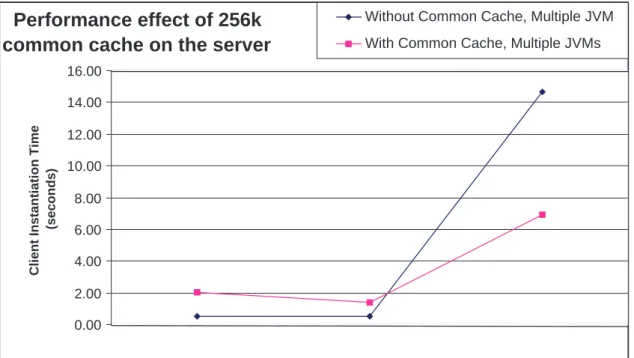
A performance-experiment was conducted in order to test the effectiveness of a common cache on the server (as de-fined in the Server caching strategy section) under the as-sumption of multiple client JVMs. A common class pack-age was transmitted to a set of 4, 16 and 32 clients all run-ning under their own JVM instance on the same client com-puter. Figure 4 shows the effect of averaged package in-stantiation time with and without the common 256k server cache operating. The performance effect of using the 256k common cache is not significant until 32 clients are being serviced simultaneously, at which point the average pack-age instantiation time is cut in half from 15 seconds to 7 seconds. We will use a common cache of 256K for the next set of experiments.
4.3 Experimental results
After exercising the client source application under multi-ple and various traces using different class method calls, the delivery effectiveness ratioH is calculated as a func-tion of client cache size. Table 3 presents the class transfer data gathered for a complete application run using a 32 kb cache. In the table, the effectiveness ratio is calculated as
HC=CC/CR.
The server records the stream size it delivers to the client. Previous experiments [7] had demonstrated that activating the class prediction mechanism delivered twice as many bytes to the client as opposed to simply delivering every class stream on-demand. The separately threaded client class loader, threads B and C, records the total stream trans-fer time it took to receive requested data as the amount of time the class loader blocks on the server, not including ac-tual class instantiation. However, the two-stage packaging mechanism that transmits the two separate class package streams does not double the amount of transfer time be-cause the predicted classes are transmitted asynchronously to the client. The additional network traffic occurs while the client is busy processing the current class, in effect, overlapping operations. By convention, the custom class loader itself and the application’s main class are counted in
SC. We do not count those classes that are already
accessi-ble within the client’s JVM.
Recall that multiple stage I classes are usually required to initialize any particular class for active use, which sim-ply activates the class in the client JVM. Depending upon the application’s structural class hierarchy, these implicitly loaded classes and interfaces may be satisfied by either the CCC or the server. In either case, CR = 52reflects the
actual number of classes the application trace instantiates, both implicit and explicitly named. Without prediction, the server has to deliver 27 out of 52 classes (52%) to the ap-plication stream while the client blocks. Note that the cus-tom class loader makes a fewer number of explicit class requests than what is actually delivered to the CCC, and so does not produce a reliable number for comparison.
With prediction, the number of classes SC satisfied by
the server, where the client is forced to request, block and wait for a class stream, is 4 less because the server has an-ticipated their use, then prefetched and transmitted them to the CCC. Now the server delivers only 23 out of 82 classes (28%) to the application stream responding to a blocked request. The total client class cache count, CR = 82, is
larger because the server has transmitted additional, pre-dicted stage II classes. However, the prediction process increasesCC, the number of classes fetched from the local
client cache. We claim that any successful local access by the client to a prefetched class is a significant performance gain. The end benefit is that the client effectiveness ratio
HC, has increased from0.48to0.72, an improvement of
50%.
Figure 5 illustrates the averaged instantiation times and
HC ratios, prediction over no prediction, under four
dif-ferent cache sizes: 8k, 16k, 32k, and 64k. A client cache size of 16k accommodates most class requests relatively efficiently. A client cache size of 32k nearly approximates immediate class activation, as measured by averaged time of class activation. The averaged class cache hit ratios ap-proached 54% with a cache size of 64k, revealing the effec-tive limits of the prediction mechanism as well as demon-strating the effective parallelization of class delivery with program execution. For a modest increase in client mem-ory, say 32k, a large application can be effectively delivered to an otherwise resource-constrained client.
To show the effect of communication overlap of the re-quired additional data transfer to the client’s overall exe-cution time, we compare estimates of the total application trace execution timetewith and without prediction.
Be-cause we are interested in client I/O-bound applications, it is fair to factor out the common duration of in-memory class execution time and to concentrate on the I/O param-eter of total blocking time tb, which includes total class
Performance effect of 256k
common cache on the server
0.00 2.00 4.00 6.00 8.00 10.00 12.00 14.00 16.00
Client Instantiation Time
(seconds)
Without Common Cache, Multiple JVM
With Common Cache, Multiple JVMs
Figure 4: Common class package instantiation for 4, 16 and 32 clients.
Table 3: Effectiveness of class prediction for 1 client.
32kb Client Cache: 1 Active Client No Prediction No Prediction P/NP
. Stage I Only Plus stage II .
Total stream size (compressed bytes) 84746 169104 1.995 Total stream transfer time (secs) =tb 14.2 19.3 1.36
Classes satisfied by server =SC 27 23 0.85
Classes satisfied by client cache =CC 25 59 2.36
Total client class cache count =CR 52 82 1.58
Effectiveness ratioHC=CC/CR 0.48 0.72 1.50
Table 4: Total execution te and blocking times tb (sec)
without prediction.
CCC Size 8k 16k 32k 64k
tb 23.7 17.5 15.2 15.0
te 38.1 34.1 31.8 31.2
tb/te 62% 51% 48% 48%
Table 5: Total executionteand blocking timestb(sec) with
prediction.
CCC Size 8k 16k 32k 64k
tb 29.5 18.9 12.1 12.0
te 39.9 31.5 28.1 28.6
tb/te 74% 60% 43% 42%
As shown in Figure 6, we conclude that prediction be-comes more effective than not in terms of reducing total client execution time at a client cache size of 32k, even though twice as many class bytes are delivered to the client.
5 Related work
Arnold’s recent survey [14] of adaptive optimization in virtual machines presents the three major developments of adaptive optimization technology in virtual machines over the last thirty years: 1) selective optimization, 2) directed code generation, and 3) other feedback-directed optimizations in order to improve VM perfor-mance. The survey discusses the benefits and drawbacks of just-in-time compilers, synchronized thread management, dynamic class loading, native code caches, class splitting and dynamic class caching. Most of these techniques ex-ploit some form of temporal locality to be effective.
8k: 18%
16k: 37%
64k: 54%
32k: 50%
0
500
1000
1500
2000
2500
3000
3500
Cache sizes and class cache hit ratio percents
(msec)
Figure 5: Client cache size vs. average time of class instantiation.
redefining the Java Virtual Machine specification. The combination of techniques reduces the overall transfer de-lay encountered during a mobile program’s execution by 25% to 30% on average. However, Krintz’s method re-quires inserting prefetch statements into the Java source code as well as compilation using a binary modification tool.
Bartels et al [1] describe an adaptive fault-based prefetching scheme based on a one-level Markov net that achieved high prediction accuracy for some classes of sci-entific applications.
Thiebaut’s work [10] with synthetic traces demonstrated the structural importance of the locality of reference in real programs and its impact on hit and miss ratios.
Chilimbi [12] proposes a data reference framework and an exploitable locality abstraction calledhot data streams
as a quantitative basis for understanding and optimizing data reference locality.
Our general approach is indebted to Patterson’s semi-nal paper [6] on informed aggressive disk prefetching and caching (TIP), where it is shown that prefetching can not only mask latency with asynchrony, by overlapping I/O with computation, but also expose parallelism for the sake of greater throughput.
6 Conclusions
Our paper describes a streaming mechanism that distributes Java class bytecode streams to a client from a class server using a 1st-order Markov probability model to predict the client’s next class request. The experimental results demonstrate that a simple class prediction mechanism
sig-nificantly reduces client blocking using a dedicated client cache size of 32k. At the cost of the client receiving twice as many bytes over the network and a modestly-larger cache, the client is able to execute rich and complex appli-cations not otherwise possible. We acknowledge that this extra network processing is clearly a concern for power-sensitive devices.
Using the Java architecture requires writing and deliver-ing a custom class loader for mobile devices. Sun’s Java 2 Micro Edition (J2ME) CLDC, targeted to cell phones, re-quires 128K to 512K total memory available with less than 256K ROM/Flash and less than 256K RAM (JSR-000030). However, it currently does not support user-defined class loaders or native method access. The mobile device man-ufacturers would themselves have to embed modified class loaders into these devices in order to handle the proposed streaming mechanism.
To summarize, this paper makes the following contribu-tions:
– The Java linking process permits dynamic class load-ing that delivers application streams to clients.
– A 1st-order Markov class invocation probability model effectively predicts the client’s next class re-quest in order to reduce invocation latency and trans-fer delay by overlapping program execution with net-work communication. Prediction is worth the effort.
0 10 20 30 40 50 60 70 40
45 50 55 60 65 70 75
Client Cache Size (kb)
Blocking/Execution Times (%)
No prediction With prediction
Figure 6: Execution and blocking time percent vs client cache size.
– We also plan to carry out the methods developed in this work with various benchmarks on appropriate hardware, such as mobile handsets.
References
[1] Bartels, G., Karlin, A., Levy, H., Voelker, G.; Ander-son, D., Chase, J. (1999).Potentials and Limitations of Fault-Based Markov Prefetching for Virtual Mem-ory Pages, ACM SIGMETRICS Performance Evalu-ation Review, Volume 27 , Issue 1, June 1999.
[2] Gosling, J., B. Joy, G. Steele, and G. Brach. (2000).
Java Language Specification, 2nd Ed. Boston: Addi-son Wesley.
[3] Liang, Sheng and Bracha, Gilad. (1998). Dynamic Class Loading in the Java Virtual Machine, in Pro-ceedings of OOPSLA ’98, published as ACM SIG-PLAN Notices, Volume 33, Number 10, October 1998, pages 36-44.
[4] Venners, Bill. (1999).Inside the Java 2 Virtual Ma-chine, 2nd Ed., New York: McGraw-Hill Companies.
[5] Krintz, C., Calder, B., and Holzle, U. (1999). Reduc-ing Transfer Delay UsReduc-ing Java Class File SplittReduc-ing and Prefetching, UCSD Technical Report, CS99-615, March 1999.
[6] Patterson, R.H. Gibson, G.A., Ginting, E., Stodolsky, D. and Zelenka, R. (1995).Informed Prefetching and
Caching, J. Proc. of the 15th Symposium of Oper-ating Systems Principles, Copper Mountain Resort, CO, December 3-6, 1995, pp. 79-95.
[7] Alagbhand, G., Gnabasik, D. (2004).Streaming Java Applications to Mobile Computing Devices, Proceed-ing of the 2004 International Conference on Wireless Networks, Monte Carlo Resort, Las Vegas, Nevada, June 21-24, 2004, pp. 637-643.
[8] Sun Microsystems. (1998). Java Object Se-rialization Specification. Available online: http://java.sun.com/products/jdk/1.2/docs/
guide/serialization/spec/serialTOC.doc.html
[9] Gunther, N., (1998).The Practical Performance An-alyst: Performance-By-Design Techniques for Dis-tributed Systems, New York: McGraw-Hill Compa-nies.
[10] Thiebaut, D., Wolf, J.L., and Stone, H.S. (1992). Syn-thetic Traces for Trace-Driven Simulation of Cache Memories. IEEE Trans. Computers. 41(4):388-410.
[11] Highleyman, W.H., (1989). Performance Analysis of Transaction Systems. Englewood Cliffs, N.J.: Prentice-Hall
[12] Chilimbi, Trishul. (2001). Efficient Representations and Abstractions for Quantifying and Exploiting Data Reference Locality. Microsoft Research, One Mi-crosoft Way, Redmond, WA
ma-jorization, and some folk theorems. To appear in Per-formance Evaluation and Planning Methods for the Next Generation Internet, A. Girard, B. Sanso and F.J. Vazquez-Abad, Editors, Kluwer Academic Press.