Qualitative Data Mining
and Its Applications
Ivan Bratko and Dorian
Suc
ˇ
Faculty of Computer and Information Science, University of Ljubljana, Slovenia
In machine learning from numerical data, usually the target concept is a numerical function that facilitates quantitative prediction. In contrast to this, we consider qualitative data mining which aims at finding qualitative patterns, or qualitative relationships in numerical data. We present one approach to qualitative data mining, in which the target concepts are expressed as qualitative decision trees. We review some case studies in qualitative data mining, and discuss typical application scenarios that involve the learning of qualitative trees.
Keywords: data mining, machine learning, qualitative reasoning, numerical regression, qualitative induction.
1. Introduction
Consider the mining of numerical data. Usually, in machine learning involved in this, the target construct is a numerical function of the form
y = f(x1 x2 :::) where y is a distinguished
variable, usually called the class variable(or
de-pendent variable), andx1 x2 ::: are attributes (or independent variables). Examples of this
kind of numerical learning are regression trees
(CART, Breiman et al. 84), Retis(Karalic 92ˇ ),
M5(Quinlan 1992).
In contrast to this, in this paper we consider
qualitative data mining which aims at finding
qualitativepatterns, or qualitative relationships in numerical data.
An obvious motivation for qualitative data min-ing comes from the fact that for some tasks, qualitative models are more suitable than clas-sical quantitative, numerical models. Examples of such tasks are diagnosis, generating expla-nation of system’s behaviour, and the design from first principles. In the fields of Qualitative
Physics and Qualitative Reasoning (Weld and
de Kleer 1990), techniques have been developed
that enable a kind of commonsense reasoning with qualitative models, based on the abstrac-tion of numerical values into qualitative values, and real functions into qualitative constraints. This kind of reasoning enables the solution of certain types of problems without resorting to numerical computation, and without the use of a quantitative model of the system in question. When a problem can be solved at the qualitative level of abstraction, there is no need for build-ing a quantitative model — often a demandbuild-ing or unrealistic task. Building qualitative models for complex systems should be easier. However, even this simpler task is known to be demand-ing and time consumdemand-ing, and tools to support this would be welcome. In particular, machine learning methods aiming at inducing qualitative models from (possibly numerical) data would
be very useful in this respect.
While there are many machine learning or data mining tools that support the building of nu-merical models from data, there are few tools to support the building of qualitative models from data.
2. The QUIN Approach to Qualitative Data Mining
2.1. Representation
QUIN(Qualitative Induction)is a learning
pro-gram that looks for qualitative patterns in nu-merical data(Suc 2001;ˇ Suc and Bratko 2001ˇ ).
These patterns are then combined into a so-calledqualitative tree. Induction of qualitative trees is similar to the well-known induction of decision trees. The difference is that in deci-sion trees the leaves are labelled with class val-ues, whereas in qualitative trees the leaves are labelled with what we call qualitatively con-strained functions.
Qualitatively constrained functions (QCFs for
short)are a kind of monotonic constraints that
are widely used in the field of qualitative rea-soning. A simple example of QCF is: Y =
M+
(X). This says that Y is a monotonically
increasing function ofX. In general, QCFs can have more than one argument. For example,
Z = M +;
(X Y)says thatZ monotonically
in-creases inXand decreases inY.
Monotonic constraints can be combined into if-then rules to express piece-wise monotonic functional relationships. For example:
ifX <0 thenY =M ;
(X)elseY =M +
(X)
Nested if-then expressions can be represented as trees, called qualitative trees (Suc 2001ˇ ).
Qualitative trees are similar to regression trees
(Breiman et al. 1984). Both regression and
qualitative trees describe how a numerical vari-able (called class) depends on other variables (calledattributes). The difference between the
two types of trees only occurs in the leaves. A leaf of a regression tree specifies a numeri-cal regression function that tells how the class variable numerically depends on the attributes within the scope of the leaf. On the other hand, a leaf in a qualitative tree only specifies the re-lation between the class and the attributes qual-itatively, in terms of monotonic qualitative con-straints.
QUIN takes as input a set of numerical examples and looks for regions in the data space where monotonicity constraints hold. Such a set of qualitative patterns are represented in terms of aqualitative tree. As in decision trees, the inter-nal nodes in a qualitative tree specify conditions that split the attribute space into subspaces. In
a qualitative tree, however, each leaf specifies a QCF that holds among the input data that fall into that leaf. As a simple example consider a data set with three variablesX,Y andZ where data triples(X Y Z)correspond to the function
Z = X
2
; Y
2, possibly with some Gaussian
noise added. When QUIN is asked to find in these data qualitative constraints onZas a func-tion ofXandY, QUIN generates the qualitative tree that can be represented by the following nested if-then-else expression:
ifX <0 then
ifY <0 thenZ =M ;+
(X Y)
elseZ =M ;;
(X Y)
else
ifY <0 thenZ =M ++
(X Y)
elseZ =M +;
(X Y)
This tree partitions the data space into four re-gions that correspond to the four leaves of the tree. A different QCF applies in each of the leaves. The tree describes howZ qualitatively depends onX and Y. QUIN can tolerate some noise in the data and would induce in this ex-ample the same tree(with thresholds forXand
Yslightly distorted)even when moderate noise
is added to the data.
2.2. Outline of Algorithm
QUIN constructs a tree in a top-down greedy fashion, similarly to decision tree induction al-gorithms. At each internal node of the tree, QUIN considers all possible splits, that is condi-tions of the formX <Tfor all the attribute
vari-ables X and effectively all possible thresholds
T with respect toX. Each such condition parti-tions the training data into two subsets. QUIN finds the “best” QCF for each subset accord-ing to an error-cost measure for QCFs. Then the best split is selected according to the MDL
(minimum description length)principle, which
minimizes the error-cost and the encoding com-plexity of QCFs. The error-cost of a QCF with respect to an example set S is defined so that it takes into account the consistency and “pre-dictive strength” of the QCF with respect toS
(the more unambiguous qualitative predictions
the QCF can make inS, the better). Technical
details of all this can be found in(Suc 2001ˇ )or
(Suc and Bratko 2001ˇ ) where QUIN’s
3. Case Studies
In this section, some applications of QUIN will be reviewed in which some unexpected uses of qualitative data mining were observed. One is the so-called behavioural cloning where the skill of a human operator controlling a dynamic sys-tem is reconstructed from the operator’s control traces. Another one is qualitative reverse en-gineering where a device is qualitatively recon-structed from its behaviour data(
ˇ
Suc and Bratko 2002). Finally, QUIN has also been used in the
current work on the so-calledQ2learning
(
Qual-itatively faithful Quantitative learning)in which
numerical regression is carried out in such a way that the qualitative properties in the data are pre-served. In an application aiming at speeding up an industrial car simulator, Q2 learning signif-icantly outperformed other state-of-the-art re-gression techniques.
3.1. Behavioural Cloning
Controlling a complex dynamic system, such as an aircraft or a crane, requires operator’s skill acquired through experience. This skill is tacit and hard to access through introspection. Therefore some questions of interest are: How to understand such tacit human skills? How to design automatic controllers based on human skill, that is how to transfer the operators’ skill into a controller?
Given the difficulties of skill transfer through introspection(studied by Bratko and Urbanciˇ cˇ
1999), an alternative approach to skill
recon-struction is to use themanifestationof the skill that is available in the form of traces of the op-erator’s actions. One idea is to use these traces as examples and extract operational models of the skill by machine learning techniques. This is known asbehavioural cloning(Michie 1993;
Michie et al. 1990). In general there are two
goals of behavioural cloning:
To generate good performance clones, that
is those that can reliably carry out the control task.
To generatemeaningfulclones, that is those
that would help to understand the operator’s skill by making the skill symbolically ex-plicit.
Here we illustrate how qualitative machine learn-ing can help the understandlearn-ing of operators’
control strategies, and generating explanation of how and why these strategies work.
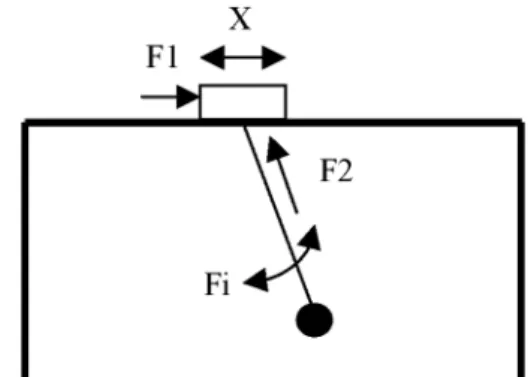
In one experiment, a simulated container crane
(Fig. 1)was controlled by several human
opera-tors and qualitative descriptions of their control strategies were induced with QUIN from the operators’ control traces. Each control trace is a sequence of dynamic states of the crane sys-tem and operator’s actions performed in these states. A control trace in this domain typically consisted of 500 to 1000 states taken at sample time points. In the case of the container crane, a dynamic state of the system consists of six variables:
X, position of the trolley
DX, trolley velocity
Fi, angle of rope with respect to vertical
DFi, angular velocity
L, length of rope
DL, rope length velocity
The available actions are: force F1 (to push
the trolley left or right), and force F2 (to pull
the rope). In the task executed by the
opera-tor, in the initial state the trolley’s position was
X=0. The trolley’s goal position wasX=60.
The requirement was that when the load was at the goal position, the swinging of the load was within very small tolerance around the vertical. The task was to be executed in as short a time as possible.
Fig. 1.Container crane with horizontal(F1)and vertical (F2)control forces; the task is to move the load to a goal position while controlling the swinging of the rope at the
goal.
movement of the trolley and the swinging of the load, and chooseDXas the class variable andX,
FiandDFias the attributes. With this selection of variables, we use QUIN to find qualitative properties of the relationDX= f(X Fi DFi).
Below we give as an example two qualitative trees induced by QUIN from qualitative traces of two of our human operators that we here re-fer to asSandL. We chose these two operators because their control performances were rather different, and we were interested in finding the differences in their control strategies. Operator
S performed very cautiously, never causing a large swing of the load. To avoid large swing, he could not afford large accelerations of the trol-ley. The qualitative tree (written as an if-then
expression)induced from a trace of operatorS,
is:
ifX <20:7
thenDX=M +
(X)
else
ifX <60:1 thenDX =M ;
(X)
elseDX =M +
(Fi)
This tree offers a nice explanation of operator
S’s control strategy. In the initial stage, whenX
is small, the desired velocityDXincreases with
X. From about one third of the total distance to the goal, velocityDX starts decreasing with
X. Obviously, this aims at zero velocity when the goalX=60 is reached. The right-most leaf
of the qualitative tree above (DX = M +
(Fi))
mentions the angleFi. This reveals that this op-erator makes an effort at controlling the swing, although only at the very final stage.
OperatorLwas much more adventurous thanS. His skill allowed him to afford vigorous accel-erations in theX direction, causing large swing of the load. However, he had the skill of re-ducing the swing later. This enabled him to perform much more efficiently in terms of exe-cution time, achieving about 20 or 30% shorter finishing times than S. A qualitative tree in-duced by QUIN from a trace of operatorLis as follows:
ifX <29:3
thenDX =M ++;
(X Fi DFi)
else
ifDFi<;0:02 thenDX =M;(X)
elseDX=M ;+
(X Fi)
Although the overall structure of this tree is sim-ilar to that ofS’s tree,L’s qualitative strategy is
considerably more sophisticated. Obviously,L
was paying attention to the load swing already at the initial stages of the task and making active effort at reducing the swing.
3.2. Qualitative Reverse Engineering
Accumulated engineering design knowledge in a company often takes the form of a library of designs and corresponding simulation models. Typically such libraries contain numerous ver-sions of models (designs) where comparative
advantages and drawbacks of alternative mod-els are not comprehensively documented. Re-use of such design libraries is made difficult specially because the intuitions behind designs and their improvements are not explained in the documentation. Although there may be com-plete mathematical models and working simu-lation programs included in the library, the user of the library is impeded by lack of understand-ing of how does the designed system work. For example, how does a controller of a dynamic system achieve the goal of control.
The case study in(Suc and Bratko 2002ˇ )
consid-ers the task of recovering the underlying ideas of designs by aid of qualitative machine learning. We assume a model in an engineering library is complete so that it can be executed on a sim-ulator. The simulated system can thus be ob-served as a black box, but the internal structure of the system is obscure to the user because it is too complex to be understood without some intuitive explanation. To help the user to de-velop some intuitive understanding of how the black box works, QUIN was applied to hope-fully induce some meaningful relations among the system’s variables.
The particular task of this case study was to re-verse engineer the design of a crane controller that has been in regular industrial use(Valaˇsek
1996). In this case study we compared two
ma-chine learning methods that both seem relevant to this task: (a)the usual regression tree
learn-ing, and in particular its variant called model trees, implemented in the M5 system(Quinlan
1992), and(b)induction of qualitative trees
im-plemented in QUIN.
skill: (1) How successfully the induced clone
performs the control task, and (2) how useful
the clone is as an explanation of the control strategy implemented by the controller?
The experiments in this case study in reverse en-gineering of controllers showed advantages of the qualitative learning approach. The induced qualitative trees help to explain intuitively the main idea behind the design of this crane con-troller. When the qualitative trees were trans-formed(through optimisation)into a numerical
controller that could actually be used to per-form the control task, the so obtained controller performed equally well as the original indus-trial controller and was simpler than the original controller. In a similar case study in qualitative reverse engineering within the Clockwork Eu-ropean research project, a semi active car shock absorber was reversely engineered in a similar way. The resulting controller outperformed the original design according to the performance criteria normally used in the design of shock absorption controllers.
3.3. Q2Learning
In (Suc et al. 2003ˇ ) QUIN was applied to
in-duce, from system’s behaviour data, a quali-tative model of a complex, industrially rele-vant mechanical system (a car wheel
suspen-sion system). The induced qualitative model
enables nice causal interpretation of the rela-tions among the variables in the system, as one would expect from a qualitative model. More surprisingly, however, it was also shown in this case study that the qualitative model can be used to guide thequantitativemodelling process that may lead to numerical predictions that are sig-nificantly more accurate than those provided by state-of-the-art numerical modelling methods. Thus the main message of this case study is that a combination of methods for qualitative and quantitative system identification methods has good chances to attain significant improvements over numerical system identification techniques, including techniques of numerical machine le-arning methods, such as regression trees, model trees, and locally weighted regression. The po-tential improvements are in two respects: first, the predictions are qualitatively consistent with the properties of the modelled system, and in addition they are also numerically more accu-rate.
This idea of combining qualitative and quanti-tative machine learning for system identifica-tion was in(Suc et al. 2003ˇ )carried out in two
stages. First, induce with QUIN qualitative con-straints from system’s behaviour data. Second, induce a numerical regression function that both respects the qualitative constraints and fits well the training data numerically(called Q2Q
trans-formation, Qualitative to Quantitative transfor-mation). This approach was namedQ
2learning,
which stands for Qualitatively faithful Quanti-tative learning.
4. Summary and Conclusions
In this paper we reviewed some ideas of quali-tative data mining or qualiquali-tative machine learn-ing. We also reviewed case studies in which qualitative induction with QUIN was applied. These case studies demonstrate, as one would expect, that induced qualitative patterns are use-ful to facilitate the user’s understanding of the domain of application, and to enhance the do-main knowledge. For example, to better under-stand the tacit operator’s skill or the differences between different operators, or reconstruct the intuition behind an engineering design.
However, less expected, we found another very common application scenario of qualitative le-arning, when we are not just interested in qua-litative relations, but in a concrete quantitative solution (e.g. making quantitative predictions,
synthesising an actual, numerical controller for a dynamic system, numerical system identifica-tion, or qualitatively faithful quantitative learn-ing).
This type of application gives rise to the general scheme in which we complete the abstraction-concretion loop shown in Fig. 2. In our ap-proach, roughly the qualitative solution was
obtained through qualitative machine learning
(with program QUIN), and quantitative
concre-tion was accomplished as a soluconcre-tion of an op-timisation problem in the Q2Q transformation
(Qualitative-to-Quantitative transformation).
5. Acknowledgements
The work reviewed in this paper was partly sup-ported by the European Fifth Framework project Clockwork, and the Slovenian Ministry of Ed-ucation, Science and Sport.
References
1] BRATKO, I., URBANCIˇ Cˇ, T., Control skill, machine learning and hand-crafting in controller design, in:
Machine Intelligence 15 (eds. K. Furukawa, D. Michie, S. Muggleton), Oxford University Press, 1999.
2] BREIMAN, L., FRIEDMAN, J.H., OLSHEN, R.A., STONE, C.J., Classification and Regression Trees.
Monterey, CA: Wadsford, 1984.
3] KARALICˇ, A., Employing linear regression in re-gression tree leaves.Proc. ECAI’92 (10th European Conference on Artificial Intelligence), pp. 440–441. Vienna 1992. Wiley & Sons.
4] MICHIE, D., Knowledge, learning and machine intel-ligence, in: L.S. Sterling(ed.)Intelligent Systems, Plenum Press, 1993.
5] MICHIE, D., BAIN, M., HAYES-MICHIE, J., Cognitive models from subcognitive skills, in: Grimble, M., McGhee, J., Mowforth, P.(eds.)Knowledge-Based
Systems in Industrial Control, Stevenage: Peter Peregrinus, 1990.
6] QUINLAN, J. R., Learning with continuous classes,
Proc. 5th Australian Joint Conf. Artificial Intelli-gence, pp. 343–348. Singapore: World Scientific, 1992.
7] SˇUC, D.,Machine Reconstruction of Human
Con-trol Strategies. PhD Thesis, University of Ljubljana, Faculty of Computer and Information Sc., Ljubljana 2001.
8] SˇUC, D., BRATKO, I., Induction of qualitative trees,
Proc. Machine learning: ECML 2001: (Lecture notes in artificial intelligence, Lecture notes in com-puter science, 2167)pp. 442–453, Berlin: Springer, 2001.
9] SˇUC, D., BRATKO, I., Qualitative reverse engineer-ing,Proc. ICML’02 (Int. Conf. on Machine Learn-ing), Sydney, Australia, 2002.
10] SˇUC, D., VLADUSIˇCˇ, D., BRATKO, I., Qualitatively faithful quantitative prediction, Proc. IJCAI’2003, Acapulco, pp. 1052–1057, San Francisco: Morgan Kaufmann, 2003.
11] VALASEKˇ , M., Position and velocity control of gantry crane,Proc. Mechatronic96, pp. I–203–208, Guimaraes, 1996.
12] WELD. D. S.,DEKLEER, J.(eds.),Readings in
Qual-itative Reasoning about Physical Systems, Morgan Kaufmann, San Mateo, California.
Received:June, 2003
Accepted:September, 2003
Contact address:
Ivan Bratko, DorianSucˇ Faculty of Computer and Information Science University of Ljubljana Trzaˇ ˇska 25 SI-1001 Ljubljana Slovenia Phone:(+386)1 4768-267
Fax:(+386)1 4768-386
e-mail:[email protected]
Web:http://ai.fri.uni-lj.si/ dori an/
IVANBRATKOis professor of computer science at the Faculty of Com-puter and Information Science, Ljubljana University, Slovenia. He heads the AI laboratory at the University. He has conducted research in machine learning, knowledge-based systems, qualitative modelling, intelligent robotics, heuristic programming and computer chess. His main interests in machine learning have been in learning from noisy data, combining learning and qualitative reasoning, and various appli-cations of machine learning and inductive logic programming, including medicine, ecological modelling and control of dynamic systems. Ivan Bratko is the author of widely adopted text PROLOG Programming for Artificial Intelligence(third edition: Pearson Education/
Addison-Wesley 2001). He co-edited (with R.S. Michalsky and M. Kubat)
Machine Learning and Data Mining: Methods and Applications, Wi-ley, 1998, and co-authored(with I. Mozetic and N. Lavrac)KARDIO:
a Study in Deep and Qualitative Knowledge for Expert Systems(MIT
Press, 1989).