through Technology Applications in Independent Language Learning
Norizul Azida Darus1, Norhajawati Abdul Halim2
1,2
Academy of Language Studies, Universiti Teknologi MARA, Perlis, 02600 Arau
Authors’ email address:¹[email protected], ²[email protected]
Received Date: 20 December 2019 Accepted Date: 6 January 2020
ABSTRACT
Any language can be acquired at any time, but to acquire the language, one needs to learn the language. Learning a second or foreign language is not a favourite among second or foreign language learners. This is because learning a language is a very intense time-consuming activity. Learning is often unsuccessful because learners receive impoverished or insufficient input and lack of motivation. To this, second language or foreign language teachers play the most significant role to help and motivate the students to acquire the said language. The preferred method is to be immersed into the actual ecosystem of the target language and become part of the language ecosystem. The other way is to dunk the learners into the artificial ecosystem of the language classroom. In dunking, the learners are immersed temporarily and repeatedly into the simulated ecosystem language. As can be seen now, technology remains the only viable option to get enough interactive contact with the target language. Using interesting software is one of the methods in making learning more interesting. Furthermore, the students are able to practice the language not only during class time, but on their own free time outside of class hours, that is during students’ independent time of learning. The findings revealed that most students found using the applications has improved their language learning. The role of teachers on the other hand is to provide instructions and assist whenever necessary and needed by the students.
Keywords: independent, acquire, motivate, immerse, ecosystem, simulated, technology
INTRODUCTION
By 2020, Universiti Teknologi MARA’s (UiTM) existing physical and formal structures of the classroom ecosystem and testing procedure will remain unchanged. However, UiTM’s pedagogical strategies would have changed significantly. They will be more flexible in addressing and implementing individual needs and preferences. UiTM’s teaching population will integrate external resources and practical opportunities with the notion of student learning time and independent learning. Technology is the mediator for both pathways. One of the most powerful affordances of technology is smartphone in which is useful for situated learning. Embedding activities and language in real world environments hold the potential to make learning more meaningful and memorable (Traxler, 2011).
BACKGROUND OF THE STUDY
As language is known, it can be acquired at any time, but often it is introduced by speakers of the language or it is introduced as part of the curriculum. For instance, to acquire a language you need to learn the language. Learning a language is not easy; rather, it is a very intensive time-consuming activity. The most essential part is the contact time with the target language. Thus, the preferred method is to be immersed into the actual ecosystem of the target language and become part of the ecosystem. The reason is real language acquisition normally occurs in natural, immersion settings outside the classroom and the classroom, by contrast, is viewed as an artificial setting for language learning. Learners in immersion settings are generally unconscious of the ways their languages operate in tandem, although they are placed in a classroom setting to improve their proficiency in the target language. So, it is best viewed as the staging area for real language use in the natural setting of the target culture (Scott, 2016).
The other way of learning a language is to dunk the learner into the artificial ecosystem of the target language. In dunking, the learner is immersed temporarily and repeatedly into the simulated environment of the language classroom. However, this is not reality because language learners are unable or unwilling to go aboard. Some learners are demotivated or not interested to learn the language. The reason is as simple as everybody knows. They are unable to understand, to speak and to communicate in the language learnt. In order to capture these young generations to learn the language, especially English Language, technology remains the only viable option to get interactive contact with the target language.
OBJECTIVES OF THE STUDY
The objectives of the study are:
1. to verify students’ baseline profile at the start of the study;
2. to find out students’ language input and output using the applications; and 3. to determine students’ performance after the study.
LITERATURE REVIEW
Language is prior to science. Moreover, science itself is a construct of language, because scientists impose their language based on what they assume is there to be named by that language (Harris, 2005). In the case of language studies, when linguists try to explain language with the help of the very same language, the subjectivity of such explanations only grows (Kravchenko, 2003). Human ecology is extended by integrating value and meaning born of linguistics interactions into ecological structures. Steffensen and Fill (2014) offer the following definition:
“Ecolinguistics is the study of the processes and activities through which human beings- individual, group, population and species levels exploit their environment in order to create an extended, sense saturated ecology that supports their essential trajectories, as well as the study of the organismic, societal and ecosystemic limits of such processes and activities”.
interdependencies among all the elements in the setting, not only at the social level, but also at the physical and symbolic levels (Chen, 2016).
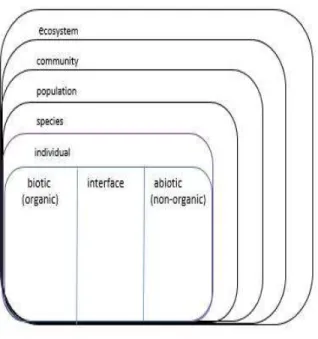
The ecological framework below is based on evidence that no single factor can explain why individuals, or groups are different or similar. This framework views the difference or similarities as the outcome of multi-directional interactions at the levels of individuals, species, populations, communities and ecosystems and treats the factors at the different levels with equal importance as with the influence of factors within a single level. The framework explains the resulting difference or similarities of behavior and performance as the interaction of an individual at five levels. This framework is also useful to identify and cluster teaching and learning intervention strategies. For example, based on the ecological level in which they act.
Figure 1: Ecological Environment
Language ecology thus, may be defined as the study of interactions between any given language and its environment. The true environment of a language is a society that uses it as one of its codes. Language exists in the minds of its users, and it only functions in relating these users to one another and to nature. The ecology of a language is determined primarily by the people who learn it, use it and transmits it to others (Haugen, 1972).
The core of an ecology of science is an ecology of knowledge. That is why knowledge and language are related. Although our human knowledge exhibits some special features that are bound to the peculiarities of our brains, it is worthwhile to study the much simpler steps of knowledge evolutionarily prior to the complex results of human beings (Finke, 2014).
RESEARCH METHODOGY
For the purpose of this study, a group of 16 Diploma students comprising of 7 males and 9 females were chosen as samples. Their selection criteria for this study varied in terms of their personal background, personality and proficiency levels. However, it was recognized that out of the 16 chosen, 9 of them were good in English Language. The subjects have already taken English Language in Part 1 and Part 2 of their academic year. They took their Part 3 English paper during the time of this study. They were explained on how the research will be carried out.
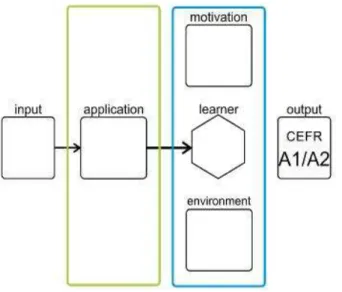
In ecological studies, observation, modelling and experimentation were used. One crucial element in ecological research is the need for a baseline; an initial set of critical observations (data) used for comparison or a control. Without this, a study could become flawed and irrelevant. The conceptual framework below explains on how the subjects will undergo the study. The subjects were explained on the usage of CEFR (Common European English Framework) which was used for the purpose of the study.
.
Figure 2: Conceptual Framework
For this study, three technological platforms provide some interactivity of language ecosystem to assist language learning. The technical focus of this study is using Computer Based Testing and Computer Assisted Language Learning; CBT/CALL and World ware, and the use and development of integrated language learning systems.
CALL is used because it supports the learning theories of constructivism (learners are capable to construct knowledge in the context of their own experience) and social constructivism (learners acquire information through social interactions because “learning is a social negotiation of meaning”). This has proven in the study conducted in the US Higher Education where it helped to improve students’ Arabic proficiency as a foreign language (El Omari, 2015).
This is a qualitative study to see students’ achievement in language learning whereby ecological performance of students’ language performance is taken into consideration. Ecology is the scientific study of how living things interact with each other, and with their environment. It addresses the complex and diverse relationship from various perspectives. Ecological study is structured into a nested hierarchy of individuals, species, populations, communities and ecosystems.
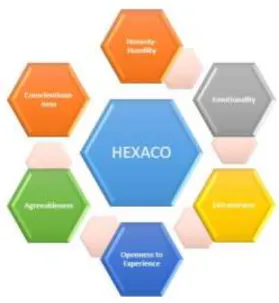
The subjects were then profiled using a battery of appraisals and psychological inventories including but not limited to motivation to learn language profiles, learning styles, multiple intelligences, Myers-Briggs Type Indicators (MBTI) and HEXACO.
Figure 3: The HEXACO Model
The Myers–Briggs Type Indicator is an introspective self-report questionnaire indicating differing psychological preferences in how people perceive the world and make decisions. The original versions of the MBTI were constructed by two Americans, Katharine Cook Briggs and her daughter Isabel Briggs Myers (Cherry, 2019). Meanwhile, The HEXACO model of personality structure is a six-dimensional model of human personality that was created by Ashton and Lee and explained in their book, The H Factor of Personality, based on findings from a series of lexical studies involving several European and Asian languages (Lee & Ashton, 2008).
DISCUSSION AND FINDINGS OF THE STUDY
The results show that there are positive, negative or neutral effects on the individual’s current and future fitness and ability to survive, to do well or to perform. Time is the definitive factor as most changes happen over very long periods. The ecological studies use observation, modelling and experimentation too. As such, one crucial element in ecological research is the need for a baseline; initial set of critical observations (data) used for comparison or a control. Without it, a study would become flawed and irrelevant.
Generally, based on the outcome of the programme on the first batch of students, the researcher managed to encourage the whole class in using the programme. There were a few setbacks at times when not all the programmes worked properly. When this happened, the students would feel frustrated because they either had to share the device or wait for their friends to finish, then only they would be able to use the device. The students’ interest and enthusiasm in using the programme indicated that they were getting used to the programme and this indirectly, has helped them to improve their language as a whole. This has answered the second objective of this study.
Out of 16 students using the programme, 10 of them performed well in their final examination compared to those who did not use the programme. After an interview with the students who have improved in their essay writing, they were happy to share their experience. According to them, the programme was easily installed and could be used anywhere provided they had their devices with them. It was convenient and took lesser time in getting feedback. The students were very much interested with the programme. Students who were getting used of the programme expressed their satisfaction and happiness when using the programmes and told the researcher that they would not mind having to use the programmes even after the study was over. This has answered the third objective of this study.
Based on this also, it can be proven that students were ready to perform their self-learning. Thus, this will enhance their ecological performance and contribute to their independent learning time. This has answered the first objective of the study whereby before the study started, the researcher has conducted a brief investigation on the students’ background performance in English from their lecturers.
However, Jones (2017) cautions that the above result may not provide full appreciation of technology-enabled learning if the devices are loaned to the students. The reason is device ownership allows the students to have different usage patterns, motivation and opportunities for integration into user-installed online services or tools. This means that the students can use the device at any time of day or night, and in any context or environment, can personalize their devises, load desired applications, customize settings and set up social networks which eventually become their trusted companion and necessitous daily accessories. For this reason, the researcher believed that students nowadays are technology savvy generation and would not mind installing the programmes in their own personal devices.
CONCLUSION
RECOMMENDATIONS
Based on the findings of the research, the following recommendations would be of help to researchers.
1. Students need to be exposed to the many programmes which can allow them to use English for the betterment of their own self since most now own their own devices.
2. Teachers should allow students to use their devices in classroom even some students might misuse the opportunity given to them in doing so.
3. Teachers should guide students when allowing them to use their devices so that they will not misuse the opportunity and know that the reason of using the device is only for learning purposes.
4. Teachers must encourage students to always use their devises at anytime and anywhere since it is very convenient to use.
5. Students must be encouraged and guided to explore outside their thinking abilities to ensure that they are aware of the learning process.
Consequently, from the above recommendations, there must be an awareness and acknowledgement that using programmes installed in the devices will help students to learn language better. This is also necessary for them to use their thinking ability for decision making. As such, the emphasis on using technological advancement is essential not only for the purpose of passing examination, but also for daily usage.
ACKNOWLEDGEMENT
The authors gratefully acknowledge the help and fund of Universiti Teknologi MARA (UiTM) in providing the ARAS Fund through a Social Science & Management research grant file (600-IRMI/DANA 5/3/ARAS (0012/2016) The authors are also thankful to the students of UiTM Perlis Branch in being the respondents for this research.
REFERENCES
Bang, J. C., & Trampe, W. (2014). Aspects of an ecological theory of language. Language Sciences, 41, 83-92.
Bernhardt, S., Edwards, S., & Wojahn, P. (1989). Teaching college composition with computers: A program evaluation study. Written Communication, 6 (1), 108- 133.
Chen, D.P. (2016). Assessment, evaluation and research. Retrieved from http://onlinelibrary.wiley.com/toc/ pp 85-92.
Cherry, K. (2019). An overview of the Myers Briggs Type Indicator, The 16 personality types. Retrieved from https://www.verywellmind.com/the-myers-briggs-type-indicator-2795583
El Omari, S. (2015). The effect of Computer-Assisted Language Learning on improving Arabic as a foreign language in higher education in the US. Procedia- Social and Behavioural Sciences, 192, 621-628. Retrieved from https://www.sciencedirect.com
Finke, P. (2014). The ecology of science and its consequences for the ecology of language. Language Sciences, 41, 71–82.
Haugen, E. (1972). The ecology of language. California: Stanford University Press.
Jones, A. (2017). Mobile informal language learning: Exploring Welsh learners’ practices. E-Learning Papers, 45, 4- 14. Retrieved from http://oro.opens.ac,uk/
Kravchenko, A. V. (2003). The ontology of signs as linguistic and non-linguistic entities: A cognitive perspective. Annual Review of Cognitive Linguistics, 1, 179—191.
Lee, K., & Ashton, M. C. (2008). The HEXACO personality factors in the indigenous personality lexicons of English and 11 other languages. Journal of Personality, 76, 1002– 1054.
Scott, V.M. (2016). Multi competence and language teaching. NJ: Prentice Hall.
Steffensen, S. V., & Fill, A. (Eds.) (2014). Ecolinguistics: The ecology of language and science: Special Issue of Language Sciences. Language Sciences (Elsevier).