Dr. Chen, Business Intelligence 1
MBUS673 - Business Intelligence
Contents and coverage:
•
Managerial approach
Concepts, models etc.
•
Hands-on realization
Software tools
Data Mining
– Rapid Minder (free download) one user only with full features
Business Performance Management
– AHP (Analytical Hierarchy Process) web version
Dr. Chen, Data Base Management
Chapter 1
An Overview of Business
Intelligence, Analytics, and
Decision Support
Jason C. H. Chen, Ph.D. Professor of MIS School of Business Administration
Gonzaga University Spokane, WA 99258 [email protected]
Dr. Chen, Business Intelligence 3
Event Driven Alert - A Scenario
• Three transactions were posted in a credit
account while the account holder was
traveling in summer 2010:
Ranch 99 San Jose, California $102.33 Aug. 1, 2010
Exxon Austin, Texas $99.12 August 3, 2010
Exxon Houston, Texas $120.44 August 5, 2010
• What action will you (the credit company)
take and why?
• How the scenario can be detected?
Dr. Chen, Business Intelligence 4
What is “Business Intelligence”?
•
”Business intelligence is the process of
making better decisions in an environment
that provides data and reporting that is
timely, reliable, consistent and
understandable in a useful format or
presentation”.
Dr. Chen, Business Intelligence 5
Questions Posed in a BI seminar
• “I am not sure what BI really is these days,
but our execs tell me we need it.”
the question really is …
• “Why is BI suddenly such a hot topic with
our senior management team? We are
already using several end-user tools and yet
they want more!”
Dr. Chen, Business Intelligence 6
More Questions
• Why BI is on the agendas of the majority of
CIOs
because CIOs have become extremely aware of BI’s importance in providing a competitive ____________ at all levels of the business.
• What is the primary goal of BI at the
enterprise level?
is to deliver _________ business information and analysis from all data sources in context and in a timely manner.
differentiator
Dr. Chen, Business Intelligence 7
Goal of Business and Its Supporting
Decision Making Processes…
Problem Solving Decision Making Information MIS/ IT DB, ____ Revenue/ Profit DW
Dr. Chen, Business Intelligence 8
DECISION MAKING
• Reasons for the growth of
decision-making
information systems
People need to analyze large amounts of information
People must make decisions quickly
People must apply sophisticated analysis techniques, such as modeling and forecasting, to make good decisions
People must protect the corporate asset of organizational information
Dr. Chen, Business Intelligence 9
DECISION MAKING
•
Model
– a
simplified
representation or
abstraction of
reality
• IT systems in
an enterprise
Dr. Chen, Business Intelligence 10
DBQ: Explain the difference between transactional information and analytical information. Be sure to
provide an example of each
• Transactional information encompasses all of the information contained within a single business process or unit of work, and its primary purpose is to support the performing of _____ ________
tasks.
Examples of transactional information include withdrawing cash from an ATM or making an airline reservation.
• Analytical information encompasses all organizational information, and its primary purpose is to support the performing of _________
analysis tasks.
Examples of analytical information include trends, sales, and product statistics.
daily operational
managerial
Dr. Chen, Business Intelligence 11
Major Roles of Information Systems
Support of Strategic Advantage (BI/BA/EIS) Support of Managerial Decision Making (DSS) Support of Business Operations (TPS)
Dr. Chen, Business Intelligence 12
Strategic Management Tactical Management Operational Management Decision Characteristics Unstructured Semi-structured Structured
Decisions in the Business
Planning and Control of Overall Organizational Direction by Top Management
Planning and Control of Organizational Subunits by Middle Management
Planning and Control of Day to Day Operations by Supervisory Management
Dr. Chen, Business Intelligence 13
Enterprise Information Portals and DSS
Enterprise Information Portal Gateway Enterprise Information Portal User Interface
Search Agents OLAP Data Mining Knowledge Management
Database Management Functions Data _____ Other Business Applications Operational Database _______ Database Knowledge Base DSS What-If Models Sensitivity Models Goal-Seeking Models Optimization Models
Internet Intranet Extranet
Mart
Analytical
Dr. Chen, Business Intelligence 14
History of the role of Information Systems
Data
Processing Management Reporting Decision Support Strategic & End User Electronic/Mobile Commerce 1950-1960 1960-1970 1970-1980 1980-1990 1990 and Beyond Electronic Data Processing - TPS Management Information Systems (DBMS) Decision Support Systems - Ad hoc Reports End User Computing Exec Info Sys Expert Systems SIS E/M Business & Commerce -Internetworked E/M-Business & Commerce (PCs invented) BI/BA/ Social Media 2010 and Beyond Analytical/ Predictive Information; Knowledge, Social Communication
Dr. Chen, Business Intelligence 15
Learning Objectives
• Understand today's turbulent business environment and describe how organizations survive and even excel in such an environment (solving problems and exploiting opportunities) • Understand the need for computerized support of
managerial decision making
• Describe the business intelligence (BI) methodology and concepts
• Understand the various types of analytics
Dr. Chen, Business Intelligence 16
Opening Vignette…
Magpie Sensing Employs Analytics to
Manage a Vaccine Supply Chain
Effectively and Safely
• Company background
• Problem
• Proposed solution and results
• Answer & discuss the case questions
Dr. Chen, Business Intelligence 17
Opening Vignette…
Questions for the Opening Vignette
1. What information is provided by the descriptive analytics employed at Magpie Sensing?
2. What type of support is provided by the predictive analytics employed at Magpie Sensing?
3. How does prescriptive analytics help in business decision making?
4. In what ways can actionable information be reported in real time to concerned users of the system?
5. In what other situations might real-time monitoring applications be needed?
Dr. Chen, Business Intelligence 18
Opening Vignette…
Questions for the Opening Vignette
1. What information is provided by the descriptive analytics employed at Magpie Sensing?
2. What type of support is provided by the predictive analytics employed at Magpie Sensing?
3. How does prescriptive analytics help in business decision making?
4. In what ways can actionable information be reported in real time to concerned users of the system?
5. In what other situations might real-time monitoring applications be needed?
Dr. Chen, Business Intelligence 19
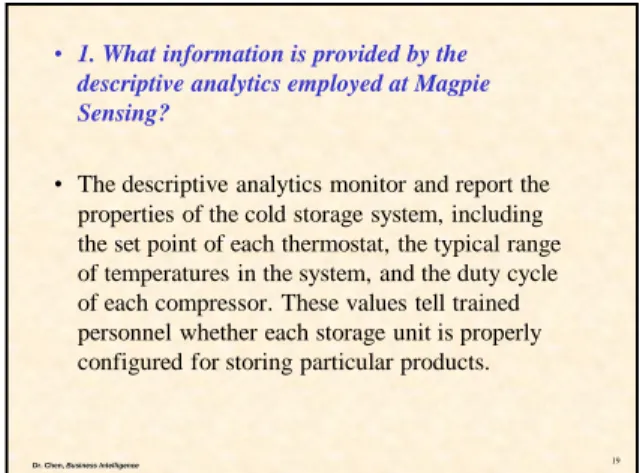
• 1. What information is provided by the descriptive analytics employed at Magpie Sensing?
• The descriptive analytics monitor and report the properties of the cold storage system, including the set point of each thermostat, the typical range of temperatures in the system, and the duty cycle of each compressor. These values tell trained personnel whether each storage unit is properly configured for storing particular products.
Dr. Chen, Business Intelligence 20
• 2. What type of support is provided by the predictive analytics employed at Magpie Sensing?
• The predictive analytics use the descriptive data to alert users when a unit is not configured properly for storing the products. It also sends an alert when average temperature and compressor cycle runs signal that a temperature may go out of range (for example, after a power failure) or that there may have been a human error, such as failure to shut a door.
• These analytics tell users about a problem that may occur, giving them time to prevent the problem.
Dr. Chen, Business Intelligence 21
• 3. How does prescriptive analytics help in business decision making?
• Prescriptive analytics guides decision makers to the alternative with the greatest benefits. In Magpie’s cold chain system, prescriptive analytics uses data about storage unit performance to help buyers select the best storage units. And based on data about storage system efficiency and product sensitivity, prescriptive analytics guides decisions about where to distribute particular products in the supply chain. • 4. What are possible ways to report actionable information
in real time to the concerned users of the system? • The system uses shippable wireless monitors. These
continuously measure temperature, humidity, and location and transmit the data to the computer that analyzes the data.
Dr. Chen, Business Intelligence 22
• 5. What other situations might need real-time monitoring applications?
• Answers will vary, but students should consider other systems where current performance provides information about changes or decisions that would improve future performance.
• Examples include monitoring inventory levels at a manufacturing company to determine when to replenish stocks, monitoring sales in a store to identify when and how to adjust the mix of products, and monitoring patient status in a hospital to identify situations where different treatment is required or devices are malfunctioning.
Dr. Chen, Business Intelligence 23
1.2 Changing Business Environment &
Computerized Decision Support Model
• Companies are moving aggressively to
computerized support of their operations =>
Business Intelligence
• Business Pressures–Responses–Support
Model
Business pressures result of today's competitive business climate
Responses to counter the pressures
Support to better facilitate the process for making (or improving) better decision
Dr. Chen, Business Intelligence 24
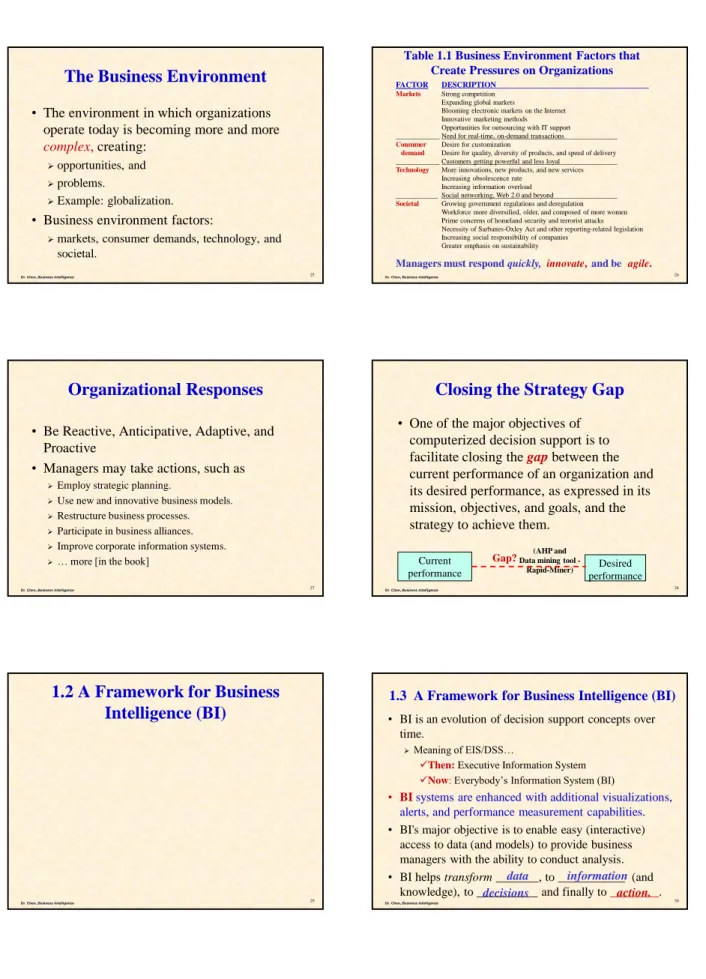
Fig. 1.1: Business Pressures – Responses – Support Model
[Business Pressure] [Response/Action] [IT/Computerized Support]
AHP and Data mining tool
(Rapid-Miner) Managers must respond quickly, _________ and be ______
innovatively, agile.
Be Reactive, Anticipative, Adaptive, and Proactive
Dr. Chen, Business Intelligence 25
The Business Environment
• The environment in which organizations
operate today is becoming more and more
complex
,
creating:
opportunities, and
problems.
Example: globalization.
• Business environment factors:
markets, consumer demands, technology, and societal.
Dr. Chen, Business Intelligence 26
Table 1.1 Business Environment Factors that Create Pressures on Organizations
FACTOR DESCRIPTION Markets Strong competition
Expanding global markets Blooming electronic markets on the Internet Innovative marketing methods Opportunities for outsourcing with IT support Need for real-time, on-demand transactions
Consumer Desire for customization
demand Desire for quality, diversity of products, and speed of delivery Customers getting powerful and less loyal
Technology More innovations, new products, and new services Increasing obsolescence rate
Increasing information overload Social networking, Web 2.0 and beyond
Societal Growing government regulations and deregulation Workforce more diversified, older, and composed of more women Prime concerns of homeland security and terrorist attacks
Necessity of Sarbanes-Oxley Act and other reporting-related legislation Increasing social responsibility of companies
Greater emphasis on sustainability
Managers must respond quickly, and be innovate, agile.
Dr. Chen, Business Intelligence 27
Organizational Responses
• Be Reactive, Anticipative, Adaptive, and
Proactive
• Managers may take actions, such as
Employ strategic planning.
Use new and innovative business models.
Restructure business processes.
Participate in business alliances.
Improve corporate information systems.
… more [in the book]
Dr. Chen, Business Intelligence 28
Closing the Strategy Gap
• One of the major objectives of
computerized decision support is to
facilitate closing the
gap
between the
current performance of an organization and
its desired performance, as expressed in its
mission, objectives, and goals, and the
strategy to achieve them.
Current
performance performance Desired
Gap? Data mining tool - (AHP and Rapid-Miner)
Dr. Chen, Business Intelligence 29
1.2 A Framework for Business
Intelligence (BI)
Dr. Chen, Business Intelligence 30
1.3 A Framework for Business Intelligence (BI)
• BI is an evolution of decision support concepts over time.
Meaning of EIS/DSS…
Then: Executive Information System
Now: Everybody’s Information System (BI)
• BI systems are enhanced with additional visualizations, alerts, and performance measurement capabilities.
• BI's major objective is to enable easy (interactive) access to data (and models) to provide business managers with the ability to conduct analysis. • BI helps transform _______, to ___________ (and
knowledge), to __________ and finally to ________.
data information
Dr. Chen, Business Intelligence 31
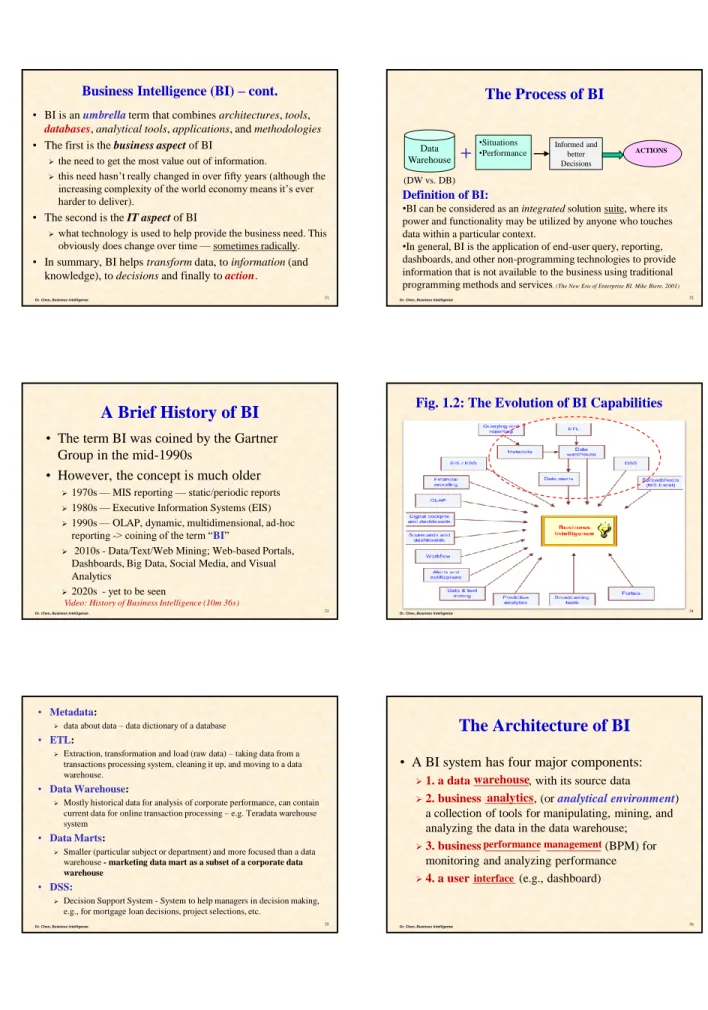
Business Intelligence (BI) – cont.
• BI is an umbrella term that combines architectures, tools,databases, analytical tools, applications, and methodologies • The first is the business aspect of BI
the need to get the most value out of information.
this need hasn’t really changed in over fifty years (although the increasing complexity of the world economy means it’s ever harder to deliver).
• The second is the IT aspect of BI
what technology is used to help provide the business need. This obviously does change over time — sometimes radically. • In summary, BI helps transform data, to information (and
knowledge), to decisions and finally to action.
Dr. Chen, Business Intelligence 32
Data Warehouse •Situations •Performance Informed and better Decisions ACTIONS
+
The Process of BI
Definition of BI:•BI can be considered as an integrated solution suite, where its power and functionality may be utilized by anyone who touches data within a particular context.
•In general, BI is the application of end-user query, reporting, dashboards, and other non-programming technologies to provide information that is not available to the business using traditional programming methods and services. (The New Era of Enterprise BI, Mike Biere, 2001)
(DW vs. DB)
Dr. Chen, Business Intelligence 33
A Brief History of BI
• The term BI was coined by the Gartner
Group in the mid-1990s
• However, the concept is much older
1970s — MIS reporting — static/periodic reports
1980s — Executive Information Systems (EIS)
1990s — OLAP, dynamic, multidimensional, ad-hoc reporting -> coining of the term “BI”
2010s - Data/Text/Web Mining; Web-based Portals, Dashboards, Big Data, Social Media, and Visual Analytics
2020s - yet to be seen
Video: History of Business Intelligence (10m 36s)
Dr. Chen, Business Intelligence 34
Fig. 1.2: The Evolution of BI Capabilities
Dr. Chen, Business Intelligence 35
• Metadata:
data about data – data dictionary of a database • ETL:
Extraction, transformation and load (raw data) – taking data from a transactions processing system, cleaning it up, and moving to a data warehouse.
• Data Warehouse:
Mostly historical data for analysis of corporate performance, can contain current data for online transaction processing – e.g. Teradata warehouse system
• Data Marts:
Smaller (particular subject or department) and more focused than a data warehouse - marketing data mart as a subset of a corporate data warehouse
• DSS:
Decision Support System - System to help managers in decision making, e.g., for mortgage loan decisions, project selections, etc.
Dr. Chen, Business Intelligence 36
The Architecture of BI
• A BI system has four major components:
1. a data _________, with its source data2. business ________, (or analytical environment) a collection of tools for manipulating, mining, and analyzing the data in the data warehouse;
3. business _________ _________ (BPM) for monitoring and analyzing performance
4. a user _______ (e.g., dashboard)
warehouse analytics
performance management
Dr. Chen, Business Intelligence 37
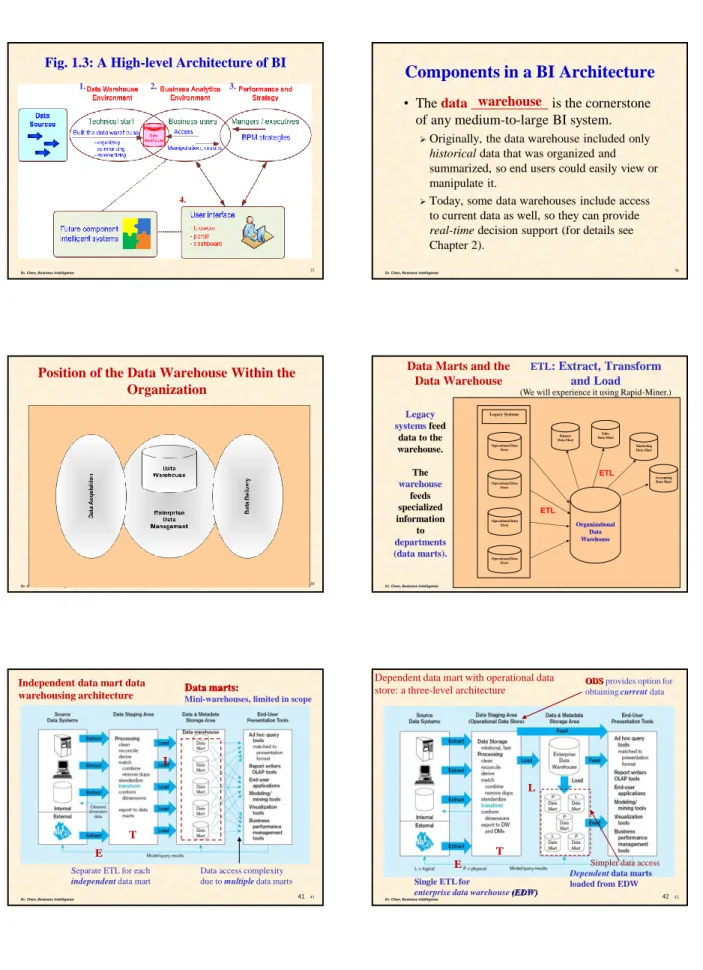
Fig. 1.3: A High-level Architecture of BI
1. 2. 3.
4.
Dr. Chen, Business Intelligence 38
Components in a BI Architecture
• The data ___________ is the cornerstone
of any medium-to-large BI system.
Originally, the data warehouse included only
historical data that was organized and
summarized, so end users could easily view or manipulate it.
Today, some data warehouses include access to current data as well, so they can provide
real-time decision support (for details see
Chapter 2).
warehouse
Dr. Chen, Business Intelligence 39
Position of the Data Warehouse Within the
Organization
Dr. Chen, Business Intelligence 40
Data Marts and the Data Warehouse Organizational Data Warehouse Legacy systems feed data to the warehouse. The warehouse feeds specialized information to departments (data marts). Finance Data Mart Accounting Data Mart Marketing Data Mart Sales Data Mart Operational Data Store Operational Data Store Operational Data Store Operational Data Store Legacy Systems ETL ETL
ETL: Extract, Transform and Load
(We will experience it using Rapid-Miner.)
Dr. Chen, Business Intelligence 41 41
Independent data mart data
warehousing architecture Data marts: Mini-warehouses, limited in scope
E T
L
Separate ETL for each independent data mart
Data access complexity due to multiple data marts
Dr. Chen, Business Intelligence 42 42
Dependent data mart with operational data store:a three-level architecture
E T
L
Single ETL for
enterprise data warehouse (EDW)
Simpler data access
ODS provides option for obtaining current data
Dependent data marts loaded from EDW
Dr. Chen, Business Intelligence 43 43
E T
L
Near real-time ETL for Data Warehouse
ODS and data warehouse are one and the same
Data marts are NOT separate databases,
but logical views of the data warehouse
Easier to create new data marts Logical data mart and real time
warehouse architecture
Dr. Chen, Business Intelligence 44
Components in a BI Architecture
• Business analytics are the tools that help users transform data into knowledge (e.g., queries, data/text mining tools, etc.).
Dr. Chen, Business Intelligence 45
Components in a BI Architecture
• Business Performance Management (BPM), which is also referred to as corporate performance management (CPM), is an emerging portfolio of applications within the BI framework that provides enterprises tools they need to better manage their operations (for details see Chapter 3).
• User Interface (i.e., dashboards) provides a comprehensive graphical/pictorial view of corporate performance measures, trends, and exceptions.
Dr. Chen, Business Intelligence 46
Business Analytics –
another perspective
• Business Analytics (BA) is an ________ term including data ___________, business ____________ , enterprise information management, enterprise performance management, analytic applications, and governance, risk, and compliance.
• Business Intelligence (BI) is a set of ____________ and ___________ used to describe business performance.
• Companies find success through better use of analytics. • Many companies offer similar products and user
comparable technologies.
• Business processes are among the last remaining points of differentiation.
• Focus on ____-based management to drive decision making. umbrella
warehousing intelligence
technologies processes
fact
Dr. Chen, Business Intelligence 47
What's The Difference? Business Analytics vs Business Intelligence
• Business Analytics (BA) is a close cousin of Business Intelligence (BI). Both are meant to help companies make better decisions by analyzing business data. The difference is in their methods, and in the general direction of their analysis.
• Business Intelligence, the most common form, concentrates on ______ from the present and the immediate past, and drawing conclusions from that. • Business Analytics makes more of an effort to predict
the future using more complex tools relying heavily on anything from _________ to neural nets.
http://it.toolbox.com/blogs/inside-erp/whats-the-difference-business-analytics-vs-business-intelligence-58672
data
statistics
Dr. Chen, Business Intelligence 48
Business Intelligence vs.
Business Analytics
• Business Intelligence
traditionally focuses on using a consistent set of metrics to both measure past ___________and guide business _______.
• Business Analytics
focuses on developing new ________ and understanding of business performance
What’s the difference between Business Analytics and Business Intelligence? The correct answer is: everybody has an opinion,
but nobody knows, and you _________ care
performance planning
insights
Dr. Chen, Business Intelligence 49
BI vs BA Business Intelligence Business Analytics
Answers the questions:
________ happened? _______ ? _______ ? How ______ ?
Why did it happen? Will it happen again? What will happen if we change x? What else does the data tell us that never thought to ask?
Includes:
Reporting (KPIs, metrics) Automated Monitoring/Alerting (thresholds)
Dashboards Scorecards
OLAP (Cubes, Slice & Dice, Drilling) Data Mining Ad hoc query Statistical/Quantitative Analysis Data Mining Predictive Modeling Multivariate Testing
While the terms business intelligence and business analytics are often used interchangeably, there are some key differences:
What When Who
many
Dr. Chen, Business Intelligence 50
Business Analytics (cont.)
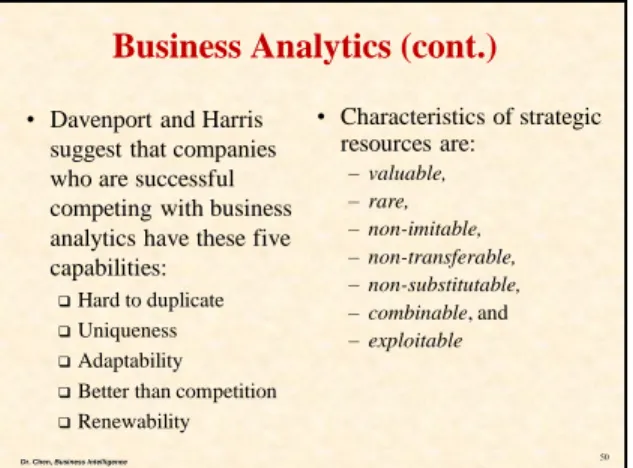
• Davenport and Harris suggest that companies who are successful competing with business analytics have these five capabilities:
Hard to duplicate
Uniqueness
Adaptability
Better than competition
Renewability • Characteristics of strategic resources are: –valuable, –rare, –non-imitable, –non-transferable, –non-substitutable, –combinable, and –exploitable
Dr. Chen, Business Intelligence 51
KM Project vs. IT Project
• According to Davenport and Prusak point
out in their “________
% rule
,”
if more than one-third of the time and money spent on a project is spent on technology, the project becomes an IT project rather than a KM project.
33 1/3
Dr. Chen, Business Intelligence 52
The Benefits of BI
• The ability to provide accurate information when needed, including a real-time view of the corporate performance and its parts • A survey by Thompson (2004)
Faster, more accurate reporting (81%)
Improved decision making (78%)
Improved customer service (56%)
Increased revenue (49%)
• See Table 1.2 for a list of BI analytics
applications, the business questions they answer and the business value they bring.
Dr. Chen, Business Intelligence 53
Analytic Application
Business Question Business Value
Customer segmentation
What market segments do my customers fall into, and what are their characteristics?
Personalize customer relationships for higher satisfaction and retention. Propensity to buy Which customers are more likely to
respond to my promotion?
Target customers based on their need to increase their loyalty to your product line.
Also, increase campaign profitability by focusing on the most likely to buy. Customer
profitability
What is the lifetime profitability of my customer?
Make individual business interaction decisions based on the overall profitability of customers. Fraud protection How can I tell which transactions are
likely fraudulent?
Quickly determine fraud and take immediate action to minimize cost. Customer attrition Which customer is at risk of leaving? Prevent loss of high-value customers
and let go of lower-value customers. Channel
optimization
What is the best channel to reach my customer in each segment?
Interact with customers based on their preference and your need to manage cost.
Table 1.2 Business Value of BI Analytical Applications
Source: A. Ziama and J. Kasher (2004), Data Mining Primer for the Data Warehousing Professional. Dayton, OH: Teradata.
Dr. Chen, Business Intelligence 54
1.4 Intelligence Creation and Use
A Cyclical Process of Intelligence Creation And Use
Data warehouse and BI initiatives typically follow a process similar to that used in military intelligence initiatives depicted in this figure.
Pre-condition:
Fig. 1.4: Process of Intelligence Creation and Use.
a data warehouse must be in place.
Dr. Chen, Business Intelligence 55
Intelligence Creation and Use
• Steps Involved
Data warehouse deployment (pre-condition)
Creation of intelligence
Identification and prioritization of BI projects – By using ROI and TCO (total cost ownership-benefit
analysis)
– This process is also called BI governance
•
BI Governance
Who should do the prioritization?
Partnership between functional area heads and/or product/service area leaders (middles)
Partnership between customers and providers
Dr. Chen, Business Intelligence 56
BI Governance Issues/Tasks
1. Create categories of projects (investment, business opportunity, strategic, mandatory, etc.)
2. Define criteria for project selection
3. Determine and set a framework for managing project risk
4. Manage and leverage project interdependencies
5. Continuously monitor and adjust the composition of the portfolio
Dr. Chen, Business Intelligence 57
Intelligence and Espionage
• Stealing corporate secrets, CIA, …
Intelligence vs. Espionage • Intelligence
The way that modern companies ethically and legally
organize themselves to glean as much as they can from their customers, their business environment, their stakeholders, their business processes, their competitors, and other such sources of potentially valuable information
• Problem – too much data, very little value
Use of data/text/Web mining (see Chapters 4, 5)
Dr. Chen, Business Intelligence 58
1.5 Transaction Processing vs. Analytic Processing (OLTP vs. OLAP)
• Transaction processing systems are constantly involved in handling updates (add/edit/delete) to what we might call operational databases.
ATM withdrawal transaction, sales order entry via an ecommerce site – updates DBs
Online transaction processing (OLTP) handles routine on-going business
ERP, SCM, CRM systems generate and store data in OLTP systems
The main goal is to have high _________ efficiency
Dr. Chen, Business Intelligence 59
• Online analytic processing (OLAP) systems are involved in extracting information from data stored by OLTP systems
Routine sales reports by product, by region, by sales person, etc.
Often built on top of a data warehouse where the data is not transactional
Main goal is ____________ (and then, efficiency) – provide correct information in a timely manner
More on OLAP will be covered in Chapter 2
Transaction Processing vs. Analytic Processing
(OLTP vs. OLAP)
effectiveness
Dr. Chen, Business Intelligence 60
More on OLTP vs. OLAP
Fig. Extra-a: A simple database with a relation between two tables.
• The figure depicts a relational database environment with two tables.
• The first table contains information about pet owners; the second, information about pets. The tables are related by the single column they have in common: Owner_ID.
• By relating tables to one another, we can reduce ____________ of data and improve database performance.
• The process of breaking tables apart and thereby reducing data redundancy is called _______________.
redundancy
normalization
For those have database background.
Dr. Chen, Business Intelligence 61
• Most relational databases which are designed to handle a high number of reads and writes (updates and retrievals of information) are referred to as ________
(OnLine Transaction Processing) systems.
• OLTP systems are very efficient for high volume activities such as cashiering, where many items are being recorded via bar code scanners in a very short period of time.
• However, using OLTP databases for analysisis generally not very efficient, because in order to retrieve data from multiple tables at the same time, a query containing ________ must be used.
OLTP vs. OLAP (cont.)
joins
OLTP
Dr. Chen, Business Intelligence 62
• In order to keep our transactional databases running quickly and smoothly, we may wish to create a data warehouse. A data warehouse is a type of large database (including both current and historical data) that has been _____________ and archived.
• Denormalization is the process of intentionally combining some tables into a single table in spite of the fact that this may introduceduplicatedata in some columns.
• The figure depicts what our simple example data might look like if it were in a data warehouse. When we design databases in this way, we reducethe number of joinsnecessary to query related data, thereby speedingup the process of analyzing our data.
• Databases designed in this manner are called __________ (OnLine Analytical Processing) systems.
OLTP vs. OLAP (cont.)
Fig. Extra-b: A combination of the tables into a single dataset.
OLAP
denormalized
Dr. Chen, Business Intelligence 63
• Transactional systems and analytical systems have conflictingpurposes when it comes to database speedand performance. For this reason, it is difficult to design a single system which will serve both purposes. This is why data warehouses generally contain archiveddata. Archived data
are data that have been copied out of a transactional database.
• Denormalization typically takes place at the time data are copied out of the transactional system. It is important to keep in mind that if a copyof the data is made in the data warehouse, the data may become out-of-______ .This happens when a copy is made in the data warehouse and then later, a change to the original record is made in thesourcedatabase.
• Data mining activities performed on out-of-synch records may be useless, or worse, misleading.
• An alternative archiving method would be to move the data out of the transactional system. This ensures that data won’t get out-of-synch, however, it also makes the data unavailable should a user of the transactional system need to view or update it.
OLTP vs. OLAP (cont.)
synch
Dr. Chen, Business Intelligence 64
1.6 Successful BI Implementation
• Implementing and deploying a BI initiative is a lengthy, expensive, and risky endeavor! • Success of a BI system is measured by its
widespread usage for better decision making • The typical BI user community includes
Not just the top executives (as was for EIS)
All levels of the management hierarchy Provide what is needed to whom he/she needs it
• A successful BI system must be of benefit to the enterprise as a whole…
Dr. Chen, Business Intelligence 65
BI - Alignment with Business Strategy
• To be successful, BI must be aligned with the company’s business strategy (think about IS/IT
Triangle Strategy Model).
BI cannot/should not be a technical exercise for the information systems department
• BI changes the way a company conducts business by
improving business processes, and
transforming decision making to a more data/fact/information driven activity
• BI should help execute the business strategy and not be an impediment for it!
Dr. Chen, Business Intelligence 66
BI for Business Strategy
• Strategy should be aligned with BI/DW – has the capability to execute the initiative by establishing a BI Competency Center (BICC) which can:
Demonstrate linkage – BI to strategy.
Encourage interaction between the potential business users and the IS organization.
Both sides have a lot to learn from each other
Serve as a repository and disseminator of best BI practices
among the different lines of business.
Advocate and encourage standards of excellence.
Help stakeholders understand the crucial role of BI.
Facilitate a real-time, on-demand agile environment. (see next slide)
Dr. Chen, Business Intelligence 67
Issues for Successful BI
• Developing vs. Acquiring BI systems
• Justifying via cost-benefit analysis
It is easier to quantify costs
Harder to quantify benefits
• Security and Protection of Privacy
• Integration of Systems and Applications
Dr. Chen, Business Intelligence 68
Real-Time, On-Demand BI Is Attainable
• The demand for “real-time” BI is growing! • Is “real-time” BI attainable? (Continental Airlines
case to be discussed in chapter 2)
• Technology is getting there…
Automated, faster data collection (RFID, sensors,… ) Database and other software technologies (agent, SOA,
…) technology is advancing
Telecommunication infrastructure is improving
Computational power is increasing while the cost for these technologies is decreasing
• Trend -> Business Activity Management (BAM)
Dr. Chen, Business Intelligence 69
BI Implementation Considerations
• Developing or acquiring BI systems
BI shell?
In-house versus outside consultants
• Justification and cost-benefit analysis
• Security and protection of privacy
• Integration of systems and applications
Dr. Chen, Business Intelligence 70
1.7 Analytics Overview
• Analytics?
Something new or just a new name for … “The process of developing actionable decisions or
recommendations for actions based upon insights generated from historical data.”
• A Simple Taxonomy of Analytics ___________/Reporting Analytics
Knowing what is happening in the organization and understanding some underlying trends and causes of such occurrences.
__________ Analytics
Aims to determine what is likely to happen in the future.
__________ Analytics
The goal is to recognize what is going on as well as the likely forecast and make decisions to achieve the best performance possible.
• Analytics or Data Science?
Business-oriented vs. Science/technical-oriented Descriptive
Predictive Prescriptive
Dr. Chen, Business Intelligence Fig. 1.5: Three Types of Analytics 71 Descriptive/
[1] [2]
[3]
Dr. Chen, Business Intelligence 72
Analytics Overview
Descriptive Predictive Prescriptive
Business Analytics Qu e st ion s What happened? What is happening?
What will happen? Why will it happen?
What should I do? Why should I do it?
En ab le r s • Business reporting • Dashboards • Scorecards • Data warehousing • Data mining • Text mining • Web/media mining • Forecasting • Optimization • Simulation • Decision modeling • Expert systems O u tc o m e s Well defined business problems and opportunities Accurate projections of the future states
and conditions
Best possible business decisions
Dr. Chen, Business Intelligence 73
Introduction to Big Data Analytics
• Big Data?
Not just big!
Volume
Variety
Velocity
structured, unstructured, or in a stream
• Two aspects for studying “Big Data”
_______ and __________ /analyzing “Big Data”
• Push ___________ to the data instead of pushing data to a computing mode.
• More on big data and related analytics tools and techniques are covered in Chapter 6.
storing processing computation
Dr. Chen, Business Intelligence 74
End-of-Chapter Application Case
Nationwide Insurance Used BI to
Enhance Customer Service
Questions for Discussion
1. Why did Nationwide need an enterprise-wide data warehouse?
2. How did integrated data drive the business value? 3. What forms of analytics are employed at Nationwide? 4. With integrated data available in an enterprise data
warehouse, what other applications could Nationwide potentially develop?
Dr. Chen, Business Intelligence 75
• 1. Why did Nationwide need an enterprise-wide data warehouse?
• With more than 100 business units offering a
variety of products, Nationwide experienced
duplication of effort in gathering data, analyzing it, and generating reports. Data-processing
environments were widely dissimilar, and there was extreme data redundancy, resulting in higher expenses.
• Mergers and acquisitions only added to the difficulty and cost. A single, authoritative data warehouse would apply best practices and provide clean, consistent, and complete data.
Dr. Chen, Business Intelligence 76
• 2. How did integrated data drive the business value?
• Integrated data about customers improved marketing campaigns and better targeted communications, which improved customer satisfaction and retention, as well as contributing to a gain in sales.
• Integrated financial data made financial reporting faster and more efficient and added tools for better risk assessment and decision support.
• Integrated data following mergers fostered smoother integration of businesses. Integrated data for reporting gave agents easy access to reports within seconds rather than days, significantly improving productivity.
Dr. Chen, Business Intelligence 77
• 3. What forms of analytics are employed at Nationwide?
• It uses the three basic types of business analytics. • The company’s data warehouse supports
descriptive analytics for all functions. For
example, the data describes customer behavior, financial performance, and policy information. • It uses predictive analytics in the Customer
Knowledge Store to identify the kinds of customer interaction that are important for customers at different points in their lives.
Dr. Chen, Business Intelligence 78
• 3. (cont.)
• At the level of prescriptive analytics, the Financial Performance Management system applies financial data to a decision support system. • You may identify additional examples of these
three categories. Optionally, you may also refer to analytics applied to different domains, such as marketing analytics, financial analytics, and even insurance analytics.
Dr. Chen, Business Intelligence 79
• 4. With integrated data available in an enterprise data warehouse, what other applications could Nationwide potentially develop?
• The case described customer relationships and financial reporting.
• Other areas of decision making for an insurance business would include the development and
pricing of products, regulatory compliance, hiring,
risk management, and the location of facilities.
Dr. Chen, Business Intelligence 80
Data process Information
Quality Information Accessible Organizational Knowledge Sharable Collaborative -As a product NOT byproduct
-As core intellectual capital NOT merely a few smart employers
Decision Making Available Reusable CRM Accounting Finance Operations Manufacturing External customers D. B. D.B.: Structured: R-DBMS Unstructured: Document Mgt. Systems
context, experience
automate informate innovate
Useable
K.B D.W
From Data to Knowledge:
How Can Organization Gain Competitive Advantage? (Survive and Prosper in the Digital Economy)
Dr. Chen, Business Intelligence 81