ESSAYS ON REGULATION AND SUPERVISION
ALFREDO EBENTREICH
April 2005
Microfinance Regulation in
Peru: Current State, Lessons
Learned and Prospects for the
Future
ESSAYS ON REGULATION AND SUPERVISION
No.4 — Microfinance Regulation in Peru: Current State, Lessons Learned, and Prospects for the
Future
ABOUT THE AUTHOR
Alfredo Ebentreich is a senior analyst at the Superintendency of Banking and Insurance Companies in Peru. He has worked as off-site supervisor of microfinance institutions, and currently works in the Department of Analysis of Microfinance Institutions in the Economic Studies Division, reviewing the situation of the entire microfinance system in Peru. He can be reached at [email protected].
ABOUT THE SERIES
The Essays on Regulation and Supervision series has been commissioned for the Microfinance Regulation and Supervision Resource Center, funded by the
Consultative Group to Assist the Poor (CGAP) and implemented by the IRIS Center. These essays are intended to provide additional insights and perspectives on the experiences of microfinance institutions, regulators, donors, and others regarding specific microfinance legal and regulatory environments.
DISCLAIMER
The views and opinions expressed in these essays are those of each author and do not necessarily reflect the opinions of CGAP, the IRIS Center, or Peru’s
Superintendency of Banking and Insurance Companies.
THE MICROFINANCE REGULATION AND SUPERVISION RESOURCE CENTER
You may find this and other essays in this series at the Microfinance Regulation and Supervision Resource Center: www.cgap.org/regulation. CONTACT IRIS IRIS Center University of Maryland Department of Economics 2105 Morrill Hall College Park, MD 20742 USA E-mail: [email protected] Phone: +1.301.405.3110 Fax: +1.301.405.3020 Web: www.iris.econ.edu
Introduction
THE MICROFINANCE INSTITUTIONS in Peru are
composed of Municipal Savings and Loan Institutions (MSLI - also known as CMAC), Rural Savings and Loan Institutions (RSLI - also known as CRAC) and Entities for the Development of the Small and Microenterprise (EDPYME).
MSLIs started their operations in the early 1980s, and were created with the cooperation of the German government to replicate the success of the German Sparkassen. They are owned by local governments and operate in provinces, helping small business to expand their services by offering them financial products from funds collected in the communities. RSLIs were created in early 1990, after the Agrarian Bank was closed due to the 1992 financial reforms.1 They are owned by local private
entrepreneurs, and operate mainly in rural areas with large exposure in the agriculture and livestock sectors. EDPYMEs were created in the mid 1990s to formalize those NGOs that were granting loans to microentrepreneurs; this formalization became more important by the end of the 1990s when a law was passed which required NGOs to pay value-added tax on all interest from loans. Since NGOs did not have experience collecting deposits from the public, EDPYMEs were created as credit-only institutions.
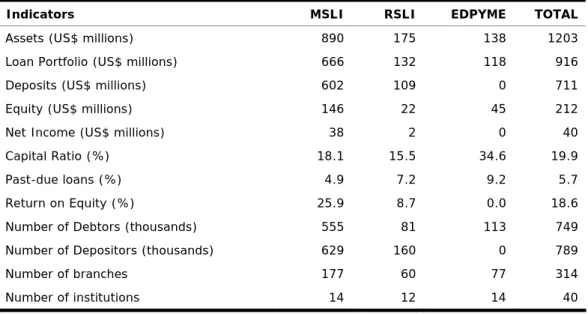
Table 1: Current State of Microfinance Institutions in Peru
Indicators MSLI RSLI EDPYME TOTAL
Assets (US$ millions) 890 175 138 1203
Loan Portfolio (US$ millions) 666 132 118 916
Deposits (US$ millions) 602 109 0 711
Equity (US$ millions) 146 22 45 212
Net Income (US$ millions) 38 2 0 40
Capital Ratio (%) 18.1 15.5 34.6 19.9
Past-due loans (%) 4.9 7.2 9.2 5.7
Return on Equity (%) 25.9 8.7 0.0 18.6
Number of Debtors (thousands) 555 81 113 749
Number of Depositors (thousands) 629 160 0 789
Number of branches 177 60 77 314
Number of institutions 14 12 14 40
Note: Information for December 31st, 2004
By the end of 2004, there were 40 microfinance institutions operating in Peru, with total assets of US$1.2 billion, representing 5.8% of total assets of the entire Peruvian financial system.
1. The Agrarian Bank (Banco Agrario) was a state-owned development bank focused on agriculture financing. Created in 1961, Banco Agrario channeled government funds to small peasants at subsidized interest rates and loan conditions. It was closed due to problems of insolvency (very poor repayment rates) and its ability to effectively target the agriculture sector was questionable.
Regulation and Supervision of
Microfinance Institutions (MFIs) in Peru
Microfinance institutions, and their operations, are regulated with the same norms as banking and other financial institutions in Peru, with some differences in the minimum capital requirement and the number of operations allowed.Entry Regulations
The basic requirements to enter the financial sector are established in Resolution N° 600-98. All applications, whether they are for banks, finance companies or microfinance institutions, have to follow this norm.
The shareholders of the new financial institution have to pass a fit and proper test, which includes submitting their Résumé, statement of rents and properties, and certification of no criminal records. Special attention is paid to their experience in the financial sector and their own financial situation. In the case of major executives, their experience in the management of financial operations, and especially in the market niche the financial institution wants to enter, is crucial.
A feasibility study has to be submitted which forecasts projected business, taking into account the market the applicant wants to enter. Once the first stage of the application process is finished, the new institution will receive an on-site inspection to examine the information systems, manuals and procedures, accounting and the condition of the main office. All applicants must have equity of at least the minimum regulatory capital for the institution type for which they are applying.
The last part of the entry process is to receive the approval of the Central Bank. Once this is obtained, authorization to begin operations is granted.
Regulation of Solvency Risk
Solvency is regulated and supervised by establishing and monitoring minimum capital by type of institution. Minimum capital requirements are readjusted each trimester by wholesale inflation in the period.
In addition, all financial institutions have to maintain a capital adequacy ratio of at least 9.1%, meaning that risk-weighted assets should be up to 11 times the regulatory capital, composed of paid capital, reserves, losses from previous years, loan-loss provisions of loans with risk category Normal and up to 50% of paid capital in subordinated debt.2 This capital ratio is slightly
higher than the 8% suggested by the Basel Committee, recognizing than Peru is not a developed country, and its
2. See articles 184° to 196° of Law N° 26702 for more details on regulatory capital and risk-weighted assets.
financial sector has to be very solvent to confront the effect of financial crises on developing countries.
Table 2: Minimum Capital Requirement (US$ thousands) Type of Institution Minimum Capital
Banks 6 051.2 Finance Companies 3 043.0 MSLI 275.1 RSLI 275.1 EDPYME 275.1 Note: As of March 31, 2005.
Regulation of Credit Risk
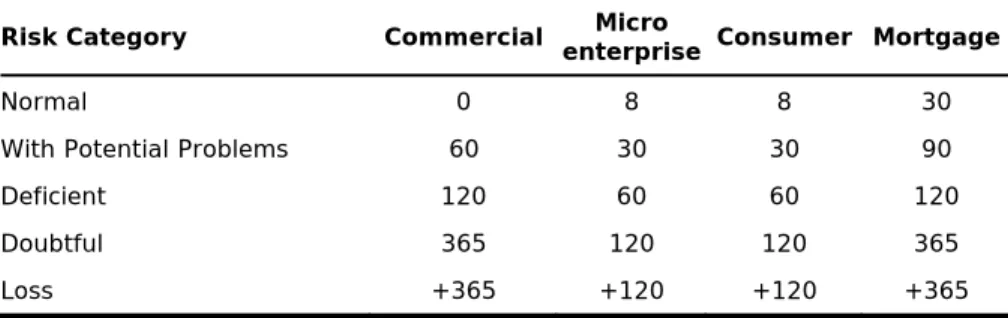
The regulation of credit risk in Peru is established in Resolution N° 808-2003, which defines the types of loans available in the financial system, the risk categories by type of client, loan-loss provisions, and collateral qualifying for lower provisions. Additionally, the General Law of the Financial, Insurance and Private Pension System, Law N° 26702, establishes a number of limits on financing to a single client, to related parties and to board members and employees of the financial institution. In Peruvian regulation there are four types of loans: commercial and microenterprise loans are granted to firms and individuals to finance their economic activities; microenterprise loans have a limit of US$30,000. Consumer loans are granted to individuals for consumption purposes, and mortgage loans are granted to build, modify or buy housing, using the property as collateral. While the risk categories of microenterprise, consumer and mortgage loans depend solely on their past-due days, the risk evaluation of commercial loans also requires an assessment of the financial situation of the client.3
Table 3: Definition of Risk Categories by Type of Loans (number of days past due)
Risk Category Commercial enterprise Micro Consumer Mortgage
Normal 0 8 8 30
With Potential Problems 60 30 30 90
Deficient 120 60 60 120
Doubtful 365 120 120 365
Loss +365 +120 +120 +365
Source: Resolution N° 808-2003.
Since microenterprise and consumer loans are granted with shorter terms than commercial and mortgage loans, they move into riskier categories sooner. Establishing additional requirements to evaluate microenterprise and consumer loans would have made them burdensome, since it is not only hard to
3. Recognizing the nature of microenterprise loans, the SBS allows financial institution to establish their own information
requirement for each client, unlike commercial loans, where the SBS has a list of minimum
information each credit file has to have.
evaluate the financial situation of a microenterprise or of a person, but also these loans have higher administrative costs than commercial loans. This has had a positive impact on microfinance institutions, since microenterprise and consumer loans are their biggest products, representing 53.7% and 25.2% of the total loan portfolio as of December 2004.
All financial institutions report their clients to the Superintendency, which consolidates the information and shares it, through its credit bureau, to all financial institutions. Many clients have debts with more than one financial institution. However, a single client cannot have several risk categories, since the client represents the same risk. Therefore, through the credit bureau, financial institutions can see the risk category of common clients, and must change their risk assessment according to the riskier category assigned by any financial institution which has lent a significant portion of the total debt to these clients (20% at least).4 This prevents debtors from
borrowing with several financial institutions and repaying only to those they choose.
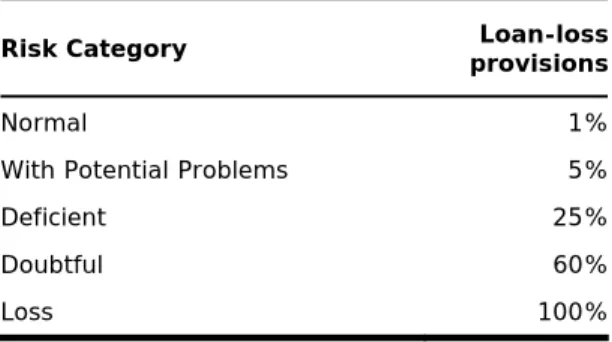
After a client defaults, according to the number of days their debt is past due, the type of loans they received, and their financial situation, loan-loss provisions have to be made to reflect the real value of the loan. In cases where collateral was obtained, these provisions can be reduced depending on the liquidity of the collateral.5
Table 4: Loan-loss Provisions by Risk Category Risk Category provisionsLoan-loss Normal 1%
With Potential Problems 5%
Deficient 25% Doubtful 60% Loss 100%
Source: Resolution N° 808-2003.
Financing to a single party cannot exceed 10% of the regulatory capital, but exceptions are made if more liquid collateral is utilized, which can increase the limit up to 30% of the regulatory capital. Financing to related parties, meaning those that are shareholders and/or have management control over the financial institution, cannot exceed 30% of the regulatory capital, and financing to board members and employers cannot exceed 7% of paid capital and reserves.6
Regulation of Liquidity Risk
The main regulation with respect to liquidity risk is the minimum liquidity ratio, both in local and foreign currency. The liquidity ratio is defined as liquid assets over short-term
4. Financial institutions can have differences in risk categories assigned to a client up to just one level. For example, a client can be rated as Normal for one institution, and by the others as With Potential Problems.
5. Any financial institution can be more conservative than the regulatory agency stipulates, and can place their clients in higher risk categories if it is believed they pose a higher risk.
6. For more information on limits of loan portfolio concentration, see articles 200°to 211° of Law N° 26702.
obligations. Since Peru is a highly dollarized economy, and local currency generally devaluates with respect to the US dollar, the minimum liquidity ratio in foreign currency was set at 20% and the liquidity ratio in local currency at 8%, so that financial institutions can cope better with runs on foreign currency due to sudden changes in the exchange rate with US dollars.
These liquidity requirements are easily met by most MFIs, since deposits from the public are usually at long term. Apart from having liquid assets to meet short-term obligations, MFIs also keep liquid assets to increase their supply of loan products The Central Bank, as one of its instruments of monetary policy, requires all deposit-taking institutions to place reserves at the Central Bank. Its purpose differs from liquidity requirements, as reserves are intended to reduce the expansion of credit, while the liquidity ratio is a regulatory tool to minimize the risk of bank runs.
Regulation of Market Risks
The market risk to which MFIs are exposed the most is foreign exchange risk. There are limits to the exposures: for assets greater than liabilities in foreign currency, 100% of regulatory capital, and for the opposite, 5% of the regulatory capital. In the case of banks, additional capital must be made for 9.1% of the exposure of foreign exchange risk.
MFIs, due to the market niche they serve, operate mostly in local currency, but since some of them receive external financing in foreign currency, many have open positions, more liabilities than assets in foreign currency.
Regulation of Market Exit
The regulatory framework clearly establishes when the regulator can intervene in a financial institution and when the institution can be liquidated. Before liquidation, there is a surveillance period lasting up to three months, during which the financial institution has limitations in conducting its normal business and has to submit a rehabilitation plan within seven days after being put under surveillance.
Financial institutions that suspend the payment of their obligations, do not comply with their rehabilitation plan, have capital ratios lower than 4% (or financial leverage higher than 25 times), or have a loss or reduction of more than 50% of their regulatory capital, are intervened. After that, the institution suspends its operations and is managed by the supervisory agency. The intervention lasts up to three months, after which
the institution is liquidated.7 7. For more details on the
regulation of market exit, see articles 95° to 123° of Law N° 26702.
Lessons learned in the
Regulatory and Supervisory Processes for MFIs
THERE HAVE BEEN microfinance institutions in Peru since
the mid 1980s. Over this period, a number of closures have occurred, and many institutions have entered the market. The most important lessons have been learned after reviewing the reasons for the closure of MFIs, and are being applied both to current MFIs as well as to institutions applying for a license as any type of MFI in Peru.
Table 5: Reasons for Liquidation: Rural Savings and Loan Institutions, and EDPYMEs
Financial Institution Closure Date of Reason(s) for Liquidation and Intervention RSLI Valle del Río
Apurimac y Ene 97.04.20 Loss of more than 50% of regulatory capital
RSLI Tumbay 97.10.22 Loss of more than 50% of regulatory capital
RSLI Selva Peruana 97.12.30 Loss of more than 50% of regulatory capital, inadequate rehabilitation plan and irregularities in the equity of the RSLI.
RSLI Ucayali 98.04.13 Loss of more than 50% of regulatory capital
RSLI Mantaro 98.04.13 Loss of more than 50% of regulatory capital and failure to comply with the rehabilitation plan under the surveillance regime. RSLI Majes 99.01.08 Suspension in the payment of obligations (deposits), loss of more than 50% of regulatory capital and failure to comply with the rehabilitation plan under the surveillance regime.
EDPYME Credinpet 99.08.10 Loss of more than 50% of regulatory capital
RSLI Selva Central 99.09.16 Loss of more than 50% of regulatory capital
As it can be seen in Table 5, the most frequent reason for MFI closures have been losses larger than 50% of their regulatory capital. This can happen because of a low capital requirement, or losses coming mostly from the loan portfolio of these institutions, or because of both.
Minimum Regulatory Capital
A minimum regulatory capital of roughly US$250,000 has proven to be a very low requirement, not just in comparison with minimum capital in other countries for MFIs,8 but also for any
new MFI to sustain their initial losses while a minimum loan portfolio is built to support their expenses, as well as to cover the investment in the entry process. In fact, not a single license application for a MFI has been authorized if its equity equals the minimum regulatory capital, and all operating MFIs have equity higher than US$400,000. In reality, it has been accepted that a higher minimum capital is required.
8.For example, Bolivia requires almost US$1 million for their Private Financial Funds.
Another implication of having such a low minimum capital is that high levels of leverage can be reached if there are no increases in equity to match growing levels of loan portfolio. Many authors have suggested establishing a higher capital ratio for MFIs - or lower leverage limits - due to the riskier profile of MFI clients, as well as the fact that shareholders of these institutions do not have “deep pockets” to draw on in case of financial distress.
Supervision of MFI Loan Portfolio
In traditional on-site supervision, a sample of credit files is selected to review the classification of the clients to determine whether the financial institution adequately provisions for loan losses according to the risk level of its client. However, in the case of MFI loan portfolios, composed mostly of microenterprise and consumer loans, selecting a sample would require reviewing a large number of files, and also would require the institution to have more information about their clients, which would be problematic when many clients do not have financial statements, and MFIs instead rely on estimates elaborated by the credit analyst.
On-site inspections at MFIs now involve a review of the entire database of all microenterprise and consumer loans,9 and a
selected sample of commercial loans, which are very few, to determine the need for additional provisions.10 It has been
learned that many MFIs grant additional loans to clients in financial trouble, so that they can repay their former loans, and no additional provisions are made for these refinanced loans (also called reprogrammed loans). This has brought attention to the issue of refinanced loans, and a project has started to create a process to review this issue during on-site inspections.
The Role of Internal Controls
One of the reasons for closure among MFIs was a failure in the internal control system to detect irregularities and the deterioration of the loan portfolio. Initially MFIs were required to have internal auditors who report to the board of directors, but due to the growing size of their loan portfolio, it was also necessary to require these institutions to establish a department in charge of risk evaluation, especially credit risk, which could permanently oversee compliance with limits and internal norms regarding risk management. This became especially salient as the number of regulated MFIs grew over the past few years and the supervisory agency could not perform frequent on-site inspections. There are plans to require MSLIs, which have three major management positions (loan, finance and administration) to add an additional manager to deal with risk evaluation.
9.Since these types of loans based their risk categories on past-due days, each operation is checked with respect to morosity, and the risk category of the client inside the MFI compared to their riskier qualification in the entire financial sector. 10A past-due portfolio does
not only mean provisions to cover losses, but also shifting the accounting of interest from earned to cash method. Therefore, earned interest of these clients will not be part of financial income, and will reduce net income.
Prospects of Peruvian
Microfinance Institutions
MFIS HAVE BEEN the fastest-growing financial institutions in
Peru over the last decade. They have reached a market niche un-served by banking institutions, which have started to compete slowly in this market after seeing the positive results achieved by the MFIs. The regulation and supervision of these institutions will have to deal with this changing market, as well as with the growing outreach of MFIs and the impact of the New Basle Capital Accord on microfinance in Peru.
Growth
According to estimates, the microenterprise sector in the Peruvian economy accounts for 42% of GDP and employs 75% of the working age population.11 However, and despite the fact that
MFI assets have grown on average 38.5% annually over the last decade, and the growing interest from commercial banks in microfinance, the microenterprise portfolio is still the smallest loan portfolio in the entire financial system, with US$960 million, representing just 7.9% of the total loan portfolio.
The microfinance industry has room to grow in Peru. From a supervisory point of view, however, it is better for the industry to grow at a slower pace, as has happened in the last few years,12
because high growth rates could lead to riskier business practices among MFIs than they currently engage in. The supervisory agency has allowed MSLIs from other regions to open branches in Lima, not only to allow these institutions to grow, but also to reduce their risk exposure in the provinces they come from.13
Many MFIs have sustained their growth by collecting deposits and granting loans all at higher interest rates than those offered by banks. However, high interest rates also may attract those clients unwilling to repay, since they can accept those higher interest rates with no intention of repayment (adverse selection).
11National Institute of Statistics and Informatics (1995).
12From 1994 to 1997, the average annual growth rate of MFI assets was 51.4%, which reduced to 32.0% for the 1998-2000 period. From 2001 to 2004, MFIs further slowed their growth, with an annual average rate of asset growth of 30.2%. 13In early 2003, the MSLIs
from Arequipa, Piura and Trujillo were allowed to open branches in Lima, and by the end of 2004, these branches had a portfolio of US$17.7 millions and deposits for US$48.4 millions, 4.5% and 13.1% of their total, respectively.
Assets of MFI: Size and Share
0 200 400 600 800 1000 1200 1400 1994 1995 1996 1997 1998 1999 2000 2001 2002 2003 2004 (US$ millions) 0,0 1,0 2,0 3,0 4,0 5,0 6,0 7,0 (Participation %) Size Share
Microenterprise Loan Portfolio: Size and Share 400 500 600 700 800 900 1000 2001 2002 2003 2004 (US$ millions) 0,0 1,5 3,0 4,5 6,0 7,5 9,0 (Participation %) Size Share
High interest rates on deposits are also unsustainable since they reduce the financial margin and could attract depositors only interested in short-term and highly-remunerated deposit accounts, not in a long term relationship with the MFI.
According to the Law No 26702, there is freedom to set interest and any other charges in the Peruvian financial sector, but reductions in interest rates are not only welcomed by clients, but also by the supervisory agency because of the reasons mentioned above. The SBS has increased its efforts in transparency, publishing more information on the effective costs of all kinds of loans, so that clients can make more informed decisions.14 Aside
from increasing transparency, the association of banks created an ombudsman for financial customers, which, coupled with the National Institute of Competition and Intellectual Property, provide consumers with many options to file complaints.
Competition
Banks and finance companies have played a big role in granting microenterprise loans, but due to impressive MFI growth, their share in this loan portfolio was reduced from 63% in 2001 to 49% in 2004. However, because banks’ financial margins have grown slimmer, some banking institutions have seen the profitability of the MFIs and begun moving strongly towards this market niche. Banks have an advantage in their larger network of branches to offer their services, their ability to offer a larger number of services to their clients, and more equity to invest in this market.
Table 6: Microenterprise Loan Portfolio by type of financial institution (US$ millions and percentage)
Type of Institution 2001 2002 2003 2004 Banks 273 52% 248 43% 298 41% 469 49% Finance Companies 59 11% 72 13% 76 10% 0 0% MSLI 124 23% 169 29% 240 33% 340 35% RSLI 34 6% 38 7% 46 6% 64 7% EDPYME 40 7% 47 8% 64 9% 88 9% Total 530 100% 575 100% 723 100% 961 100%
Note: The only finance company that was granting microenterprise loans was then integrated into the bank of the same financial group, for which by the end of 2004 there was no microfinance loan portfolio under finance companies.
The Law No 26702 created a Modular Scheme, under which MFIs can apply for authorization to perform additional operations if they offer higher equity, A or B external ratings and an ad hoc evaluation by the supervisor of the institution’s capacity to offer the new service(s). However, no MFI has yet been granted such authorization under the Modular Scheme, which was recently modified to eliminate the biggest barrier, the external rating requirement. This has been of special interest for EDPYMEs interested in taking deposits from the public, and by MSLIs which want authorization to issue credit cards to compete on equal terms with banks.
14Since May of 2003, the SBS has published information 16 times on effective costs of
Microenterprise, Consumer and Mortgage loans, showing not only interest rates, but also
commissions, credit life insurance, fire insurance (for mortgage loans), etc.
The effects of competition can also be seen in the lower percentage of unique clients at each type of financial institution.15 In the last four years, the percentage of unique
microenterprise clients has reduced by more than 20% in banks, and more than 10% in MFIs.
Graph 3
Unique Microenterprise Clients (% total)
50 60 70 80 90
Jun-01 Sep-01 Dic-01 Mar-02 Jun-02 Sep-02 Dic-02 Mar-03 Jun-03 Sep-03 Dic-03 Mar-04 Jun-04 Sep-04
Banks MSLI RSLI EDPYMEs
While this may reflect the fact that financial institutions share the risk in financing a single client, this could also be a sign of over-indebted clients who will ultimately fail to repay their obligations. Predatory competition, such as offering interest rates below cost to A-class clients, will affect all institutions involved, and the supervisor will have to intervene if it is proved that lending by many institutions to a single debtor affects his/her ability to repay.
Another potential effect of competition will be that the smallest MFIs, mostly EDPYMEs, will have to merge to have higher equity, increased loan diversification and the ability to offer more services to their clients. Because the high number of MFIs makes it difficult for the supervisor to conduct appropriate supervision given limited resources, mergers and acquisitions would be welcomed.
Transparency
Due to supervision requirements, MFI have to submit to the supervisory agency various reports on their financial condition. The improvement in the quality of information submitted to the credit bureau could reduce the number of reports MFI have to submit, reducing their burden. The credit bureau collects information of all clients of financial institutions, reporting both positive and negative information of their loans (amount, risk category, type, collateral, etc.).
Basel II
The SBS has created a special commission to analyze the implementation of the New Capital Accord, mostly known as
15Unique clients refers to clients that work with only one financial institution.
Basel II. The implementation of Basel II under the simple standardized approach could impact MFIs because it is suggested that the retail portfolio, which in Peru is comprised of the microenterprise and consumer loan portfolio, should have a lower risk weight (75% rather than the current 100%), which could reduce the financial leverage these institutions have by reducing their risk-weighted assets.
On the other hand, if Basel II is implemented using the internal ratings-based approach, MFIs would lack the information and systems required to calculate their own parameters (probability of default, loss given default, etc.); thus it will be very hard for them to determine their economic capital. Another way in which MFIs could be affected is that most of them do not have external ratings, meaning that any financing they receive from other financial institutions would be rated at a high level of risk, thus increasing the cost of capital.
Peru has not yet decided how and when Basel II will be implemented, but apparently financial institutions could choose their internal ratings with approval by the supervisor, while other financial institutions would use the standardized approach with some modifications adapted to the Peruvian situation. MFIs could be among the latter type of institutions.