16. Mai 2013 “The Future of Life Insurance”
Guarantees: Past, Present, Future?
Ralf Korn (TU Kaiserslautern, Fraunhofer ITWM, EI-QFM)
Motivation I:
Nov. 2011: DGVFM/DAV launched the “Topic of the Year 2012”
The Future of the Interest Rate Guarantee in German Life Insurance
Nov. 2012: DGVFM/DAV launched the “Topic of the Year 2013”
Alternative (to) Guarantees
Workshop on “Alternative Guarantees” at TU München, 9.9.2013
(see also
https://aktuar.de/dgvfm/topic_of_the_year/
)
Motivation II:
Motivation III:
Work of the group “Altersvorsorgeprodukte” of the EI-QFM in Kaiserslautern
(including members of ERGO, Swiss Life, Canada Life, MLP, Franke und
Bornberg, Fraunhofer ITWM, Univ. Ulm, … ) that discusses all aspects of
guarantee products
Symposium “
Zukunft der Garantien – Garantien der Zukunft
”
at EI-QFM in Kaiserslautern on August 22 (information:
[email protected]
)
See: www.ei-qfm.de
0.
Some preliminary remarks
Guarantees are the basis of every insurance deal
Guarantees have a price
Guarantees can result in different challenges
o Guarantees for a collective („Law of large numbers“) o Singular guarantees (Single contracts, reinsurance, …) o ….
Guarantees cannot be canceled (at least not without an enormous loss in the
public image of the corresponding insurer) But also:
There is no arbitrage opportunity on the financial market Hope for a better future is no basis for a guarantee
1.
Motivation
:
Some aspects/problems of Life Insurance
Aim:
Save today for the retirement period
Problems:
Long time lag between premium and pension payments
o Duration matching
Uncertainty about the amount of money needed in the future
o Interest rate and inflation risk
Uncertainty on the duration of the payment period
o Longevity risk
Typical problems in financial mathematics with non-hedgeable risks
Danger for the insured:
1.
Motivation
:
Basic forms of pension
Defined Benefit – The insurer takes the risk
payment (often just a lumo sum),
insurer invests and finally pays the guaranteed amounts Defined Contribution – The insured takes the risk
customer pays,
insurer invests, customer gets the result
Best (?) of both worlds – The German system …
mixture of a Defined-Contribution-System
and a performance guarantee (free of charge !!!)
Unique selling property compared to bank products (?)
1.
Motivation
:
Average yield
guarantee rate
(“Höchstzinssatz”)
1.
Motivation
:
The historical interest rate date
2. Main problems – Practical point of view
Longevity risk => will not be considered today
Are older (and more expensive!!!) contracts fully hedged ? => will not be considered today (but might be the biggest problem!)
How long will the interest rate stay low? o Hard to predict
o Given today’s term structure curve: still some time. o Model based: be very careful !
o No good economic forecasting models available !!!
2. Main problems – Practical point of view
Valuation of financial products
There are no arbitrage opportunities (“Arbitrage-free markets”)
A riskless (!) gain above the riskless interest rate is not possible
Guarantees have a price:
Implicit costs (Reduction in return => CPPI)
Explicit costs (Costs for derivatives=> OBPI) Modelling problems
There do not yet exist tractable models for the long term evolution of stock prices and interest rates
Conceptual problems
Understanding guarantees?
How to advertise guarantees?
2.
Main problems – Understand that a classical product is a good product
A very simple example
Initial capital 100 €
Index with rate of return µ = 5%, volatility = 20% (Black-Scholes model)
Money market account r = 2% (constant interest rate)
Alternative 1:
Costs of an option based guarantee (i.e. index fund plus put on the fund) with a
Lower bound of 101,01 € (i.e. 1% minimum rate of return), full upside potential =>
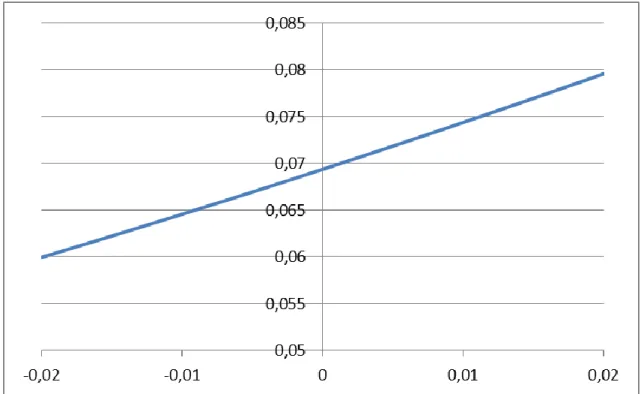
Costs of the additional put option: 7,44 €
Costs of lower bounds
Option based guarantees – some numbers 1
Figure C1: Costs of an additional put option (y-axis) as a function of the guarantee expressed in the equivalent interest rate (x-axis)
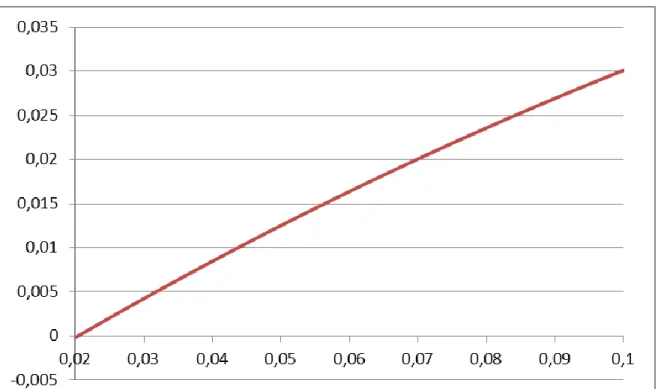
Reduced costs via upper bounds
Option based guarantees – some numbers 2
Figure C2: Costs of a guarantee of 2% (y-axis) as a function of the sacrificed guarantee expressed in the equivalent upper bound for the percentage yield (x-axis)
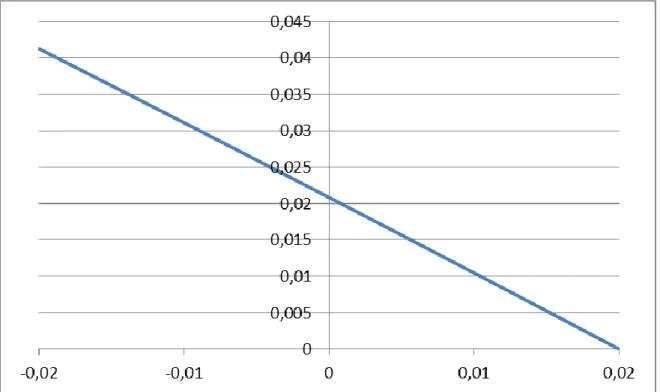
Additional mean wealth via reduced guarantees
An alternative – some numbers 3
Figure C3: Additional mean wealth above the guarantee(y-axis) as a function of the guaranteed minimum interest rate (x-axis)
Lessons learnt
An interest rate guarantee is hard to beat impressively
There is not so much room if an interest rate guarantee is very close to the maximal achievable rare
Simple modifications will not solve current problems
Hence
It needs a new understanding of the quality of classical products (No reasons to hide)
It needs a radical conceptual change if one wants a new quality of products In particular: new kind of guarantees ?!
Note :
3. How to deal with the current situation?
Promise, take the risk and hope => Not really a strategy …
Improve the reputation of the classical guarantee and compare the costs/yields of a classical collective product with a single, personalized bank product
Alternative guarantees
o Variable annuities are a step in the right direction, because they are expensive!
o Paid guarantees vs. guarantees for free Personalized CPPIs
o Similar problems as classical products (hard to generate attractive guarantees at the current situation!)
o More or less a bank product!
Temporary fixed guarantees
3. How to deal with the current situation?
A step in the wrong direction:
o Construct a very complicated product and try to explain it in all details to the customer, such as e.g. complicated cliquet options
(*)
1 1 1max min max min , , , ,
n i i i i i i i S t S t P C F C F S t
paid in To Suggestion: Only communicate the important details, otherwise trust will be lost!
4. Aspects for future generations of guarantees - requirements
Some requirements on future generations of guarantees
(my personal view/recommendation):
A. A guarantee should be constructed in such a way that it is always possible to generate it
B. A guarantee should be fair to the whole of the collective
C. A guarantee in life insurance should make use of the advantages of the collective
D. Guarantees should be flexible in the sense that they should be quoted in relative
form with respect to an index i.e. as a percentage (“Compare to the economy
4. Aspects for future generations of guarantees – some suggestions
Suggestion 1: Classical guarantees with a moving benchmark
“Guaranteed return of x % of the return of an index (such as REX, DAX, ….)” Advantages:
Can always be satisfied by construction of the guarantee and leaves room for working with the contributions (“safe” and “potential”)
Attitude towards risk of the customer is mirrored in the choice of the benchmark (“flexible”)
Same local returns for all members in the same risk class of the collective (“fair”) Disadvantages:
Needs arguments (such as historical simulation or model simulations) to be accepted
Has to offer a lower guaranteed interest rate than the one offered at the moment
4. Aspects for future generations of guarantees – some suggestions
“Suggestion” 2: Make use of longevity risk
No new product, more a suggestion for ingredients of ways to generate
guarantees or attractive products
Life insurers face longevity risk anyway and can maybe eliminate/swap parts of the longevity risk
o Mortality bonds, mortality derivatives, …
o Direct investment in the “retirement industry” (medical industry, care centers, ….)
Main problems so far:
o reliable modeling necessary
o deep and liquid markets
Note the innovation:
4. Aspects for future generations of guarantees – further aspects
“Suggestion” 3: 100% guarantees or not ?
Combination of a very basic 100% guarantee (say for 60 % of the paid premia) and
a very likely – say – 95% guarantee on the remaining premia plus participation in the surplus
Note:
o 100 % guarantees do not exist anyway …
o Difference in the long term evolution between variance and capital-at-risk of stock investments can be made use of !
“Suggestion” 4: Idea behind universal portfolios (T. Cover (1991)) Highest possible degree of diversification
Use a variant for the collective Still very vague idea
5. Concluding remarks
I believe in a future for life insurance
if
Life insurers believe in their own product (“No lamentations about the low guarantee, about the own wrong investment strategy, …)
Future guarantee concepts will be generated more flexible and easier to fulfill
Life insurers concentrate on their advantages compared to banks (i.e. the collective, the compentence on hedging mortality, smoothing returns…)
Politics remains in favour of life insurance by setting/keeping the appropriate legal/political framework
Insurance/financial mathematics considers relevant scientific problems: oOptimal investment for large investors
oLong-term interest rate modelling
oOptimal asset-liability management strategies o…..