HSMP-382x, 482x
Surface Mount RF PIN Switch and Limiter Diodes
Data Sheet
Features
Diodes Optimized for: Low Current Switching Low Distortion Attenuating
Power Limiting /Circuit Protection
Surface Mount SOT-23 and SOT-323 Packages Single and Dual Versions
Tape and Reel Options Available
Low Failure in Time (FIT) Rate[1] Lead-free
Note:
1. For more information see the Surface Mount PIN Reliability Data Sheet.
Package Lead Code Identifi cation, SOT-323 (Top View)
Description/Applications
The HSMP-382x series is optimized for switch ing ap-plications where ultra-low resistance is required. The HSMP-482x diode is ideal for limiting and low induc-tance switching applications up to 1.5 GHz.
A SPICE model is not available for PIN diodes as SPICE does not provide for a key PIN diode characteristic, carrier lifetime.
Package Lead Code Identifi cation, SOT-23 (Top View)
COMMON CATHODE #4 COMMON ANODE #3 SERIES #2 SINGLE #0 DUAL ANODE HSMP-4820 DUAL ANODE HSMP-482B
Absolute Maximum Ratings
[1]T
C
= +25°C
Symbol Parameter Unit SOT-23 SOT-323
If Forward Current (1 μs Pulse) Amp 1 1
PIV Peak Inverse Voltage V 50 50
Tj Junction Temperature °C 150 150
Tstg Storage Temperature °C -65 to 150 -65 to 150
θjc Thermal Resistance[2] °C/W 500 150
Notes:
1. Operation in excess of any one of these conditions may result in permanent damage to the device.
2. TC = +25°C, where TC is defi ned to be the temperature at the package pins where contact is made to the circuit board.
Minimum Maximum Typical Maximum Typical
Part Package Breakdown Series Total Total Total
Number Marking Lead Voltage Resistance Capacitance Capacitance Inductance
HSMP- Code Code Confi guration VBR (V) RS (Ω) CT (pF) CT (pF) LT (nH)
4820 FA A Dual Anode 50 0.6 0.75 1.2 1.0
482B FA A Dual Anode
Test Conditions VR = VBR IF = 10 mA f = 1 MHz f = 1 MHz f = 500 MHz –
Measure VR = 20 V VR = 0 V 3 GHz
IR ≤ 10 μA
High Frequency (Low Inductance, 500 MHz – 3 GHz) PIN Diodes
Electrical Specifi cations T
C= 25°C
Package Minimum Maximum Maximum
Part Number Marking Lead Breakdown Series Resistance Total Capacitance
HSMP- Code Code Confi guration Voltage VBR (V) RS (Ω) CT (pF)
3820 F0 0 Single 50 0.6 0.8 3822 F2 2 Series 3823 F3 3 Common Anode 3824 F4 4 Common Cathode Test Conditions VR = VBR f = 100 MHz f = 1 MHz Measure IF = 10 mA VR = 20 V IR ≤ 10 μA
Typical Parameters at T
C= 25°C
Part Number Series Resistance Carrier Lifetime Reverse Recovery Time Total Capacitance
HSMP- RS (Ω) τ (ns) Trr (ns) CT (pF)
382x 1.5 70 7 0.60 @ 20 V
Test Conditions f = 100 MHz IF = 10 mA VR = 10 V
IF = 10 mA IF = 20 mA
Typical Parameters at T
C= 25°C (unless otherwise noted), Single Diode
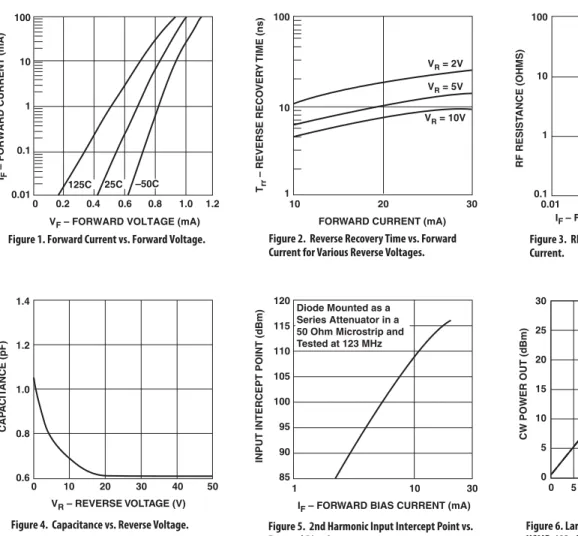
Figure 3. RF Resistance at 25C vs. Forward Bias Current. 100 10 1 0.1 RF RESIST ANCE (OHMS)
IF – FORWARD BIAS CURRENT (mA)
0.01 0.1 1 10 100 1.4 1.2 1.0 0.8 0.6 0 10 20 30 40 50 VR – REVERSE VOLTAGE (V) CAP A CIT ANCE (pF)
Figure 4. Capacitance vs. Reverse Voltage.
120 115 110 105 100 95 90 85 1 10 30
IF – FORWARD BIAS CURRENT (mA)
Figure 5. 2nd Harmonic Input Intercept Point vs. Forward Bias Current.
INPUT INTERCEPT POINT (dBm)
Diode Mounted as a Series Attenuator in a 50 Ohm Microstrip and Tested at 123 MHz
FORWARD CURRENT (mA)
Figure 2. Reverse Recovery Time vs. Forward Current for Various Reverse Voltages. Trr – REVERSE RECO VER Y TIME (ns) 1 10 100 10 20 30 VR = 2V VR = 5V VR = 10V 100 10 1 0.1 0.01 0 0.2 0.4 0.6 0.8 1.0 1.2 IF
– FORWARD CURRENT (mA)
VF – FORWARD VOLTAGE (mA)
Figure 1. Forward Current vs. Forward Voltage.
125C 25C –50C
CW POWER IN (dBm)
Figure 6. Large Signal Transfer Curve of the HSMP-482x Limiter. CW POWER OUT (dBm) 0 30 25 20 15 10 5 0 40 10 5 15 20 25 30 35
Measured with external bias return
1.0 GHz 1.5 GHz
Typical Applications for Multiple Diode Products
RF COMMON RF 1 BIAS 1 RF 2 BIAS 2 RF COMMON BIAS BIAS RF 2 RF 1
Typical Applications for Multiple Diode Products,
continuedBIAS
Figure 9. Switch Using Both Positive and Negative Bias Current. Figure 10. Very High Isolation SPDT Switch, Dual Bias.
Figure 11. High Isolation SPST Switch (Repeat Cells as Required. Figure 12. Power Limiter Using HSMP-3822 Diode Pair. See Application Note 1050 for details.
RF COMMON RF 1 RF 2 BIAS RF COMMON RF 2 RF 1 BIAS
Typical Applications for HSMP-482x Low Inductance
Series
Microstrip Series Connection for HSMP-482x Series
In order to take full advantage of the low inductance of the HSMP-482x series when using them in series applications, both lead 1 and lead 2 should be connected together, as shown in Figure 14.
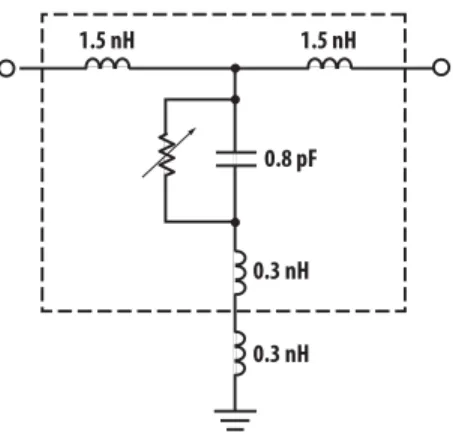
Figure 16. Equivalent Circuit.
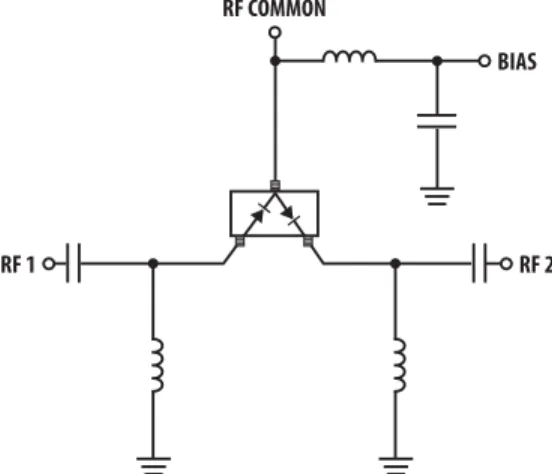
Co-Planar Waveguide Shunt Connection for HSMP-482x Series Co-Planar waveguide, with ground on the top side of the printed circuit board, is shown in Figure 17. Since it eliminates the need for via holes to ground, it off ers lower shunt parasitic inductance and higher maximum attenuation when compared to a microstrip circuit. See AN1050 for details.
50 OHM MICROSTRIP LINES
PAD CONNECTED TO GROUND BY TWO VIA HOLES 1 2 3 0.3 nH 0.3 nH 0.8 pF 1.5 nH 1.5 nH 0.8 pF 0.75 nH Figure 13. Internal Connections.
Figure 14. Circuit Layout.
Microstrip Shunt Connections for HSMP-482x Series
In Figure 15, the center conductor of the microstrip line is interrupted and leads 1 and 2 of the HSMP-482x diode are placed across the resulting gap. This forces the 0.5 nH lead inductance of leads 1 and 2 to appear as part of a low pass fi lter, reducing the shunt parasitic inductance and increasing the maximum available attenuation. The 0.3 nH of shunt inductance external to the diode is created by the via holes, and is a good estimate for 0.032" thick material.
Figure 15. Circuit Layout, HSMP-482x Limiter.
Figure 17. Circuit Layout.
Figure 18. Equivalent Circuit.
Co-Planar Waveguide Groundplane
Groundplane Center Conductor
Assembly Information
SOT-323 PCB Footprint
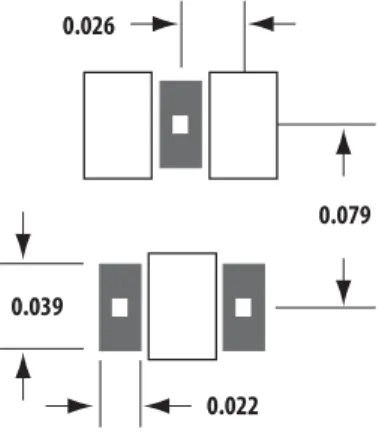
A recommended PCB pad layout for the miniature SOT-323 (SC-70) package is shown in Figure 19 (dimensions are in inches). This layout provides ample allowance for package placement by automated assembly equipment without adding parasitics that could impair the performance. 0.026 0.039 0.079 0.022 Dimensions in inches 0.039 1 0.039 1 0.079 2.0 0.031 0.8 Dimensions in inches mm 0.035 0.9
Figure 19. Recommended PCB Pad Layout for Avago’s SC70 3L/SOT-323 Products.
SOT-23 PCB Footprint
Figure 20. Recommended PCB Pad Layout for Avago’s SOT-23 Products.
SMT Assembly
Reliable assembly of surface mount components is a complex process that involves many material, process, and equipment factors, including: method of heating (e.g., IR or vapor phase refl ow, wave soldering, etc.) circuit board material, conductor thickness and pattern, type of solder alloy, and the thermal conductivity and thermal mass of components. Components with a low mass, such as the SOT-323/-23 package, will reach solder refl ow temperatures faster than those with a greater mass.
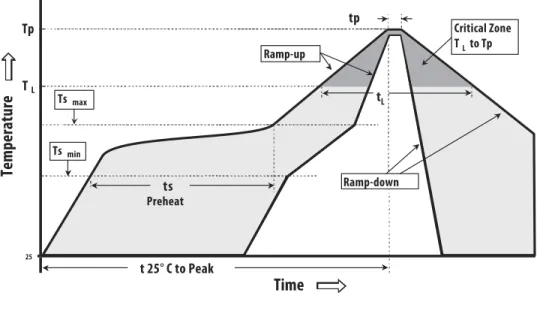
Avago’s diodes have been qualifi ed to the time-temperature profi le shown in Figure 21. This profi le is representative of an IR refl ow type of surface mount assembly process.
After ramping up from room temperature, the circuit board with components attached to it (held in place with solder paste) passes through one or more preheat zones.
The preheat zones increase the temperature of the board and components to prevent thermal shock and begin evaporating solvents from the solder paste. The refl ow zone briefl y elevates the temperature suffi ciently to produce a refl ow of the solder.
The rates of change of temperature for the ramp-up and cool-down zones are chosen to be low enough to not cause deformation of the board or damage to components due to thermal shock. The maximum temperature in the refl ow zone (TMAX) should not exceed 260°C.
These parameters are typical for a surface mount assembly process for Avago diodes. As a general guideline, the circuit board and components should be exposed only to the minimum temperatures and times necessary to achieve a uniform refl ow of solder.
Figure 21. Surface Mount Assembly Profi le.
25
Time
Temperature
Tp TL tp tL t 25° C to Peak Ramp-up ts Ts min Ramp-down Preheat Critical Zone TL to Tp Ts maxLead-Free Refl ow Profi le Recommendation (IPC/JEDEC J-STD-020C)
Refl ow Parameter Lead-Free Assembly
Average ramp-up rate (Liquidus Temperature (TS(max) to Peak) 3°C/ second max
Preheat Temperature Min (TS(min)) 150°C
Temperature Max (TS(max)) 200°C
Time (min to max) (tS) 60-180 seconds
Ts(max) to TL Ramp-up Rate 3°C/second max
Time maintained above: Temperature (TL) 217°C
Time (tL) 60-150 seconds
Peak Temperature (TP) 260 +0/-5°C
Package Characteristics
Lead Material ... Copper (SOT-323); Alloy 42 (SOT-23) Lead Finish ... Tin 100% (Lead-free option) Maximum Soldering Temperature ... 260°C for 5 seconds Minimum Lead Strength ... 2 pounds pull Typical Package Inductance ...2 nH Typical Package Capacitance ... 0.08 pF (opposite leads)
Ordering Information
Specify part number followed by option. For example: HSMP - 382x - XXX
Bulk or Tape and Reel Option Part Number; x = Lead Code Surface Mount PIN
Option Descriptions
-BLKG = Bulk, 100 pcs. per antistatic bag -TR1G = Tape and Reel, 3000 devices per 7" reel -TR2G = Tape and Reel, 10,000 devices per 13" reel
Tape and Reeling conforms to Electronic Industries RS-481, “Taping of Surface Mounted Components for Automated Placement.”
Package Dimensions
Outline 23 (SOT-23) Outline SOT-323 (SC-70)
e B e2 e1 E1 C E XXX L D A A1 Notes: XXX-package marking Drawings are not to scale
DIMENSIONS (mm) MIN. 0.79 0.000 0.30 0.08 2.73 1.15 0.89 1.78 0.45 2.10 0.45 MAX. 1.20 0.100 0.54 0.20 3.13 1.50 1.02 2.04 0.60 2.70 0.69 SYMBOL A A1 B C D E1 e e1 e2 E L e B e1 E1 C E XXX L D A A1 Notes: XXX-package marking Drawings are not to scale
DIMENSIONS (mm) MIN. 0.80 0.00 0.15 0.08 1.80 1.10 1.80 0.26 MAX. 1.00 0.10 0.40 0.25 2.25 1.40 2.40 0.46 SYMBOL A A1 B C D E1 e e1 E L 1.30 typical 0.65 typical
Tape Dimensions and Product Orientation
For Outline SOT-23
Device Orientation
For Outlines SOT-23/323
USER FEED DIRECTION COVER TAPE CARRIER TAPE REEL
Note: "AB" represents package marking code. "C" represents date code.
END VIEW
8 mm
4 mm TOP VIEW
ABC ABC ABC ABC
9 MAX A0 P P0 D P2 E F W D1 Ko 8 MAX B0 13.5 MAX t1
DESCRIPTION SYMBOL SIZE (mm) SIZE (INCHES) LENGTH
WIDTH DEPTH PITCH
BOTTOM HOLE DIAMETER
A0 B0 K0 P D1 3.15 ± 0.10 2.77 ± 0.10 1.22 ± 0.10 4.00 ± 0.10 1.00 + 0.05 0.124 ± 0.004 0.109 ± 0.004 0.048 ± 0.004 0.157 ± 0.004 0.039 ± 0.002 CAVITY DIAMETER PITCH POSITION D P0 E 1.50 + 0.10 4.00 ± 0.10 1.75 ± 0.10 0.059 + 0.004 0.157 ± 0.004 0.069 ± 0.004 PERFORATION WIDTH THICKNESS W t1 8.00 + 0.30 – 0.10 0.229 ± 0.013 0.315 + 0.012 – 0.004 0.009 ± 0.0005 CARRIER TAPE CAVITY TO PERFORATION (WIDTH DIRECTION) CAVITY TO PERFORATION (LENGTH DIRECTION) F P2 3.50 ± 0.05 2.00 ± 0.05 0.138 ± 0.002 0.079 ± 0.002 DISTANCE BETWEEN CENTERLINE
Tape Dimensions and Product Orientation
For Outline SOT-323
For product information and a complete list of distributors, please go to our web site: www.avagotech.com
P P0 P2 F W C D1 D E A0 An
t1 (CARRIER TAPE THICKNESS) Tt (COVER TAPE THICKNESS)
An
B0 K0
DESCRIPTION SYMBOL SIZE (mm) SIZE (INCHES)
LENGTH WIDTH DEPTH PITCH
BOTTOM HOLE DIAMETER
A0 B0 K0 P D1 2.40 ± 0.10 2.40 ± 0.10 1.20 ± 0.10 4.00 ± 0.10 1.00 + 0.25 0.094 ± 0.004 0.094 ± 0.004 0.047 ± 0.004 0.157 ± 0.004 0.039 + 0.010 CAVITY DIAMETER PITCH POSITION D P0 E 1.55 ± 0.05 4.00 ± 0.10 1.75 ± 0.10 0.061 ± 0.002 0.157 ± 0.004 0.069 ± 0.004 PERFORATION WIDTH THICKNESS W t1 8.00 ± 0.30 0.254 ± 0.02 0.315 ± 0.012 0.0100 ± 0.0008 CARRIER TAPE CAVITY TO PERFORATION (WIDTH DIRECTION) CAVITY TO PERFORATION (LENGTH DIRECTION) F P2 3.50 ± 0.05 2.00 ± 0.05 0.138 ± 0.002 0.079 ± 0.002 DISTANCE
FOR SOT-323 (SC70-3 LEAD) An 8C MAX
FOR SOT-363 (SC70-6 LEAD) 10C MAX
ANGLE WIDTH TAPE THICKNESS C Tt 5.4 ± 0.10 0.062 ± 0.001 0.205 ± 0.004 0.0025 ± 0.00004 COVER TAPE