VISUAL ARTS – Grades 5-7
SUBJECT MATTER
: Visual Arts
Grade: 5
Unit/Theme Content and Essential Questions
Skills Methods of
Assessment
Teacher Resources & Notes Framework Strand/s & Standard/s Vales, Shapes, Forms Shapes vs. Forms The illusion of 3-D from 2-D Is Cézannes 7 Form Theory right?
Using line and shading to create the illusion of 3-D
"Ring" worksheet Shape/Form/ "Styrofoam City" Drawing
Use of large all-white forms to create a still-life arrangement
1.5, 1.6, 1.7, 1.8, 2.2, 2.4, 2.10, 2.11, 4.4, 5.5
Cartooning Is a picture a form of communication? Illustration of oral and written stories
sequential composition
Divide a story into a distinct sequence of events. Illustrate a clear sequence of events visually.
Out of sequence story illustration, comic strip of a personal experience
Comic how to handouts Harold and the Purple Crayon 1.5, 1.6, 1.8, 3.4, 4.4, 4.5, 5.5, 5.6, 7.3, 9.4 Color Theory
Discuss a color wheel what are primary and secondary colors? Compare physical properties to emotional properties of color
Use colors to represent emotions in a self-expressive portrait
Appropriate completion of "2-moods" self-portrait folder
Personal examples using color to express emotion
1.5, 1.6, 1.7, 1.8, 2.7, 3.5, 3.6, 4.4, 4.6, 5.6, 6.4
Abstract Art Compare abstract art to other art form. What is
Learn techniques for creating both objective and non-objective and abstract art, i.e. line, cropping
1. Scribble - non-objective
Personal examples scholastic arts featuring
1.5, 1.6. 1.7, 1.8, 2.7, 2.10, 3.4, 4.4,
Unit/Theme Content and Essential Questions
Skills Methods of
Assessment
Teacher Resources & Notes
Framework Strand/s & Standard/s
abstract art and why? Who was Georgia O'Keefe?
grade is like - objective
Clay What are ceramics? Brief history of...
Follow instructions to create a ceramic piece Creation of a functioning whistle (sometimes 2)
"Clay Whistles" video, worksheets and handout sheets
1.5, 1.6, 1.7, 1.8, 4.4, 4.5, 4.6, 5.5, 6.4, 7.2, 7.3, 9.2, 9.3, 10.2
Sculpture What is the basic process?
How is clay turned into glass/ why do people use ceramics (past and present)
Clay whistles
conceptualize and construct a useful piece (a theme mug)
Planning and creating a mug
Handouts and worksheets 1.5, 1.6, 1.7, 1.8, 4.4, 4.5, 4.6, 5.5, 6.4, 7.2, 7.3, 9.2, 9.3, 10.2
Printmaking Why make prints? Positive and negative space. Pattern and repetition, black and white design
Use of both positive and negative space to create a repeating pattern. Use of ink and stamp.
Creation of a black and white pattern, creation of a re-usable stamp
Personal examples and prior student works
1.5, 1.6, 1.7, 1.8, 2.10, 2.11, 4.4, 9.2
Unit/Theme Content and Essential Questions
Skills Methods of
Assessment
Teacher Resources & Notes Framework Strand/s & Standard/s Drawing 1: Point Perspective 1 point perspective - Can the illusion of 3-D be created using 1 point perspective on a 2-D surface?
Use of horizon line vanishing point, perspective lines to create a proportional image with a 3-D appearance on a flat surface
1. Street and building drawing 2. Letters of "floating boxes"
Railroad track visual (photos) Blackboard demonstration "Drawing in Perspective," by 1.2, 1.7, 1.8, 2.8, 2.11, 3.7, 4.4, 4.5, 5.5, 5.7, 7.3, 9.3, 9.4 Anatomy and Portraiture Facial portraiture (human proportion and anatomy - What are the basic proportional comparisons of the human form? Foreshortening Gesture Drawing
Identify and represent basic facial proportions and features.
Identify and represent basic human proportions
1. Before portrait and anatomy folder 2. After portrait 3. Dynamic human poses "Dynamic Anatomy" handouts
"How to draw the Marvel Way" 1.6, 1.7, 1.9, 2.8, 2.9, 2.11, 4.4, 4.6, 4.7, 4.8, 5.5, 5.6, 7.3, 8.5 Landscape Drawing
How can you create the illusion of depth in a non-linear landscape drawing?
A. Size B. Placement
Use of techniques to draw and represent scenes in nature in a realistic format
1. "The Barn" worksheet 2. Complete a
landscape sketch on canvas for use
Barn worksheets Student-generated photos Board visuals 1.6, 1.7, 1.8, 2.8, 2.9, 2.11, 3.4, 4.4, 4.6, 4.8, 5.5, 10.2
Unit/Theme Content and Essential Questions
Skills Methods of
Assessment
Teacher Resources & Notes
Framework Strand/s & Standard/s
How does color work? How can we use colors for realistic representations? 2. Painting using techniques of showing depth Calendars Sculpture Clay/ceramic s Ceramics history, techniques and basic properties.
Why work with clay What can we make with clay?
How can we build with clay?
What is form follows function?
Manipulation of wet clay - wedging; slab; pinch; coll, score and slip; firing and glazing;
Designing for a specific need.
1. Creation of a mug with handle (hold hot liquid) 2. Creation of a container with lid 3. Form Follows Function: create a "Martian Water Carrier" Personal library of ceramics found in books and magazines 1.5, 1.6, 1.7, 1.8, 2.9, 2.10, 2.11, 3.9, 4.4, 4.5, 4.6, 5.5, 5.7, 6.3, 6.4, 7.2, 7.3, 9.2, 9.3 Design Principals
What are positive and negative space, balance, repetition and visual weight?
How are they used in designs?
Develop designing skills through conscious manipulation of positive and negative space, balance, repetition and weight.
1. Monograms
project 2.
Student generated examples of commercial logos i.e. Nike, Adidas etc. 1.5, 1.6, 1.7, 1.8, 2.8, 2.8, 2.10, 2.11, 3.5, 3.6, 3.7, 4.4, 4.5, 5.6, 6.4, 7.2, 7.3, 9.2, 9.3, 9.4
Printmaking Can realistic and/or complex
representations be created when limited to only black and white?
Use of hatching, cross hatching, neutral values - contrast and design; use of scratchboard tools and materials; use of linoleum tools and materials; use and basics of printmaking, tools and materials. 1. Black and white composition on commercial scratchboard 2. Color scratchboard 3. Linoleum prints
Personal printing book Past student and personal examples 1.5, 1.6, 1.7, 1.8, 2.8, 2.8, 2.10, 2.11, 3.5, 3.6, 3.7, 4.4, 4.5, 5.6, 6.4, 7.2, 7.3, 9.2, 9.3, 9.4
SUBJECT MATTER
: Visual Arts
Grade: 7
Unit/Theme Content and Essential Questions
Skills Methods of
Assessment
Teacher Resources & Notes Framework Strand/s & Standard/s Drawing: Perspective Drawing 1 and 2 point perspective drawing How can more than 1 vanishing point be used in a linear perspective drawing and a technical drawing?
Use of multiple point perspective to represent scenes and technical objects with the illusion of 3 dimensionality. 1. 1 point perspective reviews: "boxes" 2. 2 point perspective introduction: "floating box with shadow and light" 3. 2 point perspective final project "City Streets" 4. Scale 2 point perspective of a deck 5. Actual 3-D construction of wooden deck model Personal perspective books
"How to build a deck" by,
1.2, 1.5, 1.6, 1.7, 1.8, 2.8, 2.11, 3.4, 3.5, 3.7, 4.4, 4.5, 4.6, 4.8, 5.5, 5.7, 6.4, 7.3, 9.2, 9.3, 9.4, 10.2 Mixed Media/comm ercial Art What is commercial art?
What is media, can media be combined? How can an image be reproduced to scale using a grid system
Use of combined media
Use of grid for scale reproductions
Large poster reproduction using 4+ media of a small commercial image (CD cover) using a grid Student generated commercial images (CDs, cassettes, games). Note: it is possible to combine the poster project with the painting project to create large scale mural reproduction 1.5, 1.6, 1.7, 1.8, 2.8, 2.9, 3.4, 4.4, 4.5, 4.6, 4.8, 5.6, 6.4, 7.3, 8.5, 9.2, 9.3, 9.4, 10.2
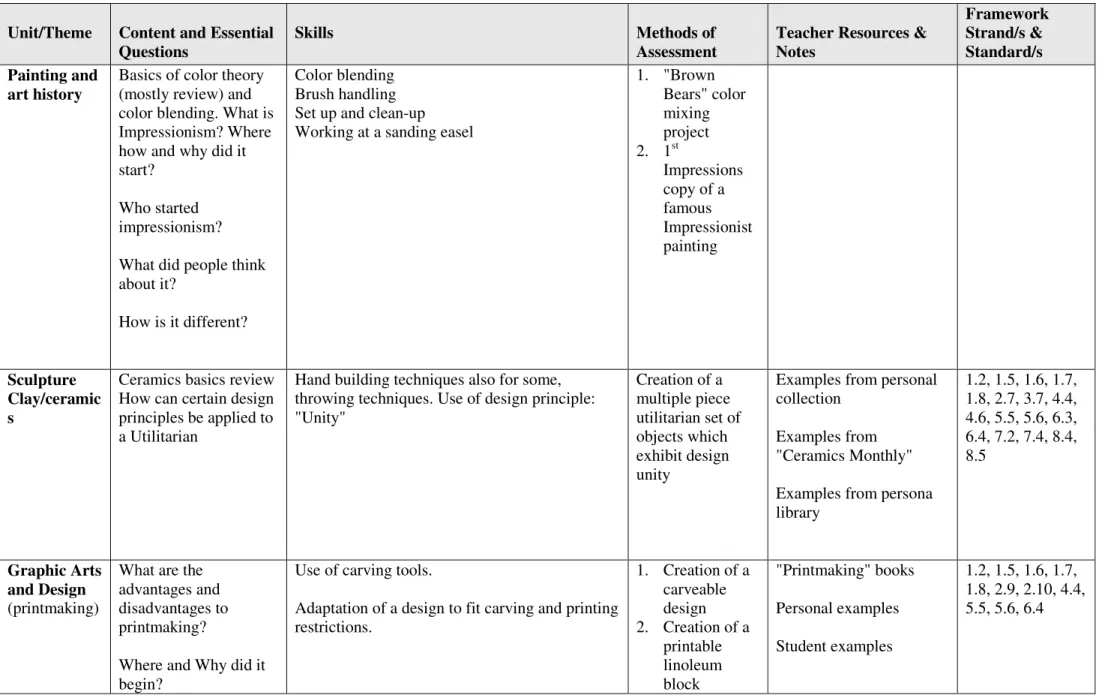
Painting and art history
Basics of color theory (mostly review) and color blending. What is Impressionism? Where how and why did it start?
Who started impressionism? What did people think about it?
How is it different?
Color blending Brush handling Set up and clean-up Working at a sanding easel
1. "Brown Bears" color mixing project 2. 1st Impressions copy of a famous Impressionist painting Sculpture Clay/ceramic s
Ceramics basics review How can certain design principles be applied to a Utilitarian
Hand building techniques also for some, throwing techniques. Use of design principle: "Unity" Creation of a multiple piece utilitarian set of objects which exhibit design unity
Examples from personal collection
Examples from "Ceramics Monthly" Examples from persona library 1.2, 1.5, 1.6, 1.7, 1.8, 2.7, 3.7, 4.4, 4.6, 5.5, 5.6, 6.3, 6.4, 7.2, 7.4, 8.4, 8.5
Unit/Theme Content and Essential Questions
Skills Methods of
Assessment
Teacher Resources & Notes
Framework Strand/s & Standard/s
How is it used today? Linoleum black applications and techniques. 3. Creation of signed numbered, consistent quality prints
Examples from personal library