Ore
B
egon’s
Building
g Asset
Individ
dual De
ts and I
Regiona
evelopm
Increasi
al Researc
ment A
ing Fin
E
Diane
Briann
S
ch Institu
Account
nancial R
Evaluati
Oct
Yatchm
ne H. Ko
Sara Jade
te for Hu
t Initiat
Resilien
ion Rep
tober 20
Prepared
enoff, Ph
othari, Ph
Webb, M
uman Serv
tive
nce
port
012
d by
h.D.
h.D.
M.S.
vices
Table of Contents
Executive Summary………...….i-vi
Background……….………....1
Oregon IDA Participants……….….1
Oregon IDA Initiative Overview………...2
Oregon’s Nonprofit IDA Initiative Partners……….4
Impact of the Oregon IDA Initiative……….……6
Participant Surveys………..….6
Forming New Habits and Maintaining them Over Time………..…6
Participants Report Immediate Changes………...……7
Changes are Sustained Over Time………8
Financial Wellbeing of Non-Completers………...…...9
Lasting Impact of Participation in the Oregon IDA Initiative………...………...9
The Major IDA Savings Categories………11
Home Ownership IDAs……….………….12
Micro-Enterprise IDAs………...14
Education IDAs………...………...18
Youth IDAs……….………19
Participant Feedback for Program Improvement………..………...20
Suggested Improvements……….………...20
Conclusion……….21
Appendix A: Methodology……….…...22
Appendix B: IDA Participant Characteristics………..….23
Appendix C: Survey Respondents and Results for IDA Programs………...24
Appendix D: Copies of Surveys………27
Appendix E: Complete IDA Participant Stories……….……...39
Executive Summary
Background
The Oregon Individual Development Account (IDA) Initiative was built on the premise that a strong middle class where everyone has access to financial and educational opportunity is the foundation of healthy communities and the state’s economic strength. IDAs help individuals and families with low incomes and limited net worth acquire and retain assets through matched savings accounts combined with financial education and counseling. In Oregon, IDA participants save to purchase or renovate a home, further their education, start or expand a micro-enterprise, or buy specialized equipment or technology in support of an employment goal.
Since late in 2007, Portland State University (PSU) has worked closely with Neighborhood Partnerships, the managing entity for the IDA Initiative, to compile and report data on program performance and outcomes. Data presented in this document were drawn from the PSU evaluation and include information about IDA accounts opened between January 2008 and December 31, 2011.
Evaluation Highlights
• Nearly 4,000 Oregon residents with limited incomes and net worth opened individual development accounts between January 2008 and the end of 2011, making Oregon’s IDA Initiative one of the largest in the country.
• These IDA account holders saved nearly $5 million to purchase a home, start or expand a micro-enterprise, or further their education.
• Through donations eligible for an Oregon IDA 75% Tax Credit, $5.5 million in matching funds was provided to 1,164 participants who reached their savings goals and made their investments.
• Participants reported major changes in financial behaviors and confidence as a result of the education and encouragement they received. Most notably, there were large increases in the percentage that used a budget to monitor spending, regularly made deposits to a savings account, and had an emergency fund.
• Beyond the immediate results of newly acquired assets for individual participants, many pointed to broader impact: benefits to their children, other family members, their friends, co-workers, and community.
The Oregon IDA Initiative has grown exponentially since its start-up in 1999 to nearly 4,000 accounts that were opened between January 2008 and the end of 2011.Funded through
contributions by individuals and businesses to the Oregon IDA 75% Tax Credit, the Oregon IDA Initiative has provided close to $5.5 million in matching funds since 2008 to 1164 successful ‘graduates,’ who saved approximately $2 million. The total number of active IDA participants has grown each year over the past four years (see figure 1). Oregon’s Initiative is one of the largest IDA enterprises in the nation.
More than 2,000 accounts were still open at the end of 2011, but among those that had closed, 65% of participants (1,164) ‘graduated’ – that is, they met their savings goal and received matching funds. Graduates saved an average of $1,718 over a period of about 19 months, with an average match of $4,719.
Program Participants
Eligibility for an Oregon IDA is based on limited income and net worth at the time of enrollment. Other requirements are a willingness to save, a desire to invest in one of the approved savings categories, and a commitment to the educational aspects of the program. In addition, IDA account holders must be Oregon residents and at least 12 years of age.
IDA participants come from all over Oregon and represent the growing diversity of the state. Among those enrolled between January 2008 and the end of 2011, 30% were non-white and 20% were Latino. Most were born in the United States (82%) but a significant number came originally from Mexico, Slavic countries, or any of 81 other countries around the world. The majority were women and two-thirds had attended at least some college.
918 1709 2435 2883 0 500 1000 1500 2000 2500 3000 3500 2008 2009 2010 2011
Figure 1. Number of Active Oregon
IDA participants receive basic financial education, one-on-one financial counseling, training specific to their purchase goals, as well as personal support and encouragement. As a result, many report dramatic changes in financial behaviors as well as increased confidence in their own
competence. Changes in savings and budgeting habits were especially notable, contributing to improved financial circumstances and satisfaction. Nearly 60% had an emergency fund (a key component of financial resilience). These changes are illustrated in Figure 1 below.
Many participants reported maintaining important financial practices even 12 months after they completed their IDA experience, for example:
• 55% were still using a budget in contrast to only 30% who said they used a budget prior to opening their IDA account;
• 52% still had an emergency fund to tide them over during difficult times.
Even IDA participants who were not able to complete their savings goals often cited aspects of the program they found helpful. Fifty-six percent said “learning to use a budget” was very helpful. Others said “The whole program was very helpful” or “The program is a great asset.” Still others pointed to the classes they attended, the skills they learned, and the support they received from program staff.
The Broader Impact of the Oregon IDA Initiative
Beyond the immediate results of newly acquired assets for individual participants, the goals of the Oregon IDA Initiative are to build financial resilience that impacts family and community over the long term. Many participants indicated longer term benefits of their participation in the Oregon IDA
18% 30% 21% 42% 67% 73% 58% 82% 0% 20% 40% 60% 80% 100%
Habit of Savings Use of Budget Financial Resilience Satisfaction with Financial Status
Figure
2.
IDA
Graduates
Financial
Wellbeing
Entry to Exit
Creating New Jobs…
“This program really allowed me to purchase the tools I needed in order to be more competitive in my industry. Purchasing the tools allows me to work more efficiently and accurately. This led to being able to hire an additional employee-it has been an amazing domino effect for my company.”
Providing Positive Role Models for Children…
“Now that we’ve seen the fruit of saving, we are excited to continue those healthy habits in our monthly budget as well as teach our children how to save and spend wisely. That’s a huge gift to give them, one I never received.”
Moving Out of Poverty…
"The IDA Initiative is a way out of the hopelessness of poverty for those willing to work at bettering their lives... My confidence, satisfaction in life, and ability to deal with difficult situations have all improved. I have gone from a fearful state to one of increasing hope."
“…I feel as if my life is changing for the better. I have struggled for years as a single mother of three and was never able to get ahead…Now I am able to buy my new home and I feel as if this horrible
struggle of poverty is behind me. I am looking forward to the future and I now have hope of a new positive good life.”
Seeing New Possibilities for the Future…
“The self-esteem from participating in the savings process has given me the confidence to use these same saving skills to improve other areas of my life.”
“I plan on taking the workshop classes. I will also continue to create new business plans. This program is changing my life. It was the best thing for me at this period in my life.”
Home Purchase. Despite the challenges for buyers in the current housing market, purchasing a home has been the priority for the 1,289 Oregon IDA account holders (34% of total new
participants) who enrolled since January 2008. These prospective home owners received assistance to determine an appropriate price range for their home, given their income and resources, and were trained in what to expect in the home-buying process. They acquired skills and information about how to take advantage of programs for first-time homebuyers, how to search for a house, details about the inspection process and insuring the home, and how to maintain and protect their investment.
Micro-Enterprise. Almost 30% of IDAs (1,061 accounts) that have opened since January 2008 were aimed at building up resources to start or expand a micro-enterprise. Many aspiring small business owners with IDA accounts live in rural or frontier communities where their personal successes can have an impact on the entire community. Others are part of a growing urban micro-enterprise community, which includes the thriving food cart industry in Multnomah County and surrounding areas. Micro-enterprise investments have included a wide variety of business assets, such as construction tools, a massage table, jewelry-making equipment, or vehicles to transport supplies and equipment for a
home cleaning business.
Education. Almost 1,400 Oregon residents enrolled in an IDA program to save for their education (about 36% of all accounts opened through the end of 2011). IDA providers and their local partners across the state assisted low-income and underrepresented students to finance post-secondary education. Some were the first in their family to attend college; others were overcoming
barriers of poverty and/or other
life circumstances. Education IDAs are often structured with enough flexibility that students can work and save money over the summer, withdraw their money and matching funds for tuition during the year, then repeat the same process the following year.
Summary
Findings from the evaluation highlight strengths of the Initiative and positive results for individual participants, many of whom achieved outcomes for themselves and their families that they could not have envisioned on their own.
Across all of the IDA savings categories, graduates who were surveyed have expressed excitement about their experiences:
“This program builds confidence, encourages savings, and makes home purchases possible for low income single people like myself who otherwise wouldn't be able to close on a first home.”
“This is an incredibly valuable program for young, new farmers like myself who have limited access to capital. I couldn't have started my business without my IDA. I would love to see the program expand throughout the state and nation!”
“I now have an AAS degree - IDA Initiative paid for my final term. Thank you.”
a budget, and set aside savings to meet new goals and safeguard their future financial wellbeing. These findings are particularly encouraging in light of the extremely challenging economic climate in Oregon and elsewhere. IDA participants in the study were enrolling in the program, setting goals for themselves and making the effort to deposit savings to their accounts every month at a time of record-high unemployment in the state. Although not all participants reached their financial goals and received matching funds, even those who had to withdraw early appreciated the opportunity, the support, and the skills they gained from their IDA program.
Oregon’s IDA Initiative is recognized as one of the strongest in the nation, reflecting the state’s commitment to increasing financial resilience among residents with low-income. With this foundation, Oregon is well positioned to expand the IDA Initiative and to develop and test new strategies that increase participation and success across the diverse population of individuals and families living in poverty and experiencing the precarious circumstances that poverty entails. The ‘ripple effect’ we found - broader and more far-reaching results for individuals, families, and communities – speaks to the importance of Oregon’s continued investment and the potential for the IDA Initiative to substantially affect the health of Oregon’s economy.
“We know that to help Oregonians build a better future for themselves and their families we need to help them invest in themselves today. The IDA Initiative does just that. It combines skill-building in cash management and business planning, provides support and encouragement while the participant’s investment goals are finalized and implemented, and gives them a small financial boost as they invest in their future. As a result, homes are purchased, businesses created, education and employment goals reached. It works.”
Daniel Robertson, Board Chair Neighborhood Partnerships
Oregon’s Individual Development Account Initiative
Building Assets and Increasing Financial Resilience
I. Background
The Oregon Individual Development Account (IDA) Initiative was built on the premise that a strong middle class where everyone has access to financial and educational opportunity is the foundation of healthy communities and of the state’s economic strength. The goals of the Oregon IDA Initiative are to help rebuild Oregon’s middle class by fostering financial wellbeing and resilience for all residents.
IDAs help individuals and families with low incomes and limited net worth acquire and retain assets through matched savings accounts combined with financial education and counseling. In Oregon, IDA participants save to purchase or renovate a home, further their education, start or expand a micro business, or buy specialized equipment or technology in support of an
employment goal.
Since late in 2007, Portland State University (PSU) has worked closely with Neighborhood Partnerships, the managing entity for the IDA Initiative, to compile and report data on program performance and outcomes. Data presented in this document were drawn from the PSU evaluation and include information about IDA accounts opened between January 2008 and December 31, 2011. Evaluation methods are described in Appendix A.
Oregon IDA Participants
Eligibility for an Oregon IDA is based on income and net worth at the time of enrollment. Other
requirements are a willingness to save, a desire to invest in one of the approved savings categories, and a commitment to the educational aspects of the program. In addition, IDA account holders must be Oregon residents and at least 12 years of age.
IDA participants come from all over Oregon and represent the growing diversity of the state. Among those enrolled between January 2008 and the end of 2011, 30% were non-white and 20% were Latino.
Most were born in the United States (82%) but a significant number came originally from Mexico, Slavic countries, or any of 81 other countries around the world.
Participants ranged in age between 12 and 86 with the average age of 33 years. Youth under 18 were 12% of the total population. The majority of IDA account holders (68%) were women and 67% had attended college. More than half were single, and nearly a quarter were single mothers. About 40% were in school, either full- or part-time, when they enrolled. Nearly 40% were receiving income support through food stamps.
IDA participants reflect the strengths and challenges of many Oregonians with low incomes. Fifty percent had less than $9000 in assets when they entered the program; 82% had a checking account, 63% had a savings account, 25% had investments of some kind, and 17% owned a home.
Participants also had debt, most frequently credit card debt, student loans, auto loans and medical bills.
Additional demographic information can be found in Appendix B.
Oregon IDA Initiative Overview
IDA participants receive basic financial education, one-on-one financial counseling, training specific to their purchase goals, and personal support. Each Initiative Partner provides these services in a structure and format to meet the needs of their community and constituents.
Participants agree to make monthly deposits to their IDA account for up to three years, based on their
Individual Development Plan. These individualized plans help participants clarify their life goals as well as short- and medium-term financial goals. In addition, plans specify the household budget, changes that participants want to make in their financial habits, monthly savings goals, and banking information. Among the approved savings categories, most frequently IDA accounts are opened to save for an education, to buy a home, or to start or expand a micro-enterprise (see Figure 1)1.
The Oregon IDA Initiative has grown exponentially since its start-up in 1999 to nearly 4000 accounts that were opened between January 2008 and the end of 2011. 2 Funded through
1
A “microenterprise” or “micro business” is commonly defined as a business with fewer than five employees and with
capital needs of under $35,000.
2 Data on the IDA initiative have been tracked since 1999. However, early in 2008, statewide IDA data were
consolidated in the current information system for greater accuracy and comprehensive tracking and reporting.
Micro‐ enterprise 28% Education 36% Employment related equipment and Assistive Technology <1% Home Purchase 34% Home Renovation 2%
Figure
1.
Oregon
IDA
Initiative
Savings Categories
contributions by individuals and businesses to the Oregon IDA 75% Tax Credit, the Oregon IDA Initiative has provided close to $5.5 million in matching funds since 2008 to 1,164 successful ‘graduates,’ who saved approximately $2 million. The total number of active IDA participants has grown each year over the past four years. See Figure 2. Oregon’s Initiative is one of the largest IDA enterprises in the nation.
Neighborhood Partnerships, a statewide charitable organization, has managed the day-to-day operations of the Initiative since 2003. Oregon Housing and Community Services3 provide
leadership and oversight to the Oregon IDA Initiative, with support from the Oregon Department of Revenue.
The dollars saved by IDA graduates are matched three-one (in some cases four-one or five to-one) by the Oregon IDA Initiative
funds when the participant’s savings goal has been reached.
Payments then go directly to vendor(s), title companies, educational institutions, or other entities to complete the participant’s investment. Participants who are not able to complete their savings plan may withdraw their own deposits but would not receive matching funds.
3
http://www.oregon.gov/OHCS/
All donations are dedicated entirely to reaching the goals of the Oregon IDA Initiative. This provides significant leverage for the state’s commitment of the 75% tax credit for donations. Initiative resources support modest administration and marketing
expenses, and are competitively allocated to Initiative Partners (termed “Fiduciary Organizations “in statute) to support their program delivery and administration (typically 20% and 5% respectively of allocations) and matching payments for participants (75% of allocations).
Neighborhood Partnerships: http://oregonidainitiative.org
918 1709 2435 2883 0 500 1000 1500 2000 2500 3000 3500 2008 2009 2010 2011
Figure
2.
Number
of
Active
Oregon
IDA
Participants
(2008‐2011)
Oregon’s Nonprofit IDA Initiative Partners
Between 2008 and 2011,4 eight non-profit IDA Initiative Partners (or “Fiduciary Organizations”) served 32 out of 36 urban, rural and frontier counties. These IDA Initiative Partners:
• Work with participants through the entire IDA process (e.g. recruitment; enrollment; financial training and counseling; asset-specific training to prepare IDA participants to own a home, start a
micro-enterprise or pursue a career; setting up and monitoring monthly deposits with partnering financial institutions; and
documenting and processing payments);
• Secure partnerships with financial institutions, referral organizations, and other institutions and professionals related to specific savings categories;
• Develop and maintain systems for the matched savings process, including monthly reporting to participants about savings and match; and distribution of bank statements;
• Engage in ongoing program development and innovation, and ongoing evaluation of impact and outcomes.
4
Two additional Initiative Partners were added in 2011, and one merged IDA operations into an existing partner.
“Initiative Partners bring programmatic and fiscal capacity as well as relationships deep in Oregon communities. They bring a wealth of experience to the Initiative, and represent diverse communities, approaches, and perspectives.”
Janet Byrd, Executive Director Neighborhood Partnerships
Figure
3.
Number
of
Oregon
IDA
Participants
by
County
In addition, Initiative Partners report participant, program and fiscal data back to the Oregon IDA Initiative, and are subject to regular program and fiscal reviews.
Many of the Initiative Partners provide services directly to Oregon residents, some through local partners, and still others by a combination of both. Some enroll as many as 528 participants annually; others enroll much smaller numbers.
• CASA of Oregon currently provides IDAs exclusively through two provider networks in 27 counties across Oregon. They provide support and expertise to their networks, and oversee the administration of the program for their subcontractors. One of their provider networks, the Valley Individual Development Account (VIDA) is comprised of 36 non-profit, tribal and housing authority local partners across the state. Some VIDA local partners offer the full range of IDAs; some specialize in one category such as homeownership or micro-enterprise development. CASA’s other provider network, the Matched College Savings Program (MCSP) is made up of 21 partner schools - high schools, private colleges and a community college.
• NeighborImpact, although no longer acting as an Initiative Partner as of May 2012, provided all categories of IDAs directly to residents of Deschutes and Crook Counties, and continues to provide through NWU.
• NeighborWorks Umpqua (NWU) provides IDAs directly to participants and also manages a network of 15 local partners, including community action agencies, educational institutions, and non-profits. Together they serve 21 counties in central and southern Oregon and offer the full range of IDAs.
• MercyCorps Northwest provides micro business IDAs primarily in Multnomah County, but also in surrounding areas.
• The Portland Housing Center(PHC) provides IDAs for first-time home buyers, primarily in Multnomah and Washington County, but also in surrounding areas. • Native American Youth and Family Center (NAYA)
provides IDAs for all categories for Native American and other underserved populations of youth, individuals and families primarily in Multnomah County, but also in surrounding areas.
• Entrepreneurial Development Services (eDev) formerly Lane MicroBusiness,provides micro business IDAs in Lane County and surrounding areas.
• Warm Springs Community Action Team provides IDAs for all categories for residents of Warm Springs and the surrounding community.
• NEW: Neighborhood Economic Development Corporation (NEDCO) provides homeownership, education and may expand to provide micro-enterprise IDAs in Lane and Marion Counties.
• NEW: The Immigrant and Refugee Community Organization (IRCO) provides IDAs primarily in Multnomah County. They work closely with immigrants from Asia, Africa and the former Soviet Union and currently focus on education and training IDAs.
A complete list of Oregon IDA Initiative local partners can be found in Appendix F.
II. Impact of the Oregon IDA Initiative
Between January 2008 and December 2011, almost 4,000 Oregon residents opened IDA accounts, setting aside savings of nearly $5 million during that period. Participants maintained their IDA accounts for up to three years (and in some cases longer), with an average duration of about 18 months.
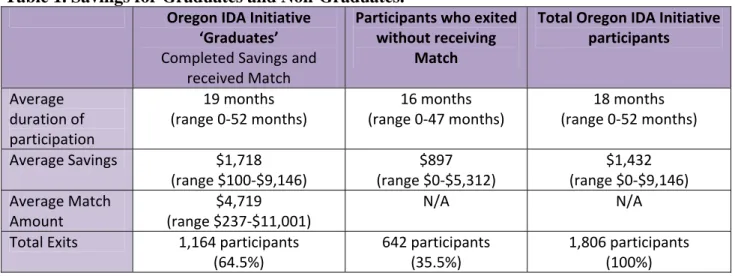
More than 2,000 accounts were still open at the end of 2011, but among those that had closed, 65% of participants (1,164) ‘graduated’ – that is, they met their savings goal and received matching funds. On average, graduates were involved with the Initiative longer and saved more than those who left without receiving matching funds. Graduates saved an average of $1,718 over a period of about 19 months, with an average match of $4,719. See Table 1 for additional details.
Table 1. Savings for Graduates and Non-Graduates. Oregon IDA Initiative
‘Graduates’ Completed Savings and
received Match
Participants who exited
without receiving
Match
Total Oregon IDA Initiative
participants Average duration of participation 19 months (range 0‐52 months) 16 months (range 0‐47 months) 18 months (range 0‐52 months) Average Savings $1,718 (range $100‐$9,146) $897 (range $0‐$5,312) $1,432 (range $0‐$9,146) Average Match Amount $4,719 (range $237‐$11,001) N/A N/A
Total Exits 1,164 participants
(64.5%) 642 participants (35.5%) 1,806 participants (100%) Participant Surveys
As part of the evaluation of the Oregon IDA Initiative, participants are asked to share their
experiences with the program through surveys administered at the time they exit and again twelve months later. Participants are asked questions focused on specific financial habits and behaviors as well as questions regarding their opinions and perceptions. Response rates for exit surveys have been high (77% of program ‘graduates’ have returned their surveys as have 49% of those who left the program without receiving matching funds). Response rates for the twelve-month follow-up survey are also good (26%), with higher rates among home owners and micro business owners than students. Additional information about respondents and copies of the surveys can be found in Appendixes C and D respectively.
Forming New Habits and Maintaining them Over Time
The overarching goals of the Oregon IDA Initiative are addressed through the financial education and support, coaching and guidance that are part of IDA programs all over the state. Learning to
manage personal finances effectively is particularly critical in an economic climate in which 8.4% of Oregonians are unemployed5 and 28% are asset poor6, i.e., they do not have enough money set aside to survive three months if they are faced with loss of income for any reason. Equally
important is the confidence and sense of competence that IDA participants may acquire. Comments from participants highlight the impact the IDA initiative had on their financial wellbeing.
“The IDA initiative showed me that it is possible to deposit/save money on a monthly basis. My life has changed dramatically, and I am now living my dream.”
In fact, many participants indicated how the skills they learned changed their habits and outlook for the future.
“We think more about our spending habits and think about long term goals versus daily spending.”
“I have learned how to do without what I want today, in order to have what I need in the future.”
“It started me thinking about saving, and it made me realize that even when I don't have much money, I can save a little and meet important goals.”
“I have a much firmer belief that even though I am low-income, I am still capable of saving and meeting my personal goals financially.”
“I am better (a lot!) at living by a budget.”
Participants Report Immediate Changes
Dramatic changes were reported in participants’ financial behaviors from the time they entered the program to the time they transitioned out. Changes in
saving and budgeting habits were especially notable, and contributed to improved financial circumstances and sense of confidence. For example, 73% of participants were regularly using a budget to monitor spending by the time they left the program in contrast to only 30% when they entered, and 67% were making regular deposits to a savings account compared to 18% at the time they opened their IDA account. Nearly 60% had an emergency fund (a key component of financial resilience). Moreover, 82% of participants said they were satisfied with their financial status at program exit compared to only 42% at program entry.
5 http://www.bls.gov/lau/ 6
http://scorecard.assetsandopportunity.org/2012/state/or
At program exit, IDA account holders had set new savings goals. In addition to saving for an emergency fund:
• 32% were saving to purchase or improve a home. • 36% were saving for a trip.
• 19% had started an IRA or other long-term savings. • 20% were saving for their education.
Further examples of impact reported by survey respondents appear in Appendix C.
Changes are Sustained Over Time
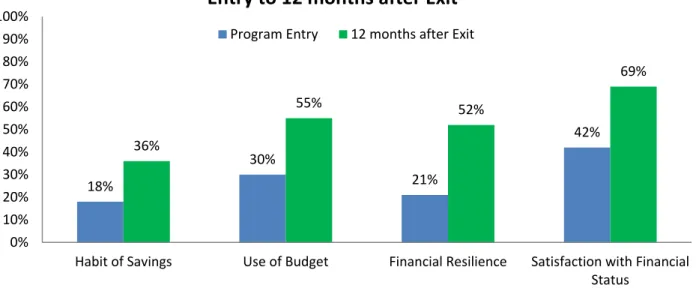
Graduates especially valued what they learned about using budgets to plan and monitor their spending. Many were continuing this and other important practices even 12 months after they completed their IDA experience. Figure 5 below illustrates the percentage of families still utilizing critical skills a year after exit, for example:
• 55% were still using a budget in contrast to only 30% who said they used a budget prior to opening their IDA account;
• 52% still had an emergency fund to tide them over during difficult times.
18% 30% 21% 42% 67% 73% 58% 82% 0% 10% 20% 30% 40% 50% 60% 70% 80% 90%
Habit of Savings Use of Budget Financial Resilience Satisfaction with Financial Status
Figure
4.
IDA
Graduates
Financial
Wellbeing
Entry to Exit
Program Entry Program Exit
Savings goals twelve months after exit included saving for a trip (36%), for other family needs (29%), to purchase or improve a home (31%), to start or expand a micro business (20%), for an IRA or other long-term savings plan (20%), or for education (15%).
Financial Wellbeing of Non-Completers.
Among IDA participants who were not able to complete the program, reasons were varied. Most often, personal circumstances changed through loss of job or unexpected expenses that made it impossible to maintain the savings program. But even this group of ‘non-completers’ often cited aspects of the program they found helpful. Fifty-six percent said that “learning to use a budget”
was very helpful. Others said “The whole program was very helpful” or that “The program is a great asset.” Still others pointed to the classes they attended, the skills they learned, and the support they received from program staff. Some vowed to try again in the future.
Lasting Impact of Participation in the Oregon IDA Initiative
Beyond the immediate results of newly acquired assets for individual participants, the goals of the Oregon IDA Initiative are to build financial resilience that impacts family and community over the long term. Many participants indicated longer term benefits of their participation in the Oregon IDA Initiative, and some noted how their participation has had ripple effects – benefiting their children, other family members, their friends, co-workers, and community.
Creating New Jobs…
“This program really allowed me to purchase the tools I needed in order to be more competitive in my industry. Purchasing the tools allows me to work more efficiently and accurately. This led to being able to hire an additional employee-it has been an amazing domino effect for my company. The Initiative came at the perfect time.”
18% 30% 21% 42% 36% 55% 52% 69% 0% 10% 20% 30% 40% 50% 60% 70% 80% 90% 100%
Habit of Savings Use of Budget Financial Resilience Satisfaction with Financial Status
Program Entry 12 months after Exit
Figure
5.
IDA
Graduates
Financial
Wellbeing
Entry to 12 months after Exit
Providing Positive Role Models for Children…
“Now that we’ve seen the fruit of saving, we are excited to continue those healthy habits in our monthly budget as well as teach our children how to save and spend wisely. That’s a huge gift to give them, one I never received.”
“I appreciate the value of a dollar. My daughters have also started saving their money earned and look for bargains.”
Frederick Edwards, Corvallis
Moving Out of Poverty…
"The IDA Initiative is a way out of the hopelessness of poverty for those willing to work at bettering their lives. My financial situation has improved dramatically. I only had one debt, but it was a "bad" one. That debt has been settled and my credit score has risen. I now have no debt
whatsoever! I have learned how to better my finances and maintain a good credit score. I have learned a great deal about buying a home. My confidence, satisfaction in life, and ability to deal with difficult situations have all improved. I have gone from a fearful state to one of increasing hope."
“I am buying a home in Cottage Grove. I am so excited. It is beautiful. I feel as if my life is changing for the better. I have struggled for years as a single mother of three and was never able to get ahead. After my kids grew up I became disabled and consequently was held back financially. Now I am able to buy my new home and I feel as if this horrible struggle of poverty is behind me. I am looking forward to the future and I now have hope of a new positive good life.”
What helped the most? When asked what was ‘most
helpful’ about their IDA experience, the preponderance of responses focused on learning to budget and save. In addition, the personal support provided through the IDA experience was greatly valued. Substantial numbers reported the motivation and encouragement they received from staff as one of the ‘most helpful’ aspects of the program:
“The people that talked with you about goals and all the education to break the bad habits in order to make room for the new good habits.” “The encouragement and positive feedback from all of the Community Development Corporation (CDC) staff I dealt with.”
“The support groups [staff] offered. The information (was) helpful and support was great to keep motivated.”
“Having the IDA specialist around to help and assist me with the process. [Staff of local partner] was very helpful and [I] would recommend her to anyone looking to apply for this program.”
Seeing New Possibilities for the Future…
“Long term impacts of participating in the IDA program include a sense of pride and
accomplishment as a new homeowner,
monetary gain from savings, interest and equity earned from my new home purchase, and stability.”
“The self-esteem from participating in the savings process has given me the confidence to use these same saving skills to improve other areas of my life.”
“I plan on taking the workshop classes. I will also continue to create new business plans. This program is changing my life. It was the best thing for me at this period in my life.”
III. The Major IDA Savings Categories
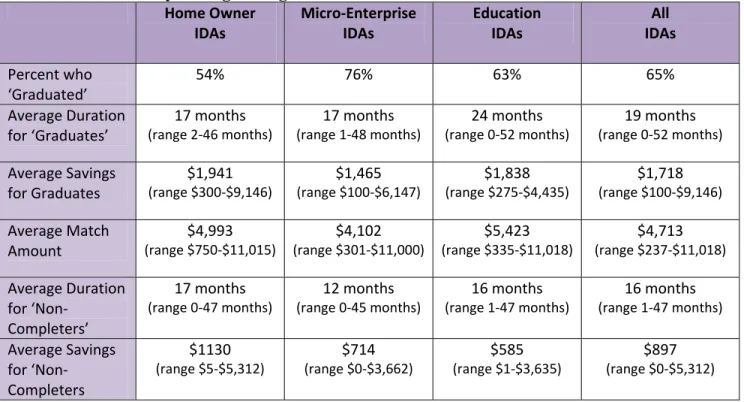
The three largest savings categories in the IDA Initiative are Home Ownership, Micro-Enterprise and Education. Table 2 below illustrates similarities and differences in results across these asset categories:
• Graduation rates ranges around the overall average of 65%.
• Micro-Enterprise IDAs had the highest graduation rates. These are typically somewhat smaller accounts than those for home purchase or education. Moreover, the total purchase price for the asset tends to be covered entirely by the dollars saved combined with matching funds, making Micro-Enterprise IDAs relatively straightforward to complete.
• Home purchases, on the other hand, are far more difficult and complex, as well as
expensive. Many factors and multiple sources of funding are often involved. In addition, in the current financial climate, home buyers may complete their savings plan but be unable to find a home approved by the lender for the amount they can afford.
• The pattern of saving for education is more varied across participants and providers, so that averages are more difficult to interpret.
Table 2. Outcomes by Savings Categories Home Owner IDAs Micro‐Enterprise IDAs Education IDAs All IDAs Percent who ‘Graduated’ 54% 76% 63% 65% Average Duration for ‘Graduates’ 17 months (range 2‐46 months) 17 months (range 1‐48 months) 24 months (range 0‐52 months) 19 months (range 0‐52 months) Average Savings for Graduates $1,941 (range $300‐$9,146) $1,465 (range $100‐$6,147) $1,838 (range $275‐$4,435) $1,718 (range $100‐$9,146) Average Match Amount $4,993 (range $750‐$11,015) $4,102 (range $301‐$11,000) $5,423 (range $335‐$11,018) $4,713 (range $237‐$11,018) Average Duration for ‘Non‐ Completers’ 17 months (range 0‐47 months) 12 months (range 0‐45 months) 16 months (range 1‐47 months) 16 months (range 1‐47 months) Average Savings for ‘Non‐ Completers $1130 (range $5‐$5,312) $714 (range $0‐$3,662) $585 (range $1‐$3,635) $897 (range $0‐$5,312)
Home Ownership IDAs
Despite the challenges, purchasing a home has been the priority for the 1,289 Oregon IDA account holders (34% of total new participants) who enrolled since January 2008. They opened IDA accounts through the Portland Housing
Center, NeighborWorks Umpqua or local partners,NAYA, local partners of CASA, or NeighborImpact. These prospective home owners received assistance to determine an appropriate price range for their home, given their income and resources, and were trained in what to expect in the home-buying process. They acquired skills and information about how to take advantage of programs for first-time homebuyers, how to search for a house, details about the inspection process and insuring the home, and how to maintain and protect their investment. Among those who
completed their investment, final sale prices ranged widely, reflecting regional differences across the state, with an average of $162,673.
Across all of the IDA savings categories, graduates who were surveyed have expressed excitement about their experiences:
“This program builds confidence, encourages savings, and makes home purchases possible for low income single people like myself who otherwise wouldn't be able to close on a first home.”
“This is an incredibly valuable program for young, new farmers like myself who have limited access to capital. I couldn't have started my business without my IDA. I would love to see the program expand throughout the state and nation!”
“I now have an AAS degree - IDA Initiative paid for my final term. Thank you.”
National studies have suggested that IDA participants who purchase homes typically obtain more preferable mortgage rates and are two to three times less likely to lose their homes to foreclosure.7 A follow-up survey of Oregon IDA graduates reinforces these findings, at least in the short term, with 96% of respondents indicating they still had their home twelve months later and 94% who said they were ‘always’ able to pay their mortgage. Graduates indicated that many aspects of the Home Buying IDAs were helpful, especially the asset-specific instruction.
The following introductions to recent Oregon IDA home buyers reflect participants’ achievements. Their complete stories can be found at: http://oregonidainitiative.org/impact-policy/ida-stories/ and inAppendix E of this document.
Meet Natalie Mitchell
The Gresham community is stronger because of the Oregon IDA Initiative’s investment in resident Natalie Mitchell. Natalie’s hard work and the support of the Oregon IDA Initiative through the NAYA Family Center combined to make her a homeowner in July of 2012. She is the thrilled owner of a home developed by Proud Ground, the metro area’s community land trust. Natalie has 30 years of rootsin Gresham – as a high school and college student, as a mother raising three sons and as a community leader. Testifying in support of further
funding for homeownership opportunities to the Gresham City Council, she said, “The financial pressures of raising my family and attending college and always having two to three part time jobs meant that I wasn’t able to put money aside for the purchase of a home… Thanks to the financial education with the NAYA Family Center and the Proud Ground Home Buyer Initiated Grant, I was able to choose a home that I desired, a home of my choice in Gresham, which is going to make a strong, stable foundation for my children as they continue to be Gresham residents in the community.” Natalie’s success has made her a role model for others at the NAYA Family Center who admire her drive to save and her tenacity in becoming a homeowner.
7
http://cfed.org/assets/pdfs/ida_program_survey_homeown_foreclose.pdf
Meet Tomas Monter-Rangel
Today, fifteen families have a safe, new and affordable place to call home in Ashland, Oregon. This southern Oregon town is now home to a new green, affordable community that was made possible through the USDA Rural Development's Mutual Self-Help Housing
Program. Twelve of the families that moved in were able to because of their Individual Development Accounts through the DreamSavers network of the Oregon IDA Initiative. Tomas Monter-Rangel, his wife, Jessie,
and their two children make up one of those families.
Tomas heard about the Oregon IDA Initiative from a visiting speaker at HeadStart, where he works as an interpreter. The IDA Initiative provided him and his wife the first opportunity to save enough money for a new house. When they found out about the opportunity, they jumped at the chance recognizing this would help them get the most out of the Mutual Self-Help Housing
Program. Because of the Oregon IDA Initiative, paired with the USDA Rural Development’s Mutual Self-Help Housing Program, Tomas Monter says that he was able to finally “buy a house in Oregon for my family” and learn financial skills that will empower him to continue being successful in the future.
Micro-Enterprise IDAs
Almost 30% of IDAs (1,061 accounts) that have opened since January 2008 were aimed at building up resources to start or expand a micro-enterprise. These micro business IDAs have been available through seven non-profit Initiative Partners and the non-profit local partners they work with around the state.8 Many aspiring micro business owners with IDA accounts live in rural or frontier
communities where their personal successes can have an impact on the entire community. Others are part of a growing urban micro-enterprise community, which includes the thriving food cart industry in Multnomah County and surrounding areas.
In addition to general financial education that is part of the program for everyone who opens an IDA, these participants also attended classes for business owners, where they learned to:
8
In 2012, this number increased to eight.
• Determine the appropriate legal status for the business
• Obtain the correct licenses and permits.
• Calculate start-up costs, unit of sale, profit margins, break-even point, and pricing
window.
• Forecast a 12-month cash-flow projection.
• Analyze the competition.
• Identify target markets and create a marketing plan.
• Identify funding sources and write a strong business plan.
Micro-enterprise participants have been enthusiastic about these foundational courses and often identified the ‘business plan’ as extraordinarily helpful.
“It was fantastic to go through the business planning and budgeting process. It created a great foundation for the start-up of my firm and helped me gain valuable new skills.” “The help in planning a business plan really made a difference. Also just making sure we were taking the proper first steps in starting our business.”
“The education was more valuable than the money. I feel comfortable doing business plans now.”
When asked “what was most helpful,” micro-enterprise account holders noted:
“Classes abut marketing, Quickbooks, reorganizing my thinking to write a business plan, networking with other small
business owners-learning about small business.” “Learning about cash flow projections was huge, looking at budgeting and financial situation, learning what it looks like to start a business and what it takes to succeed.” “Meeting other like minded people trying to improve their personal as well as business lives.”
Micro-enterprise investments have included a wide variety of business assets, such as construction tools, a massage table, jewelry-making equipment, or vehicles to transport supplies and equipment for a home cleaning business.
Below are three brief introductions to Oregon IDA participants who reached their goals in saving for their micro businesses. Visit http://oregonidainitiative.org/impact-policy/ida-stories/ to read
more about how IDAs taught these participants financial skills that empowered them to reach their goals. These complete stories can also be found in Appendix E.
Meet Forest James
Forest James combines his love of photography and his entrepreneurial talent in many ways, and thanks to the Oregon IDA Initiative and strong support from Central Oregon institutions his business is thriving, he’s creating jobs, and he’s giving back to his community. Forest now lives in Ashland with his wife, but he grew up near the Southern Oregon/Northern California Coast where “the redwood trees meet the ocean.” He heard about the Oregon IDA Initiative from a fellow member of the Tolawa tribal community, known as the Smith River Rancheria. Forest spoke about how the financial classes presented “the new idea of being able to understand money
management and make it work for me. All of the courses shed light on areas to improve in not only my business, but also personally.” The Initiative, through support from partners NeighborImpact and NeighborWorks Upmqua, provided him the perfect opportunity to solidify his business understanding and practices for his promising photography business, to develop credit and financial habits that helped him grow his business, to purchase the specialty equipment he needed to expand his customer base, and allow him to continue to contribute towards the cultural traditions of his tribe.
Meet Janet and Don Davis
Janet and Don Davis believe in the power of community and keeping things local, so it makes sense that they have a small scale farm business to feed the community with sustainable, local foods. When Janet and Don moved onto their property in Tillamook County in 1998, it was a single acre overgrown with three foot tall thistles. Over the past 14 years, they managed to find time to work the land while working full time jobs and raising
their two sons, keeping their eyes on the end goal of owning their own farm and greenhouses. With the support of the Oregon IDA Initiative and partners CASA of Oregon and Food Roots, and her already strong background in business and accounting, Janet was ready to take their business to Forest James, Ashland
the next level. She enjoyed the classes that were taught by local community members and solidified her saving habits by treating it as another necessary bill. Janet says her IDA enabled their farm “to do things that were going to produce more food for more people and that is a phenomenal
thing.” Don’s Waterfall Farm now has six greenhouses. It is hard for Janet to remember what they did before they used Janet’s IDA to purchase the tractor, the rototiller, and the power washer. The community benefits too. The Davis’ used the tractor to help one neighbor tackle overgrown weeds and another neighbor with a cultivation project. They look forward to the use they will get out of all of the tools for decades to come, for their own farm and to help their neighbors.
Meet Jed Lazar
SoupCycle is a locally owned and operated business that delivers organic soups to homes and offices by bicycle. SoupCycle began in 2008, as owner Jed Lazar came to Mercy Corps Northwest and enrolled in the Oregon IDA Initiative. From there, he received business advice and planning, and began saving. Now, nearly two and a half years later, the business is thriving and is hiring new employees. Jed says that from the beginning,“SoupCycle was about influencing the business and other businesses to start delivering by bicycle and to show that bicycle delivery and
lower carbon delivery is feasible. We also wanted to support local and organic farmers. Soup on a bike, it is a simple idea but it does all of that!”
Through the Oregon IDA Initiative Soup Cycle was able to upgrade from an electric to a gas stove, purchase more soup delivery trailers, and invest in marketing material and web payment
programming. “The matched savings allowed us to build efficiencies into our business...We became a “real” business.”
Education IDAs
Almost 1,400 Oregon residents enrolled in an IDA program to save for their education (about 36% of all accounts opened through the end of 2011). IDA providers and their local partners across the state assisted low-income and underrepresented students to finance post-secondary education. Some are the first in their family to attend college; others are overcoming barriers of poverty and/or other life circumstances. Education IDAs are often structured with enough flexibility that students can work and save money over the summer, withdraw their money and matching funds for tuition during the year, then repeat the same process the following year. Graduates appreciated the
opportunities that Education IDAs created and found the matching funds helped them reach their educational goals.
“Everything was…helpful! The scholarship was the foundation gateway to a Biology position with the US Forest Service.”
“It helped me save money for college by having a small payment each month into a savings account that I couldn’t touch.”
Opportunities like the Matched College Savings Program (MCSP), formerly known as the Matched Education Savings Account (MESA) College Initiative, serve as the portal for entry into the Oregon IDA Initiative. MCSP, managed by Initiative Partner CASA of Oregon, works with a network of high schools and higher education institutions, and has helped participants like these:
Meet Hilda Escalera
Hilda Escalera is the oldest from a family of eight. She is a graduate of Linfield College, having earned a double major in Intercultural Communication and Spanish, and is a first generation Latina. However, four years ago, she never would have believed that she would be where she is today, succeeding and playing with the challenges of building a bright future for herself. When she first heard about the Matched College Savings Plan (MCSP) (formerly called the MESA Program), a partner of the Oregon IDA Initiative through CASA of Oregon, she thought it was too good to be true. Hilda was able to save her hard-earned money from working, and MCSP matched it, increasing the overall amount of funds available for college.
Through her IDA Hilda learned how to save and invest in her future. “This is a fantastic, enriching program for anyone. Four years ago I did not know how to write a check, was fearful of bank corporations, and was illiterate in regards to real-world business terms such as credit scores, debit cards, and interest rates. I feel much more prepared to meet the real-world, as well as to be an informed participant of it. I know how to meet deadlines and pay bills…I learned to set goals, and work with the budget I had…I also learned to set goals for my future, post-graduation, including starting to think early on about my career and life.”
Youth IDAs
Some IDA participants are young people, involved in programs like the one at REACH Community Development, Inc., a local partner of CASA that pioneered youth IDAs in Oregon, and
Dream$avers, a program of NeighborWorks Umpqua. These programs connect with youth while they are still in middle and high school.
Meet Rozalyn Patrick
Prior to hearing about the IDA program, Rozalyn Patrick had tried to figure out on her own how to get a computer in her home, but saving small amounts of money in a piggy bank was not getting her closer to her goal any time soon. When she was a freshman at Sutherlin High School, Rebekah Barger of Neighborworks Umpqua visited her class and told her about the Youth 3As IDA program, a partner of the Oregon IDA Initiative. Through Youth 3As, a young person could participate in a matched savings program for an artistic, athletic, or academic asset. Roz immediately signed up and saved by working various household jobs to help her aging grandmother. Roz would put half of the earned match money in her IDA towards a laptop and the other half in a Dream$avers IDA towards future college tuition. After 2 years of saving, the laptop she purchased with her Youth IDA was the first computer in her
household. Her parents also felt the benefits of having a computer at home, and Roz commented that “saving on my own took pressure off of them, because laptops can be spendy and I was able to get the kind of laptop I wanted after doing all of my own research on what I needed to succeed. It was my first independent, responsibility type of thing – so that was really neat.” The positive experience motivated Roz to save for college. Her education IDA, along with other scholarships and grants, enabled Roz to pursue a degree in Environmental Economics and Policy at Oregon State University, where she is a student currently.
Visit http://oregonidainitiative.org/impact-policy/ida-stories/ or Appendix E to read the complete stories from these youth and education IDA participants
IV. Participant Feedback for Program Improvement
The Oregon IDA Initiative, its partners around the state who provide IDAs, and Neighborhood Partnerships, which manages the Initiative, share a strong commitment to ongoing program improvement. An important aspect of the exit and follow up surveys administered by PSU as part of the evaluation is the opportunity for participants to share their experiences with the IDA
Initiative, what was most important to them, and how the Initiative could be improved to be as helpful as possible. Samples of much of this feedback were included as quotes in the preceding sections. Below are some ideas participants suggested as improvements.
Suggested Improvements.
When participants were asked to provide feedback about ways to improve their experience with the Initiative, many said “nothing,” others said “we wished we knew about the program earlier” and some responded saying “it was a very comprehensive program.” Few respondents had critical feedback for the Initiative, but suggestions included ensuring flexibility in how participants complete the financial
education pieces (e.g., online classes or flexible schedules, etc.) and making sure that guidelines and policies are very clear. Some indicated specific things that they would have liked to see covered. These ideas highlight how IDA participants are looking towards their financial futures:
“Maybe … other ways of saving such as investments, IRAs, stocks, bonds, etc.”
“More long-term financial options and account information.”
“Learn more about CDs and other saving plans.” “I want to learn more about investment options.”
V. CONCLUSION
Findings from the evaluation highlight strengths of the Initiative and positive outcomes for individual participants, many of whom achieved outcomes for themselves and their families that they could not have envisioned on their own.
Moreover, participants reported sustained longer-term impact. The majority held onto the asset they acquired through their IDA and were excited about their continued ability to plan for the future, use a budget, and set aside savings to meet new goals and safeguard their future financial wellbeing. These findings are particularly encouraging in light of the extremely challenging economic climate in Oregon and elsewhere. IDA participants in the study were enrolling in the program, setting goals for themselves and making the effort to deposit savings to their accounts every month. Although not all participants reached their financial goals and received matching funds, even those who had to withdraw early appreciated the opportunity, the support,
and the skills they gained from their IDA program. Oregon’s IDA Initiative is recognized as one of the
strongest in the nation, reflecting the state’s commitment to increasing financial resilience among residents with low-income. With this foundation, Oregon is well positioned to expand the IDA Initiative and to develop and test new strategies that increase participation and success across the diverse population of individuals and families living in poverty and experiencing the precarious circumstances that poverty entails.
The ‘ripple effect’ we found - broader and more
far-reaching results for individuals, families, and communities – speaks to the importance of Oregon’s continued
investment and the potential for the IDA Initiative to substantially affect the health of Oregon’s economy.
APPENDIX A: METHODOLOGY
This report was based on an evaluation of Oregon’s IDA Initiative conducted by the Regional Research Institute at Portland State University. The evaluation was designed to assess overall program performance as well as the shorter- and longer-term impact of IDA programs on the lives of participants.
Data on program performance were drawn from Outcome Tracker, a web-based management information system to which Oregon IDA Initiative Partners submit information on all account holders, transactions, and payments. Outcome Tracker data allowed the evaluation to examine statewide results, including the distribution of IDA participants across the state and among residents from different ethnic and racial groups, and the characteristics of participants with respect to age, income, education, employment, marital status, and membership in sub-groups such as Veterans or Farm Workers.
Outcome Tracker also allows compilation and analysis of data on graduation rates, savings accrued, matching funds utilized, change in net worth, and predictors of success in the population served. Findings regarding the impact of IDA programs on participants’ financial behaviors and financial wellbeing were largely taken from surveys administered by the IDA Initiative Partners and their local partner organizations and sent to PSU for data entry, compilation, and analysis. Program graduates are asked to complete an exit survey at the time they leave the program. By December 2011, 1,100 of these exit surveys were submitted to PSU (a 77% response rate) from participants who left the program after May 1, 2008 when the surveys were initiated.
Beginning in January 2009, similar surveys were also mailed to participants who had exited the program without receiving matching funds (i.e., non-completer surveys). Participants were offered a $15 gift card or money order as an incentive to complete and return their surveys. As of December 2011, 323 of these surveys had been returned (49% response rate).
Finally, also starting in January 2009, twelve-month follow-up surveys went out each month to participants who had exited the program one year prior (i.e., follow-up surveys). As of December 2011, 419 surveys had been returned (a 26% response rate).
Quotes in this report were obtained from responses to open-ended questions on the surveys. Stories in the report came from interviews with participants and program staff conducted by Neighborhood Partnerships (NP).
APPENDIX B: IDA PARTICIPANT CHARACTERISTICS
Eligibility
• 100% of IDA participants are Oregon residents with low income and limited net worth.
o All IDA participants have income at the time of enrollment of no more than 80% of the
median family income in their county of residence or 200% of the federal poverty level (whichever is higher). For example, in Douglas County, a single adult would need to earn less than $28,350 to be eligible, and a family of three would need to have income of less than $36,620 annually.
o Eligibility requirements also stipulate that IDA participants have limited assets, with no
more than $20,000 in net worth at the time of enrollment (excluding one home and one vehicle).
Characteristics:
• Participants came from across the state: 32 of the 36 counties in Oregon were represented (counties
not represented were Gilliam, Grant, Harney, and Wheeler).
• Participants reflected the diversity of Oregon’s low income population.
o 70% were White
o 20% were Latino
o 6% were African American
o 17% were Multiple Race or ‘Other’
o 4% were Native American/Alaskan Native
o 4% were Asian, Native Hawaiian/Pacific Islander
• The majority had been to college:
o 16% had not graduated from high school;
o 17% had a high school diploma or GED;
o 30% had some college
o 8% had a two-year degree
o 20% had a four-year degree
o 9% had graduate education
• 68% were women
• 55% were single.
• Nearly 60% had children.
• 24% were single mothers.
• Most adult participants (83%) did not own their home.
• 62% relied on one or more of these Supportive Services at the point of enrollment:
• 38% Food Stamps
• 29% Oregon Health Plan
• 13% Federal Housing Assistance
• 10% Low Income Energy Assistance
• 8% Emergency Food Assistance
• 2% Vocational Rehabilitation Benefits
• Participants with children were benefiting from services and supports:
47% Free or Reduced Price School Lunches
• 17% Working Family Child Care Tax
• 19% WIC
• 5% Employment Related Day Care
• 7% Head Start
IDA participants who completed surveys for the evaluation are subsets of the total population. Exit survey sample (program graduates):
1,100 surveys submitted to PSU 30 counties were represented 67% of respondents were women 82% identified as ‘white’
13% were Latino
Intended use for IDA savings:
37% were saving for a micro business 38% were saving to purchase a home 20% were saving for more education
Early exit survey sample (participants who left without receiving matching funds): 323 surveys submitted to PSU
25 counties represented 68% were women
72% identified as ‘white’ 16% were Latino
Intended use for IDA savings: 62% were saving for a home
18% were saving for a micro business 18% were saving for more education Follow-up Survey (twelve months after exit): 419 surveys submitted to PSU
25 counties were represented 76% were women
81% identified as ‘white’ 12% were Latino
Intended use for IDA savings: 51% were saving for a home 33% were saving for a business 11% were saving for education
83% had met savings goal by the time they exited 79% received matching funds.