Digital
Inclusion
including handset makers, software companies, equipment providers and Internet companies, as well as organisations in industry sectors such as financial services, healthcare, media, transport and utilities. The GSMA also produces industry-leading events such as the Mobile World Congress and Mobile Asia Expo.
For more information, please visit the GSMA corporate website at www.gsma.com
or Mobile World Live, the online portal for the mobile communications industry, at www.mobileworldlive.com
Contents
1 ExEcutivE Summary 3
2 Digital incluSion – inDuStry contExt 6
2.1 The internet revolution 6
2.2 The mobile revolution 10
2.3 The mobile internet revolution 12
2.4 The offline population 15
3 nEtwork infraStructurE anD Policy 16
3.1 Lack of mobile network coverage 16
3.2 Lack of adjacent infrastructure - grid electricity 19
4 taxation 22
4.1 Consumer taxes and fees 25
4.2 Operator taxes and fees 27
4.3 Benefits of lowering taxes 29
5 conSumEr BarriErS 32
5.1 Literacy 32
5.2 Internet awareness 38
6 local contEnt 42
6.1 What is local content? 44
6.2 Impact of language on local content 46
6.3 Impact of social media on local content 46
6.4 Impact of smartphones on local content 47
6.5 Barriers to uptake of local content 49
6.6 Strategic implications for stakeholders 50
6.7 The benefits of local content 52
7 local contEnt: DEEP DivE on E-govErnmEnt SErvicES 53
7.1 Evolution from information to transaction services 56
7.2 Benefits of e-government 60
8 aPPEnDix: caSE StuDiES 61
8.1 Network infrastructure and policy case studies 61
8.2 Taxation case studies 64
8.3 Consumer barriers case studies 67
The goal of the
Digital Inclusion
programme is to
support the connection
of an additional
one
billion
people to the
mobile internet.
| Executive Summary
Executive Summary | 3
Over the last 30 years, the internet has had a major impact on the world, transforming the way individuals, societies, businesses and industries function and interact. The International Telecoms Union (ITU) estimates that global internet users will grow from 1.6 billion in 2008 to 2.9 billion by the end of 2014, accounting for approximately 40% of the global population2. But this leaves the
remaining 60%, or approximately 4.4 billion people unconnected3.
This gap will largely be addressed by growth in mobile internet, which will see billions of people connect to the internet for the first time via a mobile device. GSMA Intelligence estimates that in 2013 the number of people using the mobile internet reached
2.2 billion, rising to 3.8 billion by 2020, driven by growth in developing countries. The unconnected population in these markets is predominantly rural, with low incomes and high levels of illiteracy creating barriers to mobile internet adoption. In April 2014 the GSMA launched Digital Inclusion, a new programme aimed at expanding global connectivity by addressing barriers to mobile internet adoption, with the goal to “support the connection of an additional one billion people to the mobile internet4.” The programme will collaborate
with mobile operators, governments, broader mobile ecosystem players and non-governmental organisations (NGOs) to address four key barriers to mobile internet adoption.
Mobile phones have become the most popular and
widespread form of personal technology on the planet,
with 3.6 billion unique mobile subscribers and 7.2 billion
connections globally
1. Mobile has had a profound impact
on all aspects of life, from simply allowing people to
communicate with each other, to providing access to
services such as education, healthcare and financial
services. The mobile internet will bring the next wave of
growth and impact.
Executive Summary
Mobile internet
Wireless access to the internet
through a mobile phone,
smartphone, USB wireless modem,
tablet or other mobile device.
Mobile broadband
Access to the mobile internet via
a high speed 3G or 4G mobile
connection.
1. GSMA Intelligence
2. http://www.itu.int/net/pressoffice/press_releases/2014/23.aspx#.VDKPgfldV9y 3. VNI Service Adoption Forecast, Cisco, June 2014
| Executive Summary 4
Network Infrastructure and Policy – Network coverage is critical for access to the mobile internet. Mobile operators covered 85% of the global
population with 2G and 55% with 3G mobile signal. The economic case for mobile operators to expand networks into remote, rural areas is challenging because of the cost of maintaining and powering cell towers in remote, off-grid locations, combined with lower revenues expected from thinly spread, low income populations. Industry solutions to address this barrier include infrastructure sharing and use of renewable energy for powering off-grid cell towers. Government policies can also support increased network coverage including timely release of low frequency spectrum, supporting voluntary network sharing and providing public subsidies for networks.
Taxation – The combination of low incomes, the cost of the device, charging fees, and data plan payments creates an affordability barrier to accessing the mobile internet. This issue is compounded by government taxes and fees, such as airtime taxes and handset taxes. Taxes on mobile consumers restrict access and usage by reducing affordability, while taxes on mobile operators limit incentives for investment in networks. Yet mobile is often subject to higher taxation than other sectors. Reducing mobile taxes has been demonstrated to increase digital inclusion, as well as mobile operator investment, leading to a greater economic contribution from the mobile industry which ultimately expands the tax revenue base for governments.
Consumer Barriers – Illiteracy, digital illiteracy and lack of internet awareness are consumer barriers to mobile internet adoption. In 2011 there were 774 million illiterate adults globally5. In developing
countries in particular, illiteracy is most prominent across rural areas and marginalised groups, such as the poor and youth, and causes a major challenge in accessing internet content which is predominately text based. Combined with an overall lack of awareness about the internet and its potential uses and benefits, this creates a significant barrier for mobile internet adoption, even where coverage and affordability issues have been addressed. Building awareness of the internet and required skills in the developing world will require efforts of multiple stakeholders with respect to the delivery of awareness building campaigns and literacy training programmes.
Local Content - Content plays a vital role in the adoption of mobile internet in developing countries, however, at present the majority of content is in English and is largely focussed on data-heavy smartphone apps. Smartphone penetration is still low in the developing world and English is not the primary language for the majority of the population, thereby limiting accessibility and usefulness of the content. In order to reach the widest audience, content needs to be available on as many devices as possible in languages the users understand, as well as being relevant to their local needs and interests. E-government services are emerging as a major source of local content for mobile internet in developing countries, and are a driver for use of mobile internet.
5. http://www.un.org/apps/news/story.asp?NewsID=47034#.VDKh2PldV9w
McKinsey and Company completed a detailed analysis of the barriers to internet access in “Offline and falling behind: Barriers to Internet adoption”, which is summarised in Figure 1.
Digital Inclusion has prioritised four barriers to mobile internet adoption
to address:
Figure 1: Barriers to internet access
Source: offline and falling behind: barriers to internet adoption, McKinsey and Company, 2014
low incomES
anD afforDaBility
Low income or consumer
purchasing power
Total cost of ownership for device
Cost of data plan
Consumer taxes and fees
infraStructurE
Lack of mobile internet coverage or
network access
Lack of adjacent infrastructure
(e.g. grid electricity)
uSEr caPaBility
Lack of digital literacy
Lack of language literacy
incEntivES
Lack of awareness of internet or
relevant use cases
Lack of relevant content and services
(e.g., local, localised)
Lack of cultural or social acceptance
| Digital Inclusion – Industry Context 6
Digital Inclusion
Industry Context
2
The way the internet facilitates both social and business interaction has led to it contributing significantly to the global economy. McKinsey and Company estimates that the internet contributed 2.9% of global GDP in 2010, or about US$1.7 trillion7.
In the last five years the internet has accounted for 10% of total GDP growth in China, India and Brazil, and the trend is accelerating across the developing world.
The greatest future impact from the internet will be in developing countries, where user penetration is typically lower than more advanced countries, but where access and usage will likely grow the most, and investments in infrastructure that will increase bandwidth, reduce costs and connect previously unconnected populations to the internet will drive economic growth. As an example, McKinsey and Company estimates that the internet could account for up to 10% (US$300 billion) of Africa’s annual GDP by 2025 due the transformational effects on retail, agriculture, education and healthcare, up from around 1% today8.
The internet has had a major impact on the world over
the last 30 years, transforming the way individuals,
societies and business interact, creating entire
businesses with the internet at their core. Consumers
and businesses across the world, from financial
centres to remote villages, are able to join a global
community that is expanding by the day: according to
the ITU, global internet users grew from 1.6 billion in
2008 to 2.9 billion by the end of 2014, accounting for
approximately 40% of the global population
6.
2.1
The internet revolution
6. http://www.itu.int/net/pressoffice/press_releases/2014/23.aspx#.VDKPgfldV9y 7. McKinsey & Company, The Impact of the Internet on Economic Growth and Prosperity, 2011 8. Lions go digital: The Internet’s transformative impact in Africa, McKinsey and Company, January 2013
Digital Inclusion – Industry Context | 7
The internet
could account for
up to
uS$300B
of Africa’s annual
GDP by 2025
| Executive Summary 8
Internet
Barriers addressed by the Digital Inclusion programme
Mobile
40%
are connected
60%
remain unconnected
(source: ITU)GLOBAL INTERNET CONNECTIVITY:
64%
Rural populations account for
of the unconnected population
(source: McKinsey and Company)
Mobile operator data revenues
expected to surpass voice
revenues globally by 2018
(source: GSMA Intelligence)
Mobile internet connections
overtook fixed-broadband
connections globally in 2008, and
mobile data traffic is expected to
overtake desktop traffic in 2014
3G/4G
mobile internet
subscribers will be
the size of
2G
mobile
internet users in 2020
Taxation
Consumer barriers
Local content
Industry Context
40-50%
10%
Smartphones account for
of total handsets in the
developed world, but below
in the developing world
unique mobile
subscribers globally
developing world
are in the
(source: GSMA Intelligence)
(source: GSMA Intelligence)
(source: Global Mobile Data Traffic Forecast Update, Cisco, February 2014)
(source: GSMA Intelligence estimate)
3.6B 2.7B
Global mobile data traffic in 2013
was nearly 18X the size of the
entire internet in 2000
18x
UNIQUE
MOBILE
INTERNET
SUBSCRIBERS
2.2B
3.8B
2013
2020
Network infrastructure
and policy
Executive Summary | 9
Internet
Barriers addressed by the Digital Inclusion programme
Mobile
40%
are connected
60%
remain unconnected
(source: ITU)GLOBAL INTERNET CONNECTIVITY:
64%
Rural populations account for
of the unconnected population
(source: McKinsey and Company)
Mobile operator data revenues
expected to surpass voice
revenues globally by 2018
Mobile internet connections
overtook fixed-broadband
connections globally in 2008, and
mobile data traffic is expected to
overtake desktop traffic in 2014
3G/4G
mobile internet
subscribers will be
the size of
2G
mobile
internet users in 2020
Taxation
Consumer barriers
Local content
Industry Context
40-50%
10%
Smartphones account for
of total handsets in the
developed world, but below
in the developing world
unique mobile
subscribers globally
developing world
are in the
(source: GSMA Intelligence)
(source: GSMA Intelligence)
(source: Global Mobile Data Traffic Forecast Update, Cisco, February 2014)
(source: GSMA Intelligence estimate)
3.6B 2.7B
Global mobile data traffic in 2013
was nearly 18X the size of the
entire internet in 2000
18x
UNIQUE
MOBILE
INTERNET
SUBSCRIBERS
2.2B
3.8B
2013
2020
Network infrastructure
and policy
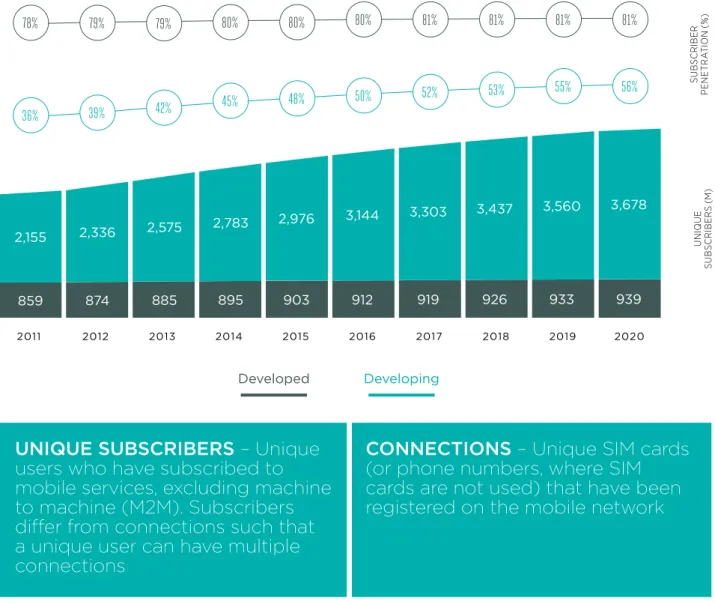
| Digital Inclusion – Industry Context 10 2011 2012 2013 2014 2015 2016 2017 2018 2019 2020 859 874 885 895 903 912 919 926 933 939 3,678 3,437 2,155 2,783 3,560 2,336 2,575 2,976 3,144 3,303 UN IQ UE SU B SC R IB ER S ( M)
Presently, mobile phones are the most popular and
widespread form of personal technology on the
planet, with GSMA Intelligence reporting 3.6 billion
unique mobile subscribers and 7.2 billion connections
globally
9.
2.2
The mobile revolution
Figure 2: Unique subscribers
Source: GSMa intelligence
36% 78% 39% 79% 42% 79% 45% 80% 48% 80% 50% 80% 52% 81% 53% 81% 55% 81% 56% 81% SU B SC R IB ER P EN E TR A TI O N (% ) Developed Developing
UniqUe SUbSCriberS
– Unique
users who have subscribed to
mobile services, excluding machine
to machine (m2m). Subscribers
differ from connections such that
a unique user can have multiple
connections
ConneCtionS
– Unique SIm cards
(or phone numbers, where SIm
cards are not used) that have been
registered on the mobile network
Digital Inclusion – Industry Context | 11
The cost of both mobile devices
and data plans has fallen sharply
over recent years. Strategy
Analytics report that an entry-level
smartphone in 2013 cost on average
just US$63, down from US$296 in
2003 (a drop of 80%). This trend is
particularly prevalent in developing
countries. In Latin America for
example, the average price of an
entry level smartphone data plan
(with a 250MB usage cap) fell from
US$17.68 in 2010 to US$8.33 in
2013, a decline of 52% in just three
years
10.
According to Strategy Analytics smartphones have been a major factor in the global growth of mobile internet, increasing from 11% of total handset sales in 2007 to just under 60% in 2013, expected to reach just under 70% by the end of 2014. However, it must be noted that smartphone growth is not a global phenomenon. In the developed world, smartphones account for around 45-50% of total handsets, whilst in the developing world, this number is below 10%11.
Lower income groups (often earning less than US$2 a day) represent large sections of the populations in many developing countries and smartphones are still a niche product reserved for the upper echelons of society, despite a general decline in price.
Nevertheless, the developing world continues to be the engine room of mobile growth, adding 416 million new unique subscribers over the last 2 years and pushing total unique subscribers to 2.8 billion, with 5.9 billion connections12.
The socio-economic impact of mobile is significant and well documented. The mobile industry, both directly and indirectly, contributed around 3.6%, or US$2.4 trillion of global GDP in 2013, and this is expected to increase to 5.1% by 2020. The mobile industry contributed 10.5 million jobs and US$336 billion in public funding in 2013, not including regulatory and spectrum fees13.
The widespread availability of affordable mobile technology has revolutionised the way people communicate globally, particularly in developing countries. According to GSMA Intelligence, unique mobile subscriber penetration in the developing world increased steadily over the last 5 years to 44% (from approximately 25%), with an additional 15-20% having access to a mobile despite not owning one. Given the widespread lack of fixed-line infrastructure and the inherent low level of PC ownership (under 10%)14, this makes
mobile the primary communication platform for the majority of the developing world population. As a result, more people are using their mobile devices to communicate with friends and family, and businesses are increasingly able to connect with their employees and customers.
Ironically, while mobile penetration rates continue to rise in the developing world, basic services continue to be limited. In some markets, less than a third of the population has access to basic utilities, such as banking and education services. Because of its near ubiquity, mobile technology can act as an enabler, and is already helping provide underserved people with access to education, healthcare, energy, and improved water sources, as well as providing previously unbanked populations with access to financial services. As such, mobile technology can play an invaluable role in the social, economic and environmental development of developing countries.
The GSmA currently tracks over 1750 life-enhancing mobile products and
services throughout the developing world. To access the online tracker go
to: www.gsmaintelligence.com/m4d
10. Barriers to Expanding Internet Access, McKinsey and Company, July 2014 11. GSMA Intelligence
12. GSMA Intelligence
13. The Mobile Economy, GSMA, 2014
| Digital Inclusion – Industry Context 12
The next wave of growth in the mobile industry
is the mobile internet, which will see billions of
people connect to the internet for the first time via
a mobile device, resulting in social and economic
transformation.
2.3
The mobile internet revolution
Global mobile data traffic in 2013 was nearly 18 times the size of the entire internet in 2000, and mobile is now the dominant means of accessing the internet. According to Cisco, global mobile internet connections overtook fixed-broadband connections in 2008, and mobile data traffic is expected to overtake desktop traffic in 201415.
Motivation to use the mobile internet is amplified by the portable nature of handsets, which enable access to information from anywhere, as well as useful location-based services, such as mapping based on GPS. The simple and increasingly touch-screen nature of handsets supports intuitive operation, simplifies web browsing, and improves the appearance of content such as pictures and movies. In addition, secure SIM cards support digital identity services such as mobile signatures, payments and biometric solutions.
Much of the developing world accesses the internet via mobile devices, and this impacts overall
economic activity of a country. The World Bank estimates that the mobile internet has a higher positive economic impact than fixed-line broadband, particularly in developing countries, and that a 10% increase in mobile broadband penetration drives a 1.4% increase in GDP for low-to-middle income countries. This GDP growth, coupled with stimulation of the job market, helps fuel a virtuous circle that reduces poverty, improves infrastructure and services, and increases internet access and usage.
The mobile internet is widely accepted to be the next wave of industry growth. Mobile operators have made significant capital investments of over US$1 trillion in the last 6 years, focussing on both improving network coverage and facilitating the growth in mobile broadband connections. According to GSMA Intelligence, there are currently 707 mobile broadband (3G & 4G) networks worldwide, of which 422 are in the developing world, and capital expenditure is expected to continue to increase in order to accommodate the growing demand in global data traffic, with investments totalling US$1.7 trillion expected between 2014 and 202016.
This investment will drive mobile internet usage, resulting in mobile operator data revenues surpassing voice revenues globally by 2018. GSMA Intelligence estimates that in 2013 the
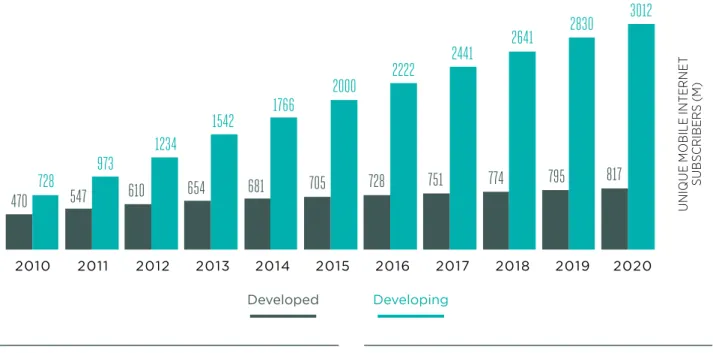
number of people using the mobile internet reached 2.2 billion, rising to 3.8 billion by 2020, driven by growth in developing countries. In those developing countries alone, at the end of 2013, it is estimated that 1.5 billion people used mobile internet services. By 2020, this figure is set to double reaching 3.0 billion, 45% of the population.
15. Global Mobile Data Traffic Forecast Update, Cisco, February 2014 16. The Mobile Economy, GSMA, 2014
Digital Inclusion – Industry Context | 13
“The first time I used the internet
was on my phone…In previous
days, we were not able to obtain
our own information. Whatever
the teacher said, that’s all the
information we had. Now I can
download information in two
minutes. In the future, why can’t
the services we queue for in banks
and post offices be sent via the
mobile?”
dUrGeSh, Uttar PradeSh, india
“With my phone I can get
information about farming. I can
gather information about any
crop related diseases, or find
information about the quality of
seeds, or information about market
prices. As an example, we’ve
doubled production in our Bajra
and sugarcane crops. Regarding
my family’s health, we’re now also
in better contact with doctors.
Small domestic sicknesses, the
ones related to children also, we
get immense relief with regard to
those. The mobile internet tells you
what injections should be given to
small children right from the start,
in what month it should be taken.
All this information can be found.”
rajendra, laKhori VillaGe, Uttar PradeSh, india
| Digital Inclusion – Industry Context 14
Figure 3: Growth in unique mobile internet subscribers
Figure 4: Developing markets technology split
Source: GSMa intelligence
Source: GSMa intelligence
As the number of unique mobile internet subscribers continues to explode there will also be a transition to higher speed connectivity. The end of 2013 saw virtual parity between those using mobile internet services primarily on 2G networks and those using 3G/4G networks but a rapid shift of the subscriber base to faster, more advanced technologies results in 3G/4G mobile internet subscribers being almost 3 times the size of 2G mobile internet users in 2020.
2012 2014 2010 2011 2013 2015 2016 2017 2018 2019 2020
470
728
973
1234
1542
1766
2000
2222
2441
2641
2830
3012
547
610
654
681
705
728
751
774
795
817
U N IQ U E M O B IL E I N TE R N E T SU B SC R IB ER S (M ) Developed 2G Developing 3G / 4G 2012 2014 2010 2011 2013 2015 2016 2017 2018 2019 2020581
683
753
777
802
842
869
876
856
819
770
147
290
481
765
964
1157
1353
1566
1785
2011
2242
U N IQ U E M O B IL E I N TE R N E T SU B SC R IB ER S (M )Digital Inclusion – Industry Context | 15
The ITU estimates there will be 2.9 billion fixed and
mobile internet users by end of 2014, accounting for
approximately 40% of the global population
17. But this
leaves the remaining 60%, or approximately 4.4 billion
people unconnected. And given the current pace of
internet adoption, it is estimated 3.6 billion or 48% will
still be offline by 2018
18.
2.4
The offline population
McKinsey and Company have researched the demographic profile of the offline population across 20 countries and identified that rural populations account for 64% of the unconnected population19.
Despite rapid urbanisation over the last few
decades, there are currently 3.3 billion people living in rural areas, 3 billion of whom are in developing countries20. The rural populations in developing
countries ranges from 15% in Brazil to 83% in Ethiopia, these rural populations typically have poor communication and power infrastructure, lower incomes, and suffer from higher rates of illiteracy. Another characteristic identified was low income with over half of the unconnected population being low-income individuals. Even with the declining prices of data plans and devices, connectivity remains beyond the reach of many, particularly those who must prioritise food, shelter, clean water and energy over internet access.
Illiteracy is very common in the unconnected population with 28% being unable to read, causing a significant barrier to usage of mobile internet as the majority of content is text based. The issue of literacy and digital literacy is explored in ‘Chapter 5: Consumer Barriers’.
Both youth and seniors are prominent in the offline population with 42% being younger than 25, and 18% being older than 54 years old. The youth segment,
a very large portion of the population of developing countries, have a strong appetite to adopt new technology and will be a major driver of mobile internet adoption. Seniors are disproportionately represented in the offline population due to their more conservative adoption of new technology and physical constraints that make accessing the internet on a small mobile device challenging.
Further, there is a bias towards fewer females being connected to the internet than men. Women account for 53% of the non-internet users versus 41% of the online population, with the gender gap rising up to 45% in certain parts of sub-Saharan Africa. The GSMA Connected Women programme
estimates that as of 2010, 21%, or 300 million fewer women than men owned a mobile phone in low-to middle-income countries, not only putting women at a disadvantage, but also hindering societal progress. Many factors contribute to this discrepancy, and cost, awareness, illiteracy, culture and religion are all barriers that have been found to disproportionately affect women. The GSMA Connected Women programme is focused on increasing women’s access to and use of mobile phones and life-enhancing mobile services in developing markets, as well as closing the digital skills gender gap, attracting and retaining female talent, and encouraging female leadership in technology on a global basis.
17. http://www.itu.int/net/pressoffice/press_releases/2014/23.aspx#.VC04vvldV9 and http://www.itu.int/en/ITU-D/Statistics/Documents/facts/ICTFactsFigures2014-e.pdf 18. VNI Service Adoption Forecast, Cisco, June 2014
19. Offline and falling behind: Barriers to Internet adoption, McKinsey and Company, 2014 20. GSMA Intelligence
| Network Infrastructure and Policy 16
Network Infrastructure
and Policy
3
The economic case for a mobile operator to expand networks into rural areas is challenging because of the cost of maintaining and powering cell towers in remote, off-grid locations, in combination with the lower revenues expected from the thinly spread, low income populations. Both industry and government have a role to play in improving the economics of mobile networks and facilitating greater network coverage in rural areas.
Mobile coverage is provided by cell towers over a
surrounding radius, a cell, which is interlinked via
backhaul to create a mobile network that can provide
internet connectivity. Today, approximately 85% of
the world’s population is covered by a 2G signal
and 2G coverage exceeds 70% for all countries. For
faster mobile broadband 3G technology, population
coverage is 55% globally, with concentration in urban
areas
21.
3.1
Lack of mobile network coverage
Network Infrastructure and Policy | 17
(source: GSMA)
85%
55%
85% of the world’s population
is covered by a
2G
signal
(source: GSMA Intelligence)
55% of the world’s population
is covered by a
3G
signal,
concentrated in
urban areas
$
Solutions
BARRIERS
cost of maintenance
& power in remote,
off-grid locations
lower revenues from
low income populations
Infrastructure
sharing
renewable energy
Use of
Timely release
of low frequency
spectrum
$
Public subsidies
for networks
to network expansion in rural areas:
60
Energy constitutes as high as
60% of the total network
operating expenditure
and Policy
EXPANDING RURAL NETWORK COVERAGE
| Network Infrastructure and Policy 18
Addressing the costs of powering remote, rural cell towers is a priority for developing world mobile operators. A range of technological innovations to both improve the energy efficiency of cell tower equipment and to utilise solar, wind and other renewable energy sources are now commonplace as highlighted in section ‘3.2.1 Renewable energy mobile networks’. Network vendors, such as VNL22
are designing innovative cell towers for rural, remote regions by using a combination of efficient, low capacity equipment with solar power and satellite technology for backhaul.
Infrastructure sharing is a solution that can help reduce the cost of extending network coverage, particularly into remote or geographically
challenging areas. Infrastructure sharing is common in many countries, with arrangements allowing mobile operators to jointly use masts, buildings and even antennas, avoiding unnecessary duplication of infrastructure. It has the potential to strengthen competition and reduce the carbon footprint of mobile networks, while reducing costs for operators. Several operators in conjunction with the GSMA, announced an agreement in early 2014 to “cooperate on network sharing initiatives” and ”to help to provide mobile broadband access to underserved rural communities and drive down the cost of mobile services for all sections of the population”23.
Whilst the operators themselves are taking steps to address the coverage challenge, there are measures that can also be taken by governments and regulators to help support the goal of improving mobile internet coverage. These particularly relate to issues around spectrum management, network sharing, public subsidies for networks and proposals for single wholesale networks (‘SWN’).
Spectrum management and release of the Digital Dividend spectrum bands
The timely release of spectrum, particularly the Digital Dividend spectrum, can play an important role in helping to facilitate network deployments. Lower frequency bands, in particular the 700MHz and 800MHz bands have the broadest geographical coverage, requiring far fewer cell towers and are therefore more cost-effective to provide coverage to wider areas. Governments often use coverage obligations as terms for the license which define the extent and timescale for provision of rural coverage which are factors in the cost of the license.
Regulators should facilitate voluntary infrastructure sharing
As described above, infrastructure sharing is a mechanism the industry uses to reduce the cost and carbon footprint of mobile networks. However, in reality there may be barriers to infrastructure sharing. The government may be able to take steps to removing such administrative and
regulatory barriers, which, if it facilitated voluntary infrastructure sharing between mobile operators would support expansion of mobile coverage in rural areas.
Regulators should facilitate voluntary infrastructure sharing between operators by easing planning controls to encourage shared fibre transmission facilities, and including preferential access along roads and other state property. Furthermore, registered providers (including third party tower companies) should be permitted to construct and acquire passive infrastructure and sell access to operators.
3.1.1
3.1.2
Industry solutions
Government solutions
22. www.vnl.com 23. http://www.gsma.com/newsroom/gsma-and-operators-mobile-access-affordability-across-africa-and-the-middle-east/Network Infrastructure and Policy | 19 Using public finances to directly subsidise rollout
in uneconomic areas
The government can award public funds directly to operators, where aids are allocated on the basis of a public tender. In low demand areas, the expected rollout costs exceed the expected margin that would be generated from offering services in the area. As a result, the area will remain uncovered in the absence of public funding. The government could provide funding to bridge the gap between costs and margins such that the area becomes viable to cover. In addition there might be remote areas which by themselves have enough demand to make roll out commercially viable, but the cost of extending the backhaul network might be too high. In these cases, government can help to bring broadband connectivity closer to rural customers by supporting the construction of backhaul links.
Regulators should not impose single wholesale networks
Regulators and governments in a number of developing markets are looking at the creation of ‘single wholesale networks’ as a policy tool, particularly to deliver mobile broadband networks. No SWN has as yet been implemented and some of the proposals differ in the detail. However, this would represent a radical departure from the existing model of competing networks and there are a number of concerns as to how a SWN would operate in practice. GSMA published a report analysing this topic ‘Assessing the case for Single Wholesale Networks’24 highlighting that SWNs
will lead to worse outcomes for consumers than network competition.
Mobile networks in developing countries face various challenges in terms
of power due to lack of reliable grid electricity infrastructure. When grid
electricity is not available, cell towers typically use diesel generators, but
consumption of diesel fuel is expensive, prone to maintenance problems
and is heavily polluting.
3.2
Lack of adjacent infrastructure -
grid electricity
Energy provision is a critical aspect of telecom networks. Diesel consumption for telecom towers will increase by 13-15% from today’s levels, to over 150 million barrels a day. The resulting annual cost of diesel will be over US$19 billion in 2020, or US$5 per mobile-phone per year25. With a requirement
of 99.9% uptime for the cell towers, networks must be powered up constantly throughout the year.
Therefore, electricity supply and grid infrastructure play a vital role in an operator’s day-to-day
operations.
The scale of this challenge is huge and growing as networks expand into ever more remote, rural areas. There are over 1 million off-grid and unreliable-grid cell towers in the world today, and this number is expected to grow to 1.2 million by 202026.
24. Assessing the case for Single Wholesale Networks, GSMA, 2014 25. Green Power for Mobile, Bi-Annual report, 2014
| Network Infrastructure and Policy 20
Operators have built approximately 43,000 renewable energy sites globally since 200827 using a range of
technologies including solar, wind and fuel cells. These sites require minimal amounts of diesel to operate and therefore significantly reduce the operating costs and maintenance burden of rural cell towers. This allows operators to expand network coverage to more remote areas on a cost effective basis.
The main challenge for operators to build renewable energy cell towers is the high upfront capital costs of the equipment compared to diesel generators. The savings on diesel fuel typically have a pay-back period against the higher upfront cost of one to three years. Operators also lack resources with technical skills and expertise in renewable energy technology to design, cost and procure the equipment, and they therefore require support from the equipment vendor community on this challenge.
3.2.1
Renewable energy mobile networks
GSMa Green Power for Mobile
In 2008 the GSmA established the Green Power for mobile programme
with an objective to
“Extend the coverage, reduce the cost and minimise
the environmental impact of mobile networks by championing renewable
energy”.
The programme, in partnership with the International Finance Corporation,
supports operators to resolve these challenges by developing a body of
knowledge and insight, supporting a thriving vendor ecosystem, hosting
working group forums, assessing latest technologies and resolving
financing challenges. For more information visit www.gsma.com/gpm
Network Infrastructure and Policy | 21
Operators have
built approximately
43,000
renewable
energy sites globally
since 2008
| Taxation 22
Taxation
4
Mobile taxation includes taxes on handset purchases, subscriptions and consumption of services, as well as a number of sector-specific levies on operators. In a recent survey of 19 markets, taxes accounted for more than 30% of sector revenue in over half the markets surveyed, and more than 40% of sector revenue in Jordan, Tunisia, and Brazil. In Bangladesh and Turkey, taxes accounted for almost 60% of sector revenue.28
Taxes on mobile consumers restrict access and usage by reducing affordability, while taxes on operators limit incentives for investment, for example into expanded network coverage. As a result of these negative impacts, high levels of taxation have caused some communications ministers, like those of Nigeria and Brazil, and international institutions such as the ITU and the Broadband Commission, to call for reduced mobile taxation.29 For the sector to achieve its potential,
governments should harmonise mobile taxes to the general tax level.
The mobile sector in many countries is the target
of excess taxation that creates barriers to digital
inclusion, especially in developing countries. Even
though mobile is an essential service, it is often taxed
at a substantially higher rate than other sectors. While
these taxes are often imposed to meet short-term
fiscal targets, they come at the cost of immediate and
long-term benefits from increased access to mobile
internet, and ultimately greater government revenue.
28. Mobile Taxes and Fees: A toolkit of principles and evidence, GSMA/Deloitte, 2014
29. Nigeria: http://www.punchng.com/business/business-economy/taxes-levies-gulp-70-of-telecoms-investment-minister Brazilian: http://www.marketwatch.com/story/brazilian-official-phone-taxes-are-excessive-2012-08-27
ITU: http://www.itu.int/net/pressoffice/press_releases/2012/11.aspx
Taxation | 23
Taxes can account
for up to nearly
60%
of mobile
sector revenues
The average proportion
of total cost
of mobile phone
ownership from tax is
18%
The average annual growth
of taxes and fees on
mobile services is
Reducing mobile taxes can
increase consumer service
access and usage,
and operator investment
Mobile taxation includes:
Taxes on
handset purchases
subscriptions
Taxes on
Taxes on service
consumption
levies on operators
Sector-specific
Taxation
REDUCING TOTAL COST OF OWNERSHIP OF MOBILE INTERNET BY ADDRESSING GOVERNMENT TAXES AND FEES
(source: GSMA/Deloitte 2014 "Mobile taxes and fees: A toolkit of principles and evidence")
(source: GSMA/Deloitte 2014 "Mobile taxes and fees: A toolkit of principles and evidence")
(source: GSMA/Deloitte 2011 "Global mobile tax review")
| Taxation 24
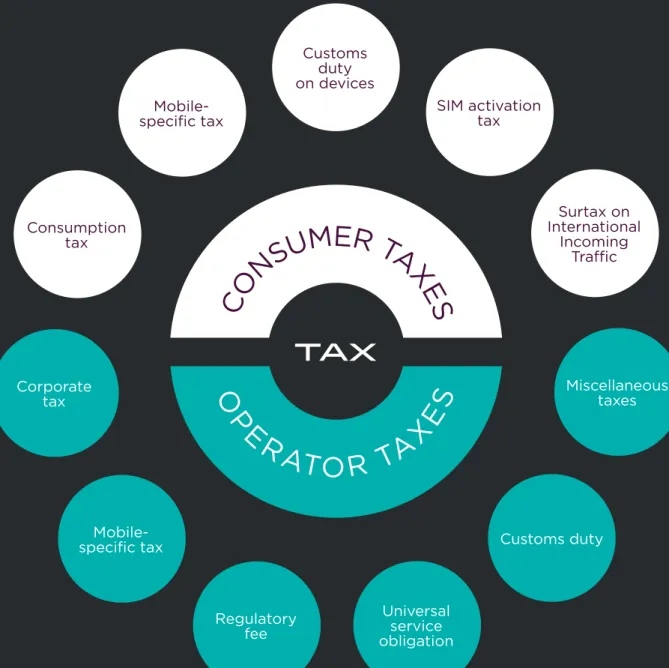
Figure 5: Taxes apply to both consumers and operators
Source: GSMa Customs duty on devices Mobile-specific tax Consumption tax Corporate tax Mobile- specific tax Regulatory fee Universal service obligation Customs duty Miscellaneous taxes Surtax on International Incoming Traffic SIM activation tax
Tax
Taxation | 25
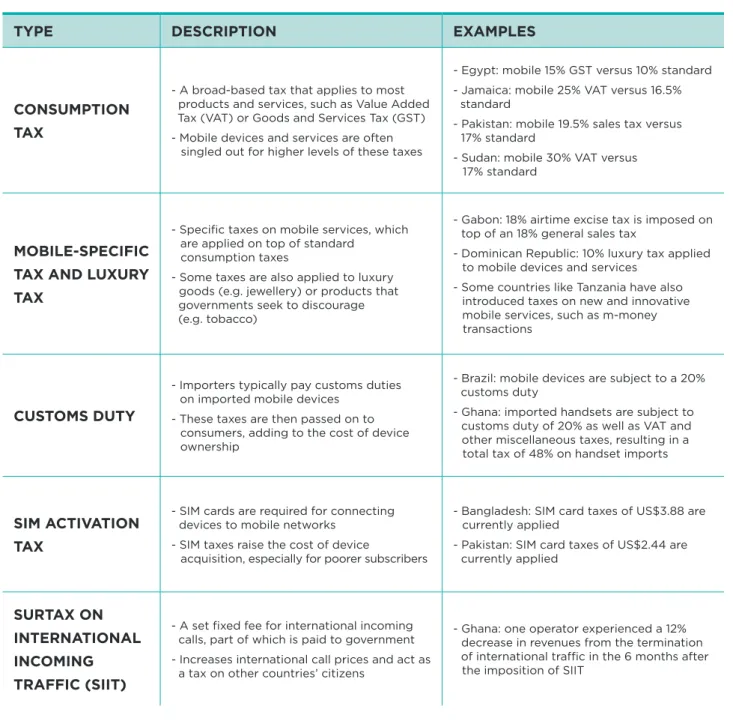
Taxes paid by consumers add to the cost of owning and using mobile
phones. In Africa, taxes account for 19% of total cost of mobile ownership
30,
representing a significant cost burden for consumers, especially poorer
consumers. Mobile consumer taxes can take many forms.
4.1
Consumer taxes and fees
tyPE DEScriPtion ExamPlES
conSumPtion tax
- A broad-based tax that applies to most products and services, such as Value Added Tax (VAT) or Goods and Services Tax (GST) - Mobile devices and services are often singled out for higher levels of these taxes
- Egypt: mobile 15% GST versus 10% standard - Jamaica: mobile 25% VAT versus 16.5% standard
- Pakistan: mobile 19.5% sales tax versus 17% standard
- Sudan: mobile 30% VAT versus 17% standard
moBilE-SPEcific tax anD luxury tax
- Specific taxes on mobile services, which are applied on top of standard
consumption taxes
- Some taxes are also applied to luxury goods (e.g. jewellery) or products that governments seek to discourage (e.g. tobacco)
- Gabon: 18% airtime excise tax is imposed on top of an 18% general sales tax
- Dominican Republic: 10% luxury tax applied to mobile devices and services
- Some countries like Tanzania have also introduced taxes on new and innovative mobile services, such as m-money transactions
cuStomS Duty
- Importers typically pay customs duties on imported mobile devices
- These taxes are then passed on to consumers, adding to the cost of device ownership
- Brazil: mobile devices are subject to a 20% customs duty
- Ghana: imported handsets are subject to customs duty of 20% as well as VAT and other miscellaneous taxes, resulting in a total tax of 48% on handset imports
Sim activation tax
- SIM cards are required for connecting devices to mobile networks
- SIM taxes raise the cost of device
acquisition, especially for poorer subscribers
- Bangladesh: SIM card taxes of US$3.88 are currently applied
- Pakistan: SIM card taxes of US$2.44 are currently applied
Surtax on intErnational incoming traffic (Siit)
- A set fixed fee for international incoming calls, part of which is paid to government - Increases international call prices and act as a tax on other countries’ citizens
- Ghana: one operator experienced a 12% decrease in revenues from the termination of international traffic in the 6 months after the imposition of SIIT
Table 1: Common taxes on mobile consumers
Source: GSMa
| Taxation 26
Taxes on mobile consumers constitute a significant portion of mobile ownership costs, creating a barrier to mobile internet access. In 2011 the Global Mobile Tax Review (GSMA/Deloitte, 2011) of 111 countries showed that the proportion of the total cost of mobile ownership (TCMO) from tax had increased to an average of 18.1%, and in many countries, the proportion is significantly higher. In 11 countries, tax constituted over 40% of the cost of handsets. Figure 6 shows how taxes applied to every aspect of mobile ownership, from handsets to usage, contribute to TCMO in the top 5 countries ranked in the 2011 study.
Figure 6: Tax as a proportion of total cost of mobile ownership
Source: Global Mobile tax review, GSMa/deloitte 2011
50% 40% 30% 20% 10% 0%
Turkey Gabon Pakistan Greece Dem Rep.Congo
Taxation | 27
The added cost for mobile consumers due to taxes creates a significant barrier to mobile access. Taxes on mobile devices and SIM cards make mobile handsets, tablets and dongles more expensive. Low income consumers are especially hurt by this barrier and may be prevented from accessing internet-enabled mobile devices or even basic mobile phones. Taxes on airtime, short message service (SMS) and mobile broadband raise the cost of using mobile services and can cause consumers to limit the amount of mobile services they use or even to be deterred from using mobile services altogether.
Figure 7: Consumer taxes are a barrier to digital inclusion
Source: GSMa
Operators frequently face a greater tax burden than companies in other
sectors due to numerous sector-specific taxes and fees. The Mobile Taxes
and Fees: Toolkit of Principles and Evidence (GSMA/Deloitte 2014) report
surveyed 19 markets and found that taxes accounted for more than 30%
of sector revenue in over half the markets surveyed, and more than 40% of
sector revenue in Jordan, Tunisia, and Brazil. These include taxes on network
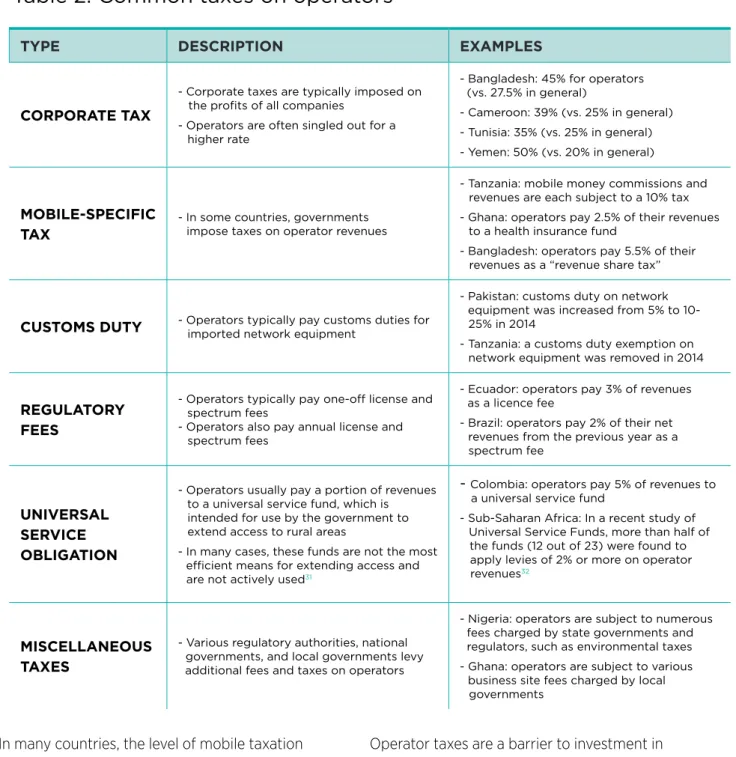
equipment, revenues, profits and regulatory fees, as shown in Table 2.
4.2
Operator taxes and fees
Mobile consumer taxes Device taxes Service taxes Increased cost of upgrading to internet-enabled phone Increased cost of mobile ownership Increased cost of service usage Barrier to internet access Barrier to mobile service access Barrier to mobile service use and internet access
| Taxation 28
tyPE DEScriPtion ExamPlES
corPoratE tax
- Corporate taxes are typically imposed on the profits of all companies
- Operators are often singled out for a higher rate
- Bangladesh: 45% for operators (vs. 27.5% in general)
- Cameroon: 39% (vs. 25% in general) - Tunisia: 35% (vs. 25% in general) - Yemen: 50% (vs. 20% in general)
moBilE-SPEcific
tax - In some countries, governments impose taxes on operator revenues
- Tanzania: mobile money commissions and revenues are each subject to a 10% tax - Ghana: operators pay 2.5% of their revenues to a health insurance fund
- Bangladesh: operators pay 5.5% of their revenues as a “revenue share tax”
cuStomS Duty - Operators typically pay customs duties for imported network equipment
- Pakistan: customs duty on network equipment was increased from 5% to 10- 25% in 2014
- Tanzania: a customs duty exemption on network equipment was removed in 2014
rEgulatory fEES
- Operators typically pay one-off license and spectrum fees
- Operators also pay annual license and spectrum fees
- Ecuador: operators pay 3% of revenues as a licence fee
- Brazil: operators pay 2% of their net revenues from the previous year as a spectrum fee
univErSal SErvicE oBligation
- Operators usually pay a portion of revenues to a universal service fund, which is intended for use by the government to extend access to rural areas
- In many cases, these funds are not the most efficient means for extending access and are not actively used31
- Colombia: operators pay 5% of revenues to a universal service fund
- Sub-Saharan Africa: In a recent study of Universal Service Funds, more than half of the funds (12 out of 23) were found to apply levies of 2% or more on operator revenues32
miScEllanEouS taxES
- Various regulatory authorities, national governments, and local governments levy additional fees and taxes on operators
- Nigeria: operators are subject to numerous fees charged by state governments and regulators, such as environmental taxes - Ghana: operators are subject to various business site fees charged by local governments
Table 2: Common taxes on operators
Source: GSMa
In many countries, the level of mobile taxation is increasing. The average annual growth of the taxes and fees burden on mobile services across all markets is 2.1%33. For example, over the last five
years in Hungary, although the overall tax level on the economy increased by 0.5% annually, the level on telecoms rose 7%, predominantly driven by the introduction of a ‘telecoms crisis tax’ in 2010.
Operator taxes are a barrier to investment in network coverage and quality of service. Mobile taxes reduce operator margins, thus limiting their incentives for investment and limiting their returns available for reinvestment. In many countries, significant gaps in rural coverage remain, so investing in network roll-out is crucial. By limiting operators’ ability to invest in networks, taxes on operators threaten to worsen the digital divide between those living in areas with access to mobile services and those without.
31. Sub-Saharan Africa – Universal Service Fund Study, GSMA, 2014 32. Sub-Saharan Africa – Universal Service Fund Study, GSMA, 2014
Taxation | 29
Lowering mobile taxes can help governments achieve their digital
inclusion objectives. In markets where consumer tax levels have been
reduced, an increase in the take-up and usage of services has occurred.
In Ecuador, for example, the abolition of a mobile excise tax in 2008
resulted in a 40% increase in penetration, a lower cost per minute of calls,
and increased usage per user
35. Reducing operator taxes can similarly
encourage network investment, leading to extension of mobile services to
underserved areas and improvements in quality of service.
4.3
Benefits of lowering taxes
Service quality and development of innovative services such as mobile banking services, may be limited due to taxes on operators. The International Monetary Fund (IMF), for example, highlighted the decline in investment in the information and communication sector of Hungary in recent years as a result of the disproportionate taxation burden on that sector.34
Figure 8: Mobile operator taxes act as barrier to investment
Source: GSMa Mobile operator taxes A portion of the tax is passed on to the consumers Taxes reduce operators’ margins Service adoption slows Limited funds are available for
reinvestment Operators’ investment incentives are reduced Low income consumers are penalised Network expansion may be limited Quality of service may be affected
34. Hungary: Article IV Consultation, IMF, 2014
| Taxation 30
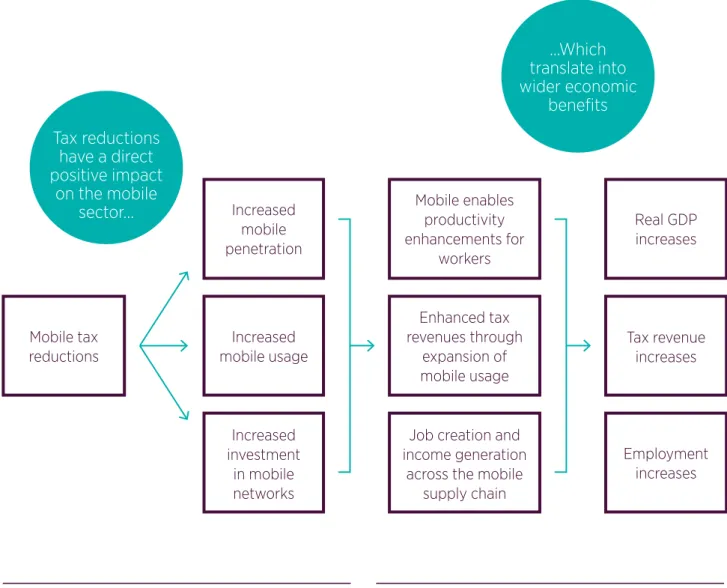
...Which
translate into
wider economic
benefits
The Mobile Taxes and Fees: Toolkit of Principles and Evidence (GSMA/Deloitte 2014) report estimates that if countries reduced mobile-specific taxes by approximately 6%, tax revenues would return to 2013 levels by between 2016 and 2020. Policymakers must be careful not to hinder mobile growth potential with polices that maximise near-term tax revenues at the expense of medium-term growth and development. A phased programme of tax harmonisation can offer governments the opportunity to benefit from a stronger economic contribution from mobile whilst limiting the short-run fiscal costs of such harmonisation.
Figure 9: The benefits of mobile tax reduction
Source: GSMa Mobile tax reductions Mobile enables productivity enhancements for workers Enhanced tax revenues through expansion of mobile usage Job creation and income generation
across the mobile supply chain Real GDP increases Tax revenue increases Employment increases Increased mobile penetration Increased mobile usage Increased investment in mobile networks
Tax reductions
have a direct
positive impact
on the mobile
sector...
Taxation | 31
Reducing
operator taxes
leads to extension
of mobile services to
underserved areas
and improvements in
quality of service
| Consumer Barriers 32
Consumer Barriers
5
In the traditional context, adult literacy is defined as “the per cent of population aged 15 years and over who can both read and write with understanding a short simple statement on his or her everyday life”37.
Literacy is essential for understanding the mobile phone user interface, reading its display and using its keyboard. Lack of English literacy further prevents many native language speakers from using the mobile internet as 55% of websites use English as the primary language38. Generally, regions with high levels of
illiteracy are also those that lag in take-up of the mobile internet.
In 2011 there were 774 million illiterate adults globally
and developing countries account for the majority of
this population
36. Despite high illiteracy rates, people in
developing countries are adopting mobile technology
at a high rate, albeit predominantly for voice calls,
since many consumers are unable to tap into mobile
internet due to lack of basic literacy.
5.1
Literacy
36. http://www.un.org/apps/news/story.asp?NewsID=47034#.VDKh2PldV9w 37. http://www.uis.unesco.org/literacy/Pages/default.aspx
Consumer Barriers | 33
55%
of websites use English
as the primary language
INCREASING ADOPTION AND USAGE OF MOBILE INTERNET
BY ADDRESSING LITERACY AND INTERNET AWARENESS BARRIERS
(source: Web Technology Surveys - http://w3techs.com/technologies/overview/content_language/all)
774M
illiterate
adults globally.
(developing countries
are the majority)
(source: UN)
African individuals stated the
top reason they
do not
access the
internet is
lack of digital skills
(source: McKinsey and Company)
(source: McKinsey and Company)
69%
of respondents in India
cited
lack of awareness
as the
main reason for not using the internet
Building
internet awareness
and
digital literacy
skills requires efforts of
multiple stakeholders to deliver campaigns
| Consumer Barriers 34
Figure 10: Literacy vs. internet penetration
Figure 11: Literacy rates urban vs. rural
Source: GSMa intelligence, world bank
Source: UneSCo, world bank, indian express, tribune
Illiteracy in developing countries is prominent across rural areas and marginalised groups of people such as the poor and youth, whilst women account for 64% of the total global illiterates39. These segments of the
population are often most underserved by mobile technology, and by extension the largest untapped market for mobile internet adoption and usage.
Burkino Faso Brazil Senegal Pakistan India
Urban Rural
63%
20%
77%
33%
49%
68%
95%
69%
73%
84%
2007-20132013, Data includes both fixed and mobile internet users
50% 100% 90% 80% 70% 60% 50% 40% 30% 20% 10% 0% 60% 70% 80% 90% 100% Literacy Rates Int ernet P enetr a tion 110% North America East Asia Pacific South Asia Middle East Africa Central / Eastern Europe Western Europe LATAM 39. http://www.uis.unesco.org/literacy/Pages/data-release-map-2013.aspx
Consumer Barriers | 35
Figure 12: Why do people not use the internet?
Source: Google and basis research
Further to traditional literacy barriers, McKinsey and Company found that the top reason African individuals do not access the internet is because they have not developed the digital skills to do so40. This highlights that literacy outcomes must
account for proficiency in basic language as well as technology – in other words, digital literacy. This concept might be summed up as “a set of skills that allows a user to not only access the internet, but to navigate websites, and evaluate and create information through digital devices”.
In Africa, Google and Basis Research’s survey of 13,000 people in urban centres in 6 key African countries (Ghana, Kenya, Nigeria, Senegal, South Africa and Uganda) found that among non-adopters, lack of knowledge of how to use the internet was perceived as a larger hurdle than coverage or cost.
5.1.1
Digital literacy
Knowledge Access Cost
Ghana Kenya Nigeria Senegal South Africa Uganda
44%
39%
29%
33%
29%
22%
44%
41%
43%
40%
26%
49%
48%
44%
40%
33%
44%
47%
| Consumer Barriers 36
Basic mobile literacy: The ability to use the phone to make voice calls
Mobile technical literacy: The ability to use a mobile phone and its non-voice and core functions such as SMS, the calculator, alarm clock, time and date, contact menu, and camera. People who are technically illiterate are less likely to use these core functions effectively, if at all
Mobile internet literacy: The ability to access the internet using a mobile device internet browser and or application to find resources, and the capability to critically evaluate and create information
Advanced mobile internet literacy: The ability to find, evaluate, utilise, share, and create content using information technologies and the internet using a mobile phone or a computer. Advanced skills are achieved via five interdependent stages
It is important to highlight that mastering mobile internet literacy is not essential from the onset, nor is basic literacy always a pre-requisite for meaningful use of technology. The journey starts with learning the mechanics of using a mobile device, with a gradual transition towards use of more advanced features such as the internet.
Figure 13: Stages of digital literacy using a mobile device
Source: GSMa intelligence
Mobile phones are and will continue to be the primary gateway to the
internet for the majority of developing countries, due to their near
ubiquity, along with the lack of fixed broadband infrastructure. Since a
mobile user interface is different to that of a traditional PC, the user’s
internet journey requires different skill sets:
TRADITIoNAL LITeRACy: Reading, writing, numeracy BASIC MoBILe LITeRACy: Use of voice on phone MoBILe TeChNICAL LITeRACy
Use of features such as calendar, calculator, camera and text (SMS, USSD) in addition to
voice
MoBILe INTeRNeT LITeRACy
Ability to search for content via internet browser and apps
ADvANCeD MoBILe INTeRNeT LITeRACy Access, create, navigate and consume online content on a range of digital devices
Consumer Barriers | 37
To address the needs of the illiterate population in the developing world,
it is necessary to create awareness about the internet and its benefits in
an effort to help people embark on the digital literacy journey. Specifically,
we believe key stakeholder groups should consider targeted action:
5.1.2
Role of stakeholders
Mobile operators
Using the various assets in their business, operators can promote digital literacy leading to increased data revenues:
• Distribution channels: Using existing agent networks and door-to-door sales agents who are proficient in digital literacy, operators can provide training sessions to rural communities
• SMS and interactive voice response (IvR): Using these basic technologies, operators can design basic literacy tutorials that can be delivered to a wider subscriber base, particularly feature phone users
• existing customers: Incentivise and encourage existing internet subscribers to become local agents, disseminating knowledge of the mobile phone, internet and relevant services to friends and family
Government
Governments must dedicate sufficient funding and support in the following areas:
• education: Expedite the work in offering strong education systems at primary school level
• ICT: Promote use of ICT and internet as a medium of learning in schools, colleges and universities allowing students to master technology use.
• Rural engagement: Devote sufficient resources to extend a supportive learning environment to rural areas
• e-government services: Deliver services in education, health and financial disbursements and other life-enhancing services
Development organisations
• Partnership: Work with operators and governments to produce relevant content to teach digital literacy
• engagement: Develop ways to keep the rural community engaged and interested in improving their mobile internet skills
• Dissemination: Create mobile training centres and recruit trainers to improve digital literacy
• Use existing infrastructure: Offer digital literacy training via public libraries, schools, community centres and places of worship
| Consumer Barriers 38
5.2
Internet awareness
Operators are increasingly finding that awareness is a significant barrier to internet take-up. To overcome this awareness barrier, MTN Uganda has been organising regional expos to drive awareness and assist subscribers in accessing the internet on feature phones and smartphones, as well as showcasing MTN’s data products and services in an
engaging, entertaining and informative way (see Appendix for MTN case study).
Figure 14 illustrates a framework for the customer awareness and user journey, taking the user from a basic level of awareness, to trial and continued use of the mobile internet.
Figure 14: The customer awareness journey
Source: research iCt africa, GSMa intelligence
“I’m using the internet” “I’m not aware of the internet” Never heard of mobile internet Heard of mobile internet and knows
what it does
Understands the value of the mobile
internet, the use case, the costs and
trusts the service
Gains access to the internet on mobile either via data plan,
pay-as-you-go or Wifi
Interacts with the mobile internet via search, app and uses
other functions
Uses the mobile internet for social
and business purposes
Creates content for sharing
UNAWARE AWARE UNDERSTANDS INTERNETACCESS TRIAL REGULARUSE CONTENTCREATE
Internet awareness is the ability to perceive the internet and its existence,
leading to an understanding of the benefits of its use. Basic awareness
is a major challenge in the developing world, with large sections of
the population still unaware of the mobile internet’s existence and
empowering potential. In a recent McKinsey and Company survey in India,
69% of respondents cited lack of awareness as the main reason for not
using the internet
41.
Consumer Barriers | 39
Looking at Base of Pyramid (BoP) users, research in Kenya suggests that while over 60% of individuals own or have access to a mobile phone, very few use applications other than M-PESA (M-Pesa is a mobile-phone based money transfer and microfinancing service, launched in 2007 by Safaricom and Vodacom, in Kenya and Tanzania), due to lack of awareness and confusion about the difference between applications42. Research conducted by
Microsoft highlighted that, despite the lack of financial inclusion, most non-adopters of mobile banking cite lack of awareness as the main reason they do not use the application.
The consumer journey from unaware to a regular user of mobile internet is impacted by misconceptions. For example, in India, the internet is perceived as a premium and lifestyle service. There is also confusion about which content and services on the internet are trustworthy, secure and beneficial. As many applications require users to share their financial and personal information, individuals may lack the trust to engage. Finally, in some countries, governments censor opinion-orientated sites such as YouTube, leading to further negative perception in specific cultural environments.
Awareness of the value and benefits of the mobile internet is the first step a consumer takes in the adoption journey. While applications like email, search, social networking and instant messaging often bring significant benefits to the consumer; many non-adopters remain unaware of these benefits and the potential utility to their lives.
Figure 15: Awareness of applications among those who do not use
the mobile internet
Source: insights africa, 2011
Email Search MessagingInstant
34%
28%
24%
Social
Networking StreamingContent