G
ENERATING AQ
UALITYP
EACE: N
EGOTIATEDS
ETTLEMENTS ANDG
OVERNMENTR
ESPECT FORR
IGHTS IN THEW
AKE OFC
IVILW
ARLindsay Reid
A dissertation submitted to the faculty of the University of North Carolina at Chapel Hill in
partial fulfillment of the requirements for the degree of Doctor of Philosophy in the
Department of Political Science.
Chapel Hill
2016
ABSTRACT
Lindsay Reid: Generating a Quality Peace: Negotiated Settlements and Government Respect for Rights in the Wake of Civil War
(Under the direction of Mark J.C. Crescenzi)
How can a quality peace be established in the wake of civil war? What role do peace agreements play in shaping what peace looks like following the resolution of civil war? This dissertation builds and tests a theory of how peace agreements and their contents influence the quality of post-conflict peace. Moving beyond negative or minimalist definitions of peace, I define a quality peace as one that is politically inclusive in nature. Specifically, I focus on two key components of a quality peace within this work: women’s political rights and the political rights of societies more broadly. I argue that peace agreements both constrain and incentivize actors to commit to more politically inclusive outcomes. As such, I assess the extent to which peace agreements not only end war but go on to create a peace that is meaningful for those living in post-conflict societies.
ACKNOWLEDGMENTS
I would like to extend my sincerest thanks to my dissertation committee members, Navin Bapat, Mark Crescenzi, Stephen Gent, Caroline Hartzell, and Kelly Kadera, for the guidance and support that they have provided to me throughout the development of this dissertation. Their advice, questions, and conversation throughout graduate school and throughout the writing of this dissertation have been invaluable and have shaped the scholar that I am today. I would like to dedicate a special thanks to Mark Crescenzi for advising my research, granting me freedom to tackle big questions, and always encouraging me to remember the big picture.
Many others have contributed to the development of this project. I want to thank the organizers and participants of the 2015 Journeys in World Politics workshop hosted by Kelly Kadera and Sara Mitchell at the University of Iowa. I thank the participants of Journeys not only for their feedback on my research but also for creating an incredible support network for female scholars. I want to thank my amazing graduate student colleagues and the faculty at the University of North Carolina for attending numerous presentations of this material. Their support and encouragement helped me maintain motivation and remember why this research is so important. I also extend my gratitude to the panelists and discussants of the following conferences for feedback on various iterations of this research: the 2015 Meeting of the American Political Science Association; Power-Sharing Pacts and the Women, Peace and Security Agenda in Belfast, Northern Ireland; and, the 2016 Meeting of the International Studies Association.
TABLE OF CONTENTS
LIST OF TABLES . . . viii
LIST OF FIGURES . . . ix
1 INTRODUCTION . . . 1
Puzzle and Motivations . . . 5
Definitions and Overview of a Quality Peace . . . 8
Literature . . . 10
Theory . . . 17
Roadmap . . . 25
2 PEACE AGREEMENTS AND WOMEN’S RIGHTS: A QUANTITATIVE ANALYSIS . . . 26
Civil War Resolution, Quality Peace, and Women’s Empowerment: What We Know . . 28
Theory: Peace Agreements as “Quasi-Constitutional” Documents . . . 33
Research Design . . . 39
Results . . . 43
Discussion and Conclusion . . . 50
3 PEACE AGREEMENTS AND WOMEN’S RIGHTS: CASE ILLUSTRATIONS . . . 52
A Note on Case Selection . . . 55
Qualitative Illustrations . . . 57
Tying Hands: The Arusha Peace and Reconciliation Agreement for Burundi . . 58
Positive Externalities: Liberian Women Empowered to Push for Change . . . . 68
Norms Shifts: Changing Perceptions of Women in South Africa . . . 77
Missing a Seat at the Table: Women’s Exclusion in Angola . . . 87
Conclusion: Lessons and Limits of the Case Illustrations . . . 92
4 CONTEXT-SPECIFIC PEACE AGREEMENTS: A QUANTITATIVE ANALYSIS . . . 95
A Theory of Context-Specific Peace Agreements and Quality Peace . . . 101
Research Design . . . 108
Results . . . 112
Discussion and Conclusion . . . 115
5 CONTEXT-SPECIFIC PEACE AGREEMENTS: CASE ILLUSTRATIONS . . . 117
Case Selection . . . 120
Qualitative Illustrations . . . 121
Liberia . . . 122
Burundi . . . 131
Cˆote d’Ivoire . . . 139
Discussion and Conclusions . . . 144
6 CONCLUSION . . . 146
Future Research . . . 149
Policy Implications . . . 154
APPENDIX 1 . . . 157
APPENDIX 2 . . . 159
LIST OF TABLES
1.1 A Sample of Studies of Civil War Resolution and their Measures of Success . . . 14
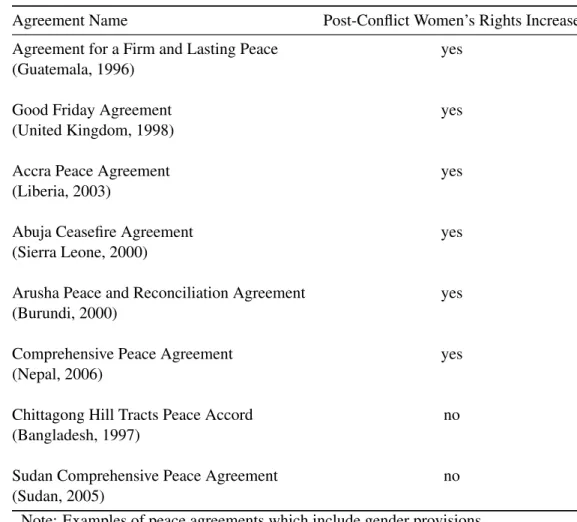
2.1 Peace Agreements and Women’s Post-Conflict Political Rights (Select Examples) . . . 38
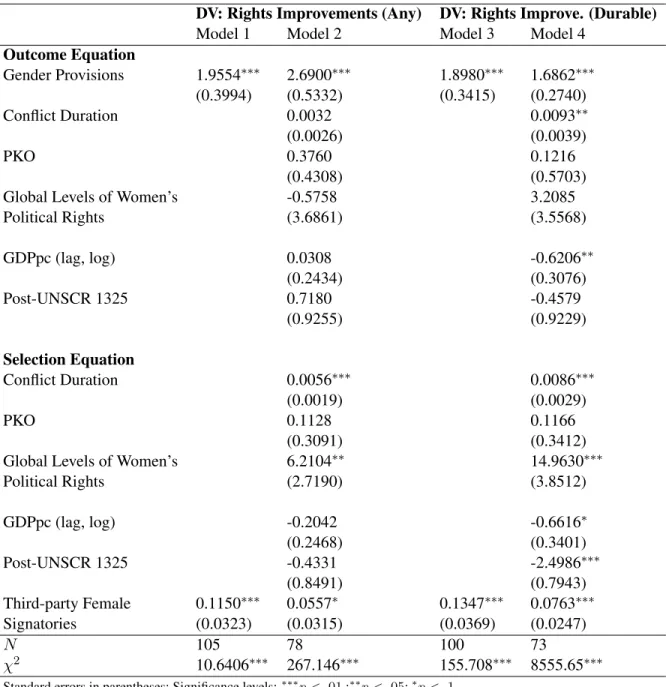
2.2 Seemingly Unrelated Bivariate Probit: Peace Agreements and Women’s Rights . . . . 45
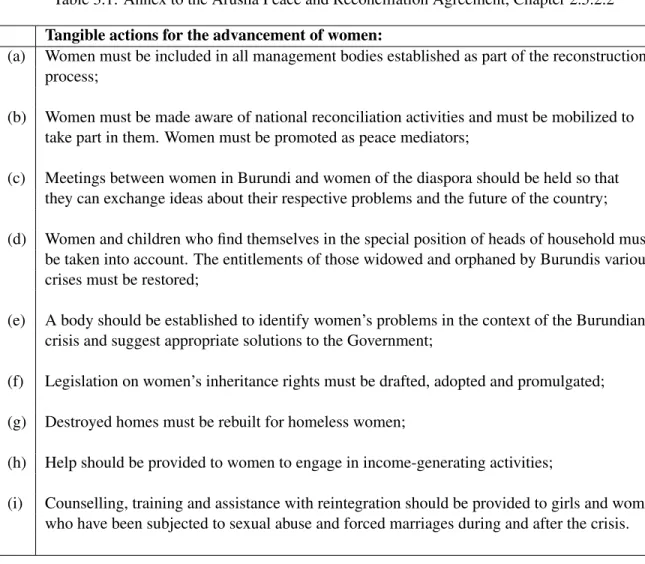
3.1 Annex to the Arusha Peace and Reconciliation Agreement, Chapter 2.5.2.2 . . . 62
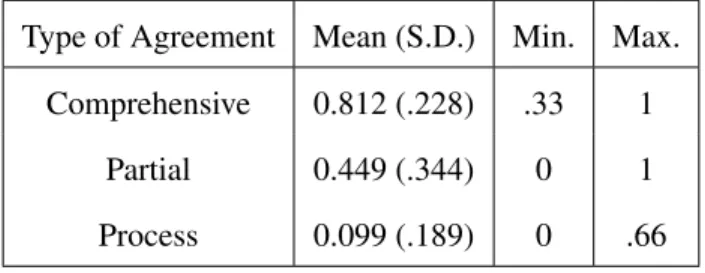
4.1 Descriptive Statistics of Context-Specificity by Peace Agreement Type . . . 111
4.2 Logistic Regression: Peace Agreements and Government Respect for Political Rights . 113 A.1 Robustness Check: Controlling for Comprehensive Agreements . . . 157
A.2 Peacekeeping Operations and Gender-Specific Peace Agreements . . . 158
A.3 Peacekeeping Operations and Women’s Rights Improvements . . . 158
LIST OF FIGURES
2.1 Gender-Specific Peace Agreements and Improvements in Women’s Political Rights . . 44
2.2 Predicted Probability of Improvements in Women’s Political Rights . . . 48
3.1 Women’s Civil Liberties, Liberia 1980-2014 . . . 72
3.2 Women’s Civil Liberties in South Africa, 1980-2014 . . . 82
3.3 Gender Perceptions in South Africa, 1990 . . . 84
3.4 Gender Perceptions in South Africa, 1996 . . . 84
4.1 Substantive Effects of Context-Specific Agreements . . . 114
CHAPTER 1
INTRODUCTION
...[T]he view that one cannot meaningfully work for both absence of personal violence and
for social justice can also be seen as essentially pessimistic, as some sort of intellectual
and moral capitulationism... [O]nce the double goal has been stated – that peace research
is concerned with the conditions for promoting both aspects of peace – there is no reason
to believe that the future will not bring us richer concepts and more forms of social action
that combine absence of personal violence with [a] fight against social injustice... There
are more than enough people willing to sacrifice one for the other – it is by aiming for both
that peace research can make a real contribution.
– Johan Galtung in “Violence, Peace, and Peace Research,” 19691
The 2002 signing of the Luena Memorandum of Understanding by the military commanders of UNITA (Uni˜ao Nacional para a Indepˆendencia Total de Angola) as well as the Government of Angola has been durable and successful in preventing the recurrence of civil war in Angola. The case of Angola, though, reveals that conflict resolution must strive for more; in Angola, while war is over, structural violence continues to manifest itself through social injustice and inequality. Galtung (1969) writes that “Within this region [of peace] a tremendous amount of variation is still possible, making an orientation in favor of peace compatible with a number of ideologies outlining other aspects of social orders” (168). Galtung thus posits that while peace is indeed the absence of violence, peace itself comes in many forms. While the Luena Memorandum of Understanding put an end to the violence that had endured for almost
1
three decades, an accomplishment that cannot and should not be understated, the peace emerging from the agreement remained void of political, social, and economic opportunity or growth.
Since emerging from its lengthy civil war, Angola has been plagued by political, social, and eco-nomic struggles. The current president, Jose Eduardo Dos Santos, has been in power since 1979. Ac-cording to the Polity IV Country Report on Angola from 2010, the opposition (UNITA) has accused the Dos Santos government of destroying democracy in the country (Marshall, Gurr and Jaggers, 2010). In 2010 revisions to the country’s constitution, presidential elections were abolished; instead, the president is now elected by the majority party in the legislature. At the same time, political freedoms are restricted across the country, rendering political participation minimal. Gender disparities also plague Angola and offer indication that peace is elusive for Angolan society. Women in Angola formed a number of orga-nizations during the country’s civil war. As early as 1962, the Organization of Angolan Women (OMA) was created as the women’s wing of the Popular Movement for the Liberation of Angola (MPLA); in 1973, the Independent League for Angolan Women (LIMA) was created as the women’s wing of UNITA. While women’s roles and importance varied throughout the conflict,2 women remained active in various political and social capacities. Following the signing of the Luena Memorandum of Under-standing, however, the vast majority of Angolan women were left out of all direct benefits set forth in the agreement. Angola has avoided war recurrence since 2002, yet peace remains one that is marked by inequality, injustice, and structural violence. In sum, Angola is in a state of peace (as defined by the absence of war), but the country has a long way to go to consolidate a meaningful and just peace.
Liberia experienced two deadly episodes of civil war spurred by the Liberian government’s highly exclusionary and corrupt practices. Indeed, the pre-war and interwar governments monopolized political and economic power amongst a small class of elites. Following the second civil war, which began in 2000, Liberians put a durable end to their conflict with the signing of the Accra Peace Agreement in 2003. Members of the Government of Liberia, the Liberians United for Reconciliation and Democracy (LURD), and the Movement for Reconciliation and Democracy (MODEL) committed to negotiations and reached an agreement to bring a durable end to Liberia’s war. In contrast to the case of Angola,
2
Liberia offers indication that countries can and should strive for a higher quality peace in the post-conflict period. While Liberia still faces a number of challenges stemming from issues such as poor infrastructure, governmental corruption, and sexual violence, it has nonetheless been able to achieve some of the very structures of justice and opportunity that Galtung described in his 1969 writing.
In the aftermath of civil war, Liberia has made positive strides toward inclusivity and opportunity for many of its citizens. For example, the political activities of Liberians have been marked by greater security and greater access. All significant groups, according to one account, have at least some access to political power. President Ellen Johnson-Sirleaf, who was elected in 2006 following the post-conflict transitional period, has supported a Constitutional Review Committee which aims to increase the par-ticipation of political parties, civil society groups and other groups within the political life of the state (UN News Centre, 2013). Women, in particular, have gained a greater voice in Liberian politics. Thus, Liberia has made strides toward a peace that is not only defined as the absence of personal violence, but one that has greatly reduced structural violence as well. The legal and normative structures of the state have made important progress toward a more inclusive and secure state; indeed, the post-conflict environment in Liberia is one that is at the same time more meaningful and more hopeful for many in society.
and equality in post-conflict societies. Indeed, the goal is to grapple with how peace can be made mean-ingful for those living in post-conflict societies. How, truly, can countries be guided out of the conflict trap and move beyond the legacy of war?
A great disconnect exists between policymaking goals and scholarship on civil war resolution. While scholarship on conflict resolution strives to measure determinants that end violence (either in the short-or long-term), the policymaking community has been calling fshort-or, as United Nations Secretary General Boutros Boutros-Ghali stated in 1992, more “comprehensive efforts to...consolidate peace.”3 Ending war is the necessary first step in the search for peace, but it is only the beginning of the journey and it is insufficient for the consolidation of peace. This dissertation tackles the concept of quality peace and explores mechanisms through which the international community can work to increase the quality of peace in the wake of civil war.
Within this dissertation, I build a theoretical framework and test the extent to which peace agree-ments, in particular, influence the quality of peace following civil war. Specifically, I argue that the contents of peace agreements shape the post-conflict peace through institutional constraints and incen-tives. Peace agreements’ contents constrain actors to new institutions and policies while also incentiviz-ing new behaviors, attitudes, and norms within societies. In the case of Liberia, the 2003 Accra Peace Agreement incentivized inclusivity while also constraining actors from perpetuating exclusionary poli-cies. Through direct and indirect mechanisms, the specific content of peace agreements helps to guide countries away from a legacy of war.
In particular, the chapters of this dissertation focus on two distinct applications of the aforemen-tioned theory. First, I posit that gender-specific peace agreements influence inclusivity and rights for women in the post-conflict period, leading to tangible improvements in the quality of peace. Second, I argue that the context-specificity of peace agreements shapes levels of political protections within post-conflict societies.4 Across both sections, I contribute new data on the contents of peace agree-ments; beyond using this data for the research questions herein, the data on the gender-specificity and context-specificity of peace agreements can be applied to a number of questions about conflict resolution
3
From “And Agenda for Peace: Preventive Diplomacy, Peacemaking and Peace-keeping,” 31 January 1992.
4I define gender-specific agreements as those agreements that include provisions for women’s rights and context-specificity
processes and post-conflict outcomes. In sum, this dissertation contributes strong evidence that peace agreements are instrumental in shaping the environments within post-conflict societies, and it offers new data to strengthen understanding of when and through which mechanisms peace agreements shape both the end of violence as well as the consolidation of a quality peace.
Puzzle and Motivations
Why are some countries, such as Liberia, able to make strides toward a higher quality peace while others, like Angola, remain plagued by widespread structural violence? In other words, what can peace-makers do to achieve Galtung’s calls for promoting both negative and positive dimensions of peace? The research presented here focuses on peace agreements as defining tools in achieving a peace that is both durable and meaningful. Peace agreements, documents that are crafted by both domestic and in-ternational actors to lead countries out of war, are roadmaps for the post-conflict realities that states will face. As former U.N. Secretary General Boutros-Ghali pointedly states, international efforts to guide countries out of the grips of civil war require extensive attention to identify and strengthen structures that facilitate the consolidation of peace. Moreover, he states that peace agreements themselves can be harnessed as mechanisms to advance and consolidate peace in the post-conflict period. Peace agree-ments, in this account, can be crafted to not only end violence but also establish institutions that foster political, social, and economic opportunity for populations emerging from war.
the goal is the creation of a long-lasting peace in the wake of civil war, why do so many agreements lack the mechanisms necessary to build not only a durable, but also a self-enforcing and equitable peace?
A key shortcoming within peace efforts and within extant work on civil war resolution can be identi-fied in policy-makers’ and scholars’ visions of conflict resolution success. At the most basic level, civil war resolution success is often marked by the signing of an agreement, whether it be a ceasefire or a more comprehensive peace agreement. More “advanced” definitions of resolution success measure the concept as the creation of a durable peace. A subset of this more advanced definition imply that civil wars have been successfully resolved if the subsequent peace lasts a set number of years. Another subset of these studies posit that the longer lasting peace is following a civil war, the more successful the reso-lution process has been. While these conceptualizations of civil war resoreso-lution success have generated much knowledge and contributed important insights into the civil war resolution process, they are all plagued by a common flaw. Each of these definitions of successful civil war resolution assume peace to mean the absence of violence at levels associated with war. If violence is occurring but does not reach the 1,000 battle-death threshold, is that really peace? As Galtung (1969) identifies, these definitions of success rely on the idea of a negative peace, or a peace that is defined by the absence of personal violence.
Crocker and Hampson (1996) reiterate, however, that success can and should be measured in a number of ways when studying conflict resolution. They write:
In some circumstances, success can legitimately be defined as the avoidance of major set-backs or disasters. In others, success may mean a marginal improvement in stabilizing, containing, and checking the human price and territorial spread of a volatile struggle. Fi-nally, success may entail constructing building blocks for a settlement or even obtaining full implementation, complete with resolution of the underlying issues (Crocker and Hampson, 1996, 62).
Why, more specifically, are current definitions of civil war success not enough? What are the impli-cations of continuing to measure success as has been done in the past? If scholars and policy-makers do not conceptualize success in longer-term or more nuanced ways, they will remain bound to pro-cesses that end violence but stop short of creating political environments that provide broader forms of personal security. By relying on short-term and/or minimalist definitions of success, scholars are identifying ways to avoid war recurrence but they are not identifying ways to create a sustainable and self-enforcing quality peace. Current work offers a vast number of recommendations to increase the likelihood that a negotiated settlement will put an end to war, but it does not adequately say how ne-gotiated settlements generate peace. The factors that end war are not necessarily sufficient to create peace; ending war is but the first step of many needed to create peace. This dissertation focuses on what happens when war ends and how the settlement process shapes positive peaceful outcomes.
Of course, the distinction between the end of war and the creation of peace is not entirely new but it has yet to be studied in a rigorous way. Galtung (1969), for example, discusses definitions of peace and violence and writes of the concepts of negative and positive peace. Negative peace, which captures the current conceptualization of successful civil war resolution, is simply the absence of personal violence. Positive peace, on the other hand, describes a state that is free from structural violence as well. A positive peace relies on concepts such as social justice and a more egalitarian distribution of power, resources, and opportunity. As an example, Galtung (1969) writes: “if people are starving when this is objectively avoidable, then violence is committed, regardless of whether there is a clear subject-action-object relation” (171). Empirical work within political science needs to pay more focus to this idea of a positive peace or, to use the term that will appear throughout this work, the quality of the peace. If the ways currently identified to resolve civil wars merely create a negative peace but do nothing in terms of social, economic, and political justice, then scholars and practitioners are missing a key component in long-term, durable civil war resolution. Peace research, as Galtung wrote nearly half a century ago, must strive for more.
Agreement, for example, ended violence at levels associated with war between the government’s forces and the SPLM/A, but it did not create a peace that spread to all groups in the country nor did it generate a stability amenable to economic growth, political and social inclusivity, or general human development and security. As such, I have tasked myself with generating a better understanding of the quality of peace emerging from civil war resolution and the ways in which such a quality peace can be achieved. How can civil wars be resolved and peace agreements be designed so as to create a quality peace that is more than the absence of war? Ending war, although essential, should not be seen as the end game. Giving attention to the quality of peace is a necessary second step in helping societies truly escape the grips of civil war.
While much research has been done to investigate how peace is reached following civil wars, much less is known about the nature or quality of peace emerging from civil conflicts. Many countries are stuck in a conflict trap, experiencing recurring instability and civil war. Are there shortcomings in the civil war resolution process and ensuing peace that preclude lasting peace and leave countries in the conflict trap? I argue that thequalityof post-conflict peace is a crucial component in preventing recurring conflict. Peace is not peaceful for some; although the physical fighting may end in countries recovering from civil war, many post-civil war societies still experience ongoing conflict and struggle. The main research question I seek to explore, then, is how a high-quality peace can be established following a civil war. In approaching this question, I am pushing further than previous studies of civil war resolution. By answering these questions and creating this extension of the civil war resolution literature, I hope to generate a more nuanced understanding of what a quality peace is and how, in practice, a quality peace can be created. In sum, this work explores the way in which the post-civil war peace can become more peaceful for those people who are living in countries recovering from the atrocities of civil war.
Definitions and Overview of a Quality Peace
specifically defined as the extent to which the majority of citizens in a country enjoy basic political rights and freedoms.5 In his own work on political inclusion and civil war recurrence, Call (2012) defines political inclusion as the opposite of exclusion, or more specifically, “behavior that does not exclude former parties...from access to state positions in ways contrary to their expectations” (39). I extend Call’s definition in that I do not exclusively focus on warring parties. Instead, the dependent variable of interest within this dissertation is one that looks at political inclusion as the extent to which groups in society can securely exercise political voice and access positions of political power. As countries move toward greater political inclusion, they are making strides away from the legacy of war toward a higher quality peace.
Before proceeding further, I must emphasize that a quality peace has many dimensions; a quality peace encompasses the entirety of positive peace and social justice outlined by Galtung (1969). I choose to focus on the political dimensions of a quality peace for the following reasons: (1) political inclusion and exclusion shape the stability and legitimacy of the post-conflict state and are thus a crucial pillar of quality peace, and (2) most peace settlements are themselves focused on political goals and reforms so one would expect that, if peace agreements influence the quality of peace, their effects should manifest themselves first and foremost in the political life of the state. Future work on quality of post-conflict peace must, undoubtedly, investigate the economic and social dimensions of quality peace.6 As the field of peace research moves beyond definitions of peace that rely on the negative conception of peace, research must strive to broaden the scope of quality peace so as to better understand the many pathways through which countries can be guided out of the conflict trap.
The quality of peace is not only important in that a high quality peace takes countries out of the grips of the conflict trap; a high quality peace also brings benefits to the people on the ground who have lived through the destruction of war. Ending violence brings relief to those who have survived a civil war, a relief whose importance cannot be adequately captured in words. But as days, months, or even years pass without the quality of peace improving, people become disillusioned and dissatisfied;
5At the same time, I want to emphasize that I do not intend to conflate quality of peace with democracy, per se. As will
be discussed in later chapters, prescribing democratic institutions as a one-size-fits-all solution can be both dangerous and destabilizing. While a quality peace may be democratic, it need not be.
6
peace is not peaceful for many if the political, social, and economic situation does not improve for most of the population. Systematic political exclusion, corruption, and insecurity do not qualify as war recurrence and therefore they would go unnoticed by Correlates of War or UCDP databases. They do qualify, however, as a form of violence against a population (Galtung, 1969). Although countries such as Angola, Sudan, and Cˆote d’Ivoire are no longer at war, peace remains elusive.
Literature
In what follows, I discuss extant literature falling under two broad categories. First, I focus on what is known about negotiated settlements and their role in ending violence. In general, work on negotiated settlements has focused on two key components of civil war peace agreements. Research has found that both third-party enforcement as well as power-sharing institutions contribute to the successful and durable resolution of civil wars. Second, I present the very limited work that has thus far been done regarding the quality of post-conflict peace. Perhaps more accurately, I highlight how a number of scholars have suggested that the quality of peace is a crucial dimension of civil war resolution, but that little systematic work has been done to pursue such research. I emphasize in this section, as I have previously, that more work must be done to extend the bounds of current definitions of civil war reso-lution success. If scholars and practitioners want to strive to end both personal violence and structural violence, then greater focus must be placed on the means to establish a quality peace.
Resolving Civil War Through Negotiated Settlement
this, I add that another challenge is not only creating agreements and peace processes that create a durable end to war; agreements and peace processes must also be concerned with creating a quality peace that extends basic political rights and freedoms to all portions of society and that is inclusive of underrepresented segments of the population.
Given that peace agreements have a less-than-stellar history as a mechanism for ending wars, do such negotiated settlements matter and if so, how? Fortna (2003), looking at interstate wars, finds evi-dence that agreements are more than just scraps of paper. Scholars and practitioners alike cannot write off negotiated settlements as a means for resolving conflict. Works by the likes of Walter (2002), Fortna (2003), and Hartzell and Hoddie (2003) thus confirm that the content of peace agreements matters greatly. When agreements include specific mechanisms such third-party guarantees or specific insti-tutional arrangements, the agreement will render a durable peace more likely. The research on peace agreements, then, has moved from whether or not peace agreements work at all to a more nuanced analysis of how they work and what conditions increase their likelihood of success in the long term.
Research on peace agreements and peace implementation has emphasized the unparalleled impor-tance of giving attention to the mechanisms embedded within peace agreements. Much work has focused on the importance of revising the security and military environment in the wake of civil war (see e.g. Stedman, 2002; Mattes, 2008; Mattes and Savun, 2009, 2010; Walter, 2002). Crocker and Hampson (1996) posit that “a well-led implementation can transform the climate that develops among the parties, making possible compromises and deals that would have been unthinkable before the settlement” (57). Similarly, Hampson (1996) asserts: “For peace settlements to succeed third parties must entrench and institutionalize their role...” (23). Why should agreements be sure to include provisions for verifica-tion or enforcement by third parties? Most prominently, Walter (2002) posits that third-party security guarantees serve as a promise that the third party will intervene if one group decides to renege on a bargain and take advantage of its opponent. Thus, the third party serves to mitigate commitment prob-lems and reduce incentives of belligerents to renege on their agreement.7 More broadly, third parties
7While I do not dispute the importance of third-party enforcement, I do push back on Walter’s assertion that the resolution
“verify and monitor compliance with an agreement, provide security for combatants..., and reduce in-centives to cheat” (Walter, 2009, 255). Outside parties can actually serve to “manipulat[e] the utility function of combatants,” a process which renders fighting or war recurrence to be a less attractive option (Addison and Murshed, 2002, 499). Mattes and Savun (2009) refer to such third-party guarantees as a fear-reducing provision in that third-party guarantees “are designed to reduce belligerents’ insecurity and fear about future actions of their adversary” (740). Moreover, monitoring and enforcement by third-parties can reduce uncertainty and thus mitigate the information asymmetries which often lead to civil war recurrence (Mattes and Savun, 2010).
On the other hand, a broad line of research has also argued that the institutional arrangements set forth in agreements matter for the probability of conflict resolution success; power-sharing institutions have been flagged as a crucial component to rebuild peace in divided societies (see e.g. Hartzell and Hoddie, 2003, 2007; Walter, 2002; Mattes and Savun, 2009). For durable peace, a civil war settlement must be generated in a way that includes new or revised institutions that reduce the security fears of disputants. The most common institutional focus is on power-sharing institutions, or institutions that offer guarantees that all groups control some share of political, economic, territorial and/or military power. Using the model of consociational democracy as a foundation (see Lijphart, 1969), the literature on power-sharing generally argues that the institutional distribution of power between former belliger-ents has clear and important implications for the trajectory of civil war resolution. As Hartzell and Hoddie (2007) suggest, power-sharing and power-dividing institutions offer “an opportunity for former combatants autonomously to overcome mutual distrust and lay the foundations for an enduring peace” (92). Beyond assuaging mutual distrust, Mattes and Savun (2009) emphasize that power-sharing pro-visions, by ensuring that no group single-handedly controls the government or security forces, reduce the fear of former belligerents. Such institutions signal to disputants that they will not become victims of systematic discrimination, exclusion, or violence. The very willingness of an agreement’s signato-ries to endure and enforce the implementation of power-sharing institutions entails costs that signal the peaceful intentions of disputants (Hartzell and Hoddie, 2003, 2007).8
the literature as a determinant of civil war outcomes” (561). The non-finding could be indicative that international intervention is not a necessary component of civil war resolution; on the other hand, the non-finding could be a by-product of a mediocre measure. In certain cases, then, third-party enforcement may not be a necessary condition for the successful resolution of war.
8
Beyond the formula of third-party guarantees and power-sharing institutions identified above, I sug-gest that greater attention must be given to the contextual needs of the disputants and the civil war environment. While power-sharing and third-party guarantees are two examples of provisions that tend to increase the durability of settlements, their utility varies from case to case. Werner and Yuen (2005), in this vein, do not argue in favor in any particular institutional arrangements per se; instead, they posit that the arrangements of a negotiated settlement must “reflect broadly the belligerents’ convergent expectations about the military consequences of no agreement” (2005, 262). In other words, Werner and Yuen argue that certain agreements are vulnerable to failure as belligerents update their beliefs post-agreement and conclude that renewed fighting would create greater gains than remaining at peace. Agreements, then, must be designed to mitigate the danger of such revisions to belligerents’ beliefs. Agreements must address the underlying causes of conflict and reflect the distribution of power of the disputants in a way that both minimizes the utility of war in comparison to peace and creates costs for reneging on the settlement.
A peace agreement can serve many functions, as highlighted above, ranging from providing in-formation and reducing uncertainty to increasing the likelihood of commitment to peace. Negotiated settlements hold the potential to alter the incentives of disputants, put an end to conflict, and as I will explore in more detail, lay the foundations for a quality peace. With that said, agreements are not a panacea to conflict – they are but one component of a web of mechanisms that contribute to the gener-ation of a quality peace. In the following section, I engage the limited body of work that has thus far pushed beyond negative conceptions of peace.
The Quality of Post-Conflict Peace
Above, the discussion of negotiated settlements suggests two key findings. For civil war resolution to be “successful,” settlements should include provisions for different types of power-sharing institutions and assurances of third-party monitoring and enforcement. A key area that warrants greater research
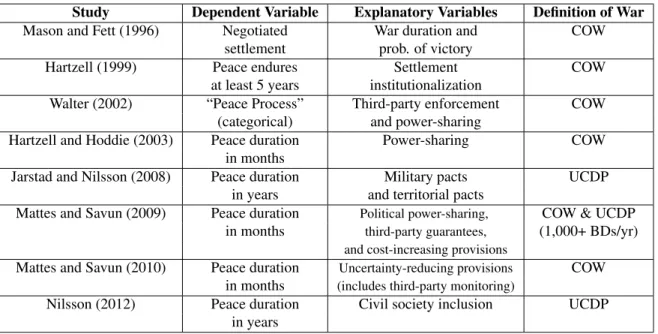
Table 1.1: A Sample of Studies of Civil War Resolution and their Measures of Success
Study Dependent Variable Explanatory Variables Definition of War
Mason and Fett (1996) Negotiated War duration and COW
settlement prob. of victory
Hartzell (1999) Peace endures Settlement COW
at least 5 years institutionalization
Walter (2002) “Peace Process” Third-party enforcement COW
(categorical) and power-sharing
Hartzell and Hoddie (2003) Peace duration Power-sharing COW
in months
Jarstad and Nilsson (2008) Peace duration Military pacts UCDP
in years and territorial pacts
Mattes and Savun (2009) Peace duration Political power-sharing, COW & UCDP in months third-party guarantees, (1,000+ BDs/yr)
and cost-increasing provisions
Mattes and Savun (2010) Peace duration Uncertainty-reducing provisions COW in months (includes third-party monitoring)
Nilsson (2012) Peace duration Civil society inclusion UCDP
in years
is how peace agreements and their contents influence not only the end of war but also the quality of peace. Table 1.1 provides an overview of the definitions of successful resolution as found in a number of prominent studies of civil war resolution. Most of the studies’ dependent variable – successful resolution of civil war – is operationalized as the duration of peace, either in months or in years. As I have stated already, though, these studies are measuring success as the absence of war recurrence, a negative peace. They do not consider the nature of the peace following conflict; in other words, extant work does not consider the quality of peace in their measures of success. Of course, this is not a flaw of existing studies; it is undoubtedly important to understand when and how wars can be ended. On the other hand, it is equally or perhaps more important to understand how peace can be consolidated and a quality peace can be established so as to truly remove countries from the grips of civil war. A pessimist would contend that in most countries recovering from civil war all one can hope for is the avoidance of violence. If that is all one hopes for, however, that is all one gets. Places such as Northern Ireland and South Africa still struggle with the legacies of violent conflict yet they have moved beyond the shadow of conflict to achieve a more inclusive and higher quality peace. These societies and others that are on the trajectory away from civil war demonstrate that the quality of the peace post-conflict is a measure of success worth striving for.
of peace. Moreover, the UN has repeatedly emphasized that the creation of a quality peace will, beyond improving the lives of those within post-conflict societies, reduce the likelihood of violence in the long-run. A United Nations Security Council (2001) Presidential Statement on peacebuilding posits:
The Security Council recognizes that peacebuilding is aimed at preventing the outbreak, the recurrence or the continuation of armed conflict and therefore encompasses a wide range of political, development, humanitarian and human rights programmes and mechanisms. This requires short- and long-term actions tailored to address the particular needs of societies sliding into conflict or emerging from it. These actions should focus on fostering sustain-able development, the eradication of poverty and inequalities, transparent and accountsustain-able governance, the promotion of democracy, respect for human rights and the rule of law and the promotion of a culture of peace and nonviolence (UNSC, 2001).
Policymakers at the international level, then, have recognized the need to address inequalities, generate a respect for human rights, and create institutions that promote “a culture of peace.” Empirical work in political science, however, has been slow to integrate these recommendations. The preponderance of work on civil war resolution focuses on ending violence. This dissertation takes a big step to engage the call of the United Nations by considering how to achieve a quality peace that is socially, politically, and economically inclusive in nature.
(2004), as well, cites political variables as mitigating the risk of conflict recurrence. She finds that higher quality of life and greater access to political participation do decrease the likelihood of civil war recurrence. Additionally, she demonstrates that countries with higher levels of economic well-being and more open political systems are, again, less likely to face civil war recurrence. The need to think beyond the cessation of violence to the ways in which a quality peace can be established and consolidated is thus evident.
Beyond political and economic aspects that influence the quality of post-conflict peace, scholars have also pointed to human rights protections as a key goal in peace processes. Crocker and Hampson (1996) point out that third parties involved in peace processes can and should help to promote new norms and codes of conduct in post-conflict societies. They write that both economic and social reconstruction are essential in pursuit of successful peace processes. Their work provides initial support for the need to look more deeply into the quality of peace, broadly defined, in studies of civil war resolution. Stedman (2001), without using the term quality, gets at the quality of peace issue and confirms the importance of human rights in consolidating a quality peace. He posits: “Two low-cost opportunities that should be pursued during implementation are civilian security, through police and judicial reform, and local capacity-building for human rights and reconciliation” (3). Why, though, are such security and human rights mechanisms important, if not to end conflict? Stedman (2001) continues on to state: “Although the study did not identify a single case where a failure to pursue these opportunities undermined imple-mentation, it found that the potential long-term benefits of security reform and local capacity-building for peace building warrant the relatively inexpensive investments that such measures require” (3). Cer-tain policies are not necessary to end conflict, but they are necessary to bolster the quality of the peace. In sum, peace agreements that are aimed not only at ending war but at strengthening the quality of the peace must include these “extra” policies of human rights, security, and inclusivity, even though they are not in and of themselves necessary to stop the fighting.
Within the past couple of years, an increasing focus within peace research has turned to the quality of peace. Wallensteen (2015) asserts that, in the absence of dignity, a country has not achieved a quality peace, but has only reached a postwar period. The end of violence does not directly translate to the creation of peace. Wallensteen (2015) goes on to write:
and even to measure universally over time and space. But the postwar situation may still be unsatisfactory in other respects... Thus the quality of the relationships is of importance. Equity may mean deliberate redistribution of resources from rich to poor, for the purpose of improving quality of life for the latter... It may serve to reduce ostentatious inequalities in society that otherwise may prompt opposition (16-17).
Wallensteen thus captures the necessity of pushing beyond negative conceptions of peace. Both re-searchers and policymakers must keep in mind the dignity, equity, and security of all people as they seek to achieve settlements to conflict.
Although scholarship is beginning to catch up to calls by the international community to focus on not only peace but quality peaceful outcomes, much more research is needed to better understand the sources of a quality peace. In particular, this dissertation analyzes how peace processes and their content influence the quality of peace. In the next section, I present an overview of the theory. Peace agreements, I argue, are quasi-constitutional documents (Bell, 2006) and as such, they establish the legal framework for the post-conflict state. I thus expect the contents of peace agreements to directly and indirectly shape what peace looks like for those living in post-conflict societies. Beyond ending violence, the contents of peace agreements have tangible effects on what peace looks like for those in post-conflict societies. The policy implications of the theory and findings herein, while complementary to extant works on civil war resolution, are important on their own for they show that actors can increase the likelihood of achieving a quality peace if they pay close attention to the contents and substance of negotiated settlements.
Theory
Thus far, I have addressed what is meant by the quality of peace, why its study is important in moving forward scholarly understanding of civil war resolution, and how extant work has yet to achieve any systematic study of quality peace.9 This section presents the theoretical framework of this dissertation, a framework which identifies peace agreements as instrumental in shaping the quality of peace. First, I further discuss what is meant by the quality of peace and why, in a global sense, a deeper understanding of peace (beyond the cessation of violence) matters for theories of war and peace. Second, I consider the
9
ways in which the quality of peace can be bolstered, and I give specific attention to how peace processes and agreements influence the quality of peace. Whereas countless theories of war exist, a more nuanced theory of peace – specifically, the quality of peace – will generate much new insight into the occurrence and consolidation of peace following civil war.
The establishment of a quality peace represents a move by a formerly war-torn country away from the grips of war. It demonstrates that peace, in a positive sense, is consolidating or consolidated. It represents a deeper goal, one that does not stop at the cessation of violence but pursues opportunity and protection for broad portions of a population. I define the quality of peace as the extent to which the majority of a population enjoys basic political rights as well as the extent to which historically excluded and underrepresented groups such as women and minorities are free from systematic political exclusions in the wake of conflict. Quality peace, then, is taken to be a positive formulation of peace in this framework, to use the words of Galtung (1969). I do not reject the extant notions of civil war resolution success that rest on negative conceptualizations of peace. I do, however, posit that scholars and policymakers must consider a wider, or loftier, definition of peace when considering how best to guide countries away from civil war.
Generating a new definition of conflict resolution success is crucial for longer term solutions to conflict. Civil wars are deadly and violent in a physical sense, but they also wreak havoc on country’s infrastructures, economies, educational resources, political systems, and other basic institutions and opportunity structures. The resolution of wars, then, requires actors to not only end violence but also address the institutional and structural damage of war. War does not end when the violence ends; war ends when society has achieved peace. Little is known about how peace processes can be shaped to generate institutions and structures that bolster the quality of peace. The following discusses the theoretical framework for the study of a quality peace.
Crafting a Quality Peace
political science identifies international peace efforts and actors as highly influential players in con-flict resolution; (2) From a policymaking perspective, identifying pathways through which international actors can bolster the quality of peace is practical and prudent; (3) Peace agreements come in many different shapes and sizes, and this variation is likely to have implications for the nature of peace in the wake of war; and (4) Peace agreements are the most tangible byproduct of the overall formal peace process. Existing works on civil war resolution focus on the ways to end violence at levels associated with war.10 What is less known, though, is how common techniques of civil war resolution influence the nature or quality of post-conflict peace. What can practitioners and peacemakers do throughout the peace process to increase the quality of peace in addition to generating a sustainable negative peace? Do comprehensive peace agreements or power-sharing arrangements, for example, sow the seeds for positive aspects of peace such as human rights protections or political opportunity?
The theoretical focus of this dissertation is thus on one tangible component of peace processes, the peace agreements themselves. I consider how peace agreements can be crafted by international and domestic actors to lay the foundations for a quality peace. Based on existing work, it is unsurprising to state that peace agreements can help disputants overcome the bargaining failures that lead to war and war recurrence. Within this dissertation I assess peace agreements along two main dimensions: gender-specificity and context-specificity.11 Gender-specificity and context-specificity are two avenues through which peace agreements can create a more inclusive, just, and meaningful peace. These two typologies need not be mutually exclusive; indeed, the agreements which lay the strongest foundations for quality peace are likely to be gender-specific and context-specific. Gender-specific agreements con-tain provisions for the protection of women’s rights and/or clauses for gender equality. Context-specific agreements are those agreements that address the main grievances of the disputants. In other words, a context-specific agreement is one that is designed to meet the unique needs of disputants.12 The greater
10
In so doing, the political science literature has identified key determinants of civil war resolution, some short- and some long-term. Ceasefires and third-party mediation efforts, for example, tend to put an end to conflict, at least in a short-term way. Power-sharing arrangements and third-party enforcement, on the other hand, increase the likelihood of a durable end to war. International actors, then, play a clear role in both short- and long-term solutions to violence.
11
This dissertation focuses on these two dimensions, because I argue that they hold the greatest capacity to shape levels of political inclusivity and opportunity following civil war. In future research on quality of peace, scholars may choose to focus on other peace agreement dimensions as are appropriate given their particular focus within quality of peace outcomes.
12An agreement that is inclusive and contextual need not be comprehensive, but comprehensive agreements are more likely
the gender- and context-specificity of peace agreements, the more likely they are to lead actors’ toward higher quality peaceful outcomes.
I address the two aforementioned dimensions of peace agreements in turn in the following sections. I argue that the contents of peace agreements are not only important for putting an end to conflict but they have strong implications for the quality of peace as well. Just as peace agreements render peace more durable when crafted in an appropriate manner, I argue that peace agreements can also be crafted in ways so as to increase the quality of peace in the wake of war. Peace agreements are quasi-constitutional documents that lay the framework or roadmap for the institutions and practices of the post-conflict state (Bell, 2006). In the transformative period that occurs during and after civil war, the legal provisions of the peace agreement have the power to set in motion the transformation of institutions or to reinforce the status quo. If actors and policymakers are striving for higher quality peaceful outcomes, they must take advantage of the opening for change and shape peace agreements accordingly. Peace agreements serve as a type of commitment mechanism, and they incentivize and constrain actors’ behavior in the post-conflict period. I expand upon these mechanisms throughout the chapters of this dissertation.13 When peace agreements include provisions that provide protections for women or address grievances of the disputants, the agreements not only lay the foundation necessary to improve the quality of post-conflict peace but they also tie the hands of signatories and future leaders to higher quality and more inclusive outcomes.
Gender-Specific Peace Agreements
Gender-specific agreements are defined as those peace agreements which make specific references to protections for women in the post-conflict period. Slowly – but increasingly – scholars and policymakers have been shining a spotlight on the role of women in the peace process, either as mediators or political
women’s rights and addresses one of the key grievances of the disputants may be more effective at generating a quality peace than a comprehensive agreement that does none of the above. I have taken time to point this distinction out so as to be clear that my analysis is not restricted to comprehensive agreements; I want to be as inclusive as possible so as to be able to truly assess the variations in agreements and the implications of these variations.
13
actors who help pave the path for peace following civil war. A growing corpus of work identifies gender inequality as being associated with higher likelihoods of violent conflict, at both the inter- and intra-state levels (e.g., Caprioli, 2005). Women’s equality and women’s inclusion in peace processes, then, is more than a moral good but a step that holds tangible implications for decisions of conflict and cooperation. I argue, in this vein, that the inclusion of protections for women’s rights in an agreement is a crucial step in establishing a quality peace. Not only does the inclusion of women’s rights signal some level of commitment to change, but it also opens the door for new actors to become involved and invested in consolidating peace through political, social, and economic means. Because a quality peace is, for purposes of this research, defined as a peace that is politically inclusive and one that protects the rights ofall groupsof the population, it is rather self-evident that a gender-sensitive peace agreement will lead to a higher quality peace.
Why, more specifically, are women’s rights important for a quality peace? Perhaps the more blunt version of this question is simply: why care about women’s rights? In countries torn apart by years of civil war, why should time be spent investing in women’s rights? First, civil wars kill disproportionate numbers of men; women are often needed in post-conflict societies to fill the roles that men formerly held. At the same time, though, women rarely are extended the rights, privileges, or empowerment required to move up in society or to assume roles of political power. In short, it is prudent to extend rights to women so that they may perform more functions outside of the home and be more productive members of society. Second, women have a lot to offer. In places such as Liberia, a women’s peace movement was instrumental in encouraging and shaping the peace process in 2003. Women have the potential to be agents for peace. When war ends, women must be granted equal political, social, and economic rights so that they may continue to exercise their influence. In the case of Liberia, women played an active role in the peace process yet still struggle for political and economic equality, in partic-ular, in the post-conflict period. While the country has a female president, there are still many changes to be made in the search for a higher quality peace.
is still on the long and arduous path out of the conflict trap over a decade later, the society is marked by some dimensions of a quality peace. Women, particularly President Sirleaf, have achieved positions of influence in politics. Elections have proceeded freely and fairly, according to the international commu-nity, in both 2005 and 2011; the 2011 elections were held without direct involvement of international actors, rendering their transparency and legitimacy an ever greater success. While much more needs to be done to provide basic services to Liberians and generate greater economic opportunities, the country does seem to be on the path to a higher quality peace through the more inclusive nature of peace in the wake of the Accra Peace Agreement.
Overall, the gender-specificity of peace agreements is likely to have serious implications for the nature and quality of post-conflict peace. Agreements that address the belligerents’ grievances and provide protections for women’s rights will do more than end violence; they will create a quality peace that is more politically, economically, and socially inclusive. Specifically, I argue that gender-specific peace agreements influence women’s political rights through three mechanisms, one direct and two indirect. Directly, gender-specific peace agreements hold the potential to tie actors’ hands to change. In other words, the gender-specific language of peace agreements directly translates into changes in laws and practices toward women in post-conflict states. The words within the peace agreement render it more difficult for actors to renege on their commitment. Similarly, the provisions within the agreement may make it less politically costly to adopt potentially unpopular changes. As such, gender-specific peace agreements have led to direct and positive improvements in the status of women in countries such as Burundi, where the gender-specific language of the Arusha Peace and Reconciliation Agreement appeared in the country’s post-conflict constitution.
spurring norms shifts, I also argue that gender-specific peace agreements may have positive external-ities in that they empower women and other groups to push for greater inclusion. Because women’s rights appear within an agreement, women’s groups, international observers, or civil society groups will be empowered to hold leaders accountable. Moreover, their voices will be legitimized by the agree-ment’s text. In Liberia, for example, women’s groups were empowered to push for change and hold leaders accountable to the promises that they made within the Accra Peace Agreement. Through the three preceding mechanisms, I expect that women’s rights are more likely to improve following the signing of a gender-specific peace agreement than following an agreement that is devoid of women’s rights.
Context-Specific Agreements
Context-specific agreements are those that include provisions that directly address the grievances of disputants. Peace agreements vary greatly in their character; whereas some follow what seems like a barebones formula to demobilize and separate forces, others go into great detail regarding political, social, economic, and military plans for the post-conflict period. Additionally, settlements vary in the extent to which they reflect the needs and preferences of belligerents, ranging from one-size-fits-all solutions to highly specific plans for resolving the particular conflict. I argue that agreements that address the underlying grievances that contributed to conflict onset will be more successful than those agreements that address few or none of the belligerents’ grievances. By addressing the grievances of belligerents, these agreements will not only be more successful in the traditional sense – in the sense that they reduce the likelihood of war recurrence – but they will also be successful by contributing to a higher quality peace.
they increase the benefits felt by disputants and render reneging a less attractive option. An agreement that, in short, solves the most pressing problems for the warring parties generates benefits for complying and costs to reneging; war becomes a less attractive option.
While grievances evolve over time, I argue that it is crucial that an agreement address the origi-nal causes of conflict. By including provisions that seek to remedy the underlying causes of conflict, peace agreements can minimize the likelihood of commitment problems and reduce the incentives of disputants to renege on the agreement. As such, contextual agreements help overcome commitment problems that plague conflict resolution. Thus, the relationship between contextual agreements and the generation of a negative peace seems quite evident. A settlement that is sensitive to the context of the conflict and the specific grievances of the belligerents, however, is also expected to bolster the quality of peace post-conflict. Such agreements will not only end conflict and stop the violence, but they will also tend to generate a peace that is more inclusive in nature and more sensitive to the rights of various societal groups.
The specific mechanisms linking context-specific agreements to a higher quality peace fall into two main categories: constraints and (dis)incentives. Peace agreements create a web of new political, economic, social, and security structures; by creating a new state apparatus, the agreements greatly limit actors’ behavior and the amount of power any single actor or group can wield. As such, the webs of new institutions created by context-specific peace agreements inhibit continued exclusions or unjust policies, and limit the extent to which actors can deviate from new structures. In Northern Ireland, a society which struggles daily with divisions and legacies of conflict, new institutions laid forth in the Good Friday Agreement have constrained any single group from taking a monopoly of power.
and/or spurring a return to war.
Roadmap
The following study of the quality of peace proceeds with a combination of quantitative chapters and qualitative case illustrations. The next two chapters, Chapters 2 and 3, focus on the question of women’s rights as one key component of quality peace. Specifically, the chapters assess the role that gender-specific peace agreements play in spurring improvements in women’s rights. Chapter 2 further develops the causal mechanisms that lead gender-specific peace agreements to improve women’s rights. The chapter then presents a quantitative analysis of civil war peace agreements that were signed be-tween the years 1981 and 2011 (H¨ogbladh, 2011). The results offer strong support for the hypothesized relationship: peace agreements that include provisions for women’s rights do indeed work. Chapter 3 looks at the cases of Burundi, Liberia, South Africa, and Angola to further assess the plausibility of the causal mechanisms proposed herein. While not intended to be a test of the theory, Chapter 3 reaffirms the links between gender-specific peace agreements and women’s rights improvements and illustrates that the relationship exists through a number of causal pathways, both direct and indirect.
CHAPTER 2
PEACE AGREEMENTS AND WOMEN’S RIGHTS: A QUANTITATIVE ANALYSIS
No society will know peace if it leaves half its population behind. Women’s voices are a
critical part of coming to terms with the past by investing in a shared future that rejects
conflict and promotes dignity. Women have been subjected to rape and sexual violence as
tactics of war. Now we must enlist and empower them as agents of peace.
– John Kerry and William Hague1
Following the resolution of civil wars in countries such as Liberia and Burundi, women became more active members in the political life of their respective states. Liberia elected a female head of state, Ellen Johnson-Sirleaf, to lead it through its post-conflict reconstruction, while in Burundi, women have been guaranteed seats and representation across many dimensions of politics. While the conclusion of civil wars provides a clear opportunity to revise the status quo, such improvements in women’s rights should not be treated as inevitable. What spurred countries such as Liberia and Burundi to take strides toward greater gender equality? Why, on the other hand, were women largely excluded from the post-conflict political apparatus in countries such as Angola? As John Kerry and William Hague note above, societies are not at peace when they exclude fifty percent of the population. Johan Galtung (1969) identifies widespread exclusion, repression, and inequality as forms of structural violence and as societal ills that inhibit the achievement of peace. Peace, he notes, cannot truly take hold when portions of society remain excluded and marginalized. The perpetuation of structural violence and inequality, particularly with respect to gender, reinforces conflict and renders peace more fragile (Caprioli, 2005); the goal of gender equality, then, is more than a normative goal but also one that brings tangible benefits to societies as a whole. With this in mind, this chapter assesses the conditions under which women
1From “Preventing Sexual Violence Is a National Security Imperative,” 25 February 2014. See:
experience greater equality in post-conflict societies. Women’s equality is a key step in in establishing a quality peace and guiding countries on the path away from war.
To gain an understanding of how a quality peace can take hold and how, more specifically, women’s rights might improve, I focus on the role peace agreements play in shaping peace. While much is known about how agreements may be crafted to end violence at levels associated with war, more needs to be done to understand the implications of peace processes for the post-conflict environment. Peace agreements, as quasi-constitutional documents, have the potential to lay the framework for the political, social, and economic structures of the post-conflict period. Do peace agreements, however, actually work beyond ending war? Do they tie actors’ hands to new policies so as to generate a higher quality peace post-conflict? In answering these questions, this chapter considers one component of post-conflict quality of peace: women’s political rights. For the purposes of this chapter, then, I focus on quality peace as the extent to which women experience freedom from discrimination and equal access to political opportunities in the post-conflict environment.2 Women’s political rights are an important dimension of the post-conflict environment, even if only one piece of the puzzle. By extending rights to women, actors in the peace process generate the foundations for a more open, inclusive, and secure post-conflict environment.
In what follows, I first engage extant work on civil war resolution and peace agreements. I highlight that the study of civil war resolution would benefit greatly from a better understanding of how peace processes influence the quality of peace following war. Moreover, I discuss how existing work on gender and conflict has shown that women’s rights are instrumental in creating more peaceful societies. Second, I develop a theoretical framework of peace agreements and argue that they not only tie actors’ hands to change but that they also generate externalities that diffuse into the post-conflict society. In particular, I hypothesize that peace agreements that are gender-sensitive in nature will generate positive outcomes for women’s post-conflict political rights. Rather than scraps of paper, the theory herein argues that the contents of peace agreements shape post-conflict structures. I quantitatively test this expectation using the universe of peace agreements from the UCDP Peace Agreement Dataset (H¨ogbladh, 2011).
2
My findings speak to the ongoing push by the United Nations and others to conduct peace processes in ways that are more inclusive of women. Indeed, peace agreements that contain specific provisions for women’s rights do actually work to generate more inclusive outcomes following conflict. I conclude with a number of extensions of this research as well as policy implications of the paper’s findings.
Civil War Resolution, Quality Peace, and Women’s Empowerment: What We Know
Thus far, little systematic empirical work has been done to explore the sources and foundations of a quality peace. Below, I present an overview of work on civil war settlements, quality of peace, and women and conflict. I highlight that while scholarship has shown that peace agreements and their contents matter for putting an end to war, little is known regarding how peace agreements influence the post-conflict environment.3 I argue that more must be done to bridge the work on civil war settlements and quality of peace indicators such as human rights and women’s rights. It is time to know how the substance of peace agreements shapes the resolution process beyond the cessation of violence. I emphasize the need to better understand the long-term implications of peace processes for the post-conflict environment and women’s post-post-conflict political rights, in particular.
Negotiated Settlements and Negative Peace
The settlement of civil wars is a process wrought by uncertainty and instability. An increasing number of civil wars end through negotiated settlement; nonetheless, negotiated settlements have an inconsistent history as a mechanism for resolving wars. To what extent, then, are peace agreements an important focal point for the resolution of civil wars? I argue that peace agreements can and do lay the foundations for a higher quality peace, and more specifically, I posit that gender provisions within peace agreements create tangible benefits for women’s empowerment following conflict. Indeed, a long history of research on war settlements has suggested that agreements are more than “scraps of paper,” and that “their content affects whether peace lasts or war resumes” (Fortna, 2003, 365). The research on peace agreements has moved from whether or not peace agreements and negotiated settlements work at
3
all to a more nuanced analysis of how they work and what conditions increase their likelihood of success in both the short and long term.4
While past works on civil war resolution focus on success as the end of war, I build upon this research to develop a framework for how peace agreements generate more positive conceptions of peace. A peace agreement works to reduce uncertainty and increase actors’ commitment to peaceful outcomes. I also argue that the content of peace agreements shapes not only the achievement of negative peace but also the extent to which a quality peace takes hold. In the following section, I review current works on quality peace and human rights, more broadly, to understand the role peace agreements might play in influencing these outcomes. The following section identifies political inclusivity and human rights as two key dimensions for the consolidation of peace; moreover, the works discussed in the following section identify the specific legal structures of agreements as one mechanism for facilitating improvements in political and human rights.
Civil Wars and a Quality Peace
Research on civil wars and their resolution, by and large, operationalizes resolution success as the absence of war and/or the duration of peace. These studies, then, measure success as the absence of war, a negative conception of peace. They do not consider, as this dissertation does, the nature of peace or the extent to which the peace that is established is meaningful for those living in post-conflict societies. As I have already stated, this is not a shortcoming or flaw of existing work; understanding the factors that lead to a negative peace is crucial in hopes of ending the death and destruction of civil war. At the same time, however, it is equally important to expend resources on identifying the factors that lead to a quality peace. In other words, research must now focus on how to create peace after the end of war. Post-conflict societies vary dramatically in their treatment of political, economic, and social rights; whereas some have made strides toward more inclusive systems, others remain marked by widespread injustices, inequalities, and structural violence. What accounts for these differences? What mechanisms exist to generate a higher quality peace in the wake of conflict?
4
A number of studies focus on political-institutional mechanisms that influence the longevity and nature of peace following civil war. Call (2012), for example, writes that political exclusion inhibits the consolidation of peace. Inclusion, he argues, can come in any number of forms, but regardless of the form, inclusion is a necessary component to escape the conflict trap. Nilsson and Kovacs (2005) write that political instability and lack of good governance undermine the success of peace in many post-conflict states. Munck and Kumar (1995) identify the inclusiveness of parties to the peace process as a key factor in achieving successful peace outcomes in El Salvador, for example, as opposed to in Cambodia. To achieve truly peaceful civil war resolution, then, countries must move toward greater political inclusivity, stability, and more responsive and responsible governance. In addition to domestic actors and institutions, Crocker and Hampson (1996) argue that international actors involved in peace processes should promote new norms and institutions in post-conflict societies, particularly in the area of human rights.