O R I G I N A L A R T I C L E
Use of Pooled State Administrative Data for Mental Health
Services Research
Kimberly Eaton Hoagwood•Susan Essock•Joseph Morrissey•Anne Libby • Sheila Donahue•Benjamin Druss•Molly Finnerty• Linda Frisman•
Meera Narasimhan•Bradley D. Stein•Jennifer Wisdom •Judy Zerzan
Published online: 13 January 2015
The Author(s) 2015. This article is published with open access at Springerlink.com
Abstract State systems are a rich, albeit challenging, laboratory for policy-relevant services research studies. State mental health authorities routinely devote resources to collect data for state planning and reporting purposes. However, these data are rarely used in cross-state com-parisons to inform state or federal policy development. In 2008, in response to key recommendations from the National Institute of Mental Health (NIMH) Advisory Council’s ‘‘The Road Ahead: Research Partnership to Transform Services,’’ (http://www.nimh.nih.gov/about/ advisory-boards-and-groups/namhc/reports/road-ahead.pdf),
NIMH issued a request for applications (RFA) to support studies on the impact of state policy changes on access, cost, quality and outcomes of care for individuals with mental disorders. The purpose of the RFA was to bridge the divide between research and policy by encouraging research that used state administrative data across states, and to address significant state-defined health policy ini-tiatives. Five projects involving eight states were selected through peer review for funding. Projects began in 2009 and were funded for 3 years. This report provides a brief description of the five projects, followed by an analysis of the impact, challenges, and lessons learned from these K. E. Hoagwood (&)
Department of Child and Adolescent Psychiatry, New York University Langone School of Medicine, New York, USA e-mail: [email protected]
S. Essock
Department of Psychiatry, New York State Psychiatric Institute, Columbia University, New York, USA
J. Morrissey
Cecil G. Sheps Center for Health Services Research, Department of Health Policy and Management, University of North Carolina at Chapel Hill, Chapel Hill, USA
A. Libby
School of Medicine, University of Colorado Health Sciences Center, Denver, USA
S. DonahueM. Finnerty
New York State Office of Mental Health (OMH), Albany, USA
B. Druss
Rollins School of Public Health, Emory University, Atlanta, USA
M. Finnerty
Bureau of Evidence Based Services & Implementation Science, NYS Psychiatric Institute, New York, USA
L. Frisman
School of Social Work, University of Connecticut, Storrs, USA
M. Narasimhan
Department of Neuropsychiatry and Behavioral Sciences, School of Medicine, University of South Carolina, Columbia, USA
B. D. Stein
RAND Corporation, School of Medicine, Pittsburgh, USA
B. D. Stein
School of Medicine, University of Pittsburgh, Pittsburgh, USA
J. Wisdom
Office of the Vice President for Research, George Washington University, Washington, USA
J. Zerzan
Colorado Department of Health Care Policy and Financing, Denver, USA
policy-partnered studies. We conclude by offering sug-gestions on ways to use state administrative data for informing state health policies, which is especially timely given national and state changes in the structure and financing of healthcare.
Keywords StatesMental health PolicySystems State mental health systems routinely collect data for state planning and reporting purposes. All states collect Med-icaid data and utilization data for reimbursement that can be used for quality improvement. States are required to report data for special populations served. Many states collect additional data through other systems such as child welfare, corrections, aging, housing, and education pro-grams. In addition, there are administrative data collected through federal agencies [e.g., Centers for Medicare & Medicaid Services (CMS), Social Security Administration (SSA), Substance Abuse and Mental Health Services Administration (SAMHSA), Centers for Disease Control and Prevention (CDC), and Department of Justice (DOJ)] that are available for analyses. Given the vast amount of data and the cumbersomeness of combining data across these entities, such data may be underutilized in the development and monitoring of mental health policies.
This is unfortunate because state systems are a fertile if challenging laboratory for policy-relevant services research studies. Such studies can test the impact of policy decisions on health services delivery. Using these data to not only
informbut to create a set of evidence-based policies has
immediate, almost intuitive appeal to policy-makers and healthcare decision-makers (Goldman et al.2001).
In the development of public policies about healthcare services, however, research evidence can be secondary to interests such as advocacy, political initiatives, media ste-reotypes, and public opinion (Bowen and Zwi2005; Dobrow et al.2004; Waddell et al.2005). Competing interests are often overlooked in studies examining the use of research evidence by policy-makers (Lomas and Brown2009). Fur-thermore, the question of what kind of evidence or infor-mation policy-makers actually draw upon when making decisions has been largely unaddressed by researchers (Hyde et al. in press; Soydan and Palinkas2014).
State mental health systems face an increasingly uncertain environment in which to develop healthcare policies, as the pressures to regulate and manage mental health services are constrained by tighter budgets, changing federal rules, smaller allocation of funds through block grants, and ambiguities about the implementation of the Patient Protection and Affordability Care Act (ACA), passed in 2010 (Hoagwood et al.2014). State responses to
these changes are highlighting the importance of using data systematically to drive healthcare service delivery and decision-making (Gray 2013; Kazdin 2013; Kazdin and Rabbitt 2013; Kelleher 2010). For example, states are struggling with ways to integrate data across their systems and to identify quality indicators for use in monitoring processes and outcomes of care as part of quality improvement initiatives (Institute of Medicine, Committee on Quality of Health Care in America 2006; Institute of Medicine, Committee on Science, Engineering, and Public Policy, National Academy of Sciences, National Academy of Engineering,2009; Institute of Medicine, Committee on Quality of Health Care in America 2000).
Project Overviews
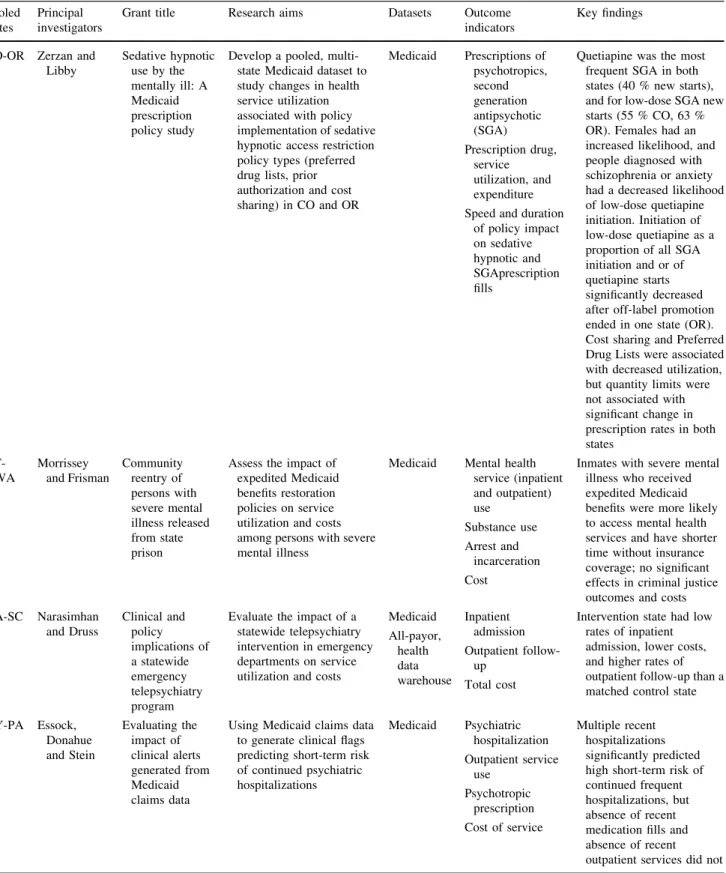
The five projects involved eight states, with comparisons between two states in each project (two projects involved the same two states). Projects began in 2009 and were funded for 3 years; see Table1for a summary of studies, methods, major findings, and impacts. The projects differed in terms of populations targeted, data sets used, degree to which the data could be merged, and type of state policy addressed. All of the projects used Medicaid data; in six states, Medicaid data were accessed directly, whereas in SC and WA, databases were used that included Medicaid data. Medicaid data are available in all states and they allow examination of service use across time, providers, and service modalities in ways that would be difficult to determine from other data sources.
CO-OR
Libby and Zerzan used Colorado and Oregon Medicaid claims data to measure the extent to which Medicaid pre-scription drug policies reduced the use of newer sedative hypnotics and increased the unintended use of low-dose second generation atypical antipsychotics (SGA) as possi-ble sedative substitutes. This was an important issue because low-dose antipsychotics may be used off-label (i.e., for other than a Food and Drug Agency (FDA) indi-cation) despite more frequent side effects, compared to other drugs used for insomnia. Using a retrospective, quasi-experimental, difference-in-differences design, the study measured baseline trends, and isolated policy impacts on sedative hypnotic utilization across states and over time for patient subpopulations. The study rationale came from discussions with states participating in the Drug Utilization Review Project (DURP), who expressed concern about the use of sedatives for people with mental illness, and inap-propriate use of anti-psychotics for insomnia. Both Colo-rado and Oregon manage prescription drug coverage using preferred drug lists (PDL). PDLs are like managed for-mularies in that a committee assesses evidence and advises Medicaid on the medications that should be made available for current practice, based on evidence, FDA indication, and costs. Unlike private health plans with managed for-mularies, Medicaid cannot have a formulary with discrete limitations on access to medications. Medicaid PDLs list medications to be used first within a drug class (i.e., first-line therapy) with no restrictions on prescription drug coverage. PDLs use policies to influence prescription drug use such as requiring a prescriber to obtain prior authori-zation, or to prescribe in limited quantities, and patient-targeted PDL policies such as cost-sharing (higher co-payments for non-preferred drugs).
Methods
Three distinct Medicaid policies were implemented from 2002 to 2009 on sedative hypnotics: patient cost-sharing, prescriber quantity refill limits, and preferred drug list status/prescriber prior authorization. Retrospective cohorts were created for patients with serious and less severe diagnosed mental illness who met inclusion criteria. Medicaid prescription drug fill claims and eligibility rates by age group and year were acquired for analysis using multivariate methods and time series with segmented regression. Second generation antipsychotics were mea-sured in both states with particular attention to low-dose quetiapine because of its off-label use as a sleep aid. Key Findings
CO and OR baseline rates of psychotropic medication use were substantially different, perhaps because of less-restrictive access policies and attitudes about mental health treatment in OR. Nearly two-thirds of quetiapine use fell below recommended dosing levels, suggesting off-label use for insomnia. Trends in OR suggested reduction in low-dose use after policies were implemented to curb use of antipsychotics for insomnia. Time series analyses of three alternative access restriction policies using segmented regression (unpublished study) found cost-sharing and prior authorization were associated with significant chan-ges in aggregate utilization. Quantity limits alone were not associated with reduced prescription use of newer sedative hypnotics (Campbell et al. 2013; Hartung et al. 2012, 2014).
Policy Impact
Colorado used this information in refining its PDL and prior authorization policies, and to identify drug classes in which drug utilization review could be helpful to pre-scribers and clients. Oregon also used this information to refine its policies around sedative-hypnotics and antipsy-chotics, and to identify areas in need of further evaluation. The finding of wide variation in prescribing across these two states has led both states to further investigate potential causes of variation (Zerzan et al. 2011).
GA-SC
Table 1 Summary of NIMH R01 grants funded under RFA-MH-09-050 ‘‘Use of Pooled State Administrative Data for Policy Relevant Mental Health Services Research’’
Pooled states
Principal investigators
Grant title Research aims Datasets Outcome indicators
Key findings
CO-OR Zerzan and Libby
Sedative hypnotic use by the mentally ill: A Medicaid prescription policy study
Develop a pooled, multi-state Medicaid dataset to study changes in health service utilization associated with policy implementation of sedative hypnotic access restriction policy types (preferred drug lists, prior authorization and cost sharing) in CO and OR
Medicaid Prescriptions of psychotropics, second generation antipsychotic (SGA) Prescription drug, service utilization, and expenditure Speed and duration
of policy impact on sedative hypnotic and SGAprescription fills
Quetiapine was the most frequent SGA in both states (40 % new starts), and for low-dose SGA new starts (55 % CO, 63 % OR). Females had an increased likelihood, and people diagnosed with schizophrenia or anxiety had a decreased likelihood of low-dose quetiapine initiation. Initiation of low-dose quetiapine as a proportion of all SGA initiation and or of quetiapine starts significantly decreased after off-label promotion ended in one state (OR). Cost sharing and Preferred Drug Lists were associated with decreased utilization, but quantity limits were not associated with significant change in prescription rates in both states CT-WA Morrissey and Frisman Community reentry of persons with severe mental illness released from state prison
Assess the impact of expedited Medicaid benefits restoration policies on service utilization and costs among persons with severe mental illness
Medicaid Mental health service (inpatient and outpatient) use Substance use Arrest and incarceration Cost
Inmates with severe mental illness who received expedited Medicaid benefits were more likely to access mental health services and have shorter time without insurance coverage; no significant effects in criminal justice outcomes and costs GA-SC Narasimhan and Druss Clinical and policy implications of a statewide emergency telepsychiatry program
Evaluate the impact of a statewide telepsychiatry intervention in emergency departments on service utilization and costs
Medicaid All-payor, health data warehouse Inpatient admission Outpatient follow-up Total cost
Intervention state had low rates of inpatient admission, lower costs, and higher rates of outpatient follow-up than a matched control state
NY-PA Essock, Donahue and Stein Evaluating the impact of clinical alerts generated from Medicaid claims data
Using Medicaid claims data to generate clinical flags predicting short-term risk of continued psychiatric hospitalizations Medicaid Psychiatric hospitalization Outpatient service use Psychotropic prescription Cost of service
shortage of psychiatric providers and also access to care in rural counties
Methods
Individuals treated via telepsychiatry were matched to individuals treated for mental health diagnoses in non-participating hospitals within South Carolina. Regression models were used to assess differences in outpatient follow up, admission following the emergency department (ED) visit, length of stay, inpatient, and total costs.
Key Findings
As compared with the control group, the telepsychiatry group was more likely to have successful outpatient mental health follow-up, lower odds of admission and length of stay for the index visit, and lower 30-day inpatient costs than the matched controls.
Policy Impact
The findings of improved access enabled the state to make a strong business case for expansion of telepsychiatry. Blue Cross and Blue Shield of South Carolina became champi-ons in leading the way to reimburse telehealth because it would increase access to specialty care for its members. Sustainability efforts are underway.
NY-PA: Data from Adults
Essock, Donahue, and Stein studied the feasibility and impact of clinical flags developed within Medicaid claims data for New York and Pennsylvania to predict the risk of psychiatric hospitalizations for adults with severe mental
illnesses. The purpose of this study was to test the devel-opment of claims-based performance measures that could be built into future contracts for managed care to incen-tivize the engagement of persons in services post-hospi-talization, to prevent rapid re-hospitalizations, and to target alternative, less- intensive and less-costly services for state implementation. The study tested how well pat-terns of service use predicted subsequent high short-term risk of continued psychiatric hospitalizations.
Methods
Medicaid claims files were used to identify Medicaid recipients, aged 18–64, with two or more inpatient psychi-atric admissions during a target year ending March 31, 2009. Definitions from a quality-improvement initiative were used to identify patterns of inpatient and outpatient service use and prescription fills suggestive of clinical concerns. Gen-eralized estimating equations and Markov models were applied to examine claims through March 2011.
Key Findings
Analyses demonstrated that claims data on prior psychiat-ric hospitalizations can identify Medicaid-enrollees disen-gaged from treatment (Smith et al. 2014; populations at higher risk of not re-engaging in treatment (Smith et al. 2014), and populations at unusual risk of continued fre-quent hospitalizations (Stein et al. 2014a, b). Further, as few as 4 months of recent claims data are sufficient for this purpose. Multiple recent hospitalizations, but not failure to use outpatient services nor failure to fill medication pre-scriptions, were significant predictors of high risk of con-tinued frequent hospitalizations, with odds ratios greater than 4.0 (Stein et al.2014b).
Table 1continued
Pooled states
Principal investigators
Grant title Research aims Datasets Outcome indicators
Key findings
NY-PA Wisdom, Hoagwood, Finnerty and Stein
Quality improvement implementation in child mental health: A 2-state comparison
Evaluate the impact of a statewide continuous quality improvement initiative for psychotropic polypharmacy and the effects of prior authorization policies on antipsychotics
psychotropic prescription among children and adolescents
Medicaid Area
Resource File
Psychotropic polypharmacy Antipsychotics
prescription
Policy Impact
New York State now routinely uses administrative data to identify individuals at high risk of continued frequent hospitalizations. The NY and PA findings suggested that utilizing recent service use data to identify individuals most in need of services helps to break the cycle of continuing rapid psychiatric readmissions. The NY and PA findings also led to the development and testing of algorithms to avoid determining service eligibility based solely on past service use.
NY-PA: Data from Children and Youth
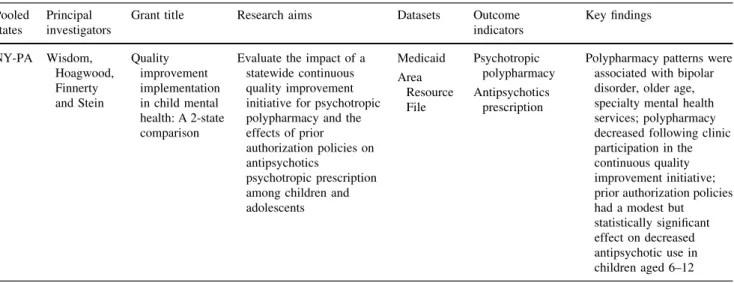
Wisdom, Hoagwood, Finnerty, and Stein examined the impact of state-level interventions to improve the quality of psychotropic medication prescribing among publically insured children in NY and in PA. The significant increase in the use of psychotropic medication among children, including increased use of antipsychotics and multiple concurrent medications, raised quality concerns for both states (Essock et al. 2009; Medicaid Medical Directors Learning Network2010; Kealey et al.2014). NY engaged mental health clinics in a health information technology (HIT) supported (PSYCKES-Medicaid) continuous quality improvement (CQI) initiative to facilitate reduction of psychotropic polypharmacy among children, and PA introduced a prior authorization policy for the use of antipsychotic medications in children.
Methods
The CQI intervention study identified children who received mental health clinic services in New York between 2006 and 2011 and used joinpoint regression analyses to model trends in polypharmacy use among children in CQI participating versus non-participating clinics (Wisdom et al.2012). The prior authorization study examined the effect of the prior authorization policy on the proportion of Medicaid-enrolled children on antipsychotic medications in PA using a triple-difference strategy including differences between PA and NY, where there was no prior authorization policy; time periods (before and after the introduction of the prior authorization policy in PA), and differences in antidepressant prescribing rates over the same time periods (to control for secular trends in psychotropic prescribing) (Stein et al.2014a).
Key Findings
In NY, a significant shift in polypharmacy trends occurred in the year following the CQI project launch with a sig-nificant decrease in use of psychotropic polypharmacy
among children in participating clinics, while children in non-participating clinics had a significant increase in use of polypharmacy over the study period. In the prior authori-zation study, policies were associated with a small but significant reduction in antipsychotic prescribing for chil-dren 6–12, but had no impact among 0–5 year olds.
Policy Impact
The results of the CQI study suggest that mental health clinics can be successfully engaged in a large scale, HIT-supported quality collaborative and change prescribing practices for children. These findings, along with similar results for adults, supported the continuation and expansion of the HIT CQI program in NY to other quality measures and settings. Further, this approach has been expanded to other states through an Agency for Healthcare Research and Quality funded multi-state quality collaborative (Finnerty et al.2014). The prior authorization study high-lighted that this commonly-used pharmacy benefit man-agement strategy may not work for all populations and medications.
WA-CT
Morrissey and Frisman examined expedited Medicaid benefits programs in Washington State and Connecticut for released prisoners with severe mental illness. Both states had developed initiatives to improve mental health out-comes and reduce recidivism among released prisoners with severe mental illness. The goal of the study was to assess the impact of expediting benefits on post-prison Medicaid access and uptake, hospitalizations, use of out-patient mental health and substance abuse services, crimi-nal recidivism (re-arrests, jail days, prison incarcerations), and costs.
Methods
Key Findings
In both WA and CT, expedited Medicaid was associated with a greater probability of accessing Medicaid, and quicker Medicaid access after prison release. In addition, expedited Medicaid was associated with a greater proba-bility of accessing mental health services, and quicker access to mental health and medical services. However, there was no effect on criminal justice outcomes as more than 50 % of participants in both groups had at least one re-arrest in the 12 months following index release.
Policy Impact
Findings suggest that Medicaid improves mental health service use, but alone, might not be enough to keep pris-oners with severe mental illness out of the criminal justice system. Nationally, the implications for the expansion of the Affordable Care Act to justice-involved populations is that simply adding offenders to the Medicaid roles may not be enough to reduce their criminal recidivism. The project also shaped both policy and new research at the state-level, especially in Connecticut, where the state found support for arranging Medicaid benefits for mentally ill prisoners prior to their release, which meant that the program has been sustained. Further, the project demonstrated to stakeholders the value of interagency data mining, supported the expansion of services beyond Medicaid for transitioning prisoners, and facilitated new studies using interagency data.
Discussion
These projects are examples of the yield that can be expected when state policy leadership and services researchers bring their expertise to bear on policy-relevant questions. Given the profound shifts in state mental health policies as more and more states move to managed care (National Association of State Mental Health Program Directors Research Institute, Inc. 2012), and the restruc-turing occasioned by healthcare reform, such partnerships will be even more useful for informing state planning and policy making.
These projects were structured as academic-policy partnerships and incorporated ongoing collaborations, fre-quent communications, and delineation of responsibilities, roles, and partnered decision-making. These partnerships allowed the academic partner to become expert in the complexities, opportunities, and shortcomings of state data files, and the state partner to have the benefit of working with researchers to support development of data-driven policymaking. Having opportunities to feed findings back
to stakeholders, to assess hypotheses and interpretations, and to stay abreast of emerging initiatives, fostered engagement between policymakers and researchers and helped ensure that the approaches undertaken would yield findings relevant to that state.
The authors of this paper identified a set of important issues that arose at the system interface of these studies involving state policy and academic research. The issues described below are simultaneously methodologic, administrative, and substantive. We outline these below as a guide for future policy-relevant studies using state administrative data.
Data Quality
All of the studies used state Medicaid data. As these data are collected for administrative rather than research pur-poses, researchers had to develop a comfort level in working with information where, often, only approximate answers can be arrived at, even with regard to pressing policy issues. The usability of Medicaid data for policy research varies by state, and researchers need to be aware of the quality of the individual state data they are working with (Byrd and Dodd 2012,2013). In addition, Medicaid and other claims data are imperfect in that they provide limited information from which to make inferences about the content or quality of services, results of tests, or out-comes of services; in addition, the diagnostic information is generated from routine clinical and billing practices, not research diagnostic interviews. Medicaid claims data reflect service use, not need. In many states, the department of mental health receives information on service use (numerator), but not on the total population of users and non-users (needed for a denominator), hence measures of penetration (e.g., percentage of youth with a mental health visit) can’t be computed.
approaches to state policy research, see Duan et al. 2014 and Palinkas et al.2013).
These experiences speak to the value of including state partners with intimate knowledge not only of state pro-grams but the individual state administrative data files relevant to the study to ensure feasibility and validity of methods. Some projects here incorporated such state data analysts from the outset. The grant projects allowed researchers to become more familiar with individual state databases, and laid the groundwork for future studies and public-academic partnerships.
Because of the variability, state-to-state, in the gener-osity of Medicaid mental health benefits and regional variation in treatment patterns, generalizability of the findings from any of the state projects to all other states would be problematic. There are also, of course, significant variations in the demographic make-up of the populations across states. Thus, the findings from any of these studies may be applicable to a select number of other states that could be matched on demographic patterns, financing, generosity of benefits, etc. In the selection of state pairings, all investigative teams sought to make meaningful con-trasts so that the findings could be applicable to other states. For example, some pairings (e.g., NY and PA) were selected to contrast states with similar coverage. Strategic consideration of the characteristics of the Medicaid benefit package and of state differences needs to be made prior to extrapolation of any of these findings.
Data Access and Linkage
Multi-system data linkage is easy to envision and difficult to implement. Accessing state data and linking Medicaid data with other state administrative data, or across state Medicaid programs, requires a significant investment of time for both the academic and state partners. Consistent with other reports (Finnerty et al.2014), in some states, it took university-based investigators half of the 3-year study timetable to develop acceptable data use agreements with state agencies and their contracted data vendors (some-times separately) to link files with Medicaid claims. In one state, researchers found that key variables, such as eligi-bility, were not available at the individual level, and that race/ethnicity or cross-system involvement were typically not reported, with the net result that the interagency data was of limited use. States or the federal government could ameliorate this situation by creating the equivalent of advance directives granting academic partners access to such data in an accelerated way when the data will be used for the state’s quality improvement purposes. Further, states need to develop their capacity to track and study populations via administrative data (e.g., from death records, criminal justice, education) in addition to
Medicaid so that, when linked to claims data, the com-posite data will enhance the generalizability and policy relevance of study findings.
Investigators had a much easier time in data access and linkage in states where there were data warehouses, or where there were already-established relationships for multi-agency studies. In Washington State, investigators benefitted from access to a pre-existing data warehouse, maintained by the state, that linked Medicaid claims with a variety of other behavioral health and criminal justice data systems. In Connecticut, these same data were assembled through data use agreements negotiated by the principal investigator, who was the long-term director of research for the state behavioral health agency and an active participant in an interagency data sharing network for multiple prior research studies. In the South Carolina project, investiga-tors were able to use an all-payor dataset as well as Med-icaid data.
The take-away message about data access and linkage is that states maintaining data warehouses and those with established university-agency collaborations are better positioned to conduct research using administrative data. States that have invested their own resources in developing university partnerships and data linkages across public sector agencies to support evidence-based management decisions are much better positioned to participate effec-tively in this type of policy research. Researchers interested in establishing new public-academic partnerships should plan for dedicated time to establish these data sharing agreements and protocols. One benefit of grant-funded public academic partnerships is that once established, data access protocols are easier to expand and sustain, building a foundation for future work (Finnerty et al.2014).
Institutional Review Boards (IRB)
The inevitable consequence of attempting to link multi-agency data is that human subject approvals have to be obtained from multiple agency and university IRBs. Ambiguity as to whether the studies were quality improvement or research led to significant (i.e., up to 1 year) IRB approval delays for some groups.
staff changes in some states also led to interruptions in the work.
Parallel Versus Pooled Analyses
Most of the projects had proposed combining the data from the two comparison states to conduct a pooled analysis, while others proposed parallel analyses from the outset. The pooling of data across states can be cumbersome in the absence of prior experiences with Medicaid and agency coding, defining key parameters (service episodes, eligi-bility, etc.) consistently in each state, and employing common algorithms to identify comparable samples. Dur-ing study implementation, however, some state agencies did not approve providing de-identified data to other states for this purpose. As a result, some projects had to construct parallel databases and then conduct separate, parallel analyses. The two approaches—pooling the data or pooling the findings—can lead to equivalent results as long as there is careful alignment and specification of data elements, codes, definitions, and other parameters. An advantage of data pooling is a bump-up in statistical power, which might be important in studies analyzing low-frequency events or small samples. When agency policies prevent combining data across states, or when such pooling would greatly increase the cost and complexity of the task at hand, pooling based upon separate, parallel analyses may be the best and, perhaps only, recourse. In addition, given the large variation observed within and between states, and the challenges in using data across state systems, single state studies should be considered.
Political Context
State systems are by nature embedded in an operating environment heavily influenced by day-to-day political realities. Change is not only ongoing, but also typically driven by the dominant political culture of the time. Ten-sions can arise between the pressures of maintaining sci-entific rigor and meeting the demands of peer review versus the necessity of responding to new policy pressures or initiatives that might divert studies from intended aims. These tensions reflect the different epistemologies and cultures of science versus governing and policy-making. The differing perspectives are an inevitable part of the reality of this kind of academic-policy research partnership. Even so, conducting rigorous research within a political environment can be facilitated by clear communication and understanding between state and academic partners as to where compromises can and cannot be made on both sides. It requires translation and back-translation between those crafting policy, and those pursuing data-driven answers. Tensions may arise when policymakers need to make quick
policy decisions, yet researchers realize that study findings are still emerging and that early findings may not pan out, hence not ready to guide implementation. Policymakers may feel that even preliminary findings offer them more information than they usually have available to inform their decisions. Researchers on the other hand, trained not to draw conclusions early and to look to peer-reviewed publication and confirming studies to increase confidence in conclu-sions, may feel very uncomfortable sharing preliminary findings or having states act upon them. CQI is a framework that may bridge state and research cultures, and lead to a shared recognition that some questions cannot be answered at all, many are not answered quickly, and that continuous evaluation and review is needed to assess, in real-time, the impact of quality improvement efforts. Frank, open, and honest conversations among the partners about these dif-ferent pressures help create strong partnerships and high-impact findings focused on state policy priorities.
Cui Bono?
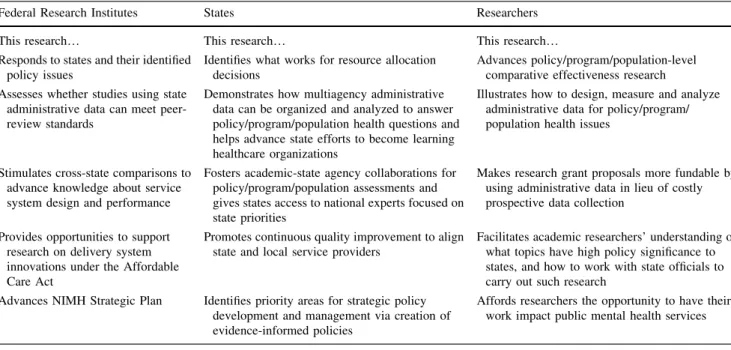
It is appropriate in concluding this brief report to pose the question as to who benefits from this type of research. We believe that there are multiple benefits for different stake-holders from state policy research using administrative data. Benefits accrue to the host states, to researchers committed to developing an evidence-base that can be used to enhance the health of people with severe mental illness or serious emo-tional/behavioral disorders, and even to the funding agency (in this case, NIMH) for being able to demonstrate its utility in informing state mental health policy (See Table2). Although the five projects profiled in this report focused primarily on state-level policy issues, state administrative data can also be used at the client, clinician, and program level to inform clinical decision making and quality improvement (Finnerty et al.2011; PSYCKES-Medicaid2014) or compare outcomes of treatment interventions at the program level (Morrissey et al.2013), or at the population level to identify needs and disparities, determine access, and target interventions to address the needs of distinct populations in the mental health and broader health and human services arena.
States, in turn, benefit from supported research done collaboratively with university-based research teams on topics salient to the state mental health authorities and other agency stakeholders. These studies demonstrate how data that states collect for their own administrative and reimbursement purposes can also be used in a rigorous scientific manner to answer questions about what works, for whom, and under what circumstances. Academic part-nerships can give states access to national experts focused on questions that are a high priority for states. Importantly, funding for this type of research fosters academic-state agency collaborations that build state capacity to use their data to conduct policy research, help advance state efforts to become learning healthcare organizations, and facilitate growth of a new generation of services research that will be stimulated by the Affordable Care Act.
Lastly, researchers and the field of mental health ser-vices and policy research also benefit in important ways. Studies using state administrative data will increasingly become necessary, given declining budgets for services research at the federal level, and reduction of funding for prospective studies of service interventions such as those conducted in the clinical trials tradition. This research provides opportunities for researchers to apply the latest developments in theory and methods with big data sets to answer important questions with immediate relevance to helping people with severe mental illness live more pro-ductive lives in their community. In addition, researchers who demonstrate expertise in using state administrative data to answer important questions at the program, popu-lation, or policy levels will be much more likely to succeed
in the increasingly demanding world of competitive research grant funding.
Conclusion
The use of state administrative data for generating evidence about public policy issues is both scientifically and ethically valuable. Our combined experiences in developing and maintaining these state-academic partnerships demonstrate that the research-policy-practice gaps that exist can be bridged. We identified five issues that may arise when conducting such studies. The challenges can be significant, yet the yield from this kind of partnered research can have immediate public health benefits. There is also an ethical responsibility to benefit the public by facilitating access to data generated with public dollars, using these data to improve the quality of services for children and adults with mental disorders, and applying the highest-quality scientific methods to ensure accuracy and validity in the interpreta-tions of analyses. States, in collaboration with academic partners, create a fertile laboratory for such work.
Open Access This article is distributed under the terms of the Creative Commons Attribution License which permits any use, dis-tribution, and reproduction in any medium, provided the original author(s) and the source are credited.
References
Bowen, S., & Zwi, A. B. (2005). Pathways to ‘‘evidence-informed’’ policy and practice: A framework for action. PLoS Medicine, 2(7), e166.
Table 2 Who benefits from use of state administrative data in Policy/Program/Population Health Research?
Federal Research Institutes States Researchers
This research… This research… This research…
Responds to states and their identified policy issues
Identifies what works for resource allocation decisions
Advances policy/program/population-level comparative effectiveness research Assesses whether studies using state
administrative data can meet peer-review standards
Demonstrates how multiagency administrative data can be organized and analyzed to answer policy/program/population health questions and helps advance state efforts to become learning healthcare organizations
Illustrates how to design, measure and analyze administrative data for policy/program/ population health issues
Stimulates cross-state comparisons to advance knowledge about service system design and performance
Fosters academic-state agency collaborations for policy/program/population assessments and gives states access to national experts focused on state priorities
Makes research grant proposals more fundable by using administrative data in lieu of costly prospective data collection
Provides opportunities to support research on delivery system innovations under the Affordable Care Act
Promotes continuous quality improvement to align state and local service providers
Facilitates academic researchers’ understanding of what topics have high policy significance to states, and how to work with state officials to carry out such research
Advances NIMH Strategic Plan Identifies priority areas for strategic policy development and management via creation of evidence-informed policies
Byrd, V. L. H., & Dodd, A. H. (2012). Assessing the usability of encounter data for enrollees in comprehensive managed care across MAX 2007–2009.MAX Medicaid Policy Brief15.http:// www.cms.gov/Research-Statistics-Data-and-Systems/Computer-Data-and-Systems/MedicaidDataSourcesGenInfo/Downloads/ MAX_IB_15_AssessingUsability.pdf.
Byrd, V. L. H. & Dodd, A. H. (2013). Assessing the usability of MAX 2008 encounter data for comprehensive managed care.Medicare and Medicaid Research Review.3(1):E1–E18.
Campbell, J. D., Zerzan, J., & Garrison, L. P, Jr. (2013). Libby AM (2013). Comparative-effectiveness research to aid population decision making by relating clinical outcomes and quality-adjusted life years. Clinical Therapeutics, 35(4), 364–370. doi:10.1016/j.clinthera.2013.02.011.Epub.
Dobrow, M. J., Goel, V., & Upshur, R. E. (2004). Evidence-based health policy: context and utilization.Social Science Medicine, 58(1), 207–217.
Duan, N., Bhaumik, D. K., Palinkas, L. A., Hoagwood, K. (2014). Optimal Design and Purposeful Sampling: Complementary Methodologies for Implementation Research. Administration and Policy in Mental Health. doi:10.1007/s10488-014-0596-7. Essock, S. M., Covell, N. H., Leckman-Westin, E., Lieberman, J.,
Sederer, L., Kealey, E., et al. (2009). Identifying clinically questionable psychotropic prescribing practices and their prev-alence among Medicaid recipients in New York State. Psychi-atric Services, 60, 1595–1602.
Finnerty, M., Kealey, E., Leckman-Westin, E., Gupta, N., White, T., Engel, G., & Opler, L. (2011). Long-term impact of web-based tools, leadership feedback, and policies on inpatient antipsy-chotic polypharmacy.Psychiatric Services, 62(10), 1124–1126. Finnerty, M., Neese-Todd, S., Bilder, S., Olfson, M., & Crystal, S. (2014). MEDNET: A multi-state policymaker/researcher collab-oration to improve prescribing practices.Psychiatric Services, 65(11), 1297–1299.
Goldman, H. H., Ganju, V., Drake, R. E., Gorman, P., Hogan, M., Hyde, P. S., & Morgan, O. (2001). Policy implications for implementing evidence-based practices. Psychiatric Services, 52(12), 1591–1597.
Gray, J. A. M. (2013). The shift to personalized and population medicine.The Lancet, 382(9888), 200–201.
Hartung, D. M., Zerzan, J., Morden, N. E., Yamashita, T., Tong, S., & Libby, A. M. (2012). Characteristics and trends of low-dose second-generation antipsychotic use in two state Medicaid programs.Pharmacoepidemiology Drug Safety, 21(Special Issue 3), 189.
Hartung, D. M., Zerzan, J., Yamashita, T., Tong, S., Morden, N. E., & Libby, A. M. (2014). Characteristics and trends of low-dose quetiapine use in two western state Medicaid programs. Phar-macoepidemiology Drug Safety,23(1): 87–94. doi:10.1002/pds. 3538.
Hoagwood, K. E., Olin, S. S., Horwitz, S., McKay, M., Cleek, A., Gleacher, A., …Hogan M. (2014). Scaling up evidence-based practices for children and families in New York State: toward evidence-based policies on implementation for state mental health systems. Journal of Clinical Child and Adolescent Psychology,43(2): 145–57.
Hyde, J. K., Mackie, T. I., & Palinkas, L. et al. (in press). Evidence use in mental health policy making for children in foster care. Administration and Policy in Mental Health and Mental Health Services Research.
Institute of Medicine, Committee on Quality of Health Care in America. (2000). In L. T. Kohn, J. M. Corrigan, & M. S. Donaldson (Eds.),To err is human: Building a safer health system. Washington, DC: National Academies Press.
Institute of Medicine, Committee on Quality of Health Care in America. (2006).Improving the quality of health care for mental
and substance-use conditions: Quality chasm series. Washing-ton, DC: National Academies Press.
Institute of Medicine, Committee on Science, Engineering, and Public Policy, National Academy of Sciences, National Academy of Engineering. (2009).On being a scientist: A guide to responsible conduct in research (3rd edn). Washington, DC: National Academies Press.
Kazdin, A. E. (2013). Evidence-based treatment and usual care: cautions and qualifications.JAMA Psychiatry, 70(7), 666–667. Kazdin, A. E., & Rabbitt, S. (2013). Novel models for delivering
mental health services and reducing the burdens of mental illness.Clinical Psychological Science, 1, 170–191.
Kealey, E., Hudson Scholle, S., Byron, S. C., Hoagwood, K., Leckman-Westin, E., Kelleher, K., & Finnerty, M. (2014). Quality concerns in antipsychotic prescribing for youth: A review of treatment guidelines. Academic Pediatrics, 14(5), S68–S75.
Kelleher, K. (2010). Organizational capacity to deliver effective treatments for children and adolescents. Administration and Policy in Mental Health, 37(1–2), 89–94.
Lomas, J., & Brown, A. D. (2009). Research and advice giving: A functional view of evidence-informed policy advice in a Canadian Ministry of Health.Milbank Quarterly, 87, 903–926. Medicaid Medical Directors Learning Network (MMDLN) and
Rutgers Center for Education and Research on Mental Health Therapeutics Publication Committee: Foti, M. E., Harper, G., Moon, R., Oestreich, G., Snow, R., Thompson, J., Finnerty, M., Freeman, E., Knapp, P., Muse, N. J., Parks, J., Crystal, S., Gerhard, T., Wilson, N. Antipsychotic Medication Use in Medicaid Children and Adolescents: Report and Resource Guide from a 16-State Study. New Brunswick NJ, Rutgers Institute for Health, Health Care Policy and Aging Research, Center for Education and Research on Therapeutics, July 2010.http://rci. rutgers.edu/*cseap/MMDLNAPKIDS/Antipsychotic_Use_in_ Medicaid_Children_Report_and_Resource_Guide_Final.pdf. Morrissey, J. P., Domino, M. E., & Cuddeback, G. S. (2013).
Assessing the effectiveness of recovery-oriented ACT in reduc-ing state psychiatric hospital use.Psychiatric Services, 64(4), 303–311.
National Association of State Mental Health Program Directors Research Institute, Inc. (2012). The impact of the state fiscal crisis on state mental health systems: Winter 2011–2012 update. Available athttp://media.wix.com/ugd/186708_c2fd199b2a9f4d 04818b889b93c3a884.pdf.
Palinkas, L. A., Horwitz, S. M., Green, C. A., Wisdom, J. P., Duan, N. & Hoagwood, K. (2013). Purposeful sampling for qualitative data collection and analysis in mixed method implementation research.Administration and Policy in Mental Health. doi:10. 1007/s10488-013-0528-y. Epub ahead of print.
PSYCKES Medicaid. (2014). Retrieved August 1, 2014 fromhttp:// www.omh.ny.gov/omhweb/psyckes_medicaid/.
Smith, T. E., Appel, A., Donahue, S. A., Essock, S. M., Thomann-Howe, D., Karpati, A., et al. (2014a). Determining engagement in services for high-need individuals with serious mental illness. Administration and Policy in Mental Health and Mental Health Services Research., 41(5), 588–597.
Smith, T. E., Stein, B. D., Donahue, S. A., Sorbero, M., Karpati, A., Marsik, T., et al. (2014b). Re-engagement of high need individuals with serious mental illness following discontinuation of services.Psychiatric Services, 65(11), 1378–1380.
Soydan, H., & Palinkas, L. A. (2014).Evidence-based practice in social work: Development of a new professional culture. New York: Routledge.
medications: Evidence from two Mid-Atlantic States.Journal of Child and Adolescent Psychopharmacology, 24(7), 374–381. Stein, B. D., Pangilinan, M., Sorbero, M. J., Marcus, S. M., Donahue,
S. A., Xu, Y., et al. (2014b). Using claims data to generate clinical flags predicting short-term risk of continued psychiatric hospitalizations.Psychiatric Services, 65(11), 1341–1346. Waddell, C., Lomas, J., Lavis, J., Abelson, J., Shepherd, C. A., &
Bird-Gayson, T. (2005). Joining the conversation: newspaper journalists’ views on working with researchers. Healthcare Policy, 1(1), 123–139.
Wisdom, J. P., Leckman-Westin, E., Chor, K. A. B., Shen, S., Chen, Q., Stein, B., Olfson, M., Finnerty, M., & Hoagwood, K. (2012).
Psychiatric polypharmacy among children: Impact of a quality improvement initiative. American Academy of Child and Adolescent Psychiatry, 59th Annual Conference, New Research, Poster May 26, 2012. Retrieved June 19, 2014 https://aacap. confex.com/aacap/2012/webprogram/Session9160.html. Zerzan, J. T., Gibson, M., & Libby, A. M. (2011). Improving state