www.atmos-chem-phys.net/16/11001/2016/ doi:10.5194/acp-16-11001-2016
© Author(s) 2016. CC Attribution 3.0 License.
Chemical characterization of organosulfates in secondary organic
aerosol derived from the photooxidation of alkanes
Matthieu Riva1, Thais Da Silva Barbosa2,3, Ying-Hsuan Lin1,a, Elizabeth A. Stone4, Avram Gold1, and Jason D. Surratt1
1Department of Environmental Sciences and Engineering, Gillings School of Global Public Health,
The University of North Carolina at Chapel Hill, Chapel Hill, NC 27599, USA
2CAPES Foundation, Brazil Ministry of Education, Brasilia, DF 70.040-020, Brazil
3Departamento de Química, Instituto de Ciências Exatas, Universidade Federal Rural do Rio de Janeiro,
Seropédica, Brazil
4Department of Chemistry, University of Iowa, Iowa City, IA 52242, USA
anow at: Michigan Society of Fellows, Department of Chemistry, University of Michigan, Ann Arbor, MI 48109, USA
Correspondence to:J. D. Surratt ([email protected])
Received: 9 January 2016 – Published in Atmos. Chem. Phys. Discuss.: 19 January 2016 Revised: 5 August 2016 – Accepted: 10 August 2016 – Published: 6 September 2016
Abstract. We report the formation of aliphatic organosul-fates (OSs) in secondary organic aerosol (SOA) from the photooxidation of C10–C12alkanes. The results complement
those from our laboratories reporting the formation of OSs and sulfonates from gas-phase oxidation of polycyclic aro-matic hydrocarbons (PAHs). Both studies strongly support the formation of OSs from the gas-phase oxidation of an-thropogenic precursors, as hypothesized on the basis of re-cent field studies in which aromatic and aliphatic OSs were detected in fine aerosol collected from several major urban locations. In this study, dodecane, cyclodecane and decalin, considered to be important SOA precursors in urban areas, were photochemically oxidized in an outdoor smog chamber in the presence of either non-acidified or acidified ammo-nium sulfate seed aerosol. Effects of acidity and relative hu-midity on OS formation were examined. Aerosols collected from all experiments were characterized by ultra perfor-mance liquid chromatography coupled to electrospray ion-ization high-resolution quadrupole time-of-flight mass spec-trometry (UPLC/ESI-HR-QTOFMS). Most of the OSs iden-tified could be explained by formation of gaseous epoxide precursors with subsequent acid-catalyzed reactive uptake onto sulfate aerosol and/or heterogeneous reactions of hy-droperoxides. The OSs identified here were also observed and quantified in fine urban aerosol samples collected in La-hore, Pakistan, and Pasadena, CA, USA. Several OSs
identi-fied from the photooxidation of decalin and cyclodecane are isobars of known monoterpene organosulfates, and thus care must be taken in the analysis of alkane-derived organosul-fates in urban aerosol.
1 Introduction
Atmospheric fine aerosol (PM2.5, aerosol with aerodynamic
diameter≤2.5 µm) plays a major role in scattering and ab-sorption of solar radiation, which impacts global climate (Kroll and Seinfeld, 2008; Stevens and Boucher, 2012). PM2.5also participates in heterogeneous chemical reactions,
affecting the abundance and distribution of atmospheric trace gases (Hallquist et al., 2009). Human exposure to PM2.5is
associated with respiratory and cardiovascular diseases (El-der and Oberdorster, 2006).
Typically, the largest mass fraction of PM2.5 is organic,
dominated by secondary organic aerosol (SOA) formed by the oxidation of volatile organic compounds (VOCs). Al-though SOA contributes a large fraction (20–90 %, depend-ing on location) of total PM2.5 mass, current models
aromatic hydrocarbons (PAHs), could contribute in part to the underestimation of SOA mass observed in urban areas (Robinson et al., 2007; Tkacik et al., 2012). Long-chain alka-nes are important anthropogenic pollutants emitted by com-bustion and vehicular sources, representing up to 90 % of the anthropogenic emissions in certain urban areas (Fraser et al., 1997; Gentner et al., 2012). In the atmosphere, they are rapidly depleted by reaction with OH and NO3radicals
(Atkinson, 2000) yielding a large variety of oxygenated com-pounds (Lim and Ziemann, 2005, 2009; Yee et al., 2012, 2013), which could lead to SOA formation (Lim and Ziem-man, 2009; Loza et al., 2014). SOA yields have been mea-sured for C7–C25 alkanes with linear, branched and cyclic
structures (Lim and Ziemman, 2009; Presto et al., 2010; Tkacik et al., 2012; Loza et al., 2014; Hunter et al., 2014). Structure plays a key role in SOA yield, which increases with carbon number or the presence of cyclic features and tends to decrease with branching as gas-phase fragmentation predom-inates (Lambe et al., 2012; Carrasquillo et al., 2014; Loza et al., 2014; Hunter et al., 2014).
The presence of organosulfates (OSs) has been demon-strated in several atmospheric compartments, including at-mospheric aerosol (Iinuma et al., 2007; Gómez-González et al., 2008; Hawkins et al., 2010; Hatch et al., 2011; Kris-tensen et al., 2011; Stone et al., 2012; Shalamzari et al., 2013; Hansen et al., 2014; Liao et al., 2015), rain (Altieri et al., 2009), clouds and fog (Pratt et al., 2013; Boone et al., 2015), and several studies indicate that OSs could contribute to a substantial fraction (up to 30 %) of the organic mass mea-sured in ambient PM2.5 (Surratt et al., 2008; Tolocka and
Turpin, 2012).
Although the variety of OSs identified from field measure-ments is quite large (Surratt et al., 2008; Tao et al., 2014; Wang et al., 2015; Kuang et al., 2016), only a few OS precur-sors have been unequivocally identified through laboratory studies. OSs have been generated in SOA in smog chambers from OH, NO3or O3oxidation of biogenic VOCs (BVOCs),
including isoprene (Surratt et al., 2007; Ng et al., 2008), 2-methyl-3-buten-2-ol (MBO) (Zhang et al., 2012; Mael et al., 2015), unsaturated aldehydes (Schindelka et al., 2013; Shala-mzari et al., 2014, 2015), monoterpenes (Iinuma et al., 2007, 2009; Surratt et al., 2008) and sesquiterpenes (Liggio et al., 2006; Surratt et al., 2008; Iinuma et al., 2009; Noziere et al., 2010; Chan et al., 2011) in the presence of acidified sulfate aerosol. However, the large number of unidentified OSs with C2–C25 skeletons observed in recent field studies is clearly
not derived from BVOC precursors and suggests alkanes and aromatics as a major source of hitherto unrecognized of OS precursors (Tao et al., 2014; Wang et al., 2015; Kuang et al., 2016). Ma et al. (2014) have recently shown that the contri-bution of aromatic OSs could represent up to two-thirds of the OSs identified in Shanghai. Aliphatic OSs were identi-fied in the ambient samples from urban locations (Tao et al., 2014; Wang et al., 2015; Kuang et al., 2016), suggesting that gas-phase oxidation of long-chain or cyclic alkanes could be
an important source of OSs (Tao et al., 2014). At present, lack of authentic standards prevents quantitation of OS contribu-tions to PM2.5mass, underscoring the need to better identify
the OS precursors.
Studies on the impact of NOx and O3 on SOA
forma-tion from oxidaforma-tion of long-chain alkanes (Loza et al., 2014; Zhang et al., 2014) have shown that the presence of NOx
tends to reduce SOA formation by reaction of peroxy rad-icals (RO2) with NO to yield alkoxy radicals (RO). For
alkanes containing fewer than 10 carbons, the fragmen-tation/decomposition of RO radicals will produce higher-volatility species (e.g., small carbonyls), which suppresses or reduces SOA formation (Lim and Ziemann, 2005, 2009). Recent studies have shown that increased aerosol acidity is a key variable in enhancing SOA formation through acid-catalyzed reactive uptake and multiphase chemistry of oxida-tion products derived from BVOCs such as isoprene (Surratt et al., 2010) andα-pinene (Iinuma et al., 2009). Formation of highly oxidized products, including OSs, demonstrates the importance of heterogeneous processes, such as reactive up-take of epoxides onto acidic sulfate aerosol, in SOA forma-tion (Iinuma et al., 2009; Surratt et al., 2010; Chan et al., 2011; Lin et al., 2014; Shalamzari et al., 2015). OSs may also be formed by either nucleophilic substitution of organic nitrates by sulfate (Darer et al., 2011; Hu et al., 2011) or by heterogeneous oxidation of unsaturated compounds involv-ing sulfate anion radicals (Noziere et al., 2010; Schindelka et al., 2013; Schone et al., 2014).
Formation of OSs from the gas-phase oxidation of the C10 alkanes cyclodecane (C10H20) and decalin
(bicy-clo[4.4.0]decane; C10H18) and the C12 alkane dodecane
(C12H26)is reported in this work in the presence of sulfate
aerosol under varying acidities. These alkanes were selected based on their potential contribution to atmospheric SOA formation (Hunter et al., 2014). Studies have demonstrated that cyclic compounds (< C12)are expected to be more
ef-ficient SOA precursors than linear or branched alkanes with the same number of carbons (Lim and Ziemann, 2005; Pye and Pouliot, 2012). Alkanes≥C10 are considered as
effec-tive SOA precursors, especially when placed in the context of their emission rates (Pye and Pouliot, 2012). Effects of RH and aerosol acidity on OS formation were investigated. SOA collected from outdoor smog chamber experiments was chemically characterized by ultra performance liquid chro-matography interfaced to high-resolution quadrupole time-of-flight mass spectrometry equipped with electrospray ion-ization (UPLC/ESI-HR-QTOFMS). In addition, the effect of solvent mixture (methanol vs. acetonitrile/toluene) on OS quantification was investigated. Finally, PM2.5samples
2 Experimental
2.1 Chamber experiments
Eighteen experiments were performed at the University of North Carolina (UNC) outdoor smog chamber facility lo-cated at Pittsboro, NC. Details of this facility have been pre-viously described (Lee et al., 2004; Kamens et al., 2011). Briefly, it is a 274 m3dual chamber divided into two sides by a Teflon film curtain. One side, referred to as “north cham-ber”, has an actual volume of 136 m3, and the other side, referred to as “south chamber”, has an actual volume of 138 m3. Prior to each experiment, both sides of the cham-ber were flushed using rural background air using an ex-haust blower for at least 12 h. Clean air was then injected into both sides of the chamber using a clean air generator to reduce concentrations of background aerosol and VOCs. Ex-periments were performed under two humidity conditions: at low RH (10–20 %) and high RH (40–60 %). For exper-iments conducted at low RH (i.e., dry), the clean air gen-erator was used after the preliminary venting using rural air for approximately 48–72 h. A scanning mobility parti-cle sizer (SMPS, TSI 3080) was used to measure aerosol size distributions, including number and volume concentra-tions inside both chambers. Before each experiment, the typ-ical aerosol mass concentration (assuming an aerosol den-sity of 1 g cm−3)background was less than ∼3 µg m−3 in humid conditions and less than ∼0.2 µg m−3for dry exper-iments. Either non-acidified or acidified ammonium sulfate seed aerosols were introduced into the chambers by atom-izing aqueous solutions of 0.06 M (NH4)2SO4 or 0.06 M
(NH4)2SO4+0.06 M H2SO4, respectively. After 15 min of
atomization, ∼40 µg m−3 of seed aerosol was injected into the chambers. After stabilization of aerosol volume concen-trations, Teflon blank filters were collected (47 mm diameter, 1.0 µm pore size, Tisch Environmental, EPA PM2.5
mem-brane) over 45 min at a sampling rate of ∼25 L min−1in order to measure baseline aerosol composition prior to injec-tion of the SOA precursors. None of the aliphatic OSs pro-duced from the oxidation of studied alkanes were detected in the chamber background. Dodecane (Sigma-Aldrich, 99 %), cyclodecane (TCI, 94 %) or decalin (Sigma-Aldrich, 99 %, mixture of cis+trans) were introduced into both sides of the chamber by passing a N2 flow through a heated manifold
containing a known amount of liquid compound. Concen-trations of alkanes were measured online in each side every 10 min by a gas chromatograph with a flame ionization de-tector (GC–FID, model CP-3800, Varian), calibrated before each experiment with a standard mixture of hydrocarbons. Isopropyl nitrite (IPN) (Pfaltz and Bauer, 97 %) was used as an OH radical source (Raff and Finlayson-Pitts, 2010) and was injected into both sides when VOC signals were stable as measured by the GC–FID. O3and NOxconcentrations were
monitored using UV photometric and chemiluminescent ana-lyzers, respectively (O3: model 49P, Thermo-Environmental;
NOx: model 8101B, Bendix). Both instruments were
cali-brated as described in previous work (Kamens et al., 2011). Dilution rate for each chamber was monitored by sulfur hex-afluoride (SF6) measured using gas chromatography with
electron capture detection (GC–ECD). RH, temperature, ir-radiance and concentration of O3and NOxwere recorded
ev-ery minute. SOA formation from alkane photooxidation was monitored for all experiments. Filter sampling was initiated 2–3 h following IPN injection, which corresponds to the end of SOA growth as measured by the SMPS. For most of the experiments, three filters from each side of the chamber were collected for 45 min to 2 h (sampling rate ∼25 L min−1)
to characterize particle-phase reaction products. Based on SOA volume concentrations measured by the SMPS, sam-pling time was adjusted to obtain an SOA mass of about ∼100 µg filter−1. Experimental conditions are summarized in Table 1.
2.2 Ambient aerosol collection
Five filters collected in Lahore (Pakistan) between Jan-uary 2007 and JanJan-uary 2008 (Stone et al., 2010) and eight filters collected in Pasadena, CA (USA), during the 2010 California Research at the Nexus of Air Quality and Climate Change (CalNex) field study from 15 May to 15 June 2010 (Hayes et al., 2013) were analyzed for the OSs identified in smog chamber experiments. PM2.5 was
collected on prebaked quartz fiber filters (QFF, Pall Life Sciences, Tissuquartz, 47 mm for Lahore, 20.3 cm×25.4 cm for Pasadena) using a medium-volume sampling apparatus at Lahore (URG-3000, Chapel Hill, NC, USA) and a high-volume sampler (Tisch Environmental, Cleves, OH, USA) at Pasadena. As stipulated previously at both urban sites, anthropogenic activities (e.g., vehicular exhaust, industrial sources, cooking) likely dominated the organic aerosol mass fraction of PM2.5(Stone et al., 2010; Hayes et al., 2013). In
addition, Gentner et al. (2012) reported significant emission of long-chain alkanes during the CalNex field study.
2.3 Filter extraction
Table 1.Summary of outdoor smog chamber conditions used for the photooxidation of long-chain alkanes using isopropyl nitrite (IPN) as an OH radical precursor.
Hydrocarbons Initial Chamber Seed aerosol Initial [NO] [O3] T RH Final Total
(HCs) [HC] side [IPN] OA mass peroxides (ppb) (ppb) (ppb) (ppb) (K) ( %) (µg m−3) (µg m−3) Dodecane 412 N Non-acidified 215 < 1 512 304–311 49–59 58 n.d. 420 S Acidified 212 < 1 528 305–311 51–63 65 n.d. Dodecane 422 N Non-acidified 215 < 1 507 302–308 15–20 49 n.d. 427 S Acidified 212 < 1 538 303–308 14–17 53 n.d. Dodecane 397 N Acidified 215 < 1 506 304–309 45–52 52 15.4 409 S Acidified 212 < 1 585 305–310 15–19 59 15.2 Decalin 175 N Non-acidified 138 < 1 327 302–309 48–45 204 n.d. 180 S Acidified 136 < 1 335 302–308 51–49 224 n.d. Decalin 199 N Non-acidified 138 < 1 317 305–306 13–13 200 59.7 204 S Acidified 136 < 1 328 306–306 13–14 211 75.5 Decalin N.I. N Acidified 138 < 1 319 302–306 43–54 245 43.9 N.I. S Acidified 136 < 1 324 301–306 9–12 270 57.8 Cyclodecane 257 N Non-acidified 172 < 1 374 298–301 53–61 218 76.6 263 S Acidified 170 < 1 364 299–301 52–60 238 72.2 Cyclodecane 256 N Non-acidified 172 < 1 350 300–303 13–15 177 57.8 261 S Acidified 170 < 1 332 300–302 13–14 210 68.3 Cyclodecane 245 N Acidified 172 < 1 345 298–300 10–11 259 78.8 250 S Acidified 170 < 1 355 299–300 51–49 270 69.2
N and S indicate “north chamber” and “south chamber”, respectively; N.I.: no information; n.d.: not determined.
50/50 (v/v) solvent mixture of acetonitrile and water. Filters collected from field studies were extracted using methanol as solvent and following the protocol described above; how-ever, prior to drying, extracts were filtered through 0.2 µm PTFE syringe filters (Pall Life Science, Acrodisc) to remove insoluble particles or quartz filter fibers.
2.4 Chemical analysis
Characterization of OSs in chamber experiments was per-formed using ultra performance liquid chromatography in-terfaced to a UPLC/ESI-HR-QTOFMS (6500 Series, Ag-ilent) operated in the negative ion mode. Exact oper-ating conditions have been previously described (Lin et al., 2012). Sample aliquots of 5 µL were injected onto a UPLC column (Waters ACQUITY UPLC HSS T3 column). Octyl sulfate (C8H17O4S−; Sigma-Aldrich) and
3-pinanol-2-hydrogen sulfate (C9H13O6S−)were used as surrogate
stan-dards to quantify the identified aliphatic OSs.
2.5 Total organic peroxide analysis
The total organic peroxides in the SOA were quantified us-ing an iodometric–spectrophotometric method adapted from Docherty et al. (2005). As described in Surratt et al. (2006), the method employed in this work differs in the choice of ex-traction solvent: we used a 50/50 (v/v) mixture of methanol and ethyl acetate rather than pure ethyl acetate. Calibrations
and measurements were performed at 470 nm using a Hitachi U-3300 dual beam spectrophotometer. Benzoyl peroxide was used as the standard for quantification of organic peroxides formed from alkane oxidations. The molar absorptivity mea-sured from the calibration curve was∼825, which is in ex-cellent agreement with previously reported values (Docherty et al., 2005; Surratt et al., 2006).
3 Results and discussion
In the subsequent sections, detailed chemical characteriza-tion of OSs identified from the gas-phase oxidacharacteriza-tion of do-decane, decalin and cyclodecane in the presence of ammo-nium sulfate aerosol is presented. The presence of OSs was revealed by the appearance of characteristic fragment ions atm/z79.95 (SO3q−), 80.96 (HSO−3)and/or 96.96 (HSO−4)
3.1 Characterization of OSs from dodecane photooxidation.
Seven OSs, including isobaric compounds, were identified in SOA produced from the gas-phase oxidation of dodecane in the presence of sulfate seed aerosol. None have previ-ously been reported in chamber experiments, although they have recently been observed in ambient fine aerosol samples (Tao et al., 2014; Kuang et al., 2016). Concentrations of the products are reported in Table S2. Three isobaric parent ions with m/z 279 (C12H23O5S−, 279.1254), hereafter referred
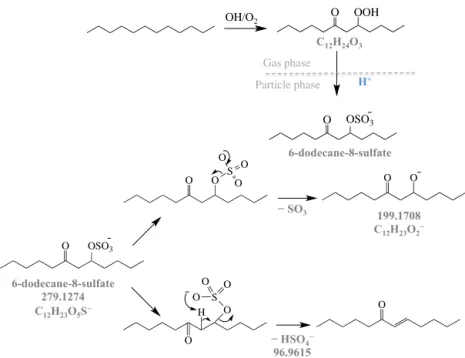
to as OS-279, were identified in SOA generated from dode-cane oxidation in the presence of acidified ammonium sulfate aerosol. Kwok and Atkinson (1995) reported that OH oxida-tion of long-chain alkanes preferentially occurred at an inter-nal carbon and thus multiple isomers may be proposed. One such isomer, 6-dodecanone-8-sulfate, is drawn in Fig. 1 to represent a proposed structure for OS-279. The MS2spectra of the products were identical, with product ions diagnostic for a sulfate esterβ to an abstractable proton (Surratt et al., 2008; Gómez-González et al., 2008) atm/z199 (C12H23O−2,
loss of neutral SO3) and 97 (HSO−4), precluding
assign-ment of positional isomerism. Figures 1 and S1 present the MS2spectrum of OS-279 and proposed fragmentation path-way, respectively. By chemical ionization mass spectrometry (CIMS) operating in the negative mode, Yee et al. (2012) identified the formation of hydroperoxides from the oxi-dation of dodecane under low-NOx conditions, confirming
the predicted RO2−HO2reaction pathway in the low-NOx
regime. First-generation hydroperoxides (C12H26O2)can
un-dergo further oxidation by reaction with OH to form either more highly oxidized products, such as dihydroperoxides (C12H26O4), or semi-volatile products (C12H24O) (Yee et
al., 2012). In addition, hydroperoxides can be photolyzed to alkoxy radicals (RO), undergoing additional transformation to form more highly oxidized products. Low-volatility prod-ucts could then condense onto sulfate aerosols and undergo further heterogeneous reactions (Schilling Fahnestock et al., 2015), leading to OSs as discussed below. In our study, OH radicals were formed from IPN photolysis without additional injection of NO. Under these conditions, RO2 chemistry is
dominated by RO2+HO2and/or RO2+RO2reactions as
dis-cussed by Raff and Finlayson-Pitts (2010). Although RO2
radicals could also react with NO formed by either IPN or NO2 photolysis, formation of ozone under chamber
condi-tions (0.3–0.6 ppm, depending on the concentration of IPN injected, Table 1) would rapidly quench NO (Atkinson et al., 2000). Therefore, RO2+NO reactions are not expected to be
significant. In addition, total organic peroxide aerosol con-centrations, presented in Table 1, reveal that organic perox-ides account (on average) for 28 % of the SOA mass mea-sured in the different experiments in support of a significant contribution of RO2+RO2/HO2and/or RO2autoxidation to
SOA formation from alkane oxidations.
Carbonyl hydroperoxide (C12H24O3), which has been
identified in the gas phase by Yee et al. (2012), is likely in-volved in acid-catalyzed heterogeneous reactions onto sul-fate aerosol. Heterogeneous chemistry of gas-phase organic peroxides has been previously suggested to explain the for-mation of certain OSs and tetrols (Riva et al., 2016). Acid-catalyzed perhydrolysis of hydroperoxides followed by reac-tion with sulfate anion radicals could also be possible route to the formation of OS-279 (Fig. 1). OS-279 generated from the reactive uptake of the corresponding epoxide (C12H24O) has
been considered but the composition of OS-279 (one double bond equivalency (DBE)) is inconsistent with reactive up-take of an epoxide. However, further investigation is required to better understand how acidified sulfate seed aerosol takes up organic peroxides from the gas phase and how particle-phase reactions might degrade organic peroxides into OSs. It should be mentioned that photooxidation of dodecane has also been investigated using an additional injection of NO (200 ppb) prior IPN injection. In this experiment SOA for-mation was significantly reduced as well as the OS concen-trations (factor of 3–4), confirming that NO strongly impacts the formation of OSs, such as OS-279.
3.2 Characterization of OSs from decalin photooxidation
Gas-phase oxidation of cyclic alkanes at room temperature and atmospheric pressure has received less attention than linear or branched alkanes. However, recent studies have demonstrated that oxidations of cyclic alkanes by OH rad-icals produce less-volatile oxygenated compounds and have larger SOA yields (Lim and Ziemann, 2005; Lambe et al., 2012; Tkacik et al., 2012; Yee et al., 2013; Hunter et al., 2014; Loza et al., 2014). Significant formation of OSs (up to 1 µg m−3)and SOA were observed in all experiments of decalin photooxidation (Tables 1 and S3), revealing the high potential for bicyclic alkanes to form OSs. All OSs (25 OSs including isomeric/isobaric structures) identified from the oxidation of decalin in the presence of ammonium sulfate aerosol have been observed in ambient aerosol, underscoring the potential importance of alkanes to OS formation in urban areas (Tao et al., 2014; Wang et al., 2015; Kuang et al., 2016). MS2 spectra were obtained for all OSs identified from de-calin oxidation, except for parent ions atm/z195.0697 (OS-195) and 299.0805 (OS-299). All of the parent ions show an intense product ion atm/z 96.96, indicative of an aliphatic sulfate ester. Retention times and tentative structural assign-ments are given in Table S1.
Figure 1. Proposed formation pathway of OS-279 (m/z 279.1274) and its corresponding fragmentation routes. The suggested mechanism is based on identified products from previous study (Yee et al., 2012).
O OOH
O OSO3
O
O O
O
O O
OSO3
H O S
O O O
O SO O O
OH/O2
Gas p hase
Particle p hase H+
− SO3
6-dodecane-8-sulfate 279.1274 C12H23O5S−
− HSO4− 96.9615
199.1708 C12H23O2− C12H24O3
6-dodecane-8-sulfate
Figure 1.Proposed formation pathway of OS-279 (m/z279.1274) and its corresponding fragmentation routes. The suggested mechanism is based on identified products from previous study (Yee et al., 2012).
in the fine urban aerosol samples. The different reaction path-ways presented below are separated based on OSs that are generated from branching reactions of a common transient. Four isomers of OS-265 with composition C10H17O6S−
were identified in decalin-derived SOA collected from all ex-periments. With regard to components of ambient SOA, it is important to mention that the formation of isobaric OSs with the same elemental composition of C10H17O6S−
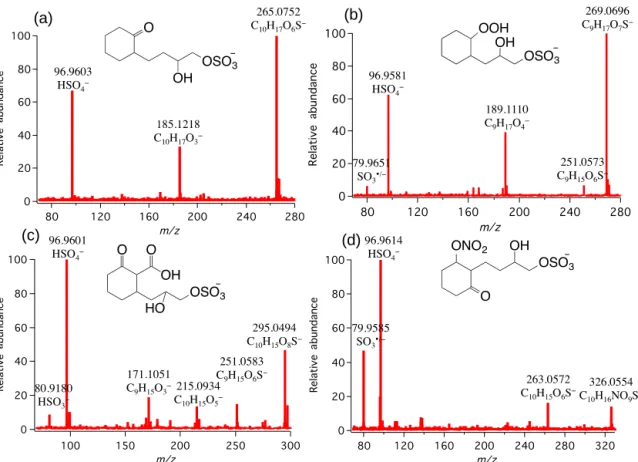
iso-bars have also been previously identified in SOA produced from the gas-phase oxidation of monoterpenes (Liggio et al., 2006; Surratt et al., 2008) and are not unique to decalin ox-idation. The product ion at nominal m/z 97 (HSO−4) and loss of neutral SO3 in the MS2 spectrum (Fig. 2a) is
con-sistent with an aliphatic OS with a labile proton in a β po-sition (Attygalle et al., 2001). Absence of product ions cor-responding to a loss of a terminal carbonyl (−CO) or a car-boxyl group (−CO2)(Romero and Oehme, 2005; Shalamzari
et al., 2014) and a composition corresponding to two DBEs have thus been attributed to an internal carbonyl group and a six-membered ring. A scheme leading to the structure pro-posed in Fig. 2a is based on the cleavage of the C1−C2
de-calin bond, followed by reaction with a second O2molecule
and HO2 that leads to a terminal carbonyl hydroperoxide
(C10H18O3)(Yee et al., 2013). C10H18O3could then further
react with OH radicals and led to an epoxide and sulfate es-ter by reactive uptake/hees-terogeneous chemistry (Paulot et al., 2009). OS-265 (C10H17O6S−)could also arise from the
acid-catalyzed perhydrolysis of the hydroperoxide (C10H18O4)
generated from the reaction of C10H17O4q+HO2 (Fig. S8,
pathway b). The MS2 spectrum for the single parent ion
atm/z281 corresponding to the composition C10H17O7S−
(OS-281) gave product ions expected for a sulfate ester β
to a labile proton with 2 DBEs, but no additional structural information (Fig. S4). The pathway proposed in Fig. S8 path-way b is based on gas-phase oxidation of a 4-(cyclohexan-2-one)but-1-yl radical followed by reaction with O2and a
1,5-H shift (Crounse et al., 2011; Orlando and Tyndall, 2012) and lead to a C10-carbonyl-hydroxy hydroperoxide (C10H18O4).
C10H18O4 could then further react with OH radical and by
elimination of OH lead to an epoxide (Fig. S8, pathway b). In addition, OS-281 could arise from acid-catalyzed perhydrol-ysis of C10-carbonyl dihydroperoxides (C10H18O5)as
pro-posed in Fig. S8, pathway c. The direction of ring opening of the internal epoxide by reactive uptake to give the final product is arbitrary. Three isobaric parent ions atm/z 297 corresponding to the composition C10H17O8S−with 2 DBEs
were identified. Loss of water, HSO−4 and SO3as a neutral
fragment in the MS2spectrum of the major isobar (OS-297) is consistent with a hydroxyl-substituted sulfate esterβ to a labile proton (Fig. S6). The scheme proposed in Fig. S8 pathway c is based on the oxidation to a 4-(cyclohexan-2-one)but-1-yl radical as in pathway b. However, in contrast to pathway b, RO2formed by the addition of O2undergoes a
1,6-H shift (Crounse et al., 2011; Orlando and Tyndall, 2012) followed by the addition of a second O2 molecule, a 1,5-H
Figure 2. MS2 spectra obtained for selected decalin-derived OSs: (a) m/z 265.0752
(C10H17O6S–), (b) m/z 269.0696 (C9H17O7S–), (c) m/z 295.0494 (C10H15O8S–) and (d) m/z
326.0554 (C10H16NO9S–). Fragmentation schemes are proposed in Figure S2.
(a) (b)
(c) (d)
Figure 2.MS2spectra obtained for selected decalin-derived OSs:(a)m/z265.0752 (C10H17O6S−),(b)m/z269.0696 (C9H17O7S−),
(c)m/z295.0494 (C10H15O8S−)and(d)m/z326.0554 (C10H16NO9S−). Fragmentation schemes are proposed in Fig. S2.
The composition of the parent ion at m/z 269.0696 (C9H17O7S−) corresponds to one DBE. MS2 spectrum
yields products consistent with a sulfate ester β to an ab-stractable proton and, similarly to OS-265, neither a termi-nal carbonyl nor a carboxyl functiotermi-nal group was detected in the OS-269. As a result, the presence of hydroperoxide and/or hydroxyl substituents is expected in order to satisfy the molecular formulas obtained by the accurate mass mea-surement. Although ESI-MS in the negative ion mode is not sensitive to multifunctional hydroperoxides and alcohols (Cech and Enke, 2001; Witkowski and Gierczak, 2012), this technique is highly sensitive to hydroperoxides and alcohols, which also contain OS groups and give [M–H]− ions (Sur-ratt et al., 2008; Kristensen et al., 2011; Kundu et al., 2013; Hansen et al., 2014).
In Fig. 3, tentative pathways leading to the formation of OS-267, OS-269 and OS-285 are proposed. Following anal-ogous mechanisms for low-NOxconditions (Atkinson, 2000;
Yee et al., 2013), abstraction of a protonαto the ring scis-sion of decalin followed by reaction with O2 leads to the
1-hydroperoxy radical, which in turn can react with an-other RO2radical to yield the corresponding alkoxy radical
(C10H17O). Cleavage of the C1−C2decalin bond, followed
by reaction with a second O2 molecule and HO2, leads to
a terminal carbonyl hydroperoxide (C10H18O3). The
aldehy-dic intermediate in the sequence following C1–C2ring
scis-sion may be oxidized to the corresponding acyl radical ei-ther by photolysis (Wang et al., 2006) or by H-abstraction (Kwok and Atkinson 1995), followed by addition of O2,
re-action with RO2or HO2 and decarboxylation of the
result-ing acyloxy radical (R(O)O) (Chacon-Madrid et al., 2013) to a hydroperoxyperoxy radical (C9H17O4q). C9H17O4qcan
re-act via pathway a (Fig. 3) through a 1,6-H shift (Crounse et al., 2011; Orlando and Tyndall, 2012) followed by elimina-tion of OH, resulting in a formaelimina-tion of an epoxide analogous to the formation of isoprene epoxydiol (IEPOX) (Paulot et al., 2009; Mael et al., 2015). The epoxide can then undergo acid-catalyzed ring opening to give OS-269 (C9H17O7S−).
The MS2spectrum of OS-285 (C9H17O8S−; Fig. S5) shows
product ions corresponding to HSO−3, HSO−4 and loss of neu-tral SO3, in accord with a sulfate ester β to a labile
pro-ton, but yields no further structural information. The struc-ture proposed for OS-285 is based on the formation of re-action of the hydroperoxy peroxyl radical intermediate in pathway b with RO2 followed by a 1,4-H shift (Rissanen
et al., 2015) and addition of O2to give a
hydroxyhydroper-oxyperoxyl radical (C9H17O5q). C9H17O5q could then lead
Sur-ratt et al., 2010; Jacobs et al., 2013; Mael et al., 2015) and form OS-285. C9H17O5qcould also react with HO2and form
the corresponding C9-hydroxydihydroperoxide (C9H18O5),
which could then undergo heterogeneous reaction and lead to OS-269 (Fig. 3, pathway b). Finally, a C9-carbonyl
hy-droperoxide (C9H16O3) could also be formed from the
RO+O2reaction (Fig. 3, pathway c), which could then
fur-ther react with OH radicals and lead to a C9-carbonyl
dihy-droperoxide (C9H16O5). Hence, C9H16O5 could form
OS-267 (C9H15O7S−) from heterogeneous reaction on acidic
aerosols.
In Fig. 4, pathways from an initial 1-peroxy transient are proposed to products designated OS-295, OS-311 and OS-326. Three isobaric ions corresponding to OS-295 (C10H15O8S−)were identified in decalin-derived SOA
un-der all experimental conditions. Figure 2c shows the MS2 spectrum of the parent ion atm/z295. A product ion atm/z
251 corresponding to a loss of CO2 (Romero and Oehme,
2005; Shalamzari et al., 2014) is present in addition to prod-uct ions consistent with a sulfate esterβto a labile H (Riva et al., 2015). Pathway a leads to the structure consistent with the MS2 spectrum and three DBEs required by the compo-sition of the parent ion. The salient features of pathway a include oxidation of the RO2to 2-decalinone, formation of a
C10alkoxy radical, followed by ring cleavage of the C9−C10
decalin bond and further RO2 isomerization (1,8-H shift),
leading to a 4-(carboxy cyclohexyl)-1-hydroperoxybut-2-yl radical via RO2chemistry. Although considered as a minor
reaction pathway (Crounse et al., 2013), the acyloxy radi-cal could lead to the epoxide from the isomerization of the O2 adduct (Paulot et al., 2009; Yao et al., 2014; Zhang et
al., 2015). Further acid-catalyzed ring opening of the epox-ide leads to OS-295 (C10H15O8S−).
Two isobaric parent ions with identical MS2spectra were observed atm/z311 (C10H15O9S−; Fig. S7). The only
ob-served product ion atm/z97 is consistent with a sulfate ester, but not informative with regard to a more refined assignment of molecular structure. Pathway b to a hydroperoxide for the parent ion with three DBEs is proposed by analogy to the pu-tative hydroperoxide structures of 267, 269 and OS-285. Pathway b is characterized by a H-abstraction from a carbon at the ring fusion of 2-decalinone, leading to forma-tion of an 2-decalinone-6-oxy radical followed by a sequence of ring cleavage, O2additions and H shifts to form a
4-(2,6-cyclohexyl)-2-hydroperoxybutan-1-oxide that can form the sulfate ester on reactive uptake. Abstraction of H1 rather than H6 would lead to an isobaric structure.
Four isobaric ions corresponding to C10H16NO9S− with
analogous MS2 spectra (Fig. 2d) were detected at nominal massm/z 326. The loss of 63 mass units as neutral HNO3
(Fig. S2d) is in accord with a nitrate ester (Surratt et al., 2008), supported by the absence of product ions from loss of NO or NO2(Kitanovski et al., 2012). Although RO2+NO
reactions are expected to be minor under the conditions used in this work (i.e., NO < 1 ppb, formation of RO radicals or
organonitrates cannot be ruled out. Indeed, Ehn et al. (2014) have demonstrated that NO reactions could be competitive at ppb levels. Under our experimental conditions, RO2+NO,
RO2+HO2/RO2and RO2autoxidation are possible.
There-fore, the parent ion atm/z326 could arise from the reaction of the 2-peroxy radical with NO to form decalin-2-nitrate (C10H17NO3)with subsequent reactions shown in
Fig. 4, pathway c. From this point, a sequence of reactions identical to pathway b yields the parent OS-326. It is impor-tant to mention that the formation of isobaric OSs with the same elemental composition of C10H16NO9S−isobars have
also been identified in SOA produced from the gas-phase ox-idation of monoterpenes (Surratt et al., 2008).
3.3 Characterization of OSs from cyclodecane photooxidation
The concentrations of OSs identified from gas-phase oxida-tion of cyclodecane are reported in Table S4. High levels of OSs were observed in experiments performed under dry conditions with acidified ammonium sulfate seed aerosol. The impact of acidity on OS formation will be discussed in more detail in the following section. The MS2spectra of all cyclodecane products show only a single product ion at nominalm/z 97 corresponding to bisulfate (Figs. S9–S13), indicating that the oxidation products are sulfate esters β
to a labile proton. None of the fragment ions observed in the MS2 spectrum suggest the presence of a terminal car-bonyl or a carboxyl functional group in the cyclodecane-OSs, which is consistent with conservation of the cyclode-cane ring. Tentative structures proposed in Table S1 are based on DBE calculations and retention of the cyclode-cane ring supported by MS2 data. Pathways proposed in Fig. S14 are initiated by H-abstraction and based on reac-tion sequences for which precedent has been established: ad-dition of O2 to cycloalkyl radicals to give RO2, which
ei-ther reacts with RO2to yield alkoxy radicals (Atkinson and
Arey, 2003; Ziemann and Atkinson, 2012) or undergoes in-tramolecular H shifts, leading to generation of hydroperox-ides (Ehn et al., 2014; Jokinen et al., 2014; Mentel et al., 2015). The formation of compounds such as cyclodecanone (C10H18O), cyclodecane hydroperoxide (C10H20O2)or
cy-clodecane hydroxyhydroperoxide (C10H20O3)are proposed
as intermediate products, leading to epoxy compounds after additional oxidation/isomerization processes, as presented in Fig. S14. In addition, C10H20O3, cyclodecane
hydroper-oxide ketone (C10H18O3)and cyclodecane
hydroxyoxohy-droperoxide (C10H18O4), proposed as intermediate products,
Figure 3. Tentatively proposed formation pathways of OS-267 (m/z 267.9552), OS-269 (m/z
269.0696) and OS-285 (285.0654) from the oxidation of decalin in presence of sulfate aerosol.
OOH OOH
OOH O
OOH
OSO3
OH OOH
O
OOH O
OOH O
OOH
OSO3
OOOH
OOH OH
OOH OH
OOH OH
OOH O
OSO3
OH OH
OOH
OO O O
OO
O
OOH
O
OOH OO O
OOH O
OOH OO
OH/O2 RO2/HO2 HO2
OH; hν/O2
RO2/HO2
− CO2
RO2/HO2 1,6-H
H+ H+
Particle phase Gas phase
O2
− H2O
O2
OS-285
C9H17O8S−
OS-267
C9H15O7S−
OS-269
C9H17O7S−
− OH −HO2
H+
O2/1,4-H − OH O 2/HO2
OH/O2/
HO2
− H2O
− H2O
(c) (b) (a)
O2
C10H18O3
C9H16O3
C9H16O5
C9H18O5
1,4-H
Figure 3.Tentatively proposed formation pathways of OS-267 (m/z267.9552), OS-269 (m/z269.0696) and OS-285 (285.0654) from the oxidation of decalin in presence of sulfate aerosol.
possible) (Orlando and Tyndall, 2012). In the case of OS-249, where cis/trans isomers are not possible, the two iso-baric structures may result from different H shifts. OS-265 and OS-281 are reported here for the first time in chamber studies.
3.4 Impact of relative humidity and acidity on OS formation
Experiments were performed under conditions reported in Table 1. As shown in Fig. 5 and Tables S2–S4, the pres-ence of acidic aerosols significantly increases OS formation in most cases, as previously observed for OSs in SOA gener-ated from biogenic sources (Iinuma et al., 2007; Surratt et al., 2007; Chan et al., 2011). Since differences in meteo-rology could impact experimental results from the outdoor chamber, caution must be exercised in comparing experi-ments performed on different days. However, same-day, side-by-side experiments allow for clear resolution of the effects of aerosol acidity and seed composition on OS formation.
When comparing experiments performed under dry vs. wet conditions with acidified ammonium sulfate aerosol, higher RH conditions significantly reduce OS formation, likely at-tributable to an increase in pH because of dilution by addi-tional particle water. It is important to point out that the effect of varying the aerosol acidity was not cleanly separated from the potential impact of larger concentrations of aerosol sul-fate. However, Chan et al. (2011) have demonstrated that the formation of OSs from the oxidation ofβ-caryophyllene is directly correlated with aerosol acidity ([H+]). Indeed, the authors have changed the acidity of the seed aerosols by ad-justing the ratio of the aqueous (NH4)2SO4/H2SO4
solu-tions to produce a constant aerosol sulfate concentration of 30 µg m−3across the range acidities.
photoox-Figure 4. Tentatively proposed formation pathways of OS-295 (295.0494), OS-311 (m/z 311.0447) and OS-326 (326.0554) from the oxidation of decalin in the presence of sulfate aerosol.
O
O OO
O
O
OOH
O
O
OOH
O
O O OOH
OOH OO
O ONO2
O
O ONO2
O O
O
O
ONO2
O O
OOH O
O
OOH O
O
O
OOH O
OH
O
O O
OH
ONO2
O OO
ONO2
O
OOH
ONO2
O O
O O
OH OSO3 HO
ONO2
O OH
OSO3
H+ Particle phase
Gas phase
H+ H+
− OH
− OH
− OH
O2/RO2/HO2
OH/O2
RO2 NO − HO2
OH OH
−H2O
−H2O −H2O
1,6-H
O2/1,5-H
OS-326 C10H16NO9S−
OS-311 C10H15O9S−
OS-295 C10H15O8S−
O
O
OSO3
OOH
OH
O2/RO2/HO2 O2/RO2/HO2
O2/RO2/HO2
1,4-H
1,6-H 1,8-H a
( ) ( )b ( )c
Figure 4.Tentatively proposed formation pathways of OS-295 (295.0494), OS-311 (m/z311.0447) and OS-326 (326.0554) from the oxida-tion of decalin in the presence of sulfate aerosol.
idation, including OS-195, OS-269 and OS-297, belong to group 2 as well. OSs can be formed via different pathways, including acid-catalyzed ring-opening reactions of epoxy-containing SOA constituents, reactive uptake of unsaturated compounds into the particle phase or reaction with the sul-fate anion radical (Rudzinski et al., 2009; Nozière et al., 2010; Schindelka et al., 2013; Schöne et al., 2014). OSs may also result from nucleophilic substitution of nitrate by sulfate (Darer et al., 2011; Hu et al., 2011). The impact of acidity on OS formation arising from the different pathways has been investigated principally for reactive uptake of epoxy com-pounds (Jacobs et al., 2013; Lin et al., 2012; Gaston et al., 2014; Riedel et al., 2015) for which OS formation is strongly enhanced under acidic conditions (Lin et al., 2012). How-ever, a similar enhancement was not observed in our study on PAH-OSs, which were not expected to result from
epox-ide chemistry (Riva et al., 2015). Based on these observa-tions, the formation of group 1 OSs are hypothesized to be products of reactive uptake of gas-phase epoxides.
M. Riva et al.: Chemical characterization of organosulfates 11011
Figure 5.Impact of acidity on OS formation from gas-phase oxi-dation of(a)dodecane,(b)decalin and(c)cyclodecane. OSs from group 1 corresponds to compounds strongly impacted by aerosol acidity, while OSs from group 2 appeared to have less dependency on aerosol acidity.
extracted by the ACN/toluene mixture. It is important to note that the concentrations of the aliphatic OSs could be un-derestimated due to their potential partial re-dissolution in the reconstitution solutions. Tables S2–S4, showing the ra-tios of the concentrations individual OSs extracted by the ACN/toluene mixture divided by the concentration of OSs extracted by methanol, indicate that all C10- and C12-OS
products, including highly oxidized OSs, appear more ef-ficiently extracted by the ACN/toluene mixture. For OSs smaller than C10, extraction efficiencies are about the same.
As noted above, isobars of OSs identified from the oxidation of alkanes have been observed in SOA generated from the oxidation of monoterpenes that are currently used as tracers
Figure 6. Impact of extraction solvent composition on quantification of identified OSs from gas-phase oxidation of alkanes.Figure 6.Impact of extraction solvent composition on
quantifica-tion of identified OSs from gas-phase oxidaquantifica-tion of alkanes.
for monoterpene SOA chemistry (Hansen et al., 2014; Ma et al., 2014). Hence, in addition to the caution that quan-titation of alkane and monoterpene OSs is uncertain in the absence of authentic standards, some monoterpene OSs may be underestimated if not fully extracted because most studies use methanol as an extraction solvent (Surratt et al., 2008; Iinuma et al., 2009). However, more work is needed to better characterize and elucidate the impact of solvent mixture on the quantitation of biogenic- and anthropogenic-derived OSs, especially compounds > C10, by using internal standards.
3.6 OSs derived from alkanes in ambient fine urban aerosol
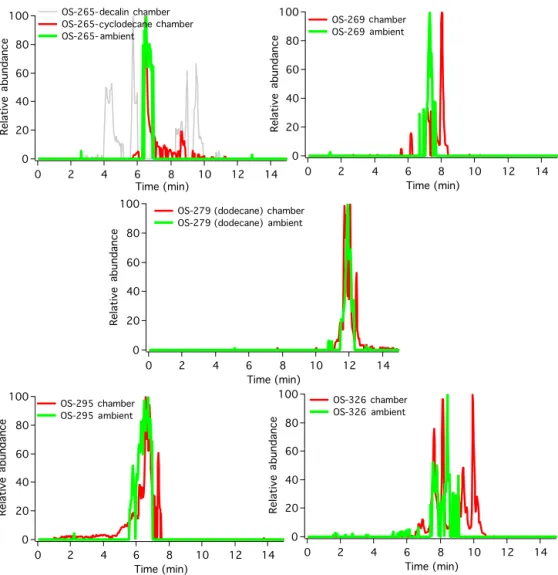
Archived fine urban aerosol samples collected at Lahore, Pakistan, and Pasadena, CA, USA, were used to evaluate and quantify OSs identified in SOA produced from the pho-tooxidation of alkanes. Filters were initially extracted using methanol and comparison to OSs quantified using another solvent mixture was not possible. As previously mentioned, seven parent ions have been observed in laboratory stud-ies. Therefore, extracted ion chromatograms (EICs) obtained from smog chamber experiments were compared to those ob-tained from both urban locations to confirm that observed OSs correspond to OSs identified in our lab study. Figures 7 and S15 present the EICs of OSs observed in both ambi-ent and our smog chamber-generated SOA. Table 2 idambi-enti- identi-fies 12 OSs, along with concentrations, present in PM2.5
col-lected from Lahore, Pakistan, and Pasadena, CA, USA, and also observed in our smog-chamber-generated SOA.
The high concentrations, especially at Lahore (Pakistan) of the OSs measured in the ambient aerosol samples support their use as tracers for SOA produced from the oxidation of alkanes in urban areas. This is consistent with recent proposals (Tao et al., 2014). OS-195 (C7H15O4S−),
OS-249 (C10H17O5S−), OS-255 (C9H19O6S−),
OS-267 (C10H19O6S−), OS-281 (C10H17O7S−), OS-299
Figure 7. Extracted ion chromatograms (EICs) for selected alkane OSs identified in both smog chamber experiments (in red) and ambient samples (in green).
Figure 7.Extracted ion chromatograms (EICs) for selected alkane OSs identified in both smog chamber experiments (in red) and ambient samples (in green).
(C10H15O9S−) have been recently identified in ambient
aerosol collected from the major urban locations Shanghai and Hong Kong (Tao et al., 2014; Wang et al., 2015; Kuang et al., 2016). In the absence of retention times and chromatographic conditions, OS isobars such as OS-249 or OS-279, which are currently assigned to biogenic-derived OSs (Ma et al., 2014), could also arise from anthropogenic sources such as photooxidation of cyclodecane, especially in urban areas.
4 Conclusions
The present study demonstrates the formation of OSs from the photooxidation of alkanes and complements the smog chamber study on formation of OSs and sulfonates from pho-tooxidation of PAHs (Riva et al., 2015). Together, the results strongly support the importance of the contribution of anthro-pogenic precursors to OS in ambient urban PM2.5proposed
on the basis of aromatic and aliphatic OSs in fine aerosol collected from several major urban locations (Kundu et al., 2013, Tao et al., 2014). Chemical characterization of OSs that were identified in SOA arising from the photooxidation of alkanes was performed and tentative structures have been proposed for OSs identified from the photooxidation of de-calin, cyclodecane and dodecane based on composition from exact mass measurement, DBE calculations and the transfor-mations expected from hydroxyl radical oxidation dominated by RO2/HO2chemistry. Enhancement of OS yields in the
presence of acidified ammonium sulfate seed is consistent with reactive uptake of gas-phase epoxides as the pathway for OS formation. As previously proposed for IEPOX forma-tion (Paulot et al., 2009), isomerizaforma-tion of RO2species toβ
consis-tent with the larger concentration of OSs identified from the oxidation of cyclodecane and decalin. However, more work is required to validate pathway(s) leading to the formation of gaseous epoxy products, since OS formation from other chemical pathways such as nuclophilic substitution of the −ONO2group by a−OSO3group cannot be ruled out (Darer
et al., 2011; Hu et al., 2011). Of critical importance would be investigations starting from authentic primary or secondary oxidation products suggested in this study as putative in-termediates to validate the proposed mechanisms. A novel pathway involving heterogeneous reactions of hydroperox-ides followed by hydrolysis/sulfation reactions is proposed to explain the formation of 8 OSs identified in this study; however, more work is also required to examine how acidi-fied sulfate seed aerosols take up organic peroxides from the gas phase and how particle-phase reactions might degrade or-ganic peroxides into low-volatility products such as the OSs.
5 Data availability
Data can be made available upon request to the correspond-ing author (Surratt). Data sets that could be made available include aerosol size distributions, meteorology data, gas-phase constituent concentrations (NOx, O3, and alkanes),
as well as alkane-derived OS characterizations provided by UPLC/ESI-HR-QTOFMS operated in the negative ion mode.
The Supplement related to this article is available online at doi:10.5194/acp-16-11001-2016-supplement.
Acknowledgements. The authors thank the Camille and
Henry Dreyfus Postdoctoral Fellowship Program in Environ-mental Chemistry for their financial support. The authors wish also to thank CAPES Foundation, Ministry of Education of Brazil (award no. 99999.000542/2015-06), for their financial support. This study was supported in part by the National Oceanic and Atmospheric Administration (NOAA) Climate Program Office’s AC4 program, award no. NA13OAR4310064. The authors wish to thank Kasper Kristensen and Marianne Glasius (Department of Chemistry, Aarhus University, Denmark), who synthesized the 3-pinanol-2-hydrogen sulfate. The authors also thank Tauseef Quraishi, Abid Mahmood and James Schauer for providing filters collected in Lahore in addition to the Government of Pakistan, the Pakistani Higher Education Commission and the United States Agency for International Development (US-AID) for funding field sample collection in Pakistan.
Edited by: S. A. Nizkorodov
Reviewed by: four anonymous referees
References
Atkinson, R.: Atmospheric chemistry of VOCs and NOx, Atmos.
Environ., 34, 2063–2101, 2000.
Atkinson, R. and Arey, J.: Atmospheric degradation of volatile or-ganic compounds, Chem. Rev., 103, 4605–4638, 2003.
Altieri, K. E., Turpin, B. J., and Seitzinger, S. P.: Oligomers, organosulfates, and nitrooxy organosulfates in rainwater iden-tified by ultra-high resolution electrospray ionization FT-ICR mass spectrometry, Atmos. Chem. Phys., 9, 2533–2542, doi:10.5194/acp-9-2533-2009, 2009.
Attygalle, A.B., Garcia-Rubio, S., Ta, J., and Meinwald, J.: Collisionally-induced dissociation mass spectra of organic sul-fate anions, J. Chem. Soc., 2, 498–506, 2001.
Boone, E. J., Laskin, A., Laskin, J., Wirth, C., Shepson, P. B., Stirm, B. H., and Pratt, K. A.: Aqueous processing of atmospheric or-ganic particles in cloud water collected via aircraft sampling, En-viron. Sci. Technol., 49, 8523–8530, 2015.
Carrasquillo, A. J., Hunter, J. F., Daumit, K. E., and Kroll, J. H.: Secondary organic aerosol formation via the isolation of indi-vidual reactive intermediates: role of alkoxy radical structure, J. Phys. Chem. A, 118, 8807–8816, 2014.
Cech, N. B., and Enke, C. G.: Practical implications of some re-cent studies in electrospray ionization fundamentals, Mass Spect. Rev., 20, 362–387, 2001.
Chacon-Madrid, H. J., Henry, K. M., and Donahue, N. M.: Photo-oxidation of pinonaldehyde at low NOx: from chemistry to
or-ganic aerosol formation, Atmos. Chem. Phys., 13, 3227–3236, doi:10.5194/acp-13-3227-2013, 2013.
Chan, M. N., Surratt, J. D., Chan, A. W. H., Schilling, K., Offen-berg, J. H., Lewandowski, M., Edney, E. O., Kleindienst, T. E., Jaoui, M., Edgerton, E. S., Tanner, R. L., Shaw, S. L., Zheng, M., Knipping, E. M., and Seinfeld, J. H.: Influence of aerosol acid-ity on the chemical composition of secondary organic aerosol from β-caryophyllene, Atmos. Chem. Phys., 11, 1735–1751, doi:10.5194/acp-11-1735-2011, 2011.
Claeys, M., Wang, W., Ion, A.C., Kourtchev, I., Gelencsér, A., and Maenhaut, W.: Formation of secondary organic aerosols from isoprene and its gas-phase oxidation products through reaction with hydrogen peroxide, Atmos. Environ., 38, 4093–4098, 2004. Crounse, J. D., Paulot, F., Kjaergaard, H. G., and Wennberg, P. O.: Peroxy radical isomerization in the oxidation of isoprene, Phys. Chem. Chem. Phys., 13, 13607–13613, 2011.
Crounse, J. D., Nielsen, L. B., Jorgensen, S., Kjaergaard, H. G., and Wennberg, P. O.: Autoxidation of organic compounds in the atmosphere, J. Phys. Chem. Lett, 4, 3513–3520, 2013.
Darer, A. I., Cole-Filipiak, N. C., O’Connor, A. E., and Elrod, M. J.: Formation and stability of atmospherically relevant isoprene-derived organosulfates and organonitrates, Environ. Sci. Tech-nol., 45, 1895–1902, 2011.
Docherty, K. S., Wu, W., Lim, Y. B., and Ziemann, P. J.: Contri-butions of organic peroxides to secondary aerosol formed from reactions of monoterpenes with O3, Environ. Sci. Technol., 39,
4049–4059, 2005.
A., Kerminen, V.-M., Kulmala, M., Worsnop, D. R., Wildt, J., and Mentel, T. F.: A large source of low-volatility secondary or-ganic aerosol, Nature, 506, 476–479, 2014.
Elder, A., and Oberdörster, G.: Translocation and effects of ultrafine particles outside of the lung, Clin. Occup. Environ. Med., 5, 785– 796, 2006.
Fraser, M. P., Cass, G. R., Simoneit, B. R. T, and Rasmussen, R. A.: Air quality model evaluation data for organics. 4. C2-C36 non-aromatic hydrocarbons, Environ. Sci. Technol., 31, 2356–2367, 1997.
Gaston, C. J., Riedel, T. P., Zhang, Z., Gold, A., Surratt, J. D., and Thornton, J. A: Reactive uptake of an isoprene-derived epoxy-diol to submicron aerosol particles, Environ. Sci. Technol., 48, 11178–11186, 2014.
Gentner, D. R., Isaacman, G., Worton, D. R., Chan, A. W. H., Dall-mann, T. R., Davis, L., Liu, S., Day, D. A., Russell, L. M., Wil-son, K. R., Weber, R., Guha, A., Harley, R. A., and Goldstein, A. H.: Elucidating secondary organic aerosol from diesel and gaso-line vehicles through detailed characterization of organic carbon emissions, P. Natl. Acad. Sci. USA, 109, 18318–18323, 2012. Gómez-González, Y., Surratt, J. D., Cuyckens, F., Szmigielski,
R., Vermeylen, R., Jaoui, M., Lewandowski, M., Offenberg, J. H., Kleindienst, T. E., Edney, E. O., Blockhuys, F., Van Alsenoy, C., Maenhaut, W., and Claeys, M.: Characterization of organosulfates from the photooxidation of isoprene and unsat-urated fatty acids in ambient aerosol using liquid chromatogra-phy/electrospray ionization mass spectrometry, J. Mass Spect., 43, 371–382, 2008.
Hallquist, M., Wenger, J. C., Baltensperger, U., Rudich, Y., Simp-son, D., Claeys, M., Dommen, J., Donahue, N. M., George, C., Goldstein, A. H., Hamilton, J. F., Herrmann, H., Hoff-mann, T., Iinuma, Y., Jang, M., Jenkin, M. E., Jimenez, J. L., Kiendler-Scharr, A., Maenhaut, W., McFiggans, G., Mentel, Th. F., Monod, A., Prévôt, A. S. H., Seinfeld, J. H., Surratt, J. D., Szmigielski, R., and Wildt, J.: The formation, properties and im-pact of secondary organic aerosol: current and emerging issues, Atmos. Chem. Phys., 9, 5155–5236, doi:10.5194/acp-9-5155-2009, 2009.
Hansen, A. M. K., Kristensen, K., Nguyen, Q. T., Zare, A., Cozzi, F., Nøjgaard, J. K., Skov, H., Brandt, J., Christensen, J. H., Ström, J., Tunved, P., Krejci, R., and Glasius, M.: Organosulfates and organic acids in Arctic aerosols: speciation, annual variation and concentration levels, Atmos. Chem. Phys., 14, 7807–7823, doi:10.5194/acp-14-7807-2014, 2014.
Hatch, L. E., Creamean, J. M., Ault, A. P., Surratt, J. D., Chan, M. N., Seinfeld, J. H., Edgerton, E. S., Su, Y., and Prather, K. A.: Measurements of isoprene-derived organosulfates in ambient aerosols by aerosol time-of-flight mass spectrometry – Part 1: Single particle atmospheric observations in Atlanta, Environ. Sci. Technol., 45, 5105–5111, 2011.
Hawkins, L. N., Russell, L. M., Covert, D. S., Quinn, P. K., and Bates, T. S.: Carboxylic acids, sulfates, and organosulfates in processed continental organic aerosol over the south east Pacific Ocean during VOCALS-REx 2008, J. Geophys. Res.-Atmos., 115, D13201, doi:10.1029/2009JD013276, 2010.
Hayes, P. L., Ortega, A. M., Cubison, M. J., Froyd, K. D., Zhao, Y., Cliff, S. S., Hu, W. W., Toohey, D. W., Flynn, J. H., Lefer, B. L., Grossberg, N., Alvarez, S., Rappenglück, B., Taylor, J. W., Allan, J. D., Holloway, J. S., Gilman, J. B., Kuster, W. C., De Gouw, J.
A., Massoli, P., Zhang, X., Liu, J., Weber, R. J., Corrigan, A. L., Russell, L. M., Isaacman, G., Worton, D. R., Kreisberg, N. M., Goldstein, A. H., Thalman, R., Waxman, E. M., Volkamer, R., Lin, Y. H., Surratt, J. D., Kleindienst, T. E., Offenberg, J. H., Dusanter, S., Griffith, S., Stevens, P. S., Brioude, J., Angevine, W. M., and Jimenez, J. L.: Organic aerosol composition and sources in Pasadena, California, during the 2010 CalNex campaign, J. Geophys. Res. Atmos., 118, 9233–9257, 2013.
Hu, K. S., Darer, A. I., and Elrod, M. J.: Thermodynamics and kinetics of the hydrolysis of atmospherically relevant organon-itrates and organosulfates, Atmos. Chem. Phys., 11, 8307–8320, doi:10.5194/acp-11-8307-2011, 2011.
Hunter, J. F., Carrasquillo, A. J., Daumit, K. E., and Kroll, J. H.: Secondary organic aerosol formation from acyclic, monocyclic, and polycyclic alkanes, Environ. Sci. Technol., 48, 10227– 10234, 2014.
Iinuma, Y., Müller, C., Berndt, T., Böge, O., Claeys, M., and Her-rmann, H.: Evidence for the existence of organosulfates fromβ -pinene ozonolysis in ambient secondary organic aerosol, Envi-ron. Sci. Tech., 41, 6678–6683, 2007.
Iinuma, Y., Böge, O., Kahnt, A., and Herrmann, H.: Laboratory chamber studies on the formation of organosulfates from reac-tive uptake of monoterpene oxides, Phys. Chem. Chem. Phys., 11, 7985–7997, 2009.
Jacobs, M. I., Darer, A. I., and Elrod, M. J.: Rate constants and prod-ucts of the OH reaction with isoprene-derived epoxides, Environ. Sci. Technol, 43, 12868–12876, 2013.
Jokinen, T., Sipilä, M., Richters, S., Kerminen, V.-M., Paasonen, P., Stratmann, F., Worsnop, D., Kulmala, M., Ehn, M., Herrmann, H., and Berndt, T.: Rapid Autoxidation Forms Highly Oxidized RO2 Radicals in the Atmosphere, Angew. Chem. Internat. Ed., 53, 14596–14600, 2014.
Kamens, R. M., Zhang, H., Chen, E. H., Zhou, Y., Parikh, H. M., Wilson, R. L., Galloway, K. E., and Rosen, E. P.: Secondary or-ganic aerosol formation from toluene in an atmospheric hydro-carbon mixture: water and particle seed effects, Atmos. Environ., 45, 2324–2334, 2011.
Kitanovski, Z., Grgic, I., Yasmeen, F., Claeys, M., and Cusak, A.: Development of a liquid chromatographic method based on ultraviolet–visible and electrospray ionization mass spectromet-ric detection for the identification of nitrocatechols and related tracers in biomass burning atmospheric organic aerosol, Rapid Commun. Mass. Sp., 26, 793–804, 2012.
Kristensen, K. and Glasius, M.: Organosulfates and oxidation prod-ucts from biogenic hydrocarbons in fine aerosols from a forest in North West Europe during spring, Atmos. Environ., 45, 4546– 4556, 2011.
Kroll, J. H. and Seinfeld, J. H.: Chemistry of secondary organic aerosol: formation and evolution of low-volatility organics in the atmosphere, Atmos. Environ., 42, 3593–3624, 2008.
Kuang, B. Y., Lin, P., Hub, M., and Yu, J. Z.: Aerosol size distri-bution characteristics of organosulfates in the Pearl River Delta region, China, Atmos. Environ., 130, 23–35, 2016.
Kundu, S., Quraishi, T. A., Yu, G., Suarez, C., Keutsch, F. N., and Stone, E. A.: Evidence and quantitation of aromatic organosul-fates in ambient aerosols in Lahore, Pakistan, Atmos. Chem. Phys., 13, 4865–4875, doi:10.5194/acp-13-4865-2013, 2013. Kwok, E. S. C. and Atkinson, R.: Estimation of hydroxyl radical
structure-reactivity relationship: an update, Atmos. Environ., 29, 1685–1695, 1995.
Lambe, A. T., Onasch, T. B., Croasdale, D. R., Wright, J. P., Martin, A. T., Franklin, J. P., Massoli, P., Kroll, J. H., Canagaratna, M. R., Brune, W. H., Worsnop, D. R., and Davidovits, P.: Transitions from functionalization to fragmentation reactions of laboratory secondary organic aerosol (SOA) Generated from the OH oxida-tion of alkane precursors, Environ. Sci. Technol., 46, 5430–5437, 2012.
Lee, S., Jang, M., and Kamens, R. K.: SOA formation from the photooxidation of α-pinene in the presence of freshly emitted diesel soot exhaust, Atmos. Environ., 38, 2597–2605, 2004. Liao, J., Froyd, K. D., Murphy, D. M., Keutsch, F. N., Yu, G.,
Wennberg, P. O., St. Clair, J. M., Crounse, J. D., Wisthaler, A., Mikoviny, T., Jimenez, J. L., Campuzano-Jost, P., Day, D. A., Hu, W., Ryerson, T. B., Pollack, I. B., Peischl, J., Anderson, B. E., Ziemba, L. D., Blake, D. R., Meinardi, S., and Diskin, G.: Air-borne measurements of organosulfates over the continental US, J. Geophys. Res. D, 120, 2990–3005, 2015.
Liggio, J. and Li, S.-M.: Organosulfate formation during the uptake of pinonaldehyde on acidic sulfate aerosols, Geophys. Res. Lett., 33, L13808, doi:10.1029/2006GL026079, 2006.
Lim, Y. B. and Ziemann, P. J.: Products and mechanism of sec-ondary organic aerosol formation from reactions of n-alkanes with OH radicals in the presence of NOx, Environ. Sci. Technol.,
39, 9229–9236, 2005.
Lim, Y. B. and Ziemann, P. J.: Effects of molecular structure on aerosol yields from OH radical-initiated reactions of linear, branched, and cyclic alkanes in the presence of NOx, Environ.
Sci. Technol., 43, 2328–2334, 2009.
Lin, Y.-H., Zhang, Z., Docherty, K. S., Zhang, H., Budisulistiorini, S. H., Rubitschun, C. L., Shaw, S. L., Knipping, E. M., Edgerton, E. S., Kleindienst, T. E., Gold, A., and Surratt, J. D.: Isoprene epoxydiols as precursors to secondary organic aerosol forma-tion: acid-catalyzed reactive uptake studies with authentic com-pounds, Environ. Sci. Technol., 46, 250–258, 2012.
Lin, Y.-H., Budisulistiorini, S. H., Chu, K., Siejack, R. A., Zhang, H., Riva, M., Zhang, Z., Gold, A., Kautzman, K. E., and Surratt, J. D.: Light-absorbing oligomer formation in secondary organic aerosol from reactive uptake of isoprene epoxydiols, Environ. Sci. Technol., 48, 12012–12021, 2014.
Loza, C. L., Craven, J. S., Yee, L. D., Coggon, M. M., Schwantes, R. H., Shiraiwa, M., Zhang, X., Schilling, K. A., Ng, N. L., Canagaratna, M. R., Ziemann, P. J., Flagan, R. C., and Seinfeld, J. H.: Secondary organic aerosol yields of 12-carbon alkanes, Atmos. Chem. Phys., 14, 1423–1439, doi:10.5194/acp-14-1423-2014, 2014.
Ma, Y., Xu, X., Song, W., Geng, F., and Wang, L.: Seasonal and di-urnal variations of particulate organosulfates in urban Shanghai, China, Atmos. Environ., 85, 152–160, 2014.
Mael, L. E., Jacobs, M. I., and Elrod, M. J.: Organosulfate and nitrate formation and reactivity from epoxides derived from 2-methyl-3-buten-2-ol, J. Phys. Chem. A, 119, 4464–4472, 2015. Mentel, T. F., Springer, M., Ehn, M., Kleist, E., Pullinen, I., Kurtén,
T., Rissanen, M., Wahner, A., and Wildt, J.: Formation of highly oxidized multifunctional compounds: autoxidation of peroxy radicals formed in the ozonolysis of alkenes – deduced from structure-product relationships, Atmos. Chem. Phys., 15, 6745– 6765, doi:10.5194/acp-15-6745-2015, 2015.
Mutzel, A., Poulain, L., Berndt, T., Iinuma, Y., Rodigast, M., Böge, O., Richters, S., Spindler, G., Sipila, M., Jokinen, T., Kulmala, M., and Herrmann, H.: Highly oxidized multifunctional organic compounds observed in tropospheric particles: a field and labo-ratory study, Environ. Sci. Technol., 49, 7754–7761, 2015. Ng, N. L., Kwan, A. J., Surratt, J. D., Chan, A. W. H., Chhabra, P.
S., Sorooshian, A., Pye, H. O. T., Crounse, J. D., Wennberg, P. O., Flagan, R. C., and Seinfeld, J. H.: Secondary organic aerosol (SOA) formation from reaction of isoprene with nitrate radicals (NO3), Atmos. Chem. Phys., 8, 4117–4140,
doi:10.5194/acp-8-4117-2008, 2008.
Nozière, B., Ekström, S., Alsberg, T., and Holmström, S.: Radical-initiated formation of organosulfates and surfactants in atmospheric aerosols, Geophys. Res. Lett., 37, L05806, doi:10.1029/2009GL041683, 2010.
Orlando, J. J. and Tyndall, G. S.: Laboratory studies of organic per-oxy radical chemistry: an overview with emphasis on recent is-sues of atmospheric significance, Chem. Rev., 41, 6294–6317, 2012.
Paulot, F., Crounse, J. D., Kjaergaard, H. G., Kroll, J. H., Seinfeld, J. H., and Wennberg, P. O.: Isoprene photooxidation: new insights into the production of acids and organic nitrates, Atmos. Chem. Phys., 9, 1479–1501, doi:10.5194/acp-9-1479-2009, 2009. Pratt, K. A., Fiddler, M. N., Shepson, P. B., Carlton, A. G, and
Sur-ratt, J. D.: Organosulfates in cloud water above the Ozarks iso-prene source region, Atmos. Environ., 77, 231–238, 2013. Presto, A. A., Miracolo, M. A., Donahue, N. M., and Robinson, A.
L.: Secondary organic aerosol formation from high-NOx
Photo-oxidation of low volatility precursors: N-alkanes, Environ. Sci. Technol., 44, 2029–2034, 2010
Pye, H. O. T. and Pouliot, G. A.: Modeling the role of alkanes, polycyclic aromatic hydrocarbons, and their oligomers in sec-ondary organic aerosol formation, Environ. Sci. Technol., 46, 6041–6047, 2012.
Raff, J. D. and Finlayson-Pitts, B. J.: Hydroxyl radical quantum yields from isopropyl nitrite photolysis in air, Environ. Sci. Tech-nol., 44, 8150–8155, 2010.
Riedel, T. P., Lin, Y., Budisulistiorini, S. H., Gaston, C. J., Thornton, J. A., Zhang, Z., Vizuete, W., Gold, D., and Surratt, J. D.: Hetero-geneous reactions of isoprene-derived epoxides: reaction proba-bilities and molar secondary organic aerosol yield estimates, En-viron. Sci. Technol. Lett., 2, 38–42, 2015.
Rissanen, M. P., Kurten, T., Sipila, M., Thornton, J. A., Kausiala, O., Garmash, O., Kjaergaard, H. G., Petaja, T., Worsnop, D. R., Ehn, M., and Kulmala, M.: Effects of chemical complexity on the autoxidation mechanisms of endocyclic alkene ozonolysis prod-ucts: from methylcyclohexenes toward understandingαpinene, J. Phys. Chem. A, 119, 4633–4650, 2015.
Riva, M., Tomaz, S., Cui, T., Lin, Y.-H., Perraudin, E., Gold, A., Stone, E. A., Villenave, E., and Surratt, J. D.: Evidence for an unrecognized secondary anthropogenic source of organosulfates and sulfonates: Gas-phase oxidation of polycyclic aromatic hy-drocarbons in the presence of sulfate aerosol, Environ. Sci. Tech-nol., 49, 6654–6664, 2015.
Robinson, A. L., Donahue, N. M., Shrivastava, M. K., Weitkamp, E., Sage, A. M., Grieshop, A. P., Lane, T. E., Pierce, J. R., and Pandis, S. N.: Rethinking organic aerosols: semivolatile emis-sions and photochemical aging, Science, 315, 1259–1262, 2007. Romero, F. and Oehme, M.: Organosulfates – a new component of humic-like substances in atmospheric aerosols?, J. Atmos. Chem., 52, 283–294, 2005.
Rudzinski, K. J., Gmachowski, L., and Kuznietsova, I.: Reactions of isoprene and sulphoxy radical-anions – a possible source of at-mospheric organosulphites and organosulphates, Atmos. Chem. Phys., 9, 2129–2140, doi:10.5194/acp-9-2129-2009, 2009. Schilling Fahnestock, K. A., Yee, L. D., Loza, C. L., Coggon, M.
M., Schwantes, R., Zhang, X., Dalleska, N. F., and Seinfeld, J. H.: Secondary organic aerosol composition from C12alkanes, J.
Phys. Chem. A, 119, 4281–4297, 2015.
Schindelka, J., Iinuma, Y., Hoffmann, D., and Herrmann, H.: Sulfate radical-initiated formation of isoprene-derived organosulfates in atmospheric aerosols, Faraday Discuss., 165, 237–259, 2013. Schöne, L., Schindelka, J., Szeremeta, E., Schaefer, T., Hoffmann,
D., Rudzinski, K. J., Szmigielski, R., and Herrmann, H.: At-mospheric aqueous phase radical chemistry of the isoprene oxi-dation products methacrolein, methyl vinyl ketone, methacrylic acid and acrylic acid – kinetics and product studies, Phys. Chem. Chem. Phys., 16, 6257–6272, 2014
Shalamzari, S. M., Ryabtsova, O., Kahnt, A., Vermeylen, R., Hérent, M.-F., Quetin-Leclercq, J., Van Der Veken, P., Maen-haut, W., and Claeys, M.: Mass spectrometric characterization of organosulfates related to secondary organic aerosol from iso-prene, Rapid Commun. Mass Spectrom., 27, 784–794, 2013. Shalamzari, M. S., Kahnt, A., Vermeylen, R., Kleindienst, T. E., Lewandowski, M., Cuyckens, F., Maenhaut, W., and Claeys, M.: Characterization of polar organosulfates in secondary organic aerosol from the green leaf volatile 3-Z-hexenal, Environ. Sci. Technol., 48, 12671–12678, 2014.
Shalamzari, M. S., Vermeylen, R., Blockhuys, F., Kleindienst, T. E., Lewandowski, M., Szmigielski, R., Rudzinski, K. J., Spólnik, G., Danikiewicz, W., Maenhaut, W., and Claeys, M.: Characteri-zation of polar organosulfates in secondary organic aerosol from the unsaturated aldehydes 2-E-pentenal, 2-E-hexenal, and 3-Z-hexenal, Atmos. Chem. Phys., 16, 7135–7148, doi:10.5194/acp-16-7135-2016, 2016.
Stevens, B. and Boucher, O.: The aerosol effect, Nature, 490, 40– 41, 2012.
Stone, E., Schauer, J., Quraishi, T. A., and Mahmood, A.: Chemical characterization and source apportionment of fine and coarse par-ticulate matter in Lahore, Pakistan, Atmos. Environ., 44, 1062– 1070, 2010.
Stone, E. A., Yang, L., Yu, L. E., and Rupakheti, M.: Character-ization of organosulfate in atmospheric aerosols at Four Asian locations, Atmos. Environ., 47, 323–329, 2012.
Surratt, J. D., Murphy, S. M., Kroll, J. H., Ng, N. L., Hildebrandt, L., Sorooshian, A., Szmigielski, R., Vermeylen, R., Maenhaut, W., Claeys, M., Flagan, R. C., and Seinfeld, J. H.: Chemical com-position of secondary organic aerosol formed from the photoox-idation of isoprene, J. Phys. Chem. A, 110, 9665–9690, 2006. Surratt, J. D., Kroll, J. H., Kleindienst, T. E., Edney, E. O., Claeys,
M., Sorooshian, A., Ng, N. L., Offenberg, J. H., Lewandowski, M., Jaoui, M., Flagan, R. C., and Seinfeld, J. H.: Evidence for
organosulfates in secondary organic aerosol, Environ. Sci. Tech-nol., 41, 517–527, 2007.
Surratt, J. D., Gómez-González, Y., Chan, A. W. H., Vermeylen, R., Shahgholi, M., Kleindienst, T. E., Edney, E. O., Offenberg, J. H., Lewandowski, M., Jaoui, M., Maenhaut, W., Claeys, M., Flagan, R. C., and Seinfeld, J. H.: Organosulfate formation in biogenic secondary organic aerosol, J. Phys. Chem. A, 112, 8345–8378, 2008.
Surratt, J. D., Chan, A. W. H., Eddingsaas, N. C., Chan, M., Loza, C. L., Kwan, A. J., Hersey, S. P., Flagan, R. C., Wennberg, P. O., and Seinfeld, J. H.: Reactive intermediates revealed in sec-ondary organic aerosol formation from isoprene, P. Natl. Acad. Sci. USA, 107, 6640–6645, 2010.
Tao, S., Lu, X., Levac, N., Bateman, A. P., Nguyen, T. B., Bones, D. L., Nizkorodov, S. A., Laskin, J., Laskin, A., and Yang, X.: Molecular characterization of organosulfates in organic aerosols from Shanghai and Los Angeles urban areas by nanospray-desorption electrospray ionization high-resolution mass spec-trometry, Environ. Sci. Technol., 48, 10993–11001, 2014. Tkacik, D. S., Presto, A. A., Donahue, N. M., and Robinson,
A. L.: Secondary organic aerosol formation from intermediate-volatility organic compounds: cyclic, linear, and branched alka-nes, Environ. Sci. Technol., 46, 8773–8781, 2012.
Tolocka, M. P. and Turpin, B.: Contribution of organosulfur com-pounds to organic aerosol mass, Environ. Sci. Technol., 46, 7978–7983, 2012.
Wang, L., Arey, J., and Atkinson, R.: Kinetics and products of pho-tolysis and reaction with OH radicals of a series of aromatic car-bonyl compounds, Environ. Sci. Technol., 40, 5465–5471, 2006. Wang, X. K., Rossignol, S., Ma, Y., Yao, L., Wang, M. Y., Chen, J. M., George, C., and Wang, L.: Molecular characterization of atmospheric particulate organosulfates in three megacities at the middle and lower reaches of the Yangtze River, Atmos. Chem. Phys., 16, 2285–2298, doi:10.5194/acp-16-2285-2016, 2016. Witkowski, B. and Gierczak, T.: Analysis ofα-acyloxyhydroperoxy
aldehydes with electrospray ionization–tandem mass spectrome-try (ESI-MSn), J. Mass. Spectrom., 48, 79–88, 2013.
Yao, L., Ma, Y., Wang, L., Zheng, J., Khalizov, A., Chen, M., Zhou, Y., Qi, L., and Cui, F.: Role of stabilized Criegee Intermediate in secondary organic aerosol formation from the ozonolysis of
α-cedrene, Atmos. Environ., 94, 448–457, 2014.
Yee, L. D., Craven, J. S., Loza, C. L., Schilling, K. A., Ng, N. L., Canagaratna, M. R., Ziemann, P. J., Flagan, R. C., and Sein-feld, J. H.: Secondary organic aerosol formation from low-NOx
photooxidation of dodecane: Evolution of multigeneration gas-phase chemistry and aerosol composition, J. Phys. Chem. A, 116, 6211–6230, 2012.
Yee, L. D., Craven, J. S., Loza, C. L., Schilling, K. A., Ng, N. L., Canagaratna, M. R., Ziemann, P. J., Flagan, R. C., and Seinfeld, J. H.: Effect of chemical structure on secondary organic aerosol formation from C12 alkanes, Atmos. Chem. Phys., 13, 11121– 11140, doi:10.5194/acp-13-11121-2013, 2013.
Surratt, J. D.: Organosulfates as tracers for secondary organic aerosol (SOA) formation from 2-methyl-3-buten-2-ol (MBO) in the atmosphere, Environ. Sci. Technol., 46, 9437–9446, 2012. Zhang, X., Schwantes, R. H., Coggon, M. M., Loza, C. L., Schilling,
K. A., Flagan, R. C., and Seinfeld, J. H.: Role of ozone in SOA formation from alkane photooxidation, Atmos. Chem. Phys., 14, 1733–1753, doi:10.5194/acp-14-1733-2014, 2014.
Zhang, X., McVay, R. C., Huang, D. D., Dalleska, N. F., Aumont, B., Flagan, R. C., and Seinfeld, J. H.: Formation and evolution of molecular products inα-pinene secondary organic aerosol, P. Natl. Acad. Sci. USA, 112, 14168–14173, 2015.