Principal’s Instructional Leadership Among Catholic Elementary Schools
By John Pendergrass
A dissertation submitted to the faculty of the University of North Carolina at Chapel Hill in partial fulfillment of the requirements for the degree of Doctor of Education in the School of Education.
Chapel Hill 2007
Approved by:
______________________________ Advisor: Dr. Frank Brown
______________________________ Reader: Dr. William W. Malloy
ABSTRACT
John Pendergrass:Principals’ Instructional Leadership Among Catholic Elementary Schools
(Under the direction of Dr. Frank Brown)
Elementary school principals seek to maintain a strong and consistent vision, and to use a variety of leadership skills that build a shared vision with an array of stakeholders. Current scholarship offers a model of a school as a learning community for keeping both teachers and students engaged in learning. The current research has examined the leadership behaviors of Catholic elementary school principals and the way the needs of a school’s learning community impact principal’s leadership behaviors. Using the 161 respondents of the invited population of 529 elementary school teachers as participants in this study, the researcher sought to understand the influence of principals' instructional leadership behaviors on teachers. The research assessed principals' leadership behaviors, with an adapted form of the Inventory of Strategies Used by Principals to Influence Classroom Teaching (Blase and Blase 1998). This is a 32 item questionnaire that asked teachers to assess to how principals conduct instructional conferences, facilitate staff development and foster improved teaching. Eight independent variables are used to determine how the characteristics of a school’s principal and faculty influence principals’ leadership behavior.
DEDICATION
ACKNOWLEDGMENTS
There are many people who helped make the completion of this goal a reality. Dr. Frank Brown, thank you for your guidance as the chair of this effort. Dr. Malloy, you
Page
LIST OF TABLES……….……. x
LIST OF ABBREVIATIONS……….……...…. xii
Chapter 1. INTRODUCTION……….… 1
1.1 Background……… 1
1.2 Research Question ……….……….………..……… 4
1.3 Significance of the Research ……..……….……… 7
1.4 Limitations of the Research….………... 11
1.5 Terms ……….……….……….……….. 14
1.6 Theoretical Framework ……….. 17
1.7 Hypotheses ………. 19
1.8 Summary ……….………. 21
2. REVIEW OF THE LITERATURE ……….…….. 22
2.1 Introduction ………...……….………… 22
2.2 The School Milieu ………..……….... 23
2.3 Leadership and Vision ……….…... 24
2.4 Shared Vision ……….. ………... 26
2.5 Leadership and Community ………. 27
2.6 Theoretical Framework ………..………. 31
2.6.2 Staff Development ……… 38
2.6.3 Reflection on Practice ……….. 41
2.7 Summary ……….………. 42
3. METHODOLOGY……… 45
3.1 Population ……… 46
3.2 Instrumentation ………..….….………..……… 47
3.3 Data Collection ………. ……….……….…..……… 50
3.4 Data Analysis..……….……… 51
3.5 Setting ………...…………. 52
3.6 Operational Definition of Variables ………... 52
3.7 Hypotheses ………. 55
3.8 Limitations of the Research ……….. 59
3.9 Summary ……… 61
4. DATA ANALYSIS AND FINDINGS …………..……….. 62
4.1 The Population ……....……….……….……….. 64
4.2 Response Rate ………..……….……. 65
4.3 Hypothesis Testing ………..………. 65
4.5 Summary ……….. 86
5. SUMMARY and DISCUSSION ……….………... 88
5.2 Methodology ………..………. 89
5.3 Results……… 91
5.4 Other Observations ……...……….………… 98
5.5 Limitations ………..… 100
5.6 Implications for Practice ………..….. 101
5.7 Future Research ……….. 103
5.8 Summary ………..……….……….……… 104
Appendix A Cover letter to the teacher ………. 106
Appendix B Questionnaire……….. 107
Appendix C Diocese of Raleigh Performance Profile ………. 110
Reference ………. 111
LIST OF TABLES Table 2.1 Senge Compared to Blasé and Blasé ……….. 36
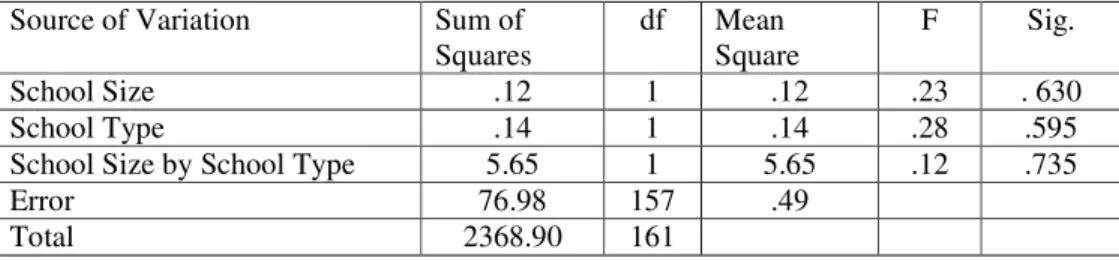
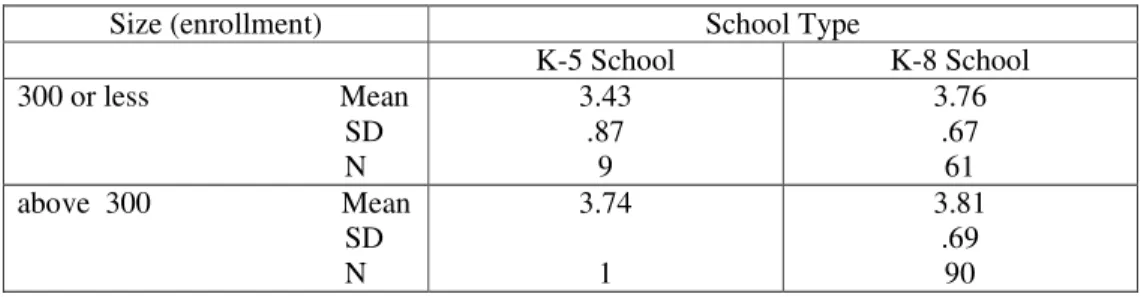
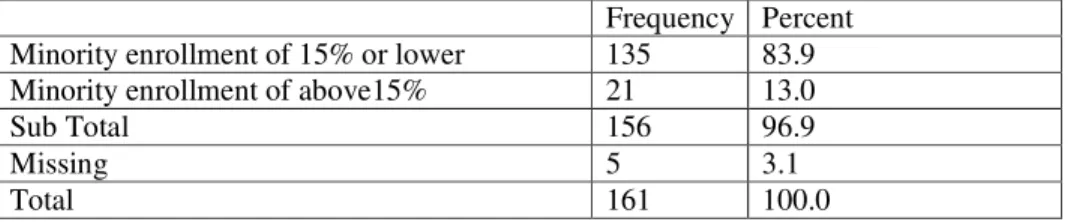
Table 4.1. Student Demographics of NC Public Schools and Raleigh Diocese .64 Table 4.2. Dependent Variable Means and Standard Deviations………. 66 Table 4.3. 2x2 ANOVA Total leadership score- School Type/Tuition... 67 Table 4.4. School type/tuition means and standard deviations……..…... 67 Table 4.5. School Types Present at the Schools in the Population……… 68 Table 4.6. Tuition/ School type means and standard deviations ………… 68 Table 4.7. 2x2 ANOVA, Total leadership score- Tuition / School type …….. 69 Table 4.8. Tuition at the Schools in the Population ………. 69 Table 4.9. 2x2 ANOVA, Total leadership score- School size/school type…… 70 Table 4.10. School size/ School type means and standard deviations .…... 70 Table 4.11. School Size in the Population ……..……….. … 71 Table 4.12. 2x2 ANOVA, Total leadership score- Minority enrollment/School
type ………..……… 72
Table 4.13. Minority enrollment/School grade level means and standard deviations…72 Table 4.14. Minority Enrollment at Schools in the Population...73 Table 4.15. 2x2 ANOVA, Total leadership score - Teachers total years experience/
School type ……….………. 73
Table 4.16. Teacher’s total years of experience /School type means and
standard deviations ……….. 74 Table 4.17. Teachers’ years of experience in the population………... 74 Table 4.18. 2x2ANOVA,Total leadership score-Teachers experience at present
school/school type……….…………. 75
Table 4.19. Teacher experience at present school/ School type means and
Table 4.21. 2x2ANOVA,Total leadership score-Teachers grade level
taught/school type………...……… 77 Table 4.22. Teachers’ grade level taught/ School type means and
standard deviations ……….….. 77 Table 4.23 Grade levels taught by teacher……….………...78 Table 4.24 2x2ANOVA,Total leadership score-Principals experience at present
school /school type ………..….….... 79
Table 4.25 Principals’ experience at present school/ School type
means and standard deviations ………. 79 Table 4.26 Years the Principal has been at the present school in the population….80 Table 4.27 ANOVA, Teacher/Principal conference – School type……….………80 Table 4.28 ANOVA, Teacher/Principal conference – Tuition……….………81 Table 4.29 Teacher/ Principal conference – School type/ Tuition
means and standard deviations……….. 81 Table 4.30 ANOVA, Staff Development –School Type … ……..……….82 Table 4.31 ANOVA, Staff Development – Tuition……….………..……..82 Table 4.32 Staff development –School type/ Tuition means and
standard deviations ………...82 Table 4.33 ANOVA, Reflection on practice – School Type …………..……….. 83 Table 4.34 ANOVA, Reflection on practice – Tuition ………..……….. 83
Table 4.35 Reflection on Practice –School type/ Tuition means and
standard deviations………..… 84
LIST OF ABBREVIATIONS
CHAPTER I
Introduction
Background
This chapter provides background information about this study, The Principal’s Instructional Leadership in Catholic Schools. The research questions are addressed, as well as the significance of the study, and an outline of the methodology.
This study explored the way in which the school principals’ instructional leadership behavior impacts Catholic elementary schools. Drawing from instructional leadership literature and using the theoretical framework of learning communities, this study has explored insights from elementary school teachers in North Carolina Catholic schools. This research should enrich the research base on existing models of instructional leadership among principals.
Catholic elementary schools in the United States. In the United States, a Catholic
Diocese is an administrative division, operating under the jurisdiction of a bishop. Thus this study refers to Catholic schools. Catholic schools comprised 8, 351, or 32 % of the 26,093 private schools, making them the largest sub-group of non-public schools in the United States. This number accounts for 6,923 elementary and 1,428 secondary schools (NCEA 2005). Recent history has seen a mixture of schools being closed or consolidated in some Dioceses, whereas other Dioceses have been adding new schools. By 2005, the total number of schools has decreased to 7,799 with 6,574 elementary schools and 1,225 secondary schools. McDonald (2001) noted that Catholic school enrollment reached an apex in the 1960s with 4, 373,000 elementary school students enrolled. The enrollment number had decreased to 2,004,037 by 2001. (McDonald, 2001). Though there has been an overall decline, but since 2000 the trend is beginning to slow and even reverse (USCCB, 2006).
Elementary schools in the Catholic Diocese of Raleigh. The Catholic Diocese of
Raleigh North Carolina schools are predominantly urban/suburban, serving 7,376
The schools in the Raleigh Diocese have a racial minority enrollment of 1066 (14%) (NCEA, 2005).
Principals influence schools through goals, leadership, and actions. Leithwood and Montgomery (1982) asserted that the school principal’s vision should be oriented toward schools as a learning community. The vision of the principal is mitigated by teachers and classroom instruction. In another study, Leithwood and Montgomery (1984) interviewed 90 school principals and found that principals’ problem-solving and shared decision-making with faculty influenced student learning. Huffman (2003) interviewed teachers at 18 schools that sought to become learning communities to improve instruction. The Huffman study was part of a 5-year project by the Southwest Educational Development Laboratory. The study found that faculty members benefited from the process of establishing shared vision and values, and that process had a positive impact on students. The pattern was clear: teachers directly impact students, and principals directly impact teachers.
Although all people have the capacity to learn, the structures in which people function may inhibit reflection and engagement that lead to organizational improvement.
goals of tomorrow. Mental models are the assumptions individuals possess and how those assumptions interact with others in the organization. Shared vision unites individuals to a set of organizational goals. Team learning helps both individuals and the organization grow professionally. Systems’ thinking allows the various parts of the organization to see the need for interdependency, with all parts working toward the shared vision. Through
systems thinking the organization unites the previous four disciplines and becomes a
learning organization that can adapt to support the vision of the organization.
The Research Question
The research question. This research has explored these questions: What instructional leadership actions by principals in Catholic elementary schools influence classroom instruction? Does a pattern emerge that defines what instructional leadership behaviors of principals make a difference in student learning? Teachers are asked to assess the leadership behaviors of principals and their effects on classroom instruction. Specifically, does the parochial elementary school principal adhere to tenets of the learning community as a model of instructional leadership?
The researcher sent a questionnaire to the population of 529 elementary school teachers in the Diocese of Raleigh, North Carolina. Participants were asked to assess different leadership actions of their principals using an adapted form of the Inventory of Strategies Used by Principals to Influence Classroom Teaching (Blase and Blase, 1998).
Learning community model. Under the learning community model of school
leadership, instructional leadership is seen as the responsibility of teachers and not as the exclusive purview of the principal (Kleine-Kracht, 1993; Shields, 1996; Staratt, 1996). Though consensus on all matters has not always been possible, Shields’ (1996) case study of principals in Native American schools found that learning communities were feasible in a cross-cultural setting. Kleine- Kracht (1993) asserted that there is a need for principals to encourage and model shared leadership in order to facilitate instructional leadership. The principal is a leader of the leaders, and it is the principal who directs the process that enables the community to “discover insights not attainable individually” (Senge, 1990, p.10). In a mixed method study of 910 teachers, schools led by principals who exhibited high shared instructional leadership had have higher pedagogical quality (Marks & Printy, 2003). It appears that shared leadership produces a better school for students.
The research design. The researcher administered an adapted version of the Blase
2005). Using the patterns that emerged from the data in the work of Blase and Blase (1998), this research has explored what actions by principals influenced instruction in Catholic elementary schools. Blase and Blase (1998) suggested three behaviors of principals that influenced classroom practices:(a) the conducting of instructional conferences; (b) staff development; and (c) the facilitating of teacher reflection on instructional improvement. These behaviors make principals a leader of a learning community (Blase & Blase, 1998).
Tenets of the instructional leadership model.The first tenet of the instructional leadership model is the educational conference (Blase & Blase, 1998). The well-executed conference is a collaborative moment at which the principal and the teacher exchange information and ideas. The goal of a well-constructed conference provides growth opportunities for both the teacher and the principal. It is an opportunity to foster a shared vision of what instruction can and will be.
The second tenet is staff development that is sustained over time and is directly related to improving classroom instruction (Kent 2001). Teachers become partners in the
continuous commitment to refine the craft of teaching. Characteristics of effective staff development include: emphasis on the teaching skills and learning; supporting
collaboration among educators; access to resources for redesigning programs; and applying the foundations of adult learning to the process of staff development (Blase & Blase, 1998).
Significance of the Research
Sharing results. This study of the leadership role of Catholic elementary school
principals should be useful to all schools, private and public. A learning community model was used to assess the outcomes of this study on instructional leadership. Through the framework of a community of learners, the principal’s role as instructional leader is expected to influence teaching and student outcomes. Findings from this research should augment our understanding of what leadership behaviors by principals have a positive impact on the instructional process.
Through perceptions of teachers in Catholic elementary schools, this research explored what actions by principals influenced classroom instruction. The perceptions of teachers were analyzed, controlling for characteristics of schools and teachers. The data collected in this study allowed the exploration of the similarities and differences between the role of school principals in different Catholic Diocese elementary schools and the role of a principal in non-Diocesan schools (Ciriello, 1996).
The vision and leadership of school principals are key factors in leading their faculties toward more effective instructional practices as a learning community (Hord, 1997; Louis & Kruse, 1995). Using open-ended interview questions, Boyd and Hord (1994) found that through a strong vision established by the first principal in their longitudinal study, one school maintained a strong sense of vision through a series of four different principals. Each principal continued to work with his or her faculty to create a caring environment in which teachers collaborated that led to improved instruction.
This study concentrated on the Catholic elementary schools in the Diocese of Raleigh, North Carolina. The study explored the teachers' perceptions of their principals' leadership behaviors. The elementary school teachers became the population for this study. The Diocese of Raleigh covers the 54 easternmost counties of North Carolina (Kennedy, 2005). The perceptions of classroom teachers provided salient data concerning the principals’ influence on classroom instruction. This study utilized the Blase and Blase (1998) leadership behaviors survey to assess the influence of principals’ actions on teachers. This research exploration of teachers' perceptions of their principals ’ instructional leadership behaviors was controlled for teachers' experience, characteristics of the school, and the principals experience. These demographics were controlled to assess their influence on teachers’ perceptions of a principal’s leadership behavior.
This research studied the principals' behavior to assess influence on classroom instruction. As a result of this research may determine whether or not leadership traits in public schools discovered by Blase and Blase (1998) are also present in parochial schools.
Hudson (2003) stated that parents, teachers, and students often make reference to the community aspect of Catholic schools, to explain why these schools are academically successful. Hudson also noted that the school as a community echoed outside the school walls, to the point where they foster active participation by teachers. Hudson (2003) explored aspects of community in Catholic schools through schools in the United States. Hudson used a three-part data-gathering strategy that obtained responses from the principal, five faculty members, and five students from each school. One aspect of a learning community was found among the school faculty. Delmer Wagner (2001) noted that the purpose of the principal is to produce more leaders, following a servant-leadership model. The assertion that the school principal is a leader of leaders is also a component of a learning community. (Kleine-Kracht, 1993; Louis, Kruse, Raywid, 1996;Scribner,1999; Shields, 1996).
The National Catholic Education Association asserted the need for more research on Catholic elementary schools (Convey, 1992). Sander (1996) found that small Catholic schools did affect improved student performance in grade school in the areas of
experienced the unwillingness of schools to participate, as she chaired more that 100 dissertation studies in this area at the University of San Francisco.
Jepsen (2002) found moderate mathematics and reading gains among Catholic elementary school students, as compared to their public school counterparts. Jespen noted, as did Sander (1996), that there was a correlation between improved academic performance and better student attendance in Catholic schools. The study included analysis of test scores in mathematics and reading over a two year period in grades 1 and 4, and involved a cohort of 10,000 public school students from 200 schools and a cohort of 1,000 students from 35 Catholic schools. It was asserted that more may be learned from research about instructional leadership behavior in Catholic schools.
North Carolina Schools
In North Carolina, there are 117 public school districts and 93 charter schools that serve a student population of 1,360,209 (N.C.E.S. 2005). There are two Catholic school systems in the state (Kennedy, 2005). The western 46 counties of North Carolina constitute the Diocese of Charlotte, which was established in 1972 when the Diocese of Raleigh was separated into two parts. The Diocese of Charlotte has 18 schools, 16 elementary schools (5,604 students) and 2 high schools (1,636 students). The population for this study is the Diocese of Raleigh, which covers the 54 Eastern counties of North Carolina and has 23 elementary schools (7,491 students) and one high school, which has 982 students (Kennedy, 2005).
elementary and 1,428 secondary schools. More recent history has seen a mixture of schools being closed or consolidated in some Diocese, while other Dioceses are adding new schools. By 2005, the total number of schools had decreased to 7,799 with 6,574 elementary schools and 1,225 secondary schools. Catholic school enrollment was highest in the 1960s, with 4, 373,000 elementary school students enrolled. This enrollment number had decreased to 2,004,037 by 2001 (McDonald, 2001).
This research has adhered to the model of a community of learners as a preferred environment for instructional leadership, which includes a strong sense of shared vision for the school, shared decision-making, and modeling life long learning (Hord,
1997;Louis & Marks, 1992; Prawatt,1993; Senge, 2000). This study provides information about how principals' instructional leadership behaviors, as perceived by teachers may influence classroom instruction. Principals’ instructional leadership behaviors were assessed, using 32 different traits observed by a sample of 809 teachers (Blase & Blase, 1998). These 32 leadership behaviors were divided into three categories: Instructional conferences, staff development and reflection on the practice of teaching to improve instruction.
Limitations of the Research
Population/Sample. The population for this research was conducted among Catholic
Raleigh contributed to that tally, the number of elementary educators in the population was 529 (Kennedy, 2005).
The population for this research included Catholic school teachers in the Diocese of Raleigh, North Carolina. The study did not incorporate other faith-based elementary schools. This population consisted of 529 elementary school teachers (Kennedy, 2005).
There were no data available on the social economic status of Catholic school students. Schools admit students who are unable to pay full tuition, but those students’ names are confidential and unavailable to the researcher. Catholic schools are not included in the North Carolina testing program for public schools and this prevented a direct comparison to the local public schools. (The researcher's was previously a principal in the Catholic school and is aware of these limitations.)
The questionnaire allowed teachers to respond about any principal with whom he/she had worked. This was done to provide anonymity for principals. The instrument was also limited to assessing the principals' instructional leadership.
Another limitation of this study is the low response rate from the K-5 schools. The wide divergence in the number of respondents hampered the ability to get a true comparison of significant differences in the responses of the two types of school. The responses given in this study may also have been limited due to the researcher’s role in the central administration in the Raleigh Diocese.
Confidentiality. Because the researcher was a former-principal in the Diocese of
Raleigh, the researcher was aware of certain limitations due to the rules of the Catholic schools, some data could not be gathered for this study. For example, if students' names had been necessary to this study, that information would not have been available. There are no data available on students who receive free or reduced lunch, and although some students who are unable to pay tuition would have been admitted, those students’ names were deemed confidential and would also have been unavailable to the researcher. In addition, the parochial schools do not participate in the state-mandated testing program, which would have prevented a direct comparison with the local public schools.
Purpose
ability to encourage participation in the study in any methodical way that could target schools with a low response rate.
Terms
Dependent variable. The principal’s leadership behavior score was calculated using
the teachers’ responses to a 32-item questionnaire. The questionnaire used provided a total assessment score for instructional leadership behaviors as well as three
sub-components of instructional leadership behavior: staff development; reflection to improve instruction; and instructional conferences.
The major dependent variable is the total score assessed by teachers on the 32 instructional leadership behaviors of principals. . Instructional leadership behaviors by principals encompass a wide variety of strategies designed to promote collegiality among teachers to enhance student achievement (Blase &Blase 2000). This total score is also separated into three minor dependent variables; instructional conferences, staff development and reflection on practice.
Independent or control variables. considered are:
1. School tuition
2. School type (K-5 or K-8) 3. School size
4. Minority percentage 5. Teacher years of experience
8. Principal’s experience in the present school
The independent variables are: the years of experience of the teacher, grade level the teacher teaches, the number of years teaching at the present school, school enrollment (size), percentage of minority enrollment and the tuition level (above or below average). The independent variables are the hypotheses that assess the composite numeric score for principals behavior employed: when conducting instructional conferences, facilitating staff development and fostering teacher reflection on practice. The independent variables were used as hypotheses for their influence on the dependent variables.
Learning community: In a learning organization, people continually enhanced their
capacity to create the results they desired patterns of thinking to nurtured, collective aspiration by teachers to create a learning community. The rationale for learning organizations was that in situations of rapid change to produce a flexible, adaptive and productive learning environment. Thus, a learning organization discovers how to create commitment and capacity to learn (Senge, 1990). In a school setting, a learning community incorporates organizational learning that reflects on practice and purposeful staff development to build both social and intellectual connection among the members of the community (Prawat, 1993). The leadership behaviors that foster a learning
community, according to Blasé and Blasé (1998) are:
growth opportunities for both the teacher and the principal as it fosters a shared vision of instruction (Blase & Blase 1998).
2. Staff development: Activities that foster a culture of collaboration and life long learning that support the teacher in learning about teaching (Blase & Blase, 1998).
3. Reflection on practice: This is a reflective dialog with oneself and with others that allows one to construct meanings, analyze experiences and teaching strategies and apply these reflections to future practice of the artistry of teaching (Blasé & Blase, 1998).
The questionnaire, The Inventory of Strategies Used by Principals to Influence Classroom Teaching (ISUPICT), was used to conduct this research. It focused on the behaviors of principals’ and did not ask teachers to assess the principal’s motives for this behavior. The high degree of internal consistency of the ISUPICT in the original study was .90 (Blase & Blase, 1998) among public school made the instrument attractive for use among Catholic elementary school teachers. This research experienced a reliability of .978, using an adapted form of the ISUPICT.
An ANOVA was used to analyze the data for this study. Changes in the dependent variable, leadership behavior, were presumed to result from changes in the independent variables: school, teacher, and principal characteristics. Significant changes were assessed at the.05 level of statistical significance.
support previous research findings and previous experiences or illuminate new insight into the instructional leadership behaviors and new perceptions.
The leadership behaviors measured by this study were expected to be consistent with the learning community model of instructional leadership (Blase & Blase, 1998). Though many schools claim to be learning communities, this study tested the popular parlance to ascertain if the foundations of a learning community existed in the instructional leadership actions of principals in Catholic elementary schools. One question was, do Catholic schools find themselves operating in a learning community model that has been grasped by public schools as a way to create learning organizations?
Theoretical Framework
The learning community concept is the theoretical framework of this research. The learning community model emerged from the organizational research by Senge (1990). Senge noted five disciplines that created learning organizations. The five disciplines are: personal mastery, mental models, shared vision, team learning and systems thinking. The first discipline, personal mastery, is when one has a consistent sense of his or her current setting. This personal awareness makes it possible to move toward the goals of tomorrow. Next, one becomes aware of the mental models or assumptions he or she holds and how those assumptions interact with others in the organization. Shared vision unites the
organization to a set of goals. Team learning helps both individuals and the organization grow professionally and support the shared vision. Finally, systems’ thinking (the fifth
discipline) allows the various parts of the organization to see the need for
organization should adapt to change and be creative in the acquisition and use of shared learning. Educators have embraced the concept of a learning organization which is also referred to as a learning community (Grave 1992; Shields, 1996; Staratt, 1996; Hord, 1997; Louis & Marks 1992).
Schools create a better learning community if they maintain a collective commitment to shared principles and a belief that the school should strive to be a learning community (Dufour & Eaker, 1998). The model of a community of learners should result in the interaction of the faculty and administration through shared leadership and decision making. Hord (1997) noted that members of a learning community seek a shared vision to augment instruction for the betterment of students. Hord goes on to note that a professional learning community needs shared vision, shared leadership collective learning, collective application of learning, and the physical conditions to facilitate this new paradigm of school improvement. In a learning community, cooperative and self reflective qualities combine as an organization works, “toward common goals while respecting a variety of perspectives, values and lifestyles” (Graves, 1992 p.94). A school as a learning community needs leadership that builds partnerships between teachers and administrators. This changes the roles of administration and teachers which are often rigid, and makes these roles more flexible (Kruse and Louis, 1993). Fullan (1993), Scribner (1999), and Sergiovanni (1994) add credence to the assertion that focusing on learning across an entire organization, has merit for schools.
(Blase & Blase, 1998). Quantitative methodology is used to explore the influence of selected control variables on principals’ instructional leadership behavior.
Hypotheses
Assumptions of the research It was assumed that the teachers who agreed to
participate in this study would provide honest responses. The instrument, a questionnaire, protects anonymity of respondents to encourage the sharing of insights.
Eleven points of the study's hypothesis. Fourteen hypotheses were tested in this
study. The total score for 32 principals' actions that might impact instruction were to be analyzed in relationship to each of the eight independent variables. In addition, three components (instructional conferences facilitated by principals, staff development, and reflection on practice fostered by principals) were also analyzed using the independent variables of school type and tuition.
Hypotheses:
The hypotheses are:
A. Total Instructional Leadership Score
1. School type (K-5 or K-8) influences the principal's instructional leadership behavior. 2. School size influences the principal's instructional leadership behavior.
3. The percentage of minority students influences the principal's instructional leadership behavior.
4. The tuition level of a school influences the principal's instructional leadership behavior.
5. A teacher's years of experience in a school influences his or her perception of the principal’s instructional leadership behavior.
7. A teacher’s total years of experience in a teaching career influence his or her perception of a principal’s instructional leadership behavior.
8. A principal's years of experience in a school influence his or her instructional leadership behavior.
B. Instructional conference
9. School Type (K-5 or K-8) will influence teachers’perceptions of instructional conferences as part of principals’ instructional leadership behavior in K-5 and K-8 schools
10. The tuition level of the school will influence teachers’ perceptions of instructional conferences as part of principals’ instructional leadership behavior in K-5 and K-8 schools
C. Staff Development
11. School type (K-5 or K-8) will influence teachers’ perceptions of staff development as part of principals’ instructional leadership behavior in K-5 and K-8
schools
12. The tuition of the school will influence teachers’ perceptions of staff
development as part of principals’ instructional leadership behavior in K-5 and K-8 schools
D. Reflection on practice
13. School type (K-5 or K-8) will influence teachers’ perceptions of fostering reflection on practice as part of principals’ instructional leadership behavior in K-5 and K-8
schools
14. School tuition will influence teachers’ perceptions of instructional
conferences as part of principals’ instructional leadership behavior in K-5 and K-8 schools
Statistical models tested relationships between each dependent variable and
Summary
Chapter 1 has presented an introduction and a background for the study: The Instructional Leadership of Principals of Catholic Elementary Schools. Catholic elementary schools, though deemed successful in educating students, have rarely been subjects of research studies. This research sought to provide information on Catholic elementary schools by exploring a subset of instructional leaders. The major question explored was: How do principals' leadership behaviors in Catholic elementary schools impact instruction? The population of elementary school teachers in the Catholic Diocese of Raleigh was used as the population for this study.
CHAPTER II
Review of the Literature
Introduction
Leadership has been defined in many ways. “Leadership is both under and over studied. It is understudied because there is much that we still do not know about it. It is over-studied because much has been written, compared to other human energies, about which we also know little” (Whicker, 1996, p.3). As one views the myriad of leadership skills, it is apparent that, regardless of the skill set that is employed, leaders take organizations from the place that they are to the place they should be. Even if the organizational goal is to maintain the status quo, the leader must choose actions that will and will not be taken. This research explores the instructional leadership behaviors of principals in Catholic elementary schools that impact classroom instruction.
reflection on teaching. These three actions should adapt to the changing dynamics of schools. They create and maintain a shared vision of the organization and provide support for continued dialogue and improvement.
The School Milieu
Today, educational organizations are viewed as processes and relationships rather than structures and rules (Mitchell et al. 1997). The planning of a future-focused school requires providing students the opportunity to develop positive skills and abilities (Spady, 1998). To change our schools, we must overcome a variety of obstacles. Ginsburg (1995) highlighted how schools are part of many power struggles by noting that educators interact in a context of power relations and distributions of symbolic and material resources. The actions (or inactions) educators engage in have political effects for themselves and others. Sergiovanni and Starratt (1998) also highlighted the dynamics of the educational context, denoted six change-forces that demand a different action plan if schools are going to navigate the tides of change. The six change-forces are identified as: personal, market, professional, cultural, bureaucratic, and democratic. One of the most difficult areas is the challenges posited by the forces of culture. Cultural norms are harder to assess. Just as the outcomes of education have changed, there are varied inputs into the educational system that offer a bewildering array of challenges.
permanent teacher workforce; and (c) schools' milieu is characterized by continuous and unpredictable threats to the organization’s stability. Schools have to adapt to changing environments, and shape the environment through educating the young (McRel, 2001).
Leadership and Vision
Leadership is the central action by which a principal influences a school (Greenfield, 1995). Leadership is “an interpersonal influence process aimed at eliciting from others a voluntary change in preferences” (p.70). Greenfield went on to assert that, for a principal to bring about change in the dynamic setting of the school, leadership skills in the moral, managerial, instructional, political and social/ interpersonal arenas are needed. Leadership is powered by vision. A principal’s leadership vision forges a shared vision with the faculty.
Owens (1998) asserted that leaders must state a vision of things to come, and then revise it depending upon emerging events, ideas and beliefs; restating the vision of where
we are and where we are going, so that it binds the members of the organization in mutual
purpose and resolve. This is a pivotal leadership activity. In the ever- changing milieu of a school, then, vision is an integral part of leadership activity. As Jefferies (1992, p.17) stated, “A goal is where you are heading. The question that effective leaders always ask of themselves before the question “Where are we heading?” is the question
leadership domains: authentic leadership, visionary leadership, cultural leadership, quality leadership, and service leadership.
In authentic leadership, the organization needs a clear and compelling statement of the organizations purpose. The purpose must be supported by the values that guide
professional interactions and by the structures and patterns in which the organization functions. The organizations leader must place this mission at the core of decision-making. With an authentic foundation in the purpose of the organization, the visionary domain moves educators toward the future.
The visionary leadership domain is of particular interest in discerning principals' actions that impact classroom instruction. The visionary leader has the ability to create an inspirational and concrete picture of the organization’s future (Schwann & Spady, 1998). This vision shifts as future needs emerge, but it does not radically change if it is well formed. The vision is jointly created, blending the vision of the principal and the educational organizations norms; it is then re-affirmed and taught to each new member of the organization.
The quality leadership domain builds the school's capacity to strive for the vision that brings the purpose to full expression. Here Schwan and Spady (1998) intersect with Senge (1990), highlighting the need to become learners if one seeks to create learners. Finally, the service leadership domain works to ensure that the organizational support is present for change. As a school reaches for the vision of continuous improvement, organization barriers may need to fall. Service leadership manages resources in support of the vision.
The value held by these leaders can change the outcomes of our schools. School personnel have a need for shared vision and shared values to influence learning and teaching (Anne Gold, 2003). The data from the case-studies by Gold (2003) illuminated four attributes that enhanced the ability of the school to articulate, retain, and
communicate the values that are the foundation to achieving a shared vision. These four attributes are;
1. working with, managing and even searching out change
2. paying careful attention to information management within the school thus keeping staff constantly informed
3. working closely and sometimes seamlessly with leadership groups 4. developing leadership capacity and responsibility throughout the school These four attributes create the foundation for a learning community.
Shared Vision
create a shared vision. Leaders bring a set of values to an organization; subsequent redefinitions of these values are formed by the experience of leading. This reciprocal relationship between the leader and organizational members creates an effective learning community (Blase & Blase, 1998).
Many researchers have noted the connection between vision and values. Dantley (2003) urged administrators to consider the spiritual roots of leadership, leadership driven by purpose and ignores the dichotomy of mind and spirit. Dantley urged leaders to deal with the multitude of daily challenges with an inner strength to enrich themselves and the organization.
The moral foundations of leadership are eroded as the outcomes sought from schools are dictated from the political arena (Wright, 2001). This creates a tension, in that the principal sets the tone of the school climate, which may impact on achieving mandated goals. The work day of a principal is inundated with concerns and tasks that detract from an instructional focus. Martin and Willower (1981) found that high school principals spend only 17.4% of their time on academic matters. Principals are in the midst of major changes in the definition of “good work” from their superiors; and are being asked to reconstruct channels of decision-making to include more stakeholders (King, 1991).
Leadership and Community
p.55) noted that school climate must encourage students to consider issues such as, “What is right behavior?” The United States Supreme Court echoed the impact of shared vision and values in the 1986 Decision of "Bethel v. Fraser," in which the Court stated that the process of educating our youth for citizenship in the public schools is not confined to books, the curriculum, or civics classes; schools must teach by example the shared values of a civilized social order. The principal operates in the cultural leadership domain. The Cultural Leadership Domain was characterized by establishing, monitoring and modeling positive organizational norms, values and principles (Schwann & Spady, 1998). The cultural leadership domain seeks to monitor and establish organizational norms. These create “the way things are done around here,” or the organizational culture.
When schools harness the power of shared decision making, the organizational culture becomes a learning community (Dufour & Eaker, 1998), and has a faculty and
Principals build the human capital to improve schools. Research into organizational behavior suggests that institutions that foster personal growth for teachers reap the benefits in more effective faculty (Owens, 1998). Again, the importance of the principal as a leader is recognized as integral. The relationship between the members is the foundation of the organizational culture. This culture may oppose or support a school’s mission. The principal must guide the culture to be a buttress to the vision.
We ask much of leaders in educational organizations (Weick, 1976). A school is a union of groups in which principals must handle differing needs from each. A school is a loosely bonded series of cultures, just as a school district is a series of loosely coupled schools. As one interacts with an organizational culture, there must be awareness that subunits of the organization have different cultures with distinctive attributes. For example, the principal helps one group redefine itself due to the addition of new staff, whereas older members of the group operate smoothly from established group norms. In effect, the entire continuum of organizational life cycles of an organization may be present on a single school campus.
Rothschild (1993) noted that a leader needed to be: a risk-taker, a caretaker, a surgeon and an undertaker, the four faces of strategic leadership. These leadership traits apply to steering both the vision and culture of an organization. The risk-taker is the creative gambler, the dreamer can create new organizations and build an institution during its organizational infancy. The caretaker is the orderly manager who guides the mature organization to stable, long-term prosperity. The surgeon can make the meticulous changes and alterations to prolong the life of an organization, whereas the undertaker maximizes the organization as it declines. The undertaker traits also help those who are left behind in a declining organization, to cope with the change. Organizational cultures and norms experience similar stages: the educational leader must guide the school through the maze of shifting subgroup norms. The new life of one group may be the surgical cure for the subset of the staff that seems “burned out” or tired of the struggle. This is where the leadership of a school is solidly in what Schwann and Spady (1998, p. 26) called the "cultural leadership domain."
collaborators in developing their vision. It must be our vision, our mission; and that sense of “our” must flow from the principal, to the faculty, to students and to parents.
Through a series of focus group interviews, personal interviews and observation of 12 elementary school principals, Mitchell and Castle (2005) found elementary principals to be aware that building a positive school climate is part of instructional leadership, and that fostering a positive school climate begins with positive formal and informal interaction with the faculty. The researchers were surprised by the extent to which the principal’s attention to instructional leadership created a climate in which improved instruction became an organizational goal. The nature of the improvement that is sought was highly impacted by the context of individual schools.
Blake and Mouton (1964) asserted, in their Managerial Grid, that the most desirable form of leadership is one with attention to both “product” and people, and this same insight is captured in the managerial style of “team management” (Hersey & Blanchard, 1996). Leaders combine disparate parts into a directed community. Just as a high school coach applies some of the same guiding principles to a different team every year, likewise a principal seeks the same educational mission each year, to motivate teachers and staff Leadership strategies change to meet the challenges of each new faculty and student-body. Teachers are able to give us insight into identifying which actions of a principal impact instruction (Blase & Blase, 1998). This study tests three leadership behaviors on instruction in parochial schools.
There are many recommendations about the roles and functions of school principals. Thelbert and William (2003, p.21) noted, “In essentially every report, the need for strong leadership is stressed as necessary to bring our nation’s schools to the state of excellence.” Schools need effective leadership and one framework is schools as learning communities.
In an extensive review of research pertaining to learning communities, Hord (1997) buttressed the understanding of the term “learning community “for her colleagues in education seeking improved instructional leadership. Hord’s experience concurs with the research that suggests that a learning community can be the foundation for schools to support structural change and instructional improvement. School based learning
communities can increase teacher empowerment and collective responsibility for student learning (Kruse, Louis & Bryk, 1995) The focus of instructional leadership through a learning community is improved student learning (Louis & Kruse, 1995). The 3 year longitudinal case-study of four urban public schools by Kruse and Louis (1995) found that leadership supported teacher development and a culture of trust and respect helped increase student learning. This study explored these leadership behaviors in one Catholic diocese among elementary school principals to discern how improved instruction is fostered through the principal’s behavior.
collaboration between regular and special education teachers while implementing inclusive teaching practices led to the formation of a learning community through the sharing of vision, leadership, values and practice (Walrond, 2005).
The term “community” is often used in reference to schools. The word community is powerful and alive in education (Beck, 2002). A learning community can emerge as a constructivist model for learning where knowledge is constructed within dialogue, and the quality of that knowledge is impacted by the social context (White, 2002). The word "community" evokes an expectation of dialogue, the pursuit of a common good. The language used to describe schools gives us insight into how we begin to construct meanings. To extend Beck’s use of “metaphoric mapping,” the common good is sought through a cooperative dialogue in life-long learning. Better learning in the classroom is the unifying characteristic of a learning community of professional educators (Louis & Kruse, 1995). It has been asserted that principals build successful schools through observations, instructional conferences, and in-service programs to enhance teachers’ skills (Wynne, 1980; US Department of Health, Education and Welfare, 1978). Blase and Blase (1998) moved the discussion to include reflection on practice to the actions of principals’ use in establishing an educational setting.
Grave (1992) noted that in a learning community, cooperative and self-reflective qualities combined as an organization works “toward common goals while respecting a variety of perspectives, values and lifestyles” (p.94). A strong leader is needed, but the leadership requires administrators and teachers to view themselves as part of the same endeavor. This outlook will cause role boundaries to become more flexible (Kruse & Louis, 1993). The National Association of Elementary School Principals (2001) urged principals to build learning communities by using these standards of instructional leadership that include:
• leading schools in a way that places student and adult learning at the center of the schools focus
• setting high expectations for students' academic and social developments and for the performance of adults
• creating a culture of continuous learning for adults that is tied to student learning
This supports the trend to multiple instructional leaders who are supported by the principal, identified as the lead learner.
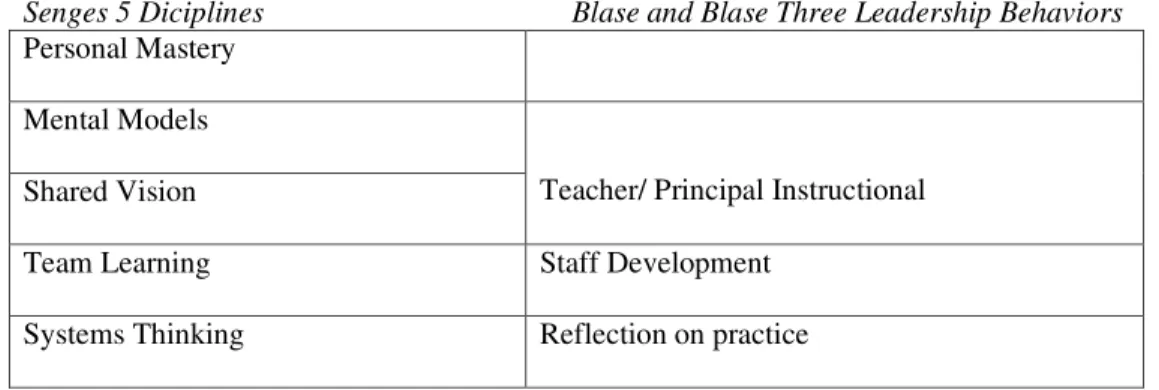
The theory that Blase and Blase (1998) promoted became evident as a result of qualitative data gathered from 809 teachers. Their methods relied on individual perceptions and interpretations by teachers of the leadership behaviors of principals. Their research describes the principals' actions that have the greatest impact on classroom learning. They suggest that a learning community is formed when a principal displays instructional leadership behaviors that utilize instructional conferences to increase shared vision, foster reflection on teaching to improve instruction, and facilitates purposeful staff development. Table 2.1 diplays the relationship between Blase and Blase three leadership behaviors (1998) and Senge’s 5 disciplines (1990).
Table 2.1 Senge Compared to Blasé and Blase
Senges 5 Diciplines Blase and Blase Three Leadership Behaviors
Personal Mastery Mental Models
Shared Vision Teacher/ Principal Instructional
Team Learning Staff Development
Systems Thinking Reflection on practice
leaders and a builder of partnerships. This is consistent with the idea of a learning community.
Instructional Conference
The well-executed conference is a collaborative moment in which the school principal and the teacher exchange input (Blase & Blase, 1998). The goal of a well-constructed conference provides growth opportunities for both the principal and the teacher. It is the moment in time that fosters a shared vision of what instruction can and will be. In a two year case-study of an urban elementary school, teachers noted the instructional conferences that focused on both the principal and teacher as instructional leaders, and built a dialog that later led to productive reflection on practice (Zepeda, 2004). Essential dialog is fostered; it is not just the completion of a supervisory process, when the conference gives the teacher scheduled time for reflection and feedback on his/her classroom, while the principal surveys the instructional needs of the classroom and the needs of individual learners. This model of the instructional conference (Blase & Blase, 1998) helps build a partnership between teachers and parents, for the benefit of students. A collaborative conference helps establish shared learning and the collaborative structure sets the framework for reflection on practice. Collaboration and reflection among principals and teachers are strategies that enhance student learning.
Meadows & Dyal, 2001). McGreal (1983) asserted that principal/teacher conferences were effective for collecting data on teacher performance. The change in the principal's instructional leadership role is changing the goal of the instructional conference.
The learning community embraces all members of an organization as a learner (Senge, 1990). A learning community is more than the sum of individual learning, though it does simultaneously encompass individual learning. Staff development, directed to augment the shared vision that is forged in instructional conferences, gives teachers a chance to both improve instruction and to model the value of lifelong learning they seek to instill in their students. Integrated staff development that included shared leadership in instructional conferences was found to improve classroom teaching in a study of 10 elementary schools (Devlin-Scherer, Devlin-Scherer; Wright; Roger; Meyers, 1997).
Staff Development
Staff development is the second area in which principals influence classroom instruction. Purposeful staff development can be viewed in light of what Senge (1990) calls team learning (i.e., “the process of aligning and developing the capacities of a team to create the results is members desire” (Senge 1990, p. 236). This perspective also magnifies the need to construct a shared vision of the organization’s future, so all can strive to attain it. A consistent program of staff development is essential for improved teaching and learning in our schools (Darling-Hammond, 1997; National Research Council, 1999).
Individual learning by organization members is integral for collective learning (Leithwood et al, 1998). The characteristics of effective staff development include: emphasis on the skills of teaching and learning; supporting collaboration among educators; providing resources for redesigning programs; and applying the principles of adult learning to the process of staff development (Blase & Blase, 1998) . If a principal respects the teachers as learners, just as the teachers are asked to respect their students as learners, then staff development can become a dynamic interchange that fosters creativity, collaboration and innovation. The tools for maintaining the shared vision are found in effective staff development. Staff development activities need to respect the expertise of the professional teacher and augment that expertise as well. Faculty input augmented the school improvement process, making all instructional leaders aware of the purpose of organizational practices (Scribner, Cockrell, Cockrell, Valentine. 1999).
A strong system of staff enrichment encourages teacher input into the design and content of and scheduling staff development events. This helps ensure that in-service training actually meets teachers’ needs. Staff development and in-service education in the milieu of schools must move from the top-down dictates of the principal to a shared enterprise between teachers and administration (Sergiovanni & Starratt, 1998). Teachers become partners in the ongoing commitment to refine the craft of teaching. For staff development to be successful, it must be sustained over time and directly related to improving classroom instruction. (Kent, 2001)
concluded that successful professional development is collaborative, purposeful, and guided by the clear goal of improving student learning. Teachers should be given choices from among optional development opportunities, so that they may choose the
development they need, given their cognitive style and career level needs. Productive staff development gives teachers practical skills that may be adapted to different subject matter and that enhances a teacher’s ability to instruct students with varied learning styles and abilities. Hallinger and Heck (1996) suggested that both the process and the content of learning forms students into lifelong learners and, consequently, members of future learning-communities. The Blase and Blase (1998) concept of staff development contains some of the same ideas of organizational learning and the model of a learning community. Fullan (1993) asserted that, for organizations to learn, they must be filled with individuals who are learning; but individual learning does not automatically ensure organizational learning. Individual learning precedes organizational learning; it does not guarantee it. The logical progression calls administrators to examine their instructional leadership in the area of the formation and support of teachers through staff development.
Sergiovanni and Starratt (1998) asserted similar convictions, as they noted that in-service education in schools must move from the purview of the principal to become a shared realm with teachers. Each teacher becomes a herald for the ongoing commitment to refine the craft of teaching. Thus, the impact of a principal on student learning is mediated by the faculty. Louis and Marks (1998) supported formation of a professional learning community among teachers at a school as an avenue to have a positive influence on classroom instruction and student achievement. The case-study research of Dorph, Stodolsky and Wohl (2002) found teachers expressing tension between the “learning” and “community” role of this new staff development dynamic. How much leadership can teachers express before being perceived as “pushy”? Though the case-studies highlighted the tension of the learning-community paradigm, it called for more research on resolving the tension. The vision of who we want our students to be is taught by teachers through the process and content of daily lessons. Both the process and the content form our students into life-long learners, members of future learning communities.
Reflection on Practice
faculty. School leadership can establish a school-wide norm that fosters teachers’ ability to plan classroom strategies. (Squires, Huitt & Segars, 1981).
Reflection takes on many styles, from simple descriptions of ideas to critical analysis of problem areas and the application of new research to attack these problems. Teacher coaching and collaboration augment reflective thinking (Blase & Blase, 1998). This assertion is supported by Borko, Elliot, McIver and Wolf (2000), who also found that teachers who are active learners improve their teaching skills. When new competencies are tested and refined, the effects are more readily assessed and reconsidered. Blase and Blase noted that “our study provided compelling evidence of the dramatic effects of principals’ behaviors can influence the reflective capacities of teachers. These behaviors include; modeling, classroom observation, dialog, suggestion and praise” (p. 92). Reflection gives teachers a chance to derive meaning from the process of teaching and learning. Deliberate reflection on practice also bears the fruit of instructional improvement, for it is the time when meanings are assigned to the experiences of teaching.
Summary
role of facilitator. Education becomes a relationship between learners and not a hierarchy of principal, teacher and then student.
The task of a principal is imbued with hope and challenge. Though principals may be future-focused, they are working today. If the principal is going to lead learning, the principal must also be a learner. This is the root of a learning organization. “School leaders who take seriously their instructional role are concerned to promote and develop their schools as learning systems or professional learning communities” (Gold, 2003). It is incumbent upon principals that they heed the signs of the times and be actively involved in gaining new competencies.
The reciprocal nature of a learning community makes the development of the human capital of the faculty and staff intrinsic to the leadership in school. The teachers are the primary point of contact with the students. Teachers are also the first point of contact for most parents. By investing in the human capital of the faculty, a principal reaches two groups that are measures of accountability. To phrase it pictorially, the fruit is on the branches (the students); the principal strengthens the tree (faculty and staff), which is rooted in the soil of community (parents, Church, organizations).
This chapter has established that a principal must lead an institution that is wrought with change. To do so, a principal needs to maintain a strong and consistent vision and use a variety of leadership skills to build a shared vision with an array of stakeholders.
will shed light on the behaviors specific to the Catholic elementary school milieu and also provide insight as to how the needs of the learning community impact the leadership activities of the principal.
CHAPTER III
Methodology
Background
This study explores principals' instructional leadership in Catholic elementary schools. The researcher invited the population of the elementary school teachers in the Catholic Diocese of Raleigh, North Carolina, to participate in this study. The methodology for this study was driven by the question of how the leadership behaviors of Catholic school principals impact and influence teachers’ perceptions of instruction in elementary classrooms. Using a questionnaire that asked teachers to assess different leadership actions of their principals, this study explored the faculty of Catholic elementary schools for their insight on the instructional leadership of their principal. The quantitative methodology described in this chapter allowed the research subjects to express their opinions on the leadership activities of principals that contribute to classroom instruction.
The study used a modified version of the Blase and Blase (1998) Inventory of Strategies Used by Principals to Influence Classroom Teaching (ISUPICT) to assess the principals’ impact on teaching through: educational conferences, staff development and the facilitating of reflection on classroom practice.
Population
The population of this study included all the elementary school teachers from the Catholic Diocese of Raleigh, North Carolina. There were 23 schools in the 54 counties (31,875 square miles) of eastern North Carolina that constituted the Catholic Diocese of Raleigh (Kennedy, 2005). The researcher invited the total population of these teachers to participate, designed to examine the principals' leadership behavior, and its impact on their teachers.
Instrumentation
Boyd and Hord (1994) used a longitudinal case study approach with in depth interviews in investigating educational leaders' actions during the implementation of school reforms. Though this brought forth rich data, the nature of this research disallowed longitudinal studies. Kruse and Louis (1993) employed field notes interviews as they explored school leadership. The study brought structural concerns that could impede school restructuring and began to highlight the role of principals as the facilitator of teacher development that improves student outcomes. The model of a learning community was seen as a structure for instructional leadership. As researcher, my question of the principals` impact on the classroom was supported by their results but not explored directly by their methodology.
The increase of the interest in examining the learning community as a prominent model for instructional leadership led me to consider the use of an instrument ( Hord & Meehan, 1999) that consisted of 17 descriptors of a learning community. The instrument they used,
Descriptors of Professional Learning Communities, had varied degrees or reliability in
The instrument used in this study is an adapted form of the Inventory of Strategies Used by Principals to Influence Classroom Teaching (ISUPICT). The survey instrument was adapted from the qualitative study originally designed to measure the impact of the principal’s leadership behavior on teaching among 806 public school teachers in grades K-12. From this study, three leadership behaviors principals used to impact instruction were developed. Using this model, the theory is grounded in the data set, not imposed upon it (Gall, Borg, & Gall, 1996).
Instrument scale reliability. When an analysis of the internal consistency for the
instrument was performed, the result was encouraging. The reliability alpha for the scale of 32 items was.978, a value that is well above the mark of .07, which indicates strong internal consistency of the survey questions among the respondents (Gall, Borg & Gall, 1996).
The instrument measures three dimensions of principals’ instructional leadership behavior: (a) conducting educational conferences; (b) staff development; and (c) fostering reflection on practice, all of which correspond to the essence of learning community. The 32 item questionnaire consists of three categories (see Appendix C).
Table 3-1 (see below) presents the survey items separated into the three subsets of the dependent variables.
Table 3.1
Three Categories of the Questionnaire
Three main categories
Item number for questions that will be entered as part of each main category
Instructional Conference Items 1,2,3,4,5,6,10,11,12,13, 32
Formatted: Font: 12 pt
Formatted: Font: 12 pt
1. My principal gives me suggestions for improving my teaching during the conference we have after a classroom observation.
2. My principal gives me proactive suggestions for improvement informally, out side of a post-observation conference.
3. My principal suggests actions that are purposeful and appropriate to the students I teach.
4. My principal asks me what I feel went well in the lesson that was observed as part of my evaluation. 5. My principal asks me where I see areas in my teaching
that could use improvement.
6. My principal encourages me to use interactive teaching methods.
10. My principal asks me why I made the choices to use certain instructional methods and lessons.
11. My principal asks me if my lessons reach their intended outcomes.
12. My principal asks my opinion on how to improve instruction.
13.My principal offers input on how I can improve instruction.
32. My principal visits classrooms. Staff Development Items 14,15,16,17,18,19,20,21,23,24,28
14. My principal gives me choices as to how I implement the suggested changes to instruction. 15. My principal distributes educational journal articles
that are relevant to classroom teaching.
16. My principal invites the faculty to discussions of articles from educational journals.
17. My principal keeps the faculty informed of workshops, seminars and conferences that are related to instruction.
18. My principal gives the faculty discretion to choose workshops, seminars and conferences that are related to instruction.
19. My principal facilitates time for me to share information with other teachers, as based on conferences/ workshops that I attend.
20. My principal schedules planning time for teachers to work together to improve instruction.
21. My principal participates in cooperative instructional planning meetings.
23. My principal encourages me to observe other
teachers and learn from their classroom practices. 24. My principal encourages me to watch teachers that
are recognized as exemplary.
28. My principal provides resources for teachers to improve instruction.
Reflection on Practice Items 7,8,9,22,25,26,27,29,30,31
7. My principal has positive interactions with the faculty outside the classroom setting.
8. My principal has positive interactions with students during instructional time.
9. My principal offers input on how I maintain the student/teacher relationship.
22. My principal schedules times when teachers can take a break together and informally share thoughts and ideas.
25. My principal partners experienced teachers as mentors for less experienced teachers.
26. My principal informs teachers of the areas that will be a focus for improvement.
27. My principal organizes the needed data to help the faculty focus on improvement goals.
29.My principal provides opportunities for teachers to share resources that will improve instruction. 30.My principal facilitates partnerships with
professionals and volunteers who augment instruction. 31. My principal praises specific teaching behaviors.
Data collection. The Superintendent of the Raleigh Diocese system granted the
researcher, permission to distribute the research instrument to teachers in the 23 elementary schools. Upon receipt of this permission, a questionnaire was mailed to 529 teachers. A letter of introduction accompanied the questionnaire informing the teachers of the purpose of the research, and the confidentiality of all teachers’ responses. The letter