MAKING GIGS WORK: CAREER STRATEGIES, JOB QUALITY AND MIGRATION IN THE GIG ECONOMY
Michael Dunn
A dissertation submitted to the faculty at the University of North Carolina Chapel Hill in partial fulfillment of the requirements for the degree of Doctor of Philosophy in the Department of
Sociology.
Chapel Hill 2018
ABSTRACT
Michael Dunn: Making Gigs Work: Career Strategies, Job Quality and Migration in the Gig Economy
(Under the direction of Arne Kalleberg)
The early-21st century has witnessed a transformation in both technological advancement and the nature of the employment relationship. Flexible workforce strategies have been adopted (Kalleberg 2003); internal labor markets have disappeared (Cappelli 2001); and large, vertically integrated firms have vanished as well (Davis 2016a). These trends have all led to a dramatic rise in the use of independent contractors. In conjunction, we have witnessed a shift in employment, from the career, to the job, to the task (Davis 2015). At the confluence of changes in the nature of employment relationships and technological advancements lies the gig economy — the focal point of this study. What differentiates work in the gig economy is that it operates within a new work ecosystem that is managed by online platforms, which broker work between employers and workers.
Using in-depth interviews and secondary sources, this study examines the gig economy through three main lines of inquiry. First, it investigates the role of gig work in a worker’s labor market and career strategy. To do this, the study demarcates who is completing gig work and examines why they are completing it. Next, the project considers job quality through two lenses: a platform perspective and a worker perspective. In examining job quality from both these angles, it tries to answer the question: is gig work a good or a bad job? Finally, the project
To my inspiration, my wife Maureen, for her constant love, support, and encouragement. Her patience and devotion are more than I could ask. Thank you for always believing in me, even
ACKNOWLEDGEMENTS
Completing this dissertation is an accomplishment that would not have been possible without the support of my committee members, advisor, friends and family. I would like to thank my committee members Arne Kalleberg (chair), Howard Aldrich, Jerry Davis, Jacqueline Hagan, and Zeynep Tufekci for their guidance and feedback.
I owe a special debt of gratitude to my advisor and mentor, Arne Kalleberg. Throughout my journey Arne has been a strong advocate on my behalf. He has been an open sounding board for my academic, professional and personal aspirations. He has provided a well-seasoned voice of reason. He has been and continues to be an honest, articulate and pragmatic critique of my scholarship. I will forever be indebted to Arne for the investment that he made for me to be successful.
Friends are also necessary to survive a Ph.D. program, and I am grateful for the support, encouragement and guidance from Holly Straut-Eppsteiner. I’d like to also thank Lori Burgwyn, founder and owner of Franklin St. Yoga, for her steadfast support of me and the broader Carolina community. Thank you to Dani Strauss for her weekly dose of inspiration and grounding, I always left her classes inspired to continue.
TABLE OF CONTENTS
LIST OF TABLES ... x
LIST OF FIGURES ... xi
CHAPTER 1. INTRODUCTION ... 1
Introduction ... 1
The Gig Economy: A New Phenomenon — or Piecemeal Work Reincarnated? ... 3
What is the Gig Economy? ... 5
From Stable Employment to the Gig Economy: How Did We Get Here? ... 7
The Rise of the Independent Contractors – The Precursor to the Gig Economy ... 13
Work and Technological Changes ... 14
Gig Work and Control ... 17
Trends in Current Technology – The Catalyst for Platform-Driven Companies ... 19
How Big is the Gig Economy? ... 21
Job Quality in Gig Work: Why Classification Matters ... 21
Limitations of the Current Scholarship ... 22
Organization of the Manuscript ... 24
CHAPTER 2. TYPOLOGY OF PLATFORMS ... 26
Introduction ... 26
Platform Typology ... 27
Key Platform Characteristics ... 28
Delivery and Task Platforms ... 31
Online Freelance Platforms ... 32
Crowdwork Platforms ... 34
Selection of Platforms for Analysis ... 36
Dimensions of Job Quality – Control and Wages ... 37
Control ... 38
Autonomy and Flexibility ... 39
Control through Policy ... 41
Wage and Job Duration ... 45
Methodology ... 47
Recruitment ... 47
Online Freelance Platform Recruitment ... 48
Rideshare/transportation Platforms and Delivery/task Platform Recruitment ... 49
Data Collection ... 49
Sample ... 51
Conclusion ... 55
CHAPTER 3. A TYPOLOGY OF WORKERS ... 56
Introduction ... 56
Factors Influencing Workers’ Responses to Gig Work ... 56
Commitment to Gig Work – Permanent or Temporary ... 56
Employment Status ... 58
Voluntary vs. Involuntary ... 58
Hours Worked and Number of Platforms ... 59
Types of Platforms ... 61
A Typology of Gig Workers ... 63
“Searchers” ... 65
“Lifers” ... 67
“Short-Timers” ... 70
“Long-Rangers” ... 71
“Dabblers”... 73
Conclusion ... 73
CHAPTER 4. JOB QUALITY IN THE GIG ECONOMY ... 75
Introduction ... 75
Platform Categories and Worker Typology ... 76
Importance of Individual Differences in Perceptions of Job Quality ... 80
Rideshare and Transportation Platforms ... 80
Task and Delivery Platforms ... 84
Online Freelance Platforms ... 92
Conclusion ... 97
CHAPTER 5. VIRTUAL MIGRATION AND GEOGRAPHIC SOVEREIGNTY ... 99
Introduction ... 99
Technology and Its Impact on Migration Patterns ... 101
The Reorganization of Work and Virtual Labor Migration ... 102
Gig Workers and the Mobilization of Resources ... 103
Migration and Worker Typologies... 104
Highest Migration Possibility ... 105
Variable Migration Possibility ... 106
Lowest Migration Possibility ... 106
Location-Independent Labor Markets and Geographic Sovereignty ... 108
Conclusion ... 113
CHAPTER 6. CONCLUSION... 115
Summary of Findings ... 115
Project Limitations and Directions for Future Research ... 118
Final Thoughts ... 119
APPENDIX. METHODOLOGICAL INFORMATION ... 125
LIST OF TABLES
Table 2.1. Platform Typology ... 36
Table 2.2. Characteristics and Attributes of Job Quality ... 38
Table 2.3. Description of Respondents ... 52
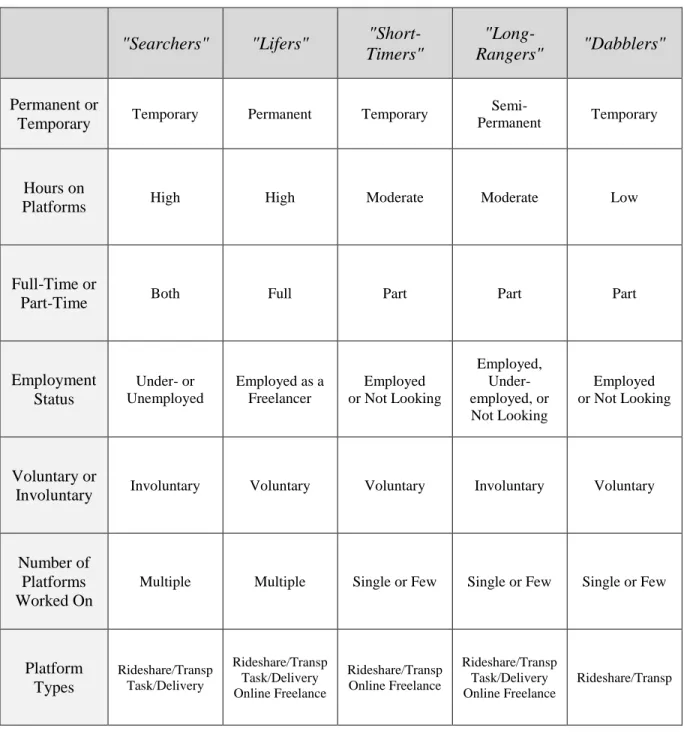
Table 3.1. Worker Typology ... 64
Table 3.2. Key Characteristics by Worker Classification ... 65
Table 4.1. Rideshare and Transportation Platform Workers ... 81
Table 4.2. Task and Delivery Platform Workers ... 88
Table 4.3. Online Freelance Platform Workers ... 94
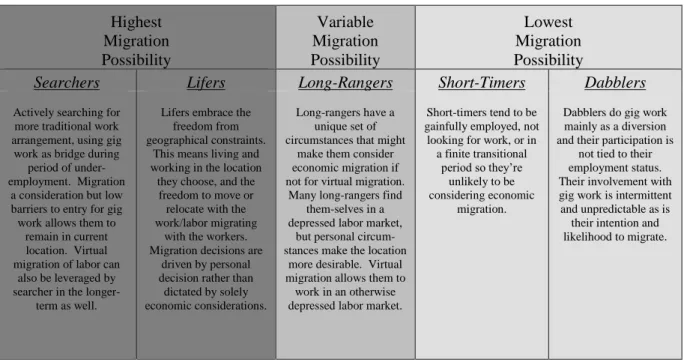
Table 5.1. Migration and Worker Typologies ... 105
LIST OF FIGURES
CHAPTER 1. INTRODUCTION
“Before the Internet, it would be really difficult to find someone, sit them down for ten minutes and get them to work for you, and then fire them after those ten minutes. But with technology, you can actually
find them, pay them the tiny amount of money, and then get rid of them when you don’t need them anymore.”-Lukas Biewald – CEO, Crowdflower
Introduction
The early-21st century has witnessed a transformation in both technological advancement and the nature of the employment relationship. A single Apple iPhone 5 — by now, already several years behind the latest technology — has 2.7 times the processing power that the 1985 Cray-2 supercomputer had.1 Furthermore, 85 percent of working-age adults in the Unites States have smartphones.2 In other words, 85 percent of Americans have portable, technologically powerful devices at their disposal. At the same time, the organization of work has also
transformed. Flexible workforce strategies have been adopted (Kalleberg 2003); internal labor markets have disappeared (Cappelli 2001); and large, vertically integrated firms have vanished as well (Davis 2016a). These trends have all led to a dramatic rise in the use of independent contractors.
In conjunction, we have witnessed a shift in employment, from the career, to the job, to the task (Davis 2015).3 At the confluence of changes in the nature of employment relationships
1 https://pages.experts-exchange.com/processing-power-compared
and technological advancements lies the gig economy — the focal point of this study. What differentiates work in the gig economy is that it operates within a new work ecosystem that is managed by online platforms, which broker work between employers and workers.
Using in-depth interviews and secondary sources, this study examines the gig economy through three main lines of inquiry. First, it investigates the role of gig work in a worker’s labor market and career strategy. To do this, the study demarcates who is completing gig work and examines why they are completing it. Next, the project considers job quality through two lenses: a platform perspective and a worker perspective. In examining job quality from both these angles, it tries to answer the question: is gig work a good or a bad job? Finally, the project
examines in what ways, if any, digital platforms and gig work may be affecting worker migration decisions.
Given the newness of digitally mediated work arrangements paired with the projected growth of gig work, research understanding the role the gig economy plays in workers’ experiences and decisions is important. This study contributes to the growing, but nascent, literature on gig work in several ways. First, it introduces both a typology of platforms and a typology of gig workers, thereby establishing a baseline understanding of platform
The Gig Economy: A New Phenomenon — or Piecemeal Work Reincarnated?
Is gig work new, or is it just a “reincarnation” of piecemeal work? To begin to answer this question, it is vital to demarcate clearly what gig work actually is — starting with its definition.
The origin of the term “gig” is up for debate, with no consensus among etymologists about its roots. The first published use of the word, according to the Random House Historical Dictionary of American Slang (1994) (or Dictionary of American Slang), was from 1907. The
Dictionary of American Slang defines a “gig” as a “business affair; state of affairs; (hence) undertaking or event.” It speculates that this might be an altered form of the word “gag,” which means, “a variety of action or behavior; practice, business, method, etc.,” which it dates to 1890.4
Gig’s first known connection to piecemeal work came courtesy of Helen Green’s 1908 book The Maison de Shine: More Stories of the Actors’ Boarding House.5 In her story, when a boarder explained that he was the “champion paper tearer of the West” he was then asked, “What kind o’ gig is that?” (p.48).6 His “gig,” specifically, was “tearing paper into odd designs” for display in shop windows.
About a decade later, the term was embraced more widely. Jazz musicians latched onto “gig” as both a noun and a verb as early as 1921 to describe the “one-nighters” or other short-term playing engagements with which they scraped out a livelihood.7 That year, the music trade magazine Billboard ran an article titled “Gigging.” The article said, “You may not have not known it, but you witnessed a ‘Gig,’ for that is the term by which such employment is known to
4 http://wordspy.com/blog/category/etymology/
about four thousand musicians and singers who are daily engaged at it.”8 The article was referring to a jazz band that was hired to play at a wedding as a short-term job.
The short-term or piecemeal work that jazz musicians were doing has many similarities to work in the gig economy. Stanford (2017) argues that work on the gig economy typically shares the following five attributes:
1. Work is performed on an on-demand or as-needed basis. Producers only work when their services are immediately required, and there is no guarantee of ongoing
engagement.
2. Work is compensated on a piecework basis. That is, producers are paid for each discrete task or unit of output, not for their time.
3. Producers are required to supply their own capital equipment. This typically includes providing the place where work occurs (home, car, etc.), as well as any tools and equipment utilized directly in production. Because individual workers’ financial capacity is limited, the capital requirements of platform work (at least the capital used directly by workers) are typically relatively small, although these assets can be
significant in the lives of the workers who must purchase and maintain them.
4. The entity organizing the work is distinct from the end-user or final consumer of the output, implying a triangular relationship between the producer, the end-user and the intermediary.
5. Some form of digital intermediation is utilized to commission the work, supervise it, deliver it to the final customer, and facilitate payment.
Taking the jazz musicians’ perspective, many of these attributes directly relate to their
arrangement; some might argue that all but the final attribute directly relate. The final attribute, though, is really the only one that differentiates today’s gigs to gigs from other epochs.
Looking further back, historically, piecemeal work and subcontracting practices were the predominant form of paid work in early capitalism, until later in the 19th century (Deakin 2000; Steinfeld 2001). Stanford (2017) also suggests that the triangular relationship between producer, end-consumer, and intermediary that is typical of digital platform work (Stewart and Stanford, 2017) (attribute #5 above) also has many historical precedents. In sum, Deakin (2000), Steinfield (2001), and Stanford (2017) demonstrate that the gig economy is really a “reincarnation” of previous work strategies that were common in earlier periods of capitalism.
Work remained mostly unstable until the 1930s, when a series of events changed the employment relationship, starting with the New Deal and other protections implemented around the same time (Jacoby 1985). The three decades following World War II were then marked by sustained growth and prosperity, along with the establishment of a new social contract between business and laborer, which solidified the growing security and economic gains of this period (Kalleberg 2009).
What is the Gig Economy?
marketplace, to work on demand” — signaling with the word “often” that the digital requirement is not a necessary condition.
Farrell and Grieg (2016) adjudicate the differences between Frenken and Schor’s (2017) definition and Katz and Kreuger’s (2016) through a key distinction: they argue that all digital platform businesses perform some kind of matching function, connecting participants who then engage in some form of exchange with one another, directly or indirectly. Furthermore, matching platforms can be divided into two broad categories: those that facilitate the exchange of assets (Frenken and Schor’s definition) and those that facilitate actual production (Katz and Kreuger’s definition) (Farrell and Grieg 2016). Such a categorization recognizes key distinctions between platforms and offers a specific point of their differentiation. This study will specifically focus on platforms that facilitate actual work and production, versus exchange of assets (examples of the latter of which would be couchsurfing.com and Airbnb). For this study, I adopt the
Congressional Research Service’s definition of the gig economy as:
The collection of markets that match providers to consumers on a gig (or job) basis in support of on-demand commerce. In the basic model, gig workers enter into formal agreements with on-demand companies to provide services to company’s clients. Prospective clients request services through an Internet-based technological platform or smartphone application that allows them to search for providers or to specify jobs. Providers (gig workers) engaged by the on-demand company provide the requested service and are compensated for the jobs. (Donovan, Bradley, and Shimabukuro 2016:1-2)
mobile interfaces or smartphone applications, thus rendering location virtually irrelevant: workers can be found and deployed anywhere — and from anywhere — at any time.
Beginning in the 1970s, scholars have also demonstrated that structural changes in social, political, and economic institutions have changed the organization of work, in a process that has seen stable employment systems replaced with work systems that are more polarized and
precarious (Kalleberg 2011). While other epochs in United States history exhibited similar trends, Kalleberg argues that the current changes “represent long-term structural transformations in employment relations rather than being simply reflections of short-term business cycles” (Kalleberg 2011: 21). Indeed, the new social contract of employment, with its increased flexibility for employers, has meant the end of lifelong employment and predictable
advancement for workers (Cappelli 1999). Coupled with this change has been the rapid rise of digitally mediated work, which has created a new twist on nonstandard work arrangements — or, more specifically, the gig economy. Understanding how work changed, back in the direction of gig work away from the more stable organization of work from the early to mid-20th century, is important for contextualizing our current situation.
From Stable Employment to the Gig Economy: How Did We Get Here?
In 2009, more than 85 percent of people in the U.S. worked in the service sector, up nearly 70 percent since 1970 (Kalleberg 2011: 29). The service sector has, in turn, fueled the expansion of contingent and nonstandard work, since service sector jobs tend to be more conducive to flexible scheduling (Kalleberg 2011). Twenty-five years ago, 1 in 5 U.S. workers was employed by a Fortune 500 company. Today, the ratio has dropped to less than 1 in 10, and one of the largest private employers in the United States is the temporary employment agency Manpower Incorporated (Lui, Feils, and Scholnick 2011).
There have also been significant drops in unionization rates (Clawson and Clawson 1999). As labor unions’ power has weakened, their ability to negotiate traditional job
arrangements has dwindled (Fantasia and Voss 2004); the precipitous decline in manufacturing jobs has led to the weakening of unions’ power and, with this, subsequently weaker bargaining positions for workers, fewer worker protections, and stronger corporate power. Recent decades have seen an accelerating decline in union membership in the private sector, falling from about 25 percent in the mid-1970s to just below 7 percent in 2012 (Bidwell et al. 2013). Furthermore, union density has dropped from 1 in 4 union members from among all wage and salary workers in the early-1970s to below 1 in 13 today (Western and Rosenfeld 2011). Literature also shows that there was a major collapse in the level of union organization in the early-1980s (Farber and Western 2002; Tope and Jacobs 2009), with other research suggesting that this decline in unionization has been linked, at least in part, to increasing employer opposition in both the workplace and the regulatory domains (Dubofsky 1994; Ferguson 2008).
markets (Cappelli 2001). Many reasons can be attributed to the decline of the internal labor market, but general consensus is that as organizations began to compete on a global stage and as the pace of technology increased, firms began to seek arrangements that could respond to this environment (Kalleberg 2003; Osterman 2000; Piore and Sabel 1984) in ways that provided flexibility (Atkinson 1984). Meanwhile, the increased global competition has, in part, created another new reality: workers can no longer expect long-term stability in their firms. Instead, employers have shifted into a paradigm in which they take a more just-in-time approach to their workers, using what can be called “flexibility strategies.”
Kalleberg (2003) proposes that employers deploy two types of flexibility strategies. The first is “functional flexibility,” in which employees in standard employment relationships can be shifted around to different tasks. The literature is divided on how this approach affects workers. Walton (1985) showed that employers eventually grew concerned about workers’ commitments; hence, in response, they began to include employees in decision-making and team-based projects as a means of encouraging employee commitment (Lincoln and Kalleberg 1985; 1990). The trade-off of these arrangements for workers is that now workers bear greater responsibility, which translates into a greater risk to their work. Furthermore, Osterman (2000) provides
evidence that employees have not received the expected mutual gains; instead he found that these changes were associated with layoffs and did not bring wage increases.
At the end of the day, though, the shift to flexible strategies has not been uniformly negative for all workers. Magnum et. al (1985) argue that flexible strategies are an extension of dual labor market theory, in which employers carefully select a core group of employees, invest in them, and take elaborate measures to reduce their turnover and maintain their attachment to the firm, while simultaneously maintaining a peripheral group of employees from whom they prefer to remain relatively detached, even at the cost of high turnover.
A dominant avenue for numerical flexibility is outsourcing, which, as mentioned above, due to globalization’s capacity, has enabled manufacturing firms to outsource their routine production jobs to low-wage regions of the world economy (e.g., Bluestone and Harrison 1982; Ross and Trachte 1990; Revenga 1993; Wood 1994, 1995; Alderson 1999; Saeger 1997;
Cappelli 1999; Whitford 2005; Brady and Denniston 2006). This has hollowed out opportunities for well-paid manufacturing work, much of which does not require a college education, thus leaving workers without a college degree to compete for lower-paying jobs in the service sector. The loss of manufacturing work in the United States that has been precipitated by globalization has also translated into a decline in the nation’s union membership — yet another key shift in the industrial and occupational structure that has changed the opportunities and prospects for
Also contributing powerfully to the reorganization of work is the trend toward project-based work. Powell (2001) coined the term "decentralized capitalism" to describe this
fundamental change in the way work is organized, structured, and governed today. Work is now being organized around projects, not jobs. Bluntly put, “the new system approaches a form of pay for productivity, with little recourse to loyalty or seniority” (Powell 2001: 34). The key consequence of the remaking of the division of labor is that “important tasks no longer need be performed inside the boundaries of the organization” (Powell 2001: 36).
The second characteristic of “decentralized capitalism” is a move from hierarchies to networks as the basic unit of economic action, introducing a “latticework of collaborations with ‘outsiders’ that blurs the boundaries of the firm” (Powell 2001: 36). The new structure of
production now relies more on subcontractors, thus substituting outside procurement for internal production.
The final characteristic of “decentralized capitalism” is the increase in inter-industry cross-fertilization. This is more of an organization-level characteristic and is less directly related to workers themselves, but it is important to note that the idea of leveraging skill and capabilities across industries is changing the way organizations have historically operated. Now, “when products and competencies change, old skills may become obsolete, firms look externally for new capabilities and utilize outsiders for tasks that cannot be done effectively internally” (Powell 2001: 46).
One of the catalysts of decentralized capitalism has been a change in employers
vertically integrated firms (i.e. corporations) are “web-page” enterprises that rely on technology, not employees (Davis 2016b). With this shift has come an increased reliance on independent contractors and companies that focus on tasks rather than jobs, while independent contractors now “hang out an electronic shingle” to find work (Davis 2016b: 513).
Lastly, employment relations have become increasingly market-mediated, and as a result, there has also been an increased shift of responsibility and risk to the worker, on many different issues. Market-mediated employment relations are based on free market competitions and are associated with diminished institutional protections for workers (Kalleberg 2011: 83). One of the features of market-mediated employment relations is the transfer of risk away from the employer towards the employee, through flexible work arrangements. U.S. society has seen the decline of pensions and the stunted growth of defined contribution plans (Chernew, Cutler, and Keenan 2005; Clark, Munnell, and Orszag 2006; Gruber and McKnight 2003; Briscoe and Murphy 2012) and a significant loss of employer support for health and retirement benefits (Maxwell, Briscoe, and Temin 2000; Shuey and O’Rand 2004). At the same time, there has been an increased use of performance and variable incentive pay (Heneman and Werner 2005; Lemieux, Macleod, and Parent 2009), and an orientation toward shareholder value has led to substantial changes in corporate strategies and structures that have encouraged outsourcing and corporate
to a dramatic rise in the use of independent contractors and have set the foundational cornerstone for a new way of approaching work, for both workers and employers alike.
The Rise of the Independent Contractors – The Precursor to the Gig Economy
The number of independent contractors, or “freelancers,” has increased significantly in the past decade. One report shows that independent contractors grew from less than 7 percent of the workforce to almost 10 percent from 2005 – 2015 (Katz and Krueger 2016). According to the “Freelancing in America 2017” study commissioned by Upwork and Freelancers Union, this number is significantly higher: 57.3 million, or about 37 percent of the workforce.
Independent contractors are those individuals who work at an organization on a short-term basis and are not regular employees of the company or the employer (Barley and Kunda 2004; Osnowitz 2010). Independent contractors often remain administratively separate from the organizations to which they provide their services and generally control their own work. In fact, having control over their work is a legal criterion that distinguishes independent contractors from “standard” employees (Kalleberg et al. 2000).
The United States has also seen a significant increase in on-call workers. On-call workers are employees of a company, but they work (and thus get paid) only when they are called in — which is, only when they are needed. The proportion of on-call workers remained relatively steady from 1995 – 2005 (Kalleberg 2009) but almost doubled from 2005 – 2015 (Katz and Krueger 2016). When called to work, on-call workers can work for a single day or for an extended period of time. They also often assist companies by filling in for employees who are absent (Cohany 1996), perhaps due to maternity leave, illness, or vacation. Substitute teachers are a classic example of on-call workers (Coverdill and Oulevey 2007).
platforms through which employers can easily reach these workers cheaply and easily, the foundation for the gig economy is now set. The rapid growth and adoption of information technology (IT), then, becomes an important factor in the proliferation of nonstandard, contingent, and precarious employment and functions as a catalyst within the gig economy.
Work and Technological Changes
Technology has played a major role in contemporary changes to the nature of the
employment relationship. In fact, the current epoch represents merely another iteration in a long history of technological advancements that have had significant impacts on work. The first two historical work ‘revolutions” were as a result of technological advancement.
In the early-1700s, for example, the steam engine was introduced: a technology that dramatically changed work. It drove the creation of mills and factories, which turned out the goods that people had previously been creating by hand. Ships and trains powered by steam, in turn, moved people and manufactured goods from place to place more quickly and efficiently than was possible prior. As a response, Western society, which had long been agrarian, began to center on cities, as laborers who had worked in cottage industries or on farms moved there in search of jobs.9
Agricultural work was revolutionized over the subsequent decades as well. In 1793, Eli Whitney introduced the cotton gin, lowering the demand for workers (slaves) who picked the sticky seeds from cotton bolls.10 Then, in 1831, Cyrus McCormick invented a reaper that cut wheat stalks by the power of the horses that pulled it, and it piled the stalks on a platform11 —
9 https://classroom.synonym.com/did-invention-steam-engine-change-way-people-worked-13612.html 10 https://en.wikipedia.org/wiki/Cotton_gin
farmers could harvest faster. In 1837, John Deere stuck the blade of a steel saw onto a plough, thus inventing the steel-edged plough that would replace cast-iron ones;12 farmers could cut a furrow in the earth more easily and sow faster. All of this technology spurned a work revolution — the first Industrial Revolution.
Subsequently, the first steel rail for railroads was introduced in 1845. This development meant that trains could carry heavier loads, which meant businesses could send more products to distant markets.13 Further connecting people from across distances was the telegraph: a telegraph line was strung from coast to coast in the US in 1861, vastly improving communication.14
Message delivery services like the Pony Express were no longer needed; the institution went out of business just two days after the introduction of the transcontinental telegraph.15 In 1886, an automatic typesetting machine for printing changed work (and communications) yet again.16 Then, in the early 1900s, Henry Ford introduced the moving assembly line; again, work was dramatically affected. Technology had again spurned yet another work revolution: The Second Industrial Revolution.
According to Brynjolfsson and McAfee (2012), we are in the midst of another wave of technological advancement. They argue that the current epoch is different because of the ongoing, rapid pace of the significant technological advancements underway. Computers are thousands of times more powerful than they were 30 years ago, and all evidence suggests that
12 https://www.deere.com/en/our-company/history/john-deere-plow/ 13 http://explorepahistory.com/hmarker.php?markerId=1-A-1CA 14 https://en.wikipedia.org/wiki/First_transcontinental_telegraph 15 ibid
this pace will continue for at least another decade, probably longer (Brynjolfsson and McAfee 2012). An increased rate of technological change leads to faster product cycles; this, in turn, increases the need for flexibility while resulting in the rapid obsolescence of skills, such that long-term relationships and seniority-based promotions become no longer profitable (Cappelli 2001). In his famous book, The World is Flat, Thomas Friedman (2005) wrote that the
technological developments that facilitate the increasing outsourcing and offshoring of service activities are turning the world into a level playing field on which anyone can compete for work with anyone else, regardless of his or her place on the globe.
Greater connectivity among people, organizations, and countries — made possible by advances in technology — has made it relatively easy to move goods, capital, and people within and across borders at an ever-accelerating pace (Kalleberg 2009). But while international trade was historically dominated by flows of final commodities that were largely conceived and produced within a single nation, trade today is increasingly characterized by the breakup of the production process across many countries.
their survey of publicly traded firms, Lepak, Takeuchi, and Snell (2003) find that firms relying more heavily on independent contractors exhibit higher profitability.
Today, the gig economy operates in a new work ecosystem that is managed by online platforms, which broker work between employers and workers. The engine behind this ecosystem is built on technological advancements in connectivity (internet infrastructure and access), software (e.g., platforms), and hardware (e.g., smartphones). Contemporary trends in technological advancement and adoption have become the catalyst for the rise of platform-driven companies and have also given rise to new ways brokering work and managing workers.
Gig Work and Control
The new ecosystem of work, in which digital platforms are brokering work, introduces a structure and organization that emphasizes technical control. Platforms are acting as
intermediaries between workers and customers, yet they have a strong vested interest ensuring work is completed correctly and efficiently. Without direct authority over the worker (because workers are independent contractors), the platforms have turned to semiautomated processes, algorithmic systems, and customers to act as de facto management functions to ensure
experience without needing to have direct managerial oversight. In essence, the most successful platforms are those in which are able coerce their workers without having direct control.
Building on Donald Roy’s ethnography thirty years prior, Burawoy (1979) provides an excellent framework to begin understanding how platforms can control workers. In his seminal ethnography at Allied Corporation, he illustrated how management is able to control workers by giving them the “illusion of choice” in a highly restricted environment. He found that Allied was "manufacturing (worker) consent" using a variety of strategies. First was through the payment structure they created, one very similar to gig work. They created a piece-rate pay system that created a culture of competition and maximizing work – it created a competitive game
environment where workers competed to “make out” or in other words maximize their profits. This culture that was created served to obscure the fact that Allied was gaining productivity with only minor increases in wages. The act of playing the game generated consent for its rules (Burawoy 1979). Burawoy also talked about avoiding potential conflict by separating workers through different mechanisms (e.g. internal labor markets), and giving the illusion of
participation and choice through processes like collective bargaining. While not as directly relevant as piece-meal work, these processes are likely played out in different ways with the platform because in the end to the extent that platforms are able to have control over their workforce, will dictate higher productivity and profits.
constrains them? To begin to understand this process, understanding worker motivation will be important.
Trends in Current Technology – The Catalyst for Platform-Driven Companies
While technology has changed the pace and manner in which work is conducted, the way in which technology has entrenched itself into the fabric of society is key in explaining how the gig economy has become a larger part of the labor market. The corresponding growth of the gig economy, not surprisingly, coincides with the dramatic growth and distribution of individual technology use. In 2000, only 52 percent of Americans used the internet, and adoption gaps aligned with expected factors, such as age, income, and education. According to Pew Research Center (2017), now, roughly 90 percent of American adults use the internet, and for some
demographic groups, internet usage is near ubiquitous. While some gaps remain, especially with income and education, a remarkable convergence has meant significant internet usage across all swaths of demographics in the United States.17
While growth in internet usage is significant, the growth of smartphone owners/users has been astronomical. Smartphone ownership rose from 35 percent of Americans in 2011 to 77 percent in 2017.18 Although smartphone ownership shows greater variation in age, income, and education, it is likely that smartphone ownership will mirror the history of internet adoption, in that it will likely reach eventual demographic convergence. It is also important to point out that smartphone usage among “working-age” populations is higher than 77 percent, approaching
17 Statistics were taken from the January 12, 2017 Pew Research Center Internet/Broadband Fact Sheet:
http://www.pewinternet.org/fact-sheet/internet-broadband/ (Accessed 7/12/17)
18 Statistics were taken from the January 12, 2017 Pew Research Center Mobile Fact Sheet:
closer to 85 percent.19 The 77 percent calculation included respondents in the 65+ category, who only have 42 percent smartphone usage.
The growth of smartphones is important, as these devices are the only interface the worker has to many of these platforms. Smartphones offer platforms instant access to workers, and they offer workers on-demand access to the platforms in turn. Put simply, the gig economy would not be what it is now without the incredible growth and adoption of smartphone
technology.
There has also been tremendous growth in infrastructure, which has facilitated the growth of smartphone use. In 2011, the US government invested $7 billion to upgrade the high-speed wireless data network and also opened up additional data spectrum auctions to providers. As a result, the high-speed wireless data network now covers 98 percent of the population.20 The increased availability of spectrums also increased competition, which has exerted downward pressure on the cost of smartphone ownership. According to the Bureau of Labor Statistics (2016), the price of cell phone bills has decreased over time, recently seeing the greatest decrease of the last 16 years.21
19 ibid
20 https://www.theverge.com/2015/3/23/8273759/obama-administration-passes-goal-lte-for-98-percent-of-americans
(accessed 7/12/2017)
How Big is the Gig Economy?
Recent research by Katz and Krueger (2016) estimated that “all of the net employment growth in the U.S. economy from 2005 to 2015 appears to have occurred in alternative work arrangements” (Katz and Krueger 2016, p. 7). Of that, they estimated the number of workers in the gig economy at approximately 0.5 percent of all workers with alternative work arrangements. Ferrell and Greig (2016), on behalf of JP Morgan Chase, also attempted to estimate the size of the gig economy. Based on the financial transactions of Chase customers on online platforms from 2012–2015, they estimated that 1 percent of adults earned income from the gig economy in a given month, and more than 4 percent participated at any point over the three-year period under study. Stated differently, the researchers saw a 47-fold increase in participation in the gig
economy over the course of their analysis. In short, while there is no consensus on the actual size of this demographic, scholars do agree that there is substantial growth year to year, and the future suggests continued growth. In fact, within the next two decades, labor scholars have estimated that 20 percent of all work could be done by contracted gig workers (Kittur 2013). Another estimate projects revenue to exceed $330 billion by 202522 and representing as much as 40 percent of the labor market workforce.23
Job Quality in Gig Work: Why Classification Matters
The categorization of a worker matters because U.S. law imposes requirements on employers with respect to their employees, such as minimum wage and overtime rules, the right to organize, and civil rights protections. As a result, workers in the gig economy (which lies in a gray area) are classified by online platforms as independent contractors rather than as employees,
22 https://www.entrepreneur.com/article/253070
to avoid incurring additional costs. A recent study found 16 different active litigations regarding “on-demand” economy cases concerning worker classification (Cherry 2016).
Workers’ classification is germane to this study to the extent that their status impacts job quality. Since gig workers are legally defined as independent contractors, they are not covered by minimum wage or safety protections. Gig work platforms do not provide them with health care, sick or vacation days, or retirement contributions. And federal labor laws to protect workers’ right to join together in unions do not apply or extend to them. Finally, the very nature of “gigs” means that workers will face economic insecurity. Besides the piecemeal nature of the work, a February 2018 Senate Subcommittee, “Exploring the ‘Gig Economy’ and the Future of
Retirement Savings,” reported that almost 50 percent of gig workers do not have the means to contribute to a savings account for retirement.24
Limitations of the Current Scholarship
As the gig economy has grown, so has the scholarship examining all facets of it. The majority of studies, though, have only looked at a small subset of the gig economy: most of these studies have focused either on a single platform (i.e. Uber or Mechanical Turk) or a subset of similar platforms (crowdwork platforms). Heeks (2017) conducted an analysis of scholarly titles in Google Scholar that were centered on key terms associated with platform-mediated work (e.g., “sharing economy,” “platform economy,” and so on). He found an overwhelming number of titles related to crowdwork, crowdsourcing, microtasking, and online labor. For comparison, note that Heeks’ (2017) analysis found over 7,000 articles with “crowdsourcing” in the title, across all disciplines, while “sharing economy” was the second-most common term, at 1,200 articles
24 https://www.help.senate.gov/hearings/exploring-the-gig-economy-and-the-future-of-retirement-savings (accessed
(Heeks 2017). The platforms most associated with these terms are Amazon Mechanical Turk (crowdwork), and Airbnb and Uber (sharing economy).
As a result of its focus — valuable though these studies are — the scholarship is left with two primary limitations. First, there is a skewed view of gig work, given that our understanding is yet based on a small subset of platforms. Second, by focusing on single platforms or single subsets of platforms, studies have been overlooking the tremendous heterogeneity between platform types and potentially between the workers who participate on them as well. The result has been a strong polarization of views about gig work. Some scholars have raised “[…] hard questions about workplace protections and what a good job will look like in the future,” fearing that the gig economy “portends a dystopian future of disenfranchised workers hunting for their next wedge of piecework” (Sundararajan 2015). These skeptics argue that gig jobs leave workers open to exploitation and low wages as employers compete in a race to the bottom (e.g., Hill 2015). On the flipside, some see the gig economy as promoting entrepreneurship and limitless innovation, coupled with jobs that offer considerable flexibility, autonomy, and work–life balance, as well as opportunities for individuals to supplement their incomes by monetizing their resources (e.g., their minds, time, talents, physical abilities, cars, computers, and more).
To adjudicate this polarization of views, a holistic examination of gig work is needed. This can only be accomplished with a rooted understanding of the entire platform landscape, alongside a systematic investigation of workers’ career strategies in the gig economy. This is the gap that this study will attempt to address.
Organization of the Manuscript
Using data from 50 semi-structured interviews with gig workers, this study aims, overall, to understand the role of gig work for workers and its impacts on their lives. I begin by establishing an understanding of the platform landscape in which workers operate. Next, I seek to demarcate the role of gig work in the career and labor market strategies of workers. Understanding worker motivations will then enable me to assess job quality in gig work more adequately. Finally, I analyze what this new work ecosystem means for worker migration.
In Chapter 2, I focus on platforms, which are the engines that power the gig economy. Platforms connect the customer (that is, the employer) with the gig worker; they facilitate the exchange of labor; and they process the financial transaction. I introduce a typology of platforms. Based on the platform typology, I then identify the two key attributes that differentiate platform categories from one another: these are Wages and Control. These attributes, in turn, become important elements and objective indicators of job quality and will be examined later in the manuscript. Chapter 2 concludes with a discussion of the
methodological underpinnings of this study.
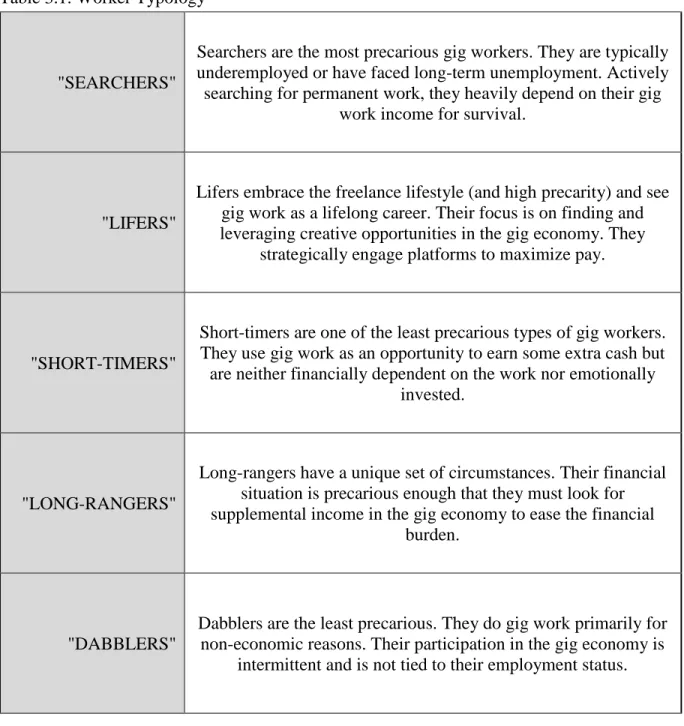
In Chapter 3, I focus on gig workers. I propose a typology of gig workers that more clearly demarcates how gig work is being used and find that workers can be classified into five distinct categories. Chapter 3 establishes that there is distinct variation in workers’ motivations for completing gig work, which in turn, becomes an important point of differentiation when assessing the job quality of gig work.
The job quality of gig work, then, is my focus for Chapter 4. I build on both the typology of platforms and the typology of gig workers to understand how workers’
differences are mediating and/or moderating the worker experience and workers’ stance on job quality in the gig economy.
In Chapter 5, I investigate the consequences for workers who are leveraging technology in ways that may change their migration decisions. Digital platforms are dramatically lowering the barriers of entry to work, and I investigate whether this new reality is influencing workers’ migration decisions. On a related note, online digital platforms are facilitating a virtual migration of labor by allowing workers to find and complete work from beyond their local labor market. Thus, this virtual labor migration (that is, the “migration” of labor into the virtual world) is creating independent labor markets, and I explore the implications of
location-independent labor markets for migration itself. Lastly, online freelance platforms are creating a form of privileged migration for higher-skilled workers — a phenomenon that I call “geographic sovereignty,” which is the main focus of the remainder of the chapter.
CHAPTER 2. TYPOLOGY OF PLATFORMS
“The digital revolution is far more significant than the invention of writing or even of printing.” -Douglas Engelbart
Introduction
Work in the gig economy operates within a historically unprecedented work ecosystem. In this system, digital platforms function as the engines, brokering work between employers (who effectively function as customers) and the workers themselves, by connecting the two parties; facilitating the labor exchange; and processing the financial transaction. The astonishing growth of internet access and the widespread adoption of smartphones has enabled platform “companies” to reach workers easily and efficiently. Yet strangely, no hard figures exist about the number or sizes of such platforms; instead, the focus is always on revenue, percent labor market shared, or number of workers.
Regardless of category, however, all are forecasted to grow. One estimate projects revenue to exceed $330 billion by 2025,25 representing as much as 40% of the labor market workforce.26 A conservative estimate of the number of platforms offering gig work would be in the several-hundreds range; I suspect the number is in the thousands, and many of these are niche sites that focus on a very specific type of work, worker, or task.
Building on the platform categories introduced by Kalleberg and Dunn (2016), I introduce a typology of platforms that demarcates the key differences between them. In doing
25 https://www.entrepreneur.com/article/253070
so, I hope to elucidate how specific characteristics might affect workers’ choice of platform, with workers essentially sorting themselves into platforms by type (Chapter 3); I will explain the role that platforms’ characteristics play in job quality (Chapter 4); and I will illuminate how such characteristics might influence workers’ migration decisions (Chapter 5). First, though, I simply begin the current chapter with an in-depth look at these platforms and introduce a typology that establishes the key characteristics by means of which they sort into types: there are crowdwork platforms, rideshare and transportation platforms, delivery and task platforms, and online freelance platforms (Kalleberg and Dunn 2016). Based on the typology, I identify two key attributes — wages and control — that differentiate them. These attributes, in turn, become important indicators of job quality in the gig economy (which are examined in depth in Chapter 4.). The final portion of this chapter describes the methodological underpinnings of the project.
Platform Typology
Within the new digital-platform ecosystem of work, the majority of work plays out within one of four platform categories: crowdwork, rideshare and transportation, delivery and task, and online freelancing (Kalleberg and Dunn 2016). Building on these categories, I researched platforms in each category, in-depth, to learn about their operations, policies, processes and key characteristics. First, I compiled a list of the largest platforms in each category. I then
findings for each platform category, and my interpretations of key areas of differentiation between platform categories.
Key Platform Characteristics
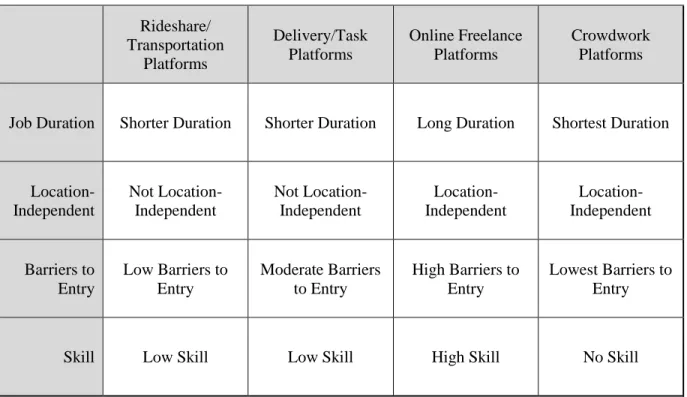
I argue that four key characteristics serve as important differentiators between the platform categories:
1. job duration — the length of the gig or task on the platform.
2. location-independence — where the work happens: does it require you to be physically present, or is it completely possible to accomplish and deliver the work online?
3. barriers to entry — the ease with which workers can find and begin completing gigs on the platform, and the speed with which revenue can be available. 4. skill — the skill(s) required to complete work successfully on the platform Each platform category comprises a unique combination of these characteristics that add up to a distinct profile for each platform category within the typology. In turn, these four characteristics become important drivers in defining two attributes of job quality in gig work: control and wages. To understand how control and wages might influence job quality, it is important first to understand the characteristics behind these attributes.
Rideshare and Transportation Platforms
Rideshare and transportation platforms are perhaps the most widely known of the gig economy platforms, mostly because of Uber and Lyft. These types of platforms are
transparency in how work is allocated. Job duration is short and workers tend to take many jobs (rides) in succession. There is little variation in a typical rideshare and transportation job. The worker logs into the platform, the platform sends a job to the worker (pick up a customer), the worker completes the job (drives the customer to their final destination), the platform executes the financial transaction.
Uber is the exemplar of this kind of gig job — hence, the popularity of the term
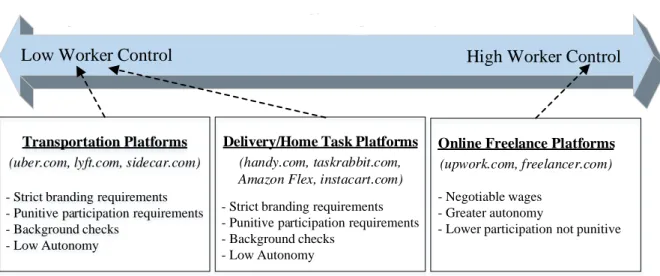
“uberization” (of the economy). Exerting considerable control over the terms of the employment relationship, Uber decides what a driver charges for each job he/she takes; indeed, Uber has lowered fares without any recourse for its drivers. Recently, the company cut fares by 15%, which means that drivers received a 15% cut in pay for each drive, and an even higher cut for longer drives, as fares were not cut uniformly. Specifically, the base fare (the amount the meter starts at) dropped from $3.00 to $2.55 (17%) and the per-mile rate fell from $2.15 to $1.75 (23%). The per-minute rate (when the driver is idling or waiting) fell from $0.40 to $0.35 (14%). Even the minimum fare fell from $8.00 to $7.00 (14 percent).27 While these changes happened overnight, Uber has cut its fares by 35% over a two-year period, which has resulted in
significantly longer hours for workers — and increased wear and tear on their vehicles— all in drivers’ efforts to earn the same amount they did two years ago.
On top of their substantial control over earning potential, rideshare platforms also have strict policies regarding work/service quality, as measured by customer rating. Poor ratings can lead to a restriction in the amount of work available to a driver, or even terminate the driver’s work if his/her customer ratings are deemed “unacceptable.” On these platforms, however, the threshold for “unacceptable” is shrouded in secrecy.
Furthermore, in addition to monitoring jobs taken and declined (data obtained as a byproduct of their job allocation function), rideshare platforms are often tracking much more regarding their drivers. For instance, Uber monitors its drivers’ behind-the-wheel habits, including acceleration, braking, and turns, and in some instances even the driver’s smartphone use frequency while driving.28
Typically, these platforms don’t penalize infrequent drivers; workers are able to log in and begin working, and log out and stop, without any reason to fear being kicked off the platform for doing so. Many rideshare and transportation platforms, though, do attempt to influence their drivers by offering incentives for frequent driving. For example, drivers may be given bonuses for number-of-rides-given during a specific time window, or for number-of-hours-actively-accepting-rides during a given time period. These platforms also use variable pricing to incentivize logging in and/or working longer hours. Lyft, for example, introduces “Prime Time” pricing during times of higher demand, in hopes of motivating drivers either to log in or to continue driving (if they were already on the road).
For this platform type, barriers to entry are low. To be eligible for work with a rideshare platform, for example, one need only have a qualifying vehicle, car insurance, and have had a valid state license for at least one year. Then, upon application, the driver is subjected to a background check and a vehicle inspection, and according to Uber, the driver can usually begin offering rides within 7 days.29 Furthermore, once a driver begins working, pay is almost
immediate, via direct deposit.
28 https://www.wsj.com/articles/ubers-app-will-soon-begin-tracking-driving-behavior-1467194404
Delivery and Task Platforms
Delivery and task platforms share many of the same characteristics as transportation platforms, but they vary enough in key characteristics that separating them is important. While completing tasks and delivering goods seem like two very different activities, I have chosen to combine these platform types because, at the root of the work involved, they are very similar, in that a large portion of delivery platforms are essentially task-driven: personal shopping
operations. In such a model, a customer orders items from a store (e.g., grocery store, drug store), and a gig worker then goes to the store to purchase the items that said worker ends up delivering. So, while these are called “delivery” jobs, many are nonetheless task-driven. It is important to note, however, that this is the platform category with the greatest variability.
Like rideshare and transportation platforms, delivery and task platforms are
geographically tied to a locale, and they are highly branded. Workers are core components of the brand (For instance, workers are called “taskers” on taskrabbit.com.) and are highly managed on set metrics. Metrics might include, for example (as on taskrabbit.com), a worker’s availability, job response rate (in terms of time it takes to respond), rate of jobs accepted, and customer ratings. On these platforms, workers are almost all subjected to background checks, and many companies also conduct face-to-face interviews; hence, barriers to entry can be higher than rideshare and transportation platforms. Moreover, transparency with respect to how work is allocated tends to be limited.
skill level doesn’t differentiate workers from those on rideshare and transportation platforms. Lastly, there is slightly more wage flexibility for these workers, as many task sites allow them to set their own hourly wages or fixed prices for jobs.
Delivery and task platforms also use customer ratings as an important metric for
assessing the quality of work/service. On many of these platforms, the penalty for low customer ratings is severe — expulsion from the platform — with little-to-no recourse. Delivery and task platforms also penalize workers for turning work down by kicking them off temporarily,
restricting their visibility to prospective clients, and/or limiting their access to additional gigs. In some cases, platforms even hide the details of a job until after it has been accepted, in order to prevent workers from turning down jobs they might personally feel are insufficiently lucrative.
Finally, the barriers to entry for delivery and task platforms are moderate. Since many of the gigs require workers to enter customers’ homes, background checks are common, in addition to face-to-face interviews. Some platforms even require the new worker to shadow a current worker to understand the process. Such preparatory measures take time, rather than allowing for an instant start with paid work; depending on the particular platform, in fact, the time investment required for mere entry can be fairly significant.
Online Freelance Platforms
Platforms in this category are quite different from those in others; these platforms
explicitly market the idea that workers are independent contractors or freelancers, and they allow workers to set and negotiate their own wages, differentiate themselves through their portfolios, take competency tests, and rate their own employers/clients. Workers can turn down work without penalty, and there are clear mechanisms for disputing work and pay. Typically, workers are hired on a project basis, so the jobs tend to be relatively long in duration.
Upwork (formerly oDesk) is just such a platform. On the site, employers offer jobs that are relatively highly-skilled and remunerated compared to other gig jobs. Workers have
considerable autonomy in how they conduct their work. At the same time, Upwork, like most other platforms of the gig economy, exerts considerable control over the terms of the
employment relationship: Upwork can (and has) abruptly change(d) its terms fee structure without notice. It also monitors their communication with clients to ensure platform users’ adherence to policies.
Despite the advantages of higher pay and greater autonomy, however, the barriers to entry for online freelancers tend to be the highest in the gig economy. While the vetting of the worker (e.g., background checks and interviews) are not as common as in gig work that entails face-to-face interaction with clients, online freelancers usually experience a longer wait before they can begin earning revenue. Online freelancers are expected to compose detailed
profiles/portfolios and sometimes even take tests that demonstrate their competency before they may begin competing for work or receiving profile views and/or work offers from prospective clients. Meanwhile, the fact that many other workers already have positive customer reviews and established reputations on the same platform(s) means that the competition for paid work itself can be time-consuming for online freelancers.
Crowdwork Platforms
The term “crowdsourcing” is relatively new, first used in 2006 by a Wired magazine author (Jeff Howe) to describe the phenomenon of “outsourcing work to the crowd on the
internet.”30 This term did not even appear in the dictionary until 2011.31 However, Howe (2006) gave the first established definition: “the act of taking a job once performed by a designated agent (an employee, freelancer or a separate firm) and outsourcing it to an undefined, generally large group of people through the form of an open call, which usually takes place over the Internet.” This is this basic concept on which the crowdwork platforms are based.
Like many of the gig economy platforms, crowdwork platforms allow employers to post “jobs” or “microtasks,” and the platforms facilitate the completion of these projects. Conducted by a collective of workers, microtasks are small, short-duration activities completed on a one-off
basis while adding up to a larger result, both in practical and financial terms. One worker may complete hundreds to thousands of microtasks in a given week. Alternatively (or concurrently), he or she might complete an identical task for the same employer numerous times (for example, entering an address into a web form, from a picture of a business card). All crowdwork is done online, making these platforms location-independent.
Given job duration and wage-for-tasks on crowdwork platforms, specialized skills are not a prerequisite for taking employment with them. The duration of the tasks is short, and the corresponding pay is extremely low; the majority of tasks are compensated at under $0.10.32 Research has shown that the majority of crowdworkers currently make less than minimum wage, with a recent estimate suggesting their hourly pay is around $2.00 (Boudreau 2015). Similarly, in my own recent, original survey of over 900 crowdworkers, in which I examined workers’ wages, I discovered that workers are earning between $1.00 – $2.00/hr.33 Not surprisingly, crowdwork platforms wages’ are the lowest of all.
The most widely known such platform is Amazon’s Mechanical Turk (mturk.com). Once a worker (a.k.a. a “turker”) registers on mturk.com, he/she is able to begin completing Human Intelligence Tasks (HITs) immediately. Thus, barriers to entry are very low. Upon the worker’s completion of a HIT, the employer (a.k.a. requester) determines whether to approve the work and is given 30 days after the HIT’s completion to pay the amount. The employer decides either to approve (and pay) the worker for the HIT or to reject the HIT; in the latter scenario, the worker has little recourse.
Amazon’s Mechanical Turk does not determine whether or when to approve or reject HITs itself, and it refers workers to talk with their employers directly in the event of pay disputes; in such disputes, Amazon does not intervene. The platform also makes certain tasks available only to workers who meet specific criteria (identified by categories such as “master status” and number of jobs completed). Many of these criteria, like “master status,” are shrouded in secrecy, with no stated benchmarks or information on how to attain such a designation.
Table 2.1. Platform Typology
Rideshare/ Transportation Platforms Delivery/Task Platforms Online Freelance Platforms Crowdwork Platforms
Job Duration Shorter Duration Shorter Duration Long Duration Shortest Duration
Location-Independent Not Location-Independent Not Location-Independent Location-Independent Location-Independent Barriers to Entry
Low Barriers to Entry
Moderate Barriers to Entry
High Barriers to Entry
Lowest Barriers to Entry
Skill Low Skill Low Skill High Skill No Skill
Selection of Platforms for Analysis
The platform categories discussed above show distinct differences on several
characteristics, including wage and job duration, with crowdwork platforms having significantly lower wages than the other platform categories. Besides the disincentive of crowdwork
United States will not opt for crowdwork platforms. In fact, as key research questions for the current study surround workers’ career strategies and wages on crowdwork platforms averaging between $1.00 – $2.00/hr, I make the assumption that workers will not consider crowdwork platforms. As such, I have purposely excluded crowdwork platforms from my sampling frame and recruitment and therefore from the remainder of my analysis.
Dimensions of Job Quality – Control and Wages
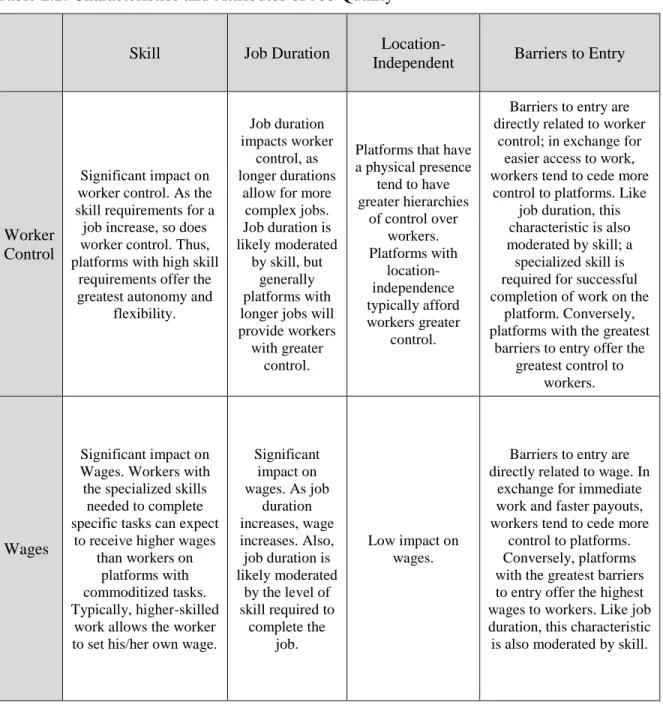
I find that control and wages are functions of the four key platform characteristics outlined above: skill, job duration, location-independence, and barriers to entry. Since each platform category comprises a unique combination of these four characteristics, this means that each category will, accordingly, vary in control and wages. In the following section, I examine how these characteristics affect control and wages, in order to understand better how overall job quality differs between platforms.
Control and wages are important attributes in assessing job quality. Objectively, high worker control and high wages would be considered good job attributes. Depending on the platform, workers have varying levels of control over their schedules; autonomy with respect to how and where work is performed; freedom to accept (or reject) work on their own terms; and degree to which the worker is affiliated with and required to conform to the platform’s identity.
Table 2.2. Characteristics and Attributes of Job Quality
Skill Job Duration
Location-Independent Barriers to Entry
Worker Control
Significant impact on worker control. As the skill requirements for a
job increase, so does worker control. Thus, platforms with high skill
requirements offer the greatest autonomy and
flexibility.
Job duration impacts worker
control, as longer durations
allow for more complex jobs. Job duration is likely moderated
by skill, but generally platforms with longer jobs will provide workers with greater
control.
Platforms that have a physical presence
tend to have greater hierarchies
of control over workers. Platforms with location-independence typically afford workers greater control.
Barriers to entry are directly related to worker
control; in exchange for easier access to work, workers tend to cede more
control to platforms. Like job duration, this characteristic is also moderated by skill; a specialized skill is required for successful completion of work on the
platform. Conversely, platforms with the greatest
barriers to entry offer the greatest control to
workers.
Wages
Significant impact on Wages. Workers with the specialized skills needed to complete specific tasks can expect
to receive higher wages than workers on
platforms with commoditized tasks. Typically, higher-skilled
work allows the worker to set his/her own wage.
Significant impact on wages. As job
duration increases, wage increases. Also, job duration is likely moderated
by the level of skill required to
complete the job.
Low impact on wages.
Barriers to entry are directly related to wage. In
exchange for immediate work and faster payouts, workers tend to cede more
control to platforms. Conversely, platforms with the greatest barriers to entry offer the highest wages to workers. Like job duration, this characteristic is also moderated by skill.
Control
through these platforms generate revenue and gig workers are identified by the platforms with which they’re associated, employers (i.e., platforms) have a clear stake in maintaining their brand. Hence, control over the content and timing of work becomes a major feature of the employment relationship. Control has several dimensions: control over what one does on the job (autonomy); control over when the job is done (flexibility); and control over how the job is done (policy).
Autonomy and Flexibility
Some platforms have very specific regulations about how their workers should complete gigs, while others give their workers wide latitude. The level or type of skill required to complete a gig usually plays a role. Online freelance platforms, for example, have relatively high-skilled gigs, such as writing software code or other creative tasks. These jobs afford workers much greater autonomy in completing their jobs, compared to that which is offered on other types of platforms. Furthermore, online freelance workers negotiate and determine timelines and
deliverables directly with their clients and are not restricted or required to be logged in or active; this type of autonomy is not available to workers in other platform categories.
As an example of how suspensions might be triggered and enacted, one prominent delivery platform operates through a “shift”-based model wherein workers sign up for shifts and commit to work during blocks of time. Drivers are allowed to “pause” only three times during a shift. They initiate a “pause” by indicating in the app that they are not available to accept a delivery at the current time. Once a driver on “pause” is ready, they can “unpause” and resume with accepting deliveries during the remainder of their shift. However, if the driver chooses to pause for a fourth time during the shift, he/she is not allowed back on the app to accept deliveries for 24 hours.
Some platforms punish workers who decline work by hampering their visibility or access to additional jobs. In the case of one task platform, this is done by displaying such workers lower in the search results while placing those who take more jobs higher in the list. Finally, to
dissuade workers from turning down jobs that are not convenient, many delivery and rideshare platforms display the location of the delivery or ride only after it has been accepted. For workers in large cities such as San Francisco, New York, or Los Angeles, traffic and gridlock are
important considerations; an inability to know the final destination can have severely
problematic consequences for these workers when they are paid only a flat fee for their services with no consideration of the time and/or date they are rendered. However, of course, the inability to receive any work at all is also an undesirable consequence; hence, many workers on such platforms feel pressured to accept such conditions.