A God in the Mechanism: German Language Theater and the Atomic Bomb, 1945-65
Patrick Stephenson Lang
A dissertation submitted to the faculty at the University of North Carolina at Chapel Hill in partial fulfillment of the requirements for the degree of Doctor of Philosophy in the
Carolina-Duke Graduate Program in German Studies.
Chapel Hill 2019
Approved by:
Jakob Norberg
Richard Langston
Inga Pollmann
Aleksandra Prica
©2019
ABSTRACT
Patrick Lang: A God in the Mechanism: The German Language-Theater and the Atomic Bomb, 1945-65
(Under the direction of Jakob Norberg)
This dissertation compiles and analyzes postwar theatrical representations of the nuclear threat to
show how German-language theater strove to establish an aesthetic and political program
adequate to a post-fascist, Cold War age. Drawing on more than 25 atomic plays written between
1945 and 1965, the dissertation demonstrates that competing aesthetic paradigms—the
aesthetically conservative director-dominated theater (Intendantentheater), burlesques and grotesques, socialist realism, and the documentary drama—incorporated the threat of
technological destruction, manifested in the Cold War arms race, to articulate conflicting
positions on the viability of a completely secular society. Skirting obvious geopolitical issues,
the atomic plays treated the atomic bomb as the symbol of a new technological unfreedom in a
society stripped of religious authority and comprised a discourse on the prospect of
re-establishing human agency. The dissertation examines eight works in depth: Max Frisch’s Die Chinesische Mauer, Curt Langenbeck’s Der Phantast, Carl Zuckmayer’s Das kalte Licht, Alfred Gong’s Zetdam: Ein Satyr-Spiel, Friedrich Dürrenmatt’s Der Erfinder and Die Physiker, Rolf Schneider’s Prozess Richard Waverly and Heinar Kipphardt’s In der Sache J. Robert
Oppenheimer. Analyzed across the 20 years of their relative prominence, the atomic plays evince a loose developmental trajectory. Experimental attempts to render the atomic bomb stageable in
the 1940s gave way to a tendency toward classical dramatic principles in the 1950s via the
so-called physicist dramas were in decline. Their dominant theme, a binary setting religion and
agency against technology and determinism, were undermined in tragi-comic works. In the
1960s, the documentary drama reframed the question of agency and the atomic bomb as an
institutional, rather than primarily moral issue. Viewed collectively, the atomic plays evince the
evolving cultural and political expectations of the postwar and the unique formal problems the
ACKNOWLEDGEMENTS
I’d like to thank my committee members past and present for their valuable insight,
including Dick Langston, Gabe Trop, Aleksandra Prica, Inga Pollmann, Tin Wegel and Jonathan
Hess. Of course, the guidance I have received from my dissertation advisor, Jakob Norberg, has
been invaluable.
Exchanges between Duke University and the Freie Universität Berlin, as well as between
Duke University and the Universität Potsdam, made much of the research for this dissertation
possible. I appreciate the warm welcome I received from Jürgen Brokoff, Andreas Degen and the
members of their colloquia, and I am grateful to Matthias Warstat and his theater course for
helping introduce me to Berlin’s contemporary theater scene.
I would also like to thank my friends and colleagues at the Carolina-Duke Program in
German Studies, both for individual feedback and feedback in the colloquia. I am thankful for
the help of friends outside of the university as well, who provided early encouragement and
TABLE OF CONTENTS
INTRODUCTION: THE ATOMIC PLAYS AND THE PHYSICIST DRAMAS ... 1
The Atomic Play and the Physicist Drama... 3
Interlocutors ... 9
Argument ... 16
Chronology ... 23
Chapters ... 29
CHAPTER ONE: EARLY SOLUTIONS TO THE ATOMIC FORM PROBLEM. MAX FRISCH’S DIE CHINESISCHE MAUER AND FRIEDRICH DÜRRENMATT’S DER ERFINDER ... 34
Radium, oder Der freie Wille des Selbstmörders: Max Frisch’s Die Chinesische Mauer ... 42
Friedrich Dürrenmatt’s Der Erfinder ... 65
CHAPTER TWO: “DIE ZEIT DES HEILIGEN UNGEHORSAMS.” THE PHYSICIST DRAMA ON THE EXAMPLE OF CURT LANGENBECK’S DER PHANTAST AND CARL ZUCKMAYER’S DAS KALTE LICHT. ... 85
Curt Langenbeck’s Der Phantast as a model of spiritual reinvigoration ... 98
Carl Zuckmayer’s Das kalte Licht: Welcoming Home a Prodigal Son ... 120
CHAPTER THREE: “DER SIEG DES GEISTES ÜBER DEN UNGEIST DER MATERIE”? THE IMPLOSION OF THE SPIRIT IN ALFRED GONG’S ZETDAM AND FRIEDRICH DÜRRENMATT’S DIE PHYSIKER. ... 139
„Ich bin Sein Schreiber“: Alfred Gong’s Zetdam Guts the Physicist Drama ... 142
An Anthropomorphism of the Apparatus: Dürrenmatt’s Die Physiker... 160
CHAPTER FOUR: “POLITISCHE EXEMPEL.” THE ATOMIC STATE IN ROLF SCHNEIDER’S PROZESS RICHARD WAVERLY AND HEINAR KIPPHARDT’S IN DER SACHE J. ROBERT OPPENHEIMER. ... 192
Heinar Kipphardt’s In der Sache J. Robert Oppenheimer ... 224 CONCLUSION ... 249
LIST OF TABLES
INTRODUCTION:
THE ATOMIC PLAYS AND THE PHYSICIST DRAMAS
On April 6th, 1945 the United States dropped an atomic bomb on Hiroshima in Japan;
three days later they dropped a second such bomb on Nagasaki. The cities were leveled and tens
of thousands were killed in the initial blasts. Thousands more suffered from radiation poisoning,
slowly dying in their hospital beds. All told, more than 200,000 people were killed in the
attacks.1 According to the American government, the nuclear bombing was a military necessity
aimed at quickly ending the war in the Pacific, and the bombings saved the American military a
long, perilous, and expensive ground invasion of Japan—in terms both of dollars and of troops.
Critics argue, however, that Japan was already at the brink of surrender: The civilian deaths of
Hiroshima and Nagasaki resulted from American generals’ gusto to try out their new weapon and
their concern that the Soviet Union, having overcome the war on its western front, would now
turn its attention eastward and, under the guise of aiding its American ally, would in truth be
vying for partial control of Japan at the war’s end.2 If, as this suggests, the dead of Hiroshima
and Nagasaki were the first collateral victims of a still tentative Cold War, it would soon be
1 Writing on the death toll of the bombings of Hiroshima and Nagasaki, Andrew Rotter notes the necessity of
accounting for all who lost their lives while acknowledging that “the dispute over numbers is somehow obscene.” His estimates allow for a degree of error: “In August 1946, a year after the bombings, the Information Department of the Hiroshima City Office estimated that 118,661 civilians and approximately 20,000 military personnel had died to that point. Among the hurt were 30,524 rated as ‘seriously injured’ and another 48,606 as ‘slightly injured.’ Many of those in the first category presumably died subsequently of their injuries. In Nagasaki the toll seems to have been around 70,000 killed, virtually all of them non-combatants. It is perhaps worth recalling that some 90,000 were killed in incendiary raids on Tokyo in the spring of 1945.” (Andrew Rotter, Hiroshima : The World’s Bomb
(Oxford ; New York: Oxford University Press, 2008), 222.)
evident that the future of nuclear weapons would be determined by this emerging conflict
between the US and USSR entirely. In 1949 the US atomic monopoly was broken as the Soviets
tested their first bomb. Competition intensified from there. In 1953 both countries tested
hydrogen bombs for the first time, and they worked intently throughout the 50s to increase their
kilotonnage and improve their delivery systems.
The first atomic bomb projects, carried out in the United States and United Kingdom,
however, were motivated neither by Japan nor by the Soviet Union, but by the fearful possibility
that the Nazi Germans were working on such a project themselves. The possibility of an
artificially induced chain nuclear fission reaction had been most directly discovered by Otto
Hahn and Lise Meitner working in Dahlem, a suburb of Berlin, in 1938. As exiled scientists
living in the US came to understand that this could lead to an atomic bomb, they petitioned
Western governments to pursue its invention as a deterrence to Hitler’s tentative bomb—
eventually leading to the Manhattan Project.3 At the end of the war in Europe, it became apparent
that the Nazis had not considered such a project necessary for the war effort. Still, the role
German scientists played in making the bomb possible (and the related myth of the conscientious
objector scientist), paired with Germany’s new position in the Cold War, meant that the ground
was fertile for intent discussion of atomic weapons in German-speaking countries in the postwar.
The year 1949 brought the formal division of Germany as the eastern German Democratic
Republic and the western Federal Republic of Germany, each assigned to its respective position
in the Cold War divide. These divisions intensified as each Germany initiated rearmament and
3 For a journalistic account of the international scientific community in the first half of the 20th century: cf. Robert
became increasingly integrated into respective military blocs—the North Atlantic Treaty
Organization and the Warsaw Pact—in 1955. If there were to be another war, it became clear,
Germany would be the battlefield and Germans would be shooting at one another. Raising the
stakes, the CDU government under Adenauer sought to bring nuclear-capable missiles to the
Bundeswehr as part of rearmament. Popular opposition to the plan developed into the first
autochthonous popular political movement in the Federal Republic, Kampf dem Atomtod, with which many German activists, artists, scientists and religious figures associated themselves. By
the mid-1950s, several German scientists became active participants in the anti-atomic
movement, taking on the role of public intellectuals and educators. For example, in 1955, Otto
Hahn held a widely-received radio address warning of the dangers of such weapons.4 Famously,
in 1957, a group of eighteen respected Göttinger scientists, many of whom were Nobel Prize
Laureates, signed the Göttinger Erklärung in opposition to the Adenauer administration’s nuclear ambitions.5 Given the salience of atomic weapons in every day discourse, it follows that
they would leave a mark on artistic production as well.
The Atomic Play and the Physicist Drama
Given the salience of the atomic bomb in the German-language public discourse, it is not
surprising that it became an important topic in the theater as well. German-language studies of
the plays that address the atomic bomb generally call them by one of two names: the “atomic
play” (Atomstück)or the “physicist drama” (Physiker-Drama). This study uses both terms and
distinguishes them in a loose typology. The atomic play is the broader term. It encompasses all
4 cf. Ilona Stölken-Fitschen, Atombombe und Geistesgeschichte. Eine Studie der fünfziger Jahre aus deutscher Sicht., Nomos Universitätsschriften Kulturwissenschaft 3 (Baden-Baden: Nomos, 1995), 109–10.
works written for theater that deal with the issue of the atomic bomb and the threats associated
with it, regardless the specific approach taken to the topic—whether the work presents military
and government officials, researchers, or other figures of a wide variety of identities and
relationships to the atomic bomb: fishermen and sailors, gangsters, fairies, bourgeois
bunker-dwellers, and gods. The term encompasses a wide range of formal approaches as well: analytical
drama, epics and station plays, a sketch, a cabaret number, a documentary drama and other stage
works. One can arguably include some radio plays among these, too. The atomic drama simply
names the preoccupation with a pervasive concern or theme of the postwar period, the menace of
the nuclear bomb.6
The physicist dramas, more narrowly defined than the atomic plays, address the atomic
bomb and present a physicist as either their protagonist or their antagonist. Commentator
Klaus-Detlef Müller has described the term “Physiker-Drama” as “deskriptiv und pragmatisch,” rather
than concerned with any specific “poetologisch[e] Ansprüche,”7 meaning that the term describes
the material inspiring the genre’s plots, rather than the aesthetic and formal decisions made by
their authors. This practical approach can be useful. However, this study will argue that the
physicist drama emerged as it did because of formal issues inherent in the selection of the atomic
bomb and arms race as dramatic material in the 20th century. The popularity of the physicist
6 While their form and content vary widely, it is notable that in contrast to a work like Friedrich Dürrenmatt’s short
story Der Winterkrieg in Tibet6 (from the mid-late 1940s)or Arno Schmidt’s 1957 novel Gelehrtenrepublik6 none
of the German-language atomic plays written before 1968 are set in a world post-nuclear apocalypse. This can in-part be attributed to the time required for the understanding of atmospheric radiation to be publicly understood. The fact that prose forms such as the novel and short story could turn to the post-apocalypse, but theater found it difficult, can likely be attributed, to theater’s concern with the possibility of human action—in this case, action toward the prevention of mass extinctions, of mass annihilation. See: Friedrich Dürrenmatt, “Der Winterkrieg in Tibet,” in Der Tunnel und andere Meistererzählungen (Zürich: Diogenes, 2011), 161–238.; Arno Schmidt, Die Gelehrtenrepublik: Kurzroman aus den Rossbreiten (Karlsruhe: Stahlberg, 1957).
7 Klaus-Detlef Müller, “Brechts Leben des Galilei und die Folgen - Physiker als Gegenstand literarischer Phantasie,”
drama amongst playwrights resulted from the continuing desire (and/or inherent demand) to
render one’s material stageable according to the precepts of drama: i.e., to contextualize it firmly
in a plot presenting an interpersonal conflict between an embodied protagonist and his or her
antagonists. However, the material of the atomic bomb is not necessarily appropriate for
representation through drama. Compounding matters, this small segment of theatrical history
took place in an age that questioned the possibility of individual agency, as central such a
concept is to the classical dramatic form. Throughout its period of relative salience, the authors
of the physicist dramas struggled to transform the material of the atomic bomb and arms race
convincingly dramatic, but their efforts are collectively worth examining as an example of the
transformations taking place in the theater of the postwar. This study will show that the thematic
material and the selected form never quite cohered over two decades of theater development and
that the lack of a fully dramatic correspondence generated successive solutions, each one
departing from and seeking to transform the preceding one.
Most of the secondary literature to address the German-language atomic plays and
physicist dramas as a literary phenomenon concentrates on a small set of works by relatively
well-known authors. These works include: Bertolt Brecht’s Leben des Galilei (1943/45), Max Frisch’s Die Chinesische Mauer (1946/55), Carl Zuckmayer’s Das kalte Licht (1955), Friedrich Dürrenmatt’s Die Physiker (1962) and Heinar Kipphardt’s In der Sache J. Robert Oppenheimer
(1964). Occasionally, secondary literature considers further works as well. As stated, however, it
is not merely my intention to provide an encompassing theory of the atomic play, but to
demonstrate its development over time. Therefore, I have identified and accessed as many
atomic plays as possible. This search took place via varied means, including the existing
histories of the 1950s, key word searches on online databases (for example, WorldCat), and
advice from colleagues. Occasionally, luck intervened as well.
As a result of such research, this dissertation has taken as its starting point a larger corpus
of atomic plays and physicist dramas than any study preceding it. The corpus consists of 24
pieces written for the stage, some of which also had televised versions or audio versions, as well
as 7 radio plays. The stage works are the focus of this study. They represent of a variety of
formal genres, including dramas (adhering in varying degrees to the analytical ideal), station
dramas, epics, a cabaret theater sketch, a cabaret number, a political cantata, and others. In my
research, I was restricted first and foremost by theme and by linguistic category: the significance
of nuclear weaponry and the German language. My research turned up works by authors living
both in East and West Germany, in Switzerland, Austria, the Alsace, and, in the case of Alfred
Gong, an author from the Bukovina who in the meantime had moved to New York and yet
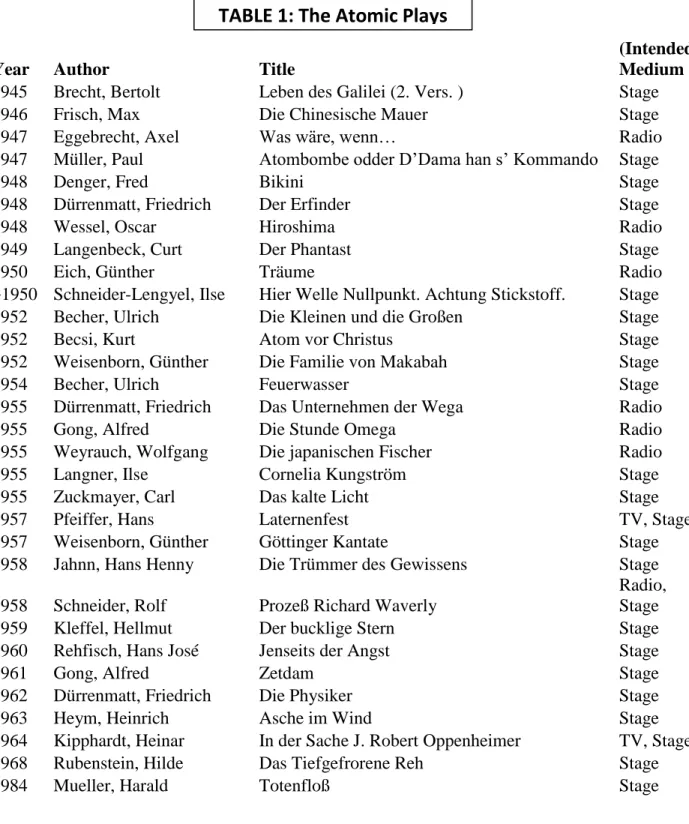
continued to write in German.8 The titles and authors of these plays are listed in the appended
table “The Atomic Plays.”
8 Of course, atomic plays were written in other languages as well. The atomic plays of the English-Language theater
have been addressed, for example, by Charles Carpenter. (Charles A. Carpenter, Dramatists and the Bomb :
American and British Playwrights Confront the Nuclear Age, 1945-1964 (Westport, Conn: Greenwood Press, 1999). Many prominent British and American playwrights wrote plays about or commented on the atomic bomb, including Upton Sinclair and a partial draft by George Bernard Shaw. Several British playwrights contributed to the anti-atomic movements in the United Kingdom in the late 1950s and early 1960s, including David Compton’s A View from the Brink, which was performed at the Easter March 1960, J.B. Priestly’s Doomsday for Dyson, and David Mercer The Climate of Fear. (cf. Raimund Kurscheid, Kampf dem Atomtod! Schriftsteller im Kampf gegen eine deutsche Atombewaffnung, Hochschulschriften Gesellschafts- und Naturwissenschaften 84 (Cologne: Pahl-Rugenstein, 1981), 227–28.) Finally, it is worthwhile to mention a late English contribution to the thematic cluster that can be considered both a physicist play and, though stylistically unique from them, an heir to the best of the earlier German atomic plays: Michael Frayn’s Copenhagen, which premiered 1998 in London and in 2000 in New York. The play draws on the trope of memory debate and reconstruction. The voices of Niels and Margrethe Bohr, as well as of Werner Heisenberg, debate and reconstruct the meeting that took place between Bohr and Heisenberg in 1941, as Bohr’s Denmark was under Nazi occupation and Heisenberg had remained loyal to the German
Year Author Title
(Intended) Medium
1945 Brecht, Bertolt Leben des Galilei (2. Vers. ) Stage
1946 Frisch, Max Die Chinesische Mauer Stage
1947 Eggebrecht, Axel Was wäre, wenn… Radio
1947 Müller, Paul Atombombe odder D’Dama han s’ Kommando Stage
1948 Denger, Fred Bikini Stage
1948 Dürrenmatt, Friedrich Der Erfinder Stage
1948 Wessel, Oscar Hiroshima Radio
1949 Langenbeck, Curt Der Phantast Stage
1950 Eich, Günther Träume Radio
~1950 Schneider-Lengyel, Ilse Hier Welle Nullpunkt. Achtung Stickstoff. Stage
1952 Becher, Ulrich Die Kleinen und die Großen Stage
1952 Becsi, Kurt Atom vor Christus Stage
1952 Weisenborn, Günther Die Familie von Makabah Stage
1954 Becher, Ulrich Feuerwasser Stage
1955 Dürrenmatt, Friedrich Das Unternehmen der Wega Radio
1955 Gong, Alfred Die Stunde Omega Radio
1955 Weyrauch, Wolfgang Die japanischen Fischer Radio
1955 Langner, Ilse Cornelia Kungström Stage
1955 Zuckmayer, Carl Das kalte Licht Stage
1957 Pfeiffer, Hans Laternenfest TV, Stage
1957 Weisenborn, Günther Göttinger Kantate Stage
1958 Jahnn, Hans Henny Die Trümmer des Gewissens Stage
1958 Schneider, Rolf Prozeß Richard Waverly
Radio, Stage
1959 Kleffel, Hellmut Der bucklige Stern Stage
1960 Rehfisch, Hans José Jenseits der Angst Stage
1961 Gong, Alfred Zetdam Stage
1962 Dürrenmatt, Friedrich Die Physiker Stage
1963 Heym, Heinrich Asche im Wind Stage
1964 Kipphardt, Heinar In der Sache J. Robert Oppenheimer TV, Stage
1968 Rubenstein, Hilde Das Tiefgefrorene Reh Stage
1984 Mueller, Harald Totenfloß Stage
My study is limited to a short period of dramaturgical writing between 1945 and 1965,
that the popularity of the atomic play follows the trajectory of the first ‘crescendo’ of the nuclear
arms race, from the bombing of Hiroshima and Nagasaki in 1945, through the development of
the hydrogen bomb by the US and USSR in 1953, intensifying at the very beginning of the 1960s
and calming following the signing of the nuclear test-ban treaty in 1963.9 This period includes
important, tense developments specific to Germany, including the Berlin Air Lift, the
rearmament of both East and West Germany, and the efforts of the Adenauer Government to arm
the Bundeswehr with nuclear-capable missiles, evoking a broad peace movement. After 1964,
the bomb becomes a less significant theme for new dramatic writing in Germany. Later
documentary dramas, such as Peter Weiss’s Viet Nam Diskurs (1968) and Rolf Hochhuth’s
Soldaten (1967) include references to the atomic bomb, but do not concentrate on it, instead including it as one element in a broader discourse on civilian targets in air wars.10 Atomic plays
written in German after 1964 are few and far-between. I have only identified Hilde Rubenstein’s
TiefgefrorenesReh (1968) and Harald Mueller’s Totenfloß (1986). Notably, these are distinct
9 cf. Stölken-Fitschen, Atombombe und Geistesgeschichte, 1995, 146–47. According to Stölken-Fitschen, following
relatively recent crises including the construction of the Berlin Wall (1961), the Bay of Pigs Disaster (1961), and the Cuban missile crisis (1962), as well as a period of rapid hydrogen bomb tests reaching phenomenal kilotonnage, the Limited Test Ban Treaty, which banned surface testing of nuclear armaments, provided a “psychologische Zäsur.” As she writes: “Dies fand ihren sichtbaren Ausdruck darin, daß die Herausgeber des Bulletin of Atomic Scientists die berühmte Uhr [the doomsday clock] auf dem Cover [of their magazine] wieder zurückstellten. Zum einen schien damit die radioaktive Verseuchung der Atmosphäre gebannt, zum anderen – und dies war der entscheidende Punkt – war mit dem Verschwinden der täglichen Bilder von Atompilzen am Horizont die atomare Bedrohung gleichsame unsichtbar geworden. Die Gefahr durch die Bombe, nicht mehr sinnlich wahrnehmbar oder am eigenen Leib zu spüren, wurde wieder zu einer abstrakten. Angesichts der gleichzeitig einsetzenden zaghaften Ansätze einer Entspannungspolitik verschwand die Bombe dann auch vorläufig aus der öffentlichen Debatte.” From this
perspective, one can argue that dramatists ceased producing new atomic plays largely because the atomic bomb had become less salient in daily discourse. Of course, this did not interrupt the success of Kipphardt’s In der Sache J. Robert Oppenheimer in 1964 or, in the United States, of the films Dr. Strangelove and Fail-Safe, both also released in 1964. (Stanley Kubrick, Dr. Strangelove or: How I Learned to Stop Worrying and Love the Bomb, Comedy, 1964; Sidney Lumet, Fail-Safe, Drama, Thriller, 1964.)
10 Peter Weiss, Diskurs über die Vorgeschichte und den Verlauf des lang andauernden Befreiungskrieges in Viet Nam als Beispiel für die Notwendigkeit des bewaffneten Kampfes der Unterdrückten gegen ihre Unterdrücker sowie über die Versuche der Vereinigten Staaten von Amerika die Grundlagen der Revolution zu vernichten
from the other atomic plays in that they imagine the wasted world following the radioactive
apocalypse, rather than the intrigues and deliberations of actors hoping to prevent it.11
Interlocutors
Several valuable assessments of the atomic plays and physicist dramas already have been
written. To address these, however, it is necessary to first briefly reflect on the work that has
widely been viewed as the initial physicist drama, Bertolt Brecht’s Das Leben des Galilei.12
While Brecht’s Leben des Galilei was originally written in 1938 and 39, before the invention of
the atomic bomb, the second version of the play, completed in collaboration with Charles
Laughton in California and later translated back into German, was rewritten in response to the
atomic bomb specifically.13 At the play’s end, Galileo implicitly addresses the physicists of the
20th century:
Ihr mögt mit der Zeit alles entdecken, was zu entdecken gibt, und euer Fortschritt wird doch nur ein Fortschreiten von der Menschheit weg sein. Die Kluft zwischen euch und ihr kann eines Tages so groß werden, daß eure Jubelschreie über irgendeine neue
Errungenschaft von einem universalen Entsetzenschrei beantwortet werden können. – Ich hatte als Wissenschaftler eine einzigartige Möglichkeit. In meiner Zeit erreichte die Astronomie die Marktplätze. Unter diesen ganz besonderen Umständen hätte die Standhaftigkeit eines Mannes große Erschütterungen hervorrufen können. Hätte ich widerstanden, hätte die Naturwissenschaftler etwas wie den hippokratischen Eid der Ärzte entwickeln können, das Gelöbnis, ihr Wissen einzig zum Wohle der Menschheit anzuwenden!14
11 Hilde Rubinstein, Tiefgefrorenes Reh: Stücke, Lyrik, Prosa, 1. Aufl, Dialog (Berlin: Henschelverlag, 1987);
Harald Mueller, “Totenfloss,” Theater heute, 1986.
12 This tendency is for example reflected in the title of Klaus-Detlef Müller’s article on the subject, which poses the
atomic plays to follow Galileo as its direct descendants. (Müller, “Brechts Leben des Galilei und die Folgen - Physiker als Gegenstand literarischer Phantasie.”)
13 cf. Heinz Geiger, Widerstand und Mitschuld. Zum deutschen Drama von Brecht bis Weiss (Düsseldorf:
Bertelsmann Universitätsverlag, 1973), 69–70.
The statement, made after Galileo has succumbed to the threat of torture and recanted his studies
supporting the Copernican system, places a pressure on scientists to follow something like the
“Hippocratic Oath” for their own discipline—that, in contrast to the previous commandment of
science, contributing to knowledge for knowledge’s sake alone—future scientific research must
be oriented toward the good of mankind, reinventing a displaced humanist paradigm for the 20th
century. At the same time, Galileo’s words place disproportionate emphasis on the significance
of his individual act of resistance; if he alone had resisted the Catholic Church’s pressures to recant, he could have “summoned great tremors.” By this he means that the moral action of a
single individual; the resistance of a single rational being to a corrupt regime, has the capacity to
make a significant impact on the future development of the world.
In a 1962 essay, Hans Meyer outlined the foundational tension within the genre of the
physicist dramas via a comparative analysis of Bertolt Brecht’s Galileo and Friedrich
Dürrenmatt’s Die Physiker. The basis of this comparison lies in the tension field between the possibility that an individual might make an active, positive intervention in the fate of mankind
and the impossibility of doing so. As Mayer notes, the arguments presented in this play reflect
Brecht’s belief in “die Möglichkeit verantwortungsvollen Handelns: nicht bloß im Jahrhundert
des Galilei, sondern auch in der Lebenszeit des Bertolt Brecht.“15 In contrast, Dürrenmatt’s Die Physiker rejects this possibility. Drawing on Dürrenmatt’s 21 Points, a series of thesis that accompany Die Physiker, Mayer argues that the play demonstrates that “Opfer des Einzelnen sind heute sinnlos. Der Einzelne kann die Welt weder durch Opfer erlösen noch durch sein
Denken und Handeln von Grund auf verändern, und sei er selbst der größte Physiker der
15 Hans Mayer, “Dürrenmatt und Brecht oder die Zurücknahme,” in Über Friedrich Dürrenmatt, ed. Daniel Keel,
Menschheitsgeschichte.”16 In other words, the days in which individuals can have an influence
on world development are long past. Thus he identifies the fundamentally counterpoised models
of human agency in these plays: one promotes the belief that individual action can have
influence in world affairs; the other rejects this notion. Without acknowledging that Brecht’s
Galileo and Dürrenmatt’s Physiker factor into a range of plays addressing similar themes, Mayer nevertheless formulated the basis of later descriptions of the physicist drama as a thematic
genre—they are arguably about agency.17
In 1968, Joanne Hines Talbot’s investigation of five major “Atomdramen” described the
thematic genre of atomic plays and identified their major parameters. The dissertation expands
the field of atomic plays: it discusses Bertolt Brecht’s Das Leben des Galilei, Carl Zuckmayer’s Das kalte Licht, Heinar Kipphardt’s In der Sache J. Robert Oppenheimer, Friedrich
Dürrenmatt’s Die Physiker, and Hans Henny Jahnn’s Die Trümmer des Gewissens. Talbot
acknowledges the common questions of these plays, starting from the fundamental distinction
between scientific research pursued as an activity in its own right and scientific research pursued
for the improvement of mankind’s position. This distinction raises further issues, including the
collective nature of modern scientific research, the scientist’s lack of control over future
16 Mayer, 78.
17 Regarding later works, I am referring to Klaus-Detlef Müller (Müller, “Brechts Leben des Galilei und die Folgen -
Physiker als Gegenstand literarischer Phantasie.”), whose interpretation draws on Charbon explicitly, the chapter on drama in Ilona Stölken-Fitschen (Stölken-Fitschen, Atombombe und Geistesgeschichte, 1995, 215–28.), which concentrates on the way that Kipphardt’s play contributed to the myth of the conscientious objector scientist in Germany, and concludes with a comparison between the three dominant physicist plays: “Aber anders als Kipphardt und auch als Brecht will Dürrenmatt die Welt mit seinem Stück nicht zum Positiven verändern, er liefert dem Zuschauer nur eine Analyse des Weltzustandes, in der die ‚schlimmstmögliche Wendung‘ (21 Punkte) bereits eingetreten ist.“ Franz Norbert Mennemeier concentrates on Brecht and Dürrenmatt, much to the same end, however, he also acknowledges more explicitly than other authors the chronological distance between Brecht and Dürrenmatt (“die Erfahrung einer Generation”) and suggests that Dürrenmatt’s pessimistic worldview had already been on the rise amongst authors in the 1950s. (Franz Mennemeier, Modernes deutsches Drama : Kritik und
applications of their discoveries, and the tensions displayed between the scientists and the
political configuration in which they work.18 Talbot acknowledges, however, that each of the
concerns presented here is significant foremost in its relationship to the individual responsibility
of the scientist. And while these plays generally suggest that their scientist-protagonists will have
to reconsider their dedication to the principle of the “scientific contribution” at the expense of
ethical considerations,19 the plays ultimately propound, Talbot concludes, that “one can only
speak of the ‘responsibility of the scientist’ in a limited sense. It is a problem that belongs to all
of society, not to the scientists alone.”20 In this respect, Talbot identifies the same argumentative
poles as Mayer, but organizes them in the realm of the sciences specifically.
Following Talbot, the 1970s saw two important contributions to the study of the physicist
dramas. In Widerstand und Mitschuld, zum Deutschen Drama von Brecht bis Weiss, Heinz Geiger’s chapter on the physicist dramas significantly expanded the number of plays considered
by contrasting the plays based on historical precedents to those “freely invented” by the author;
i.e. Brecht’s Das Leben des Galilei and Kipphardt’s In der Sache J. Robert Oppenheimer in
opposition to everything else. The distinction between historical and freely invented materials
helped to outline what might be viewed as the standard form of the physicist drama genre. In
this, an invented dramaticconflict develops out of the personal opposition between scientists
18 These topics had already been discussed occasionally, for example, in reviews of individual plays in German
theater magazines, especially following the premiere of Dürrenmatt’s Die Physiker. Talbot’s reference to Theater und Zeit from 1962 is just one example of the theater magazine’s and feuilletons’ attention of the themes she
discusses. (cf. Joanne Hines Talbot, “The Theme of ‘the Scientist’s Responsibility in the Nuclear Age’ in
Contemporary German Drama.” (Diss., Boston University, 1968), 6.) Nonetheless, Talbot’s dissertation constitutes the earliest comparative investigation of the genre.
19 cf. Talbot, 222. Talbot features several quotations that reflect the scientists’ dedication to the “wissenschaftlicher
Beitrag,” a phrase borrowed from Brecht’s Das Leben der Gallilei.
who support and who oppose the further development of nuclear technologies. Geiger
acknowledges the difficulty of transforming the material of the physicist and atomic bomb into a
strictly dramatic form, but he dismisses nearly all physicist dramas as inferior—with the
exception of those by Dürrenmatt, Brecht, and Kipphardt—without adequately investigating why
their authors have chosen their respective formal approaches.21
Finally, the appearance of Geiger’s chapter was closely followed by Rémy Charbon’s Die Naturwissenschaften im modernen deutschen Drama in 1974. The book opens with detailed historical background information on the role the sciences play in the 20th century, integrated
thoroughly into the sphere of geopolitics, while concentrating on the atomic bomb. Charbon’s
most significant contribution to the discussion of the atomic plays is his acknowledgement of the
concept of Sachzwänge, or practical constraints.22 The production of an improved weapons system places pressure on rival geopolitical actors to match and outmatch these improvements.
What Charbon terms the “Eigengesetzlichkeit des technischen Fortschritts,” is, in the given
context, concerned primarily with military hardware. Nonetheless, its implications for life in the
20th century are far-reaching:
Die Entsinnlichung und zunehmende Unüberschaubarkeit unserer Umwelt, die Ohnmacht gegenüber einem selbstgeschaffenen Apparat, dessen einzelne Teile sich allmählich verselbstständigen, und die daraus resultierende Vorherrschaft der von vermeintlichen Sachzwängen motivierten Verwaltungsbürokratie über die politische, dem Volk verantwortliche Führung.23
21 cf. Geiger, Widerstand und Mitschuld, 94 f. In addition to works by Brecht, Kipphardt, Dürrenmatt, Zuckmayer
and Jahnn, Geiger integrates valuable descriptions of Günther Weisenborn’s Die Familie von Makabah, Hans José Rehfisch‘ Jenseits der Angst, Kurt Becsi’s Atom vor Christus and Curt Langenbeck’s Der Phantast and analyzes them collectively to establish a concept of the atomic plays based on “freely invented materials.” Geiger, 86–89.
22 Rémy Charbon, Die Naturwissenschaften im modernen deutschen Drama (Zürich; München: Artemis Verlag,
1974), 27. Charbon’s study is somewhat more inclusive than Talbot’s, including, in addition to those works
discussed by Talbot, brief considerations of Georg Kaiser’s Gas and Rolf Schneider’s Prozess Richard Waverly. His work concentrates on Brecht, Dürrenmatt and Frisch.
The same practical constraints that feed the development of the Cold War manifest in all aspects
of political life. As matters concerning human collective decision-making are ceded to an
incomprehensible and complex, albeit man-made, environment and to the technocrats,
democratic politics decline and detach from practical decision-making.24 This leads Charbon to
an important reinterpretation of Dürrenmatt. As he writes “[Zu Dürrenmatts] These, was alle
angehe, könnten nur alle lösen, erfindet er eine Handlung, die jede Lösung ausschließt.”25 As a
result, as Charbon effectively articulates, the discursive axis of the physicist dramas takes place
between two poles:
Einerseits das Wissen um biologische, historische und soziale Determinationen, dramatisch fruchtbar gemacht seit Ibsen und den Naturalisten, anderer seits das erstarkende Selbstbewußtsein des Menschen, die Überzeugung, daß «Schicksal» nicht verhängt, sondern von Menschen gemacht also von Menschen gestaltbar sei.26
Such an assessment effectively leaves the interpretation of Brecht untouched, but significantly
reinterprets Dürrenmatt. This constitutes an important turn from the initial thesis posed by Mayer
and Talbot: The question is less one of “to whom does responsibility belong—the physicists or
the politicians?” and it is not even merely, despite the misleading indications of Dürrenmatt’s 21
Punkte, one of “to the physicists or to society?” It is far more fundamental, and perhaps more familiar—a question of the possibility of responsibility and agency itself. Can one, as Brecht claims, intervene in the world at all? Alternatively: To what degree, as is argued in Die Physiker, is one conditioned by and trapped in the apparatus, thoroughly enclosed, such that one cannot in
any reasonable degree take action that would intervene in the unfolding pressures of the current
system of political, social and economic relations that define the world?
24 Charbon, 30.
25 Charbon, 230.
The contributions of Mayer, Talbot, Geiger and Charbot are all important to the
interpretation of the atomic plays and physicist dramas, and they cumulatively formulate the
relevant and central question of agency in these works. They have identified the problem: the
issue of agency and drama in the age of the nuclear bomb. However, none of these authors has
adequately and comprehensively studied the problem of the nuclear bomb as an issue for drama
in historical context, through its changes in the 20th century; they neglect drama’s formal
dimension and ignore the wide variety of formal-dramatic solutions provided over two decades.
The approach I take in my dissertation therefore first significantly increases the number of works
taken into consideration and then also analyzes them in chronological order in terms of the
formal problems which arise when attempting to stage the bomb in the theater. As I argue, the
early atomic plays—those of the 1940s—largely represent an experimental effort to represent the
issues of impotency and psychological anguish in the face of the bomb—often at the expense of
the dramatic principle. The plays of the 1950s employ the figure of the physicist to produce a
more convincingly “dramatic” form, propping up the notion of individual responsibility—as I
will show—through the exploitation of a religiously-tinted immaterial/material divide. But this
approach soon withers along with the principles of classic drama. In the late 50s and early 60s,
new works arrive which reject the physicist dramas of the 1950s, sometimes appearing to parody
them, at other times rejecting dramatic principles outright in favor of a more politically
deliberative atomic play. In this dissertation, the atomic play emerges as an evolving generic
field, in which solutions to a difficult aesthetic and formal problem—how to stage nullified
agency in the age of the nuclear bomb—arise and are superseded by other solutions, which turn
Argument
The atomic bomb’s treatment in the context of German-language theater results from
several factors. Its content is influenced by the role German scientists played in advanced
research into nuclear mechanics—contributing to the possibility of nuclear weapons.
Simultaneously, the popular myth of the German physicist as conscientious objector helped as
well. The popularity of this myth is fueled in-part by another factor influencing the treatment of
the atomic bomb in the German theater: the discourse on German guilt and responsibility
following the Second World War and the Holocaust. This discussion debated the relationship
between individual and collective guilt for the crimes of Nazism; concepts of individual and
collective guilt, as well as the possibility of moral action in a system of oppressive disciplinarity
were widely discussed and readily available for interpretation within related contexts such as the
nuclear sciences.27 The widespread belief that German scientists had quietly but resolutely
sabotaged the government’s efforts to develop an atomic weapon provided a welcome counter to
discourses of mass complicity in Nazi crimes.28 And then, the new political developments of the
27 Ralf Trinks notes that the theater, alongside the newspapers, served as an important medium for the discussion of
German guilt in the early postwar. However, the stage was most often concerned with the release of Germans from guilt rather than honest Auseinandersetzung: “Zwar gab es eine intensive Auseinandersetzung mit der
Vergangenheit, doch blieb diese im Wesentlichen auf das Kriegserlebnis beschränkt. Der Reflexion über Strukturen und Ursachen des Nationalsozialismus wich man auf diese Weise aus, die Deutschen erschienen als Opfer des Hitler-Regimes. Ihre Schuld resultierte weder aus politischer Mitverantwortung noch aus individueller Beteiligung an den NS-Verbrechen, sondern war in ihrem Überleben zu suchen.“ (Ralf Trinks, “‘Schuldlos schuldbeladen’: Entlastungsstrategien und Schuldbekenntnis in der frühen Nachkriegsdramatik,” in Schuld und Sühne? :
Kriegserlebnis und Kriegsdeutung in deutschen Medien der Nachkriegszeit (1945-1961) : internationale Konferenz vom 01.-04.09.1999 in Berlin, ed. Ursula Heukenkamp, Amsterdamer Beiträge zur neueren Germanistik 50 (Amsterdam; Atlanta, GA: Rodopi, 2001), 226, https://find.library.duke.edu/catalog/DUKE003073554.) Trinks notes that these plays had a tendency to describe the Nazi-Regieme as if it were an irresistible natural force: “Das ‘Dritte Reich’ wurde dämonisiert, als Naturkatastrophe oder Schicksalsprüfung, als unüberwindliche Macht dargestellt. Man versuchte zu beweisen, daß Widerstand unmöglich gewesen war und bestritt damit die eigene Verantwortung.“ (Trinks, 219.) The physicist drama has a similar starting point—the Cold War and the arms race are beset by practical necessities; the scientist’s hand often appears forced, if not by the government, then by other historical determinants. In its concern for a future catastrophe, however, the atomic play shows that the protagonist can at least attempt to take a moral standpoint and rise above political and historical forces.
28 Stölken-Fitschen has noted that Werner Heisenberg first introduced the idea that the German atomic scientists
1940s-1960s, most significantly the gradual rise of autochthonous political movements in West
Germany around environmental concerns (including atmospheric radiation) and both the
rearmament of the Bundeswehr and its tentative armament with nuclear capabilities play a role as
well.29 There were, in other words, a host of interlinked historical factors and political
developments that served to focus German discourse on the atomic bomb.
Simultaneously, certain aesthetic, philosophical and ideological considerations played a
role in the treatment of the atomic bomb in German-language theaters. Despite the ruinous state
of their theaters, Germans, with the approval of the occupying forces, took to organizing
theatrical entertainments with gusto following Stunde Null.30 Nonetheless, the era of Nazi rule
had interrupted Germany’s relationship to the avant-garde theater of the rest of the world. Its
expressionists had been run out of the country and their works destroyed; it would take some
time before they returned, and longer yet before Germany would redevelop its own modern
als Tausend Sonnen in 1956: “Im Gegensatz zu den amerikanischen Wissenschaftler, die mit aller Energie an der neuen Waffe gearbeitet hätten, obwohl sie – in einem freien Land lebend – keinen staatlichen Zwängen ausgesetzt waren, geraten die deutschen Atomphysiker zu moralischen Helden” who had followed their consciences to resist the construction of the atomic bomb. In reality, Stölken-Fitschen notes, the German physicists were in fact never faced with the prospect of such a project due to “fehlenden Möglichkeiten und Mittlen.” (Stölken-Fitschen,
Atombombe und Geistesgeschichte, 1995, 216.)
29 Although the environmentalist movement would not come into full swing in Germany until later, Frank Uekötter
acknowledges individual, localized precursors to the movement already that emerged in the 1950s, including, for example, opposition to a dam project in the Wutach Gorge in the Black Forest and activism to protect the Knechtsand (a “nondescript sandbank in the estuary of the Weser”) from becoming a Royal Air Force bombing range. (cf. Frank Uekötter, The Greenest Nation?: A New History of German Environmentalism, 2017, 60–65.) The anti-atomic movement and its concerns about atmospheric radiation gave budding German environmentalism a global aspect, especially following the “Lucky Dragon V” incident, in which a Japanese fishing ship, working outside of the restricted zone, was irradiated with fatal and economically catastrophic effects following a U.S. hydrogen bomb test in the Pacific. (cf. Uekötter, 76–77.) For a discussion of German literature in the context of the anti-nuclear movement, see: Kurscheid, Kampf dem Atomtod! Notably, only few of the dramatists considered for this dissertation were directly involved in the Kampf dem Atomtod! movement: Wolfgang Weyrauch (Die
japanischen Fischer, 1955) and Günther Weisenborn (Die Familie von Navada, 1952/58; Göttinger Kantate, 1958).
30 See, for example: Hans Daiber, Deutsches Theater seit 1945 [i.e. neunzehnhundertfünfundvierzig] :
theatrical movements: As Franz Mennemeier has noted, “bis in die sechsziger Jahre ist modernes
Theater in Deutschland, jedenfalls in der Bundesrepublik, so gut wie identisch mit
ausländischem Theater.”31 The dominant modern theater of the postwar period was comprised
largely of imports represented in names such as Jean Anouilh, Tennessee Williams and Samuel
Beckett.32 In this way, the dramatic treatment of the atomic bomb was influenced by wider
European and international aesthetic and ideological trends, but also, importantly, by Germany’s
exclusion from aesthetic developments during the period of National Socialist rule, affecting the
tone and the theatrical devices that would be implemented by the country’s practitioners.
The Atomic Bomb as Problematic Material for the Drama
In contrast to other studies, this dissertation begins from the position that the atomic
bomb and the physicist both constitute problematic material for the formal demands of the
theater. It is not, I should say, the purpose of this study to impose an outdated prescriptive
aesthetics on the form of the drama—especially writing today, in an era where post-dramatic and
directorial theater is so thoroughly engrained as to nearly elide the formal principle of drama
entirely. Nonetheless, reference to a prescriptive formal ideal of classical drama provides a
backdrop before which one can compare theatrical works. Additionally, even if the classical
precepts of dramatic construction were well in decline by the mid-20th century, there were
nevertheless still tendencies toward them and they still had their proponents in the 1950s. (The
lasting strength of this formal ideal, despite movement toward new theatrical forms in the 20th
century, is reflected in articles written in the late 1940s in the postwar theater magazine, Theater
31 Mennemeier, Modernes deutsches Drama, 2: 1933 bis 1970er Jahre:124.
32 cf. Friedrich Michael and Hans Daiber, Geschichte Des Deutschen Theaters, 1. Aufl. (Frankfurt am Maim:
der Zeit, to be discussed in Chapter 2.) A quotation from Peter Szondi helps to outline the core of the classical dramatic conception.
Das Drama der Neuzeit entstand in der Renaissance. Es war das geistige Wagnis des nach dem Zerfall des mittelalterlichen Weltbilds zu sich gekommenen Menschen, die
Werkwirklichkeit, in der er sich feststellen und spiegeln wollte, aus der Wiedergabe des zwischenmenschlichen Bezuges allein aufzubauen. Der Mensch ging ins Drama
gleichsam nur als Mitmensch ein. Die Sphäre des ›Zwischen‹ schien ihm die wesentliche seines Daseins; Freiheit und Bindung, Wille und Entscheidung die wichtigsten seiner Bestimmungen.33
Several key ideas are expressed in this short statement. The origin of the drama in the
renaissance implies its relationship to an emerging secular humanism, in which mankind in
general and the individual human being in particular stands at the center of the European
worldview. It is in this context that it becomes possible to establish the drama as the artwork per
se that depicts—in Szondi’s definition, at its very core—the space of interaction between human
beings, of their will and decision-making power, as it contrasts to the wills and acts of others.
Given this formal precept, the atomic bomb presents a problem to the requirements of classical
dramatic form. The atomic bomb is only dramatic in a limited sense. Most of the people who live
under the threat of a future nuclear war, or in its aftermath, do not experience the bomb as the
direct outcome of their actions. It can only with difficulty constitute the object of the relations
between individuals. At best, it presents the hazy and threatening background of future
destruction, entering the experience of individuals through no identifiable action of their own
(and therefore in most cases interrupting, rather than contributing to a unity of action).
Due to the need to present social and systemic issues in terms of interpersonal conflict,
very often the physicist and his opponents formed the basis for the conflict in the atomic play:
Hence the physicist drama. In the physicist one can establish a clear hero or villain—sometimes
both—, but in any case a single focal figure and therefore, when opposed by a protagonist or
antagoinist—dramatic conflict. And yet this, too, presents its own formal issues, foreseen by
Gustav Freytag in his 1863 treatise on the technique of the drama, long before the invention of
the atomic bomb. Freytag explicitly warned his readers against the otherwise seductive
inclination to select the artist, the thinker, or—importantly—the inventor as the primary protagonist of the drama. There were several issues at hand in such a process, some stemming
from audience unfamiliarity or bias toward the chosen figure.34 Most significantly, however,
such figures are likely to lack “stageability,” due to their association with visually unrenderable
“inwardstruggles”35 As Freytag claimed,
the making use of anecdotes from the life of such great men, the meaning of which does not show itself in the action but in the non-representable activity of their laboratory, is intrinsically right undramatic. The greatness in them is non-representable; and what is represented borrows from a moment of his life lying outside the piece.36
In other words, the most important contributions of such a figure could not be represented
dramatically. While an internal motivation may be included in drama, it cannot be the main idea
of a drama. As Freytag notes, the drama presents a struggle. Though with “strong perturbations
of the soul,” the protagonist takes action and faces opposing forces which “must be made visible
34 First, if the audience did not know the historical figure, Freytag reasoned, it would be necessary to introduce him
or her through extensive, non-dramatic expositional materials. Second, if the audience was familiar with the figure, the play would be doomed to sink or swim not on its own merits, but on account of the audience’s preconceived personal views on the validity of that figure as a subject of the work. (cf. Gustav Freytag, Technique of the Drama; an Exposition of Dramatic Composition and Art. (B. Blom, 1968), 68–69.) The necessary inclusion of expositional materials is notably apparent, and interestingly executed, both by Brecht in Galileo and Zuckmayer in his
fictionalization of Klaus Fuchs. It is perhaps telling that both authors choose to use epic, rather than dramatic forms to present their respective figures. In a sense, a similar approach is true in Kipphardt’s In der Sache J. Robert Oppenheimer, in the sense that, in this play, action is generally replaced by deliberatively presented material on the life of the inventor.
35 Freytag, 68.
in a human representative.”37 The process of thought, of research, of lonely hours spent pouring
over books, pen and paper, experimental hardware, alone in the workshop, or even working
collectively as a team to produce a new instrument or gizmo simply does not contain, at least
when taken alone, material capable of being rendered in dramatic representation. Such material
does not include the moment of the deed in human interaction the contest of embodied wills. The
suffering conscience of the implicated physicists can only become dramatic when they are forced
to disclose this suffering conscience or high ideals through actions they take in opposition to
those who would force them to do otherwise. Despite Freytag’s warning, the physicist as
physicist was the most common solution to the formal issue of the atomic bomb. And his
concerns often prove true as well: the physicist dramas and the atomic plays more generally tend
toward discourse and deliberation, declamation and description, even where they successfully
invent dramatic plots. In the atomic plays and the physicist dramas, as deeply and centrally
preoccupied with the possibility of human action as they may be, the actual dramatic display of
human action is almost marginalized by discourse on the atomic bomb.
Crisis and Hope in the Search for Agency
The issue of material selection is compounded by a further issue: the less human beings
believe in the possibility and efficacy of collaborative or individual action, the less possible it is
to create drama in the classical sense intended by Szondi and Freytag. A disillusioned view of
the efficacy of human action is not the best premise for a playwright wanting to follow the
precepts of dramatic action in a theatrical production. Drama had to contend with a pervading
sense of nihilism and the difficulty of the individual in achieving agency in a 20th century that
often appeared to have ceded it to concepts of the mass, mechanical determinism, behaviorism,
or political necessity. The atomic plays and physicist dramas remain eminently concerned with
the problem of a perceived decline in human agency throughout all these phases of their
development. This was a broader issue of the theater, related to the historical relationship
between dramatic form and human action. A perceived decline in human agency via the
prominence of the mass and of the scientific analysis of individual behavior had already
registered in the theater in the 19th and early 20th centuries. The naturalism of Gerhardt
Hauptmann’s Vor Sonnenaufgang (1889)and Die Weber (1892) touched upon the issue of the drives and the mass respectively, and expressionist plays such as Georg Kaiser’s Gas II (1920) and Ernst Toller’s Masse-Mensch (1921) further address a form of human being reduced to a
product of nature and nurture, a natural or mechanical force in a broader apparatus or determined
universe. Arguably, the sharp turn toward the externalization of interiorities in expressionist
drama, as well as demands for the “New Man,” constituted an often frantic effort to reestablish
the notion of will and agency in the individual against the backdrop of mechanistic or biological
determination.38 The physicist drama of the 1950s occasionally draws on similar energies toward
similar ends: now with the possibility that human beings, if they allow themselves to be subject
to this determination, can only expect that they will bring about their own extinction by atomic
bomb. At the same time, however, it carries notions of rejuvenation of humanity helped through
mixed humanist intentions, religious transcendence and, on occasion, elements of nuclear
38 For a discussion of this development, see: Paul Edward Wyler, “Der ‘Neue Mensch’ im Drama des deutschen
physics—such as the difficulty of predicting natural nuclear decay and Heisenberg’s uncertainty
principle—which promised to overthrow ideas about determinism inherited from classical
mechanics.39 As a result, the atomic plays constantly examine the tensions between determinism
and free will.
Chronology
The acceptance of the physicist drama’s formal solution changes over the roughly twenty
years of the atomic play’s relative prominence. As such, this study has a historical scope. It
posits an incubation period of greater variety in imagining solutions to the formal issue of the
atomic bomb in the 1940s and early 1950s. Just to illustrate the variety of works in this category,
one can reflect on Max Frisch’s Die Chinesische Mauer (1946, the topic of the first chapter), Fred Denger’s Bikini (1948), Ilse-Schneider Lengyel’s Hier Welle Nullpunkt. Achtung Stickstoff
(most likely late 40s/ early 50s),40 or Ulrich Becher’s Feuerwasser (1954). The last of these, in which a New Yorker barkeep and former champion boxer outpaces a mafia boss with access to
nukes, is perhaps the most successful in combining the atomic material with dramatic form. As
39 The sense of diminished human agency in the mass was compounded by advances in mechanical sciences in the
18th and 19th centuries which had—sometimes inadvertently—provided fodder for materially deterministic
worldviews. Despite Newton’s theological intents, his Principia Mathematica helped promote the possibility of an entirely mechanistic universe, an idea that remained influenced for a long time. This was carried further in the 19th
century, by Pierre-Simon LaPlace at the latest, out of this develops the concept of scientific determinism. If one knew the status and mechanical laws of all things in the universe, he posed, would it not be possible to foresee the unfolding of the entire universe? (cf. Stephen Hawking, A Brief History of Time, 10th Anniversary edition (New York: Bantam, 1998), 55.) If this mathematical predictability is true, why should it not extend to living beings as well, including the human? By the mid-twentieth century, increased knowledge of subatomic particles had helped to put an end to this. The lifespan of the radioactive isotope, which could be conceived statistically in terms of its half-life, but not determined for any one atom of an element (and seemed to exceed determination regardless what observations might be made) helped to slay LaPlace’s demon. Heisenberg’s uncertainty principle, placed limits on the measurements that could be made for the direction and speed of subatomic particles. (cf. Helen Beebee, Nikk Effingham, and Philip Goff, Metaphysics : The Key Concepts (Abingdon, Oxon ; New York: Routledge, 2011), 103.) As a result, the tenability of transposing physics into claims about human will and agency grew increasingly questionable.
40 While I have not been able to ascertain the date at which Schneider-Lengyel wrote this work, it is most likely the
for the others, conversation about the bomb—as will remain central to the atomic plays
generally—displaces dramatic action. Bikini depicts the tense interactions between the crew and passengers of a ship destined for the Bikini islands for witnessing the Operations Crossroads
bombing. There is no clear dramatic plot; the play, rather serves as a canvas for the display of
characters’ anxieties as the onset of the nuclear age. Hier Welle Nullpunkt is a trippy surrealist rollercoaster in which God is put on trial for allowing the atomic bomb to exist (and is rejected
by his son, Jesus), but it, too, lacks dramatic action. Frisch’s play contains a dramatic plot—
between the contemporary protagonist and the ancient emperor Hwang Ti—but only treats the
atomic bomb first and foremost through episodic, declarative, and metaphorical means, rather
than including it in this plot directly. Interestingly, Dürrenmatt’s cabaret number, Der Erfinder, already sets the precedent for his later dramatic treatment of the atomic material in Die Physicist
by not only representing the physicist but treating this physicist as the node of hidden
geopolitical and economic forces. But this is still several years away; in the late 1940s, there
seems to have been no clear consensus on the treatment of the atomic material.
Starting in 1949, a consensus would begin to form in the physicist drama; by the
mid-1950s, a single technique for the staging of the atomic bomb materialized in Germany. The plays
that reflect this consolidation might most properly be collectively referred to as physicist dramas.
These include Curt Langenbeck’s Der Phantast (1949), Kurt Becsi’s Atom vor Christus (1952), Günther Weisenborn’s Die Familie von Navada/Die Familie von Makabah (1952/58), Alfred Gong’s Die Stunde Omega (1955—despite having been conceived as a radio play), Ilse
adhere to classical dramatic forms: unity of time, place and action. They all feature one or more
physicists—generally as the protagonist, occasionally as the antagonist; sometimes as both. In
most instances, this physicist is a nuclear scientist. Where he or she is not, the protagonist’s
science is nonetheless bound to some form of weapon of mass destruction, and therefore
effectively operates as a stand-in for the invention of the nuclear bomb. Most importantly,
however, these plays provide their physicists with unlikely sway over proliferation and
utilization of their discoveries, as well as with antagonists bent on sharing and/or utilizing them.
While Brecht’s Galileo realized the dimension of the scientist’s social responsibility too late to
do anything about it—effectively at the very end of the drama and in retrospect, in these plays
the moment of dramatic action is triggered by the acknowledgment of social responsibility and
the analytical conflict of the drama plays out as a result of this recognition.41 These works’
pursuit of dramatic form and to embodied, staged action requires attention to a reinvigoration of
human agency, which the dramatist tries to resolve through reference to a higher plane of
existence, be it moral, religious or mystical. Recourse to a form of religious thought
reinvigorates the possibility of the soul and therefore independent action. This might save the
human from mere materiality, but the possibility of saving humanity from the atomic bomb is
never left completely free of doubt.
41 This tendency was strong enough that Joachim Kaiser, writing in Theater der Zeit, commented on it in the early
The end of the 1950s and the early 1960s marked a decline in the new production of
physicist dramas. It brought plays that can be read as meta-critiques of the physicist dramas’
adamant recourse to religion or mystical beliefs for the recovery of agency. Here I have in mind
both Alfred Gong’s Zetdam: Ein Satyrspiel (1961) and Friedrich Dürrenmatt’s Die Physiker
(1962). Each of these works expresses an implicit critique of the physicist drama in its own way,
though common to both is the prevalence of comic grotesque themes, as well as a criticism of the
idea that invocations of moral codes, aesthetic processes, or a religious imaginary can help one
overcome the crisis of agency and face down the atomic bomb. Their emergence overlaps with a
turn (or return), in theater, toward what Gong demands and what Dürrenmatt doubts is possible:
theater as an intervention in political life. If the physicist drama’s dependence on moral victory
and political failure is read as a part of the 1950’s broader rejection from political themes, then
the changes taking place in the late 1950s and early 1960’s—perceptible in Günther
Weisenborn’s Göttinger Kantate (1957), Rolf Schneider’s Prozess Richard Waverly (initially
1958) and Heinar Kipphardt’s In der Sache J. Robert Oppenheimer (1964)—help to bring the atomic play more in line with the 1960’s trend toward more explicitly political literature.
Weisenborn’s connections to Kampf dem Atomtod and Schneider’s and Kipphardt’s ideological
proximity to socialist concerns of the German Democratic Republic are evident. Weisenborn’s
play pursued political action by directly petitioning members of the German Social Democratic
Party to reject Adenauer’s plans for nuclear rearmament.42 Schneider’s and Kipphardt’s plays
pursued political influence through fervent critiques of US ideology and nuclear policy and by
educating the public about the history of the atomic bomb (except when Kipphardt deviates from
42 Weisenborn was commissioned to write the piece for the SPD’s Stuttgarter Parteitag in 1957. The succession of
his documentary transcript and puts words in the historical Oppenheimer’s mouth). These plays
have done away with action on the stage in their entirety, and turned entirely to deliberation,
even if this deliberation is presented in an aestheticized or theatrical form.
This study identifies a historically or temporally unfolding morphology in the thematic
genre of the atomic play. The genre originates in sundry, experimental, and uncertain forms. It
finds—for a period—its most stable form in the guise of the physicist drama. These forms are
often specifically dramatic rather than generally theatrical; even where the Aristotelian principles
of unity of time and place are rejected in favor of epic plots, unity of action is generally
maintained, and the conflict are lodged in the space of interactions between humans. This
relationship remains unstable, however. Even as authors seek to discuss moral precepts rather
than specific political events, the physicist drama is bogged down by the need to pontificate on
the real hazard facing the world. Though these dramas present the form of action demanded by
principles of classical drama, they are unable to imagine a form of action that could make a real
intervention in an unfolding world history. Their victories must instead be articulated through a
praise of action regardless of its material efficiency; action instead becomes the watchword for
the reclamation of agency through dedication to a humanist religiosity that separates human
existence from mere materiality. In the late 1950s, the physicist drama therefore collapses due to
the same principles that allowed it to survive in the mid-1950s. The inadequacy of its
moral-aesthetic solution reflects a dissatisfaction with moral moral-aesthetic solutions more generally. This
dissatisfaction is expressed in implicit and explicit commentary within the theater itself, which
critiques the metaphysical appeals of the physicist dramas in favor of real-world, practical
interventions into the arms race and those who pursue it to their own profit (most sharply