CLOSED-LOOP PLANNING AND CONTROL
OF STEERABLE MEDICAL NEEDLES
Sachin Patil
A dissertation submitted to the faculty of the University of North Carolina at Chapel Hill in partial fulfillment of the requirements for the degree of Doctor of Philosophy in the Department of Computer Science.
Chapel Hill 2013
Approved by:
Ron Alterovitz
Jur van den Berg
Ming C. Lin
ABSTRACT
SACHIN PATIL: Closed-Loop Planning and Control of Steerable Medical Needles (Under the direction of Ron Alterovitz)
Steerable needles have the potential to increase the effectiveness of needle-based clinical
proce-dures such as biopsy, drug delivery, and radioactive seed implantation for cancer treatment. These
needles can trace curved paths when inserted into tissue, thereby increasing maneuverability and
targeting accuracy while reaching previously inaccessible targets that are behind sensitive or
impene-trable anatomical regions. Guiding these flexible needles along an intended path requires continuously
inserting and twisting the needle at its base, which is not intuitive for a human operator. In addition,
the needle often deviates from its intended trajectory due to factors such as tissue deformation,
needle-tissue interaction, noisy actuation and sensing, modeling errors, and involuntary patient
motions. These challenges can be addressed with the assistance of robotic systems that automatically
compensate for these perturbations by performing motion planning and feedback control of the
needle in a closed-loop fashion under sensory feedback.
We present two approaches for efficient closed-loop guidance of steerable needles to targets
within clinically acceptable accuracy while safely avoiding sensitive or impenetrable anatomical
structures. The first approach uses a fast motion planning algorithm that unifies planning and control
by continuously replanning, enabling correction for perturbations as they occur. We evaluate our
method using a needle steering system in phantom and ex vivo animal tissues. The second approach
integrates motion planning and feedback control of steerable needles in highly deformable
environ-ments. We demonstrate that this approach significantly improves the probability of success compared
to prior approaches that either consider uncertainty or deformations but not both simultaneously. We
also propose a data-driven method to estimate parameters of stochastic models of steerable needle
motion. These models can be used to create realistic medical simulators for clinicians wanting to
train for steerable needle procedures and to improve the effectiveness of existing planning and control
This dissertation advances the state of the art in planning and control of steerable needles and is
an important step towards realizing needle steering in clinical practice. The methods developed in
this dissertation also generalize to important applications beyond medical needle steering, such as
ACKNOWLEDGEMENTS
I would like to first thank Ron Alterovitz for having me as his student and providing me the
opportunity to pursue the research that led to this dissertation. It has been a privilege to have him
as my advisor. His enthusiasm and love for his research area motivated me to pursue research as a
career. He has been extremely helpful and always gave me insightful feedback on various problems. I
thank him for being patient and having faith in my abilities, and providing me the freedom to explore
things at my own pace, while always coming to the rescue whenever I got stuck or bogged down.
I would like to thank Jur van den Berg for being an excellent mentor to me throughout my PhD,
and extensively collaborating with me on this work. He significantly enhanced my understanding of
fundamental concepts involved in this work and provided a sounding board for my research ideas.
We continue to have very exciting and fruitful discussions.
I would also like to thank Dinesh Manocha and Ming Lin for being on my defense committee
and I am extremely grateful to them for giving me an opportunity to pursue research in graduate
school when I first came to UNC Chapel Hill. This was instrumental in getting me excited about
doing research in the area of motion planning. I would also like to thank Marc Niethammer for being
on my defense committee and for this support and suggestions on how to improve this dissertation.
I thank my colleagues in the Computational Robotics group at UNC Chapel Hill for their
invaluable feedback on this work and presentations over the years: Luis Torres, Wen Sun, Chris
Bowen, and Edgar Lobaton. I would like to thank several close collaborators and co-authors, which
include Robert Webster and Jessica Burgner at Vanderbilt University, Momen Abayazid, Guus
Vrooijink, and Sarthak Misra at University of Twente, and Pieter Abbeel and Ken Goldberg at
University of California at Berkeley. I am also grateful to the other faculty members at UNC Chapel
Hill for their guidance and teaching me the nuts and bolts of doing research. I thank the staff in the
Department of Computer Science, Janet Jones and Jodie Turnbull in particular, for shielding me from
I am also indebted to the many close friends and colleagues for their company, advice, and
constant encouragement throughout my stay in Chapel Hill – Vishal Verma, Vishnu Reddy, Ram
Kumar, Stephen Guy, Luv Kohli, Peter Lincoln, Ryan Schubert, Sean Curtis, Anish Chandak, Jason
Sewall, Nikunj Raghuvanshi. I would also like to thank Anya Derbakova for her support and
encouragement, particularly in the months leading up to my defense. Many thanks to my friends
from California, who had nothing to do with any of the work in this dissertation, but who always
cheered me on and warmly welcomed me back whenever I was visiting – Devsmita Das and Suddha
Basu, Nidhi Parashar and Prashant Baronia, and Priti Kadam and Aditya Prakash.
Finally, and most importantly, I thank my parents, Chandrashekhar and Shubhangi Patil, for
enabling me over all these years, for giving me the wisdom and freedom to choose the path I wanted
TABLE OF CONTENTS
LIST OF TABLES . . . xi
LIST OF FIGURES . . . xii
1 Introduction . . . 1
1.1 Steerable Needle Model . . . 2
1.2 Robotic Needle Steering . . . 4
1.3 Challenges for Closed-Loop Planning and Control . . . 5
1.4 Thesis Statement . . . 7
1.5 Main Results . . . 7
1.5.1 Needle Steering in 3D via Rapid Replanning . . . 7
1.5.2 Data-Driven Stochastic Models for Simulating Steerable Needle Procedures . 8 1.5.3 Unified Framework for Planning and Control in Deformable Environments . . 9
1.6 Organization . . . 10
2 Needle Steering in 3D via Rapid Replanning . . . 11
2.1 Rapid Replanning . . . 11
2.2 Related Work . . . 13
2.3 Objective . . . 17
2.4 Variable Curvature Needle Kinematic Model . . . 18
2.5 Rapid Replanning Approach . . . 21
2.5.1 Motion Planning . . . 21
2.5.2 Optimizing Clinical Metrics . . . 25
2.6 Experimental Setup . . . 27
2.6.1 System Components . . . 27
2.6.2 Tissue Sample Materials . . . 29
2.6.3 Needle Characterization . . . 29
2.7 Experimental Evaluation. . . 31
2.7.1 Evaluation in Tissue Phantoms . . . 32
2.7.2 Evaluation in Tissue Phantoms with Obstacles . . . 33
2.7.3 Evaluation in Ex Vivo Porcine Loin Tissue . . . 34
2.7.4 Evaluation in Anthropomorphic Liver Phantom . . . 35
2.8 Discussion . . . 37
3 Data-Driven Stochastic Models For Simulating Steerable Needle Procedures. . . 40
3.1 Simulating Steerable Needle Procedures . . . 40
3.2 Related Work . . . 43
3.3 Preliminaries and Objective . . . 45
3.3.1 State Representation . . . 45
3.3.2 Stochastic Kinematic Model . . . 46
3.3.3 Stochastic Measurement Model . . . 47
3.3.4 Problem Definition . . . 48
3.4 State Estimation . . . 48
3.4.1 Extended Kalman Filter . . . 49
3.4.2 Extended Kalman Smoother. . . 50
3.5 Expectation Maximization for Parameter Estimation . . . 50
3.6 Parameter Estimation . . . 54
3.6.1 Data Collection . . . 54
3.6.2 Estimated Error Parameters: Sim-Test . . . 55
3.6.3 Estimated Error Parameters: Ex-vivo Porcine Loin Tissue . . . 59
3.7.1 Simulation Results: Sim-Test . . . 63
3.7.2 Simulation Results: ex vivo Porcine Loin Tissue . . . 63
3.8 Discussion . . . 66
4 Unified Framework for Planning and Control in Deformable Environments . . . 68
4.1 Planning and Control in Deformable Environments . . . 68
4.2 Related Work . . . 70
4.2.1 Deformation Modeling and Simulation . . . 71
4.2.2 Motion Planning in Deformable Environments . . . 71
4.2.3 Motion Planning under Uncertainty. . . 72
4.3 Objective . . . 74
4.4 Approach . . . 76
4.4.1 Motion Planning . . . 76
4.4.2 Model Linearization . . . 77
4.4.3 LQG Control . . . 80
4.4.4 Selecting a High Quality Plan . . . 81
4.5 Estimating Probability of Success . . . 81
4.5.1 A Priori State Distributions . . . 83
4.5.2 Truncating A Priori Distributions . . . 86
4.5.3 Estimating the Probability of Collision . . . 88
4.5.4 Validation . . . 89
4.5.5 Discussion . . . 92
4.6 Results . . . 92
4.6.1 Clinical Scenario . . . 95
4.7 Discussion . . . 97
5 Conclusion and Future Work . . . 99
5.3 Future Work . . . 101
LIST OF TABLES
2.1 Comparing cost metrics for needle insertion in Sim-test phantom tissues
and ex vivo porcine loin tissue with virtual obstacles . . . 36
4.1 Comparison of our method with prior methods over100plans in terms of
LIST OF FIGURES
1.1 Anatomical scenario modeling the human male pelvic region for simulating
delivery of radioactive doses to targets within the prostate for cancer treatment . . . 2
1.2 Mechanics of insertion of steerable needle with a pre-bent bevel-tip . . . 3
1.3 Workflow for a clinically viable robotic system for steerable needle procedures . . . 4
2.1 Closed-loop needle steering via rapid replanning . . . 12
2.2 Overview of our rapid replanning paradigm which relies on a fast sampling-based motion planner for closed-loop steering of the needle to the desired target region while avoiding anatomical obstacles . . . 17
2.3 Circular arc connecting the needle tip to a point defined in the local coordinate frame of the needle tip. The needle plan is composed of circular arcs of bounded curvature . . . 19
2.4 Three stages of duty cycled steerable needle insertion . . . 21
2.5 Our needle steering system consists of a needle steering robot, a pre-bent, bevel-tip steerable needle, and an electromagnetic tracking system . . . 28
2.6 Experiments in Sim-Test tissue phantom and ex vivo porcine loin tissue . . . 29
2.7 Characterization of the relationship between the duty cycling parameter for a steerable needle in Sim-Test tissue phantom and ex vivo porcine loin tissue . . . . 30
2.8 Experiments in a cuboidal shaped Sim-Test tissue phantom environment containing virtual obstacles for planning purposes . . . 32
2.9 Comparison of targeting errors using closed-loop steering and open-loop execution for two clinically motivated optimization criteria . . . 34
2.10 Experiments in an ex vivo porcine tissue sample containing virtual obsta-cles for planning purposes . . . 35
2.11 Comparison of targeting errors using closed-loop steering and open-loop execution for two clinically motivated optimization criteria . . . 37
2.12 Our needle steering system with rapid replanning as applied to a scenario motivated by the clinical task of ablating a tumor in the liver while avoiding the hepatic veins . . . 38
3.2 Experimental data in Sim-Test: Normalized histograms showing the
distri-bution of position and orientation errors along each of the axes . . . 58
3.3 Experimental data in ex vivo porcine loin tissue: Normalized histograms
showing the distribution of position and orientation errors along each of the axes . . . . 61
3.4 Evaluation of our method by simulating steerable needle procedures with artificial noise based on our estimated error parameters in a cuboidal
shaped Sim-Test tissue phantom and in an ex vivo porcine loin tissue sample . . . 62
3.5 Comparison of the targeting error using closed-loop, rapid replanning steering and open-loop execution for two clinically motivated optimization
criteria in simulation in Sim-Test material . . . 64
3.6 Comparison of the targeting error using closed-loop, rapid replanning steering and open-loop execution for two clinically motivated optimization
criteria in simulation in ex vivo porcine loin tissue . . . 65
4.1 Motion planning for guiding steerable needles under 2D image guidance: Our unified framework accounts for uncertainty in deformation models, noisy sensing, and unpredictable actuation, results in a significantly higher probability of success in plan execution as compared to current motion
planning solutions . . . 70
4.2 Schematic overview of our unified framework for planning and control
under uncertainty in deformable environments . . . 76
4.3 Model linearization computed numerically using a deformable object simulator . . . 79
4.4 Estimating the probability of success for a motion plan based on a priori
probability distributions of the robot state . . . 82
4.5 Truncating the joint conditional distributions of the robot state with respect
to constraints imposed by obstacles in the workspace . . . 84
4.6 Local convexification of free space and transforming the environment for
truncating the joint conditional distributions of the robot state . . . 89
4.7 Comparison of the probability of collision estimated using our method and
other prior methods for a nonholonomic bevel-tip steerable needle . . . 90
4.8 Plan executions with and without feedback under the influence of actuation noise . . . . 93
4.9 Percentage of successful plan executions of plan chosen by our method consistently outperforms plans that do not simultaneously account for both
uncertainty and deformations . . . 94
4.10 Simulation of needle steering in a plane in the human liver for biopsy or
CHAPTER 1
Introduction
Needles are widely used in many minimally invasive clinical procedures for diagnosis and
treatment, including retrieval of tissue samples for biopsies, and administering therapies such as
delivering drugs, implanting radioactive seeds for cancer treatment, and facilitating thermal ablation
of cancerous tissue. Once inserted, a needle can also serve as a guide for introduction of a sheath
through which catheters and other medical devices can be introduced to reach clinical targets deep
inside a patient’s anatomy. As sensors, manipulators, and other medical devices continue to become
smaller, applications for needle-based interventional procedures will continue to expand.
Currently, needle-based procedures are performed by clinicians using stiff needles under image
guidance provided by modalities such as ultrasound, computed tomography (CT), and magnetic
resonance imaging (MRI). Performing these procedures using stiff needles is limited to straight
line paths between the needle entry location and the desired target, which can cause puncturing of
sensitive tissues leading to increased patient trauma and recuperation times (Fig. 1.1a). Moreover,
the use of stiff needles can result in deviations from the straight line path due to factors such as
needle/tissue deformation, involuntary patient motions, and noisy actuation and imaging feedback,
with limited ability to correct for this error during insertion (Abolhassani et al., 2007).
As an alternative to stiff needles, we consider a new class of needles that can steer along
curved paths through soft tissues (Cowan et al., 2011). These steerable needles offer improved
maneuverability within tissue during insertion and greater targeting accuracy. They also facilitate
access to previously inaccessible clinical targets while avoiding puncturing sensitive anatomical
Sleeve
Prostate
Stiff Needle Target
Bladder Pelvis
Perineum (Skin) Cowper’s
Gland
(a) Stiff needle
Steerable Needle
(b) Steerable needle
Figure 1.1: Anatomical scenario modeling the human male pelvic region for simulating delivery of radioactive doses to targets within the prostate for cancer treatment [reproduced with permission from (Chentanez et al., 2009)]. (a) Performing needle-based procedures using stiff needles can cause puncturing of sensitive tissues (such as Cowper’s glands in this instance) leading to increased patient trauma and recuperation times. (b) Using a steerable needle offers increased maneuverability while enabling access to previously inaccessible clinical targets without puncturing sensitive tissues.
1.1
Steerable Needle Model
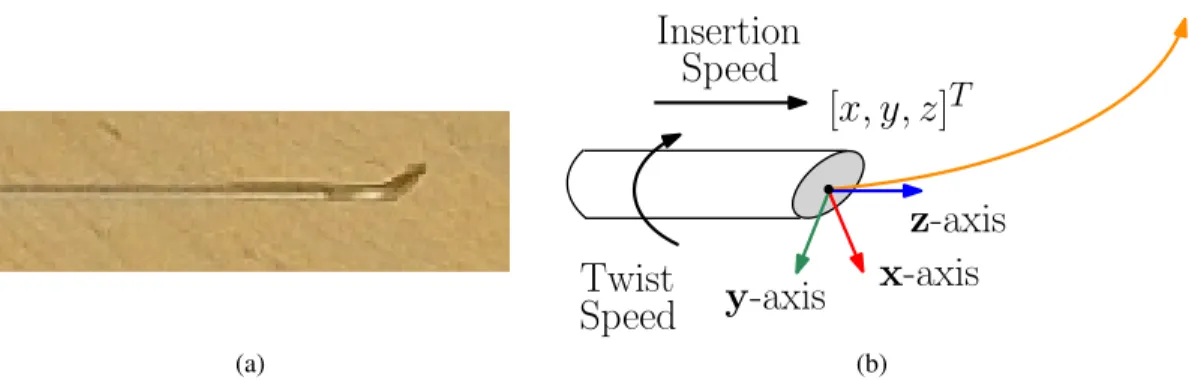
In this work, we consider steerable needles with a flexible needle shaft and a bevel-tip (see
Fig. 1.2a). Even though our emphasis is on bevel-tip steerable needles, the contributions of this
dissertation are also applicable to other asymmetric-tip steerable needles such as needles with stylet
tips (Okazawa et al., 2005) or programmable bevel-tips (Ko et al., 2011).
The needle is externally controlled by inserting and twisting the needle at its base. The needle is
maneuvered within tissue by reorienting the bevel-tip through twists applied to the needle base. The
flexible needle shaft bends due to reaction forces from the tissue on the bevel-tip, causing the needle
to follow constant curvature paths within tissue in the direction of the bevel (Webster III et al., 2006).
The natural curvature is dependent on the material properties of both the needle and the tissue.
The state of the needle tip is defined by the position and orientation as defined in a world
coordinate frame (see Fig. 1.2b). The forward motion of the needle is subject to nonholonomic
constraints, i.e., similar to a car or an airplane, the needle cannot instantaneously move in arbitrary
(a)
x
-axis
y
-axis
z
-axis
Insertion
[
x, y, z
]
TSpeed
Twist
Speed
(b)
Figure 1.2: (a) Steerable needle with a pre-bent bevel-tip. The shaft of the needle is flexible and the reaction forces from the tissue cause the needle to follow curved paths when inserted. The needle tip can be reoriented by applying twists to the base of the needle. (b) The state of the needle tip is defined by the position of the needle tip[x, y, z]T ∈R3and the orientation defined in terms of the
[x,y,z]-axes of the local coordinate frame attached to the tip of the needle. The needle is actuated by insertions and twists applied to the base of the needle.
small-time locally controllable, i.e., any state close to the current state is not reachable in arbitrarily
small amounts of time by paths close to the current state (Murray et al., 1994; Kallem, 2008).
As with all real world robotic systems, there is uncertainty involved with steerable needle
procedures and it causes the needle to deviate from its intended trajectory. This uncertainty can arise
from several factors such as unpredictable actuation, noisy and partial measurements from sensors,
unpredictable needle-tissue interaction, and involuntary patient motions.
In addition, the mechanics of steerable needle insertion into soft tissue depends on the interaction
between the needle and the tissue and the deformations in both the flexible needle and tissue resulting
from these interactions (Chentanez et al., 2009). The coupling between the needle and tissue
intro-duces new complications which cause noisy needle behavior. For instance, tissue inhomogeneities
can cause the needle shaft to deflect during insertion, and friction between the needle and tissue
could cause torsional buildup along the needle shaft when twists are applied to the base.
Analyzing all aspects of steerable needle insertion and sources of uncertainty remains a
chal-lenging problem. For these reasons, guiding a steerable needle around anatomical obstacles to a
target region under image guidance is challenging for a human operator. Creating a needle steering
robotic system that assists clinicians and addresses these challenges could enable new needle-based
Patient
Needle
Steering Robot
Clinician
Planning and
Control System
Intraoperative
Sensing
Modeling
Preoperative
Sensing
Intraoperative Closed-Loop Execution
Figure 1.3: Workflow for a clinically viable robotic system for steerable needle procedures. This dissertation advances the state of the art in planning and control of steerable needles and is an important step towards realizing needle steering in clinical practice. The clinician, who is responsible for the procedure, receives feedback from all components of the system, although these edges are omitted for succinctness.
1.2
Robotic Needle Steering
Several image-guided needle placement and insertion systems have been developed for stiff
needles, including commercial systems (Philips Healthcare, 2012; General Electric (GE) Healthcare,
2012; InnerOptic Inc., 2012) and clinically viable academic prototypes (Fichtinger et al., 2008; Long
et al., 2012; Hungr et al., 2012; Seifabadi et al., 2012). However, these systems are currently limited
to stiff needles and optimize straight line paths between the insertion location and the target, which
can potentially result in damage to sensitive tissues. Robotic needle steering systems for performing
steerable needle procedures can help overcome these deficiencies.
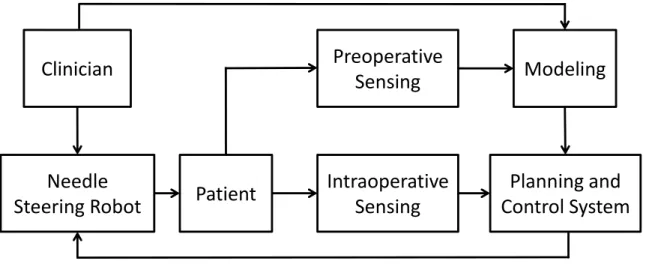
Fig. 1.3 shows the workflow for a clinically viable robotic needle steering system. In the
preoperative stage, high resolution scans (e.g., preoperative sensing modalities such as CT or MRI)
of the anatomical region of interest in the patient are acquired. In the modeling phase, the clinician
identifies sensitive structures such as glands or blood vessels and other obstacles such as bones. The
clinician also specifies the insertion location of the needle, the clinical target, a clinically motivated
fashion using measurements of the state of the system (both needle and tissue) obtained from low
resolution sensing devices such as ultrasound or electromagnetic tracking. The system is either fully
autonomous or semi-autonomous with a clinician in the loop to adjust execution as needed.
1.3
Challenges for Closed-Loop Planning and Control
The planning and control system is an important part of the robotic needle steering system. We
discuss the challenges associated with closed-loop planning and control of steerable needles below.
As discussed in Sec. 1.1, the needle is an under-actuated nonholonomic system. Motion planning
and control for such systems is challenging. Since deformable objects have possibly infinite degrees
of freedom, planning and control of a very high-dimensional, coupled system comprising of the needle
and tissue is a hard problem. In addition, steerable needle procedures are subject to considerable
deformations and uncertainty which are responsible for large deviations in the motion of the needle,
anatomical structures, and clinical targets within the tissue.
A highly accurate, deterministic model of steerable needle motion in human tissues would make
motion planning and control less challenging. In spite of many prior efforts (Cowan et al., 2011),
modeling all aspects of steerable needle insertion remains challenging to accomplish efficiently and
accurately because of the complexity of modeling deformation behaviors, modeling the interaction
of the needle with the deformable object, and incorporating uncertainty from several sources. As a
consequence, the model is often deliberately chosen to be a simplification. The mismatch between
modeling and reality is treated as an additional source of uncertainty and is addressed using
closed-loop planning and control techniques.
For computational tractability, we begin by using a simplified model for planning and control
that assumes that the needle bends to follow the needle tip exactly, i.e., the tissue does not deform the
needle shaft. We also assume that the insertions and twists applied to the needle base are directly and
exactly transmitted to the needle tip, i.e., there is no buckling or torsion along the needle shaft. This
implies that the motion of the needle is fully determined by the motion of the needle tip. Instead of
dealing with a high-dimensional coupled system, we then consider the planning and control problem
in a reduced 6D state space of the needle tip. Our objective is to address the uncertainty in steerable
It is also important to evaluate how good any planning and control approach is for steerable
needle procedures because some executions are significantly better than others. There are three key
clinically motivated criteria for evaluating an approach:
1. Accuracy: The success of any needle-based procedure depends on the targeting accuracy.
Large errors between the final position of the needle tip and the desired clinical target can have
undesirable consequences. For example, poor placement during biopses leads to false negatives
and inaccurate placement of radioactive seeds for cancer treatment destroys healthy instead of
cancerous tissue (Bogdanich, 2009). Accurate needle insertion is sufficiently difficult that poor
accuracy is common in practice. For example, experienced clinicians inserting radioactive
seeds into the prostate gland for brachytherapy prostate cancer treatment experience average
placement errors of 6.3 mm, about15%of the prostates diameter (Taschereau et al., 2000).
Other studies have found that the targeting errors for biopsies performed by experienced
clinicians averages between 5.5–6.5 mm when performing procedures using rigid needles
(Blu-menfeld et al., 2007; Schouten et al., 2012). Robotic systems for placement and insertion of
stiff needles achieve targeting errors to the order of≈1–4 mm (Fichtinger et al., 2008; Xu
et al., 2010; Long et al., 2012; Seifabadi et al., 2012; Hungr et al., 2012).
2. Safety: It is crucial that the needle avoids impenetrable anatomical structures such as bones
and sensitive structures such as glands and vessels. For instance, damage to glands during
prostate biopsies can cause problems such as incontinence (Wilt et al., 2008). Another aspect
of safety deals with minimizing the amount of tissue cut during a procedure. This might be
important for procedures being performed in critical organs such as the brain (Field et al.,
2001). Trajectories that maximize safety are less likely to cause collisions with anatomical
structures when deviations occur, but these trajectories tend to be longer, thereby increasing
the amount of tissue cut during the procedure. It is important to consider the trade-off between
avoiding specified structures and tissue cut during a procedure.
3. Efficiency: It is also important to consider the total procedure time for steerable needle
system to be clinically viable, it would need to efficiently perform procedures within a few
minutes to minimize risk to the patient and operating costs.
Considering these statistics, a robotic needle steering system that achieves mean targeting errors
that are lower than current clinical practice, is capable of safely avoiding sensitive anatomical
structures, and can facilitate efficient execution of procedures could improve patient care. It would
have the added advantage of enabling clinicians to avoid anatomical obstacles and minimize tissue
damage and patient trauma as compared to traditional stiff needles.
1.4
Thesis Statement
In this dissertation, we present approaches for closed-loop motion planning and control (or
steering) of steerable needles under sensory feedback. The objective of planning and control can be
stated as follows. Given the initial position and orientation of the needle tip, the target region, and a
specification of the anatomy and characterization of the steerable needle’s properties, the objective is
to steer the needle to clinical targets under sensory feedback while avoiding anatomical structures
and optimizing clinically relevant criteria.
My thesis is as follows:
Efficient motion planning and control techniques that consider uncertainty and deformations can facilitate closed-loop guidance of steerable needles to targets within clinically acceptable targeting accuracy while safely avoiding clinician-specified anatomical structures.
1.5
Main Results
In support of my thesis, I will present several results relating to efficient closed-loop planning
and control of steerable needles.
1.5.1 Needle Steering in 3D via Rapid Replanning
In this work, we present a new approach for automatically guiding the steerable needle to targets
in 3D environments while avoiding obstacles and compensating for real-world uncertainties. We
handle unexpected perturbations. In contrast to the standard practice of planning a feasible trajectory
and then using a feedback controller for correcting uncertain perturbations, our motion planner is
sufficiently fast enough to correct for perturbations in needle, obstacle, or target motion as they occur.
Our rapid replanning approach is enabled by an efficient sampling-based rapidly exploring random
tree (RRT) planner that achieves orders of magnitude reduction in computation time compared to
prior 3D approaches by incorporating variable curvature kinematics and a novel distance metric
for planning. We also consider two clinically motivated criteria for planning: minimizing insertion
length (minimizing tissue cut) and maximizing clearance (safety) from critical anatomical structures.
We integrated our algorithm with a needle steering system consisting of a bevel-tip steerable
needle, a needle steering robot, and an electromagnetic tracker for estimating the needle tip pose in
tissue. Given preoperative medical images, the clinician specifies the insertion location and target
region as well as obstacles comprising of sensitive structures such as glands or blood vessels and
impenetrable structures such as bones. Our rapid replanner then automatically guides the needle
around anatomical obstacles to the target region with high accuracy. We provide experimental
results to demonstrate that the approach can work in a practical clinically-inspired scenario. In our
experiments, the system guided the needle tip in 3D to targets in phantom and ex vivo animal tissues
with obstacles and achieved targeting errors averaging below 3 mm. In achieving these low targeting
errors, our rapid re-planning approach overcame substantial uncertainty: open-loop needle steering
resulted in errors exceeding 1 cm. Our experiments demonstrate that our system can achieve targeting
accuracy that exceeds current clinical practice while simultaneously enabling avoidance of obstacles.
A preliminary version of this work was published in (Patil and Alterovitz, 2010a).
1.5.2 Data-Driven Stochastic Models for Simulating Steerable Needle Procedures
The goal of this work is to create a stochastic model that captures needle behavior. We present a
data-driven method for estimating the parameters of a stochastic model of the needle motion. This
stochastic model can be used to create realistic medical simulators for clinicians to train for steerable
needle procedures and to improve the effectiveness of existing planning and control methods.
Since it is difficult to efficiently and accurately model the needle motion and its behavior within
during procedures. We also consider stochastic models to account for noisy and partial measurements
obtained during intraoperative sensing. We use the expectation-maximization (EM) algorithm to
estimate the parameters of this stochastic model using data gathered from prior experiments and
procedures. We present simulation results to validate our stochastic model.
1.5.3 Unified Framework for Planning and Control in Deformable Environments
In this work, we present a unified framework for planning and control of steerable needles in
deformable environments that simultaneously considers large deformations and substantial
uncer-tainty. Prior motion planning methods for deformable environments either assume deterministic
deformations, which may result in unsafe paths, or compute plans in a static world and consider
deformations as a type of perturbation, which neglects the large time-dependent motions of the
obstacles and target. Our unified framework, which simultaneously accounts for both uncertainty
and deformations, results in a significantly higher probability of success in plan execution.
Our method requires a simulator of steerable needle procedures. We use a sampling-based motion
planner based on the simulator to generate a set of candidate motion plans that assume expected
deformations. We then use the simulator and optimal control to numerically estimate time-dependent
state distributions based on uncertain parameters (e.g. deformable material properties or actuation
and sensing errors). We use this information to generate an optimal linear-quadratic (LQG) feedback
controller for each candidate plan to mitigate any uncertainty in the expected deformations that
occur during the actual execution of the plan. Since computing an optimal controller using the full
deformable system state is computationally prohibitive, we observe that it is possible to formulate the
optimal control problem using a subset of the full state space. We then present an efficient method
to select the plan with the highest estimated probability of successfully avoiding obstacles and
reaching the goal region. Using FEM-based simulation of deformable tissues, we demonstrate that
our method can generate high quality plans for guiding steerable needles around obstacles to clinical
targets under 2D image guidance in the presence of considerable deformations and uncertainty. We
demonstrate that our approach significantly improves the probability of success compared to prior
approaches based on standard feedback controllers or motion planners that do not simultaneously
consider deformations and uncertainty. Results from this work were published in (Patil et al., 2011)
1.6
Organization
The rest of this dissertation is organized as follows. Chapter 2 presents the rapid replanning
algorithm for closed-loop needle steering in 3D environments with obstacles. It also provides details
about our needle steering system and presents experimental results for needle steering in phantom and
ex vivo tissues. Chapter 3 describes a data-driven method for estimating parameters of a stochastic
model of the needle behavior in tissue. Chapter 4 presents a unified planning framework that takes
into account both uncertainty and deformations, by combining sampling-based motion planning in
deformable environments with feedback control techniques. Finally, Chapter 5 presents a summary
CHAPTER 2
Needle Steering in 3D via Rapid Replanning
In this chapter, we present a new approach for automatically guiding steerable needles to
targets in 3D environments while avoiding obstacles and compensating for real-world perturbations.
We unify planning and control using a new, fast algorithm that continuously replans the needle
motion while optimizing clinically motivated criteria. Our rapid replanning approach is enabled
by an efficient sampling-based rapidly exploring random tree (RRT) planner that achieves orders
of magnitude reduction in computation time compared to prior 3D approaches by incorporating
variable curvature kinematics and a novel distance metric for planning. We experimentally evaluate
our approach for needle steering using tissue phantoms and ex vivo animal tissue. We demonstrate
that our rapid replanning strategy successfully guides the needle around obstacles to desired 3D
targets with an average error of less than 3 mm, which exceeds the current standard for clinical care.
2.1
Rapid Replanning
We present a novel approach for closed-loop needle steering in 3D environments with obstacles
that unifies motion and planning and control. In contrast to the standard practice of planning a
feasible trajectory and then using a feedback controller for correcting uncertain perturbations, our
motion planner is fast enough to correct for perturbations in needle, obstacle, or target motion as they
occur. This eliminates the need for a separate feedback controller, which can be difficult to create
and tune for nonholonomic robots like steerable needles. Moreover, such controllers do not provide
obstacle avoidance guarantees, which is critical for many steerable needle procedures. Another
advantage of our approach is that the planner considers the global state of the system at each time
step, rather than just locally correcting for perturbations. This could account for displacements of the
Select Optimal Plan
Execute Control
Prediction
Actual Model
Generate Multiple Plans
Replanning
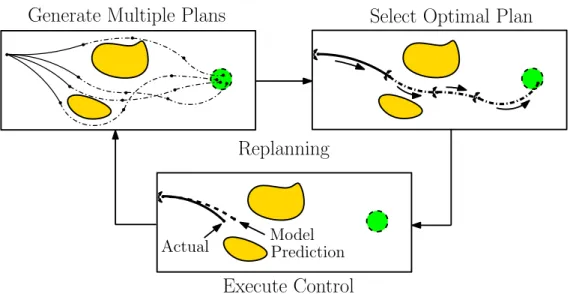
Figure 2.1: Closed-loop needle steering via rapid replanning. Given the current needle tip state, target region, a specification of the anatomy, and characterization of the steerable needle’s properties, our approach uses a fast, randomized motion planner to compute in the available time many feasible motion plans across homotopy classes (top left). The method selects the best plan based on optimiza-tion criteria such as minimizing path length or maximizing clearance from obstacles (top right). We execute the first control input of the plan and measure the state of the needle tip (bottom). The actual state of the needle tip deviates from the model predicted state because of uncertainty. We repeat the planning process, hence replanning, starting from the actual needle tip state. This approach is made possible by a new, fast planner capable of computing hundreds of feasible plans per second.
Our new rapid replanning approach uses a customized, sampling-based motion planner that
speeds up motion planning for steerable needles to the point that it can be done in real time with
typical needle insertion velocities. To enable sub-second planning times, we leverage several
observations and algorithmic advances. First, in contrast to prior motion planning approaches for
needle steering, we relax the constant curvature path assumption by planning variable curvature paths
and using duty cycled spinning during insertion (Minhas et al., 2007; Engh et al., 2010) to adjust the
needle’s net curvature. Second, we propose a new distance metric for incremental expansion of the
rapidly-exploring search tree to significantly improve planner performance. These help us achieve
orders of magnitude reduction in computation time compared to prior sampling-based planners (Xu
et al., 2009) and make the planner suitable for closed-loop needle steering. We also use the fast
performance to enable us to consider two clinically motivated optimization criteria: minimizing
insertion length and maximizing clearance from critical anatomical structures.
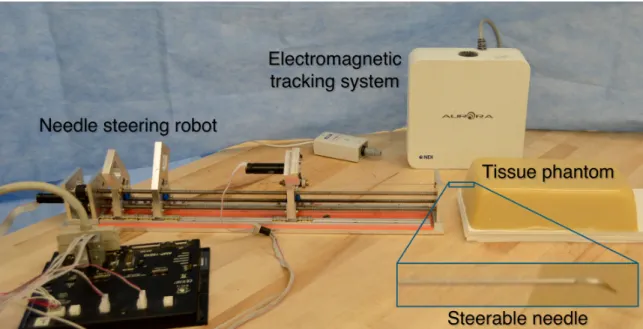
consists of a bevel-tip steerable needle, a needle steering robot, and an electromagnetic tracker for
estimating the needle tip pose in tissue. Given preoperative medical images, the clinician can specify
the insertion location and target region as well as sensitive structures such as glands or blood vessels
and other obstacles such as bones. Our rapid replanner then automatically guides the needle around
anatomical obstacles to the target region with high accuracy.
We provide experimental results to demonstrate that the approach can work in a practical clinical
scenario. In our experiments, the system guided the needle tip in 3D to targets in phantom and ex vivo
animal tissues with obstacles and achieved targeting errors averaging below 3 mm. In achieving these
low targeting errors, our rapid re-planning approach overcame substantial uncertainty: open-loop
needle steering resulted in errors exceeding 1 cm. In comparison to current standards for clinical
needle procedures, experienced physicians achieved targeting errors averaging 5.5–6.5 mm when
performing procedures using stiff needles (Taschereau et al., 2000; Blumenfeld et al., 2007; Schouten
et al., 2012). Our experiments demonstrate that our system can achieve targeting accuracy that
exceeds current clinical practice while simultaneously enabling avoidance of obstacles.
The rest of this chapter is organized as follows: Sec. 2.2 provides a survey of previous work on
planning and control for steerable needles. Sec. 2.3 summarizes the objective of our rapid replanning
framework and Sec. 2.4 presents details of the variable curvature kinematic model of the motion of
the needle tip used in this work. We provide details of our approach in Sec. 2.5 and describe our
needle steering system used in our experiments in Sec. 2.6. Finally, Sec. 2.7 presents experimental
results of needle steering in 3D environments with obstacles in phantom and ex vivo animal tissues
and we present a discussion of our approach and directions for future work in this regard in Sec. 2.8.
2.2
Related Work
Several needle steering techniques have been developed that allow clinicians to adjust the needle
path within tissue to improve targeting accuracy. These include bevel-tip flexible needles (Webster
III et al., 2006), symmetric-tip needles that can be steered by applying forces at the base (DiMaio and
Salcudean, 2003; Glozman and Shoham, 2007), stylet tips (Okazawa et al., 2005), programmable
emphasis is on bevel-tip flexible needles, but our approach is also applicable to planning and control
of needles with stylets and programmable bevel-tip needles.
Significant advancements have been made in modeling, motion planning, and controlling
bevel-tip steerable needles (Cowan et al., 2011). A kinematic model generalizing a unicycle was
experi-mentally validated by Webster et al. (Webster III et al., 2006). This model was augmented to include
the effects of torsional friction along the needle shaft (Reed et al., 2009; Swensen and Cowan, 2012).
Minhas et al. (Minhas et al., 2007; Engh et al., 2010) showed that in addition to insertion speed
and rotation speed as control inputs, the curvature of the needle path can be controlled through
duty cycled spinning of the needle during insertion. The mechanics and characteristics of steerable
needles have been modeled for ex vivo tissue (Okamura et al., 2004; Misra et al., 2010), and in vivo
tissue (Majewicz et al., 2012). Chentanez et al. (Chentanez et al., 2009) created a physically-based
3D simulation that uses nonlinear FEM for modeling needle and tissue deformations and accounts
for topological changes occurring in the tissue mesh during needle insertion.
Motion planning for steerable needles in a plane (2D) has been extensively studied. Alterovitz et
al. (Alterovitz et al., 2007) developed a planner for planar needle steering that addresses the issue
of motion uncertainty by solving a Markov decision process (MDP) over a discretized state space
and assuming full state observations. Kallem et al. (Kallem and Cowan, 2009; Kallem et al., 2010)
developed a controller that stabilizes the needle to a desired plane. Reed et al. (Reed et al., 2011)
coupled the controller to the planar planner (Alterovitz et al., 2007) to create an image-guided needle
steering planning/control system and validated the approach in phantom tissues. These planning
and control strategies do not generalize to 6D state spaces encountered in needle steering in 3D
environments. Alterovitz et al. (Alterovitz et al., 2005) also take into account tissue deformations
during needle insertion but this work does not address the issue of uncertainty due to noisy actuation,
sensing, or errors in deformation modeling and simulation. Recently, Bernardes et al. (Bernardes
et al., 2012) presented a semi-automated planar needle steering system that uses an adaptive path
planning strategy to compensate for system uncertainties.
Motion planners for needle steering in 3D environments with obstacles have been proposed by
Duindam et al. based on optimization (Duindam et al., 2008) and inverse kinematics (Duindam et al.,
2011) compute motion plans for the steerable needle by using an approach based on sampling spheres
of constant radii in the environment and concatenating trajectory segments on the surfaces of these
spheres. Sampling-based motion planners for needle steering in 3D environments are computationally
very expensive and not suitable for real-time operation. These planners also do not address the issue
of uncertainty. A path-of-probability algorithm based on diffusion-based error propagation was
developed by Park et al. (Park et al., 2010b), but this work does not take into account obstacles or
noisy sensory feedback. Open-loop execution of motion plans result in large targeting errors due to
deformation of the workspace and system uncertainties.
There is also prior work on controlling steerable needles in 3D environments to compensate for
errors during insertion. Hauser et al. (Hauser et al., 2009) propose a real-time feedback controller
which plans helical paths for 3D needle steering and experimentally demonstrate in simulation that
the controller is robust to motion deviation and noisy sensing, even for a greedy control selection
policy. Seiler et al. (Seiler et al., 2012) propose a fast trajectory correction method to compensate for
uncertainty and deformations in the environment during needle insertion. These controllers either
do not address the issue of obstacle avoidance or only propose a provisional solution and do not
provide any guarantees on safety and performance in the presence of obstacles. Van den Berg et
al. (van den Berg et al., 2010) propose a framework for planning and LQG-based feedback control of
a steerable needle under motion and sensing uncertainty. This framework was extended by Patil et
al. (Patil et al., 2011) for deformable environments. The LQG framework for estimation and control
used in this approach does not address the issue of control saturation, which is a practical concern
for needle steering. Prior LQG-based methods may fail due to control input saturation, which is a
practical concern for needle steering, and cannot respond in real-time to significant perturbations not
accounted for by the a priori model.
A core concept of this work involves the use of fast motion planning for obstacle avoidance
and correcting the needle trajectory to account for uncertainties. There is considerable prior work
in real-time replanning for dynamic environments using sampling-based planners and some of
these techniques can also be applied to robots navigating in deformable environments under
uncer-tainty (Frazzoli et al., 2002; Zucker et al., 2007). Some replanning approaches deal with discretized
state spaces and propose efficient implementations of replanning algorithms that include D* and
have been proposed to address the issue of safety in replanning in dynamic environments (Frazzoli
et al., 2002). Model predictive control (MPC), also known as receding horizon control, is a form of
replanning at each time step that formulates an optimal control problem truncated at some
predeter-mined finite time horizon. Such techniques have been successfully applied to robot navigation (du
Toit and Burdick, 2010). These methods address the issue of optimality of the computed motion
plans but are difficult to scale to higher dimensional configuration spaces and continuous dynamical
systems. Many approaches have sought to reduce the planning time to facilitate real-time replanning
by reusing information from prior plans (Kuwata et al., 2009), using pre-computed coarse global
plans to reduce planning workload (Zucker et al., 2007), or harness the computational power of
modern hardware for efficient parallel planner implementations (Pan et al., 2010). Sampling-based
planners can be practically applied to higher dimensional state spaces but the completeness of such
methods has still not been fully explored (Hauser, 2012).
Several robot-assisted needle placement and insertion systems have been proposed for stiff
nee-dles, including systems that use either ultrasound or magnetic resonance tracking for biopsies (Hata
et al., 2006; Boctor et al., 2008; Xu et al., 2010; Long et al., 2012; Seifabadi et al., 2012) and prostate
high-dose rate brachytherapy (Susil et al., 2004; Fichtinger et al., 2008; Mozer et al., 2009; Hungr
et al., 2012). These systems achieve targeting errors that are in the range of≈1–4 mm. Experimental
studies that compare the targeting error achieved by robotic needle insertion systems versus trained
clinicians (Maier-Hein et al., 2009; Schouten et al., 2012) also report targeting errors of the same
magnitude. The targeting accuracy of our system is within clinically acceptable thresholds with
the added advantage of using steerable needles which allows us to avoid anatomical obstacles and
minimize tissue damage and patient trauma.
Our sampling-based planner is customized for steerable needles (Patil and Alterovitz, 2010a;
Patil et al., 2013) and we experimentally demonstrate in phantom and ex vivo animal tissues that our
rapid replanning approach can be used for closed-loop needle steering in 3D environments. We have
also integrated the planning approach with a robotic needle steering system to create the first fully
Preoperative Imaging and Characterization
Generate Multiple Plans
Select Optimal Plan
Execute Control Target
Reachable From
State? needle tip Sense pose Yes
Fault Tolerance No
Target Reached
? No
Yes End
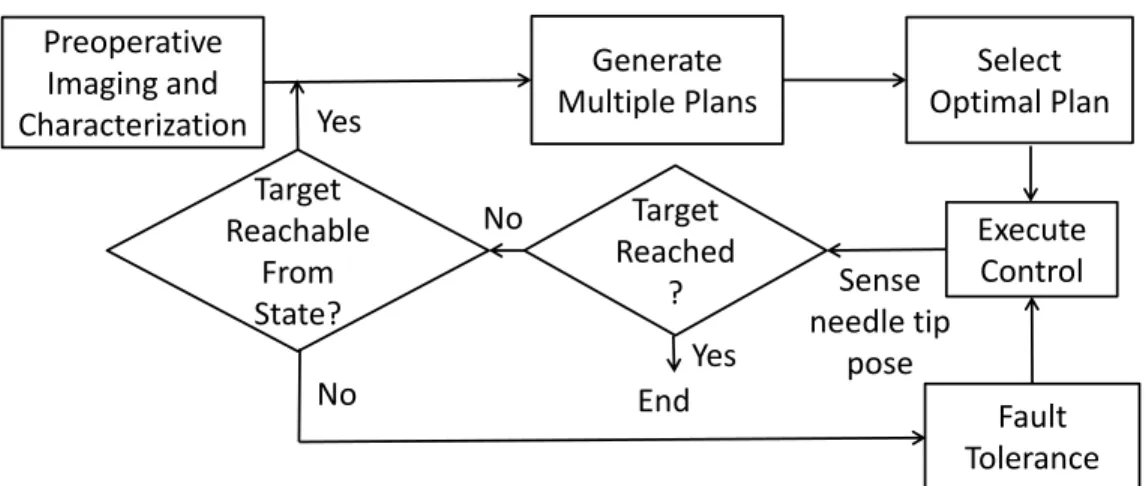
Figure 2.2: Overview of our rapid replanning paradigm which relies on a fast sampling-based motion planner for closed-loop steering of the needle to the desired target region while avoiding anatomical obstacles. We present details of the individual components of our approach in Sec. 2.5.
2.3
Objective
We specifically focus on bevel-tip steerable needles (Cowan et al., 2011), which move along an
approximately circular arc of constant curvatureκ0in the direction of the bevel when inserted into a
tissue medium. The needle is controlled by two control inputs: insertion speedvused to insert the
needle and twist speedωapplied at the needle base used to reorient the bevel-tip.
To enable automatic needle steering, our system requires as input a specification of the anatomy.
Given registered preoperative volumetric medical images that are standard in clinical care (e.g., CT
scans or MRI), the clinician can specify the initial state of the needle tipX0 ∈SE(3), a volumetric
target regionPgoal ⊂R3, and obstaclesoi ∈ Othat include sensitive structures such as glands or blood vessels and other obstacles such as bones that are represented as segmented volumes in the
images. Our system also requires characterization of the steerable needle, including the natural
maximum curvature of the needleκ0 and the empirical relationshipα = h[κ], 0 ≤ κ ≤ κ0 that
relates the needle’s curvature to the duty cycling factorα(defined in Sec. 2.4).
The objective is to automatically steer the needle around clinician-specified anatomical obstacles
while optimizing a clinician-specified clinical criteria. The criteria can include metrics such as
minimizing insertion length (i.e., minimizing tissue damage) or maximizing clearance from obstacles
(i.e., maximizing safety). Our approach, shown in Fig. 2.2, uses rapid replanning. Given the inputs
a sequence of discrete controls that will steer the needle tip to the target region while avoiding
anatomical obstacles. From the computed set of plans, the planner selects the plan that optimizes
the clinical criteria. At the core of our rapid replanning approach is a fast motion planner for needle
steering based on a customized rapidly exploring random tree (RRT) planner that incorporates
variable curvature kinematics and a novel distance measure for planning (described in Sec. 2.5). To
compensate for uncertain perturbations that occur during needle steering in tissues, the planning
process is repeated at frequent intervals in a closed loop fashion using feedback from the
electro-magnetic tracking system to sense the needle tip pose at the beginning of each interval and replan a
control sequence to reach the target region.
2.4
Variable Curvature Needle Kinematic Model
Our planner uses a variable curvature kinematic model of the motion of the needle tip’s trajectory
as the needle is inserted in tissue. The kinematic model is deterministic and does not explicitly
consider errors arising from factors such as tissue deformations, actuation errors, and noisy sensing.
Our rapid replanning approach allows us to correct for these errors as they occur during the procedure.
We assume that the needle is flexurally flexible and torsionally stiff, i.e., the shaft exactly follows
the needle tip, and the insertions and twists applied to the needle base are directly transmitted to
the tip. The motion of the needle is then fully determined by the motion of the needle tip. The
state of the entire needle is then described by the needle tip pose, represented as a4×4matrix
X=R0 p1∈SE(3), wherep∈R3is the position of the needle tip andR∈SO(3)is the rotation
matrix that encodes the needle tip orientation relative to a world coordinate frame.
We extend the constant curvature unicycle kinematic model of the needle tip proposed by Webster
et al. (Webster III et al., 2006) to consider the curvatureκ(0≤κ≤κ0) to be an additional control
input parameter. Letvbe the insertion speed andωˆ be the twist speed of the needle. Physically
realizing the variable curvature model requires that the curvatureκbe realizable in terms of insertion
speedvand twist speedω, which are the only two physical control inputs to the system. We later
show how the twist speedωˆ can be converted to the physical twist speedωusing duty cycled spinning
Xt
Xt+1
l
xt
yt
zt θ
φ
ˆ ω
xt+1 yt+1
zt+1
v
[0,−r,0]T [0,0,0]T
[x, y, z]T
z r=
1
κ
s
x2 +y
2
vκ
(a) Local coordinate frameXt
P
goalX
0X
1X
tX
T−1X
TO
O
u
0u
tu
T−1(b) Needle plan
,
Figure 2.3: (a) Local coordinate frameXtattached to the needle tip and a point inR3 : [x, y, z]T
defined in the local coordinate frame. The needle is inserted along thez-axis, and the needle rotates around a line parallel to thex-axis and passing through the point[0,−r,0]T. The circular arc traced out by the needle (shown in orange) is parameterized as a triplet[l, φ, r]. (b) Needle plan composed of circular arcs of bounded curvature(κ = 1/r,0≤ κ≤κ0)connects initial stateX0 and target regionPgoalwhile avoiding obstaclesO.
Given the control input vectoru= [v,ω, κˆ ]T ∈R3, it is convenient to describe the kinematics
in terms of the instantaneous twistU ∈se(3)expressed in the local coordinate frame attached to the
needle tip (Fig. 2.3a), given by (Webster III et al., 2006; van den Berg et al., 2010):
U =
[ˆω] v
0 0
, ωˆ =
vκ 0 ωˆ
T
, v=
0 0 v
T
. (2.1)
where the notation[s]for a vectors∈R3refers to the3×3skew-symmetric cross-product matrix.
The discrete-time kinematics evolves over time intervaltas:
Xt+1 =f[Xt,u, t] =Xtexp(U t). (2.2)
whereexp(·) denotes the matrix exponential operator. Note that for the special case ofκ = κ0,
ˆ
Prior work on motion planning for steerable needles in 3D (Xu et al., 2009; Duindam et al., 2008,
2010; Park et al., 2010b) assumesκis a constant, which severely restricts the range of motion of the
needle tip. This makes it difficult for planners to compute a feasible motion plan in 3D environments
with obstacles, thus sacrificing optimality or completeness. In contrast, our motion planning method
assumes a variable curvature kinematic model that allows us to compute trajectories composed of
circular arcs of bounded curvature (0≤κ≤κ0)(as shown in Fig. 2.3b). This helps us to compute
feasible motion plans with sub-second computation time.
We use results from Minhas et al. (Minhas et al., 2007), who demonstrated that any curvature
0 ≤ κ ≤ κ0 can be approximated by duty cycling the rotation of the needle, i.e., by alternating
between (i) insertion without rotation, in which the needle follows a path of maximum curvature
(κ =κ0), and (ii) insertion with rotation, in which the needle moves straight(κ= 0)by spinning
at a constant rate and stopping the spinning such that the tip is at the same axial angle every time.
Duty cycling of steerable needles was successfully demonstrated in cadaver brains for neurosurgical
procedures (Engh et al., 2010).
Let the control inputu = [v,ω, κˆ ]T be applied over a time duration∆. Letδbe the duration
of each duty cycling interval, which is composed of an insertion interval of durationδinsand a spin
interval of durationδspin, as illustrated in Fig. 2.4. Letα(0≤α≤1) be the proportion of the time
spent in spin intervals, i.e.,α=δspin/δ, whereδ=δins+δspin. The empirical relationship between
κandαis expressed as:
α =h[κ], 0≤κ≤κ0, (2.3)
whereh[κ]is dependent on the mechanical properties of the needle and tissue and is determined
by fitting a polynomial function to the empirical data gathered during preoperative characterization
experiments (as described in Sec. 2.4).
Duty cycling is implemented for needle steering by moving a fixed distance each cycle and
spinning with a fixed twist speedωspin. Givenκ, we use Eqn. (2.3) to determineα. Since the needle
tip arrives at the same axial angle at the end of each spin interval, the duration of the spin interval
∆
δ
=
α∆
δ
δ
δ
spin=
ω2spinkπδ
insδ
spinδ
insδ
spinδ
insFigure 2.4: The time duration∆is split into three intervals of duration δ each forα = h[κ] = 1/3. Each interval is then composed of two intervals: (i) a spin interval of duration δspin =
(2kπ/ωspin), k∈Zin which the needle is both inserted and rotated, and (ii) an insertion interval of
durationδinsin which the needle is only inserted without any rotation.
The low level control inputs during a duty cycle interval are given by:
v(t) = v, 0≤t≤∆/δ (2.4)
ω(t) =
ˆ
ω+ωspin if jδ < t≤jδ+δspin
ˆ
ω if jδ+δspin< t≤(j+ 1)δ
, (2.5)
wherej ∈ {0,1, . . . ,∆/δ}and∆/δis the total number of duty cycle intervals required to span the
duration∆.
2.5
Rapid Replanning Approach
In this section, we present details of the individual components involved in our rapid replanning
approach (Fig. 2.2) for closed-loop needle steering in 3D environments with obstacles.
2.5.1 Motion Planning
To enable motion planning for a rapid replanning approach, we create a fast motion planner
for the steerable needle. We based our planner on a sampling-based rapidly exploring random tree
(RRT) (LaValle, 2006), which is well suited for the under-actuated, nonholonomic steerable needle
and also provides completeness guarantees, i.e., the probability of finding a solution converges to
one, if a solution exists, as the number of samples approaches infinity.
The input to the planner is an initial stateX0, a target regionPgoal, and the computation time
available for planningΓ. Our algorithm is based on the classic RRT, which proceeds as follows. The
constraints of the system and avoiding obstacles in the environment. To expand the treeT, a random
stateXrandis sampled from the state space. The algorithm identifies a node in the treeXnear, that is
closest to the sampleXrand, as defined by a specified distance metricρ[·]. The algorithm attempts to
expandT towardsXrandbased upon the best control inputuand the resulting stateXnewis added
to the tree. This process is repeated until either the treeT connectsX0 andPgoalor the available
computation time is exceeded, in which case the algorithm reports that a solution cannot be found. A
feasible planΨis extracted from the tree by traversing it backwards from the goal node to the root.
For a nonholonomic system like the steerable needle, finding the best control input to a sampled
state requires solving a difficult two-point boundary value problem of connecting two states inSE(3).
Prior RRT-based needle steering planners (Xu et al., 2009) avoid this by performing deterministic
or uniform random sampling of control inputs to determine the best control input[v, ω]T ∈ R2
that leads the needle tip to a new state Xnew closest toXrand. Since these methods also assume
the constant curvature kinematic model, the limited range of motion of the needle tip requires a
large number of control samples to make progress towards the sampled state. This results in wasted
computational effort and is a major computational bottleneck.
To enable efficient planning, we customize the classic RRT algorithm for steerable needles
by leveraging several observations and algorithmic improvements. We consider variable curvature
kinematics (Sec. 2.4) and introduce a new distance metricρ[·]. We present each step of the algorithm
(outlined in Alg. 1) in detail below. In the available computation time, we compute many feasible
bounded curvature(0≤κ≤κ0)trajectories through 3D environments with obstacles.
The individual function definitions in Alg. 1 are as follows:
random point in R3(): To avoid solving the SE(3) two-point boundary value problem
or performing random sampling of control inputs, we sample a random pointprand ∈ R3 in the
workspace as opposed to sampling a random state inSE(3). The sampled point can then be connected
to a given stateXnear=
Rnear pnear
0 1
directly using a circular arc parameterized by[l, φ, r]T, wherel
is the arc length,φis the change in orientation of the needle tip coordinate frameXneararound the
Algorithm 1Ψ←needle RRT planner(X0,Pgoal,Γ)
1: T ←initialize tree(X0)
2: τ ←0
3: while(T ∩ Pgoal=∅ ∧ τ <Γ)do
4: prand←random point in R3()
5: Xnear←nearest neighbor(prand,T)
6: u←control inputs(Xnear,prand,∆)
7: Xnew←f[Xnear,u,∆]
8: ifcollision free(Xnear, Xnew,u,∆)then
9: T ←add vertex(Xnew)
10: T ←add edge(Xnear, Xnew,u,∆)
11: end if
12: ifpnew∈ Pgoalthen
13: Ψ←extract plan(T, Xnew)
14: end if
15: τ ←update time()
16: end while
17: returnΨ
ofprandin the local coordinate frame ofXnear. The parameters of the circular arc are then given by:
r= x
2+y2+z2
2px2+y2 (2.6)
φ= arctan(x,−y) (2.7)
l=rθ=rarctan(z, r−px2+y2). (2.8)
To accelerate motion planning for steerable needles, we incorporate two forms of biasing that
empirically result in significant performance gains. First, we bias the growth of the treeT towards the
target regionPgoalby sampling fromPgoalwith a higher probability than the rest of the workspace.
Second, whenever a new nodeXnewis added to the tree, the planner attempts to connectXnewto a
randomly sampled point inPgoal.
control inputs(·): Given a circular arc parameterized as[l, φ, r]and a given time interval
∆, we derive the augmented control input vector required to compute the new state of the needle
tipXnew. First, we reorient the needle tip byφradians such that the circular arc is contained in the
plane defined by they-zaxes in the reoriented local coordinate frameXnearr , which is obtained by applying a rotation ofφradians around thez-axis to the current stateXnear. We then compute the
radiusrusing the relations:v=l/∆,ωˆ = 0, andκ= 1/r. We computeXnewby applyinguto the
reoriented frameXnearr for a time duration∆according to Eqns. (2.1) and (2.2).
nearest neighbor(·): The efficiency with which the RRT algorithm is able to explore the
state space is highly sensitive to the distance metricρ[·]used to compute the nearest node in the tree.
In the presence of nonholonomic constraints, widely used metrics like the Euclidean distance are
a very poor approximation of the true distance between points in the constrained state space. The
performance of the RRT planner degrades as a result of repeated attempts at extending the same
nodes in the tree without making sufficient progress (Shkolnik et al., 2009).
We introduce a new distance metric customized for steerable needles that accounts for the
needle’s nonholonomic constraint as well as the buckling of the needle in soft tissue. Since the needle
has a maximum curvatureκ0, not all sampled points will be reachable from a given state because
of the nonholonomic constraints of the needle. Thereachable setfrom a stateXnear=
Rnear pnear
0 1
consists of all points that can be connected topnearby a circular arc that has a radiusr ≥ 1/κ0 and is tangent to theznear-axis of the local coordinate frame. This definition of the reachable set
also directly relates to the distance metricρ[·]that is used to select the tree node that is nearest to
the sampled pointprand. Accordingly, we define the distance metricρ[Xrand,prand]as the length of
such a circular arc connectingprand andXnearifprand is in the reachable set ofXnear, and infinity
otherwise, i.e.,
ρ[Xrand,prand] =
l(≡rθ) if r≥1/κ0 ∧ θ≥0
∞ otherwise
. (2.9)
This strategy restricts the search domain to only those nodes that are within the reachable set of the
nearest nodeXnear, thus increasing the likelihood of state space coverage (Shkolnik et al., 2009).
It is important to prevent buckling of the needle shaft, which may occur during insertion because
of reaction forces from the tissue. This implies that not all points in the reachable set can be physically
accessed by the steerable needle from some poses. In our experiments, we have observed that the
needle starts to buckle roughly when the needle tip heading is greater thanπ/2radians from its initial
orientation. Formally stating, given the current stateXnearand a sampled pointprand andzrand is
the insertionz-axis tangent to the circular arc connectingXnearandprandatprand, the needle would
coordinate frame. We preclude such points from being added to the tree by setting the distance to
these points to infinity.
To efficiently search for the nearest node in the tree to a sampled pointprandaccording to this
distance measure, we use the fact that the needle will not traverse a circular arc spanning more than
π/2radians due to buckling considerations and it follows that if the point is unreachable from a
stateXnear, i.e., ρ[Xnear,prand] = ∞, thenprand is unreachable from all descendant nodes in the
sub-tree of the node corresponding to stateXnear. Hence, the nearest node can be found using a
depth-first traversal of the tree, pruning parts of the tree if a node is encountered from whichprandis
not reachable. Even though the worst case complexity of the nearest neighbor search is still linear
in the number of nodes in the tree, pruning away parts of the tree in practice results in a significant
performance improvement, especially as the tree grows larger.
collision free(·): To enable obstacle avoidance, only collision free arcs are added to the
tree. We check if the circular arc connectingXnear andprand is collision free by approximating
it as a sequence of line segments and checking if all the segments are collision free. Since the
obstacle definitions are obtained from segmentation of 3D scans, the obstacle meshes are likely to
be non-manifold. We use the SOLID library (van den Bergen, 2004) for detecting collisions with
arbitrary, polyhedral obstacles at interactive rates.
extract plan(·): When the position pnew of a newly added stateXnewis found to lie in
the target regionPgoal, the planner terminates. By traversing the treeT backwards from the goal
state to the root, we obtain a trajectory composed of piecewise circular arcs of bounded curvature
(0≤κ ≤κ0). We extract a motion planΨcomprised of a discrete sequence of control inputs, in
terms of the insertion speedv(t)and twist speedω(t), that guide the needle to the target along the
computed trajectory. For each circular arc parameterized by a triplet[l, φ, r]in the trajectory, we first
reorient the needle tip byφradians by applying a control inputω =ωspinfor a duration ofφ/ωspin.
We then compute the factorαbased on the curvatureκ= 1/rusing Eqn. (2.3). Given the control
inputu= [l/∆,0,1/r]T, we compute the controls[v(t), ω(t)]T for traversing the circular arc in a
plane using Eqns. (2.4) and (2.5).
2.5.2 Optimizing Clinical Metrics
![Figure 1.1: Anatomical scenario modeling the human male pelvic region for simulating delivery of radioactive doses to targets within the prostate for cancer treatment [reproduced with permission from (Chentanez et al., 2009)]](https://thumb-us.123doks.com/thumbv2/123dok_us/8325929.2207681/15.918.138.776.124.369/anatomical-scenario-simulating-radioactive-treatment-reproduced-permission-chentanez.webp)
![Figure 2.3: (a) Local coordinate frame X t attached to the needle tip and a point in R 3 : [x, y, z] T defined in the local coordinate frame](https://thumb-us.123doks.com/thumbv2/123dok_us/8325929.2207681/32.918.209.733.118.455/figure-local-coordinate-attached-needle-defined-local-coordinate.webp)
![Figure 2.4: The time duration ∆ is split into three intervals of duration δ each for α = h[κ] = 1/3](https://thumb-us.123doks.com/thumbv2/123dok_us/8325929.2207681/34.918.272.650.103.224/figure-time-duration-split-intervals-duration-δ-α.webp)
![Figure 2.7: Characterization of the relationship α = h[κ] (Eqn. (2.3)) for Needle1 and Needle 2 in Sim-Test tissue phantom and ex vivo porcine loin tissue.](https://thumb-us.123doks.com/thumbv2/123dok_us/8325929.2207681/43.918.158.767.120.522/figure-characterization-relationship-needle-needle-phantom-porcine-tissue.webp)