EXAMINING BIDIRECTIONAL RELATIONSHIPS BETWEEN PARENTAL SOCIALIZATION BEHAVIORS AND ADOLESCENT ALCOHOL MISUSE ACROSS EARLY AND MIDDLE ADOLESCENCE
Melissa J. Cox
A dissertation submitted to the faculty at the University of North Carolina at Chapel Hill in partial fulfillment of the requirements for the degree of Doctor of Philosophy in the Department of Health Behavior in the
Gillings School of Global Public Health.
Chapel Hill 2016
Approved by: Susan Ennett Vangie Foshee Andrea Hussong Melissa Lippold
ABSTRACT
Melissa J. Cox: Examining Bidirectional Relationships Between Parental Socialization Behaviors and Adolescent Alcohol Misuse Across Early and Middle Adolescence
(Under the direction of Susan Ennett)
While numerous studies have examined the influence of parenting on adolescent alcohol use, relatively few have examined how adolescents influence parental behavior or the reciprocal nature of parent-adolescent behavior relative to alcohol use. Jointly guided by socialization theories and
ACKNOWLEDGEMENTS
Although the dissertation is an endeavor to become an independent scientist, it certainly is not an isolated pursuit. I have many people to thank for their support over the past five years.
To my committee members, Drs. Vangie Foshee, Andrea Hussong, Melissa Lippold and Luz McNaughton-Reyes: thank you for your continued guidance on this dissertation and for supporting my growth as a scholar, teacher and mentor. And especially thanks to Dr. Susan Ennett, the chair of my dissertation committee: your support far exceeds this dissertation process and your mentorship has set the highest standard for me to follow in my own academic career.
To the Center for Developmental Science: for providing me with a pre-doctoral fellowship that allowed me to find a second intellectual home within developmental science. My time at CDS greatly influenced not only this dissertation, but also the research program I will pursue in the future.
To the Odum Institute for Social Science Research: for providing me with a graduate fellowship to delve into the details of quantitative analysis.
To the UNC Graduate School: for providing me with a Dissertation Completion Award for my final year of study, which allowed me to take a ‘writing retreat’ to finish this work.
To my cohort: I don’t take for granted that we were able to travel this journey together. I look forward to all that’s to come for each of us, as colleagues and more importantly as friends.
To my personal support system: all of you are simply the best. I could not have done this without you.
TABLE OF CONTENTS
LIST OF TABLES ... x
LIST OF FIGURES ... xi
CHAPTER 1: INTRODUCTION ... 1
CHAPTER 2: THEORETICAL AND EMPIRICAL EVIDENCE FOR THE RELATIONSHIP BETWEEN PARENTAL SOCIALIZATION BEHAVIORS AND ADOLESCENT ALCOHOL MISUSE ... 5
The Problem of Adolescent Alcohol Misuse ... 5
Parental Socialization of Adolescent Alcohol Misuse ... 6
Transactional Models of Development ... 8
General Parental Socialization Behaviors and Adolescent Alcohol Misuse ... 10
Alcohol-Specific Parental Socialization Behaviors and Adolescent Alcohol Misuse ... 12
Parental Alcohol Use and Adolescent Alcohol Misuse ... 15
Developmental Considerations in the Relationship Between Parental Socialization and Adolescent Alcohol Misuse ... 15
Conceptual Model ... 18
Aims and Hypotheses ... 19
CHAPTER 3: METHODS ... 20
Participants ... 20
Measures ... 22
Missing Data ... 24
Cohort Sequential Design ... 25
Analytic Approach ... 26
Sensitivity Analyses: Cross-Lag Time Interval ... 32
CHAPTER 4: RESULTS ... 36
Adolescent Alcohol Misuse ... 43
Univariate LCM-SR for Adolescent Alcohol Misuse ... 43
Parental Closeness ... 45
Univariate LCM-SR for Parental Closeness ... 45
Bivariate LCM-SR for Parental Closeness and Adolescent Alcohol Misuse... 46
Parental Support ... 50
Univariate LCM-SR for Parental Support ... 50
Bivariate LCM-SR for Parental Support and Adolescent Alcohol Misuse ... 50
Parental Behavioral Control ... 54
Univariate LCM-SR for Parental Behavioral Control ... 54
Bivariate LCM-SR for Parental Behavioral Control and Adolescent Alcohol Misuse... 55
Parental Alcohol Use ... 59
Univariate LCM-SR for Parental Alcohol Use ... 59
Bivariate LCM-SR for Parental Alcohol Use and Adolescent Alcohol Misuse ... 59
Parental Alcohol-Specific Monitoring ... 63
Univariate LCM-SR for Parental Alcohol-Specific Monitoring ... 63
Bivariate LCM-SR for Parental Alcohol-Specific Monitoring and Adolescent Alcohol Misuse ... 64
Parental Permissive Messages ... 68
Univariate LCM-SR for Parental Permissive Messages ... 68
Bivariate LCM-SR for Parental Permissive Messages and Adolescent Alcohol Misuse ... 69
Parental Negative Messages ... 73
Univariate LCM-SR for Parental Negative Messages ... 73
Parental Closeness ... 77
Parental Support ... 78
Parental Behavioral Control ... 78
Parental Alcohol Use ... 79
Parental Alcohol-Specific Monitoring ... 79
Parental Permissive Messages ... 80
Parental Negative Messages ... 80
Sensitivity Analyses: Comparison of Adolescent versus Parental Report of Parental Socialization Behaviors ... 81
Perceived Parental Closeness ... 81
Perceived Parental Support ... 81
Perceived Parental Behavioral Control ... 82
Perceived Parental Alcohol Use ... 83
CHAPTER 5: DISCUSSION ... 84
Relating Study Variables via Intraindividual, Time-Specific Processes ... 85
Prospective Paths ... 85
Autoregressive Paths ... 90
Relating Study Variables via Interindividual, Time-Stable Processes ... 91
Strengths, Limitations, and Future Directions ... 93
Conclusions ... 94
LIST OF TABLES
Table 1: Context/Linkages study design across waves 1-5 ... 21
Table 2: Cohort sequential design for adolescent and parent data by grade,
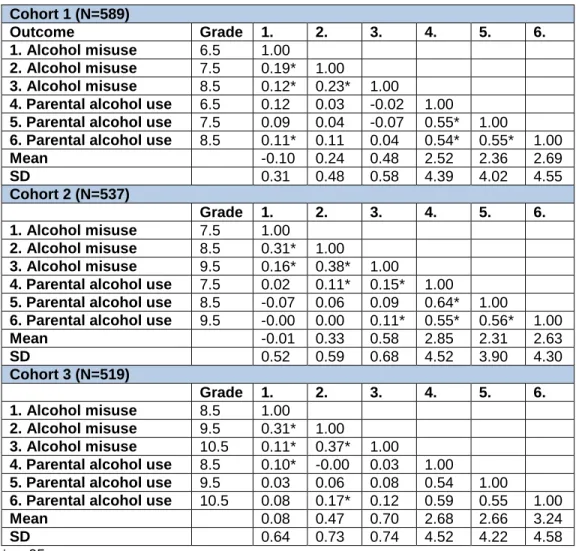
rather than wave of assessment ... 26 Table 3: Parental closeness and adolescent alcohol misuse correlations
by grade level and cohort ... 37
Table 4: Parental support and adolescent alcohol misuse correlations
by grade level and cohort ... 38 Table 5: Parental behavioral control and adolescent alcohol misuse correlations
by grade level and cohort ... 39
Table 6: Parental alcohol use and adolescent alcohol misuse correlations
by grade level and cohort ... 40 Table 7: Parental alcohol-specific monitoring and adolescent alcohol misuse
correlations by grade level and cohort ... 41
Table 8: Parental permissive messages and adolescent alcohol misuse
correlations by grade level and cohort ... 42 Table 9: Parental negative messages and adolescent alcohol misuse correlations
by grade level and cohort ... 43
Table 10: Model building process for univariate LCM-SR for adolescent
alcohol misuse ... 45 Table 11: Model-building process for bivariate LCM-SR between parental
closeness and adolescent alcohol misuse ... 48
Table 12: Model-building process for bivariate LCM-SR between parental
support and adolescent alcohol misuse ... 52 Table 13: Model-building process for bivariate LCM-SR between parental
behavioral control and adolescent alcohol misuse ... 57 Table 14: Model-building process for bivariate LCM-SR between parental
alcohol use and adolescent alcohol misuse ... 61 Table 15: Model-building process for bivariate LCM-SR between parental
alcohol-specific monitoring and adolescent alcohol misuse ... 66
Table 16: Model-building process for bivariate LCM-SR between parental
permissive messages and adolescent alcohol misuse ... 71 Table 17: Model-building process for bivariate LCM-SR between parental
LIST OF FIGURES
Figure 1: Conceptual model ... 18 Figure 2: Analytical time dimensions for autoregressive and
cross-lagged paths ... 30 Figure 3: Alternative analytical time dimensions for autoregressive and
cross-lagged paths ... 33 Figure 4: Final model for bivariate LCM-SR between closeness and alcohol misuse ... 49 Figure 5: Final model for bivariate LCM-SR between support and alcohol misuse ... 53 Figure 6: Final model for bivariate LCM-SR between behavioral control and
alcohol misuse ... 58 Figure 7: Final model for bivariate LCM-SR between parental alcohol use and
alcohol misuse ... 62 Figure 8: Final model for bivariate LCM-SR between alcohol-specific monitoring
and alcohol misuse ... 67 Figure 9: Final model for bivariate LCM-SR between permissive messages
and alcohol misuse ... 72 Figure 10: Final model for bivariate LCM-SR between negative messages
CHAPTER 1: INTRODUCTION
Adolescent alcohol misuse describes a pattern of drinking comprised of high-risk drinking, problems associated with drinking and high alcohol consumption levels.1 This type of alcohol use is
harmful to a range of health outcomes both during adolescence and into adulthood.1,2 A substantial body
of research on adolescent alcohol use has examined how parental behaviors, such as fostering a supportive parent-child relationship and parents’ own drinking, impacts adolescent drinking. However, limited research has examined how adolescents influence parental behaviors and the reciprocal nature of parent and child behaviors relative to alcohol use. For example, research has indicated that when
adolescents drink more alcohol, their parents subsequently exhibit less behavioral control, a known risk factor for adolescent alcohol use.3 Studies that clarify how the relationship between parental behaviors
and adolescent alcohol misuse develops during adolescence may help inform prevention efforts across this critical part of the lifespan. This dissertation assesses bidirectional influences between adolescent alcohol misuse and seven parental socialization behaviors using longitudinal data that spanned early and middle adolescence.
Socialization is the process by which an individual learns the norms and accepted behaviors of society. The process occurs through a continual exchange between the individual and influential others. For the developing child, family is the most proximal source of influence, and parents play a critical role in socializing their child to the use of alcohol, a culturally accepted substance used by most adults in the United States. What parents do and say, both generally and specific to alcohol, influences adolescent alcohol use and misuse. Parents who facilitate strong bonds with their children, demonstrate to their child they are loved and supported, exert developmentally appropriate levels of control over their child’s activities and who limit their own alcohol use decrease the risk their child will engage in alcohol use during adolescence.4-11 In addition, behaviors that parents employ specific to alcohol use, such as setting
The relationship between parents and teens regarding to alcohol use, however, is not limited to the influence of parents on teens. Transactional models of development state that a person and his or her environment are engaged in a continual process of mutual influence. That is, a person is developing in response to the changing environment, which in turn develops based on the changing individual. Applied to the parent-child dynamic regarding alcohol use, transactional theories suggest that an adolescent’s misuse of alcohol and the socialization behaviors of his or her parent are responsive to each other. To date, empirical studies on transactional models of development have largely focused on infant and early childhood outcomes.13-17 Few studies have examined reciprocal relationships between parents and
adolescents,18-20 and no studies have examined bidirectional processes regarding parental socialization
behaviors and the particularly consequential outcome of alcohol misuse during adolescence.
Using longitudinal data collected from both parents and adolescents, the current study addresses this gap by examining bidirectional relationships across early and middle adolescence between
adolescent alcohol misuse and seven parental socialization behaviors. The study assesses three general parenting behaviors common to socialization research on adolescent alcohol use, but not yet examined with regard to their reciprocity with adolescent alcohol misuse: parental closeness, support, and
behavioral control. The study extends examination of parental socialization behaviors to incorporate three behaviors specific to alcohol use that are supported by socialization theories, but not frequently examined in empirical research on the socialization of adolescent alcohol use: alcohol-specific monitoring and negative and permissive messages about alcohol. Additionally, the study assesses reciprocal relations between parental alcohol use and adolescent alcohol misuse.
Not only are the relationships between parental socialization behaviors and adolescent alcohol misuse potentially reciprocal in nature, they are also subject to developmental changes that occur as an adolescent matures. With increasing age, adolescents’ sense of self and personal autonomy develop and exposure to new experiences within and outside the family increases. These changes shape the
relationship adolescents have with their parents. For example, adolescents may begin to rebel if they feel their parents are encroaching on the expanded independence they seek.21,22 Because of these
Adolescent alcohol misuse is a particularly salient case for testing bidirectional pathways to determine whether the behaviors of parents and teens are dynamically linked across adolescence. First, alcohol is the most commonly used substance by adolescents. Initiation of alcohol use, as well as
escalation of use, often occurs during adolescence. Second, alcohol misuse is an exceptionally risky form of drinking during adolescence that holds severe consequences both during adolescence and into
adulthood. Third, parents are concerned about the potential negative consequences of adolescent alcohol use and want to prevent risky drinking by their teens. Thus, better understanding the dynamics of
parenting and alcohol misuse is informative to family-based prevention programs.
Theory and empirical research present a rationale for examining bidirectional processes between parents and adolescents to more fully understand the development of adolescent alcohol misuse. These processes are multifaceted and include those that are driven by characteristics of individuals as well as those specific to the timing of when a behavior occurs. Research on bidirectional processes relating parent and adolescent behavior therefore requires specific analytical techniques to disentangle multiple mechanisms of influence. Those processes related to characteristics of individuals encompass between-person, or interindividual processes. Processes that unfold within an individual, termed within-person or intraindividual processes, explain potentially meaningful relations between time-specific deviations from a person’s average level of behavior. This study focused on within-person processes as I sought to
understand how the behavior of a parent or teen at one point in time influences the behavior of the other at a subsequent time. These time-specific relations represent reactions of an individual to his or her environment as indicated by transactional models of development.
This dissertation utilizes a theoretically informed framework with appropriately matched analytical methods to assess bidirectional relationships between adolescent alcohol misuse and parental
CHAPTER 2: THEORETICAL AND EMPIRICAL EVIDENCE FOR THE RELATIONSHIP BETWEEN PARENTAL SOCIALIZATION BEHAVIORS AND ADOLESCENT ALCOHOL MISUSE
The Problem of Adolescent Alcohol Misuse
Currently in the United States, more than 50% of teenagers have had a drink of alcohol by the age of 15, a figure that rises to 70% by age 18.23 Approximately 10% of youth have initiated drinking by
10 years old,24 with nearly one third of American youth beginning to drink by age 13.25 Initiation of alcohol
use is most likely to occur during 7th and 8th grades, when youth are 12-13 years old.26 Early initiation of
alcohol use is particularly concerning, as youth who begin drinking at earlier ages are more likely to develop problem alcohol use and misuse during adolescence24,27,28 and later in life.29
Alcohol misuse describes a pattern of drinking behavior that is harmful to a range of health outcomes, as well as interpersonal relationships and social responsibilities.1,2 Multiple components of
drinking and its consequences comprise alcohol misuse. These include high-risk drinking, problems associated with drinking and high alcohol consumption levels.1 For adolescents, high-risk drinking reflects
circumstances that place youth at particularly elevated risk for detrimental consequences such as drinking before or after school, being drunk, using alcohol with other drugs, and drinking while driving. Problems associated with drinking include missing school or work, getting in a fight or feeling sick due to drinking.30
High consumption levels reflect excessive alcohol use such as heavy episodic drinking, or binge drinking, defined as four drinks for women and five drinks for men in a singular episode, as well as longer patterns of excessive use.31 Binge drinking is common among adolescents who drink alcohol, accounting for the
majority of alcohol consumed among 12-20 year olds in the United States.32,33 Thus, when adolescents
drink alcohol, they do so in an exceptionally risky manner.
Alcohol misuse is of significant public health concern, as episodes of heavy drinking and patterns of heightened drinking escalate risk for negative health and social outcomes. When adolescents
for dating violence and aggression.33,37-40 In addition, alcohol misuse increases the likelihood that
adolescents will use other substances including cigarettes and illicit drugs, 33 as well as experience
suicidal ideation and behavior.33,41
Not only does alcohol misuse amplify risk of these negative outcomes at the time of drinking, the consequences persist into adulthood. For both men and women, excessive drinking during adolescence is significantly associated with similar drinking patterns in young adulthood.42 Binge drinking during
adolescence places youth on a problematic trajectory towards alcohol abuse and dependence in adulthood.34 Such persistent drinking behavior also detracts from adolescents’ ability to maximize their
educational, social and economic potential, consequences that have lifelong ramifications.28
Parental Socialization of Adolescent Alcohol Misuse
Socialization is the process by which individuals learn the norms, values, and accepted behaviors of their society. The socialization process constitutes a continual exchange between individuals and those who seek to influence them. Primary socialization theory,43 which draws on social control and social
learning theories, points to the primacy of the family as the socialization source from early life that carries forward to adolescence.44 “The family is, after all, the most proximal social system in which patterned
exposure occurs; it generally guarantees a continuity of exposure extending back in time to the earliest consciousness of social meanings; and it is the single milieu that encompasses, at pre-adolescence, the widest range of experiences and involvements for the child”45 (p.119). Norms held by family members, in
particular parents, are passed on to children and serve as the basis for how the child learns what is expected and valued in his or her society.
Underlying primary socialization theory is the premise that human social behaviors are mostly, if not fully, learned behaviors and that this learning process occurs through interactions with proximal sources of influence. The theory is intended to explain adolescent substance use and other risk
during adolescence are of critical importance to preventing adolescent alcohol use and its escalation to misuse.
For years researchers have sought to define the conditions that support optimal parenting and effective parental socialization. How parents influence child outcomes is the focus of a large body of theory on parenting style. Early work by Baldwin and colleagues advocated for democratic parenting, which entailed maximum participation of children in family decision-making.46,47 From this came the
formative work of Diana Baumrind48,49 that defined three parenting style typologies based on the
dimensions of responsiveness, or the degree to which parents respond to their child’s needs, and
demandingness, which reflects parental expectations for mature and responsible behavior consistent with the child’s developmental stage. Baumrind’s conclusion that authoritative parenting, marked by high levels of responsiveness along with consistent and reinforced demands for meeting limits and expectations, is the most conducive for effective parenting has remained central to studies of familial socialization.50 Responsiveness and demandingness are two dimensions of parenting that have defined
parental socialization theories and the many empirical studies of parental influence on adolescent substance use that followed. Others have extended the typology to a four-fold scheme based on cross-classifying the two dimensions of responsiveness and demandingness,44 and added further dimensions
including psychological autonomy, a related construct to that of Baldwin’s democracy.51 However defined,
this work demonstrated the parental role of socializing the child in a way that reflects reciprocity between the needs and demands of self and other. Parents reflect this reciprocal dynamic by altering their own parenting behavior to meet the needs of their growing child. That is, parents alter their behaviors to support the changing needs of a developing child while relaying increasingly complex messages about their expectations for responsible behavior as the child assumes more mature social roles.
Parental socialization theories predicated on dimensions of responsiveness and demandingness describe the general approach parents take to parenting, which is independent of the content of a particular parenting behavior or the specific outcome the parent is intending to influence.52 In addition to
behavior-specific parenting tactics are related, yet distinct components of parental socialization. For example, two equally authoritative parents may employ different parenting practices related to alcohol use: one may allow the child to have a drink at family occasions while the other does not permit the child to drink alcohol under any circumstance. Assessing parental socialization of adolescent alcohol use requires an examination of both general and alcohol-specific parenting behaviors.
Socialization theories regarding general and behavior-specific parenting have focused on how parenting influences child behavior, with little attention paid to the alternative direction, how a child influences parental behavior. To more effectively prevent risky adolescent behaviors including alcohol misuse, scholars have called for a movement from a focus on the individuals involved, namely teens and their parents, to a focus on the interactions between the two.53 This shift in focus underscores the need to
investigate the processes that occur within the family that shape adolescent drinking. Fundamental to this investigation is an assessment of bidirectional relationships, or the specific ways in which parents and teens influence one another relative to alcohol use. These bidirectional relationships are the core of transactional models of development.
Transactional Models of Development
The socialization literature through the mid twentieth century provided extensive support for the role of family in shaping a child’s development. Until this point, however, conceptualizations of the parent-child relationship depicted unidirectional influence from parent to parent-child. In this respect, parent-children were passive agents responding to the behaviors of their parents or primary caregivers. In 1968, Bell54
based on the level of distress exhibited by the crying infant. Not only do children activate types of parental behavioral responses, but they also affect the level and reinforcement of those behaviors.
Building on the work of Bell, researchers began to put forth developmental models that portrayed the child as having an active role in the socialization process. These models incorporated dynamic exchanges between parent and child that shape the growth and subsequent behavior of each.55,56
Kuczynski and colleagues provided a conceptual model for bidirectional socialization that incorporated both parent and child as ‘interdependent, active agents in a process of mutual influence’56 (p.27).
Sameroff57 distinguished mechanistic and dialectical exchange orientations to describe processes in
which the dynamic interplay between parent and child occurs. From a mechanistic stance, there is a linear prediction of one variable on another, from organism to environment or environment to organism. Contrastingly, a dialectical approach addresses transactions between an organism and environment that mutually alters development of each, either in form or level58 In addition, Lerner and
Spanier59documented a dynamic interactional model of development that centered on a continuous
interdependency between an individual and social change processes. Development occurs due to these exchanges, a process that is based on a series of interactions between an individual and his or her environment such that an individual is constantly adjusting to a changing environment and the environment is continuously responding to the changing individual.
An emphasis on dynamic processes has extended previous theories widely used in family-based research. For example, early iterations of social learning theory60 framed the learning process as one in
which parents shaped their child’s growth via their own behavior. Interaction theorists extended this model to include the reciprocal processes that underlie socialization. These new conceptualizations of mutual exchange centered on feedback patterns to incorporate both action and reaction within the exchange system.61 A much studied and replicated example of the reciprocal effects between parent and
The severity of the immediate and long-term consequences of alcohol misuse makes this type of drinking an important case for studying bidirectional relationships. As suggested by coercion theory, negative cycles of behavior between a parent and child may prolong deviant actions, and the
consequences of those actions. It may be that parents and teens perpetuate a cycle across adolescence in which weak parental socialization behaviors escalate alcohol misuse and vice versa, thereby
reinforcing negative behaviors by both the parent and teen. Knowing how parents and adolescents interact relative to alcohol misuse may illuminate particular socialization processes, which in turn might suggest specific strategies for family-based prevention programs to prevent and intervene on multiple types of adolescent alcohol use.
General Parental Socialization Behaviors and Adolescent Alcohol Misuse
I now review the extant literature on the relationship between parental socialization behaviors and adolescent alcohol misuse. When applicable, I add findings from studies of bidirectional relationships to the more substantial literature base on parental influence on adolescent alcohol use. First, I review three aspects of general parental socialization: closeness, support and behavioral control.
Parental closeness.Because norms are passed on through links with socialization sources, the strength of the bond between a parent and child determines how effectively norms are transmitted; strong bonds are necessary for effective transmission of norms. Social control theory (SCT) posits that every individual holds deviant tendencies, which are manifested only when there are weak bonds between the individual and conventional society.66-68 Secure attachments, derived from emotional connectedness to
conventional role models, are indications of strong bonds and effective socialization. Parents who facilitate secure attachments with responsive actions are more likely to have children willing to comply with their expectations.69 Adolescents who feel detached or isolated from their parents are less likely to
internalize parental values and standards for pro-social behavior, and are therefore at greater risk for deviant behavior such as alcohol misuse.In contrast,children who feel close to their parents trust them to provide appropriate guidance as they mature and encounter new experiences.69,70
Cross-sectional studies have demonstrated that strong parent-child bonds increase the likelihood of delayed initiation into drinking4,71 and lower levels of use during adolescence.4,5,72 However,
relationship, use of alcohol in early adolescence weakens an adolescent’s perceived closeness to his or her parents.73 Early initiation into alcohol use can distance a child emotionally from their parents,
decreasing the ability of the parents to fully relay pro-social expectations and values. This weakening of parental closeness due to problematic substance use also holds true in later adolescence and young adulthood,74 indicating a persistent effect with long-term implications. In a study of reciprocal relations of
alcohol use and the related construct of parental attachment, adolescent alcohol use had a negative influence on subsequent levels of parental attachment, although attachment did not influence later alcohol use.73 More broadly, however, full reciprocal relations have been demonstrated between parental
attachment and adolescent externalizing behavior.75
Parental support and behavioral control.Socialization research has long regarded support and control as two parenting elements applicable to a range of adolescent behaviors.76,77 Socialization
theories specific to parenting and the empirical studies that followed largely focused on these two parenting behaviors, which are derived from the dimensions of responsiveness and demandingness that underlie authoritative parenting. Parental support comprises behaviors that indicate to the child they are accepted and loved. Parental support is a related, yet distinct, construct from parental closeness. Closeness measures the emotional connectedness between parent and child, which facilitates the
delivery and receipt of specific supportive behaviors such as giving praise and encouragement or physical affection. Parental control describes a set of actions used by parents to regulate their child’s activities and direct their behavior in a manner acceptable to the parent. When parents exert control over their child’s behaviors and activities, they restrict what the child can and cannot do without permission, and place boundaries on their activities. In doing so, children learn what is considered appropriate behavior.
For effective socialization, the family must function with adequate levels of parental support and control. Research regarding both parental support and control has concluded that effective socialization occurs with high levels of support and moderate levels of control.77,78 Overall, parental support shows a
consistent relationship with adolescent alcohol use such that higher levels of support are associated with lower levels of drinking.6,7,76,78,79 Parental support may also indirectly influence adolescent alcohol use by
In contrast to parental support, results regarding parental control are much less definitive, in some research showing no significant relationship with adolescent alcohol use.76 Researchers have found
both negative linear81,82 and quadratic77,78,83 relationships between parental control and adolescent
alcohol use. Curvilinear results can be explained in that too little and too much control may both be detrimental to adolescent outcomes.7,76 A lack of control doesn’t provide the child with adequate guidance
and may interfere with a child’s attachment to their parent, and in turn the extent to which they internalize parental values and norms. Too much control may result in rebellious acts by the adolescent, including devious behaviors such as alcohol use. More recent longitudinal studies provide equivocal evidence regarding the association between parental behavioral control and adolescent drinking. On the one hand, higher levels of parental behavioral control reduced adolescent drinking; 8,9,84 other evidence indicates
that parental control had no effect on adolescent drinking.85,86
The limited research that has assessed bidirectional associations between parental behavior and adolescent alcohol use has largely focused on parental support and control. Assessing substance use generally, full reciprocal effects have been found between both parental support and control and adolescent substance use such that lower levels of these parental behaviors prospectively predicted higher levels of adolescent substance use, which in turn predicted lower subsequent levels of parental support and control.18 Similarly with regard to alcohol use only, greater parental control resulted in less
alcohol consumption by older adolescents, and when these teens drank more, parents exhibited less subsequent control.3 Extending to related constructs of behavioral control, bidirectional effects were found
between parental knowledge and monitoring of child whereabouts and adolescent alcohol consumption specifically,73 substance use generally,19 and overall problem behavior.8,87 However, recent studies of
reciprocal effects using modeling approaches similar to those I use in this study did not find bidirectional pathways between parental knowledge and heavy episodic drinking20 nor parental monitoring and
substance use generally.88
Alcohol-Specific Parental Socialization Behaviors and Adolescent Alcohol Misuse
effects above and beyond general socialization behaviors.12,84,89 Alcohol-specific parenting reflects a
range of behaviors parents employ to deter or prevent their child from consuming alcohol.90,91 This study
examines three alcohol-specific socialization behaviors: alcohol-specific monitoring, negative communication messages and permissive communication messages about alcohol.
Alcohol-specific monitoring.Most studies of parental control operationalize the construct to include general rules and regulations on a wide range of adolescent activities, which is also the manner in which many studies define parental monitoring. In this way, parental monitoring reflects more general control efforts that pertain to multiple risk behaviors. However, it may be that monitoring practices specific to a behavior have unique effects on that behavior. While general parental monitoring has been the subject of substantial inquiry,89,92 surprisingly few studies have examined monitoring behaviors specific to
alcohol use.
Van der Vorst and colleagues93 found that supervisory practices specific to alcohol use did not
moderate the study’s primary relationship between adolescents’ drinking inside and outside the home. That is, the positive association between drinking inside and outside the home did not differ based on the level of parental supervision of their child’s alcohol use. Examining students in fifth grade, Jackson et al90
found that those students who believed their parents did not monitor their activity for alcohol use were at significantly greater odds for reporting alcohol use as compared to students who believed their parents would know if they drank alcohol. Only one study has examined reciprocal effects with regard to alcohol-specific monitoring and adolescent alcohol use. Results from this study of younger adolescents
suggested that adolescent alcohol use resulted in lower subsequent parental alcohol-specific behavioral control and alternatively, increased alcohol-specific behavioral control led to decreased adolescent alcohol use.3 Relatedly, rules regarding alcohol use decreased the likelihood of alcohol initiation, though
the impact of alcohol-specific rules declined as an adolescent aged.94,95 Bidirectionally, alcohol-specific
rules decreased subsequent alcohol use, but only for those adolescents who had not already initiated alcohol use at baseline. For both drinking and non-drinking adolescents at baseline, alcohol use by the adolescent did not influence subsequent alcohol-specific rules.94
what they say. To date, empirical literature on the influence of alcohol-related parent-child communication remains mixed. Inconsistent findings coupled with differences in methodological approaches make it difficult to conclusively interpret this body of literature. Encompassed within parent-child communication is the frequency, content, quality, and timing of the communication. Assuming that communication is
fundamental to the parent-child relationship, it might be expected that greater frequency and quality of communication regarding alcohol would protect the adolescent from risky drinking behaviors. However, the evidence remains equivocal at best.
Several studies have found that higher frequency and better quality of parent-child communication were related to lower risk for both initiation and escalation of drinking across
adolescence.96 Others have found no significant effect of communication on adolescent drinking.97,98
Some studies have shown potentially detrimental effects of communication on adolescent alcohol use. Assessing multiple components of parent-child communication on alcohol, Ennett et al’s99 study found no
influence on the initiation of alcohol use, but some evidence to suggest that conversations about the rules and consequences of alcohol may have increased alcohol use for those who had already tried alcohol, a result similar to that of van der Vorst et al. 91 Additionally, more frequent communication, especially of the
negative consequences of alcohol use, resulted in greater risk for initiation and escalation of use100 as
well as problematic alcohol use.101
Regarding specific content of parent-child communication related to alcohol use, Reimuller et al102 studied parent-adolescent dyads and found two distinct domains of alcohol-specific communication.
drinking, this study found that frequent messages regarding the consequences of alcohol use were associated with lower likelihood of initial drinking and a slower increase in drinking across adolescence.103
Parental Alcohol Use and Adolescent Alcohol Misuse
Parental drinking is related to adolescent alcohol consumption in several ways. First, it has been shown that children model their parents’ behavior as described by social learning theory.60 Adolescents
whose parents drink regularly or heavily are at increased risk for alcohol use themselves.10,104-107
Witnessing parents drink alcohol may lead adolescents to drink themselves or adopt pro-social norms regarding alcohol consumption.108-110 The more often adolescents witness their parents drunk, the more
likely they are to drink themselves.111 Furthermore, those children that drink with their parents inside the
home are more likely to also drink outside the home.93
Second, parental drinking may indirectly impact their adolescent’s drinking in several important ways. One such mechanism is that parents who drink heavily are more lenient with regard to rules and monitoring practices, known risk factors for adolescent drinking.112,113 Second, when parents drink in the
home, alcohol is more readily available which also increases risk for adolescent alcohol use.114
Additionally, it can be argued that regularly drinking parents consider themselves less credible in enforcing drinking rules on their children and are more permissive to teen drinking. Finally, parental drinking may also change the family environment to heighten teen alcohol use due to increased family conflict and less interaction between family members.109
Developmental Considerations in the Relationship Between Parental Socialization and Adolescent Alcohol Misuse
need to examine parental and adolescent behavior at multiple time points across adolescence to assess stability and change within the relationship between parenting and adolescent alcohol misuse.
Adolescents undergo many changes during adolescence that prepare them to assume adult roles in society. Underlying this development is growth in personal autonomy, with the expectation that
adolescents will seek greater independence as they get older, both in the roles they play as well as their relationships to those who have socialized them, including parents.115 Expanded independence allows for
greater personal control and autonomy, which are important characteristics for the transition to adulthood. While seeking independence may be normative, this shift holds implications for the parent-child
relationship, and subsequently other outcomes such as alcohol use that are shaped by parental interaction.
As an adolescent gains greater autonomy, parents must adjust their control efforts to balance the need to monitor their adolescent’s behavior while respecting the independence sought by their child.116,117
Person-environment fit theory suggests that optimal results occur when personal factors are in
congruence with environmental characteristics.118,119 Applied to child development outcomes, the match
between an adolescent’s desire for independence and the level of parental control exerted is highly important. Children who feel too controlled by parents may feel resentment towards their parents, or even rebel against parental control.21,22 Such rebellion could turn an adolescent away from pro-social activities
encouraged through parents’ socialization behaviors and to more deviant behaviors such as drinking. Optimal developmental outcomes occur when parental control is gradually reduced in response to a child’s desire for more autonomy,120 a process critically important during early and middle adolescent
years.
Beyond specific control efforts, the overall stability of the parent-adolescent bond during adolescence has been subject to much research.50,121-123 Processes associated with adolescent
maturation have been theorized as factors underpinning destabilization of the parent-adolescent bond. 124-127 Cognitively, adolescents develop greater capacity for critical and abstract thinking. They may want or
be offered a greater role in decision-making within the family.127,128 These cognitive changes provide
childhood.126 Additionally, adolescents may begin to reinterpret previous social conventions held by
parents, viewing them as subjective rather than absolute. This may bring about tensions in the relationship as parents and adolescents struggle to define and agree upon rules and acceptable behaviors governed by the morals and beliefs of each.127,129,130 Physical maturation affects the way
adolescents view themselves and how others, including their parents, treat them. Hormonal fluctuations caused by puberty necessitate recalibration of relationships to respond to adolescents’ heightened emotional states.127 Such pubertal changes may result in increased emotional distance between parent
and child.
Instability in the parent-child bond may occur as both parties seek to find appropriate levels of independence. As a result, closeness to parents diminishes across adolescence, as does the
interdependence of parents and children.124,126,131 Rather than an abrupt decline, closeness to parents
gradually decreases.132 High-quality relationships built on strong bonds, however, may change little
across adolescence as both parties adapt to changing circumstances and individual development in a manner that is mutually beneficial.81,126 The stability of parental closeness is paramount to the influence of
parental behaviors on adolescent behavior. This holds true in the reverse as well, closeness underlies the influence of adolescent actions on parental behavior.
In addition to the changing dynamics of the parent-child relationship, adolescence also brings a shift in importance of peer relationships.133-135 It is well documented that adolescents have greater
involvement and more intense relationships with their peers as they progress through adolescence. 115,136-138 Greater involvement with peers is important in that it often occurs simultaneously with decreased
parental involvement and relationship quality.115,133,139 The relative importance of peer relationships during
adolescence is beyond the purview of this study; however, specific elements are significant with regard to alcohol misuse. Foremost, tensions in the parent-adolescent relationship, whether due to changes in closeness, disagreements regarding control or other factors, increases the likelihood the adolescent engages with deviant peers.6,140,141 According to primary socialization theory, weak familial bonds
increase an adolescent’s risk of bonding with a deviant peer cluster and engaging in deviant behaviors.43
In summary, physical, cognitive and emotional development during adolescence impacts the strength and nature of the relationships teenagers have with their parents. This maturation has implications for the interactions between adolescents and parents, and consequently the behaviors of each. To address development change, this study assesses the relationship between parental socialization behaviors and adolescent alcohol misuse at multiple time points across early and middle adolescence.
Conceptual Model
My dissertation extends previous research on parental socialization and adolescent alcohol use by examining reciprocal relations between seven parental socialization behaviors and the particularly consequential behavior of adolescent alcohol misuse. I test bidirectional pathways between three well-documented general parenting behaviors (parental closeness, support and behavioral control), three less studied aspects of alcohol-specific parenting (alcohol-specific monitoring, negative communication messages about alcohol and permissive communication messages about alcohol) and parental alcohol use. Additionally, I assess how the reciprocal relations between each parenting behavior and alcohol misuse unfold across early and middle adolescence. The conceptual model for this research is presented in Figure 1.
Aims and Hypotheses
Aim 1: To understand bidirectional mechanisms of influence between parental socialization behaviors and adolescent alcohol misuse.
[Parent effects on adolescent] At times when the parent exhibits weaker socialization behaviors (H1: lower parental closeness, H2: lower parental support, H3: lower behavioral control, H4: higher alcohol use, H5: lower alcohol-specific monitoring, H6: higher permissive messages about alcohol, and H7: lower negative messages about alcohol), the adolescent will subsequently misuse alcohol more than is typical for him/her.
[Adolescent effects on parent] At times when the adolescent misuses alcohol more than his or her typical level, the parent will subsequently exhibit weaker socialization behaviors (H8: lower parental closeness, H9: lower parental support, H10: lower behavioral control, H11: higher alcohol use, H12: lower alcohol-specific monitoring, H13: higher permissive messages about alcohol, and H14: lower negative messages about alcohol).
Aim 2: To assess whether bidirectional influences between parental socialization behaviors and adolescent alcohol misuse change from early through middle adolescence.
[Parent effects on adolescent]: The magnitude of the effect of parent H15: closeness, H16: support, H17: behavioral control, H18: alcohol use, H19: alcohol-specific monitoring, H20: permissive messages, and H21: negative messages on adolescent alcohol misuse will decrease from 6-10th
grade.
CHAPTER 3: METHODS
Participants
Data for this study are from the Context of Adolescent Substance Use(Context Study, R01 DA13459, PI: S. Ennett) and Violence against Peers, Dates, and Self: A Developmental Focus(Linkage Study, CDC R49 CCV423114, PI: V. Foshee) that together supported Context/Linkages, a longitudinal study of adolescent health risk behaviors. The study was designed to examine the development of adolescent health risk behaviors, and the individual and contextual factors that contribute to their development.
Context/Linkagesused a cohort sequential design that included seven waves of data collection from three cohorts of adolescents in three non-metropolitan counties in North Carolina; the three cohorts were enrolled in grades 6, 7, and 8 at baseline. Targeted schools for Context/Linkages were all public schools that contained grades 6-8, as well as the high schools they fed into, in the three counties. At baseline, all adolescents enrolled in grades 6-8 were eligible for the study except for those who could not complete the survey in English, were in self-contained special education classrooms, or were out of school for long-term suspension. Analyses for this study included data from Waves 1-5. Data collection for Waves 1-5 took place every spring and fall beginning in spring 2002. The study also included a parent sample that was a simple random sample of parents of adolescents who completed the adolescent questionnaire at Wave 1. Additional eligibility required parents to have only one child in the school-based study and to be able to complete the interview in English. By design, for 98% of the cases, the mother or mother surrogate was the parent interviewed. Parents completed annual telephone interviews at Waves 1, 3, and 5.
obtain assent and provide directions on completing the questionnaire. Those adolescents who refused assent were excused. Adolescents completed the questionnaire in approximately one hour. To maintain order, teachers remained in classrooms but did not walk around the classroom or ask any questions regarding the study. Students were spread across the classroom and instructed not to talk with one another to ensure privacy. Once completed, students placed the questionnaires in envelopes before returning them to data collectors. Study staff returned to the schools as many as four additional days beyond the primary data collection day in attempt to reach absent adolescents. Trained data collectors conducted the parent interviews via telephone, each of which lasted approximately 25 minutes. The Institutional Review Board at the University of North Carolina at Chapel Hill approved all study protocols.
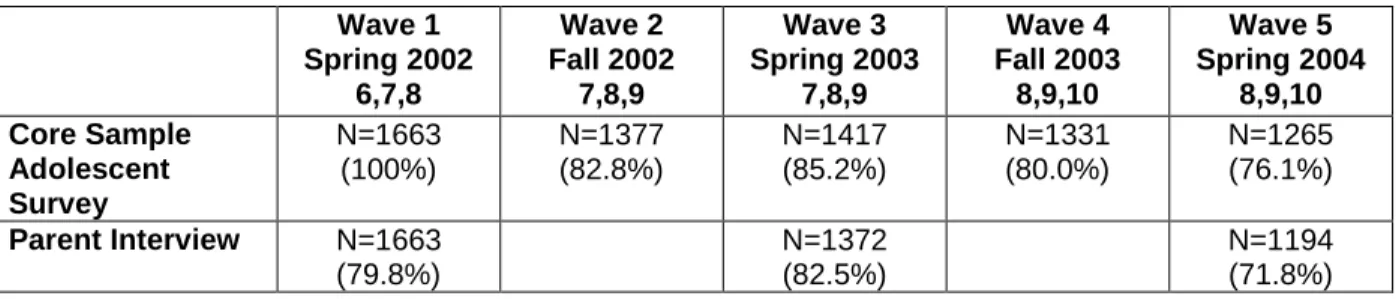
The core sample, used in these analyses, is the subsample of parent-adolescent dyads identified in Wave 1. At Wave 1, 2215 parents were eligible for data collection, which 79.8% completed the Wave 1 interview (N=1663). All adolescents of these parents completed the Wave 1 questionnaire. Pairs were excluded if 1) the metric of time for this study (grade) could not be confirmed for the adolescent (N=15) or 2) adolescents were missing data for alcohol use across all waves of data collection (N=3), resulting in an analytical sample of 1645 parent-adolescent dyads. Response rates for adolescents and parents in the core sample across Waves 1-5 are presented in Table 1.
Table 1: Context/Linkages study design across waves 1-5
Wave 1 Spring 2002 6,7,8 Wave 2 Fall 2002 7,8,9 Wave 3 Spring 2003 7,8,9 Wave 4 Fall 2003 8,9,10 Wave 5 Spring 2004 8,9,10 Core Sample Adolescent Survey N=1663 (100%) N=1377 (82.8%) N=1417 (85.2%) N=1331 (80.0%) N=1265 (76.1%) Parent Interview N=1663
(79.8%)
N=1372 (82.5%)
N=1194 (71.8%)
wave. At baseline, 50% of the adolescent sample had ever had alcohol while 27% had consumed alcohol in the past 30 days.
Measures
Primary measures for this study included adolescent alcohol misuse and seven parental
socialization behaviors, three general parental socialization behaviors (closeness, support and behavioral control), three alcohol-specific parental socialization behaviors (alcohol-specific monitoring, permissive messages about alcohol, negative messages about alcohol) and parental alcohol use. The measure for adolescent alcohol misuse was based on adolescent self-report. All measures of parental socialization behaviors were derived from parental report with the referent being the responding parent only. The adolescent and parent outcomes measures were identically constructed at each wave of data collection. Covariate demographic and behavioral measures were generated from adolescent or parent responses, as appropriate, across all waves of data collection, described in detail below. As applicable, Cronbach’s alpha averaged across waves is provided.
Adolescent Alcohol Misuse. This outcome was measured by an existing variable that was
constructed using item response theory (IRT).145 Adolescents responded to eight questions related to
recent alcohol use, measuring both problematic levels and negative consequences of alcohol use (e.g. ‘how many times have you had 5 or more drinks in a row’, ‘gotten into a sexual situation that you later regretted because you had been drinking’, ‘gotten into a physical fight because you had been drinking’). Responses fell into five categories ranging from 0 to 10 or more occurrences in the past 3 months. IRT146
methods were used to account for the skewed distribution of the responses. One observation per respondent was randomly chosen from all repeated measures to ensure independent cases in
constructing the IRT scores. A nominal, one-factor model was most appropriate for the data. IRT scale scores were computed for all participants using the item parameter estimates, resulting in a continuous distribution with lesser skewness and kurtosis than a scale derived from summary scores.
Parental Closeness. Parents were asked ‘how close do you feel toward (name)’ and ‘how close
Response options were often (4), sometimes (3), rarely (2) or never (1). The three items were averaged to create a composite parental closeness score (average Cronbach’s α=.69).
Parental Support. Parents were asked in reference to their child, how often they ‘make (name)
feel better when he/she is upset’, ‘tell (name) they did a good job on things’, and ‘want to hear about his/her problems’. Response options were often (4), sometimes (3), rarely (2) or never (1). The three items were averaged to create a composite parental support score. The resulting variable was highly skewed (skew=-3.836); therefore the variable was transformed to the exponential value for analyses to reduce skewness (average Cronbach’s α=.54). The items used in this measure of parental support have been used in a similar study elsewhere.90
Parental Behavioral Control. Parents were asked in reference to their child, how often they ‘tell
him/her what time to come home’, ‘have rules he/she must follow’, ‘makes sure he/she doesn’t stay up too late’, ‘monitor what he/she watches on tv’, and ‘put restrictions on music or videogames he/she can play’. Response options were often (4), sometimes (3), rarely (2) or never (1). The five items were averaged to create a composite behavioral control score (average Cronbach’s α=.62). The items used in this measure of behavioral control have been used in a similar study, though with additional items included.90
Parental Alcohol Use. Parents were asked how many days in the past three months they had one
or more drinks of alcohol. Response options ranged from 1=less than one day a month to 6=almost every day. Parents were also asked how much they drank on those days they did drink. Response options ranged from 1=1 drink to 5=5 or more drinks. The two items were multiplied to create a parental alcohol use score.
Parental Alcohol-Specific Monitoring. Parents were asked in reference to their child, whether they
had ‘done anything to discourage him/her from drinking’, ‘checked his/her room or other places for evidence of tobacco, alcohol or other drug use’ and ‘looked for signs that he/she might have smoked or used other kinds of tobacco, drank, or used marijuana or other drugs’. Response options were yes (1) or no (0). The three items were averaged to create an alcohol-specific monitoring score (average
Parental Permissive Messages. Parents were asked whether they had told their child ‘if he/she
ever wants to try a drink, he/she can have a few sips at home in front of you’, ‘under certain
circumstances it’s okay to have a few sips of a drink, like with parents or special family occasions’, and ‘drinking in moderation is okay’. Response options were yes (1) or no (0). The three items were averaged to create a permissive messages score (average Cronbach’s α= 0.64).102
Parental Negative Messages. Parents were asked whether they had told their child ‘drinking is
not healthy’, ‘drinking can lead to alcoholism’, ‘drinking can cause loss of control’, ‘he/she cannot ride with someone who has been drinking’, ‘he/she cannot drink and drive when old enough to drive’, and ‘he/she should call home to be picked up if he/she does drink’. Response options were yes (1) or no (0). The six items were averaged to create a negative messages score (average Cronbach’s α= 0.77).102
Covariates. An average measure of each parental socialization behavior across time points was constructed and included as a time-invariant control in models of all other socialization behaviors. Adolescent-reported sex was included, with females defined as the reference category. Race/ethnicity was based on the modal response reported by adolescents across all waves of data collection and dummy coded as White (reference), Black, or Other race/ethnicity. Parent-reported parental education consisted of six categories ranging from less than high school to graduate school or more, and was assessed as the highest level of education attained by either parent across all waves of data collection. Adolescent-reported family structure was coded as either two parents in the household (biological or not) as the referent or other family structure. Age was included as a covariate. Additionally, a variable was created to control for whether the responding parent changed across any wave of assessment.
Missing Data
All analyses used maximum likelihood estimation (MLE) techniques, which utilize all available data, and can be used under the assumption that missing data are missing at random (MAR). In this case, data on the outcomes of interest (alcohol misuse and parental socialization behaviors) were considered missing at random if the probability of missingness did not depend on the value of the outcome variable, controlling for covariates in the analytic model.147,148 While there is no way to
baseline alcohol misuse for adolescents and 2) study dropout and demographic covariates and baseline socialization behaviors for parents. Dropout was coded as ‘1’ for adolescents or parents who did not have complete data, and ‘0’ for those with complete data. In multivariate analyses, the association between dropout and baseline alcohol misuse was not significant after controlling for sex, parental education, family structure and race/ethnicity. In multivariate analyses among parents, baseline levels of closeness, support, behavioral control, alcohol-specific monitoring, negative and permissive messages and parental alcohol use were not significantly associated with parental dropout after controlling for demographic covariates. These analyses suggest that study dropout was not related to baseline alcohol misuse or parental socialization variables after controlling for demographic covariates.
Cohort Sequential Design
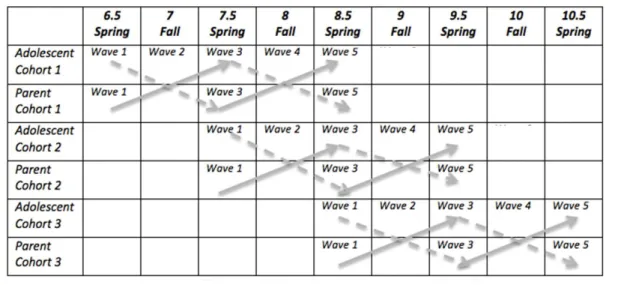
To capitalize on the cohort sequential design of the study, data were reorganized such that grade level of the child, rather than wave of assessment, was used as the metric of time. This structure allowed variables to be modeled continuously from the spring of 6th grade to the spring of 10th grade, using
half-year intervals resulting in nine discrete data points, see Table 2. Cohort sequential designs combine data from multiple, shorter longitudinal datasets into one dataset under the assumption that there is one common growth curve for which the separate cohorts do not differ. I tested for differences in the three cohorts (i.e., grades 6, 7, and 8 at baseline) in growth patterns for adolescent alcohol misuse following established multi-group methods,149 and found no evidence of cohort differences in the latent trajectory of
Table 2: Cohort sequential design for adolescent and parent data by grade, rather than wave of assessment
*solid lines represent parental effects on child; dashed lines represent child effects on parent
Analytic Approach
The overall goal of this study was to assess bidirectional effects between parental socialization behaviors and adolescent alcohol misuse across grades 6-10. In this way, the purpose of the study is to model dynamic relations that link parental socialization behaviors and adolescent alcohol misuse over time. Such an investigation provides insight as to how these behaviors mutually play out across adolescence. There is more than one way to examine how these relationships develop over time.
The first is how the relationship unfolds across individuals, describing interindividual processes. A between-person level of analysis explores interindividual differences, or those differences that exist across persons.151-154 Generally, between-person effects examine whether individuals who, on average,
experience a higher level of one construct tend to behave in a certain way on another construct; or, whether individuals who report a systematic increase in one behavior are more likely to report a
systematically higher or lower level of a second, related behavior. For example, on average, adolescents whose parents monitor their activities tend to misuse alcohol less than adolescents whose parents are not monitoring their whereabouts. Therefore, between-person processes provide information on who is at risk; specifically, which adolescents are at risk for alcohol misuse based on parental socialization
The second method of examination is how the relationship unfolds within an individual, describing
intraindividual processes. This component, referred to as the within-person effect, reflects unique components of both the individual and specific points in time, thereby examining differences within the same person across points in time.151-155 The within-person model assesses whether at times when an
individual is above or below his or her own average level of one construct, he or she is above or below their average on a second construct. This model examines whether a time-specific level at one time point is meaningfully related to another time-dependent level at a later point. Thus, with-in person effects examine time-specific deviations relative to an individual’s underlying trajectory.
For this study, parental and adolescent behaviors are linked according to time-specific deviations. This provides information on when an adolescent is most at risk for alcohol misuse based on their
parents’ socializing behaviors. Due to the bidirectional nature of the study, the within-person model also explores when parents alter socialization behaviors based on their child’s alcohol use. As outlined in transactional models of development, this study focuses on such intraindividual effects to explain the relationship between general and alcohol-specific parental socialization behaviors, parental alcohol use and adolescent alcohol misuse. All models control for the between-level effect.
The goal of the analyses was to model the over-time interrelationships between adolescent alcohol misuse and parental socialization behaviors, assessed one at a time, specifically examining the time-specific component of these relations within each adolescent-parent dyad. To simultaneously explore the hypothesized relationships of the two outcome variables over time, I utilized a latent curve model with structured residuals (LCM-SR)156, an extension of the autoregressive latent trajectory (ALT)
model.157 The approach of the ALT model assumes that each outcome (adolescent alcohol misuse and
parental socialization behavior) is dictated by an underlying growth process unique to that outcome. Thus, a separate latent curve model is estimated for each outcome to reflect its distinctive growth process and to align with a developmental perspective that change is a continuous growth process.158 The latent
The ALT model combines the strength of two common methods for the analysis of panel data: the autoregressive model and the random coefficients growth curve model. Doing so allows for the
simultaneous assessment of time-stable and time-specific associations between the two outcomes. The time-stable association is reflected through the covariation of the latent factors that govern the underlying developmental process of each outcome. Time-specific relations are assessed by the inclusion of
autoregressive paths and prospective cross-lag paths between repeated measures of time-varying outcomes.157
The current study specifically examines the within-person processes of the two outcomes, which are the time-specific relationships between adolescent alcohol misuse and parental socialization behavior for each parent-adolescent dyad. For this study, the time-specific relationships include 1) autoregressive stability paths from the observed measure of adolescent alcohol misuse at one time point to the next time point, 2) autoregressive stability paths between repeated measures of the parental socialization behavior at one time point to the next time point , 3) prospective paths from adolescent alcohol misuse at one time point to the parental socialization behavior at the next time point, and 4) prospective paths from parental behavior to the time-adjacent measure of adolescent alcohol misuse. To fully capture these four within-person effects, the between- and within- within-person effects of the model must be disaggregated.
The latent curve model with structured residuals (LCM-SR) was chosen because of its unique ability to disaggregate between- and within-person effects on the stability and change of the proposed relationship between the variables over time.152,156 The LCM-SR used in this study deviates from the ALT
model in that whereas the ALT model specifies the autoregressive and prospective paths at the level of the observed variables, the LCM-SR does so at the level of the time-specific residuals. Since the ALT model specifies these relations among the manifest variables, it can be interpreted that the repeated measures of one construct are mediators for the influence of the latent curve of that construct on the indicators of the second construct. Because of this, the ALT model does not provide a pure
time-specific residuals is not a typical parameterization of a structural equation model (SEM); however, this approach has been used previously in SEM analyses and is sometimes referred to as ‘phantom variables’. These are latent variables with no indicators used as a methodological means for imposing constraints on parameter estimates.159,160 With the imposition of a higher order structure among the
residuals, the mean structure of the repeated measures is uniquely determined by the latent curve factors while the covariance of the repeated measures is jointly modeled by the latent curve factors as well as the structure of the residuals. This parameterization allows for estimation of unique between and within person components of the model.
I present a series of equations to demonstrate the reconceptualization of the residual structure and function for the LCM-SR156. For a univariate LCM with no structured residuals, the residual (ξ
y𝑖𝑡) represents the deviation of the observed measure (𝑦𝑖𝑡) from its underlying trajectory:
ξy𝑖𝑡= 𝑦𝑖𝑡- (α𝑦𝑖 + λ𝑡β𝑦𝑖)
The reparameterization of the residuals in the LCM-SR conceptualizes the residual as a time-specific estimate of the above deviation. Rather than allowing the residuals to covary in an unstructured way, the model defines the regression of a later residual on a prior residual:
ξy𝑖𝑡= ρyyξyi(t−1)+ νyit
Where ρyy is the regression parameter and νyit ~ N(0, σ2vy). Based on this equation, a later residual is
partly determined by a prior residual, beyond the influence of the underlying trajectory.
Given that the goal of the research is to estimate the within-person processes that link two constructs over time, a multivariate model is necessary. The multivariate LCM-SR defines a residual based on the regression of both a prior autoregressive and cross-lagged residual:
ξyit=ρyyξyi(t−1)+ ρyzξzi(t−1)+ νyit
Where ρyy is the autoregressive regression parameter for the residual at time t on the residual at time t-1
and ρyz is the similar cross-lagged regression parameter. This residual structure holds for all residuals
except for T=1, which differs in that it is not conditioned on a prior residual. A similar equation for the residual of the second construct in the multivariate model can be expressed as:
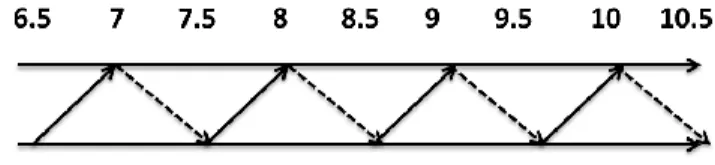
Due to model complexity, a separate model was estimated for the relation between each parental socialization behavior and adolescent alcohol misuse, controlling for all other socialization behaviors. To assess reciprocal relations within the same time period, autoregressive and cross-lagged paths were incorporated into the LCM-SR according to the time dimensions depicted in Figure 2.
Figure 2: Analytical time dimensions for autoregressive and cross-lagged paths
For nested models, I used a chi-square difference test to determine improvement in model fit. The comparative fit index (CFI), Tucker-Lewis Index (TLI) and the root mean square error of approximation (RMSEA) were used to assess model fit for all latent curves.158 Good fit was denoted as indices greater
than 0.95 for the CFI and TLI statistics and less than 0.05 for the RMSEA. Unstandardized parameter coefficients are presented throughout the results and discussion. Statistical significance is denoted at the following alpha levels: +p<.10, **p<.05, ***p<.01. I used the model building approach described below to assess increasingly complex models to test study hypotheses.
Step 1- Univariate LCM-SR for adolescent alcohol misuse: