Inhibitory Control and Internal State Language in 30-Month-Old Toddlers
Elizabeth Raines Senior Honors Thesis Department of Psychology
The University of North Carolina at Chapel Hill April 2014
A thesis presented to the faculty of The University of North Carolina at Chapel Hill in partial fulfillment of the requirements for the Bachelor of Science degree with Honors in Psychology.
Acknowledgements
First, thank you to my committee. I would like to express my deep gratitude to Dr. J. Steven Reznick, my advisor, for his patient guidance and useful critiques of this research work. Many thanks are also extended to Rebecca Stephens for her unending support and enthusiastic encouragement through this process; thank you for answering all of my questions and providing feedback whenever I needed it. I would also like to thank Dr. Kelly Giovanello, for her support during this process.
Thank you to Dr. Maura Sabatos-Devito and all of the undergraduate research assistants who contributed to my thesis work, especially Emma Brink, Mary Katherine Beam, Laura Strenk, Siddharth Shankar, and Leah Zelson. I would not have been able to complete this work without your help, support, and friendship.
Abstract
Inhibitory control, an integral aspect of executive function, specifically refers to the ability to inhibit a natural response in favor of a novel response. Internal state language refers to words that are self-referent (for example, hungry, thirsty, love, sleepy, look, see, and watch). Inhibitory control and internal state language undergo rapid development in the preschool years, and
previous research suggests that the development of these processes is related. Bellagamba and colleagues (2014) found that inhibitory control is significantly related to internal state words in 24 month old children. It is hypothesized that children with larger internal state vocabularies will exhibit higher self-regulation through complex distraction behaviors during a delay task than those with smaller internal state vocabularies. Behavioral data was collected during lab visits where seventy five 30-month-old children completed various tasks while one caretaker filled out a language measurement, the MacArthur Bates Communicative Development Inventories
Inhibitory Control and Internal State Language in 30-Month-Old Toddlers
There is not much research available concerning the development of two and a half year olds, primarily because designing tasks to accurately measure constructs of interest and
determining the validity and reliability of such tests can be difficult. Before a certain age, children are unable to communicate effectively because these processes have not yet been fully developed. By understanding the developmental course that different processes take naturally, we can more easily identify when these processes are disrupted. This study aims to determine the relationship between internal state language and inhibitory control, which is an integral aspect of executive function.
Executive function refers to the higher order cognitive control and self-regulatory
processes such as working memory, inhibitory control, and planning. Inhibitory control refers to the ability to monitor and control conscious thought and thus be able to inhibit or delay a
prepotent response. Development of executive control undergoes rapid development during the preschool years (Bellagmba et al., 2014; Carlson & Moses, 2001). Evidence for such
development is supported by neuroimaging techniques, which show rapid development of the frontal lobes during this period (Carlson & Moses, 2001; Morasch & Bell, 2011).
Inhibitory control can be tested through both conflict and delay based tasks. Carlson and Moses (2001) developed an extensive battery of tasks assessing both Theory of Mind and
inhibitory control (looking at both conflict and delay tasks). They found that both conflict and delay measures of inhibitory control were significantly related to Theory of Mind, but that conflict tasks exhibited a stronger relationship when controlling for delay tasks than delay tasks did when controlling for conflict tasks. The relationship between inhibitory control and Theory of Mind was significant even after controlling for age, gender, verbal ability, and number of siblings (Carlson & Moses, 2001).
In addition to great advances in the development of executive control, toddlers are also expanding their vocabulary exponentially. One aspect of language that is particularly relevant over the course of development in the third year of life is internal state language. Internal state language is the ability to refer to one’s internal states, and has been considered an important indicator of Theory of Mind. These words can be separated into categories that represent different aspects of internal state such as perception (e.g. look, see, watch), physiology (e.g. hungry, sleep, thirsty), emotion (e.g. happy, sad, smile), volition (e.g. want, need, can), cognition (e.g. think, pretend, dream), and moral judgement and obligation (e.g. good, bad, naughty) (Bretherton & Beeghly, 1982). These internal state words provide a measurable way to
determine the extent and complexity of how children understand of Theory of Mind. Bretherton and Beeghly (1982) have shown that the expression of internal state words begins late in the second year of life and burgeons in the third.
verbal ability, as assessed by the Peabody Picture Vocabulary Test-Revised (PPVT-R). Wolf and Bell (2004; 2007) demonstrated a link between language and working memory and inhibitory control (WMIC), such that children with higher vocabulary scores also had higher working memory and inhibitory control scores. Bellagamba, Laghi, Lonigro, Pace, and
Longobardi (2014) found a significant relationship between inhibitory control and internal state language. They found that a conflict task, but not a delay task, was significantly related to internal state language.
Bellagamba and colleagues (2014) used a response inhibition task and a delay of gratification task to investigate the relationship between conflict and delay inhibitory control measures. To address conflict, toddlers completed a reverse categorization task in which they sorted large and small blocks into large and small buckets. The researchers then proposed a ‘silly’ game, in which the large blocks went in the small bucket and the small blocks went in the large bucket. The delay task (gift delay) involved presenting the children with a shiny present while telling them that this was their thank you gift for participating in the study, but the
experimenter forgot the bow for the present! Children were told to wait to open the present until the researcher came back with the bow. They found that at 24 months, a child’s performance on the conflict task, but not delay task, was significantly related to internal state vocabulary. The researchers argue that this was the case because conflict and delay tasks pose different
In order to measure inhibitory control, the present study utilizes a slight variation on the Snack Delay Task used by Vaughn van Hecke and colleagues (2011). Vaughn van Hecke’s (2011) experiment assessed toddlers at 36-months and performed a self-regulation snack delay task. In this task, the assessor showed the child a bag of fruit snacks, a clear plastic cup, and a bell. The assessor then explained that the child would have to wait for the bell to ring to retrieve the fruit snack from under the clear cup. There were six trials, lasting 5s, 10s, 0s, 20s, 0s, and 30s. Trials were coded on the basis of prompts, anticipation, delay, and distraction (Vaughan Van Hecke et al., 2011).
The present study alters the snack delay by substituting a sticker for the snack. This alteration eliminates the confounding variable of whether children have different levels of food-related motivation by replacing the snack with a neutral sticker. This delayed-response task combines the conflict and delay concepts by being both rule based (conflict) by waiting for the assessor to ring a bell and involving a delay before retrieving the sticker immediately. Assessing inhibitory control as such will determine whether the Sticker Delay task is in fact a combination of conflict and delay measures, or if it is solely one or the other. The distraction behaviors will assess the conflict aspect of the task because the child will have to cope with the rules of the sticker task and distractions act as an externalization of inhibiting the natural response of retrieving the sticker immediately. Prompts and anticipation will assess the delay aspect of the task because they are measures directly related to regulating oneself in a delay situation.
One commonly used language measure for toddlers is the MacArthur Bates
the Internal State Language Questionnaire (ISLQ) (Breatherton & Beeghly, 1982) to assess internal state words in 24 month children. Because the present study did not implement this measure, words that were present in both the ISLQ and the MCDI were selected from the MCDI for analyses. The MCDI contained 43 of the 78 words included in the ISLQ; these words can be found in Table 1.
Based on previous research on inhibitory control and internal state language, it is hypothesized that toddlers with larger internal state vocabulary will employ the use of more complex distraction behaviors during the Sticker Delay task than those who have smaller internal state vocabulary. In addition, children with a better understanding of internal state language will use fewer prompts to the assessor to ring the bell as well as show less anticipatory behavior over the course of each trial. By combining the conflict and delay aspects of inhibitory control, the relationship between these two types of inhibitory control can be assessed and can reveal if they should be addressed as different constructs. Comparing internal state language to the reverse categorization task will (1) assess the relationship between internal state language and inhibitory control at 30 months, (2) address Bellagamba and colleagues’ (2014) results in relation to the reverse categorization to determine if their results are repeatable, and (3) serve as a comparison to the sticker task to determine if it is a valid measure of inhibitory control as both a conflict and delay based task.
neurally, through atypical activation and decreased synchrony when compared to healthy controls (Kana, Keller, Minshew, & Just, 2007). Children with autism also have deficits in Theory of Mind, which extends to limited abilities to talk about their internal states (Bird, Cleave, Curia, & Dunleavy, 2008). Bird and colleagues (2008) found that parents of children with autism tended to use less internal state language than parents of typically developing children. Siller, Swanson, Serlin, and Teachworth, (2013) also identified fewer instances of internal state references when reading a story book when compared to typically developing children. These data coupled with deficiencies in inhibitory control could provide a possible area for intervention. Identifying this link could allow parents to seek interventions sooner and therefore possibly lessen the severity of this developmental disorder.
Methods
Participants
The participants consisted of 75 children (37 female; 49.3%), recruited within 3 weeks of the date they turned 30 months (M=30.46 months, SD=0.20, Min=29.77, Max=30.73).
Participants were selected from a pool of individuals who previously participated in the First Year Inventory (FYI) and indicated that they would be interested in participating in other
research opportunities (Reznick et al., 2007). In addition, parents were only contacted if their zip code indicated that they lived within a 25 mile radius of the test location. A total of 15
Measures
Parent Report Language Measure: In order to obtain a measure of expressive vocabulary, parents filled out the MacArhtur-Bates Communicative Development Inventories (MCDI) Words and Sentences (Fenson et al., 1994) during the lab session while their child performed tasks with the experimenter. Parents indicated whether their child knew a word by checking the box beside it. Internal state words, as chosen by inclusion in the Internal State Language Questionnaires (ISLQ) (Bretherton & Beeghly, 1982), were picked out of the MCDI and summed for analyses. There was a total of 43 words in the MCDI that corresponded with the ISLQ (see Table 1 for a list of these words).
Reverse Categorization task: This task, based on the Carlson, Mandell, and Williams’ (2001) task involving different sized blocks and buckets, involved children sorting different colored blocks into different colored buckets to assess response inhibition (a conflict aspect of inhibitory control). The task required children to sort red and blue blocks into their same colored red or blue bucket in the first trial, and the switch categorizations by sorting the blocks into the incongruently colored bucket. The experimenter demonstrated how to play by placing one red block in the red bucket (“These ones go in here”) and one blue block in the blue bucket (“and these ones go in here”), while avoiding using color words, and asked the child to sort the
case, same colored) bucket. The task was coded for the number of correctly sorted blocks each trial, the errors committed by the child in each trial, the number of self-corrections observed in each trial, and the number of perseverations observed in each trial. Errors were only recorded if the experimenter had to correct the child’s sorting and gave him/her to opportunity to re-sort the block correctly. Perseverations were recorded if the child continued to make the same error with the same block. Self-corrections were recorded if a child committed an error but corrected his/her mistake before the experimenter corrected the child. Reliability was determined by a second coder assessing 20% of the videos independently and then comparing the two codes. Consistency between coders was 100% for all variables.
descriptions of each variable. Reliability was determined based on correlations between two independent coders for 20% of participants (Prompts=0.93, Anticipation=0.84, Distraction=0.97, Delay=0.99, and Completed Trials=1.00). Absolute differences between the two coders for each variable were also calculated, such that the numbers presented show the average discrepancies between the codes. (Prompts=1.75, Anticipation=0.58, Distraction=1.08, Delay=0.33, and Completed Trials=0)
Procedure
Each participant began the assessment accompanied by one parent in a quiet room with age-appropriate toys laid out on the floor. The parent and child played together for 8 minutes; this served as a ‘warm-up’ to the space. Children completed a variety of tasks with the
experimenter and/or parent, including the reverse categorization task and the sticker task, both explained by the experimenter. While the child was engaged in games with the experimenter, the parent was seated behind the experimenter in a chair and was instructed to fill out the MCDI. Parents were also instructed to not participate or help their child during any task by prompting them, using color or shape words, or providing instructions.
Results
internal state words. Table 3 reports the means, standard deviations, and minimum and maximum values of all continuous variables analyzed.
Pearson correlations revealed significant differences in children’s behaviors during the sticker task, but not the reverse categorization task (results in Table 4). The average level distraction was negatively correlated with the number of prompts per second, r(60)= -0.72,
p<0.0001. Children who showed more prompts per second exhibited lower levels of distraction than did children with fewer prompts per second. Average level distraction was also
significantly positively correlated with total delay, r(60)= 0.60, p<0.0001 and the completed trial average, r(60)= 0.60, p<0.0001. Children who did not wait the full delay time showed lower levels of distraction than did children who waited longer. Total delay was significantly negatively correlated with prompts per second, r(60)= -0.39, p<0.0001 and the completed trial average, r(60)= -0.51, p<0.0001. Children who exhibited more prompts per second were less likely to wait the entire delay time and complete all trials. The average level of anticipation was not significantly correlated with prompts per second, average level distraction, total delay, or completed trial average.
Pearson correlations also revealed that the average level of distraction had a trending correlation with the sum of internal state words, r(59)= 0.21, p=0.10). The sum of internal state words was not correlated with prompts per second, average level anticipation, total delay, or completed trial average.
quartile (low level distraction behaviors), group 2 consisted of the second and third quartiles (middle level distraction behaviors), and group 3 consisted of the upper quartile (high level distraction behaviors). This model revealed a moderately significant relationship with the sum of internal state words, F(2,56)=2.99, p=0.058, where average level of distraction scores increased as the sum of internal state words increased. These results, displayed in Figure 1, show that larger sums of internal state words are related to higher average levels of distraction. Figure 1 also shows the variability of each group, which decreases with each group (group1>
group2>group3). Children in group 3 had the highest average levels of distraction and had larger internal state vocabularies (n=18, M=39.25, SD=5.79), followed by children in group 2 (n=25,
M=38.36, SD=5.39). Group 1 showed that children with lower average levels of distraction had the lowest average levels of distraction and smallest internal state word vocabularies (n=16,
M=34.05, SD=9.08). There was no significant relationship between high/low groups in prompts per second, average level of anticipation, total delay, or the completed trial average and the sum of internal state words.
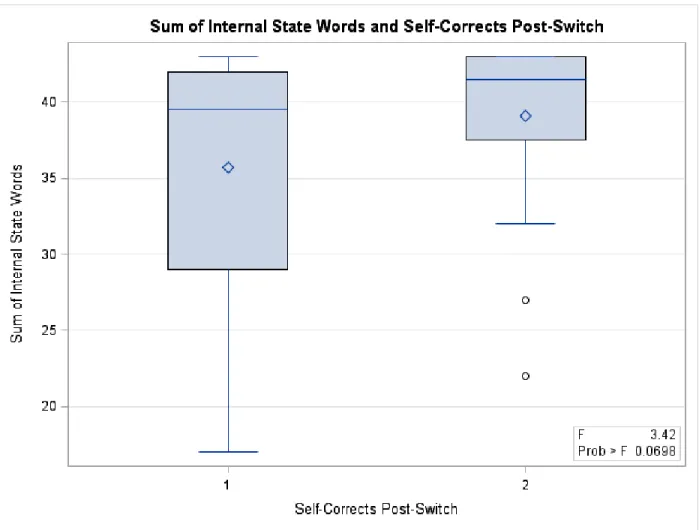
Analyses concerning the reverse categorization task revealed a marginally significant correlation between the number of self-corrects post-switch and the sum of internal state words,
r(56)= 0.26, p=0.053. Children with more self-corrects tended to have larger internal state word vocabularies than did children with fewer self-corrects. The sum of internal state words was also trending with the high/low groups of self corrects, F(2,56)=3.42, p=0.069 (Figure 2). Children in the high self-correct group tended to have larger internal state vocabularies (n=28, M=39.10,
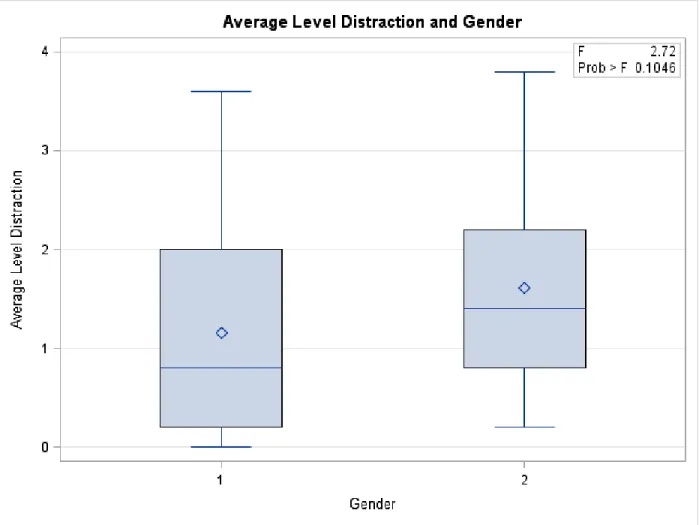
Further analyses addressing effects of gender revealed trends related to the average level of distraction behavior exhibited, F(1,58)=2.72, p=0.10 (Figure 3). Trends show that females exhibited higher level distraction behaviors (n=30, M=1.61, SD=1.01) than did boys (n=30,
M=1.16, SD=1.11). There were also marginal trends regarding gender differences with regards to total delay and the completed trial average, F(1,58)=2.62, p=0.11; F(1,58)=2.54, p=0.12. Females tended to have higher delay times (n=30, M=96.1 seconds, SD=21.04) and a higher completed trial average (n=30, M=0.83, SD=0.26), than did boys (n=30, M=85.17 seconds,
SD=30.38; n=30, M=0.71, SD=0.32). There was not a significant relationship between gender and the sum of internal state words, with either of the reverse categorization variables, or between prompts per second, average level of anticipation, total delay, or the completed trial average.
Discussion
These results partially support the initial hypotheses in that children with larger internal state word vocabularies tended to employ higher level distraction behaviors during the Sticker Delay task. There was no relationship with internal state language and prompts or anticipatory behaviors. This pattern suggests that distraction behaviors may be related to language
development, but that prompts and anticipatory behaviors are not. The sum of internal state words was also mildly correlated with the number of self-corrects post-switch in the reverse categorization task. These results support Bellagamba and colleagues’ (2014) findings linking this conflict-based measure of inhibitory control with internal state language.
that the prompts and anticipation from the Sticker Delay task were related to this delay construct. This interpretation suggests that there are different components of inhibitory control and that these components must be separated in further studies. Addressing inhibitory control as a single construct could mask true relationships between these different aspects of inhibitory control and other processes. Based on the present study, as well as the work of Bellagamba and colleagues (2014), clarification is needed to create separate subcategories of inhibitory control such that one subcategory is connected to conflict-based inhibition and the other category is related to delay-based inhibition.
With regards to measuring language, the MCDI is not designed to be a measure of internal state language, and therefore may not have provided an accurate representation of participant’s knowledge of such words, which limits conclusions. The comparison to the reverse-categorization task further supports this argument, because, if the MCDI had reliably represented the internal state language abilities of the toddlers, there should have been a stronger relationship than was observed. Further studies should assess internal state language with a reliable and valid test such that the relationship seen as a trend in the present study can be measured more accurately.
Prompts were related to the total delay time and completed trial average, such that
children who prompted the assessor more also tended to end trials preemptively and therefore not wait the entire delay. Prompts were also inversely related to distraction behaviors; children who prompted frequently also exhibited low levels of distraction and vice versa. This relationship, with regard to the different constructs of inhibitory control (conflict or delay), could explain the differences in relationship to internal state language. Perhaps prompting behaviors and delay of gratification tasks are mediated by some other developmental process.
Additionally, number of self-corrects post-switch of the reverse categorization task had a marginal relationship with the sum of internal state words. A limitation of interpreting this relationship between the sum of internal state words and the number of self-corrects observed post-switch is that children who completed the task perfectly and children who had errors but did not self-correct both received scores of zero. A better way to approach this would be to look at three groups: (1) children who made errors and did not correct (2) children who self-corrected, and (3) children who made no mistakes at all. Observed trends would support predictions that children who committed errors and did not self-correct would have the smallest internal state word vocabulary of the three proposed groups.
Finally, analyses addressing gender relationships revealed that females tended to employ higher level distraction behaviors and waited longer during trials on average than did boys. Thus supports research suggesting that women are better at delay of gratification tasks than men across the life span (Silverman, 2003). Assessing younger children could reveal if this advantage is consistent throughout development, or if males just experience a lag and catch up to females.
Identifying the distinction between these two subcategories of inhibitory control could shed light on the relationship of other processes in development. The findings that support a trend between internal state language and distraction behavior could be extended to both older and younger children to better understand how these two constructs are related. Additionally, a longitudinal investigation and more diverse sample may provide a better picture of this relationship.
References
Bellagamba, F., Laghi, F., Lonigro, A., Pace, C. S., & Longobardi, E. (2014). Concurrent
relations between inhibitory control, vocabulary and internal state language in 18-and 24-month-old Italian-speaking infants. European Journal of Developmental
Psychology, 11(4), 420-432.
Bird, E. K. R., Cleave, P. L., Curia, J., & Dunleavy, M. (2008). Parental talk about internal states to their child with autism. Focus on Autism and Other Developmental Disabilities, 23(3), 166-175.
Bretherton, I., & Beeghly, M. (1982). Talking about internal states: The acquisition of an explicit theory of mind. Developmental psychology, 18(6), 906.
Carlson, S. M., Mandell, D. J., & Williams, L. (2004). Executive function and theory of mind: stability and prediction from ages 2 to 3. Developmental psychology, 40(6), 1105. Carlson, S. M., & Moses, L. J. (2001). Individual differences in inhibitory control and children's
theory of mind. Child development, 72(4), 1032-1053.
Christ, S. E., Holt, D. D., White, D. A., & Green, L. (2007). Inhibitory control in children with autism spectrum disorder. Journal of autism and developmental disorders, 37(6), 1155-1165.
Fenson, L., Dale, P. S., Reznick, J. S., Bates, E., Thal, D. J., Pethick, S. J., ... & Stiles, J. (1994). Variability in early communicative development. Monographs of the society for research
in child development, i-185.
Morasch, K. C., & Bell, M. A. (2011). The role of inhibitory control in behavioral and
physiological expressions of toddler executive function. Journal of experimental child
psychology, 108(3), 593-606.
Reznick, J. S., Baranek, G. T., Reavis, S., Watson, L. R., & Crais, E. R. (2007). A parent-report instrument for identifying one-year-olds at risk for an eventual diagnosis of autism: the first year inventory. Journal of autism and developmental disorders, 37(9), 1691-1710. Siller, M., Swanson, M. R., Serlin, G., & Teachworth, A. G. (2014). Internal state language in
the storybook narratives of children with and without autism spectrum disorder:
Investigating relations to theory of mind abilities. Research in autism spectrum disorders, 8(5), 589-596.
Silverman, I. W. (2003). Gender differences in delay of gratification: A meta-analysis. Sex roles, 49(9-10), 451-463.
Vaughan Van Hecke, A., Mundy, P., Block, J.J., Delgado, C.E.F., Parlade, M.V., Pomares, Y.B., & Hobson, J.A. (2011). Infant responding to joint attention, executive processes, and self-regulation in preschool children. Infant Behavior and Development,35, 303-311.
Wolfe, C. D., & Bell, M. A. (2004). Working memory and inhibitory control in early childhood: Contributions from physiology, temperament, and language. Developmental
psychobiology, 44(1), 68-83.
Table 1:
Internal State Words from the MacArthur Bates Communicative Development Inventories (MCDI) ____ Internal State Words____________________________________________________________ See Look Watch Hear Listen Taste Cold Hot Hurt Hungry Thirsty Sleepy Sleep Asleep Tired Awake Wake up Sick Happy Better Good Nice Like Love Sad Mad Scared Dirty Yucky Bad (feeling) Hug Kiss Smile Cry Want Need
Have to (ability) Can (volition) Hard (difficulty) Think Pretend Good (moral) Bad (moral) Naughty Let
Have to (need to) Can (permission)
_____________________________________________________________________________
Table 2:
Sticker Task Variable Descriptions_________________________________________________
Variable Description__________________________________________________ 1. Prompts Average number of times the child pointed at/reached for the bell,
touched/rang the bell, touched or moved near the assessor, or said something to move the trial forward such as: “Ring it,” “Now,” “I’m ready,” or “OK.”
2. Anticipation Children received one score for each trial indicating the highest level of anticipation observed. A final score of “Average Level Anticipation” was recorded by summing the levels of anticipation and dividing by the 5 trials. Levels of anticipation are as follows: 0=no anticipation, 1=gaze shifts between bell/cup/assessor for <3s, 2=child reaches for, points to, holds, picks up, or plays with cup; looks at cup for >3s; vocalization about the sticker/waiting/bell/cup (but not a prompt), 3=child points to or
touches sticker but does not pick sticker up/end trial.
3. Distraction Children received one score for each trial indicating the highest level of distraction observed. A final score of “Average Level Distraction” was recorded by summing the levels of distraction and dividing by the 5 trials. Levels of distraction are as follows: 0=no distraction, 1=any gaze shift around the room/at parent/under table/out window,* 2=child makes sticker unrelated comment to assessor or parent,* 3=child engages in any of the following behaviors >3s: looks around the room, looks at/stares at/fixates on assessor, runs around room, physically adjusts self on chair, fidgets with body/chair (sit/stand/tip/bounces), plays with hands/face, goes over to parent, makes silly facial expressions to parent or assessor,* 4=child engages in level 3 distraction for greater than ½ the time of the trial (ex: 15s of 30s trial).
4. Total Delay The total number of seconds the child waits before retrieving the sticker. Max score of 110 seconds if child waited all trials.
5. Completed Trial Child received a score of 1 for each trial completed successfully and a score of 0 for each trial they ended early by retrieving the sticker before __________________the assessor rang the bell. An average was calculated across the 5 trials.
Table 3:
Descriptive Statistics __________________________________________________
Variable N Mean Std Dev Min Max______________
Average Prompts Total 60 3.75667 3.83845 0 14.6 Prompts Per Second 60 0.23269 0.22253 0 0.9359 Average Level Anticipation 60 1.38000 0.41774 0.20 2.2 Average Level Distraction 60 1.38667 1.08041 0 3.8
Total Delay 60 90.63333 26.49334 16.0 110.0
Completed Trial Average 60 0.77333 0.29566 0 1.0 Self Corrects Post-Switch 57 0.80702 1.05963 0 5.0
Errors Post-Switch 57 1.70175 2.40509 0 9.0
Table 4:
Correlations between Internal State Language and Inhibitory Control Tasks ________________
____________________________ _1 2 3 4 5 6 7 8 9
1. Average Prompts Total -- 2. Prompts Per Second 0.839* --
3. Average Level Anticipation 0.114 -0.056 --
4. Average Level Distraction -0.541* -0.717* -0.221 -- 5. Total Delay 0.059 -0.397** 0.189 0.602* --
6. Completed Trial Average -0.093 -0.508* 0.220 0.601* 0.910 -- 7. Self Corrects Post-Switch 0.078 0.040 0.173 -0.040 0.131 0.177 --
8. Errors Post-Switch -0.313 -0.144 -0.033 0.026 -0.284 -0.209 -0.289 --
9. Internal State Word Sum 0.032 -0.003 0.062 0.211 0.186 0.180 0.260 -0.149 --
Figure Captions
Figure 1. General linear model revealed a strongly trending relationship between internal state
word vocabularies and distraction group. Children with larger internal state word vocabularies tended to employ higher level distraction behaviors. Children in group 1 also exhibited the most variability in size of internal state word vocabularies.
Note. 1= Lowest average level distraction; 2= Middle average level distraction; 3= Highest average level distraction
Figure 2. A general linear model revealed a trending relationship between the number of
self-corrects post-switch in the reverse categorization task and the size of internal state language vocabularies. Children with larger internal state language vocabularies tended to make more corrects post-switch than did those who made fewer corrects. Children with fewer self-correct behaviors also exhibited greater variability in the range of the size of their internal state word vocabularies.
Note. 1=Low numbers of self-corrects; 2=High numbers of self-corrects
Figure 3. A general linear model revealed a trending relationship between gender and the
average level of distraction employed during the sticker task. Females tended to employ higher level distraction behaviors than did males.
Figure 1. General linear model revealed a strongly trending relationship between internal state word vocabularies and distraction group. Children with larger internal state word vocabularies tended to employ higher level distraction behaviors. Children in group 1 also exhibited the most variability in size of internal state word vocabularies.
Figure 2. A general linear model revealed a trending relationship between the number of self-corrects post-switch in the reverse categorization task and the size of internal state language vocabularies. Children with larger internal state language vocabularies tended to make more corrects post-switch than did those who made fewer corrects. Children with fewer self-correct behaviors also exhibited greater variability in the range of the size of their internal state word vocabularies.
Figure 3. A general linear model revealed a trending relationship between gender and the average level of distraction employed during the sticker task. Females tended to employ higher level distraction behaviors than did males.