Alternative Splicing of the Human AS3MT Gene Based on Number of
Variable Nucleotide Tandem Repeats
By Pragnya Dontu
Senior Honors Thesis Department of Chemistry
University of North Carolina at Chapel Hill
April 26, 2019
Abstract
Arsenic is an environmental toxin that is metabolized in humans by reduction and
methylation of inorganic arsenic. Arsenite methyltransferase, encoded by AS3MT, methylates trivalent arsenic so that it can be excreted in urine. Genetic studies indicate that variants at the
AS3MT locus confer risk for the development of schizophrenia. Alternate splicing of this gene leads to the production of an alternate isoform, AS3MTd2d3, predominately in the brain, and this
alternative isoform is present at higher levels in tissue from individuals with schizophrenia.
AS3MTd2d3, lacks arsenite methyltransferase activity, and its formation is linked to variable nucleotide tandem repeats (VNTRs) in exon 1 of AS3MT. It is hypothesized that VNTR copy
number determines the relative production of the two transcripts by altering DNA methylation at the locus, and this in turn alters risk for schizophrenia. This hypothesis is tested using embryonic
stem (ES) cell lines humanized with either the common AS3MT allele, an allele with three VNTRs in exon 1, or humanized with an allele we generated that carries four VNTRs.
Expression of the two AS3MT isoforms is compared in ES cell lines that carry either the triple or quadruple VNTR human DNA. While no correlation between VNTR number and ratio of the
AS3MTd2d3 isoform exists in ES cells, the ES cells will be differentiated into neuronal cells for
further analysis to confirm or deny the original hypothesis.
Introduction
Arsenic is pervasive in the environment and exists in many different forms and oxidation
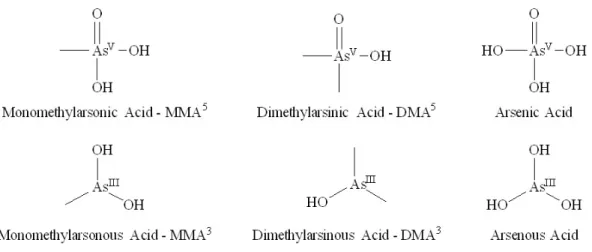
states – - III (arsine), 0 (arsenic), + III (arsenite), or + V (arsenate) (Figure 1).1 Organic arsenic,
which contains carbon, is found in fish and shellfish, while inorganic arsenic is in soil, sediment
result of industries such as mining, fracking, and ore smelting. It has been historically used in
pesticides, paint, and wood preservatives, but due to its toxicity, use of inorganic arsenic today is
restricted. Exposure to this environmental toxin in large doses may lead to nausea, vomiting,
diarrhea, or shock, or more chronic health effects such as diabetes, high blood pressure, or
hepatotoxicity. Inorganic arsenic has also been found to be a carcinogen in humans.2
Figure 1. Structures of various forms of arsenic that are relevant in arsenic metabolism.
The mechanism of metabolism of arsenic in the body is a reduction of pentavalent arsenic
to trivalent arsenic, then an oxidative methylation to pentavalent organic arsenic,1 as shown by
the following equation:
.
Monomethylarsonic acid (MMA) and dimethylarsinic acid (DMA) are the methylated forms of
inorganic arsenic that are excreted in urine.1
Trivalent forms of arsenic have shown a more potent toxicity than the pentavalent state.1
The exact mechanisms of action are not known, but it is thought that the pentavalent state may AsVO(OH)
3 + 2e- AsIII(OH)3 + CH3+ CH3AsVO(OH)2 + 2e- CH3AsIII(OH)3 + CH3+
(CH3)2AsVO(OH)2 + 2e- (CH3)2AsIII(OH)
replace phosphate in reactions,3 as arsenic is a chemical analog of phosphorous, and the trivalent
state may react with thiols in functional groups.1 Arsenate can react with glucose and gluconate
and replace phosphate in processes such as the red blood cell anion exchange transport system.4
During enzymatic reactions that create ATP, there has been diminished ATP formation in vitro
due to the substitution of arsenate for phosphate.1 Trivalent arsenite also plays a role in decreased
production of ATP, as it binds and inhibits pyruvate dehydrogenase (PDH).5 PDH normally
oxidizes pyruvate to form acetyl CoA, which is a precursor for the citric acid cycle, but with less
of the citric acid cycle intermediates, there is less ATP production and lower levels of
gluconeogenesis.1 Methylated trivalent arsenic interestingly has been shown to have a greater
acute toxicity than arsenic; human cells are more sensitive to MMAIII than arsenite,6 which may
indicate another function for methylated arsenic apart from a detoxification mechanism.
While arsenic can be toxic, it has paradoxically been used as a medical treatment option
in the past. In more recent years, this use of arsenic has become prevalent again, as it used for
patients with acute promyelocytic leukemia (APL). This acute bone marrow cancer involves the
accumulation of immature white blood cells, promyelocytes, in bone marrow. Cells are arrested
in maturation at the promyelocyte state of myeloid cell development but arsenic trioxide (ATO)
(Figure 2) can induce nonterminal cytodifferentiation of these cells.7
Figure 2. Structure of arsenic trioxide.
APL patients have a chromosomal translocation t(15;17)(q22;q21) that causes the retinoic
acid receptor (RAR) gene on chromosome 17 to fuse to the promyelocytic leukemia (PML) gene
on chromosome 15. This abnormal fusion yields PML-RARa fusion proteins. These proteins can As
O As O
As O O
form a complex with PML and disrupts nuclear bodies that play a key role in apoptosis,
epigenetic control of chromatin, transcriptional expression, and modulation of certain nuclear
proteins.8 ATO shows beneficial results in APL but not for other acute leukemia subtypes
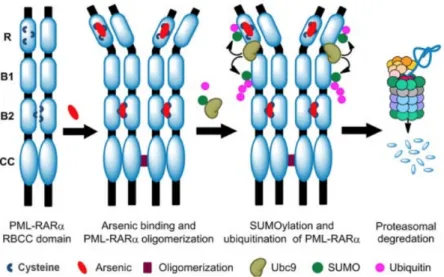
because it specifically binds to the cysteine residues in PML-RARa fusion proteins, promoting
degradation (Figure 3).7 Combined with all-trans retinoic acid (ATRA) as a treatment option,
there is terminal differentiation of APL cells and clearance of the PML-RARa transcripts,
bringing the five-year overall survival rate to 91.7%.8 Figure 4 depicts the efficiency of the
different treatment options for APL, including ATO.
Figure 3. From Chen et al.8 Representation of arsenic’s interaction with PML-RARa fusion proteins.
Figure 4. From Chen et al.8 Treatment survival outcomes over a five-year period for patients with APL. The
Apart from its effect in APL, ATO’s ability to recognize PML proteins has been further
studied in different pathways and seems to have more interactions than previously thought. For
example, it inhibits the Notch pathway in gliomas9 and the Hedgehog pathway10, and may also
help eliminate leukemia-initiating cells (Figure 5).8
Figure 5. From Chen et al.8 Targeting of arsenic in critical pathways in leukemia-initiating cells.
With the multiple, contradictory roles arsenic can have in the human body, it is
informative to focus on its metabolism and the AS3MT gene. The human AS3MT gene confers
expression of the arsenite methyltransferase protein. Arsenite methyltransferase catalyzes the
methylation of trivalent arsenicals in the body to MMAV by transferring methyl groups from
Figure 6. Reaction driven by AS3MT involving the transfer of a methyl group from s-adenosyl methionine to trivalent arsenous acid.
During treatment of APL, varying genotypes of AS3MT small nucleotide
polymorphisms (SNPs) confer different side effects to the ATO. AS3MT genotypes with a
higher efficiency to methylate arsenic have lower arsenic toxicity related side effects, and
alterations in gene expression are based on the location of SNPs in the gene.12 The non-mutated
forms of this protein are on average found in equal amounts in the brain and somatic tissues, but
are more highly expressed in the adrenal glands, cerebrospinal fluid, liver, heart, and testes.13
Alternate splicing leads to the production of an alternate isoform of AS3MT predominantly in
the brain. Genetic studies13 indicate that the variant isoform AS3MTd2d3 confers risk for the
development of schizophrenia. AS3MTd2d3 is present at higher levels in tissue from individuals
with schizophrenia and lacks arsenite methyltransferase activity, which may imply a link of
schizophrenia with arsenite accumulation. The lack of arsenite methyltransferase activity but the
prevalence of this isoform may also suggest an alternate function of the protein. AS3MTd2d3
formation is linked to variable nucleotide tandem repeats (VNTRs) in the 5’ untranslated region
in the first exon of AS3MT.13
N N N N NH2 O OH OH S+ NH2 -O O AsIII HO OH OH N N N N NH2 O OH OH S NH2 -O O AsV HO OH OH
s-adenosyl methionine s-adenosyl homocysteine
+
+
The number of VNTRs causes a variation in transcription of the gene,14 and in this
particular case, an increased number of repeats increases transcriptional activity of the AS3MT
promoter. Each repeat is 36 base pairs and there can be two to four repeats (Figure 7). There are
11 exons in the full AS3MT gene, and the isoform AS3MTd2d3 is missing exons 2 and 3 (Figure
8). The presence of VNTRs has been appreciably associated with d2d3 mRNA expression, and
the copy number shows an additive effect on d2d3 expression with an increased number of
repeats. The d2d3 expression is significantly higher in individuals with schizophrenia and/or
major depression compared to healthy subjects.13 It is hypothesized that the relative production
of d2d3 to full transcripts is altered by DNA methylation at the locus.
Figure 7. From Li et al.13 Sequence of the VNTR repeats in exon 1 of AS3MT.
Figure 8. From Li et al.13 Schematic depicting the variation of exons in the AS3MTfull and AS3MTd2d3
transcripts.
We test the effects of increased copy number of VNTRs in the AS3MT gene using mouse
embryonic stem (ES) cell lines humanized with either the common AS3MT allele, which has 3
VNTRs in exon 1, or humanized with an allele we generated that carries 4 VNTRs. ES cells are
used because of their high homologous recombineering ability and their potential to be
differentiated into different cell types. Using ES cell lines also provides us with the ability to
homologous recombination, which occurs when similar sequences are exchanged between DNA,
in order to create the cell lines. Cells use homologous recombination as a repair mechanism for
double-stranded breaks, so by introducing homologous DNA sequences into ES cells, we can
rely on the cell’s endogenous machinery to incorporate the new, modified DNA into the original
chromosomes. Homologous recombination ensures that the only difference between the cell lines
is the changed locus, and it also assures that the altered DNA sequence inserts where we want it
to (Figure 9). This limits the number of other variables between the two ES cell lines, replaces
the mouse endogenous As3mt sequence with the inserted human sequence, and reduces the
number of off target cut sites that you may experience with CRISPR/cas9 cloning methods. The
ratio of AS3MTd2d3 to AS3MTfull transcripts in the two types of cell lines are examined.
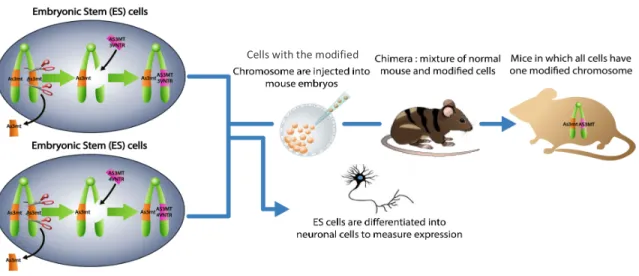
Figure 9. Schematic of the overall strategy. ES cells are humanized with either the AS3MT allele with 3 VNTRs (top) or 4 VNTRs (bottom) by homologous recombineering techniques. The ES cells can be further
differentiated into neuronal cells or used to create mice with the modified AS3MT gene.
Results
AS3MT locus
The human BORCS7 gene and AS3MT gene are located adjacent to each other in the
same orientation on chromosome 10. Given their proximity, a BORCS7-AS3MT read-through
transcript is often formed, but is subject to nonsense-mediated mRNA decay. Bacterial
recombineering techniques were used in E.coli carrying human bacterial artificial chromosomes
to create the humanized BORCS7-AS3MT locus. The human DNA is introduced into mouse ES
cells by homologous recombination, replacing the endogenous mouse As3mt locus. The inserted
human DNA is introduced with a Neo sequence into the mouse genome (Figure 10).
Figure 10. Model of the genome of the ES cells after homologous recombination. Mouse endogenous Cyp17a1 gene (dark green), and the inserted human sequence (purple) including the short and long arms and Neo sequence (blue) inserted with it. The human sequence leads to BORCS7 (pink), AS3MT (light green), and
BORCS7-AS3MT (orange) transcript formation.
Mouse phenotypes with triple VNTR AS3MT gene
Cell lines 1488-5G12 and 1489-4D3 had previously been created from mouse ES cells.
These cell lines contain the BORCS7-AS3MT locus with the triple VNTR sequence in exon 1 of
AS3MT. By injecting ES cell line 1489-4D3 into mice blastomas, mice that are heterozygous for
the huAS3MT gene where created and bred.
These mice weighed more than the control B6J mice and had larger white adipose tissue
tissue (WAT) for the control (+/+), heterozygous (+/hu), and homozygous (hu/hu) mice were
determined relative to the total body weight (Tables 1 and 2). While AS3MT is known to be
more highly expressed in adrenals and testes, there was no evident trend in weight differences
between the three genotypes.
Table 1. Tissue weights from wild type (+/+), heterozygous (+/hu) for the humanized AS3MT gene, and homozygous (hu/hu) for the humanized AS3MT gene mice.
huAS3MT mice sex Birth Date
Weight (g)
Adrenals (mg) Testes (mg)
BAT (mg) WAT/epididymal (mg)
B6J.1 +/+ M 10/10/18 32.3 8.21 206.99 124.05 351.45
B6J.2 +/+ M 10/10/18 30.9 2 219.72 100.94 293.37
1968.3 +/hu M 10/6/18 35.9 3.28 244.56 136.86 1073.44
1976.98 +/hu M 10/16/18 34.4 2.56 205.37 160.73 1068.59
1968.7 hu/hu M 10/6/18 34.5 2.2 222.72 138.21 1078.62
1968.4 hu/hu M 10/6/18 37.9 2.58 163.72 106.71 1840.26
1968.8 hu/hu M 10/6/18 34.5 9.06 207.09 84.3 753.08
1976.83 hu/hu M 10/16/18 37.1 4.65 179.91 121.12 1142.79
1976.84 hu/hu M 10/16/18 34.5 5.34 148.33 71.97 509.4
1867.91 hu/hu M 9/2/18 33.1 4.18 160.64 82.41 824.96
Table 2. The average of the relative adrenal and testes weight for each genotype. There is no apparent correlation of these numbers with the genotype.
Adrenals/total weight (mg/g)
Testes/total weight (mg/g) +/+ 0.159 6.76
+/hu 0.0829 6.39 hu/hu 0.133 5.13
After some of the heterozygous and homozygous mice that were a few days old were
allowed to breed, we noticed that only female mice that were heterozygous for huAS3MT got
pregnant while the homozygous females did not. This potential trend was found among four
Generating the quadruple VNTR construct
The quadruple VNTR AS3MT Displacer vector was constructed using recombineering
techniques to modify an existing triple VNTR AS3MT Displacer vector in E. coli carrying
human bacterial artificial chromosomes. The vector was modified by Red/ET recombination,
which is mediated by the phage protein pairs Reda and Redb. Red/ET recombination keeps
unspecific events at a minimum, works independently of restriction sites, and the method is not
limited by DNA size. The correct sequences are selected for based on antibiotic resistance. The
modified vector was transformed into bacteria and the colonies were selected by growth on
streptomycin. These manipulations result in a “seamless” alteration to the DNA such that the
correct VNTR and AS3MT sequence is inserted into the chromosome. The presence of the
correctly inserted VNTR cassette was confirmed by PCR amplification of the region followed by
Sanger sequencing.
The AS3MT Displacer construct carrying the quadruple VNTR was introduced into
embryonic stem (ES) cells by electroporation. Homologous recombination occurs and the
modified AS3MT gene replaces the mouse endogenous As3mt locus. Cells carrying at least one
copy of the construct were identified by their ability to grow in medium containing the antibiotic
G418. Lysate was prepared from individual colonies of G418 resistant ES cell clones and
screened using a PCR designed to specifically amplify the locus in which the Displacer construct
had undergone homologous recombination with the endogenous mouse As3mt locus.
Verifying construct
The ES cells lines were verified as containing the correct quadruple VNTR AS3MT DNA
further verified with a Taqman quantitative PCR (qPCR) with As3mt and Borcs7 primer probes.
The As3mt and Borcs7 probes recognize and specifically amplify the endogenous mouse As3mt
and Borcs7 DNA. The ratio of As3mt and Borcs7 concentration were determined with respect to
the Hprt gene, which is found on the mouse X chromosome. Cell lines with a fold change of 0.5
of both As3mt and Borcs7 compared to the control mouse DNA (Phnx43) were considered to be
positives, as they only have the mouse Borcs7-As3mt sequence on only one chromosome rather
than two. ES cell lines 1506-B9 and 1509-C9 were verified as having the quadruple VNTR locus
by qPCR (Figure 11).
Figure 11. qPCR analysis of the endogenous mouse As3mt and Borcs7 genes. 1506-B9, 1506-C9, 1506-C12, and 1506-C12 cell lines were potential humanized candidates, but only 1506-B9 and 1506-C9 had deleted
mouse As3mt and Borcs7 genes. Phnx43 is the male mouse control.
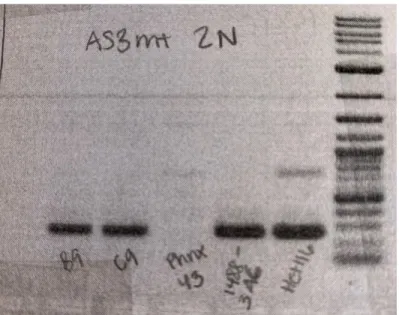
Primer probes that recognize the human BORCS7-AS3MT sequence were also used to
confirm that the full sequence was in place. Mouse DNA (Phnx43), human DNA (Hct116), and
primers. PCR reactions were performed to amplify the regions of DNA that the probes recognize
and screen for PCR product (Figure 12).
Figure 12. An example of a primer probe PCR reaction. This PCR checks for a sequence in the AS3MT gene that we have called AS3MT hu 2N. Quadruple VNTR cell lines 1506-B9 and 1506-C9 were tested using Phnx
43 (mouse), 1488-3A6 (triple VNTR) and Hct116 (human) DNA as controls. A 2-log ladder is in the furthest right lane of the gel.
ES cell line cDNA analysis
RNA is extracted from the two verified cell lines, 1506-B9 and 1506-C9, and the triple
VNTR cell lines 1488-5G12 and 1489-4D3. cDNA is reverse transcribed from these four cell
lines so that the ratios of full to d2d3 AS3MT transcripts can be determined using SYBR Green
qPCR methods. Primers were designed to amplify the full and d2d3 AS3MT sequences. The
resulting PCR product fluoresces, and the amount of relative fluorescence can be used to
determine relative transcript concentration.
In order to verify that the mice can be used as a model for the alternative splicing on the
AS3MT gene and the subsequent protein isoforms, the ES cells with the previously generated
triple VNTR locus were used to create mice humanized with the AS3MT gene. The ration of the
VNTRs cause alternative splicing in the mice (Figure 13 a, b). Based on these results, it was
confirmed that mice are capable of producing the d2d3 transcript.
Figure 13. a) Fold change in relative concentration of AS3MT d2d3 transcripts (white) and AS3MT full transcripts (black) in tissues of the mice humanized with the triple VNTR AS3MT construct compared to the concentration in the mouse whole brain. b) Percentage of the d2d3 transcripts (black) and of the full transcripts
(white) in these tissues of the total AS3MT transcript number.
The same experimental setup is repeated to determine the ratio of the transcripts in the ES
cell lines 1506-B9, 1506-C9, and 1488-5G12, along with cDNA from the humanized mouse
spinal cord and liver. In the ES cells, there is no apparent trend in the ratios of the full to d2d3
transcripts (Figure 14 and 15). whol
e bra in corte x pons medul la cere bellu m hippo campu s spin
al co rd
adren al g
lands liv er 0.0 0.5 1.0 1.5 2.0 2.5 3.0 3.5 As3mt d2d3 As3mt full 25 30 35 Re la ti ve t o wh o le b ra in
Ratio of AS3MT d2d3 to AS3MT full length transcript
whol e bra
in corte x hipp ocamp us cere bellu m pons med ulla spin al co
rd
adren al glan
ds liver 0 25 50 7590 95 100 105 full d2d3
Figure 14. Fold change analysis of the concentrations of the AS3MTfull (white) and AS3MTd2d3 (black) transcripts. Two cDNA samples of each 1506-B9, 1506-C9, and 1488-5G12 cell lines were analyzed along
with cDNA from mouse spinal cord and mouse liver. The fold change was calculated relative to the concentrations in the mouse liver cDNA. There is no apparent trend or consistency in the ES cell lines, likely
due to a high background and low AS3MTd2d3 transcript number.
Figure 15. Percentage of AS3MTd2d3 (black) and of AS3MTfull (white) transcripts of the total recognized AS3MT cDNA. Two cDNA samples of each 1506-B9, 1506-C9, and 1488-5G12 cell lines were analyzed along with cDNA from mouse spinal cord and mouse liver. There is no apparent trend or consistency in the ES
Droplet digital PCR (ddPCR) methods with EvaGreen Supermix is also used to verify
these results. The SYBR Green qPCR relies on determining the concentrations relative to a
chosen sample, but ddPCR allows for the calculation of absolute concentrations of the
transcripts. ddPCR creates droplets of the samples and measures the relative number of droplets
with the chosen PCR product. AS3MT full and the AS3MT d2d3 primers are used with the
cDNA of the 1506-B9, 1506-C9, 1488-5G12, and 1489-4D3 cells lines, along with cDNA made
from humanized mouse spinal cord and liver (Figure 16). The percent of d2d3 transcript in the
cell lines was at such a low level that the margin of error of the samples gave results that were
not consistent. As with the qPCR methods, there was no apparent change in the ratio of the
transcripts between the cells with the quadruple VNTR locus and those with the triple VNTR
locus due to the inconsistency between runs and high background.
Figure 16. Two trials of the ddPCR runs testing the ratio of AS3MT d2d3 to AS3MT full transcripts. The percentage of d2d3 transcripts of the total AS3MT transcript number is depicted by the black bars for each
sample. cDNA samples of 1506-B9 and 1506-C9 (quadruple VNTR ES cell lines), and of 1488-5G12 and 1489-4D3 (triple VNTR cell lines) were analyzed along with cDNA from humanized mouse spleen. There is no evident consistency between the two trials and the transcript percentage is at lower numbers for each of the
samples.
Discussion
The role of AS3MT in the human body may not be as clear as simply methylation of
trivalent arsenic for metabolism and detoxification. The presence of the gene in vivo seemed to
cause the mice to develop more fat and may have a role in fertility. While more experiments and
trials need to be done on these subjects, our findings hint at the fact that AS3MT may have a
more widespread role than previously thought. We cannot definitively say that it plays a role in
fertility, but the inserted locus has a Neo site that may interfere with the upstream Cypt17a1 gene
(Figure 10). Cypt17a1 is involved in the formation of sex hormones such as estrogen and
testosterone,15 so the interference could have been affecting the sexual maturation of the AS3MT
hu/hu female mice. More studies have to be done to confirm any relationship between AS3MT
and the reproductive system and rule out the chance that the pregnancy trend may have been a
coincidence.
In regards to the copy number of VNTRs in the AS3MT locus, we have not yet
confirmed or denied that the quadruple VNTR sequence increases the amount of d2d3 transcript
produced, which would be related to the schizophrenia risk factor. However, the correlation of
AS3MT to schizophrenia is related to an increased ratio of the d2d3 mRNA transcript in the
brain.13 Based on Li et al’s study,13 it is known that there is a higher amount of AS3MT
transcripts in the brain, adrenal glands, and testes compared to other tissues. In the brain
specifically, AS3MT transcripts are seen in both astrocytes and neurons, but they tend to be more
highly concentrated in the astrocytes. Given the low levels of both of the transcript types in our
ES cells, we are assuming that there is too much background noise to determine a significant
The ES cells will be differentiated into neuronal cell fates in order to increase the overall
expression of AS3MT and further tested to determine if any correlation exists between the
VNTR number and the amount of d2d3 transcript. These experiments will be conducted with
qPCR and ddPCR methods across the two quadruple VNTR cell lines and the two triple VNTR
cell lines used in the ES cell studies. The differentiated cells will hopefully give us more insight
into the role of AS3MT and whether the VNTR copy number impacts that splicing of the gene. If
the neuronal cell types do not provide conclusive data that the quadruple VNTR leads to an
increase in d2d3 transcripts, we will use the ES cell lines to create humanized mice with
chromosomes containing a couple of the quadruple VNTR AS3MT sequence to further test the
ratio of the transcripts and protein isoform. If we are not able to prove a direct relationship
between VNTR repeat number and an increase in the AS3MT d2d3 isoform, this could point to
some holes in Li et. al’s study. The correlation that they saw may not necessarily indicate
causation. It is important to verify their finding with a biochemical analysis in order to find
specific genes that can be targeted in treatment options of schizophrenia. If the VNTR repeat
number does shows an increase of d2d3 transcripts in the differentiated cells and mice, we can
further look to see if the mice humanized with the 4 VNTR locus versus the 3 VNTR locus
display schizophrenic characteristics. The existence of such characteristics would promote the
notion that d2d3 isoforms are linked to schizophrenia risk factors.
Arsenic is very prevalent in the environment and is toxic to humans, so while AS3MT
plays an important role in arsenic metabolism, it is possible that it has other functions. This is an
idea that warrants further investigation, given that cells may be more sensitive to the methylated
forms of arsenic that come from the reaction driven by AS3MT. If shown that the number of
the first biochemical evidence to support the genetic studies linking VNTRs to the d2d3 isoform,
in turn conferring risk to schizophrenia.
Methods
Bacterial Recombination
The quadruple VNTR AS3MT Displacer vector was constructed using recombineering
techniques to modify an existing triple VNTR AS3MT Displacer vector. An existing
counterselection cassette carrying an aminoglycoside phosphotransferase gene, which confers
resistance to kanamycin, and a ribosomal S12 protein gene, which confers sensitivity to
streptomycin, was modified by using standard cloning techniques to replace the kanamycin
resistance gene with a beta-lactamase gene, which confers resistance to ampicillin. Red/ET
recombination was then used to replace the triple VNTR region of the starting construct with the
counterselection cassette. The Red/ET plasmid is added with the displacer vector and
counterselection cassette and induced with arabinose. The temperature is then increased for an
hour to get transient recombineering ability. The resulting phage protein pairs Reda and Redb
have exonuclease activity and are single stranded bringing proteins, respectively, and work to
replace the target DNA sequence with the counterselection cassette. After selection on
ampicillin, the correct insertion of the counterselection cassette in the modified vector was
confirmed by a polymerase chain reaction (PCR). A second Red/ET recombination step was then
used to replace the counterselection cassette in the vector with a cassette carrying the AS3MT
quadruple VNTR. Bacteria carrying a vector in which the desired modification had occurred
were selected by growth on streptomycin, and the presence of the correctly inserted VNTR
vector was confirmed by PCR amplification of the region followed by Sanger sequencing. The
AS3MT Displacer construct carrying the quadruple VNTR was introduced into embryonic stem
(ES) cells by electroporation, and cells carrying at least one copy of the construct were identified
by their ability to grow in medium containing the antibiotic G418.
ES cell line screening
Colonies expressing G418 resistance were plated at low dilutions and colonies arising
from individual cells were sub-cultured and cell lysates prepared from ~ 300 to ~1,000 cells. Cell
lysate was made from the colonies by adding 20 µL lysate buffer (Protease K, triton, TE) to 13
µL of cells and incubating at 55°C for 30 min. The reaction was ended by heating for 10 min at
95°C. Lysates were screened by polymerase chain reaction (PCR) to screen for the presence of
the BORCS7 and AS3MT genes. The screen PCR was designed to specifically amplify the locus
in which the Displacer construct had undergone homologous recombination with the endogenous
mouse As3mt locus. Colonies expressing two copies of the wildtype As3mt locus were
eliminated.
RNA extraction
After lysing the cells, RNA is isolated using the RNA-Bee protocol. The lysate is
separated into organic and aqueous phases using chloroform and the RNA is recovered from the
aqueous phase. The isolated RNA is used as a template for a PCR reserve transcription reaction.
RT-PCR to determine the ratio of
AS3MTd2d3
to AS3MTfull transcriptsThe cDNA is used for a qPCR analysis targeting the AS3MT full transcript and the
AS3MT d2d3 transcript, which is missing exons 2 and 3. The reaction uses iTaq Universal
SYBR Green Supermix, which causes the cDNA transcripts of interest to fluoresce. Analysis of
the data is done by comparing the cycle number it takes for each sample to reach the threshold
fluorescence value. The analysis is conducted with 18S cDNA as an internal normalizing control.
The results are compared using delta-Ct, fold change analysis.
ddPCR analysis to determine the ratio of AS3MTd2d3 to AS3MTfull transcripts.
Droplet digital PCR technology targeting the AS3MT full transcript and the AS3MT
d2d3 transcript of the cDNA is used with an EvaGreen Supermix. Water-oil emulsion droplets
are created, and PCR amplification of either the full or d2d3 transcript occurs in each droplet.
References
1. Hughes, M. F. Arsenic Toxicity and Potential Mechanisms of Action. Toxicology Letters
2002, 133 (1), 1–16.
2. “National Biomonitoring Program.” Centers for Disease Control and Prevention, Centers for Disease Control and Prevention, 7 Apr. 2017.
3. Dixon, H.B.F., 1997. The biochemical action of arsonic acids especially as phosphate analogues. Adv. Inorg. Chem. 44, 191–227.
4. Kenney, L.J., Kaplan, J.H., 1988. Arsenate substitutes for phosphate in the human red cell sodium pump and anion exchanger. J. Biol. Chem. 263, 7954–7960.
5. Peters, R.A., 1955. Biochemistry of some toxic agents. I. Present state of knowledge of biochemical lesions induced by trivalent arsenical poisoning. Bull. John Hopkins Hospital 97, 1–20.
6. Petrick, J.S., Ayala-Fierro, F., Cullen, W.R., Carter, D.E., Aposhian, H.V., 2000. Monomethylarsonous acid (MMA(III)) is more toxic than arsenite in Chang human hepatocytes. Toxicol. Appl. Pharmacol. 163, 203–207.
7. Soignet, S. L.; Maslak, P.; Wang, Z.-G.; Jhanwar, S.; Calleja, E.; Dardashti, L. J.; Corso, D.; DeBlasio, A.; Gabrilove, J.; Scheinberg, D. A.; et al. Complete Remission after Treatment of Acute Promyelocytic Leukemia with Arsenic Trioxide. The New England Journal of
Medicine; Boston 1998, 339 (19), 1341–1348.
8. Chen, S.-J.; Zhou, G.-B.; Zhang, X.-W.; Mao, J.-H.; de The, H.; Chen, Z. From an Old Remedy to a Magic Bullet: Molecular Mechanisms Underlying the Therapeutic Effects of Arsenic in Fighting Leukemia. Blood 2011, 117 (24), 6425–6437.
9. Zhen Y, Zhao S, Li Q, Li Y, Kawamoto K. Arsenic trioxide-mediated Notch pathway inhibition depletes the cancer stem-like cell population in gliomas. Cancer Lett. 2010;292(1):64-72.
10.Kim J, Lee JJ, Kim J, Gardner D, Beachy PA. Arsenic antagonizes the Hedgehog pathway by preventing ciliary accumulation and reducing stability of the Gli2 transcriptional effector. Proc Natl Acad Sci U S A. 2010;107(30):13432-13437.
11.AS3MT Gene - GeneCards | AS3MT Protein | AS3MT Antibody (accessed Feb 27, 2019). 12.Lu, J.; Hu, S.; Wang, W.; Li, J.; Dong, Z.; Zhou, J.; Hai, X. AS3MT Polymorphisms, Arsenic
Metabolism, and the Hematological and Biochemical Values in APL Patients Treated with Arsenic Trioxide. Toxicol Sci 2018, 166 (1), 219–227.
13.Li, M.; Jaffe, A. E.; Straub, R. E.; Tao, R.; Shin, J. H.; Wang, Y.; Chen, Q.; Li, C.; Jia, Y.; Ohi, K.; et al. A Human-Specific AS3MT Isoform and BORCS7 Are Molecular Risk Factors in the 10q24.32 Schizophrenia-Associated Locus. Nature Medicine 2016, 22 (6), 649–656. 14.Wood, T. C.; Salavagionne, O. E.; Mukherjee, B.; Wang, L.; Klumpp, A. F.; Thomae, B. A.;
Eckloff, B. W.; Schaid, D. J.; Wieben, E. D.; Weinshilboum, R. M. Human Arsenic Methyltransferase (AS3MT) Pharmacogenetics: GENE RESEQUENCING AND
FUNCTIONAL GENOMICS STUDIES. Journal of Biological Chemistry 2006, 281 (11), 7364–7373.