ABSTRACT
CONTENTS
1. Introduction ...3
2. Literature Review ...4
a. North Carolina’s Changing Demographics ...4
b. An Introduction to the Inclusion of Immigrant Students ...8
c. Language ...10
d. Identity Development ...15
e. Culturally Sustaining Pedagogy ...20
3. Methodology ...25
a. Context ...25
b. Participants ...26
c. Data Collection and Analysis ...26
4. Findings ...28
a. Tracks at Field High School ...28
b. Anne Olson ...28
c. Joanne House ...36
d. Lainie Roman ...41
e. James Sanders ...44
f. Tina Night ...47
5. Discussion ...49
a. Emergent Themes and Implications ...49
b. Recommendations ...51
c. Limitations ...52
d. Personal Growth ...54
e. Conclusion and Future Work ...54
INTRODUCTION
Schools in the United States have become testing sites in which students are routinely measured against state standards (Kamenetz, 2015; Gewertz, 2011). In some public schools, students spend nearly a third of class time taking or preparing for these tests (Kamenetz, 2015). High stakes testing puts additional pressure on the mastery of English, pushing English as a Second Language (ESL) teachers to focus on English language acquisition. In this study, I fight the tendency to value ESL courses and teachers for their focus on English. The guiding question for this study is: What practices do ESL teachers incorporate into their classrooms that engage students in learning that extends beyond English language acquisition? Through observations at Field High School, I explore these ESL teacher practices and document the loss that emergent bilingual students face when they transition out of ESL and into mainstream courses.
I present a counter-narrative to this success story. A counter-narrative, or counter-story, is used as a “tool for analyzing and challenging the stories of those in power and whose story is a natural part of the dominant discourse – the majoritarian story” (Solorzano & Yosso, 2002, p. 156). In this case, I make the argument that the transition out of ESL is not one of gain for emergent bilinguals, but one of loss. Emergent bilinguals students are not better off for having acquired English and for having moved past introductory English courses because ESL teachers do not merely teach English, but also provide a space for students to talk about their home country, use their first language, engage with politics, practice self-advocacy, and reconcile their hybrid identities. Whereas ESL teachers practice culturally sustaining pedagogy and foster inclusive spaces for multilingual practices and identity development, teachers in mainstream courses are much less apt to incorporate these inclusive practices, if they do at all.
Taking these losses into consideration, the question becomes, so what do we do as educators and schools? In deciding on a plan of action, the very purpose of schooling must also be questioned. Based on the data and analysis conducted in this study, I propose that rather than keeping high English-proficient students in isolated ESL classrooms for the remainder of their schooling, we train mainstream educators to incorporate inclusive practices into their content areas. ESL teachers can and should model inclusive classrooms for their coworkers.
LITERATURE REVIEW
North Carolina’s Changing Demographics. In the past twenty-five years, North
home (Pew Research Center1, 2014). For comparison, in 2014, 3% of the population was Latinx in Montana, 2% of the population was Latinx in North Dakota, 39% of the population was Latinx in California and Texas, and 48% of the population was Latinx in New Mexico (Pew Research Center2, 2014).
Recent immigration to North Carolina is considered part of a new Latinx diaspora, defined as “increasing numbers of Latinos (many immigrant and some from elsewhere in the United States) [who have settled] both temporarily and permanently in areas of the United States that have not traditionally been home to Latinos” (Hamann & Harklau, 2010). The traditional Latinx Diaspora, on the other hand, resulted in large Latinx populations in Arizona, California, Colorado, Florida, Illinois, New Jersey, New Mexico, New York, and Texas (Hamann & Harklau, 2010).
had brought Mexican workers in the past, through programs such as the Bracero program, the growing chicken industry provided year-round work (Cuadros, 2006). At the same time, as the United States pushed for greater market integration with Mexico and Canada, the government militarized the border to ensure that labor did not accompany goods and commodities in their free flow across borders (Massey, Durand, Malone, 2002). As such, in addition to access to year-round work, increased border control and greater enforcement of border patrol sanctions, resulting from the Immigration Reform and Control Act of 1986, the Immigration Act of 1990, and the Illegal Immigration Reform and Immigrant Responsibility Act of 1996, further incentivized workers to settle permanently in the southeast (Massey et al, 2002; Cervantes-Soon, 2014). Workers then brought their families and moved to jobs in landscaping, textiles, furniture manufacturing, and construction, laying the foundation for future generations of Latinx residents in North Carolina. Within the span of a few years, the Latinx population had planted roots in a state that had previously seen few to no Latinos (Cuadros, 2006). Aside from the continuous flow of first generation Mexican immigrants into North Carolina, the growing second and third generations of Latinx residents are main contributors to the growth of the Latinx population in the South.
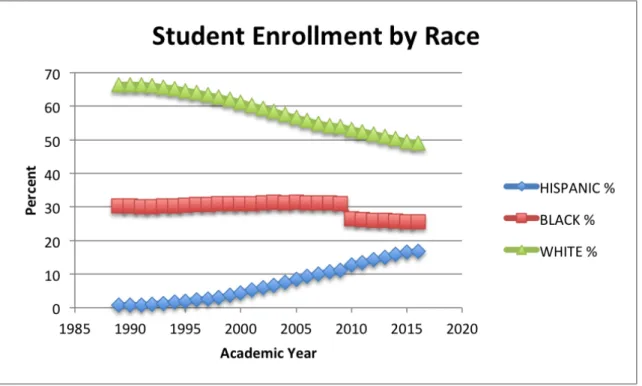
The new Latinx diaspora has transformed the North Carolina public school student population. Latinx student enrollment in 2015 was more than 20 times the Latinx student enrollment in 1990, just 25 years earlier. Hispanic students made up only 0.8% of the student population in 1990, 1.9% in 1995, 4.4% in 2000, 8.4% in 2005, 12.7% in 2010, and 16.5% in 2015 (State Board of Education, n.d.). Latinx student enrollment more than quadrupled between 1995 and 2005. During the 2015-2016 academic year, Latinx students represented 16.5% of the public school student population, Black students represented 25.7% of the public school student population, and White students represented 49.5% of the public school student population. This was the first academic year during which White students represented less than 50% of the student population. (State Board of Education, n.d.). Figure 1 shows White, Black, and Latinx (labeled Hispanic here, as this is the corresponding label in data collection) student enrollment, beginning with the 1989-1990 academic year and terminating with the 2016-2017 academic year. Figure 1. White, Black, and Hispanic Student Enrollment from 1989-2017 (State Board of
As North Carolina schools do not have a long history of large Latinx enrollment, few programs have been set up to accommodate these students. ESL classrooms are some of the only established spaces designed for Latinx students. As such, ESL teachers have the unique opportunity to provide a home space for Latinx immigrant students and ESL classrooms have potential to be transformative spaces in the new Latinx south. The role of the ESL teacher continues to grow and evolve as North Carolina public schools become more diverse.
Prior to reviewing the literature on inclusive practices, it must be noted that the majority of emergent bilinguals are first generation immigrants (García, Wiese, & Cuéllar, 2011). However, as noted earlier, not all Latinx students enrolled in North Carolina public schools are first generation immigrants. In fact, in 2014, 56% of Latinxs living in North Carolina are second(+) generation immigrants (Pew Research Center1, 2014). Second(+) generation immigrants were born in the United States to parents (grandparents, great-grandparents, etc.) who immigrated to the United States from another country. Although this research project focuses on first generation emergent bilinguals, the incorporation of inclusive practices are important for, and applicable to, immigrant students of all ethnicities.
An Introduction to the Inclusion of Immigrant Students.
Given the largenumber of Latinx students in North Carolina public schools, this research study documents inclusive practices for emergent bilingual students in public secondary education regarding language, identity development, and culturally sustaining pedagogy. The term emergent bilingual is used, as opposed to commonly used English language learner or limited English
proficient student, because it uses an additive perspective rather than a subtractive one. Within
What is inclusive programming? Inclusive programming does not rely on a deficit-thinking approach that Angela Valenzuela (1999) has coined subtractive schooling. The subtractive schooling approach strips Latinx students of their strengths and assigns them deficits in knowledge to be overcome by learning (Paris, 2012). Instead, inclusive programs rely on an additive approach that recognizes students’ unique funds of knowledge and multiple intelligences. While all communities have incredible wisdom, knowledge, resources, practices, assets, and wealth, dominant society values some capital over others. As a result, the wealth found within communities of color often goes unseen, unnoticed, and unrecognized. Moll, Carrillo, and Yosso provide educators with the following frameworks to help them recognize their students’ assets. As these are extremely condensed summaries of the theories, educators are encouraged to conduct additional research on each theory.
Moll (1992) defines funds of knowledge as “historically accumulated and culturally developed bodies of knowledge and skills essential for household or individual functioning and well-being” (p. 133). Educators, viewing households “as containing ample cultural and cognitive resources with great potential utility for classroom instructions” (p.134), are then responsible for incorporating and utilizing these funds of knowledge in the classroom.
Juan Carrillo’s Mestiz@ Theory of Intelligences (2013) includes seven components of “smartness”: navigating/contesting oppression, centering subaltern knowledge, centering critical, hybrid identities, straddling multiple forms of cultural capital, decolonization, struggling for psychic, cultural, emotional, and spiritual wholeness, and remaining committed to social justice.
a child’s multilingual abilities. Familial capital refers to the cultural knowledge found within families. Social capital refers to access to networks of people within the community. Navigational capital refers to the ability to maneuver social institutions that often are oppressive for people of color. Resistance capital refers to the knowledge and skills fostered through challenging inequality. In order to promote an equitable pluralistic society, teachers should view emergent bilinguals students through the lens of Moll, Carrillo, and Yosso’s frameworks. When their skills, funds of knowledge, and unique capitals are taken into consideration, they can be seen as extremely strong and competent students.
It is not simply enough to recognize that students enter the classroom with the strengths outlined in Moll, Carrillo, and Yosso’s works. For truly inclusive programming, an educator must practice utilizing these strengths in her classroom. It is not enough for a teacher to recognize that an emergent bilingual is fluent in both Spanish and English if she does not then allow and encourage that student to use both languages in the classroom. It is not enough for a teacher to recognize that her Latinx student has a strong social network that she can turn to for support if she does not then encourage that student to work collaboratively with her Spanish-speaking peers. It is not enough for a teacher to recognize that her emergent bilingual student challenges inequality daily if she does not then provide that student with the opportunity to complete a project that showcases her fine-tuned skills in community activism and self-advocacy.
Teaching: Creating Responsible and Ethical Anti-Racist Practice (2014), in which the themes of
language, race, and empire are used to analyze ESL teaching.
Language. In 2012-2013, 102,311 emergent bilinguals attended NC Public Schools.
These students represented 6.5% of the student population. That year, the most common native languages were Spanish, Arabic, Vietnamese, Chinese, and Hmong (Office of English Language Acquisition). Given the sheer number of emergent bilingual students and the pressure for all students to achieve grade-level standards due to the No Child Left Behind Act of 2001, schools have had little to no choice but to address English language acquisition. While most public schools in North Carolina have instituted some type of program, a majority of them are exclusive of immigrant students by dismissing their linguistic capital.
According to García and Kleifgen (2010), the five programs that promote linguistic assimilation and subtractive bilingualism are: submersion, ESL pull out, ESL push-in, structured immersion, and transitional bilingual education. Subtractive bilingualism, by definition, is second language acquisition where the second language replaces the first (Grosjean and Li, 2013). These five programs are subtractive in nature, as students are not asked to be bilingual, but rather, English replaces the home language. While subtractive bilingualism does not support or celebrate students’ multilingualism, some believe that subtractive bilingualism produces a more beneficial outcome for emergent bilinguals. Richard Rodriguez (1982) in his autobiography, Hunger of Memory, chronicles his experience with subtractive bilingualism. His loss of Spanish as he adopted English in school alienated him from both his parents, as he lost the ability to speak with them, and his Latinx identity. Rodriguez, however, claims that his linguistic and cultural loss was necessary for his success in the Dominant culture. Many scholars have since countered Rodriguez’s justification of subtractive schooling by challenging assimilationist ideologies (Carrillo, 2016; Darder, 2012; Alim, 2016).
content-based ESL, the emergent bilingual students attend ESL-exclusive content-based classes. For example, the school may offer a science core course that is exclusively taught to a cohort of emergent bilingual students at a specific level of English proficiency. The SIOP model, which requires that teachers explicitly state content and language objectives at the beginning of each class period, is often used to help teachers plan and execute content-based English as a Second Language (ESL) and sheltered instruction courses (Echevarría, Vogt, & Short, 2013). Finally, transitional bilingual education, commonly known as early-exit bilingual education, begins with literacy and subject instruction in the home language and decreases the home language instruction to less than 10% of instruction within three years (García and Kleifgen, 2010).
minority students to programs with the goal of linguistic assimilation, Cervantes-Soon (2014) points out that they may lead to “an increased reliance on the language of neoliberalism, an overemphasis on appealing to the dominant group, and the reinscription of unequal power relations between majority and minority groups deeply rooted in US society” (p. 65). She writes that although these programs have great potential to serve as additive spaces that foster biliteracy, bilingualism, and high academic achievement for all students, English still dominates classrooms and Eurocentric ideals are upheld. This serves as an additional reminder that while certain models may be more linguistically beneficial, other factors should be considered when measuring the effectiveness of each program. The last model outlined by García and Kleifgen (2010) is dynamic bi/plurilingual education. This model places English and the home language in a dynamic relationship and encourages hybrid language practices. This program is the least defined.
and goals in a task without as much resistance as their monolingual counterparts. Furthermore, dementia onset for older adults appears to be four years later in bilinguals than monolinguals, controlling for external variables (Bialystok and Barac, 2013). This suggests that bilingualism may impact the overall health of students, in addition to bolstering their cognitive abilities.
García and Kleifgen (2010) summarize the importance of linguistic inclusivity and yet, the lack of adoption of programs that promote it. They write,
“whereas research has consistently shown the importance of building on the children’s home language as they develop English language proficiency… US educational policy has often ignored these research findings. In fact, in recent years in the United States… education policy toward emergent bilinguals has become more rigid, embodying a view of these children solely from a deficit perspective and increasingly demanding that English alone be used in their education” (García and Kleifgen, 2010, p. 4).
In accordance with Garcia and Kleifgen (2010), it is time that education policy takes into consideration contemporary research findings. ESL courses should be built with the ultimate goal of plurilingualism. With this goal in mind, students will be recognized for their linguistic capital.
Identity Development. “Latinx” is a large umbrella term that serves as a grassroots
1). With such a broad definition, there is, of course, great internal diversity, including, but not limited to, “historical, geographical, and political experiences” (Oboler, 1995, p. 11), “class…national origins, time of arrival, language, race, and minority status” (Oboler, 1995, p. 3), and “experiences… in their encounters with U.S. culture” (Guarnaccia et al., 2007). Oboler (1995) reminds us that recognition of internal diversity extends beyond the present moment and requires acknowledgement of “the historical differences that shaped the experience of incorporation of the various national-origin groups” that were often deeply connected to “political relationships between the United States and [Latinxs’] respective countries” (p. 9). In order to compensate for group internal diversity, an “x” replaces the “o” in “Latino”. Typically used for the purpose of gender and sexual neutrality, the “x” can also be used for purposes of intra-group unity and coalition (DeGuzmán, 2017).
Latinxs do not fit neatly into the “Black/White binary notion of race and diversity” that has dominated the South for decades, but rather, are part of a “third race” (Cervantes-Soon, 2014, p. 66). The new presence of a people who are neither Black nor White is something that should be unpacked, not only with the emergent bilingual students, but with all students in the school.
consequences. Conversations surrounding this title can help Latinx students understand their social and political standing according to Dominant society’s perceptions, advocate effectively for themselves when faced with injustice, and find support in others who face similar oppressions.
In these spaces and conversations, concepts of duality, hybridity, and intersectionality should be incorporated into the discussion. Although often used in scholarship on second-generation immigrants and Chicanos, the notion of a literal and metaphorical borderland is also relevant to first generation emergent bilinguals. Gloria Anzaldua’s (1987) concept of the borderland is both a geopolitical space, as in the contested border between the United States and Mexico, and a symbolic space between belonging and not belonging (Elenes, 1997). Immigrant students in the United States must navigate the complexity of navigating two conflicting worlds, that of the Dominant cultural community in which they are studying, and that of the primary/subordinate culture (Darder, 2012) from which they come. Embracing a bicultural identity is a means of survival and resistance to the constant tension between conflicting cultural values and cultural subordination. Motha, in reflecting on Bhabha (1994), writes that “spaces of hope and possibility… serve as sites of transition and ambiguity, sites in which individuals are permitted to be neither wholly one category or culture nor the other, sites in which hybridity is allowed and can therefore be formed and imagined, become visible and maybe even explored” (p. 47).
border-crossing identities” was the Xicana Sacred Space created by and for Chicana students conducting research in higher education (Diaz Soto et al., 2009). This program “made room for freedom and for intense dialogue, creating an intimate circle for collective reflexivity; shared subjectivities; the transformation of identities; a source of strength, direction, and knowledge; and a springboard for powerful research and community projects” (Diaz Soto et al., 2009, p. 756). Although this space was targeted for students in higher education, similar programs could be instituted at the high school level. For example, students could be broken into affinity groups based on identity (students can self select the identity markers that they prefer) and these groups could meet in sacred spaces during morning assemblies, in an after school program, or during club meeting times that are built into the day or at lunch.
The Mexican-American/Raza Studies program in Arizona was built into the school curriculum. In the Raza Studies class, students learned about the Mexican-American identity through an innovative social justice curriculum (Palos and McGinnis, 2011). Arizona state lawmakers shut down the program in 2010 (Palos and McGinnis, 2011). Arizona’s Raza Studies program was part of a broader ethnic studies movement on the West coast and in the Southwest. This movement provides students with an “introduction to the experiences of ethnic communities that are rarely represented in textbooks” (Depenbrock, 2017).
discussions have no place in the classroom. Love (2004) frames colorblindness in a new way, “Whites behave as though naming race is what makes it matter” (p.227). This quote reminds us that the Dominant White culture prefers to ignore race, believing that, if it is not discussed, itwill not have serious implications for communities of color. Alim (2016) argues, contrary to theories of colorblindness and postracialism, that we live in a hyperracialized society, or one that is “fundamentally structured by [race]” (p. 3), therefore we must discuss racial difference. For the purposes of this paper, theories of colorblindness and postracialism can be generalized to ethnicity and culture. Post-culturalism, for example, would suggest that cultural difference is not seen, and is no longer relevant. Instead of aiming for equality by ignoring differences in race, ethnicity, and culture, we should be aiming for equity by acknowledging differences and providing additional support and resources to groups that have been systemically oppressed.
to Rodriguez (1982) and millions of other Latinx scholars. This experience is so common that Carrillo coin the term “scholarship boys” to refer to males of Mexican-origin who pursue a graduate education and experience a loss of connection to their ontological home (Carrillo, 2016). As will be discussed in the “Discussion” section, high school emergent bilingual students may be similarly asked to abandon their Subordinate culture identity when they enter assimilation-focused mainstream classes.
On the contrary, additive schooling practices (see “An Introduction to the Inclusion of Immigrant Students”) recognize race and ethnicity as factors in student achievement and provide spaces, in and out of the classroom, for students to explore and celebrate their hybrid racial, ethnic, and cultural identities.
Culturally Sustaining Pedagogy
. In 1990, Gloria Ladson-Billings first coined theLadson-Billings expanded upon her theory in her 1995 publication, “Toward a Theory of Culturally Relevant Pedagogy.” “A next step for positing effective pedagogical practice is a theoretical model that not only addresses student achievement but also helps students to accept and affirm their cultural identity while developing critical perspectives that challenge inequities that schools (and other institutions) perpetuate,” she wrote (p. 469). In other words, the adoption of culturally relevant pedagogy produces “students who can achieve academically…. students who demonstrate cultural competence… and students who can both understand and critique the existing social order” (p. 474). Ladson-Billings notes that culturally relevant pedagogy is unique in so far as, typically, academic achievement comes at the cost of cultural competence. Furthermore, the third component of Ladson-Billings’ theory is radical in that it inspires and empowers learners to confront “inequitable and undemocratic social structures” (p. 474). It should be noted that this theory, which primarily deals with race, was formed at a time before the large Latinx population growth in North Carolina schools.
within marginalized communities. Working towards a pluralistic society requires that culturally sustaining pedagogy supports and values home and community practices found within communities of color while also providing access to Dominant cultural repertoires and literacies. Additionally, culturally sustaining pedagogy is unique in that it acknowledges and responds to the “dynamic, shifting, and ever-changing nature of cultural practices” (Paris, 2012, p. 95), which wards off the tendency to essentialize cultures and languages, ignore their evolution, and homogenize the diversity of cultural expression in the lived experiences of youth. Ladson-Billings, in her 2014 article, “Culturally Relevant Pedagogy 2.0: a.k.a. the Remix,” recommends that teachers who prescribe to her previous theory of “culturally relevant pedagogy” make the transition to Paris’ (2012) “culturally sustaining pedagogy.” Thus, Ladson-Billings and Paris’ pedagogical approach allows for the seamless incorporation of race and language into every classroom and curriculum.
performance far exceeded the institution’s expectations. With a newfound appreciation for learning and its connection to social change and justice, the students expressed more interest in college admission because pursuing education “became a vehicle to bring greater justice to [their] community” (p. 93). The culturally sustaining pedagogy influenced the students’ “commitment to social justice… [and] critical awareness” (p. 90), in addition to boosting self-esteem and pride. Cammarota exposes that “self-advocacy granted the students the opportunity to see themselves as knowledgeable, intellectual, capable, and empowered” (p. 90).
curriculum, interpretation of the texts allows to students to engage with and manipulate the material using practices that they feel most comfortable with, and translation helps students to understand the content as their native-English speaking peers do.
As teachers cannot be expected to know what is relevant or sustaining for their students, they must give students opportunities to bring their own voices and perspectives to the table. The opposite of this is Paolo Freire’s (2002) banking model. The banking model of education occurs when students are expected to passively absorb the information that a teacher feeds them. Underlying this model is deficit thinking, or the assumption that students have deficits in knowledge to be filled by the teacher. The banking model fails to engage students of color in a way that they can contribute their cultural identities and capitals, as part of their Community Cultural Wealth (Yosso, 2005). Paired with a lack of a teacher’s commitment to or knowledge of cultural relevance and sustainment, the curriculum is completely void of cultural material. Neither teacher nor student infuses the curriculum with cultural material, and as such, emergent bilingual students do not see themselves reflected in the course. Junot Diaz, in a speech to students at Bergen Community College, asked, “you know, vampires have no reflections in a mirror? There’s this idea that monsters don’t have reflections in a mirror. And what I’ve always thought isn’t that monsters don’t have reflections in a mirror. It’s that if you want to make a human being into a monster, deny them, at the cultural level, any reflection of themselves” (Stetler, 2009). In assimilation-based classrooms, students are denied any reflection of themselves. This leads to a systematic dehumanization of emergent bilingual students.
activists and agents of change. This requires that teachers and schools take ownership over the school failures of students of color, rather than placing the blame on the students, and make significant curricular changes to remedy these failures. A Raza Studies advocate in the documentary, Precious Knowledge, argues that while youth do not have a dysfunctional relationship with learning, many have a dysfunctional relationship with schools (Palos & McGinnis, 2011). It is time that we mend this relationship, allowing emergent bilingual students to participate fully in, enjoy, and contribute to their education.
METHODOLOGY
This qualitative research study employed a descriptive, single-case study approach to conduct an in-depth investigation of five teachers at a public high school in North Carolina. The primary research question was: What practices do teachers incorporate into their classrooms that engage students in learning that extends beyond English language acquisition? Specifically, through direct observation, this study sought to investigate ways in which teachers use culturally sustaining pedagogy and incorporate inclusive practices of language and race with their emergent bilingual students. Rich descriptions of teacher practices helps to document a story of loss for emergent bilingual students as they move out of the ESL program and into mainstream courses. In order to protect identities, pseudonyms have been used for the name of the school, the name of the county, and the names of the teachers.
identity). Instruction is offered to emergent bilinguals in a variety of formats, including ESL pull-out, sheltered instruction, and ESL push-in.
Field High School is a well-ranked school in the nation, boasting a graduation rate of over 90% (citation omitted to protect identity). Yet, the Field High School district has one of the largest achievement gaps in the country (citation omitted to protect identity). While “achievement gap” was used in the literature, Love (2004) proposes that we replace “achievement gap” with “opportunity gap,” as it is not a lack of student achievement, but rather, unequal educational opportunity for students of color that leads to stratified academic success.
Participants. Five teachers were observed: Anne Olson, Joanne House, Lainie Roman,
James Sanders, and Tina Night (pseudonyms used). The researcher had previously volunteered with Anne Olson and Joanne House. Anne Olson recommended the other three teachers, as they were identified as mainstream teachers with Latinx emergent bilingual students in their classes. All five teachers gave full oral and written consent (via email) for their participation in this study.
Data Collection and Analysis.
Data was collected during 11 classroom visits, from January 23-March 9, 2018. Observation hours totaled 11 hours and 19 minutes. Six distinct courses were observed and each of these courses was tagged as “ESL” or “Mainstream.” “ESL” courses are those that consist of 100% emergent bilingual students. “Mainstream” courses are those that include a mixture of native English speakers and emergent bilinguals with high English proficiency. Emergent bilinguals are able to enroll in mainstream courses after they have phased out of the ESL track. See Figure 2 for a schedule of classroom visits.Figure 2. Schedule of Data Collection
ESL Path 1 Anne Olson Newcomers Class Tuesday, Jan 23 10:33am-12:18pm Friday, Feb 2 10:33am-11:24am Tuesday, Feb 6 10:33am-11:24am Tuesday, Feb 13 10:33am-12:18pm
ESL Path 2 Joanne House Common Core English 9 (EL) Friday, Jan 26
9:39am-11:24am Friday, Feb 2 9:39-10:30am Friday, March 9 9:28-10:08am
Mainstream Lainie Roman Blended course (students in the
same classroom are enrolled in two distinct courses):
NC Essential Standards World History
Honors NC Essential Standards World History
Friday, Jan 28 2:10-3:01pm
Mainstream James Sanders Civics and Economics Friday, March 9
10:11am-10:51am
Mainstream James Sanders AIS Civics and Economics Friday, March 9
10:53am-11:33am
Mainstream Tina Night Standard Biology Friday, March 9
12:30-1:10pm Notes were handwritten at the time of observation and archived for later analysis. Lesson plans were collected from the teacher, when available. Voice recordings were made after each class observation with points of reflection. All notes, lesson plans, and recordings were coded into themes of language, race, and culturally sustaining pedagogy.
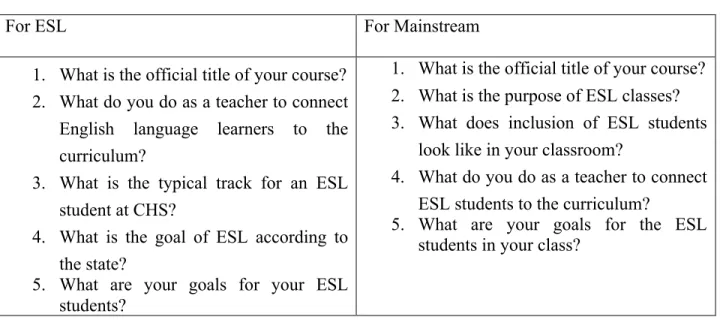
Figure 3. Follow up questions
For ESL For Mainstream
1. What is the official title of your course? 2. What do you do as a teacher to connect English language learners to the curriculum?
3. What is the typical track for an ESL student at CHS?
4. What is the goal of ESL according to the state?
5. What are your goals for your ESL students?
1. What is the official title of your course? 2. What is the purpose of ESL classes? 3. What does inclusion of ESL students
look like in your classroom?
4. What do you do as a teacher to connect ESL students to the curriculum?
5. What are your goals for the ESL students in your class?
FINDINGS
Tracks at Field High School. Emergent bilingual students are tracked at Field High
School according to each student’s English and educational background upon arrival. Newcomers are placed in either ESL Path 1 or Path 2, depending on their WIDA test (English-proficiency test) performance and if they are a student with interrupted formal education (SIFE).
There are variations on these paths. Students who arrive with a strong educational background and high English proficiency may be placed directly in the mainstream track, students who require more support may be enrolled in Academic Strategies, and students who struggle in mathematics may enroll in an alternative math sequence.
Anne Olson was observed for Path 1, Joanne House was observed for Path 2, and Lainie Roman, James Sanders, and Tina Night were observed for the mainstream courses.
Anne Olson.
Ms. Olson strongly encouraged a bilingual environment. She consistentlyincorporated Spanish into her class, both through her interactions with students and through her assignments. Furthermore, she encouraged her students to work together and ask clarifying questions in Spanish. The students began each class period by working with their peers on a warm up writing activity. The students with lower English proficiency completed sentence starters, while the advanced English students completed linguistically advanced sentence starters or responded to a given prompt. For the lower-level sentence starters, Ms. Olson wrote translations (italicized in the examples below) for specific vocabulary on the board.
On January 23, the sentence starters for students with lower English proficiency were: “Today is,” “Tomorrow is,” “Yesterday was,” “Today the weather (clima) is, “Today I feel (me siento),” “Yesterday I,” “I like (me gusta),” “I don’t (no),” and “My dad/mom/uncle doesn’t.” The
“Yesterday I went,” “Yesterday I saw (ví),” “Yesterday I ate (comí),” “My mom doesn’t,” and “My friend doesn’t (mi amigo).” On February 13, sentence starters were “Today is,” “Tomorrow is,” “Yesterday was,” “Today the weather is,” “Yesterday the weather was,” “It annoys me when (me molesta cuando),” and “On Valentines Day, I will.” The advanced students were asked to write seven sentences about their day yesterday, with a focus on using “then” and “after that” to transition between sentences. As evidenced in the examples above, Ms. Olson consistently incorporated Spanish into the warm up activity for students with lower English proficiency.
After the warm up activity, Ms. Olson began the day’s main lesson, where she incorporated Spanish into her interactions with students. On February 13, one student reported to Ms. Olson in Spanish that another student had copied his work. The second student denied the accusation. Ms. Olson clarified in Spanish, “Me promotes? Me lo juras? (Do you promise me?)” On January 23, she asked a student “Can I? Puedo?” before borrowing his pencil. On February 6, she asked a student in Spanish about the location of his missing worksheet.
Furthermore, while she often explained English words by projecting images on the board, gesturing, or using English synonyms, Ms. Olson consistently provided Spanish translations in conversation. On January 23, she translated “never” as “nunca,” “lazy” as “flojo,” “do you live” as “vives,” and “nightmare” as “pesadilla.” While students practiced the pronunciation of “ow” sounds (blow, crow, low, mow, row, slow, snow), Ms. Olson translated “grow” to “crecer.”
correct, she was able to communicate the instructions effectively in the student’s native language. On February 6, she gave instructions on going to the bathroom. She told one student that he was able to go to the bathroom “despúes de” another student. On February 13, she told a student “tú necesitas leer (you need to read).” In addition to repeating instructions, Ms. Olson used Spanish to
joke with her students. For example, on January 23, one student constructed the sentence “Ms. Olson doesn’t sleep,” to which Ms. Olson laughed and responded, “a veces!”
In addition to incorporating Spanish into her interactions with students, Ms. Olson provided translations on handouts for students with low English proficiency (determined by their group assignments and class work). On February 13, Ms. Olson passed out multiple versions of the same handout on Barack Obama. The handout for students with lower English proficiency had a list of English words translated to Spanish.
Ms. Olson’s commitment to bilingualism showed, not only in her own incorporation of Spanish, but also in her support of students bringing Spanish to the classroom. Throughout all four of the periods observed, students freely collaborated in Spanish. While their assignments were to be turned in in English, students were encouraged to make meaning of the material in their native language. For example, on February 13, the students read the article on Obama together and discussed the contents in Spanish, before writing their answers down on paper in English. On January 23, the students were asked to come up with a list of verbs. The students with low English proficiency brainstormed verbs in Spanish, while their peers helped to translate them to English.
asked that student to repeat the same question in English, despite the fact that this student was capable of putting together such questions in English.
Ms. Olson recognized the emergent bilinguals’ linguistic capital by building off of their knowledge of their native language. For example, On January 23, when one student wrote “my mom no eat,” Ms. Olson pointed out that unlike in Spanish, it is not possible to negate English verbs using “no.” In her lesson later that class, she explained that “doesn’t” is used like Spanish “no.” Furthermore, when a student wrote, “I was to walmart,” Ms. Olson engaged the student in a discussion on why that sentence is acceptable in Spanish but not in English (the student intended to use the verb went; the conjugations of to go and to be in the past tense are the same in Spanish). By bringing Spanish into the discussion, students were able to draw connections between their languages for deeper grammatical understanding. They were also encouraged to utilize their knowledge of Spanish to boost them in their English acquisition. Furthermore, this helps support students’ metalinguistic awareness.
student called out that he likes chimichangas, while a different student liked “pizza because it’s yummy.”
With regard to the starter, “I don’t like,” Ms. Olson called on one student who was struggling. Upon saying that he “didn’t know,” Ms. Olson asked, “do you like Messi?” to which he responded “no.” She then asked him to form the complete sentence, to which he provided the target response, “I don’t like Messi.” A Syrian student followed with, “I don’t like to eat pork.” Ms. Olson then contributed a few sentences, “My mom doesn’t cook pozole, “Mr. (name of another ESL teacher) doesn’t speak Spanish,” and speaking directly to one of the students who works in construction, “My mom doesn’t build houses like you do.”
The effects of this class activity are profound. By allowing students to contribute their tastes to the classroom, they were invited to explore their hybrid cultural identities. By speaking in English about the foods that they have grown up with in Mexico, Syria, or Honduras, they were exploring what it means to be both from their native country and to spend formative years in the United States. They were able to explore and test out what it means to belong to multiple spaces and cultural groups at the same time; they could like both pizza and baleadas, hip hop and merengue, and Michael Jordan and Messi.
Olson centers her students in the curriculum by building off of their funds of knowledge, which differ than the funds of knowledge that White native-English speakers bring to school.
As she did on January 23, Ms. Olson also asked students to generate content during the following two classes. On February 2, students responded to the prompt “when are you embarrassed?” On February 6, during a lesson on English gerunds and question formation, Ms. Olson split the students into pairs and had them ask each other “Do you like [insert gerund]?” Examples included: Do you like reading? Do you like shopping? Do you like cooking? The students then asked follow up questions to their partner’s preferences. For example: What do you like to read? Where do you like to shop? Again, giving emergent bilingual students opportunities to contribute their preferences and tastes during class time allowed them to tap into their funds of knowledge and explore and discover their hybrid cultural identities.
Through culturally sustaining pedagogy, Ms. Olson helped students engage with US politics and tap into their potential as self-advocates and community activists. These are necessary skills for all children who will soon graduate from high school, but they are especially helpful for students of color and immigrant students whose voices are often left out of the majoritarian narrative and public discourse. Ultimately, it is up to these students, their communities, and their allies, to advocate for change and promote an equitable society. At this current moment in time, politicians and those in power have yet to take these perspectives into consideration, except when community activists insist that their voices are heard.
the question, “Do you like Donald Trump?” The students reacted strongly to this question, contributing to a larger discussion about their needs and desires as youth in the United States.
While it may frighten or intimidate most teachers in today’s society to engage students in political debate, this was not such a foreign concept at the time of the American Revolution. Upon gaining its independence from England, revolutionary leaders proposed that mothers train their children in the virtues of a republican government, a concept that would later be coined republican motherhood. “American women had to be educated, at least enough to read, write, and
teach their children moral principles of American democracy” (Rury, 2016, p. 47). Thus, since the dawn of American independence, education has been closely linked with democracy and politics. Just as educators and mothers did then, teachers today should engage their students in conversations about the US government and what it means to be an immigrant and active participant in US society. As Rury states in the introduction to his book on education and social change, education has, throughout history, “been related to larger processes of social transformation” (Rury, 2016, p. 1). A teacher who is truly committed to promoting an inclusive pluralistic society must not fear political thought and debate. Instead, she should encourage emergent bilinguals to practice speaking about their circumstances and needs while they are in the classroom, a safe space, so that they can then return to their communities and fight for change.
interactions with students in the hallway between class periods. As she stood outside of her classroom (required for all teachers so as to prevent fights between students in the hallways), students from her newcomer’s class and from the sheltered instruction classes would come speak to her about their personal lives. For example, on January 23, one Syrian student spoke to Ms. Olson about her friend’s return to Syria. The student spoke about how sad she was, and Ms. Olson offered her support and condolences. As students are only able to participate academically to the extent that they feel safe, whole, healthy, and happy in their personal lives, it is powerful when a teacher chooses to support the student, not just the student’s academic achievement. With every conversation in the hallway, Ms. Olson demonstrated that she is there for her students as a teacher and someone to lean on during difficult times.
Once in the classroom, Ms. Olson continued to demonstrate her love and care for her students. She used terms of endearment with them, including “sweet pea” and “my love” and she often added “ito” to the ends of their names (this marks the diminutive in Spanish but can be used to show affection). Furthermore, she liberally gifted words of encouragement. For example, on February 13, she reviewed a student’s work and responded, “Beautiful! You are on fire!” As the common expression goes, students do not care what you know until they know that you care. Both in and out of the classroom, Ms. Olson demonstrated that she authentically cares (Valenzuela, 1999) about her students.
Joanne House.
Just as Ms. Olson incorporated inclusive practices into her newcomersOn January 26, student groups presented review games of their most recent course material. One group presented a version of who wants to be a millionaire, the second group presented a Kahoot quiz, and the third group presented a memory matching game (match the word with its definition by flipping cards over). At the end of the period, students reflected on their peers’ projects by answering the following prompts: “I liked,” “I did not like,” “My group was,” “I will remember,” “I learned,” and “Next time I would (something I would do differently is…).”
On February 2, the students worked in the library on their project titled “My Hero Activist Biography.” Each student chose a noteworthy person from biography.com and wrote a biography on them. The biography needed to include: When and where were they born?; Are they still alive?; What are their most important accomplishments?, What are they doing today?; Important events; Family life; and Why do we remember this person? To complete the biography, Ms. House provided the following three tips: use 3rd person, use chronological order when needed, and paraphrase from the biography.com article. The students chose Jessica Biel, Selena Gomez, Ronald Reagan, Muhammad, Chance the Rapper, Dwayne Johnson, Rachel Brosnahan, Rihanna, George Washington, Cristiano Ronaldo, Messi, and Malala.
On March 9, the students read a modified chapter of Romeo and Juliet as a class. Students volunteered to read for different characters. Ms. House paused the reading to ask the students comprehension check questions every few minutes.
the who wants to be a millionaire presentation, one of the student leaders asked, “Are there any questions in Spanish?” Ms. House allowed for the students to ask each other their questions, but as she does not speak or understand Spanish, she asked the student leader, “are any of these questions relevant to the whole class?” When he responded “no,” the students moved on to the next presentation. On February 2, students worked at tables with their peers who spoke the same first language. They conversed casually while they completed their biography projects. One student printed the biography.com article in both Arabic and English to aid his reading comprehension. Another student Google translated some of the article into Spanish. As such, while Ms. House did not provide translations for her students, they utilized online resources to assist them with the readings. On March 9, Ms. House engaged the students in a discussion of personification in Romeo and Juliet. After identifying personification in the phrase “love is blind,” Ms. House asked the students if they knew what an idiom is. Ms. House proceeded to use French to explain the concept. In general, as students in Phase 2 have higher English language proficiency, students are able to communicate much more in English and are generally expected to use English more than their native language in the school. Therefore, it is significant that Ms. House allowed the students to use their native languages, even when they were able to communicate the same ideas in English.
bilingual students during the three classes that were observed. However, per Ms. House’s responses in the follow up questions, it can be assumed that this type of work is regularly part of the class.
Ms. House’s responses to the follow up questions demonstrate her nuanced perspective on the purpose of ESL classes. She wrote, “[m]y goals are to see them just make progress from where they start at the beginning of the year, for example improving speaking and becoming more confident in using English in speaking and writing. I also strive to get them interested in reading English, which is hard. I get so excited when some of them really show interest in reading or start checking out books from the library a lot.” This demonstrates Ms. House’s commitment to the academic success of her students. She also wrote, “My goals are also to help them become part of the school community and become advocates for themselves in terms of asking for help, becoming organized and having a plan for their future. It has been great when we contribute so many students to clubs or sports teams, such as our soccer team and seeing them branch out and make friends with non EL students.” This response touches on a key point; She desires her students to be successful academically (ie: master the content), while also hoping that her students grow in their roles as community members and self-advocates. Ms. House proves that regardless of state imposed standards, teachers must not choose between content acquisition and identity development. Instead, the two goals and outcomes can coexist, if and when a teacher follows a thoughtful, creative, and intentional curriculum.
his head on the desk while the other students were reading Romeo and Juliet out loud. Again, Ms. House quietly walked over, careful not to interrupt the class reading, and asked if he was feeling alright. In all of these instances, Ms. House asked about the student, not the student’s academic progress. For example, rather than asking “why are you erasing?”, why are you not working?”, or “is there a problem with your computer or your assignment?” she asked, “are you okay?” This slight difference in the framing of the question goes a long way in making a student feel cared for.
Lainie Roman. On Friday, January 26, Lainie Roman engaged her students in a lesson
on revolutions. She presented a PowerPoint detailing the key people, causes, outcomes, and definitions of “liberty” pertaining to the American, Haitian, Mexican, and Latin American revolutions. Ms. Roman was observed to use a subtractive framework (ie: seeing the students for their weaknesses) when working with individuals belonging to marginalized communities. For example, in response to an inquiry about end of quarter grades, Ms. Roman told a student of color, “you have some good qualities and some bad.” The student, displaying his resistance and aspirational capital, responded, “all I hear is good.” To that, Ms. Roman responded, “you hear what you want to hear.” Not only did Ms. Roman ignore the student’s strength in the face of academic oppression, she proceeded to discourage him a second time.
decorations were all in English. The only exception to this was a poster on the wall that featured a phrase in Russian. Moreover, Ms. Roman did not prompt students to use any language other than English, despite the fact that the class discussion of Mexican and Latin American revolutions would have been enhanced by Spanish vocabulary. Gens de couleur libre (free people of color in French) was included on a slide about the important people in the Haitian revolution. Yet, when creoles appeared under the important people of the Latin American revolution, Ms. Roman told
the students that even though the textbook uses the Spanish translation, los criollos, “90% of the stuff I’ve seen spells it the English way.” Considering that Latin American revolutions took place in Spanish-dominant Latin America, it is surprising that Ms. Roman asserted that the majority of academic material on the matter uses the English term. With this simple passing comment, Ms. Roman communicated to students that it is both appropriate and acceptable to use an English-dominant monolingual approach to the study of history, even when the events involved exclusively speakers of other languages. When asked in the follow up questions about the inclusion of ESL students, Ms. Roman wrote, “Readings, assignments, and tests are often modified to meet [emergent bilinguals] where they are at language wise.” She did not specify if these modifications include translations or if they use simplified English vocabulary.
different if there were no revolutions, students were simply asked to copy down the information, without contributing their own perspectives and tapping into their funds of knowledge. Contributions were discouraged during this process, as the students were meant to silently copy the information. As stated earlier, the banking model of education (Freire, 2002), which expects students to absorb information, serves as the antithesis to a culturally sustaining lesson plan, as students are not able to think critically about the material nor are they allowed to contribute their capitals, intelligences, and funds of knowledge.
In the follow up questions, Ms. Roman disclosed that she aims to connect emergent bilinguals to the class by incorporating their homelands into the curriculum. “For example,” she writes, “when doing Revolutions this year, I included the Arab spring and Mexico.” It should be noted that, while the Mexican revolution was incorporated into the lesson plan, “Latin America” was listed a separate category. In class, Ms. Roman told the students that “Mexico is part of Latin America, but we’re separating them for the revolutions.” She provided no additional information as to why Mexico was not included in the Latin American category. Furthermore, Latin America, despite spanning both South and Central America and consisting of 33 countries, received the same quantity of information as did the American, Haitian, French, and Mexican revolutions individually. Ms. Roman did not provide a disclaimer to students that the information regarding the Latin American revolution was an oversimplification of an entire continent’s worth of revolutions.
When asked about her goals for the ESL students in her class, Ms. Roman wrote, “I want them to improve their English reading, writing, and speaking while learning some history. I also
want them to gain confidence interacting with non-ESL students. I also hope that my non-ESL
history can lend itself to racial and ethnic identity development, the promotion of multlingualism
and multiculturalism, and student activism, Ms. Roman made no mention of these in her goals.
Furthermore, she noted that inclusion in her classroom means, “ESL students [receive] the same
instruction as their English primary speaking peers.” This statement contributes to notions of
colorblindness and postracialism by falsely assuming that ignoring difference is the best way to
assist marginalized students.
James Sanders. On Friday, March 9, Mr. Sanders led his Civics and Economics class
in an activity about labor and production in a market economy. Students entered the classroom and sat in groups. As with Ms. Roman’s class, the students spoke exclusively in English. Mr. Sanders informed the class that each group would be considered a book publishing company and he asked the students to come up with company names. He then showed them how to make a “proper book” by tearing out a page from a magazine, tearing the page into quarters, folding the pages in half, paper clipping the sheets together, and writing their company name on the cover. Each group was given one sharpie, a handful of paperclips, and a stack of magazines and the students were expected to share the materials at their table. After Mr. Sanders modeled the process, the students participated in three rounds of book making.
At the end of the three rounds, the students were dismissed to their next class. They would make meaning out of the activity on Monday. While I was not able to attend Monday’s class, I was able to observe the AIS (Academy of International Studies) Civics and Economics Class’s debrief of the same activity. Mr. Sanders affirmed that the Civics and Economics class with the emergent bilingual students would partake in the same discussions and activities as the AIS class.
Debriefing began with a discussion of production versus productivity. In the activity, production was the raw number of books produced whereas productivity was the efficiency of the
publishing company. Mr. Sanders asked the class, “How do we maximize productivity?” and encouraged them to reflect on the differences in productivity in the three book-making rounds. This led to a discussion of specialization, during which, Mr. Sanders used the analogy that while North Carolina specializes in growing tobacco, Florida specializes in growing oranges. This would have been an ideal point in the conversation to ask emergent bilingual students what their home countries or towns specialize in. The conversation shifted slightly to a discussion of division of labor. Mr. Sanders interjected that this is not a new concept; In fact, it was a guiding principle
of the industrial revolution. Mr. Sanders continued to ask questions to the students about the effects of adding resources (scissors and sharpies) and introduced the idea of the law of diminishing returns.
factor of production. For entrepreneurship, the examples were: Henry Ford, Coco Chanel, Bill Gates, and Sheryl Sandberg. These entrepreneurs are all White and part of the Dominant culture. To wrap up the discussion of the factor of production, the students brainstormed the factors of production that went into their perfect meal. Some of the student generated responses included: land to grow the food, the chef, plates, cooking utensils, and transportation to the grocery store.
The class ended with reflections on a previous assignment on opportunity costs. Mr. Sanders focused the discussion on the question, “What are the tradeoffs and opportunity costs for voting in an election?” Tradeoffs included: stay at work and spend time with family. Opportunity costs included: missed time at work, miss out on family time, the person you vote for may not win. Mr. Sanders offered his own reflections on poor voter turnout in the US, “In some ways, in our country, [people who do not vote] are making a rational economic choice.” He added that to deter opportunity costs, “some countries make voting day a national holiday.”
revolution, Mr. Sanders could ask students to reflect on the identity of laborers. Who were the laborers who specialized during that era? What kinds of jobs require laborer specialization today? Mr. Sanders could even go so far as to engage the students in a discussion of the role of immigration in labor and production. During the discussion on voting, Mr. Sanders could ask about voting systems in students’ home countries. What are the tradeoffs and opportunity costs in these countries? How does this influence voter turnout? As shown, there were myriad opportunities to incorporate culturally sustaining material into this lesson.
Tina Night.
On Friday, March 9 from 12:30-1:10pm, Ms. Night’s standard biology course worked on a meiosis worksheet. Each student received a three-page worksheet with questions and activities to complete. The answers to the questions were to be found by observing the online cell simulation and by reviewing the PowerPoint slides from the previous class. Questions included: “what are homologous chromosomes?” “What is a tetrad” and “What is re-forming in telophase II?” Activities included: “Click on Metaphase I. Draw a cell and label the 2 tetrads. Where in the cell are the tetrads at this stage?” and “Click on Telophase I. How many cells are forming? Draw the cells in the box. In your drawing, show and label the nucleus reforming with dotted lines.”Yet, while definitions of the biological words, such as “tetrad,” were found on the PowerPoint slides from a previous lesson, it would have been helpful for the emergent bilingual students to have translations into their native languages of non-biological terms on the worksheet. For example, one emergent bilingual did not understand the meaning of “pair”. This delayed him in his work on the third question. While supplemental vocabulary support would have been helpful, Ms. Night acknowledges that mastering vocabulary is not her goal for her students. Instead, she hopes that her emergent bilingual students are able to “grasp the concepts we learn,” even when learning all of the science vocabulary proves difficult.
Ms. Night’s response to “What do you do as a teacher to connect ESL students to the curriculum?” airs on the side of equity, as opposed to equality. She wrote, “I have volunteers that come in several days of the week to work one-on-one with ESL students to make sure they have access to the curriculum.” While her answer makes no mention of identity development or the promotion of student advocacy and activism, it does suggest that she recognizes the need to supply emergent bilingual students with additional resources to allow them to succeed academically at the same level as their peers.
students of color by not making their material and assignments culturally relevant and sustaining. This is especially important as STEM education continues to rise in prestige around the globe.
DISCUSSION
The purpose of this study was to analyze observations of teachers from ESL path 1, ESL path 2, and the mainstream track at Field High School. The anticipated result was that teachers in the ESL track would excel at linguistic inclusivity, while all teachers, ESL teachers included, would do a poor job of engaging students in identity development work and instituting a culturally sustaining pedagogy. Instead, I found that ESL teachers did, in fact, engage their students in identity development work and institute a culturally sustaining pedagogy, but that mainstream teachers largely did not.
Emergent Themes and Implications.
ESL teachers tended to incorporate moreculturally sustaining pedagogy into their curriculums than did their mainstream teacher counterparts. They frequently talked about politics, gave their students the skills necessary to participate in community activism, and helped their students realize their potential as self-advocates. Emergent bilinguals were encouraged, at times, to reflect on their political opinions, which helped to prepare them to be active members in society and partake in social transformation. Culturally sustaining pedagogy, in ESL track 1, track 2, and the mainstream classes, was almost always paired with student-generated content. This reveals a foundational component of culturally sustaining pedagogy; it requires that students be given the autonomy to bring their funds of knowledge and identities to the classroom.
does not come at the cost of core content learning. Instead, it can, and should, be implemented alongside state-issued curriculum.
With regard to language use, ESL teachers allowed, if not encouraged, their students to use their native languages. This acceptance of multilingualism was not found in the mainstream classes. Instead, students engaged with course material exclusively in English. Therefore, students who transition from ESL courses to mainstream courses experience a dramatic decline in the amount of time each day that they are able to speak in their native language.
With regard to identity development, ESL teachers were observed to support emergent bilinguals’ development of a hybrid identity, whereas mainstream teachers were observed to ask students less about their identities and more about their comfort with the course material. In both ESL tracks, emergent bilinguals reflected on their experiences in their home countries through various projects, class discussions, and assignments. They were given the opportunity to explore what it means to be American and “X” nationality. Additionally, by working in groups with students of their same nationality, the emergent bilinguals formed affinity groups through which they could explore issues of hybridity and duality. These groups are also important for students because they can draw strength from each other in the face of adversity.
While ESL teachers included nationality-based and ethnicity-focused identity development in their courses, none of the teachers engaged their students in conversations on racial identity and what it means to be a person of color in the United States. As racial tensions continue to arise, these conversations are of utmost importance.
implications for this change from pluralism to assimilation cannot be assumed from this study alone. However, Carrillo (2016) and Rodriguez (1982) provide insights into the consequences of assimilation due to schooling. When students are not encouraged to bring their native languages and cultures into the classroom, they are forced to either: form two separate identities that are in perpetual conflict, one that belongs to school/ Dominant culture and one that belongs to home/ subordinate culture, or they must choose to completely assimilate or completely reject the dominant culture. In the former, the students must constantly live with the burden of maintaining a split identity. In the latter, the students will either become disconnected from their family and their home country, or they will reject schooling. It is likely that high school emergent bilinguals will reject schooling if the pressure to assimilate is too high, as they have spent many formative years in their home countries.
Ultimately, if it is to be believed that assimilation is unhealthy for emergent bilinguals, the question becomes, how do we, as educators, as administrators, and as institutions, promote pluralism once students move beyond ESL courses?