A Randomized Trial of the Impact of Amber Versus Blue Glasses
on Sleep Quality, Energy and Mood Julia N. Lukacs
University of North Carolina at Chapel Hill
Spring 2015
A thesis presented to the faculty of The University of North Carolina at Chapel Hill in partial fulfillment of the requirements for the Bachelor of Arts degree with Honors in Psychology.
Acknowledgements
First and foremost, I extend my gratitude to the participants in this study, without whom this research project could not have been completed.
Second, I would like to thank the members of my committee. This thesis was completed with the help and constant support of both my advisor, Dr. Eric A. Youngstrom, and Tate
Halverson, my graduate student mentor. I have learned much through this process with their help and would not have come this far without them. I would also like to thank Dr. Barbara
Goldman, who understood my ambitions and believed in my ability to write a thesis even before I fully believed in it myself.
I would like to thank the entirety of the MECCA lab. Mian and Steph have been
welcoming beyond belief and a joy to be around. I would also especially like to thank Lindsey, Kenny, Yen-Ling, and Uchenna for their constant willingness to jump in where help was needed.
I am very grateful to my friends and family for their help and support throughout the years, and especially this past year. This list includes but is not limited to: my mother,
Zsuzsanna, my father, Gabor, my two weird wonderful lovable brothers, Martin and Mihaly, and my dog, Sophia, who always keeps me sane. My friends have also been instrumental in keeping me upbeat and motivated, whether they were pushing me to keep working via the internet, watching favorite movies with me, or playing hard on the soccer field to let off steam.
Finally, I would like to acknowledge the support for this work from the UNC Psychology Department and the Stephenson Award Fund, resources without which this endeavor would have been much more difficult. Thank you again to all for being a part of this transformative
Abstract
The connections between sleep and mood disorders have prompted speculation in the field of psychology for some time. The human circadian rhythm, the biological mechanism which has a significant impact on the diurnal highs and lows of both wakefulness and mood, is impacted by a variety of endogenous and exogenous factors. One of the most potent of these factors is light, but it has recently been proven that the absence or presence of blue wavelength light (446-477 nm) has a particularly strong effect. With the use of blue light blocking amber lenses, one may be able to influence and regulate sleep, mood and potentially mental health for the better, especially in individuals for whom these cycles are disrupted.
A Randomized Trial of the Impact of Amber Versus Blue Glasses on Sleep Quality, Energy Sleep is a crucial part of life. However, many individuals experience difficulty sleeping at some point in their lives. Individuals who work overnight shifts, those struggling with sleep disorders, and anyone who has ever flown across multiple time zones or stayed awake all night to finish an important task may notice an evident decline in function, but sleep troubles do more than just make life more difficult in the short term. Circadian clock dysfunction has been shown to impact numerous systems in the body. Links between circadian dysfunction and cancer, diabetes, obesity, impaired memory, and premature birth are only a few of the effects (Zelinski, Deibel, & McDonald, 2014). Sleep also appears to be connected to mood, psychopathology and mental health in general (Harvey, Murray, Chandler, & Soehner, 2011). Sleep disturbances, such as insomnia and hypersomnia, are some of the common symptoms of mood disorders, such as depression, bipolar disorder, and anxiety (American Psychiatric Association, 2013).
This evidence supports the claim that circadian rhythms, the approximately 24 hour cycle of activity in the body that controls energy level, might have an effect on far more than just the sleep-wake cycle. One of the strongest influences on circadian rhythms is light (Zelinski et al., 2014). In particular, exposure to blue-wavelength light may be especially important to sleep because it appears to decrease the production of melatonin, an integral part of the sleep-wake cycle (Kayumov et al., 2005; Lockley, Brainard, & Czeisler, 2003; Sasseville, Paquet, Sevigny, & Hebert, 2006). Researchers have established the connections between mood and sleep, as well as the potential impact of filtering blue wavelength light on both mood and sleep (Burkhart & Phelps, 2009). However, the effects of blue light filters on mood and mental health based on changes in sleep still needs further investigation.
The sleep-wake cycle in humans is controlled by circadian rhythms. This cycle encompasses more than just wakefulness during the day and sleep in the evenings. In normal individuals, the pattern shows a midday drop in alertness at around 2-4 p.m., and an increase in alertness in the mid to early evening. Alertness is lowest at around 4-6 a.m. (Barion, 2011). The process by which this cycle is kept at approximately 24 hours in length based on environmental cues, like sunlight, is called entrainment (Harvey et al., 2011). Irregular shifts, backwards and forwards, in the 24 hour sleep cycle are referred to respectively as phase delay and phase advancement (Barion, 2011).
The circadian rhythm is controlled by the suprachiasmatic nuclei (SCN) which are a part of the central nervous system (CNS) and housed bilaterally in the anterior hypothalamus. The SCN consist of two parts, a core and a shell that work together to synchronize electrical activity in the brain in a cyclical pattern that is referred to as a circadian oscillation. The electrical patterns are synchronized based on endogenous and environmental factors. The core of the SCN has no endogenous rhythmic pattern, and without environmental input, there would be no discernible cyclical pattern to the electrical activity. The shell, in contrast, is controlled by mostly endogenous signals, and serves to stabilize the rhythms by connecting the SCN, the hypothalamic nuclei, and the CNS (Zelinski et al., 2014). Input pathways bring information into the SCN and output pathways send the synchronized information to the rest of the body.
(McClung, 2011).
Circadian Systems, Sleep, and Mood
classification for one category of sleep disorders, Circadian Rhythm Sleep Disorders (Barion, 2011).
Mood has also independently been investigated for evidence of a diurnal cycle influenced by circadian rhythms via the SCN. Subjective self-reports of mood reach their most negative when core body temperature is at its lowest, in synchrony with a circadian cycle (Monk, Buysse, Reynolds, Jarrett, & Kupfer, 1992). Some research shows the potential for a variety of gene-environment interactions. Studies have shown that mice with alterations in specific Circadian Locomotor Output Cycles Kaput genes, often referenced as clock genes, display symptoms similar to those of bipolar disorder, and the use of lithium alleviates those symptoms (Roybal et al., 2007). Two neurotransmitters implicated in mood disorders, serotonin (5-HT) and dopamine (DA), have been found to interact with the SCN and circadian rhythms (Kennaway, Moyer, Voultsios, & Varcoe, 2001; Yan, Bobula, Svenningsson, Greengard, & Silver, 2006). As a result, some researchers hypothesize that mood, as manifested in psychiatric disorders, and circadian systems may be connected by dopamine and serotonin pathways (Harvey et al., 2011).
example, a significant positive relationship has been found between the degree of sleep phase misalignment and symptom severity in patients with major depressive disorder (Emens, Lewy, Kinzie, Arntz, & Rough, 2009).
Light as a Zeitgeber and Light as an Intervention
Light is one of the strongest environmental factors influencing circadian rhythms and sleep. It is also the factor of chief interest in this study. Visual input reaches photoresponsive retinal ganglion cells, which then express melanopsin. The melanopsin message passes through the retinohypothalamic tract to reach the hypothalamus and eventually, the SCN (Zelinski et al., 2014). The SCN directs the pineal gland to produce melatonin, which then impacts alertness. Light is considered to be a zeitgeber, along with other physiological signals such as blood pressure, insulin, and sex hormones. The German word zeitgeber directly translates to “time giver” and refers to a factor that influences an individual’s internal clock.
Sleep disorders reflect the relationship between light, sleep, and circadian rhythm phase changes. One type of Circadian Rhythm Sleep Disorder, Non-Entrained Sleep Disorder (Free Running Type) involves increasingly delayed circadian rhythms, and is rare in sighted
individuals, but common in blind individuals. This is a significant reason to consider the aforementioned role of photoreceptor retinal ganglion cells as environmental input (Barion, 2011).
This evidence of the connections between the SCN and mood, and the SCN and sleep, support the argument that improving sleep may also improve mood. As a result of these close relationships, light therapy has been targeted as a treatment for sleep disorders and mood disorders. For example, Seasonal Affective Disorder, or SAD, appears to be connected to
impact on SAD (Lavoie et al., 2009). Meta analyses have found bright light therapy to be effective treatment for non-seasonal depression as well as seasonal depression independently (Even, Schroder, Friedman, & Rouillon, 2008; Golden et al., 2005). For other disorders, such as mania in bipolar disorder, dark therapy may be effective for shorter manic episodes (Barbini et al., 2005). This research provides evidence for the role of light or lack of light as a treatment in mood disorders.
The efficacy of many of these treatments may be influenced by a particular property of light, namely the presence or absence of blue wavelength light. Light most strongly suppresses melatonin at 446-477 nm wavelengths, the blue portion of the visible spectrum (Lockley et al., 2003). One study found that wearing amber (sometimes referred to as orange) lenses, which block the transmission of blue light, led to no significant melatonin suppression in subjects asked to stay awake overnight in a brightly lit laboratory, compared to baseline measures taken
overnight in a dim light laboratory setting. The results taken overnight without the blue-blocking lenses in a brightly lit laboratory, in contrast, show that melatonin was significantly suppressed compared to the dim light condition (L. Kayumov et al., 2005).
Another study showed that wearing amber blue blocking lenses during a 60 minute bright light pulse from 1 to 2 am led to no significant change in melatonin suppression, while wearing grey tinted glasses during the 60 minute bright light pulse led to a significant increase in
compared to one week of baseline measures in a sample of 20 subjects with sleep onset and mid sleep insomnia (Burkhart & Phelps, 2009).
Current Study
These results support the potential of blue-blocking glasses as an intervention for individuals struggling with sleep disorders and mood disorders. The lenses place users into physiological darkness, with regards to their photoreceptors, but do not limit their ability to see well enough to function on an everyday level. For example, individuals with Shift Work Type Sleep Disorder, caused by a shift in circadian rhythm due to work, could theoretically use the glasses during work or while commuting without lowering their abilities to perform tasks, and the glasses could help to sustain melatonin levels and regulate circadian rhythms. The amber lenses could also potentially aid in regulating circadian rhythms in individuals with comorbid mood and sleep disorders, altering both sleep patterns and mood.
However, in order to confirm the potential benefits of blue-blocking glasses, further research is necessary. The PANAS may not be the best measure of affect to use, because many of the items do not pertain to sleep, particularly within the negative affect subset of the schedule. The yellow glasses may not have served as an adequate control, and testing with different color lenses may be beneficial. Yellow lenses block some blue light, potentially leading to
Therefore, researchers in this study will replicate and refine the work of Burkhart and Phelps (2009) to further elaborate on the direction and scope of this area of research. We hypothesize that the use of blue light blocking amber lenses in the evening prior to sleep could improve sleep quality and mood. Specifically, the researchers hypothesize that those subjects in the blue-blocking amber lens condition will improve significantly in both sleep quality, energy, and positive affect, and decrease in negative affect as compared to their baseline measures, while those subjects wearing blue control lenses will not improve in either measures of sleep quality or measures of positive and negative affect as compared to their baseline measures. Researchers also hypothesize that somatic complaints will decrease in the amber lens condition, while they will not change from baseline in the control blue lens condition.
Methods
Participants
Participants (25 female, 6 male) were recruited for the study through a service organization and through flyers on campus at a large southeastern university. The service organization was contacted to ensure that the experiment could be a viable service opportunity for members, and an ad was posted to the service organization’s Facebook page. Flyers were posted around campus. Volunteers indicated interest through email. There were no exclusion criteria for the participants, and all participants who volunteered through the service organization received 40 hours of service credit, while all participants who volunteered through the flyers were entered in a drawing for one of two prizes of $150 dollars in compensation for their work on the study. Participants could not be eligible for both forms of compensation. Three
the study began, one more participant dropped out, leaving 27 participants (21 female, 6 male) who completed the protocol.
Materials
Participants wore glasses with either blue lenses or amber lenses for days 7 through 18 of the 18 day study. The glasses were Uvex Skyper Anti-Fog Safety Glasses in orange (S1933X) and blue (S1932X). Figure 1 shows the light transmittance of each type of glasses. We chose this particular model of glasses because the orange lenses block a large percentage (>99%) of blue light, while the blue lenses let in a majority of the blue light. The researchers asked that the participants place the glasses on three hours prior their own calculated average sleep time (based on their bedtime for 6 days of baseline measures) and not remove them for the remainder of the evening while exposed to light, because any direct or indirect light could interfere with
melatonin levels. They were not asked or required to wear the glasses overnight or while asleep. The researchers assessed compliance with this protocol on the basis of “selfies” sent via email and participant self-report of compliance at time of debriefing.
Measures
Participants, in addition to wearing the glasses, completed a sleep diary on paper and a variety of self-report measures online. The sleep diary was completed throughout the day, and the self-report measures were completed as soon as possible after waking up.
Daily sleep diary. The sleep diary is a commonly used measure, recommended by the
energy on a scale of 0 to 5, 0 being “very low, exhausted” to 5 being “excellent energy” for the following day. Finally, the diary also asks participants to note the time they put on the glasses, when applicable (Youngstrom, 2014, December).
Daily emotion ratings. The Positive and Negative Affect Schedule (PANAS) measures
mood in two domains, positive and negative emotions. The schedule consists of 20 items, 10 of which are associated with negative affect, and 10 of which are associated with positive affect. Participants rated the items on scale of 1 to 5, 1 being “very slightly or not at all”, and 5 being “extremely”, based on how they felt at the moment. Sample items include the words “nervous”, “upset”, “inspired”, and “excited”. High scores indicate a high level of positive and negative affect respectively. The Cronbach’s coefficients for a daily measure of the PANAS are .90 and .87 for positive affect and negative affect respectively (Watson et al., 1988).
Daily somatic complaints. The von Zerssen Complaint list is a list of 65 items which
assess agreement to physiological and psychological complaints on a scale of 0 to 3, 0 being “severely” and 3 being “not at all”. The measure was cut down to 48 items for brevity and clarity. Sample items include “fatigue”, “brooding”, “a feeling of weakness”, “shortness of breath”, and “trembling”. Participants were asked to rate the items based on how they felt at the moment. As a consequence of the reverse scale, a higher score indicates a lower level of
complaints (von Zerssen, 1975).
Sleep quality and problems. The Pittsburgh Sleep Quality Index (PSQI)(Buysse,
and daytime dysfunction. It includes both open-ended questions asking about hours of sleep and bedtime, as well as rankings on a scale of 0 to 3, 0 being “not during the past week” and 3 being “three or more times a week.” Sample items include “wake up in the middle of the night or early morning”, “have bad dreams”, and “during the past week, how much of a problem has it been for you to keep up enthusiasm to get things done?” The internal consistency for the PSQI is .83 and the test-retest reliability is .85 (Buysse et al., 1989).
Chronotype: Morningness versus eveningness preference. The Student
Morningness-Eveningness Questionnaire (SMEQ)(Košćec, Radošević-Vidaček, & Kostović, 2001) assesses when an individual’s peak alertness is during the day. Individuals receive from 0-2 points for the answers to each question, based on habits over a 24-hour-period. Sample items include both open-ended questions, such as “At what time in the evening do you usually start feeling tired and sleepy?”, and multiple choice queries, such as “If you have to stay awake after your usual bed-time, do you find it difficult?”, with the possible answers of “I always/usually/usually do not/never find it difficult.” A low score indicates a “morning person”, while a high score indicates an “evening person”. The SMEQ has an internal consistency of .77 (Košćec et al., 2001).
Procedure
sleep, and their answer was recorded. Regardless of their answer, we asked them to refrain from further researching the impact of different colored lenses on sleep for the duration of the study.
In addition, participants received instructions for completing the sleep diaries, the SMEQ, the PANAS, the von Zerssen Complaint List, and the PSQI. Finally, participants completed a baseline SMEQ. Using this information, the researchers randomized the sample for the control (blue lens) or experimental (amber lens) condition, using a matched-subjects design to ensure equal distributions of each sex and morningness/eveningness in each condition. The day before the study began, participants got their pair of glasses, a sleep diary, and an instruction sheet to help them remember what to do each day.
During the first six days, for the baseline measures, participants completed the sleep diary throughout each for Day 1 through Day 6. The researcher sent an email reminder about tasks at 10 a.m. every day, and participants also completed the Von Zerssen Complaint List and the PANAS through Qualtrics in the morning. If they had not completed the survey by 3 p.m., the researcher sent another reminder to them. The participants completed the PSQI for the first time on the final day of the baseline measures (Day 6). On day 6, participants also emailed the researchers a list of the times they went to bed each evening, and the researcher calculated an average sleep time for each participant, which then anchored the period for wearing the glasses to begin at three hours prior to the person’s typical bedtime.
For Day 7 through Day 18 participants put the glasses on three hours before the
10 a.m. and 3 p.m. for the surveys, and at 7 p.m. for wearing the glasses and sending a selfie. On Day 12 and Day 18, participants also completed the PSQI for the second and third time,
respectively. Shortly after the final day, participants completed the SMEQ for the second time, and returned the glasses and completed sleep diaries.
At debriefing, the researcher asked participants to share any experiences with the glasses, disclose if they had not worn the glasses any of the days of the study, and to indicate which days they had not worn the glasses, using the sleep diaries. The researchers gave participants a
debriefing packet to explain their role in the experiment and aid them in recording the 40 hours in the service learning database, when applicable.
Statistical Analyses
Researchers wanted to test the hypothesis that participants in the amber lenses
experimental condition would see more improvements in sleep quality, complaint levels, and mood than participants in the blue lenses control condition. We ran a mixed regression model for all hypotheses (Bolger & Laurenceau, 2013; Raudenbush & Bryk, 2002), with predictors of wearing or not wearing glasses (rating period), lenses color (amber or blue), and the interaction of rating period and lenses color, testing for the outcomes of sleep quality via the PSQI and the sleep diary, and energy, positive affect, negative affect, and complaint levels.
Results
maximum possible transformation, also known as POMP (Cohen, Cohen, Aiken, & West, 1999). Exploratory analyses also examined rationally derived PANAS scores focusing on items we expected would be more influenced by sleep changes.
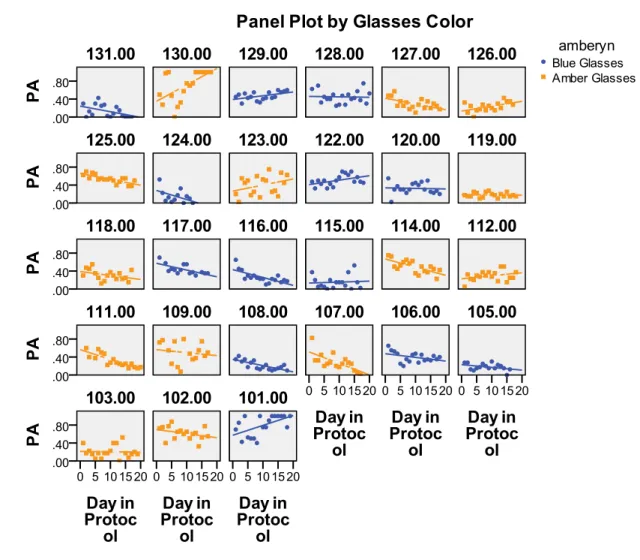
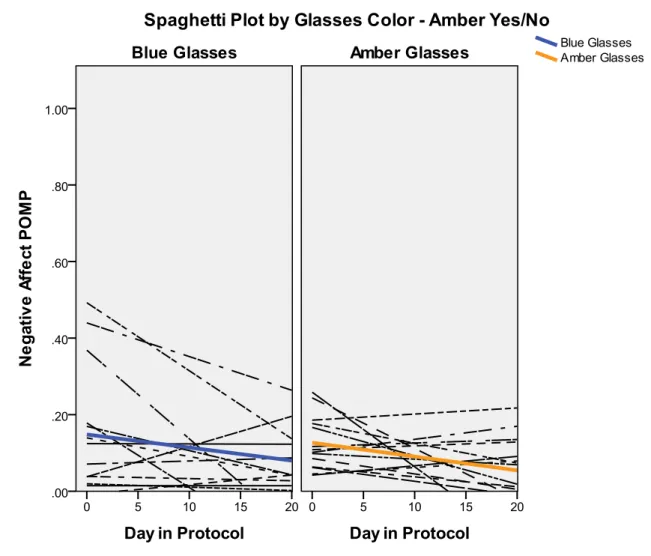
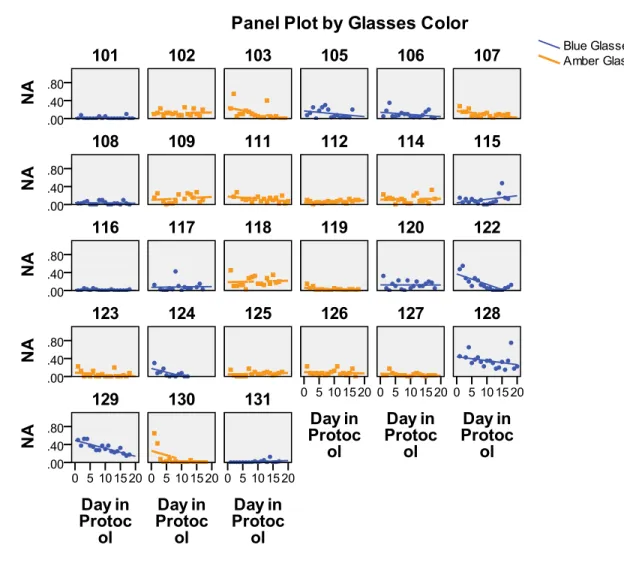
Researchers hypothesized that individuals in the amber glasses condition would have higher positive affect scores and lower negative affect scores when they wore the glasses, and that individuals in the blue glasses condition would experience no change. The individual item descriptive statistics for the Positive Affect (PA) and Negative Affect (NA) in the PANAS showed high internal reliability. Items in the PA Subscale had an internal reliability of .935, while items in the NA Subscale had an internal reliability of .851. The PA Subscale and NA Subscale were correlated at .06 (p = .233), showing no significant correlation between the
subscales, consistent with prior investigations of current mood state report (Watson et al., 1988). Mixed regression models tested the color of glasses, wearing glasses or not (rating
period), and the interaction of the color and rating period, using PA (POMP) and NA (POMP) as outcome variables. PA (POMP) scores showed only a significant intercept (b0 = .36, p < .01). This meant that when individuals had not been wearing glasses and they were in the blue group, the intercept was significantly different than 0; the lack of significance for the glasses color term indicated that the baseline scores in the orange glasses group were similar. Because the rest of the predictors were not significant, this meant that the slope of PA (POMP) scores did not change based on whether individuals had been wearing glasses or not, what color glasses they had been wearing, or the interaction of what color glasses they had been wearing and whether they were currently wearing them or not.
-.05, p <.01). This meant that when glasses were blue and the participant was not wearing glasses, the score on NA is significantly different than 0, and that the slope for NA (POMP) Scores differed significantly based on whether or not individuals were wearing glasses or not. The color of the glasses and the interaction of color of glasses and rating period were not significant.
The researchers also hypothesized that von Zerssen scores would increase (complaints would be decreased) in individuals when they wore the orange glasses. Those individuals wearing blue glasses would not see a change. The item by item descriptive statistics for the von Zerssen showed a total internal reliability of alpha = .96. The scores for the von Zerssen were skewed slightly negatively (meaning that scores in general tended to be higher, indicating lower levels of complaints, with a few people showing extremely low scores), but not enough to warrant a transformation, since the level of skewness was still between 3 and -3 – a range where parametric methods tend still to be robust.
Researchers hypothesized that the PSQI rating would improve if individuals were in the amber glasses condition and wearing the glasses, and that it would remain stable if they were in the blue condition. Internal reliability tests for the PSQI showed a Cronbach’s alpha of .636 overall. The mixed model analysis used whether individuals wore glasses or not (rating period), color of glasses, and the interaction of rating period and color of glasses as predictors, and PSQI (POMP) scores as the outcome variable. The intercept (b0 = .39, p < .01) and whether or not the individuals were wearing glasses (b1= -.11, p <.01) were both significant. This meant that the intercept for PSQI (POMP) scores was significantly different than zero if someone was not in the amber lenses group and was not wearing glasses, and that the slope of the scores on the PSQI differed significantly when individuals wore glasses as opposed to when they did not wear glasses. The color of glasses and the interaction between color of glasses and rating period were not significant, which meant that the slope of PSQI (POMP) Scores did not differ significantly when these variables changed.
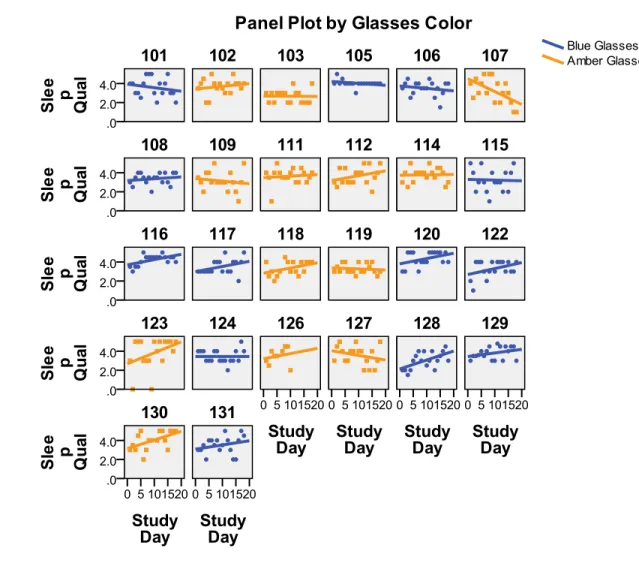
The final mixed model analysis tested whether energy ratings on the sleep diaries changed significantly as a result of glasses color, rating period, and the interaction of glasses color and rating period. The model had a significant intercept (b0 = 3.52, p < .01), but none of the other values were significant. This meant that the intercept was significantly different than zero if the individual was not in the experimental condition and was not wearing the glasses.
However, the rating period, glasses color, and the interaction of the two did not impact the slope of energy scores as rated on the sleep diary.
Discussion
Researchers had hypothesized that the amber glasses group would see significant improvements in somatic complaints (von Zerssen), sleep quality (PSQI and Sleep Diary Ratings), Energy (Sleep Diary Ratings) and Positive Affect scores (indicating higher levels of PA), and a significant decrease in Negative Affect scores (indicating lower levels of NA) for the rating periods when wearing glasses. We did not expect individuals in the blue glasses condition to see improvement from their baseline to their experimental ratings. In order for these
hypotheses to be supported, the interaction effects in the mixed models would have had to be significant. Because none of the interaction effects were significant, we can conclude that these hypotheses were not supported.
may have played into how individuals filled out the self-report measures. Because participants were not randomized according to these factors, these factors may not have been equally distributed between the 2 groups. Randomization assures that these unmeasured factors tend to be balanced between groups, but it is still possible for random assignment to include more of a particular factor in one group by chance. Historical events also occurred on campus while the study was being conducted, including a triple homicide (Grubb, 2015), which may have impacted ratings of positive and negative affect.
Another possibility is that the blue glasses are also having a physiological impact, and thus are also influencing the outcome measures. With the exception of Positive Affect, and the sleep diary ratings, wearing the glasses regardless of lens color had a significant effect on all participants. This may indicate that the blue glasses are having an impact as well as the amber glasses, either due to expectancy (“Hawthorne”) effects, or physiological activity. There also may be basic biological differences, leading to individuals who respond to the glasses, and individuals who do not, perhaps as a result of genetic polymorphisms (Burkhart & Phelps, 2009). If enough individuals are in a group who are not responsive to the glasses treatment, then effects would be hard to see.
signals, so they simply do not. Individuals may have known about the hypothesis, or guessed over time, although the answers given during the consent process and debriefing showed few indications of this. All of these could have contributed to the variety of responses to the self-report measures that led to non-significant results.
Limitations include some of the aforementioned factors, such as control glasses color and timing. The population was overwhelmingly female, and a more varied sample, racially and in gender distribution, could be very valuable. Circadian processes also fluctuate along with the menstrual cycle in women (Portaluppi, Touitou, & Smolensky, 2008), potentially adding to the heterogeneity of responses among female participants. Researchers also did not exclude anyone, with the rationale that in a real world situation, the glasses would hopefully impact anyone, regardless of their current life situation.
These possibilities and limitations raise the question of whether these glasses are effective in all populations. They may work better with working adult populations who have more regular sleep and work schedules, individuals who are motivated to see a change in their sleep schedules, and individuals who have a biological predisposition to be impacted by blue light. Because of this, it is still a line of research worth pursuing. The impact may be much greater in other populations than in college students during the middle of a difficult semester. However, if the effects can be over-ridden by lifestyle factors or stressful experiences, it suggests that the effects may also be more limited in clinical applications such as the treatment of bipolar disorder (cf. Henriksen et al., 2014).
It would be valuable to explore the impact of the glasses in different populations,
quality and mood would add variety and help identify measures that work well in studies seeking to combine sleep research with psychological studies. Further studies that collect data with more objective measures, such as melatonin samples and other biomarkers (e.g., Sasseville et al., 2006), or use actimetry as a way of measuring sleep and activity (e.g.,Thun et al., 2012), would build strength and validity of results.
In conclusion, though the study did not yield expected results, this does not rule out the possibility that amber glasses could be an effective way to improve sleep quality and mood. Careful attention to detail, research with a variety of populations, and improvement of measures and methods have the potential to lead to entirely different conclusions. Identifying those
specific areas would be valuable, because it would give researchers and clinicians a much clearer idea of areas in the field where amber lenses would be of the most use.
References
American Psychiatric Association. (2013). Diagnostic and statistical manual of mental disorders
(5th ed.). Washington, DC: Author.
Barbini, B., Benedetti, F., Colombo, C., Dotoli, D., Bernasconi, A., Cigala-Fulgosi, M., . . . Smeraldi, E. (2005). Dark therapy for mania: a pilot study. Bipolar Disorders, 7(1), 98-101. doi: 10.1111/j.1399-5618.2004.00166.x
Barion, A. (2011). Circadian rhythm sleep disorders. Disease A Month, 57(8), 423-437. doi: 10.1016/j.disamonth.2011.06.003
Bolger, N., & Laurenceau, J. P. (2013). Intensive longitudinal methods: An introduction to diary
Burkhart, K., & Phelps, J. R. (2009). Amber lenses to block blue light and improve sleep: a randomized trial. Chronobiology International, 26(8), 1602-1612. doi:
10.3109/07420520903523719
Buysse, D. J., Reynolds, C. F., 3rd, Monk, T. H., Berman, S. R., & Kupfer, D. J. (1989). The Pittsburgh Sleep Quality Index: a new instrument for psychiatric practice and research.
Psychiatry Research, 28(2), 193-213.doi: 10.1016/0165-1781(89)90047-4
Cohen, P., Cohen, J., Aiken, L. S., & West, S. G. (1999). The problem of units and the circumstances for POMP. Multivariate Behavioral Research, 34, 315-346. doi: 10.1207/s15327906mbr3403_2
Emens, J., Lewy, A., Kinzie, J. M., Arntz, D., & Rough, J. (2009). Circadian misalignment in major depressive disorder. Psychiatry Research, 168(3), 259-261. doi:
10.1016/j.psychres.2009.04.009
Even, C., Schroder, C. M., Friedman, S., & Rouillon, F. (2008). Efficacy of light therapy in nonseasonal depression: a systematic review. Journal of Affective Disorders, 108(1-2), 11-23. doi: 10.1016/j.jad.2007.09.008
Golden, R. N., Gaynes, B. N., Ekstrom, R. D., Hamer, R. M., Jacobsen, F. M., Suppes, T., . . . Nemeroff, C. B. (2005). The efficacy of light therapy in the treatment of mood disorders: a review and meta-analysis of the evidence. American Journal of Psychiatry, 162(4), 656-662. doi: 10.1176/appi.ajp.162.4.656
Grubb, Tammy. (2015, February 10). Chapel Hill police arrest man in triple homicide. The News
Harvey, A. G., Murray, G., Chandler, R. A., & Soehner, A. (2011). Sleep disturbance as transdiagnostic: consideration of neurobiological mechanisms. Clinical Psychology
Review, 31(2), 225-235. doi: 10.1016/j.cpr.2010.04.003
Henriksen, T. E., Skrede, S., Fasmer, O. B., Hamre, B., Gronli, J., & Lund, A. (2014). Blocking blue light during mania - markedly increased regularity of sleep and rapid improvement of symptoms: a case report. Bipolar Disorders. doi: 10.1111/bdi.12265
Kaplan, K. A., & Harvey, A. G. (2009). Hypersomnia across mood disorders: a review and synthesis. Sleep Medicine Reviews, 13(4), 275-285. doi: 10.1016/j.smrv.2008.09.001 Kayumov, L., Casper, R. F., Hawa, R. J., Perelman, B., Chung, S. A., Sokalsky, S., & Shapiro,
C. M. (2005). Blocking low-wavelength light prevents nocturnal melatonin suppression with no adverse effect on performance during simulated shift work. Journal of Clinical
Endocrinology & Metabolism 90(5), 2755-2761. doi: 10.1210/jc.2004-2062
Kennaway, D. J., Moyer, R. W., Voultsios, A., & Varcoe, T. J. (2001). Serotonin, excitatory amino acids and the photic control of melatonin rhythms and SCN c-FOS in the rat. Brain
Research, 897(1-2), 36-43. doi: 10.1016/s0006-8993(01)02091-1
Košćec, A., Radošević-Vidaček, B., & Kostović, M. (2001). Morningness–eveningness across two student generations: would two decades make a difference? Personality and
Individual Differences, 31(4), 627-638. doi:
http://dx.doi.org/10.1016/S0191-8869(00)00167-7
Lockley, S. W., Brainard, G. C., & Czeisler, C. A. (2003). High sensitivity of the human circadian melatonin rhythm to resetting by short wavelength light. Journal of Clinical
Endocrinology and Metabolism, 88(9), 4502-4505. doi: 10.1210/jc.2003-030570
McClung, C. A. (2011). Circadian rhythms and mood regulation: insights from pre-clinical models. European Neuropsychopharmacology, 21 Suppl 4, S683-693. doi:
10.1016/j.euroneuro.2011.07.008
Monk, T. H., Buysse, D. J., Reynolds, C. F., 3rd, Jarrett, D. B., & Kupfer, D. J. (1992).
Rhythmic vs homeostatic influences on mood, activation, and performance in young and old men. Journals of Gerontology, 47(4), P221-227. doi: 10.1093/geronj/47.4.p221 . Parsons, H. M. (1974). What Happened at Hawthorne?: New evidence suggests the Hawthorne
effect resulted from operant reinforcement contingencies. Science, 183(4128), 922-932. doi: 10.1126/science.183.4128.922
Portaluppi, F., Touitou, Y., & Smolensky, M. H. (2008). Ethical and methodological standards for laboratory and medical biological rhythm research. Chronobiology International, 25(6), 999-1016. doi: 10.1080/07420520802544530
Raudenbush, S. W., & Bryk, A. S. (2002). Hierarchical linear models: Applications and data
analysis methods (2nd ed.). Newbury Park, CA: Sage.
Roybal, K., Theobold, D., Graham, A., DiNieri, J. A., Russo, S. J., Krishnan, V., . . . McClung, C. A. (2007). Mania-like behavior induced by disruption of CLOCK. Proceedings of the
National Academy of Sciences USA, 104(15), 6406-6411. doi: 10.1073/pnas.0609625104
Thun, E., Hilde Nordhus, I., Udnes, I., Halvor Lilleholt, T., Johansen, T., Sivertsen, B., . . . Pallesen, S. (2012). An Actigraphic Validation Study of Seven Morningness-Eveningness Inventories. European Psychologist, 17(3), 222-230. doi: 10.1027/1016-9040/a000097 Van Mill, J. G., Hoogendijk, W. J., Vogelzangs, N., van Dyck, R., & Penninx, B. W. (2010).
Insomnia and sleep duration in a large cohort of patients with major depressive disorder and anxiety disorders. Journal of Clinical Psychiatry, 71(3). doi:
10.4088/JCP.09m05218gry
von Zerssen, D. (1975). Die beschwerden-liste. Parallelformen B-L und B-L'. Erganzungsbogen B-L. Beltz: Weinheim.
Watson, D., Clark, L. A., & Tellegen, A. (1988). Development and validation of brief measures of positive and negative affect: The PANAS scales. Journal of Personality and Social
Psychology, 54(6), 1063-1070. doi: 10.1037//0022-3514.54.6.1063
Yan, L., Bobula, J. M., Svenningsson, P., Greengard, P., & Silver, R. (2006). DARPP-32
involvement in the photic pathway of the circadian system. The Journal of Neuroscience, 26(37), 9434-9438. doi: 10.1523/JNEUROSCI.2538-06.2006
Yoo, S. S., Gujar, N., Hu, P., Jolesz, F. A., & Walker, M. P. (2007). The human emotional brain without sleep--a prefrontal amygdala disconnect. Current Biology, 17(20), R877-878. doi: 10.1016/j.cub.2007.08.007
Youngstrom, E. A. (2014, December). Preliminary test of amber glasses as a way of resetting
circadian melatonin release: Randomized trial during travel from Asia. Paper presented
Zelinski, E. L., Deibel, S. H., & McDonald, R. J. (2014). The trouble with circadian clock dysfunction: multiple deleterious effects on the brain and body. Neuroscience &
Biobehavioral Review, 40, 80-101. doi: 10.1016/j.neubiorev.2014.01.007
Table 1
Distribution of Gender, Age, Year in School (Overall and By Condition)
Male Female Age (M) Age (SD) Year in School (M) Year in School (SD)
Blue 3 10 19.62 1.12 2.54 1.27
Amber 3 11 19.65 2.34 2.21 2.26
Table 2
Distribution of ethnicity
Ethnicity Count Proportion
Caucasian 15 .56
African American 2 .07
Asian American 7 .26
Table 3
Descriptive Statistics of PANAS, VZ, Energy, and Sleep Quality
N Mean SD Min Max
Positive Affect (POMP)
475 .37 .23 0 1
Negative Affect (POMP)
475 .10 .12 0 .75
Von Zerssen 474 176.62 .70 54 188
Sleep Quality (Diary)
456 3.54 .94 0 5