The Geography of Secession
Rob Williams
A dissertation submitted to the faculty of the University of North Carolina at Chapel Hill in partial fulfillment of the requirements for the degree of Doctor of Philosophy in the Department of Political Science.
Chapel Hill 2019
Approved by:
Mark J.C. Crescenzi
Stephen E. Gent
Navin A. Bapat Patricia L. Sullivan
ABSTRACT
Rob Williams: The Geography of Secession (Under the direction of Mark J.C. Crescenzi)
Secessionist conflicts often begin in places abundant with resources and located far from the
centers of state power. These factors make it easier for rebels to form a functional state within the
borders of their territory following independence. Many regions that meet the necessary conditions
for sovereign governance in the world, but there are few secessionist conflicts. This relative paucity
of secessionist violence is the result of government preemption of potential separatist movements.
The secessionist conflicts we do observe are the result of government failure to adapt to changes in
outlying territories sufficiently quickly, allowing dissident groups to gain a foothold and initiate a
secessionist campaign. In extreme cases, governments may relocate large populations of the dominant
social group to minority territories to deter secession by diluting the minority’s power locally. I test
these arguments using cross-national geospatial data, and find that governments develop higher levels
of state capacity in more governable, and thus more secession prone, regions. I derive empirical
implications for government informational capability and conflict onset using an agent-based model.
Qualitative case studies show that governments engage in demographic engineering when they
fear secessionist ambitions, but highlight the risk of backlash sparking a low-level conflict. Taken
together, these dynamics suggest a pattern where the rebel groups that do emerge are not the most
capable of potential rebel groups as minorities that live in territories suited to secession are carefully
surveilled and managed by governments. Information plays a central role in both explanations of
how governments work to preempt conflict, and when these efforts fail. By focusing on the role of
information, this dissertation deepens our understanding of conflict onset, while suggesting ways
to improve our knowledge of conflict evolution and outcome. Improving information flows from
ACKNOWLEDGEMENTS
My advisor, Mark Crescenzi, bears a large share of the responsibility for the existence of this
document. During a meeting late in the process of writing my prospectus, he mentioned that I
should consider switching advisors because I was writing a dissertation on civil war and he studies
international trade and conflict. I demurred, knowing that my tendency to become fixated on the
technical details of the individual components of an argument needed to be kept in check. His
incessant requests that I “tell him a story” meant that I knew he was more than up to the task of
serving as this counterbalance. His guidance improved this dissertation in innumerable ways while
his career advice and outlook have made me a better political scientist and academic. Thanks to him,
this dissertation definitely tells a story.
I also owe an enormous debt to the rest of my committee: Stephen Gent, Navin Bapat, Patricia
Sullivan, and Santiago Olivella. Stephen provided excellent feedback that improved the clarity of
my writing and helped me to consider how the disparate parts of my dissertation related to one
another. Navin forced me to consider the bargaining implications of my arguments and explore how
they could affect our existing understanding of conflict. Patricia helped me narrow the focus of my
dissertation from conflict more broadly and identify the importance of goals in collective action.
Santiago assisted me in tackling the numerous methodological challenges my dissertation involved,
and gave me my first opportunity to teach methods. Each of my committee members also provided
extensive comments and feedback on other research projects beyond my dissertation, greatly helping
my work.
This dissertation would not exist without the personal and professional support, assistance, and
encouragement of my friends and colleagues. Daniel Gustafson read numerous passages and offered
his advice on many, many questions. Bailee Donahue was always ready with a sympathetic ear and
no fewer than three useful suggestions. Bryan Velarde read several drafts and shared his constructive
feedback on them. Rachel Porter gave a valuable perspective on many of the finer methodological
Menevis¸ Cılızo˘glu, and Chelsea Estancona have served as impeccable examples of how to be a
scholar and educator and provided extensive moral support during my Ph.D. I am thankful to all of
my friends for everything listed here and much, much more. The UNC Political Science Department
broadly, and the participants in the Methods and Design Workshop series more specifically, also
provided lots of assistance in ways both large and small.
My fellow political scientists up the road at Duke University, Juan Tellez, Howard Liu, Kaitlyn
Webster, and Margaret Foster, all provided helpful feedback on different parts of this dissertation at
varying times. Scholars at other institutions also helped me tackle key challenges. Jessica Braithwaite
and Kathleen Cunningham graciously shared their FORGE data with me before it was publicly
available so that I could add an additional robustness check to my analysis in Chapter 2. Philipp
Hunziker, Nils Weidmann, and Nils-Christian Bormann provided insight into the inner workings
of key data sources. Caroline Hartzell, Megan Stewart, Jessica Braithwaite, Rebecca Best, and the
participants in the Advancing Measurement in the Study of Conflict and Political Violence workshop
at the 2018 Annual Meeting of the Peace Science Society (International) all offered valuable feedback
on individual chapters. I am also grateful to the ICPSR, Peace Science, and PolMeth communities
which each nurtured this dissertation in their own ways.
While my committee members and colleagues within political science played an outsize role in
the success of this dissertation, people outside of the department also made innumerable contributions.
At UNC, Philip McDaniel provided invaluable assistance with the many GIS operations required by
this project, Ren´ee Bosman assisted me in locating elusive sources, and the staff of ITS Research
Computing put up with incessant questions about how to get my code to run on the cluster. Much of
the fifth chapter was written during the UNC Writing Center’s dissertation writing bootcamp. They
are not academic establishments, but Beer Study, Grey Squirrel Coffee, and Perennial Cafe provided
essential work spaces when I could no longer focus in my windowless office.
Finally, I would like to thank my family. My parents, Kathy and Jay, and my sister, Beth, have
supported and encouraged me throughout my academic career, and well before I knew I wanted to
have one. I am most grateful to my partner Gracie, who was with me throughout the ups and downs
TABLE OF CONTENTS
LIST OF TABLES . . . x
LIST OF FIGURES . . . xi
LIST OF ABBREVIATIONS . . . xiii
1 Introduction . . . 1
1.1 Significance. . . 3
1.2 Literature Review . . . 4
1.2.1 The Sincerity of Secession . . . 5
1.2.2 Rebel Groups as (Potential) State-Builders . . . 8
1.2.3 Lessons from the Spatial Conflict Literature. . . 11
1.3 Outline of the Dissertation . . . 14
2 Geographic Determinants of Rebel Goals . . . 16
2.1 A Geographic Theory of Governability . . . 17
2.1.1 Rebel groups as (potential) state-builders . . . 18
2.1.2 Geographic Governability and Group Goals . . . 22
2.1.2.1 Internal Governability . . . 26
2.1.2.2 Location, Location, Location . . . 29
2.2 Data and Methods . . . 31
2.2.1 Geospatial Data . . . 31
2.2.1.1 Ethnic Groups Territory . . . 31
2.2.1.2 Population . . . 32
2.3 Results . . . 36
2.3.1 Alternative Governability Measure . . . 37
2.3.2 Alternative Response Variable Coding . . . 39
2.3.3 Predictive Accuracy . . . 41
2.4 Conclusion . . . 43
3 The Curse of Geography . . . 44
3.1 Keeping a lid on it . . . 46
3.2 Data and Methods . . . 50
3.2.1 Universe of cases . . . 51
3.2.2 Government attention . . . 52
3.2.3 Territorial governability . . . 54
3.2.4 Capital distance . . . 54
3.2.5 Control variables . . . 54
3.2.6 Model . . . 55
3.3 Results . . . 55
3.3.1 Robustness to Alternative Measures . . . 59
3.3.2 Robustness to Nonlinearities . . . 61
3.4 Discussion and Conclusion . . . 63
4 The Failure of Prevention . . . 67
4.1 Slow on the Uptake . . . 68
4.2 A Dynamic Model of Territorial Change and Conflict Prevention . . . 71
4.2.1 Strategic Interaction . . . 74
4.3 Predictions . . . 75
4.4 Discussion . . . 77
4.5 Conclusion . . . 80
5 Demographic Engineering as Prevention Strategy . . . 81
5.1.1 Forced Displacement as a Preemption Strategy . . . 84
5.1.2 Internal Colonialism . . . 86
5.2 Case Studies . . . 92
5.2.1 The Sri Lankan Dry Zone . . . 94
5.2.2 Iraqi Kurdistan . . . 100
5.3 Discussion . . . 106
5.3.1 Alternative Explanations . . . 110
5.3.2 Demographic Engineering as a Conflict Management Strategy? . . . 112
5.4 Conclusion . . . 113
6 Conclusion . . . 115
A Supplemental Information for Chapter 2 . . . 121
A.1 Missing Data. . . 121
A.2 Population Considerations . . . 121
A.2.1 Population Concentration . . . 122
A.3 Capital Distance . . . 123
A.4 Nested Logit Model . . . 123
A.5 Estimation . . . 126
A.6 Alternate Models . . . 126
A.6.1 Multinomial Model . . . 126
A.6.2 Unconditional Model . . . 127
A.7 MCMC Diagnostics . . . 127
B Supplemental Information for Chapter 3 . . . 130
B.1 Descriptive Statistics . . . 130
B.2 Missing Data. . . 131
B.3 Nightlights Considerations . . . 131
B.4 Political Status . . . 132
B.4.2 Excluded Groups . . . 133
B.5 Out of Sample Accuracy . . . 134
B.6 Random Forest . . . 135
B.7 Prior Sensitivity Analysis . . . 136
B.8 Estimation and MCMC Diagnostics . . . 136
C Supplemental Information for Chapter 4 . . . 139
C.1 Iteration Models . . . 139
C.2 Model Details . . . 140
C.3 Extensions to the Model . . . 140
C.3.1 Variance of the Shock . . . 141
C.3.2 Stochastic Surveillance . . . 142
D Supplemental Information for Chapter 5 . . . 144
D.1 Sri Lanka . . . 144
LIST OF TABLES
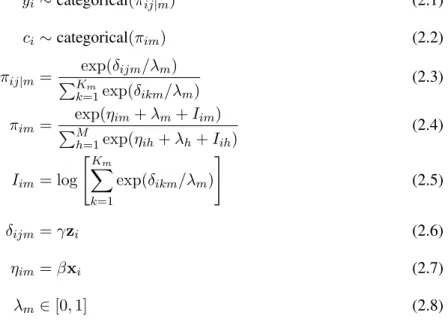
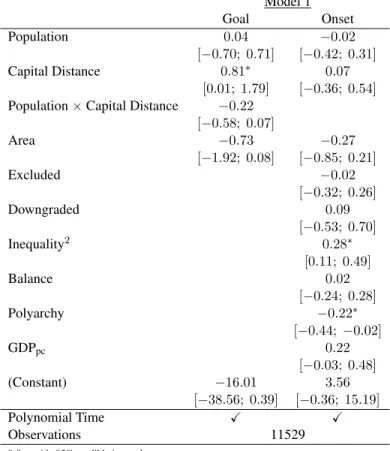
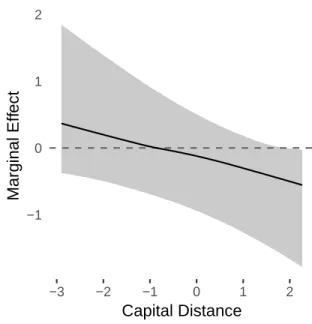
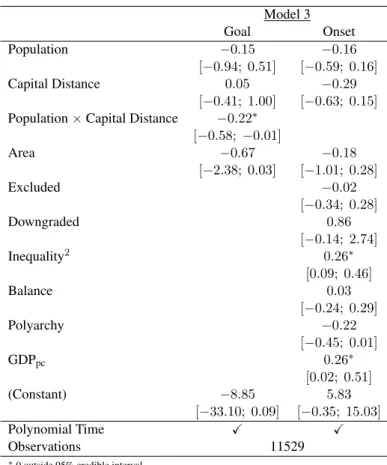
2.1 Nested logit results for onset and goal . . . 37
2.2 Nested logit results for onset and goal; population concentration . . . 39
2.3 Nested logit results for onset and goal; FORGE data . . . 41
2.4 Confusion matrix. . . 42
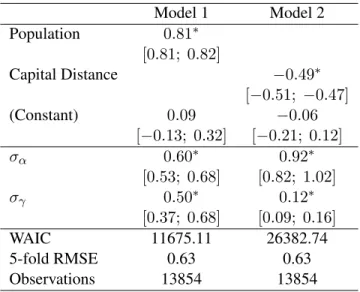
3.1 Nightlights as a function of population and capital distance . . . 56
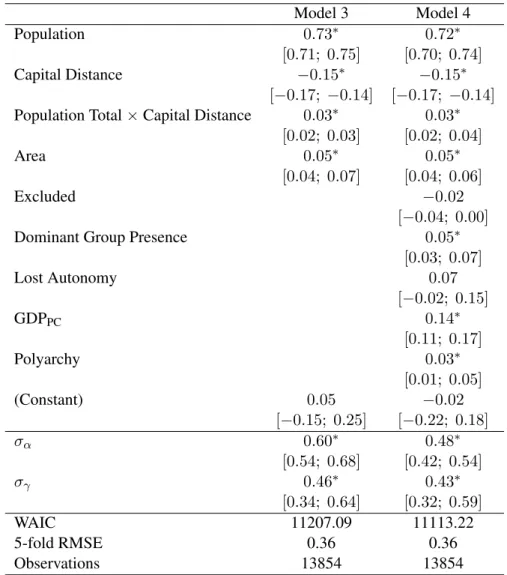
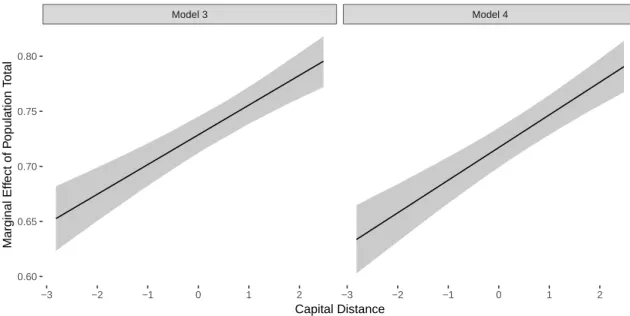
3.2 Nightlights as a function of the interaction between population and capital distance . . 57
3.3 Nightlights as a function of the interaction between population concentra-tion and distance . . . 60
4.1 Model-level parameters . . . 73
4.2 Group-level parameters . . . 73
4.3 Parameter space for the baseline model . . . 75
5.1 Land Alienated Under Land Development Schemes, 1936-66 . . . 97
5.2 Comparison of 1957, 1977, and 1997 Kirkuk Governorate Censuses . . . 104
A.1 Missingness of explanatory and control variables. . . 121
A.2 Multinomial logit results for goal . . . 127
A.3 Nested logit results for onset and goal with no interaction term . . . 129
B.1 Missingness of control variables. . . 131
B.2 Nightlights as a function of non-dominant ethnic group population and capital distance. . . 133
B.3 Nightlights as a function of excluded ethnic group population and capital distance. . . 135
C.1 Extended model-level parameters . . . 142
LIST OF FIGURES
2.1 Generalized Nested Logit Model . . . 35
2.2 Rebel Group Goal Nested Logit . . . 36
2.3 Marginal effects of population on rebel group goal . . . 38
2.4 Marginal effect of population concentration on rebel group goal . . . 40
2.5 Marginal effect of population on rebel group goal; FORGE data . . . 40
3.1 Distribution of capital distance by political status . . . 47
3.2 Population and nightlights in China . . . 53
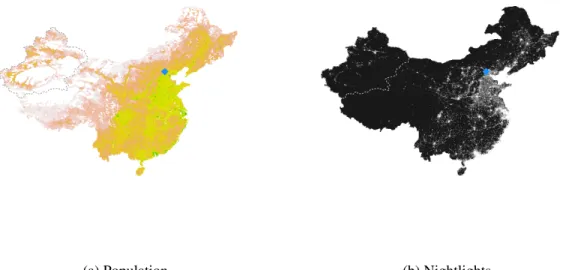
3.3 Marginal effects of population on nightlights . . . 58
3.4 Marginal effects of population concentration on nightlights . . . 61
3.5 Predicted nightlights as a function of distance and population . . . 62
3.6 Partial dependence of nightlights on distance and population . . . 63
4.1 Probability of secessionist civil war onset . . . 76
5.1 Actual versus projected population increases in Tamil districts . . . 98
5.2 Boundaries of Kirkuk Governorate over time . . . 105
A.1 Population of ethnic group territories in Nigeria . . . 122
A.2 Panel data multinomial logit marginal effects . . . 128
A.3 Panel data multinomial logit marginal effects . . . 128
A.4 Panel data multinomial logit marginal effects . . . 129
B.1 Distributions for predictors included in analysis. . . 130
B.2 Nightlights in North and South Korea . . . 132
B.3 Marginal effects of non-dominant ethnic group population on nighttime light levels. . . 134
B.4 Marginal effects of excluded ethnic group population on nighttime light levels. . . 134
B.6 Traceplot of samples forβ. . . 138
B.7 Geweke diagnostic plot forβ . . . 138
C.1 Duration to secessionist civil war onset . . . 139
C.2 Probability of secessionist civil war onset in varying shocks model . . . 141
LIST OF ABBREVIATIONS
EZLN Ej´ercito Zapatista de Liberaci´on Nacional
HHI Herfindahl–Hirschman index
ICT information communication technology
IIA independence of irrelevant alternatives
GAM Free Aceh Movement
GDP gross domestic product
KDP Kurdistan Democratic Party
KRG Kurdistan Regional Government
LTTE Liberation Tigers of Tamil Eelam
MCMC Markov chain Monte Carlo
PPV Positive Predictive Value
PUK Patriotic Union of Kurdistan
RMSE root mean squared error
ROC Receiver Operating Characteristic
RPC relative political capacity
RPR relative political reach
SPLM/A Sudan People’s Liberation Movement/Sudan People’s Liberation Army
SPLM-IO Sudan People’s Liberation Movement-in-Opposition
TEK transborder ethnic kin
WAIC Watanabe–Akaike information criterion
WWI World War I
CHAPTER 1: INTRODUCTION
When self-determination movements turn to violence in the pursuit of their goals, they sometimes
seek independence, but other times aim for greater autonomy under the authority of their existing
government. When theEj´ercito Zapatista de Liberaci´on Nacionaldeclared war on the Mexican
government in 1994, they did not demand independence, but rather autonomy within Chiapas.
The Papuans in the Indonesian provinces of Papua and West Papua have fought for independence
or reunification with neighboring Papua New Guinea. The Bengali population of East Pakistan
successfully separated from the rest of Pakistan and formed the present-day state of Bangladesh. The
Kurdistan Democratic Party fought for increased regional autonomy in the First Iraqi-Kurdistan War
during the 1960s. While each of these movements sought to exercise increased local political power
with decreased external interference, they varied considerably in the degree of independence they
sought.
When self-determination movements turn to violence to advance their aims, why do some agitate
for secession and independence from their host states, while others are content merely to seek
increased autonomy under the authority of the state? If self-determination movements are frustrated
with their state of affairs to the point of willingness to employ violence, why stop short of a demand
for independence? Independence would mean freedom from having to deal with an uncooperative
government and the ability to organize the new state according to their ideals.
Groups fight for secession when they believe that governing as an independent state in the wake
of their victory will be feasible, and settle for increased autonomy when they believe that governing
independently would be less practical. The responsibilities that a group must take on in the wake of
a successful bid for independence are enormous, and if it believes that it is not equipped to carry
them out, then autonomy can be a more realistic and attractive goal. While aspects of a group like its
degree of internal cohesion or fragmentation clearly affect how able it will be to fulfill the duties of
Modern nation-states are territorial political entities, and so group structure is only one half
of the equation for how well a group will be able to govern. The other half is how difficult it
will be to govern the specific territory that a group will control. The governability of a territory
can be influenced by numerous geographic factors such as the location and abundance of natural
resources, or how easy it is to move between population centers. Similarly, the human geography of
a territory can determine how governable it is for a specific group. Are people clustered in dense
urban populations, making the administration of the territory easier? Are there numerous other ethnic
groups in a territory that would be unlikely to submit to majority rule by the self-determination
group? The environment also plays a role by affecting how productive agricultural lands are and
what diseases a state’s citizens must contend with.
In this dissertation I focus on the latter dimensions of governability: those tied to attributes of
specific pieces of territory, rather than those that describe the groups seeking to rule them. This
definition encompasses geographic factors which are continuously distributed across a territory and
vary throughout its area. Groups will fight for secession when the territory that they occupy is more
conducive to their governance, and for autonomy when it is less so.
This focus on geography highlights the absence of the state in the theory as discussed thus far. If
geography affects how governable a group’s territory is, then geography also makes that group more
likely to pursue secession should it turn to violence. While governments may struggle to know and
comprehend the informal institutions of a nascent rebel group due to their secretive nature, they have
far less trouble knowing what type of territory that group inhabits. Geographic factors are slow to
change and more easily observable. The readily observable nature of geographic factors means that
governments are also able to identify the territories most suited to secession and therefore most likely
to secede. They then use this knowledge to act preemptively and prevent secessionist movements
from emerging in these areas.
However, states are not always able to successfully execute these preemption efforts. Preventing
the formation of secessionist movements requires directing the coercive apparatus of the state to areas
where they are most likely to form. When governments are slow to learn of changes in governability
in far-flung regions, they can be slow to update their level of preemptive activities. If they fail to
update quickly enough, this can give dissatisfied minorities the window of opportunity they need to
Finally, states are aware of this relationship and may take proactive measures to reduce the
likelihood that groups which turn to violence will seek independence and sovereign statehood instead
of more limited autonomy goals. States may encourage immigration by members of dominant ethnic
groups to a restive minority group’s territory, increasing its ethnic heterogeneity, and thus decreasing
the group’s ability to govern it independently. Even if this strategy ultimately fails to prevent a violent
self-determination movement from emerging, it can put governments in a favorable position from
which to combat it by entrenching the power of the state within the region.
I develop and test these theories with a multi method approach using large-Nquantitative analysis,
agent-based models, and qualitative case studies. In different chapters I draw on a broad array of
data sources ranging from recent global geospatial data to narrative accounts of resettlement efforts
stretching back to the end of the 19th Century.
1.1 Significance
This dissertation addresses a topic of considerable significance in political science. Nationalism
is the foundation of the modern nation state, and by exploring how potential secessionist rebels
decide which battles to fight, it provides insight into how states handle constrained decision-making
problems. In doing so, it foregrounds the fact that rebels, and potential rebels, face the same set of
obligations and opportunities as states. They must satisfy their constituents while fighting to retain
political power.
Linking geography to state building offers important advances for both the study of contemporary
rebellion and preemption and the study of historical nation formation. Work on state building in early
modern Europe (Tilly 1975, Tilly 1992, North & Weingast 1989) or the colonial period (Acemoglu,
Johnson & Robinson 2001) tends to focus on political institutions and ignore the territories those
institution occupied. Adding geography to this story can help provide more complete explanations
for divergent outcomes in historical development.
Similarly, the contemporary civil war literature is very focused on conflict onset (Fearon &
Laitin 2003, Collier & Hoeffler 2004, Buhaug 2010, Cederman, Buhaug & Rød 2009, Cederman,
Wimmer & Min 2010, Siroky & Cuffe 2015, Hegre, Allansson, Basedau, Colaresi, Croicu, Fjelde,
Randahl, Rød, Schneider, von Uexkull & Vestby 2019). While much work does treat conflict duration
(Fearon 2004, Cunningham 2006, Buhaug, Gates & Lujala 2009) and outcome (Cunningham,
Gleditsch & Salehyan 2009, Akcinaroglu 2012, Balcells & Kalyvas 2014, Schutte 2015, Greig,
Mason & Hamner 2016, Chu & Braithwaite 2018), these studies often operate in isolation. By
emphasizing the importance of post-conflict possibilities in explaining conflict prevention efforts,
this dissertation illustrates the necessity of considering all potential stages of a conflict when studying
onset. Rebel groups and governments are strategic actors, and failing to consider these possibilities
is akin to ignoring their capacity for strategic behavior.
By focusing on ways in which governments use geography to identify and thwart potential
seces-sionist movements, I shed light on the relative absence of successful self-determination movements
in recent times. While South Sudan gained independence in 2011, it is the only recent case of a
successful bid for independence. The theory of geographic governance and prevention encompasses
a range of strategies from beneficial to coercive to violent, explaining patterns in a broad variety of
cases across a spectrum of regime types.
The ways in which governments identify likely secessionist groups and act to frustrate their
ambitions are of exceptional relevance to policymakers. This logic can explain why governments
persist in supporting migration from populated areas to remote minority regions even when such
movements spark unrest and outrage locally. Furthermore, if more governable territories are more
prone to secession, then policymakers can help identify development and aid strategies that are less
likely to spur conflict down the road.
1.2 Literature Review
I begin by reviewing the literature on nationalism, self-determination movements, and independence
demands. Following this, I build on insights from the state formation literature as they relate to the
need for rebel groups to govern in the wake of a successful secession bid. To provide context for an
understanding of rebel groups as potential state-builders, I review the literature on space and conflict.
I note where existing work touches on the role of these elements in rebel strategic choice and where
To develop a theory of how geographic factors affect the goals that rebel groups pursue, we need
to draw on insights from three distinct streams of research within the literature: work on nationalism
and self-determination, scholarship on state formation, and the spatial conflict research project.
Understanding the gravity and consequences of independence claims means we can confidently
separate groups which fight for secession and autonomy without worrying about the possibility
of strategic misrepresentation. The state formation literature is important because a successful
secessionist group will have to found a new state, so it is important to consider the demands and
opportunities facing newly emerged states. While it is primarily focused on explaining the onset of
conflict, the geographic conflict literature contains many insightful observations about the relationship
between violence and space, and groups take these realities into account when deciding how to fight
their battle against the state.
1.2.1 The Sincerity of Secession
The starting point for understanding territorial conflict is nationalism. Groups only engage in
territorial conflict — the struggle to create new and alternative political institutions within the
boundaries of a given territory — when motivated by nationalist desire. Ernest Gellner writes that
nationalism is a theory of political legitimacy, which requires that ethnic boundaries
should not cut across political ones, and, in particular, that ethnic boundaries within a
given state . . . should not separate the power-holders from the rest (1983, 1).
Thus, territorial conflicts represent an attempt to replace existing geographic political divisions
with ones that more closely support the “nationalist principle” (Gellner 1983) that the government of
a state should represent the interests of the “imagined community” of the nation (Anderson 1983) that
lives within its borders. This type of conflict hopes to alter the institutions within a specific territory
by either gaining more autonomy from the central government, or by withdrawing from the current,
non-representative, state and forming a new one (Gleditsch, Wallensteen, Eriksson, Sollenberg &
Strand 2002). These conflicts are less threatening to governments than governmental ones because
the group has no desire to overthrow or replace the existing government. Instead, a group’s aims
influence of the government within this area. Focusing on territorial conflicts allows me to make
meaningful comparisons across different areas because groups are tied to their specific territories.
If territorial conflict encompasses both secessionist and autonomy-seeking civil wars, then it
is important to understand the distinctions between the two. Both will result in policies that more
closely align with the ideal point of the minority group that lives in the territory. However, autonomy
entails some degree of compromise; even if all of the policy demands of the group are met, they still
will not have their own state, in violation of the nationalist principle. Secession can be seen as the
more ‘extreme’ of the two forms of territorial conflict. This relationship implies a question: why do
some groups fight for autonomy and some for secession?
Research on self-determination groups more broadly – those both violent and nonviolent – may
hold the answer. These groups frequently change the extent of their claims. Erin Jenne views
secession and increased regional autonomy as two points along the spectrum of “demands” on the
government that minority groups can dynamically move between as part of their bargaining process
with the majority (2007, 39-41). As their bargaining leverage and capabilities increase or decrease,
groups will make more or less extreme demands of the majority. Donald Horowitz (1991, 13) concurs,
noting that
groups . . . are not born irredentist or secessionist. They can and do move back and forth
from integrated participation in the state of which they are part to a posture of secession
or irredentism.”
Empirically, the proportion of self-determination groups making secessionist demands varies
signifi-cantly over time, with individual groups making both types of demands over time (Cunningham 2014,
72). It is a logical extension to argue that groups which have already escalated to violent conflict
with the state also operate along this sliding scale, with shifts in demands reflecting changes in their
bargaining leverage. There is nothing fundamental that makes secession inherent to some groups and
autonomy inherent in others. Instead, the choice of goal is a function of the constraints that a group
faces and the strategic environment that it operates in. Stated goals, whether secession or autonomy,
are a reflection of what a group can reasonably hope to achieve.
An alternative possibility is that groups act strategically and make demands that are more extreme
difficult to be sure whether a given strategy represents a sincerely held belief or is only a
tactic . . . it seems wiser to not make too sharp a distinction between autonomism and
secessionism.
If groups can credibly make maximalist demands, then they will have more leverage in negotiations
with the state. Secession is a more extreme demand than increased autonomy because it involves
challenges to “the integrity of the state itself” (Jenne 2007, 40), and as a result should give groups a
better bargaining position. If this is the case, why do all self-determination groups not clamor for
secession at all times?
The very fact that groups do not always advocate for secession should lead us to question whether
they make these demands strategically. According to Cunningham (2014, 72), the proportion of
self-determination groups calling for secession has never passed .55 since 1960. Groups sometimes
limit their demands because of the unique nature of secession and independence claims.
Self-determination groups that advocate a policy of secession may settle for autonomy if they
are unable to triumph on the field of battle or force the state to accept their terms. What they will
not do is turn down the possibility of secession if offered. Doing so would entail disappointing their
supporters and leaving their nationalist fervor unrequited. This unfulfilled nationalist desire would
generate significant audience costs for the group’s leadership. In effect, secession is an offer that
can’t be refused.
In order for a group which initially pushed for secession to successfully accept a lesser
achieve-ment of increased autonomy, its leadership must be able to convince its mass supporters that it
was unable to force the government to grant more concessions. If a group is strong and capable of
governing in the wake of independence, its supporters are likely to know this. A group which is able
to govern will not be able to turn down an offer of independence from the government because its
supporters will punish it for not securing as much independence as it could.
South Sudan’s short history since its independence in 2011 illustrates the pitfalls of pushing for
secession if a group is not prepared to take up the reins of government. Although 98.8% of South
Sudan’s population voted for independence in a 2011 referendum (Gettleman 2011), the young state
has been plagued by problems since then. After putting down an alleged coup in late 2013, president
Movement-in-Opposition (SPLM-IO) led by former Vice President Riek Machar (Johnson 2014).
Deep-seated cleavages between factions within the ruling Sudan People’s Liberation Movement
resulted in a weak state that was unable to prevent a challenge from Machar (Rolandsen 2015), but
also unable to defeat him. The SPLM could likely have remained unified if South Sudan did not
become independent due to a common enemy in Khartoum. With hundreds of thousands of thousands
dead in the conflict to date (Reuters 2018), South Sudan is an example of what happens when leaders
miscalculate and pursue secession when autonomy may be a better goal.
Self-determination groups that advocate for secession may be willing to settle for autonomy.
However, no group that is unwilling or unable to accept secession as an outcome would agitate for
it. Why would any group not desire secession? Formal independence and the ability to forge a
functioning government within the territory of a new state are two very different things (Clapham
1996, Clapham 1998, Englebert 2000). Work which explains when groups push for secession has
typically focused on how capable groups are of defeating the government (Toft 2003), but this is only
half of the story. The following section explores the challenges of state-building, which provides
insight into why some groups may not be willing or able to accept secession.
1.2.2 Rebel Groups as (Potential) State-Builders
By focusing on territorial conflicts, I seek to explain why some groups seek increased autonomy
within the confines of existing states while others desire their own states. Answers to this question
have frequently concentrated on the group’s assessment of its outlook within the state:
Self-determination here may mean either democratic self-rule or the exercise of cultural
autonomy, depending on whether the national group in question believes it can achieve its
goals within the framework of an existing state or seeks a state of its own (Ignatieff 1994,
6).
Yet this ignores an equally important question: how possible would it be for the group to create a
new state?
The end goal of both independence and autonomy movements is political power, but the
movements may not have to make any serious adjustments to be able to use their amplified political
voices. On the other hand, secession requires the creation of a new state from whole cloth.
As a result, each goal demands different levels of political capability for post-conflict success. A
group that is capable of administering an autonomous region may not be able to govern an entire
state. Rebels are cognizant of this fact:
a nationalist movement, to stand any chance of gaining sovereignty for its group, must
. . . begin the process of evolving organisations, cadres and institutions able to act as a
‘proto-state’ the moment independence is achieved. It must, as it were, prefigure the
polity it wishes to erect, by creating a counter ‘state with a state’ as part of the fabric
of the ‘movement,’ and train its followers in the political and administrative tasks they
must perform when power is assumed (Smith 1976, 7).
If a secessionist rebel group hopes to have any chance of success after securing military victory, it
must plan for and commence the process of state-building well before triumphing on the battlefield.
The need for rebel movements to begin building the institutions that will eventually become
those of a new state even in the earliest stages of a conflict means that they will be acutely aware of
how difficult this task will be for them. If it seems insurmountable given the context a group exists
within, then perhaps independence is not the most wise goal to pursue. Thus, the easier it would be to
create a new state, the more attractive this option will be to the rebels. Conversely, the more difficult
it will be to build a new state, the higher the chance that the group will seek increased autonomy
instead. Given the territorial nature of states, the nature of the territory that the group controls and
hopes to rule is one of the largest influences on how difficult this task will be.1
In order to understand what makes certain territories more or less conducive to the creation
of new states, I draw on the state formation literature. If specific factors helped or hindered the
formation of extant states, then we can reasonably argue that these same forces affect the creation
of new states, and in turn influence whether a given rebel group seeks to secede or is satisfied with
increased autonomy.
1Other factors such as the quality of political institutions (Lemke & Carter 2016) or the presence of external
A state is “a human community that (successfully) claims themonopoly of the legitimate use of
physical forcewithin a given territory” (Weber 1965, 2). Groups that challenge the monopoly on the
legitimate use of force fight governmental conflicts. Those that focus on the second half of Weber’s
definition, that the monopoly is exercised ‘within a given territory,’ fight territorial conflicts. I focus
on this latter group to facilitate comparisons between different territories.
In less extreme cases, a group can try to convince the existing government to grant increased
regional autonomy. While this approach involves the state ceding some level of control to local
authorities, the state still maintains the ultimate monopoly on the use of force. Consequently, groups
do not have to assume all of the duties of governance, and do not have to create a new state.
If the group can seize a piece of the state’s territory and drive out its agents, the group can exert
control over life within that territory. The group would control the monopoly of the use of force
and could govern according to its preferences. While this new entity may or may not enjoy legal
recognition from other states, and thusde juresovereignty, it would havede factosovereignty.
Take for example, Myanmar’s muslim minority Rohingya population, located in the country’s
Western region, which does not enjoy basic freedom of movement, is subject to arbitrary taxation, is
barred from receiving citizenship (Amnesty International 2004), and is not even recognized as an
ethnicity by the government (BBC 2014). They can attempt to force the existing Bamar dominated
government to cede some degree of control within their territory, allowing them to exercise cultural
and language rights. Alternatively, they can try to entirely remove government influence from their
subset of Myanmar’s territory, leaving them in control of this newly established political entity.
Both of these are territorial conflicts, but a victory means very different things for both the state
and the minority in each case. Victory in secession means that the state will have to give up some
of its territory, and all of the rents it generates, while the group will have to create a new governing
apparatus. A victory for an autonomy-seeking group means that the group will have to take on some
aspects of governance, but the state will sill provide some of these services.
As evidenced by the Rohingya, excluded minorities often live in areas that are neglected or
ignored by the central government. Given the limited scope of services provided in these areas
(Stewart 2008), what benefits do these groups enjoy that could make autonomy more attractive than
secession? The main public good that governments provide, even in overlooked minority areas is
governments are not responsive to the interests of a minority, they do not want the group’s territory
to be lost to another state. An important question for excluded groups considering secession is thus
whether the group can hope to protect itself from the predations of its new neighbors and former host
if it becomes an independent state.
1.2.3 Lessons from the Spatial Conflict Literature
While previous work on space and conflict has explored the role of factors such as population or
resources, it has typically done so by asking which factors make conflict more or less likely. Other
work has investigated how geographically distributed factors can shape the future of an ongoing
conflict at the micro level. However, very little work has asked how these factors can shape the
overall trajectory of the conflict by influencing which goals a group will pursue.
Some scholars have touched on this question by studying how the promise of future resource
rents may influence the direction a conflict takes, but often this work only looks at one piece of the
puzzle. For example, Sorens (2011) argues that rebels in areas with large resource endowments are
more likely to engage in territorial conflict because they hope to enjoy the benefits of these resources
in the future. However, to actually receive and be able to exploit these resource rents, rebel groups
must also be able to control and administer the territory they lie within. Precious metal deposits will
be of little use if there are no people who live nearby to mine them or no roads on which to transport
them. The possibility of future rents is not enough to encourage a secessionist strategy if actually
realizing them will be prohibitively expensive.
My arguments build on this existing work by exploring how multiple spatially varying factors
can affect the governability of a territory after conflict ends. A group which chooses a secessionist
strategy must first create the institutions and elements of a state before they can realize the benefits
of their new territory. Thus, it is not just the potential future revenues of a territory that determine
the expected value of a goal, but how easy it is to actually generate and collect those revenues.
The existing spatial conflict literature investigates the role of several geographic factors which can
determine the governability of territory.
The more powerful a state is, the farther from the capital a conflict is likely to begin (Buhaug
2010). Conflicts start farther away in powerful states because as distance increases, the state’s power
not engage in conflict. Potential rebels located far from the capital may be able to withstand the
state’s limited reach in such remote locations. When a government and a rebel group’s ability to
project power overlap, there will be conflict.
This explanation is largely deterministic and treats politics as fixed. Rebels have goals that are
exogenously given, and when they are able to, they challenge the state. When their goals are not
achievable given their location, they do not act. They do not have a large amount of agency because
it is possible that they experience extreme exclusion, but because of their location, they will simply
endure this oppression.
Buhaug & Gates (2002) find that territorial conflicts are more likely to start farther away from
the capital. Although this study investigates the effect of incompatibility on conflict location relative
to the capital, it is easy to see the causal arrow potentially pointing the other direction with conflicts
beginning farther from the capital more likely to be territorial conflicts. Other studies have found
evidence of this relationship with location as an explanatory variable and conflict type as the response
variable (Cederman, Buhaug & Rød 2009, 517).
Geography helps us explain choices of goal, and we can improve these explanations when we go
beyond the notion of geography as just distance (Beck, Gleditsch & Beardsley 2006). Population
concentration (Weidmann 2009), the location and amount of natural resources (Lujala 2010), and
the density of infrastructure (Zhukov 2012) can all influence rebel goals. Combining all of these
factors in one analysis requires careful theorizing about the mechanisms by which each affects the
governability of territory.
Higher population density lowers barriers to collective action, facilitating the organization and
execution of armed rebellion (Weidmann 2009). Once a conflict begins, individual locations are more
likely to experience rebel violence if they have high population density for the same reason (Raleigh
& Hegre 2009, Daly 2012, Braithwaite & Johnson 2015). The more tightly concentrated populations
are, the more feasible any political action becomes, suggesting that the post-independence process of
state-building may be easier in more densely populated areas.
There is a strong relationship between a country’s national level resource wealth and conflict
(Ross 2004b, Ross 2013, Collier & Hoeffler 2004, Fearon 2005, Fjelde 2009, Bell & Wolford 2015).
The location and availability of resources can also prolong a conflict once it begins (Lujala 2010, Ross
Binningsbø 2012). When rebel groups do not have strong ties to an organized ethnic group, they are
more likely to rove widely, not consolidating control in specific locations and utilizing the resources
there (Beardsley, Gleditsch & Lo 2015).
Differences in resource availability can also affect rebel group decisions. When groups do not
have access to extensive resources to recruit new fighters, they instead entice prospective supporters
by appealing to ethnic and social ties and promising future rewards to members of their in-group
(Weinstein 2005). Resources can directly influence the goal that a group chooses. Mineral resource
abundance encourages ethnic rebellions with territorial aims, but not rebellions with governmental
aims (Sorens 2011), because these groups hope to be able to extract rents once autonomy or
independence is achieved. Oil wealth decreases the likelihood of center-seeking civil wars because
governments leverage it to improve their coercive capacity (Paine 2016). Resources make territorial
conflict more attractive because they can be exploited by the group in the future, and because they
buttress the existing state, making direct confrontation more costly. They are a further motivation for
secessionist conflict because a successful group will no longer lose a share of their revenue to the
government.
Similarly, transborder ethnic kin (TEK) may influence both the likelihood of conflict and the
form it will take. The demographic size of TEK groups has a curvilinear effect on probability that
their co-ethnics abroad will initiate a civil war against their government because small groups have
no influence, and large groups have political power and do not need to turn to violence (Cederman,
Gleditsch, Salehyan & Wucherpfennig 2013). The geographic location of these TEK groups might
also guide their foreign relatives towards either secession or autonomy. When ethnic groups are
located near an international border, and have transborder ethnic kin who live directly across that
same border, secession might be more attractive due to the large pool of potential new citizens.
When potential rebel groups have access to a large supply of future citizens, secession may be more
attractive as the difficulties of future state-building will be lessened by the influx of citizens.
Even guerrilla insurgent groups rely on roads for movement and transportation of supplies
(Zhukov 2012). This suggests that for the immediate goal of fighting the state, the amount and quality
of roads should not have a significant impact in pushing groups towards either secession or autonomy.
Instead, roads may have their biggest impact on goal choice through their effect on what happens
If resources and population are both required to successfully found a new state, then infrastructure
may be just as important. Oil, timber, ore, and rare earth metals are next to useless if they cannot
be exploited and brought to market. If a newly independent state does not have the infrastructure
necessary to monetize these resources, then it will not be able to use their rents to fund the creation
and functioning of the new government. While each of these resources requires specific capital
investments to exploit, there is an even more basic necessity they all need to function: transportation
infrastructure. The better the infrastructure in a territory, the more attractive secession because the
easier it will be to fund a new state.
We know how the demographic and political requirements of forming a state can determine
which goal a group will choose, and now we need to develop an understanding of how the geographic
contexts that groups reside within play a role in determining the goals that rebels pursue.
1.3 Outline of the Dissertation
To answer the question of how geography shapes the goals of potential rebel groups, and how
governments use these dynamics against potential secessionist groups, this dissertation proceeds in
four parts.
In Chapter 2, I present my theoretical argument about the geographically distributed factors that
determine how governable territory is, and argue that rebels will be more likely to seek secession when
their territory is more governable. I use geospatial data from 1990-2013 to test the hypothesis that
groups are more likely to engage in secessionist conflict when their territories are more governable.
This test yields a null finding with no discernible relationship between territorial governability and
the goals that groups choose to pursue. This non-finding in the face of a carefully constructed theory
motivates the remaining empirical chapters of this dissertation.
In Chapter 3, I argue that the lack of relationship between territorial governability and group
goals is due to the fact that governments can also observe this governability and act preemptively
to stop secessionist campaigns from forming. Using the same geospatial measures of governability
from Chapter 2, I show that as the governability of a group’s territory increases, the government’s
efforts to develop its capacity within that territory increases. The same factors that make a territory
Chapter 4 answers the logical followup question of why we still occasionally observe secessionist
civil wars if governments use geographic information to identify and preempt likely cases. I argue
that preemption requires good information to accurately respond to the level of threat in a region.
If a region’s territorial governability has recently increased, as occurs when oil is discovered, a
government that is slow to learn of this development will be too late in trying to prevent secessionist
mobilization. I develop these dynamics into a coherent theory with an agent-based model and use
insights from the case of Aceh to demonstrate its validity.
Chapter 5 explores how governments that take the long view try to alter the territorial
govern-ability of secession prone regions by reshaping their human geography. Governments that choose
this strategy have two options. First, they can forcibly relocate entire populations to less governable
areas, an approach employed multiple times by the Soviet Union. Second, they can encourage their
supporters to move to the minority group’s territory, thereby diluting their local political power, as
Jakarta pursues a policy of Javanese migration to the predominantly Muslim province of Aceh on the
island of Sumatra. I use qualitative case studies of these and other cases to show how concern over
secessionist desires motivates these practices. Additionally, I argue that these dynamics provide an
explanation for why states engage in internal colonialism despite the risk of backlash and ‘sons of
the soil’ wars from local residents.
Finally, Chapter 6 draws together the arguments from the previous chapters and synthesizes them
into a geographic theory of secession and control. I discuss how geography constrains and directs
the political goals of ethnic groups, and the ways in which governments leverage these patterns to
preserve their territorial integrity. In doing so, I highlight the contribution of this dissertation to the
CHAPTER 2: GEOGRAPHIC DETERMINANTS OF REBEL GOALS
Secession and increased autonomy imply very different post-conflict trajectories in the event of
a rebel victory. A successful autonomy-seeking rebellion means that the former rebel group gains
some level of regional control over policy, but remains subordinated to the government. A victorious
secessionist movement must forge a new state. Each task brings unique challenges with it, and
potential rebels are aware of this when making their decision of which goal to embrace.
Knowing this, potential rebels confront the question of whether it will be easier to build a
legitimate, stable government from scratch in territory they control, or to limit their goals and accept
that they will have to operate within the structure of the existing state. While many factors influence
how easy a territory is to govern, my argument focuses on the role of spatial ones, specifically how
the geographic distribution of resources and populations determines the governability of a territory.
Groups fighting for secession hope to be militarily successful and then exercise sovereign control
after their victory on the field of battle. Sovereignty has two dimensions: internal capacity and
legitimacy, and external legal recognition (Lake 2003). They want to exercise political power, and to
successfully do so they will require both types of sovereignty. Unfortunately for rebel groups, they
have little control over their degree of external recognition and legitimacy (Jo 2015).
Rebel movements have enjoyed varying degrees of legitimacy on the world stage ranging
from groups like ISIS which receives no external recognition, to the National Patriotic Front of
Liberia which had natural resource concessions from multinational firms (Reno 1993), to the South
West Africa People’s Organization which was recognized by UN even while its territory was still
officially claimed by South Africa (United Nations n.d.), to the Eritrean People’s Liberation Front
which coordinated extensively with NGOs on providing humanitarian aid to people in its territory
(DeMars 1994). This external standing is largely outside of groups’ control; if the other states do not
want to grant it, groups cannot force them to.
However, rebel groups can have a much larger influence over how much domestic legitimacy they
to easy governance, they may choose to accept increased autonomy instead of trying to fully govern
themselves. Conversely, if a group’s territory would be relatively easy to govern, then secession will
be more attractive.
What this theory needs to do is generate a coherent argument for what geographic configurations
of political factors make governance easier or harder. Existing theories of conflict can tell us when
ethnic groups are likely to take up arms, but we need a new theory to tell us which goals they will
aspire to.
Sometimes the choice between secession and autonomy is an easy one. Ethnic rebellions can
offer a particularly clear example of these dynamics. By comparing different ethnically based rebel
groups, we can gain greater insight into how geographic factors can push groups toward one strategy
or the other. Excluded minority groups are likely to engage in rebellion due to their lack of access
to the regular political process (Cederman, Wimmer & Min 2010), but the form this rebellion takes
varies significantly. In the following sections I present examples of ethnic groups that are similar
along certain lines but differ along others, and choose different goals as a result.
These groups are not commonly thought of as similar politically, but they can be compared along
geographic dimensions that are often overlooked in existing work. Delving into their experiences can
shed light onto how these factors affect the political decision-making of rebel groups. The rest of this
chapter develops a conception of governability that is tied to specific territory and influenced by the
characteristics of that territory. It then advances a theory that groups that inhabit more governable
territory will be more likely to fight for secession due to the needs of post-independence state building.
I test this argument using a global sample of ethnic groups from 1990-2013 and geospatial data
to measure governability. This analysis fails to find evidence of a consistent relationship between
governability and rebel group goals. The failure to find a relationship despite the plausible theory
motivates the study of government preemption that forms the remainder of this dissertation.
2.1 A Geographic Theory of Governability
The starting point for understanding territorial conflict is nationalism. Groups only engage in
territorial conflict — the struggle to create new and alternative political institutions within the
boundaries should not cut across political ones” (Gellner 1983, 1). Thus, territorial conflicts represent
an attempt to replace existing geographic political divisions with ones that more closely support the
“nationalist principle” (Gellner 1983) that the government of a state should represent the interests of
the “imagined community” of the nation (Anderson 1983) that lives within its geographic borders.
This type of conflict hopes to alter the institutions within a specific territory by either gaining
more autonomy from the central government or by withdrawing from the current, non-representative,
state and forming a new one (Gleditsch et al. 2002). These conflicts are more limited in aims than
governmental ones because the group has no desire to overthrow or replace the existing government.
Instead, a group’s aims and ambitions are limited to changes within territory that is ‘theirs,’ by
reducing or eliminating the influence of the government within this area.
One explanation for the emergence of secessionist conflict is that groups will push for
indepen-dence when they believe that they have sufficient bargaining leverage to force the state to accede
to their goals (Jenne 2007, 39-41). But why not push for secession in all cases to start from a more
extreme negotiating position? Empirically, this does not occur as the percentage of self-determination
groups calling for secession has never passed 55% since 1960 (Cunningham 2014, 72). The fact that
groups “are not born irredentist or secessionist” and can change move from conventional politics to
secession and back again (Horowitz 1991, 13) suggests that bargaining with the government is only
part of the story.
2.1.1 Rebel groups as (potential) state-builders
Formal independence and the ability to forge a functioning government within the territory of a
new state are two very different things (Clapham 1996, Clapham 1998, Englebert 2000). Work
that explains when groups push for secession has typically focused on how capable groups are of
defeating the government (Toft 2003), but this is only half of the story.
If the process of state building seems insurmountable given the context a group exists within,
then secession will be a difficult goal to pursue. Given the territorial nature of states, the features of
the territory that the group controls and hopes to rule is one of the largest influences on how difficult
this task will be. Other factors such as the quality of political institutions (Lemke & Carter 2016)
or the presence of external financial support (Stokke 2006) obviously matter as well, but they have
independent territories (Lemke 2011) and can have long-term effects on the welfare of such states
(Acemoglu, Johnson & Robinson 2001), so secessionist movements will be most likely to emerge
where territory is most favorable to them.
In order to understand what makes certain territories more or less conducive to the creation
of new states, I draw on the state formation literature. Specific factors such as strong extractive
institutions (Tilly 1992) or external military threats (Tilly 1985) that helped or hindered the formation
of extant states continue to affect the creation of new states today (Thies 2006, Thies 2007). Despite
the legacy of colonialism faced by many states that have emerged since the end of World War II, these
classical state-building dynamics still appear to be at play (Cohen, Brown & Organski 1981, Lemke
& Carter 2016). Since these mechanisms still matter today, we can ask whether other factors that
affected the difficulty of state formation in the early European context influence whether a given
rebel group seeks to secede or not.
Work on state formation and secession has primarily focused on institutional explanations.
Roeder (2007) argues that separatist movements are most likely to credibly challenge the state,
and attain independence, when they represent “segmented-states,” or subnational administrative
jurisdictions where ethnic groups enjoy some level of local political power. Empirically, political
leaders only eppear to initiate self-determination crises (nation-state crises in Roeder’s terminology)
when they are prepared to confront the requirements of sovereign governance, given the importance
of segment-states in predicting the onset of these crises. However, despite the emphasis on
segmented-states as territorial units within the larger common state’s territory, Roeder focuses mainly on the
“segmental institutions” of segmented states, rather than the territory of those states. If we expand our
attention to the role of territory in secession and post-independence state-building, a natural topic to
explore is the function of resources in this process.
The role of resources in conflict has been extensively studied and can offer many insights for
how they matter for secession. The greed-grievance debate (Berdal, Academy.— & Malone 2000)
highlights the opportunities for personal enrichment that may motivate rebel leaders or supporters
(Collier & Hoeffler 2004). Often this work only looks at one piece of the puzzle. For example,
Sorens (2011) argues that rebels in areas with large resource endowments are more likely to engage
in territorial conflict because they hope to enjoy the benefits of these resources in the future, while
However, to actually receive the benefits of these resources, rebel groups must also be able to control
and administer the territory they lie within. Precious metal deposits will be of little use if there are
no people who live nearby to mine them or no roads on which to transport them. The possibility
of future rents is not enough to encourage a secessionist strategy if actually realizing them will be
prohibitively expensive.
My argument builds on this existing work by conceiving of resources more broadly. A group
which chooses a secessionist strategy must first create the institutions and elements of a state before
they can realize the benefits of their new territory. While self-interested leaders could extract enough
capital for personal enrichment from an incomplete state, self-determination movements that wish to
establish independent homelands will find themselves stymied without a functioning state apparatus.
Thus, it is not just the potential future revenues of a territory that determine the expected value of a
goal, but how easy it will be to actually generate and collect those revenues.
The Biafrans chose to fight for secession in the Nigerian Civil War because their Southern corner
of Nigeria contained extensive resources that they could use to bankroll their new state. The territory
they inhabited within the country’s Eastern Region was responsible for 65% of total oil production
(Uche 2008, 111-123). Early in the conflict the Biafrans secured these oil reserves in the hopes of
using them to finance the conflict. However, if the Biafrans had been successful in seceding, this
oil would also have served them well in the creation of their newly independent state. The Biafrans
could also draw on the extensive agricultural sector in the region (Stremlau 1977, 218). While this
agriculture could be used to help feed troops during the conflict, it would also help to support a large
population in a future independent state, broadening the tax base its government would be able to
draw on. Biafran territory contained a network of high-quality asphalt roads and the only rail line in
the region, making the transportation of troops and equipment much easier (de St. Jorre 1972, 155).
However, just as oil could be beneficial during and after the war, this transportation infrastructure
could serve multiple roles as well. A hypothetical independent would have been easier to consolidate
and administer thanks to this transportation network than a state that which would have to develop
this infrastructure from scratch. These factors illustrate how resources can make conflict more likely
by providing resources for fighting can also make secession more attractive by offering resources for
Knowing this, potential rebels confront the question of whether it will be possible to build a
legitimate, stable government from scratch in territory they control, or whether it is better to continue
to endure unrepresentative or hostile rule. While many factors influence how easy a territory is
to govern, my argument focuses on the role of spatial ones such as population, infrastructure, and
geography.
Groups fighting for secession hope to be militarily successful and then exercise sovereign control
after their victory on the field of battle. Sovereignty has two dimensions: internal capacity and
legitimacy, and external legal recognition (Lake 2003). They want to exercise political power, and to
successfully do so they will require both types of sovereignty. While rebel groups can try to achieve
international legitimacy by signing international agreements (Jo 2015), they ultimately have little
control over their degree of external recognition and legitimacy. What they do have control over is
their domestic legitimacy, as the following quotation about the SPLM/A in South Sudan illustrates:
The relative success of the SPLM/A in recent years presents it with a dilemma. It is
caught between the need to create a ‘quasi-state within a state’ in order ensure the support
of the people of the south, with all the responsibilities and expenses for administration,
judiciary and welfare this implies, and the need to sustain itself as a rebel force that
can defeat the government. It does not want to end up with all the disadvantages of
statehood and none of its advantages in terms of recognition (Bradbury, Leader &
Mackintosh 2000, 23).
Given the requirements a group needs to meet to enjoy domestic legitimacy, dissidents are more
likely to launch a secessionist conflict when the territory they wish to rule is easier to govern.
Unlike the simple costly lottery model used in many studies of war e.g. (Fearon 1995, Powell
2006), the game doesn’t end with the group’s victory. If the entire purpose of fighting a civil war is to
secure political power, then groups reasonably believe that they must be able to govern and exercise
that power after the end of a conflict. The success or failure of secession is not limited to defeat or
victory on the field of battle. Whether the group is able to assemble and successfully manage a new
state is just as important. When a group’s situation is not conducive to forming a new state, it may
2.1.2 Geographic Governability and Group Goals
The governability of a given territory influences the goals that a group decides to pursue in a relatively
straightforward manner: the more governable a territory is, the more attractive secession is. If a
group can successfully secede, it need no longer share the rewards of its territory with a distant and
potentially adversarial central government.
Recent work on civil war onset has focused on ethnic groups because the shared identity of an
ethnicity can channel grievances in a manner that overcomes barriers to collective action (Cederman,
Buhaug & Gleditsch 2013). In addition, using ethnic groups as the unit of analysis enables us to
observe both groups which do and do not turn to violence, allowing us to avoid making biased
inferences by selecting on the response variable.
This approach has added benefits for the study of geography and conflict goals. Since many
ethnic groups have defined settlement areas, they also have a natural homeland to create a new state
in, should they decide to secede (Toft 2003). If a group wishes to secede, it needs “a potential
independent nation” and so
there must be some core territory in which the group is concentrated and is sufficiently
high a proportion of the total population for it to be credible for ´elites to claim the region
as a national homeland (Orridge 1982, 46).
When trying to decide which strategy will lead to an easier post-victory political existence, ethnic
groups take the geographic contexts of their homelands into account.
More importantly, we can use these varying geographies to explain patterns of goal choice across
groups. If a group’s territory is well suited to governance, then it should be more likely to push for
secession. If it is less accommodating, then the group should be more likely to settle for autonomy.
This is clearly a simplification of how wars are actually fought since rebel groups are rarely
able to secede with just their preferred territory. They may only be able to liberate a subset of their
homeland, or they may end up holding onto conquered territory they did not originally desire. Groups
which are more or less successful will tear larger or smaller amounts of territory away from the
preexisting state.
While these changes will result in groups holding more or less territory than they planned to,