ZERO HUNGER: THE POLITICS OF ANTI-HUNGER POLICY IN BRAZIL
RUSSELL BITHER-TERRY
A dissertation submitted to the faculty at the University of North Carolina at Chapel Hill in partial fulfillment of the requirements for the degree of Doctor of Philosophy in the Department of
Political Science in the College of Arts and Sciences.
Chapel Hill 2013
ABSTRACT
Russell Bither-Terry: Zero Hunger: The Politics of anti-Hunger Policy in Brazil (Under the direction of Evelyne Huber)
In 2003 Brazil’s President Luiz Inácio Lula da Silva (2003-2010) announced a
nationwide Zero Hunger Program (Programa Fome Zero) and created the Special Ministry for Food Security (MESA), headed by José Graziano, to integrate a wide range
initiatives to eliminate the “vicious cycle” of hunger. Within a year President Lula had
merged MESA’s Food Card program with three other cash transfers to form a conditional
cash transfer (CCT) called Bolsa Família (Family Allowance). He also merged MESA into the new Ministry of Social Development headed by Patrus Ananias.
This dissertation asks (1) why anti-hunger policies ultimately took the form they
did and (2) how well they have worked to reduce poverty and hunger. Regarding the first
question, it argues that program implementation initially failed in 2003 because the
design was too complex and did not engage constructively with policy legacies from the
Fernando Henrique Cardoso government. In contrast to the Food Card, Bolsa Família represented a simpler program that built on those legacies. The dissertation supports this
assessment with evidence from government documents, media reports, and interviews
fieldwork in Brazil (October 2010-July 2011).
Regarding poverty, previous studies find that Bolsa Família is directly
dissertation uses the income gap (I), intensity (HI), and ordinal poverty (O) measures to
analyze Brazil’s National Household Sample Survey (PNAD) and demonstrates that the
program led to a much more substantial reduction in the severity of poverty than in
headcount poverty.
Regarding hunger, malnutrition had already declined sharply before President
Lula took office, but food insecurity declined by about a third from 2004-2009. The
ACKNOWLEDGEMENTS
"I think back through my life to everybody that I owe, I mean the ones that I can remember in person. Of course I know that I owe these folks and they owe some other people and these are in debt to others and all of us owe everybody, but the amount that we owe is all that we have."
--Woody Guthrie "People I Owe," as read by Peter Glazer on "Til We Outnumber 'Em"
Many people helped make this dissertation possible. I’ll work backwards.
I cannot imagine having a better advisor or committee. Evelyne Huber, Lars
Schoultz, John Stephens, John Chasteen, and Terrie Groth were all incredibly generous
with their time and gave me an immense amount of constructive feedback. Evelyne’s
reputation for efficiency and for dedication to her students is well deserved. I was
continuously amazed at how quickly she returned drafts, even while chairing the
department and serving as president of the Latin American Studies Association.
While in Brazil for an academic year of research (October 2010 - July 2011), I
racked up more debts of gratitude than I’ll ever be able to repay. I repeatedly found
Brazilians in public service to be open to meeting with me to share their experiences and
to be passionately dedicated to working for a Brazil without poverty and hunger.
Undoubtedly many of those I interviewed will disagree with at least some of this
dissertation, but that is unavoidable. I have sought to be as fair and accurate as possible
and I hope they will regard this work as but one voice in a conversation. Terrie Groth
and Mauro del Grossi both helped me immensely with the project, as did Ana Fonseca
and Senators Eduardo Suplicy and Cristovam Buarque. My roommates Roberto, Janete,
Manu, and Claudia were incredibly patient with me and taught me more Portuguese than
I’ve learned anywhere else. I also thank Luciane Baldo, Mark Horn, Agelica Ikeda,
Rodrigo de Medeiros, Claudio Passos de Oliveira, and Rodrigo Pereira for keeping me
sane and for their continued friendship.
The opportunity to live in Brazil was possible because of a dissertation Foreign
Language and Area Studies (FLAS) grant from the U.S. Department of Education,
administered by UNC’s Institute for the Study of the Americas (ISA). Two prior FLAS
grants, an academic year award (2007-2008) and a summer award to study in Salvador
(2008), allowed me begin my Portuguese studies. A Summer Research Award (2010)
from the Thomas M. Uhlman Graduate Fund supported my preliminary data analysis.
Travel funding from the Thomas M. Uhlman Graduate Fund, ISA, and the American
Political Science Association (APSA) supported travel to academic conferences that
helped me develop this dissertation. The taxpayers of North Carolina paid my tuition,
health insurance, and teaching stipend and gave me the privilege of teaching some of
their state’s best students.
Tutoring at the UNC Writing Center exposed me to a different kind of teaching
my last three semesters of graduate school. I am thankful for the funding, but also for the
ways tutoring improved my own writing and for the many supportive friendships. Vicki
Behrens was especially supportive as I developed my skill as a tutor and as I dealt with
organized a dissertation support group and met with me individually for project planning
and goal setting.
I’m thankful for the camaraderie of others in my program as we went through this
weird journey together, especially Jon Kropko, Allison Rovny, Jan Rovny, Jenny Pribble,
Nick Pyeatt, Heather Sullivan, Joel Winkelman, Andy Pennock, Juan Bogliaccini, Ali
Stoyan, Sara Niedzwiecki, Santiago Anria, and Elizabeth Menninga.
I thank Cecilia Martinez-Gallardo for her help with Chapter 3, and the
Comparative Politics Working Group for feedback on an early version of Chapter 4. I
especially appreciated Chris Clark’s unofficial mentorship.
Equally important were friends in North Carolina outside my department,
including Torry Bend, Ben Sammons, Naman Shah, Ben Vierra, Sarah Vierra and Joe
Wiltberger. I also thank Lauren Biddle and Bryan Pitts for answering many basic
questions about Brazil, and my writing group—Leo Cao, Aaron Cavin, Rachael
Clements, Meg Kassabaum, and Malena Rousseau—for great inter-disciplinary feedback
on my pre-fieldwork writing.
Conversations with anthropologist Aaron Ansell about our shared interests greatly
improved this project, as did conversations with Cristiani Vieira Machado and Alexandre
Fortes.
My partner Lauren Kilgore ever so patiently provided emotional support and
unconditional love through five semesters of writing and the ups and downs that entails.
During the downs she always told “you can do it” and that it would be over soon. As
My undergraduate education at Willamette University left me well prepared for
graduate school. I especially thank Bill Smaldone and the late Bob Dash for their
mentorship. I was in turn well prepared for college due to an excellent education at public
schools in Alaska, California, and Montana. Here Woody Guthrie’s observation is
especially pertinent. I can never list all the people who supported my education. I think of
my excellent teachers and administrators, but my thanks go well beyond that. For
example, I think of the custodians who kept the classrooms clean; I also think of the bus
drivers who brought me to school in the Alaskan snow, those who kept those roads safe,
and those who built them; I think of workers spending a week at a time away from their
families on The North Slope whose labor led to the oil royalties that paid for Alaska’s
schools and the Permanent Dividend checks my parents saved for my college education.
And that’s just the tip of the iceberg.
That my parents set my Permanent Dividend money aside is just one small
example of how they valued education and taught me to value it. They read to me. They
encouraged me to ask questions. I don’t ever recall a time when I didn’t think I was going
to college; it was just assumed. They also instilled in me a love for peace and social
justice, which clearly influenced my decision to study politics and to write a dissertation
about hunger. They, along with my sister and the rest of my family, gave me the love I
TABLE OF CONTENTS
List of figures ... xiv
List of Tables ... xv
List of abbreviations ... xvi
Chapter 1: Introduction ... 1
Introduction ... 1
Defining the Object of Study ... 4
Theoretical Frame ... 8
Structure of the Dissertation ... 10
Chapter 2: Literature Review ... 15
Introduction ... 15
Hunger ... 15
Hunger as a Political Problem ... 16
Policy options ... 17
Politics ... 18
Politics of the Welfare State ... 18
Brazilian Politics ... 20
Legacies and continuity ... 21
Implementation and its challenges ... 23
Bolsa Família ... 32
Poverty Measurement ... 33
Impact on poverty ... 35
The impact of cash transfers on hunger ... 37
Conclusion ... 40
Chapter 3: From Theory to Practice ... 41
Introduction ... 41
Background ... 41
Alternative Explanations ... 44
Resource Constraints ... 44
Leadership ... 47
The Argument ... 48
Research Design ... 50
MESA ... 51
Food vs. Income ... 56
Baskets ... 56
Donations ... 58
Stamps vs. Cash ... 61
Choosing Municipalities ... 66
Choosing Individuals ... 69
How Bolsa Família is different ... 75
Conclusion ... 77
Chapter 4: reducing poverty ... 81
Introduction ... 81
Headcount (H) ... 85
Income gap (I) ... 85
Intensity (HI) ... 86
Conceptions of poverty ... 87
Relative Deprivation and Ordinal Measures (O) ... 87
Research Design ... 90
Data ... 92
Results ... 93
Conclusion ... 95
Chapter 5: Reducing Hunger ... 99
Introduction ... 99
Conceptions of Hunger ... 100
Was anybody hungry? ... 101
The 2001 estimate ... 102
Anthropometric Studies ... 102
The 2004 Brazilian Household Sample Survey ... 103
Discussion ... 105
Change under Lula ... 106
Bolsa Família and Food Prices ... 106
Results and Discussion: Maintaining Purchasing Power ... 108
Bolsa Família and Food Security at the State Level ... 109
First Method: Maps ... 109
Results and Discussion ... 110
Rival Explanations ... 110
Results and Discussion ... 112
Conclusions ... 113
Chapter 6: Conclusion and Implications ... 120
Summary of Findings ... 120
Policy Implications ... 122
Cash Transfers ... 126
Politics ... 128
LIST OF FIGURES
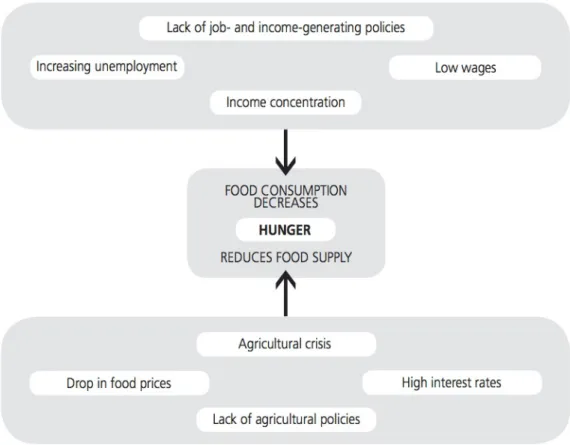
Figure 1.1: The problem. ... 13
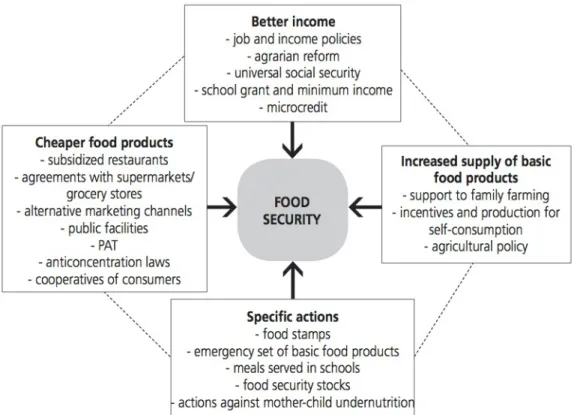
Figure 1.2: The solution. ... 14
Figure 5.1: Model from Paes Sousa and Santos. ... 115
Figure 5.2: Map: Expansion of Bolsa Familia, 2004-2009. ... 115
Figure 5.3: Map: Reduction in food insecurity, 2004-2009. ... 116
Figure 5.4: Change in Food Security and Bolsa Família Coverage, 2004-2009. ... 116
LIST OF TABLES
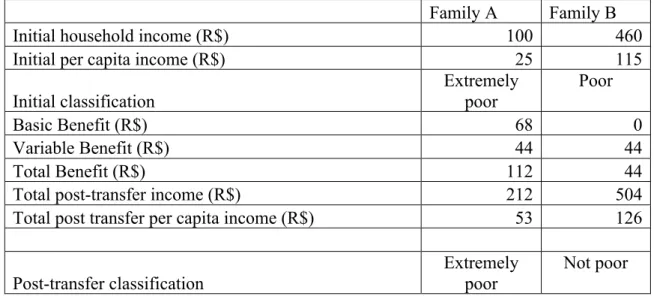
Table 4.1 Two scenarios, headcount ... 96
Table 4.2 The same scenarios, distance to poverty line ... 96
Table 4.3: Impact on poverty (per capita income) ... 97
Table 4.4: Impact on Poverty (equivalent household size) ... 98
Table 5.1: Child Stunting by income group ... 117
Table 5.2: Food security Overview, 2004 PNAD ... 117
Table 5.3: Food Insecurity at the State Level ... 118
Table 5.4: Entitlement Index for Bolsa Familia ... 119
Table 5.5: The determinants of food security at the state level, 2004-2009. ... 119
LIST OF ABBREVIATIONS
BMI Body Mass Index
CAISAN Inter-Ministerial Assembly for Food and Nutritional Security
CCT Conditional Cash Transfer
CONSEA National Council on Food and Nutrition Security
CUT Unified Workers’ Central
EDA Economic Development Administration
EMBRAPA Brazilian Agricultural Research Company
FAO Food and Agriculture Organization
GIS Geographic information system
IBASE The Brazilian Institute of Social and Economic Analysis
IBGE Brazilian Institute for Geography and Economics
IPEA Institute for Applied Economic Research
LIS Luxembourg Income Study
MDA Ministry of Agrarian Development
MESA Special Ministry for Food Security
MDS Ministry for Social Development and [the] Fight Against Hunger
NGO Non-‐Government Organization
OLS Ordinary Least Squares
PBF Programa Bolsa Família
PDT Brazilian Labor Party
PNAD National Household Sample Survey PSDB Brazilian Social Democratic Party
PT Workers’ Party
SNAP Supplemental Nutrition Assistance Program
TCU Supreme Court of Audit
CHAPTER 1: INTRODUCTION
Introduction
To understand what Brazil’s Zero Hunger Program (Programa Fome Zero)
reveals about the politics of designing and implementing new pro-poor social policies, we
must begin with the inauguration of President Luiz Inácio Lula da Silva, known simply as
Lula. It was in his inaugural address that he announced to the world that Zero Hunger
would be his government’s flagship program.
Two hundred thousand people from all over Brazil assembled on the National
Mall. Many waved Brazilian flags or Workers’ Party (PT) flags. It was January 1, 2003
and they were there to witness—and celebrate—a turning point in history.
For decades being a Brazilian leftist had meant getting used to losing. In 1964, the
military deposed leftist President João Goulart in a coup because he threatened elite
economic interests. The late 1960’s saw increasing repression of leftists through
censorship, torture, imprisonment, and “disappearances.” Though the “Brazilian Miracle”
brought rapid economic growth, inequality increased and the economy left many of the
weakest and poorest behind. After the return of democracy, Lula—running as the major
left-wing candidate—lost three elections in a row: 1989, 1994, and 1998 before his
election in 2002. Being a Brazilian leftist had meant losing, but now a leftist had just won
The above mostly focuses on the negative, but being a Brazilian leftist also meant
incremental hard-fought gains. In 1978-1980 a series of massive strikes paralyzed the
industrial center of São Paulo, and showed that it was possible to go up against the
military government and win. Lula was their young, charismatic leader, representing a
new kind of unionism. In 1980, (after the military government legalized the formation of
political parties beyond the two official sanctioned parties), the labor movement, the
progressive church, and leftist intellectuals came together to organize the Worker’s Party.
In 1983, millions filled the streets demanding direct presidential elections. In stark
contrast to the region’s dominant neoliberalism, the new Brazilian Constitution of 1988
included extensive social and economic rights.
Workers’ Party (PT) candidates ran for office and some won. In the 1990’s the
party gained a reputation for “the PT way of governing:” honest, pragmatic, and
progressive. In Porto Alegre the PT government enacted an innovative system of
participatory budgeting which allowed citizens to debate and decide spending priorities
for their communities (Wampler 2007). The PT Governor of The Federal District,
Cristovam Buarque, enacted a program called School Allowance which paid small
amounts of money to poor families provided they sent their children to school; education
would be the pathway out of poverty (Aguiar and Araújo 2002). The government of Belo
Horizonte declared food a human right and worked to integrate the actions of the city and
civil society, earning it the attention of prominent food activists (Lappé and Lappé 2002).
Lula’s election did not come out of nowhere. It was the product of decades of
sustained organizing. The hope was that, as President, Lula would be able to enact
The newly elected president recognized that hope when, after the standard formality of
listing those present, Lula began his actual address:
“Change”: this is the key word. It was the great message from Brazilian society in the October elections. Hope finally overcame fear, and Brazilian society decided that it was the hour to take a new path (da Silva 2003, my translation).
The magazine Veja reported that he used the word “change” (mudança) fourteen times in the speech.1 It was clearly the central theme. He spoke of the long struggle that had
brought him to this point and of the need for change “with courage and care, with
humility and boldness.” He then narrowed the focus:
In a country with so much fertile land and so many people who want to work, there is no reason whatsoever to talk about hunger. Nevertheless, millions of Brazilians, in the countryside and the city, in the most forsaken rural areas and in the urban outskirts, are, at this very moment, without food. They survive
miraculously under the poverty line, when they don’t die of misery, begging for a piece of bread.
It is an old story. Brazil experienced the riches of the mills and sugarcane plantations in the early colonial times, but it did not overcome hunger; it
proclaimed national independence and abolished slavery, but it did not overcome hunger; it experienced the riches of the gold deposits in Minas Gerais, and in coffee production in the Valley of Paraíba, but it did not overcome hunger; it industrialized and forged a notable and diverse industrial park, but it did not overcome hunger. It cannot continue like this.
As long as there is a Brazilian brother or a Brazilian sister going hungry, we have more than enough reason to be ashamed.
For this reason, I set among the priorities of my government a food security program called “Zero Hunger.” As I said in my first pronouncement after the election, if, at the end of my term, all Brazilians can eat breakfast, lunch, and dinner, I will have completed my life’s mission (my translation).
This dissertation is about the subsequent attempts to make good on this promise.
Specifically, it asks (1) why Brazil implemented the anti-hunger policies it did and (2)
how well they worked at reducing poverty and hunger. It argues that the need for
continuity with existing policies and for a simplified approach that limited the number of
possible roadblocks were two key factors that led the Lula Government to ultimately
adopt the conditional cash transfer program Bolsa Família2and that this approach has been effective in reducing poverty and hunger. More generally, it argues that this
experience contributes to our understanding of how continuity and complexity shape the
success of policies aimed to fight poverty and hunger.
Defining the Object of Study
The idea for a Zero Hunger program had been sketched in a 2001 proposal from
The Citizenship Institute (Instituto Cidadania), a think tank directed by Lula and charged with sketching out concrete alternatives to existing policies (Citizenship Institute 2001:
13-39). Zero Hunger was to be a broad initiative aimed at social transformation. While
emergency measures would meet the immediate needs of an estimated 44 million hungry
Brazilians, the larger goal was to create “a new economic development model” to replace
Brazil’s “perverse growth model, ” which was based on a “vicious cycle” of
under-consumption and under-production of food (Citizenship Institute 2001: 17-19; see Figure
1.1). Thus they sought to combat this through both supply-side and demand-side policies
2 Throughout this dissertation, I adopt the practice of using English names for programs
(see Figure 1.2). As president Lula would now have the opportunity to put Zero Hunger
into practice.
Ten years after Zero Hunger’s launch, there is still disagreement over how well
the program worked. A 2013 column in The Hindu by Anurodh Lalit Jain offers Zero Hunger as a model for the world’s largest democracy:
…countries like Brazil have made significant leaps in overcoming hunger by providing food security to the citizens. Brazil’s Fome Zero or Zero Hunger programme was initiated by the government in 2003. Based on the pillars of conditional cash transfer, school meals and strengthening family agriculture, Fome Zero has been able to reduce poverty, provide food security and reduce hunger. Within five years, Brazil’s child mortality rate was reduced by 13 points and 20 million people came above the poverty line. Although India and China demonstrated better economic growth than Brazil in the last decade, Brazil surpassed both countries in reducing poverty and increasing food security for its citizens.3
Yet Brazilian Journalist Eliane Cantanhêde writes: “…in practice, Zero Hunger never
existed. It was a pretty name, a piece of marketing, an empty package [author’s
translation].”4
So, Lalit Jain thinks India should copy Zero Hunger, but Cantanhêde—who
covered the program in 2003—says there is nothing to copy. During my fieldwork
(October 2010 to July 2011), I encountered a similar divide during the many informal
conversations I had with Brazilians about my research. This divide was particularly
evident in the choice of tense used to describe the program: some spoke of the program as
being over, others as still going on. It is impossible to have a productive discussion, be it
3 Jain, Anurodh Lalit. “Lessons from Brazil’s Zero Hunger.” June 16, 2013. The Hindu. Available at:
http://www.thehindu.com/opinion/open-page/lessons-from-brazils-zero-hunger/article4817950.ece (Accessed November 16, 2013)
normative or empirical, about “Zero Hunger” if we do not even agree on what the phrase
means.
The problem is that people use the phrase in at least two different ways. Some,
like Cantanhêde, limit Zero Hunger to the initial program design, when José Graziano led
a new Special Ministry for Food Security (MESA) and the Food Card, a program
modeled after the U.S. Food Stamp (now called SNAP), was its major initiative. It is easy
to see how someone with this limited definition of the program would deem it a failure.
On January 23, 2004 José Graziano and Minister of Social Assistance Benedita da Silva
left their posts, and their ministries were combined into the new Ministry of Social
Development (MDS), headed by Patrus Ananias.5 A few months earlier, in September
2003, the government had announced a new conditional cash transfer called Bolsa Família combining MESA’s Food Card with three transfers inherited from President Cardoso.6 It soon became clear that the new program was going to be the government’s
major anti-poverty initiative. Bolsa Família initially fell under its own Executive Secretary (Takagi 2006: 5), but was moved to MDS with the new ministry’s creation.
If we think of Zero Hunger as MESA and the Food Card, clearly it was not
successful because the program ended after one year. Officially, however, Zero Hunger
continued through Lula’s two terms in office, with Bolsa Família as one of its major components. MDS’s full name is the Ministry for Social Development and the Fight
Against Hunger, and it includes a Secretariat for Food Security. The organizational
5Athias, Gabriela and Eduardo Scolese. February 4, 2004. “Lula Aponta Erro e Atrela
Fome Zero a Cresimento Econômico.” Folha de São Paulo.
6 Athias, Gabriela. September 19, 2003. “Bolsa-Família Vai Unificar Quatro Programas
framework for food policy includes participation from civil society through the National
Council on Food and Nutrition Security (CONSEA) and coordination across ministries
through the Inter-ministerial Assembly for Food Security and Nutrition (CAISAN).
During my time in Brasilia at the end of Lula’s second term and the start of Dilma
Rousseff’s presidency, I encountered the Zero Hunger logo on many official publications
and event banners. The government clearly maintained the brand, even though it
emphasized Zero Hunger much less than it did in 2003. Both media and scholarship refer
to this as an “umbrella program” approach: a variety of initiatives spread throughout the
government with a common goal.
It’s their program; they can define it as they wish, and programs evolve over time.
For instance, the U.S. Secret Service was created after the U.S. Civil War primarily to
combat counterfeiting, but in the early twentieth century protecting the President became
its most important job. A 2003 restructuring moved it under the Department of Homeland
Security (United States Secret Service 2007). No reasonable person would say that it is
not “really” the Secret Service because it changed its mission and structure, but rather
that the Secret Service had changed over time. The interesting questions are why Zero
Hunger ended up becoming an umbrella program and what impact the program had, as
well as what lessons this offers for theories of social policy.
The 2001 proposal outlined a wide range of initiatives, but in 2003 the Food Card
took up two thirds of MESA’s budget (Takagi 2006: 87) and the bulk of the program’s
public attention. Given a limited budget and pressure to demonstrate results quickly, it is
not surprising that the new government focused on emergency measures, but why did
the most general terms, the programs look similar: they both give money to the poorest to
let them buy food. However, MESA tried to set the Food Card apart from existing cash
transfers by creating it as a new, independent program and incorporating a participatory
process for selecting beneficiaries that made for an incredibly complex and fragile
implementation process. In contrast, Bolsa Família built on Cardoso’s approach and simplified it by combining the existing cash transfers into one program. The streamlined
process for enrolling new beneficiaries relies on full-time social service professionals
instead of volunteers. Put simply, they went with Bolsa Família because it works, and it works because of this simple approach that built on policy legacies.
Theoretical Frame
Policy legacies are a common theme in much of the literature on the politics of
social policy. It seems reasonable to assume that policymakers will generally work within
the constraints of these legacies. However, Zero Hunger’s first year (2003) is an object
lesson in what happens when those designing and implementing a program attempt to
ignore policy legacies. By making a new ministry for hunger and a new cash transfer to
combat it, even though existing ministries already worked in this area and there were
existing cash transfers (including one called Food Allowance in the Ministry of Health),
the new government undermined its own chance of success.
Another theme found in public policy literature is that complexity can undermine
a program’s chance of successful implementation because the more necessary
components a program has, the more places it can break down. Yet the initial approach to
into a complex program, both out of commitment to participatory government and
because of a belief that inter-connected problems require inter-connected solutions.
Though Zero Hunger officially included a wide range of initiatives, Bolsa Família was the largest new initiative after the shift to the “umbrella approach,” and for this
reason is the focus of much of this dissertation. To ask if Bolsa Família works is to ask if it had a significant impact on poverty and hunger. Given that poverty was the primary
cause of hunger in Brazil, it made sense to combat hunger by combating poverty and it
makes intuitive sense that direct income support for the poorest should do this. Posing
things this way outlines the following theory and hypotheses to test:
Bolsa Família
è
ê Povertyè
ê HungerThis is deceptively simple. As with the earlier discussion of differing definitions
of “Zero Hunger,” the problem is that people mean different things by “poverty” and
“hunger.” Different concepts of poverty and hunger lead to different measures of them,
which in turn lead to radically different conclusions about program effectiveness. This is
not to imply that all concepts and measures are equally valid, but it does mean that the
first step in answering the “How well did it work?” question must be to argue that it is
more useful to think of a problem in a particular way and to adopt a corresponding
measure.
If we think of poverty as the number of people falling under a poverty line, then
line, the program made impressive gains considering the small size of the benefit.
Likewise, if we think of hunger in terms of malnutrition—measured by how many
children are underweight—then hunger had already declined sharply before Lula’s
presidency to a level that was comparatively low for a developing country. On the other
hand, if we think of hunger as food security, which means having access to enough food,
then hunger remained a problem when Lula took office and declined significantly while
he was in office. Chapters 4 and 5 engage with these choices in greater detail.
Structure of the Dissertation
The rest of this dissertation expands upon these central arguments. Chapter 2
reviews the literature to see what we already know about this dissertation’s research
questions and, on the basis of this knowledge, looks for some likely answers. For the
“Why these policies?” question, it begins by framing hunger as a political problem and
explaining the kinds of policies likely to successfully combat it. Next, it looks at how
these policies are shaped by politics, drawing on work on the welfare state and on
Brazilian politics. This work does not fully answer my questions because many of the
variables it posits as being important do not vary between the Food Card and Bolsa Família. However, work on the importance of continuity with policy legacies and on the complexity of program design helps form hypotheses about likely causes of this
difference. It then reviews studies of Bolsa Família’s impact on poverty and hunger, outlining some specific places where additional evaluations would be useful.
Chapter 3 takes up the question of why Zero Hunger took the form it did. In
case illustrates several important principles of policy implementation. The first of these is
continuity with policy legacies. The initial approach to Zero Hunger attempted to create a
new institution (MESA) to carry out a new cash transfer (the Food Card), while Bolsa Família opted to build on existing cash transfers by combining them. Second, the initial approach was incredibly complex, requiring “clearance” from a great number of parties
to succeed. This was especially evident in the decision to charge local Management
Committees, with a majority of members from civil society, with selecting beneficiaries.
Chapter 4 examines Bolsa Família’s impact on poverty. The program recently finished its first decade, so it has clearly been successful from the standpoint of
durability. But has it actually reduced poverty? The traditional approach to poverty
measurement is to count the number of people with incomes under a given poverty line.
This approach consistently finds that the program brought very few people out of
poverty. However, there is also a long tradition of thinking of poverty as a continuous
variable and developing measures to capture this. These measures demonstrate that Bolsa Família has played an important role in lessening poverty intensity.
Chapter 5 turns to Bolsa Familia’s impact on hunger. Given the role it played in lessening poverty intensity, it seems reasonable to expect Bolsa Família to have lessened hunger as well. Here again, concepts shape results. I argue that framing Zero Hunger’s
goal as “three meals a day” and focusing on access to food mean that the program should
be assessed according to its impact on food security—households reporting that they are
able to buy food of sufficient quantity and quality. Looking at hunger this way, it is clear
that the overall “umbrella approach”—that is, the sum total of all of the government’s
Bolsa Família deserves is more challenging, but I combine several approaches to looking at the data, all of which strongly suggest that the program made a significant contribution
to combatting food insecurity.
Chapter 6 reflects on Zero Hunger’s lessons for anti-hunger policy more
generally. Several countries have been designing Zero Hunger programs of their own and
there is also a United Nations campaign by the same name. Given that Brazil is the
explicit model for these programs, it is vital that policymakers understand what the
program actually was, how it changed over time, what parts might be copied and, just as
importantly, what mistakes to avoid. This chapter will also draw on the theoretical
contribution my study makes to our understanding of pro-poor policies in developing
Figure 1.1: The problem.
Figure 1.2: The solution.
CHAPTER 2: LITERATURE REVIEW
Introduction
The introduction sketched this dissertation’s key arguments. To restate,continuity
with policies from the Cardoso Government and a relatively simple design explain why
Bolsa Família emerged as Lula’s most prominent social policy initiative and why his government merged MESA into MDS. This simplified approach should be effective at
combating poverty and hunger. This chapter grounds this argument in several literatures
and outlines the places where the next three chapters will make contributions.
Hunger
We begin with research on hunger, outlining why it exists, and what policies can
address it. Drèze and Sen (1989: 7) emphasize the importance of distinguishing between
famine (“acute starvation and a sharp increase of mortality”) and chronic hunger
(“sustained nutritional deprivation on a persistent basis”). While famines may receive
more attention, “most hunger-related deaths do not occur in famines” (Leathers and
Foster 2009: 2).7 In the case of Brazil and Latin America, the problem is one of chronic
hunger and not famine, and thus I focus on what the literature has to say about this
problem.
7There is much overlap in Sen’s analysis of the two: “Even in analyzing endemic
Hunger as a Political Problem
While one intuitive cause of hunger is an aggregate shortage of food in the world,
this does not hold up to careful analysis. Sen’s Poverty and Famines (1981) rejects this explanation both at the theoretical level and in the examination of four specific famines.
For example, he demonstrates that there was actually more food present in Bengal during
the 1943 Bengal Famine than in 1941, but that hoarding led to prices many could not
afford. He summarizes this perspective in Development as Freedom:
A person may be forced into starvation even where there is plenty of food around if he loses his ability to buy food in the market, through a loss of income (for example, due to unemployment or the collapse of the market for goods that he produces and sells to earn a living). On the other side, even when food supply falls sharply in a country or a region, everyone can be saved from starvation by a better sharing of the available food...The focus has to be on the economic power and substantive freedom of individuals and families to buy enough food, and not just on the quantum of food in the country in question (Sen 1999, 161).
This is not to say that food supply is irrelevant, since it impacts prices as well as the
income of small farmers. This can be especially true in countries that consume more food
than they produce.
Drèze and Sen (1989) emphasize the political and social nature of the choices that
leave people hungry:
In each social structure, given the prevailing legal, political, and economic arrangements, a person can establish command over some alternative commodity bundles (any one bundle of which he or she can choose to consume). (9)
The set of rules governing ownership and exchange—i.e. who is entitled to what—is a
society’s “entitlement framework.”8 When someone is unable to exchange what she has
(money, labor, assets, etc.) for what she needs (food) this is a case of “entitlement
8This usage of the term entitlement is distinct from the popular usage of the word to
failure.” In other words, people go hungry because society’s rules about who gets what
leave people unable to exchange what they have for what they need.
They remark, “If politics is ‘the art of the possible’ then conquering world hunger
has become a political issue in a way it could not have been in the past” (1989:4). The
modern era is distinct from much of human history in that advances in production mean
that the capacity to provide enough food to everyone exists (1989: 3). That is, it is
technically possible; the challenge to doing so is organizing societies to meet this
objective, which is to say politics. “Political pressure plays a major part in determining
actions undertaken by governments…” (1989: 19) and “...the forms that public action can
take will undoubtedly depend on...political and social parameters” (1989: 17). Before
looking at how politics shapes policy, we need to look at what policies are effective at
combating hunger.
Policy options
Leathers and Foster (2009) survey a number of possible policy strategies to
combat hunger. In a market economy the price of food and the quantity produced will be
determined, like that of any good, by supply and demand. Approaches basically fall into
two categories: supply side (making food cheaper) and demand side (increasing the
ability of people to buy food). Economic growth and/or redistribution can raise the
incomes of the poor and increase their ability to buy food (273-289); direct cash transfers
like Bolsa Família and the Food Card would fall into this category. They argue that consumption subsidies (for example, paying farmers the difference between the market
to combat urban bias, such as investing in rural infrastructure, can decrease food prices
by decreasing costs of production and transportation (336-341). Lastly, public investment
in technology to increase food supply can reduce food costs. A greater food supply means
the poor require less of an increase in income to meet their food needs.
Cash transfers, as well as many of the other ideas in the 2001 proposal fall into
the categories just outlined, so Leathers and Foster’s work helps understand why the
Food Card and Bolsa Família might be expected to work. Drèze and Sen argue that such policy responses will be the result of politics. However, “political pressure” is a vague
phrase; the study of how those pressures and parameters play out constitutes a good
portion of the field of political science. Fortunately, other literatures provide a detailed
treatment of the process of policy formation and implementation.
Politics
Politics of the Welfare State
What kinds of governments are more likely to carry out these kinds of policies?
Given that poverty is a key cause of hunger, the political determinants of effective
anti-hunger policies are likely to be similar to those of effective anti-poverty policies. A
theory called power resource theory holds that “the balance of class power is the primary
determinant of variations through time and across countries in welfare state effort,
particularly the distributive outcomes effected by social policy” (Huber and Stephens
2001: 3). In Latin America this balance is primarily the product of two things: (1)
(2) well-organized left parties actually doing so (Pribble et al. 2009; Huber and Stephens
2012).
Sen and Drèze already highlighted the importance of democracy for responding
to public pressure. Power resource theory is more specific in that it posits the actors
behind that pressure:
Democracy has helped underprivileged sectors in Latin America by providing a setting within which these groups could organize and mobilize demands for better protection. Moreover, the existence of political competition provides incentives to politicians to be responsive to such demands. (Pribble et. al. 2009)
Simply put, democracy does not ensure the creation of a welfare state, but makes it a
possibility.9
Huber and Stephens (2001) find that left-wing government leads to more
generous welfare programs in advanced industrial democracies. The extension of this
research agenda to Latin America finds that democracy and left government are
associated with lower poverty and lower inequality there (Huber et al. 2006; Pribble et al.
2009; Huber and Stephens 2012) The focus is on how much left government there is over
a long period of time (Huber and Stephens 2001, 2012), because a social welfare regime
is the product of a decades-long political process and generally not something that may
be quickly established. What has this process looked like in Brazil?
9 There are, of course, a few examples of non-democratic governments pursuing
Brazilian Politics
The specific context of Brazilian policies provides particular challenges for a
programmatic left. In Democracy Without Equity, Weyland (1996) argues that the failure of social reform in the first decade of democracy in Brazil was due to the fragmentation
of society. This kept the majority, who should theoretically be for reform, from joining
together to achieve this. The fragmentation also meant that narrow status quo interests
could block reform in their particular area. Ames (2001) argues that Brazil suffers from
“an excess of veto players” (12) leading to “deadlock.” Hagopian (1996) finds that
traditional clientelistic politics is very much alive in rural Brazil and that the same rural
elites maintained local power during the military government and democratization. All of
this might have led one to predict Lula would have a tough time expanding Brazil’s
welfare state in a pro-poor direction.
One counterbalance to these challenges is a presidency vested with extensive
formal powers, including the ability to legislate by decree. These provisional measures
expire if congress does not approve them, but Mainwaring (1997: 63) notes that
“…presidents have regularly reissued these decrees after they expired.” Presumably a
successful, popular program will be more likely to eventually win congressional approval
and become permanent law. Indeed, in the case of Bolsa Família the president has made alterations to the program, such as increasing the benefit, through provisional measures
that congress later converted into law (see Soares 2012).
The problem with everything discussed so far is that it applies to both the Food
effective strategy. Both were federal programs enacted within less than a year of each
other by the same government. Both were the products of a left government committed to
redistribution and to fighting poverty, and both faced the same institutional obstacles.
Neither power resource theory nor the literature on Brazilian politics can explain why one
failed and the other became a global model for effective social policy. This is not really a
shortcoming; it is merely that asking why one failed and the other succeeded goes beyond
the scope of these literatures. To understand the difference in outcome we must look at
the differences in (1) the way a program design dealt with policy legacies and (2)
implementation.
Legacies and continuity
One key decision in program design is how a program positions itself relative to
policy legacies. A television advertisement for Agnelo Queiroz (PT), elected governor of
the Federal District in 2010, illustrates this idea well. The advertisement uses a simple
metaphor: government programs are like stacks of blocks. It begins with a building made
out of Duplo blocks (or the Brazilian equivalent). A narrator says, “It’s always the same
story: when the government changes, the new government changes everything the
previous government did…and starts everything from scratch.” During the description of
the process, hands disassemble the tower and then build a new one. Then Agnelo
addresses the viewer, stating: “I’m going to do things differently. My promise is to
review all the works of the previous government. What was good we’ll continue. What
was bad we’ll change. This is the new path for our city” (my translation).10
By saying “it’s always the same story” Agnelo implies that leftists do this, too,
and that this needs to change. The visual illustration of hands taking apart the old tower
and building a new one underscores the unstated point: this work takes time and money.
Thus, if what the previous government left was good, or at least a decent starting point,
this amounts to wasted effort. The message is clear: build on what you inherit.
Having to build on what you inherit is a major theme in some important works on
the welfare state. Discussing the New Deal in the United States, Weir and Scocpol (1985:
119) sum up the role of policy legacies as follows: “state structures and policy legacies
affected the possibilities for new economic ideas to be formulated and applied to
innovative government policies and influenced the political orientations and capacities of
conflicting parties and coalitions of social groups.” In his study of the welfare state in the
U.S. and the U.K., Pierson (1994:171) writes, “When Reagan and Thatcher began to seek
cutbacks in social programs, the legacies of previous decision makers profoundly
influenced their prospects for success.” We should likewise expect challenges to an
government trying to expand the welfare state. Policy legacies have also been
incorporated into the power resource approach (Huber and Stephens 2001).
Pribble (2013: 27) argues that policy legacies matter for two reasons. First, they
“structure the sorts of problems that exist.” To use an example from the present project,
Lula had to decide what to do about the fractured nature of cash transfers because
Cardoso ended his term with three separate programs in three separate ministries. Second,
policy legacies “…influence the reform process by structuring the distribution of power
within the policy sector—in other words, emboldening some groups while weakening
others.” So, in the case of cash transfers in Brazil, we should expect those within the state
benefiting from the pre-Lula status quo to resist encroachment onto their “turf.” Indeed,
in Chapter 3 we see precisely this response from mayors and people in older ministries.
It is important not to overstate the impact of policy legacies. Dion (2010: 5)
advises that “…we should not assume that policy legacies, or feedback effects, are
automatic or predetermined; actors always play important roles in shaping institutional
outcomes.” While I agree, I contend that one key to actors’ success is whether they
understand these legacies and work within the limits they provide, or ignore them. If
someone in a leadership position overestimates the possibility of a critical juncture, this
can lead to attempts to enact overambitious policies and, ultimately, failure. On the other
hand, the literature argues that an accurate assessment of present possibilities that accepts
these legacies as the necessary point of departure is more likely to yield real, and
sustainable, gains. Chapter 3 illustrates how the different approaches taken to policy
legacies help explain why Bolsa Família succeeded and the Food Card failed.
Implementation and its challenges
Cristovam Buarque, former governor of the Federal District and currently one of
its federal senators, remarked about MESA, “The program with many components rarely
succeeds.”11 As it happens, this is the thesis of the book commonly credited with
launching policy implementation as an area of study.12 The full title of Pressman and
11 Interview with author, Brasilia, Brazil. June 29, 2011.
12 Saetren (2005) points out that it actually was not the first but that it is understandable
Wildavsky’s book, originally published in 1973, is Implementation: How Great
Expectations in Washington Are Dashed in Oakland; Or Why It’s Amazing that Federal Programs Work at All, This being a Saga of the Economic Development Administration as Told by Two Sympathetic Observers Who Seek to Build Morals on a Foundation of Ruined Hopes. The study chronicles the efforts of the Economic Development
Administration (EDA) to enact infrastructure projects in a way that will generate
employment for African Americans. The EDA’s key projects were a new airport hanger
and a new port, but it also included small business loans and a health center. A reader of
their book familiar with Zero Hunger in 2003 would likely find many familiar themes,
particularly the unexpected problems that complicate and delay progress. This can
happen even in the case of something that all relevant actors theoretically support, be it
generating minority employment in Oakland or feeding hungry people in Piauí.13 To use
language from scholarship that came later (Tsebelis 2002), even when there is no veto
player trying to kill something, it can still fail.
For Pressman and Wildavsky the culprit is “the complexity of joint action.” A
complex program such as what the EDA in Oakland inherently brings together many
different “participants” who are needed at different “decision points.” This is all the more
true in a federal system like the U.S. or Brazil. The authors calculate that even if each
step has high probability of success, it takes surprisingly few steps to bring the joint
probability of success, and hence the probability of success for the program, below one in
two (Table 8: p. 107). They chronicle the number of “clearances” required to enact the
EDA’s policies, finding a total that exceeds this 50-50 chance threshold.
The intuitive appeal of this explanation is doubtless part of the reason for the
book’s success. Returning to the imagery of Agenlo’s advertisement, imagine two
children playing with blocks (this time the primitive wooden kind that do not
interconnect). The first builds a tower a few blocks high. The second uses many more
blocks to build one tall, complex tower. We know from experience that the tall tower will
be the less stable of the two creations. If another child wants to knock it over, all it will
take is a flick of the finger to any supporting block. A breeze or someone walking by
could also knock it over. In addition, no block is perfect and no block is perfectly
positioned above the block below it. The more blocks in a structure, the more likely it is
that these tiny imperfections will add up to instability of the whole creation and it may
fall even without anything knocking it over.
Policies are not block towers, but they share the characteristic of having pieces
that must fit together to form a whole, and, like blocks, the consequence of a block being
out of place depends on how the blocks are put together. Indeed, this dissertation could
easily be understood in these terms, leading to a tale of “Zero Hunger: how great
expectations in Brasília are dashed in Piauí.” Tempting though that may be, doing so
would ignore key problems with Pressman and Wildavsky’s argument.
This expectation that federal programs should rarely succeed is at odds with many
everyday experiences, earning it the name “the Pressman-Wildavsky Paradox.” Bowen
(1982) agrees that probability theory can be a useful tool when those attempting to
implement a policy are playing, in the language of game theory, “a game against nature”
because they have no opponents actively trying to stop a program. She offers four
Those implementing a policy often get more than one opportunity to pass a particular
clearance (if your block tower falls down you can build it again). The second is
packaging clearances together to get everybody on board for a set of clearances (you can
glue your blocks together so that they are more stable). The third is bandwagons, with
earlier successes increasing the probability of later ones. She argues all three of these are
reasonable descriptions of many policy implementation processes.
The fourth addendum is program reduction, which recognizes the difference
“between program activities and program goals” (12). She writes:
If events in Oakland were looked at in this way, the likely conclusion would be that most program activities were eventually implemented but that, unfortunately if not surprisingly, the goal of increasing minority employment was not achieved. This version of the Oakland episode would be recorded as a program design failure rather than an implementation failure [my emphasis].
If the important thing is to achieve a goal and there are several different ways the goal
might be met, then it makes sense to think of a program as a collection of independent
component policies, which increases the likelihood that something will succeed. For each
of these assumptions Bowen shows how they change Pressman and Wildavsky’s results,
leading to a much greater expectation of successful (or partially successful)
implementation.
Taken together, these yield insights for policy makers’ strategic decisions:
…let us imagine a hypothetical implementer with limited resources such that he or she can only enter into negotiations for twenty clearances. The implementer is confronted by three options: (1) he or she can attempt to implement a relatively complex program requiring twenty independent clearances, (2) he or she can attempt implementation of two smaller independent programs, each requiring ten clearances, or (3) he or she can ruthlessly establish priorities and attempt
In other words: be careful not to spread efforts too thin or everything will probably fail.
While Bowen works from Pressman and Wildavsky’s assumptions, Alexander
(1989) questions them. He starts with the simple observation that countless complex
activities succeed every day but “are noticed only when interrupted” (452). He argues
that the ways Bowen and other scholars have proposed modifying the approach
“…are just special cases of a more general procedure of modifying the original
independence assumption of the model. In both cases the mathematical form and
numerical scale of the modification are essentially arbitrary” (455). While he is correct to
question the “point-predictions” from these models (to again borrow language from game
theory) which estimate specific probabilities of failure, we can restate the claim in terms
of relative, rather than specific, probability. Namely, given a particular implementation
scenario, adding an additional clearance is one more place for things to go wrong, and
thus decreases the chance of success.14 This is similar to the argument regarding policy
formation that each additional veto player reduces the space of possible policy outcomes
(Tsebelis 2002).
Pressman, Wildavsky, and the responses just surveyed are examples of top-down
models. The other dominant approach, has been bottom-up. Matland (1995: 146-148)
explains that where top-down models “see implementation as concern with the degree to
which the actions of implementing officials and target groups coincide with the goals
embodied in an authoritative decision,” proponents of bottom-up models “argue that a
more realistic understanding of implementation can be gained by looking at policy from
the view of the target population and the service deliverers.” For example, Berman (1980:
14 Though it might be possible for the addition of an “easy win” to aid in a bandwagon
206) argues, “A context-free theory of implementation is unlikely to produce a powerful
explanation or accurate predictions” and that different situations will require different
strategies. This suggests that understanding the problems with the Food Card will require
looking at the politics in the particular municipalities where it was first implemented.
Chapter 3 shows that, in the case of one of Zero Hunger’s pilot municipalities, this was
indeed this case.
For all the debates about which variables, out of hundreds, have explanatory
power, there is at least one point of consensus: resources matter. O’Toole (2004: 317))
writes:
The theoretical and empirical scholarship, virtually without exception, supports the propositions that more resources increase prospects of implementation success (almost no matter what one means by that latter notion); that resources are often not liquid, so that funding sometimes cannot be converted easily into (for instance) skilled staff, or vice versa; that therefore multiple kinds of resources may be critical; and that what matters for implementation is resources for the implementation tasks themselves, not simply size of budget or extent of subsidy to clients.
While not a surprising finding, it means that resources should always be part of any
implementation analysis. Returning to Bowen’s earlier point, additional resources can
provide the opportunity to make multiple attempts at getting past a given step in the
process or to package clearances together.
All of this suggests that the following is a useful approach to analyzing the
implementation of a policy. First, consider how the resources allocated to a program
compare with the mission assigned to it. Second, pay particular attention to the role of
policy legacies, expecting that continuity with them, rather than a sharp break, should
more likely to encounter problems, and one of the places programs can encounter
complexity is in the specific context “on the ground.”
Zero Hunger
There are two Brazilian dissertations about Zero Hunger, both written a few years
after the end of MESA, by authors with direct involvement with the program.
Understanding their backgrounds is vital to understanding their perspectives.
Takagi (2006) worked closely with Special Minister José Graziano at MESA, and
he served as the second reader on her dissertation committee. Her dissertation, “The
implementation of food security and nutrition policy in Brazil: its limits and
challenges,”15 is a detailed account of Zero Hunger’s early years and she writes with the
authority of someone deeply involved with MESA. However, this closeness also eclipses
opportunities for constructive criticism.
For Takagi, the proponents of food security policy ultimately “overcame the
challenges to its implementation as a permanent policy in the country” (p. v, my
translation). This is true, in that Brazil has an official framework for food security policy
including participation from civil society through the National Nutrition and Food
Security Council (CONSEA) and coordination between ministries through the
Interministerial Chamber for Food Security and Nutrition (CAISAN). However, the
approach ultimately taken differed greatly from that originally proposed. Her chapter on
2003 does not provide a full explanation for why Lula replaced The Food Card with
Bolsa Família and merged MESA into MDS. The conceptual framework from the literature just surveyed may be able to help explain why events played out as they did.
Takagi also contends that it is necessary to take a “multi-sector” approach to food
security policy, and one of the problems faced was an excessive division of policy into
sectors (setorialização) and the use of a vertical structure (verticalização). However, as just discussed, one of the potential advantages of multiple independent initiatives aimed
at a shared goal is that some can succeed while others fail. This is not to argue that there
are not advantages to cooperation among sectors—indeed there may often be no viable
alternative, but such coordination likely complicates policy and policymakers must take
this into account.
Gomes (2007) also writes as someone directly involved with Zero Hunger in its
early stage. Having worked in food policy for decades, he agreed to serve in MESA but
quickly left in frustration. He provides a detailed account of decades of food policy, and
roots his analysis in a normative literature on basic human needs. His central claim is that
the state has a duty to meet people’s basic needs and that these needs are inherently
interconnected. In other words, it is impossible to separate them from each other. He
criticizes the cash transfer approach for making people consumers, but not citizens.
While I agree that the reality of the human condition means that basic needs are
interconnected, I do not think this means that policies cannot target particular needs first.
Take food and healthcare. Illness can lead to secondary malnutrition, meaning that even
those with access to sufficient food may be malnourished. Similarly, if people only have
access to healthcare but not enough food, going hungry will weaken their immune
to make a goal of meeting some needs but not others. However, the reality of resource
constraints and program implementation may mean that some needs are more easily met
than others. So, from an administrative standpoint it may be useful to think of them as
separate, even though this is not the actual lived reality.
The most well known account of Zero Hunger in English is likely Hall’s (2006)
article, “From Fome Zero to Bolsa Família: Social Policies and Poverty
Alleviation under Lula.” He writes, “Fome Zero was in practice an umbrella programme
for initiatives already developed under the FHC [Cardoso] administration” (694). While
this ignores some of the new, smaller-scale initiatives, such as the Food Acquisition
Program (PAA) which buys food from small producers and distributes it to the poor, the
idea of an “umbrella program” is useful for understanding the program’s evolution,
particularly after the end of MESA, and the term was also used in Brazilian media
accounts.
McCann (2008) describes things somewhat differently, writing, “Lula beat a hasty
retreat from Fome Zero and invested in social programs similar to Cardoso’s, increasing
their resources” (40). This agrees with Hall on the substance of ultimately deciding to
build upon Cardoso’s policies, but is a sharp contrast in labeling.
In his biography of Lula, Goertzel (2011) devotes an entire chapter to Zero
Hunger and Bolsa Família. Regarding Zero Hunger in its first year, he writes that “Organizationally, it was a mess” (72) and that “In the case of food security programs,
resolving the bureaucratic problems required reorganization to concentrate responsibility
in the hands of a skilled administrator” (76), and hence the 2004 merger of MESA into